Unsubscribe 48-Hour Alert: This Signal Just Flashed on (TICKER) (From Daily Edge Report)
Warner Bros. Sale Rumors Heat Up: What Investors Need to Know
Written by Leo Miller
While many stocks have come under considerable pressure over the past month, entertainment giant Warner Bros. Discovery (NASDAQ: WBD)continues trudging higher. As of the Nov. 24 close, shares are up approximately 8% during the past 30 days.
Warner Bros’ gains have persisted as rumors around a potential acquisition of the firm heat up. Below, we’ll dive into the latest news around this stock and detail what it means going forward.
Warner Bros. Eyes Year-End Deal, PSKY, NFLX, and CMCSA Submit Bids
The last time MarketBeat covered Warner Bros, the firm had just put up its proverbial “for sale” sign. WBD said on Oct. 21 that the company had received multiple unsolicited offers for some or all of the firm. It initiated a review of these offers to “maximize shareholder value.”
At this point, the serious bidders for Warner Bros. include Paramount Skydance (NASDAQ: PSKY), Netflix (NASDAQ: NFLX), and Comcast (NASDAQ: CMCSA). Recent reports indicate that a deal may be finalized sooner rather than later. According to CNBC, Warner Bros. is looking to announce the company’s path forward by the middle or end of December.
All three firms have sent in their first round of non-binding bids. Paramount Skydance is reportedly looking to acquire the entire firm, including WBD’s linear television networks like CNN and TNT Sports.
Meanwhile, Netflix and Comcast are only interested in the company’s film production and streaming assets. Film production includes DC Studios, which holds valuable intellectual property, such as Superman and Batman. Streaming is primarily centered around HBO Max, which is one of the world’s top five players in video streaming with 128 million subscribers as of last quarter.
Paramount’s Bid Offers the Clearest Path Forward
Among the offers, Paramount’s bid appears to be the most comprehensive and straightforward. Reports emerged that Paramount was planning to offer $71 billion for the firm through a group investment with the sovereign wealth funds of Saudi Arabia, Qatar, and Abu Dhabi.
This price would represent an approximately 25% premium over the stock’s Nov. 24 market capitalization of just under $57 billion and a share price between $28 and $29. However, this report appears to be inaccurate, as Paramount denies these claims.
According to Bloomberg Intelligenceanalyst Geetha Ranganathan, Paramount’s offer is likely between $25 and $27 per share. An offer price in this range would represent an approximate 9% to 18% premium over WBD’s Nov. 24 closing price. This would still be a solid win for shareholders, who would receive the offer price upon acceptance of a deal. Importantly, Ranganathan also indicated that the sale process could extend beyond WBD’s year-end timeline.
Potential Deal Denial Creates Risks
If no buyer meets WBD’s price expectations, the company could opt to split its business into two separate entities: one for film and streaming, and another for its linear TV assets.
This scenario is likely the biggest near-term risk for WBD shares. The current stock price likely already has a significant takeover premium baked in. If no takeover materializes, then the premium could dissipate quickly.
When Warner Bros. first announced that the company would split in June, shares were trading at around $10. Today, they sit around $23. In the event of a split, it’s difficult to predict how shares could behave, but it would not be surprising to see a significant drop. However, it is also possible that this path could create the most value long-term for WBD, making up for any short-term impacts.
WBD Shares and Price Targets on the Rise
The market continues to bid up WBD stock, indicating that hopes of a sale are rising. Wall Street analysts also continue to push up their price targets.
The consensus target on WBD sits just below $22, implying around 4% downside in shares.
However, among targets issued after Oct. 22, the average is just above $25, implying 9% upside to align with statements made by Ranganathan.
It’s difficult to say what will happen next for WBD. Markets could react differently depending on which firm strikes a deal with WBD—or if no deal is reached at all.
Investors should consider this risk and should also evaluate the relative merits of the stock if WBD is not acquired. READ THIS STORY ONLINE
5 Stocks That Could Double in 2026 (Ad)

While everyone’s making predictions about what might happen in 2026, we’ve identified 5 stocks with catalysts that are already locked and loaded.
These aren’t hopes or projections. These are scheduled events, signed contracts, and approved projects that will play out over the next 12 months.
The difference between 100% gains and missing out completely? Positioning before 2026 arrives.CLICK HERE TO GET YOUR FREE COPY OF THIS REPORT
From Science Project to Solvent: WeRide’s 761% Revenue Surge
Written by Jeffrey Neal Johnson
For years, the autonomous vehicle (AV) sector has been defined by a frustrating narrative of high cash burn and distant promises. Investors have watched billions of dollars vanish into research and development (R&D) with very little revenue to show for it. Now as November ends, that narrative is beginning to shift.
WeRide (NASDAQ: WRD) shares jumped 14.7% to $8.26 after its third-quarter earnings release. Despite geopolitical headwinds and a 73.8% year-to-date (YTD) decline, WeRide finally gave investors something concrete: real revenue growth and improving margins.
How WeRide Turned the Corner
WeRide reported a 761% year-over-year (YOY) jump in robotaxi revenue, which marks a potential inflection point for the industry. For the first time, the firm is offering evidence that it has moved from R&D mode to commercial viability, and Wall Street has taken notice.
Total revenue for the quarter hit RMB 171 million (approx. $24 million USD), representing a 144.3% increase compared to the same period last year. This growth was driven by two distinct engines:
- Product Revenue: This segment, which includes the sale of Robobuses and autonomous sweepers, grew 428% to $11.1 million.
- Service Revenue: This segment, primarily robotaxi fares and data services, grew 66.9% to $12.9 million.
Perhaps the most critical data point for long-term investors is gross margin. In the third quarter of 2024, WeRide’s gross margin was a thin 6.5%, typical for a hardware-heavy manufacturing phase. In this latest report, that figure expanded to 32.9%.
A rising gross margin indicates that a company is scaling efficiently. It signals a shift away from expensive hardware testing toward high-margin software and service operations. This is the holy grail for tech sector investors, as it suggests the business can grow without costs spiraling out of control.
While WeRide is not yet profitable, it is moving in the right direction. The net loss for the quarter narrowed by 71% to $43.2 million. Adjusted for non-cash items, the loss was $38.7 million. This reduction is significant because it shows that revenue growth is outpacing operating expense growth.
A Blueprint for Profit: The Abu Dhabi Model
WeRide’s revenue jump is not an accident—it is the direct result of a strategic pivot. While the United States has effectively closed its doors to Chinese autonomous technology, WeRide has found a lucrative market in the Middle East.
In October 2025, WeRide secured the world’s first city-level fully driverless robotaxi permit outside the U.S. in Abu Dhabi, a transformative agreement. The permit allows the company to remove the safety driver from the front seat, the biggest expense in the robotaxi business model.
Partnering with Uber (NYSE: UBER), WeRide sells the vehicles and provides the autonomous tech, while Uber handles customer acquisition. This structure delivers upfront product revenue and ongoing service revenue—without the need for a consumer-facing fleet.
CEO Tony Han revealed that a robotaxi breaks even at roughly 12 trips per day. The company’s current utilization target is 25 trips per day with 24/7 service, which would make each vehicle a standalone profit generator.
Cash Is King: A Billion Dollar War Chest
Autonomous driving is a capital-intensive business. Critics often cite high cash burn rates as a reason to steer clear of this part of the transportation sector. However, WeRide’s latest report offers a strong rebuttal to liquidity concerns.
As of Sept. 30, 2025, WeRide held approximately $764.1 million in cash, cash equivalents, and wealth management products.
This figure excludes the roughly $308 million raised during the company’s recent dual listing on the Hong Kong Stock Exchange in November.
When combining these figures, WeRide effectively has over $1 billion in accessible liquidity—a massive competitive advantage. The case provides a multi-year runway to continue R&D (which currently accounts for 73% of operating expenses) without the immediate need to dilute shares further.
Because of these facotors, WeRide is financially positioned to weather economic downturns while competitors may struggle to raise funds.
The Geopolitical Pivot: Risk vs. Reward
Investors must acknowledge the elephant in the room: The U.S. Commerce Department has issued a final rule banning Chinese connected vehicle software starting in 2027. This effectively locks WeRide out of the American market.
However, the market reaction to the Q3 earnings suggests this risk is already priced in. By succeeding in the UAE and securing new permits in Singapore and Switzerland, the company has proven that the Total Addressable Market (TAM) outside of the United States is large enough to support a viable business.
WeRide now holds autonomous driving permits in eight countries, including Belgium, France, and Singapore. The company has accumulated over 55 million kilometers of Level 4 (L4) autonomous mileage, a data advantage that is difficult for new entrants to replicate. The company’s success in the Middle East validates the thesis that autonomous driving is a global revolution, not just an American one.
Beyond the Taxi: The Dual Flywheel Effect
While the robotaxi segment is grabbing headlines, WeRide is not a one-hit wonder. The company operates a dual-flywheel strategy that leverages its technology to generate immediate cash flow while the robotaxi network scales. The company’s WePilot 3.0 system achieved Start of Production (SOP) in November 2025.
WePilot 3.0 is an Advanced Driver Assistance System (ADAS) sold directly to automakers for mass-market passenger cars. WeRide is currently rolling this out with partners and has been nominated by the GAC Group for future models.
Selling software to carmakers generates immediate revenue and provides vast amounts of driving data, which in turn helps refine the algorithms used in the robotaxis.
Despite the 14.7% rally, WeRide shares are still trading down approximately 74% YTD. This steep decline attracted significant short interest, which rose nearly 35% in October. The strong earnings report likely triggered a bit of a short squeeze, forcing bears to buy back stock to cover their losses.
For new investors, the Abu Dhabi Model offers tangible proof of concept. If WeRide can replicate this unit-economic success in Singapore and Dubai, the current valuation (trading significantly below its IPO levels) could represent a deep-value opportunity in the artificial intelligence sector. READ THIS STORY ONLINE
48-Hour Alert: This Signal Just Flashed on (TICKER) (Ad)

Years before it became a household name, Shopify showed an early momentum pattern that experienced traders used to catch a 120% move — and that same repeatable signal has just appeared on a new small-cap ticker that hasn’t hit the mainstream yet. Our free Momentum Trading Report breaks down how to spot these stealth setups and reveals which names are flashing right now.GET EARLY ACCESS TO THE FREE MOMENTUM TRADING REPORT HERE
Will the S&P 500 Rally in December? These 3 Signals Point to a Big Move Ahead
Written by Thomas Hughes
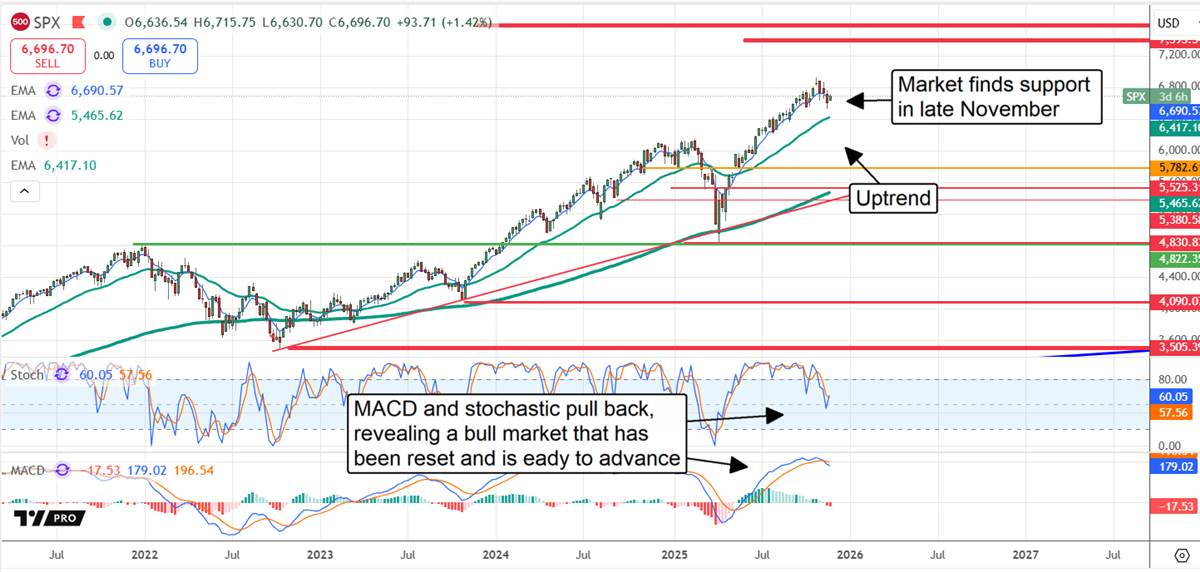
Risks remain, but the S&P 500’s (NYSEARCA: SPY) uptrend is intact. The November correction was more of a broad-market consolidation, setting the market up for another leg of the rally, likely to unfold in December. This is an examination of three major themes driving S&P 500 price action and why it’s set up to advance to new highs before year-end.
Macro-Economic Headwinds Ease
Macroeconomic uncertainty has been causing significant concern among investors throughout the year. Uncertainty is linked to trade relations, tariff impacts, and, more recently, the government shutdown. The story for December is that the government shutdown is over, trade relations aren’t deteriorating, and there has been some relief regarding tariffs.
Primarily, the impact of tariffs on Q3 results was far less than expected. The average S&P 500 company outperformed its consensus estimate by more than 600 basis points, which is well above average, and the Q4 season is likely to follow a similar trend.
While the Q3 results outperformed, and most companies improved their guidance, the Q4 consensus forecast remained unchanged. The likely outcome is that Q4 results will outperform by a similarly large margin.
Meanwhile, the FOMC remains on track to cut rates in 2026. The outlook for cuts has dimmed, but there is still an expectation of another two to three 25-basis-point cuts by next summer. The odds for a cut in December are also significantly high and may increase as the month progresses.
With the government shutdown over, government-collected data is being released, and it aligns with healthy, albeit cooler, economic conditions compared to the previous year.
Retail Earnings Were Good, Guidance Was Increased
There were some areas of weakness in the retail sector’s earnings data, but the overall trend was bullish. Most retailers grew revenue and earnings, produced solid margins, and provided favorable guidance. The takeaway is that Black Friday and Cyber Monday sales events mark the beginning of the holiday shopping season and are likely to exceed forecasts.
As it stands, holiday spending is expected to increase by 3% to 3.5% with strength centered in eCommerce. Deals and value will be a driver, positioning off-price retailers and Walmart as winners. Among the critical factors for investors is that retail leaders like Walmart (NYSE: WMT) and The TJX Companies (NYSE: TJX) have solid cash flow, pay attractive dividends, and repurchase shares, sometimes aggressively.
The next visible catalyst is the Q4 reporting cycle in January. Still, analysts could drive this sector higher before then with revenue, earnings, and stock price target revisions linked to Q3 results and early holiday spending data.
The AI Trade Is Reignited
Fears of an AI bubble bursting were laid to rest by NVIDIA’s (NASDAQ: NVDA)Q3 results, which showed stronger-than-expected growth, and by subsequent news that Amazon (NASDAQ: AMZN) plans to invest up to $50 billion in AI infrastructure for U.S. government contracts. Together, these developments reinforce the durability of AI demand across both commercial and public sectors.
The NVIDIA release confirms that its AI business is larger than initially thought, growing faster than anticipated, and accelerating in the second half of the year. This has it set up to outperform in the current and following quarters and to sustain strength long into the future.
The S&P 500 remains on course to hit the 7,300 mark soon. The move may not occur before the year’s end, but the rebound is likely to start by then, and new highs will quickly follow. Notable technical indicators include the stochastic oscillator, which has retreated to the middle of its range, indicating a market that has rebalanced itself and has ample room to move higher. READ THIS STORY ONLINE
Black Friday Warning: Gold Lockdown (Ad)

Central banks and major institutions have been increasing their gold holdings at one of the fastest paces in decades — and Dr. David Eifrig believes this trend reflects deeper shifts in the financial system that most everyday investors aren’t seeing. After four decades in the markets, including time on a trading desk during 1987’s Black Monday, he says this surge isn’t just a reaction to price movements but part of a broader realignment that could influence savings, investments, and even borrowing costs.
Eifrig recently released a new briefing explaining what’s driving this global accumulation, what it may mean for individual investors, and the practical steps he recommends considering now. During Stansberry’s Black Friday event, his latest research is also available at the lowest access price of the year.CLICK HERE TO GET THE FULL BRIEFING AND BLACK FRIDAY ACCESS
More Stories
- D-Wave: Time to Buy the Dip? Or is the Fall Just Starting?
- Missed the AI Boom? These 2 Crushed Stocks Could Be Your Second Chance
- Buffett, Gates and Bezos Dumping Stocks (Ad)
- Why Circle Stock Is Falling—and Why Some Analysts See Big Upside
- JPMorgan and Goldman Upgrade MP Materials Amid Defense-Driven Demand Outlook
- Hims, Block, and NRG Just Launched Huge Stock Buybacks
- 5 Retail Stocks That Could Deck the Halls—or Wreck Portfolios
The Night Owl is a financial newsletter that provides in-depth market analysis on stocks of interest to individual investors. Published by MarketBeat and Early Bird Publishing, The Night Owl is delivered around 9:00 PM Eastern Sunday through Thursday. If you give a hoot about the market, The Night Owl is the newsletter for you.
If you have questions about your subscription, don’t hesitate to email our South Dakota based support team at contact@marketbeat.com.
Unsubscribe
© 2006-2025 MarketBeat Media, LLC. All rights reserved.
345 North Reid Place, Sixth Floor, Sioux Falls, South Dakota 57103. USA..
Read More: The window for preparation isn’t just closing — it’s slamming shut. (From InvestorPlace)

 RJ Hamster