Unsubscribe 2,341 Wins vs. 154 Losses (From Crypto Swap Profits)
Can Waystar Still Stand Up to Rising Competition?
Written by Nathan Reiff
At the intersection of healthcare and cloud computing, Waystar Holding Corp. (NASDAQ: WAY) has built a reputation for its powerful software-as-a-service (SaaS), helping to integrate payer networks with electronic health records. However, as the AI and cloud field has become increasingly crowded overall in recent years, Waystar faces increasing competition from companies offering similar or related tools, such as Phreesia Inc. (NYSE: PHR) and Doximity Inc. (NYSE: DOCS).
Waystar shares are down some 40% in the last 12 months, but analysts are still predicting growth across multiple metrics, including earnings and share price. A closer comparison of Waystar against these rivals—one larger and one smaller, by market capitalization—may help investors to determine how best to capitalize on the rush to bring AI and cloud technology into the healthcare software space.
Waystar’s AI Developments and Growth Are Exciting, But Balance Sheet Risks Linger
Fresh off a January agentic AI update to its AltitudeAI system, which is already responsible for preventing billions of denials each year, Waystar has leaned into AI technology in its products. The company has successfully used AI to drive further adoption, expanding its capabilities and aiding with pricing—in this way, Waystar is a key example of a company utilizing AI for its potential benefits, rather than risking being displaced by AI technology.
AI has also helped Waystar to retain customers and build its network. The company reported net revenue retention of 113% for the latest quarter and sports more than 1,300 clients generating at least $100,000 in revenue over the prior 12 months. This helped overall revenue for the quarter grow by 12% year-over-year (YOY) to $269 million and adjusted EBITDA margin to reach 42%.
Waystar has also been growing via acquisitions, including its recent purchase of Iodine Software in the fall of 2025. This move should boost Waystar’s addressable market by 15%. At the same time, though, investors may be cautious about Waystar’s balance sheet following the purchase. As of the end of the third quarter 2025, Waystar had $421 million in cash compared to gross debt of $1.2 billion. This may be one reason shares have fallen in recent months.
Phreesia Reaches a Pivotal Growth Milestone
Phreesia’s patient intake management system serves a somewhat different function than Waystar’s products, but similarly utilizes cloud technology to improve efficiency and accuracy. Like Waystar, Phreesia shares have plunged in the last year, but by an even wider margin of about 55%. As a smaller firm with a market capitalization of just $768 million, Phreesia has recently achieved GAAP profitability with earnings per share (EPS) of 11 cents in the latest reported quarter.
New product initiatives and the recent acquisition of AccessOne in November are helping the company to continue to expand its footprint. In particular, AccessOne should provide about $7.5 million in revenue through the end of the 2026 fiscal year on January 31 by facilitating the addition of provider financing to Phreesia’s offerings.
Analysts are excited about Phreesia’s growth trajectory, with 17 out of 19taking a bullish view of the stock. Wall Street seems to think it will also reverse course following its recent decline, predicting upside potential of almost 134%.
Doximity’s Balance Sheet and Revenue Performance Stand Out, But Broader Sector Concerns Weigh On Shares
With another unique niche in the healthcare tech space, Doximity offers a secure medical network for healthcare providers. The company stands out amongst peers for its strong revenue growth of 23% YOY for the latest quarter, the result of high adoption rates thanks to its AI integration.
Doximity also offers attractive adjusted EBITDA and free cash flow margins, which have helped it to maintain a healthy cash position. However, despite its balance sheet strengths, investors may be concerned about whether healthcare customers will be able to continue to utilize Doximity’s services amid large-scale policy and budget changes. This may have contributed to the company’s share price decline of about 41% in the last year.
Nonetheless, like both companies above, analysts generally view DOCS shares positively, assigning a Moderate Buy rating overall and predicting some 89% in upside possible over the year to come, should the external situation become more navigable. READ THIS STORY ONLINE
Why Trump and Musk suddenly care about Fort Knox (Ad)

Recent public comments from political and business leaders have renewed discussion around U.S. gold reserves, national debt, and the role gold has historically played during periods of monetary stress.
In a free report, one analyst examines why gold audits and revaluations have occurred in past debt crises, how those events affected the dollar, and what investors may want to understand about protecting savings during periods of potential monetary change. The guide focuses on historical precedent and preparedness rather than prediction. DOWNLOAD THE FREE REPORT HERE
Is Chipotle’s 2026 Playbook the Secret Sauce for a Reversal?
Written by Thomas Hughes

Chipotle Mexican Grill (NYSE: CMG)faces hurdles, but it appears on track to sustain and accelerate growth, setting its stock price up for a major reversal. Critical details from the Q4 release and conference call include the confident tone set by CEO Scott Boatwright and the 2026 strategy outlined.
Plans include increased investment in technology, back-of-house operations, menus, and innovation, alongside accelerated store count growth. Not only is Mr. Boatwright planning to open more stores than in the previous year, but the International segment will grow at a hyper pace, doubling its Middle Eastern footprint while expanding in high-growth markets in Mexico, Singapore, and South Korea. If successful, international segment growth could easily outpace domestic, eventually becoming the larger portion of revenue as the company doubles in size.
Valuation, Analysts, Institutions, and Charts Reveal a Bottom for CMG Stock
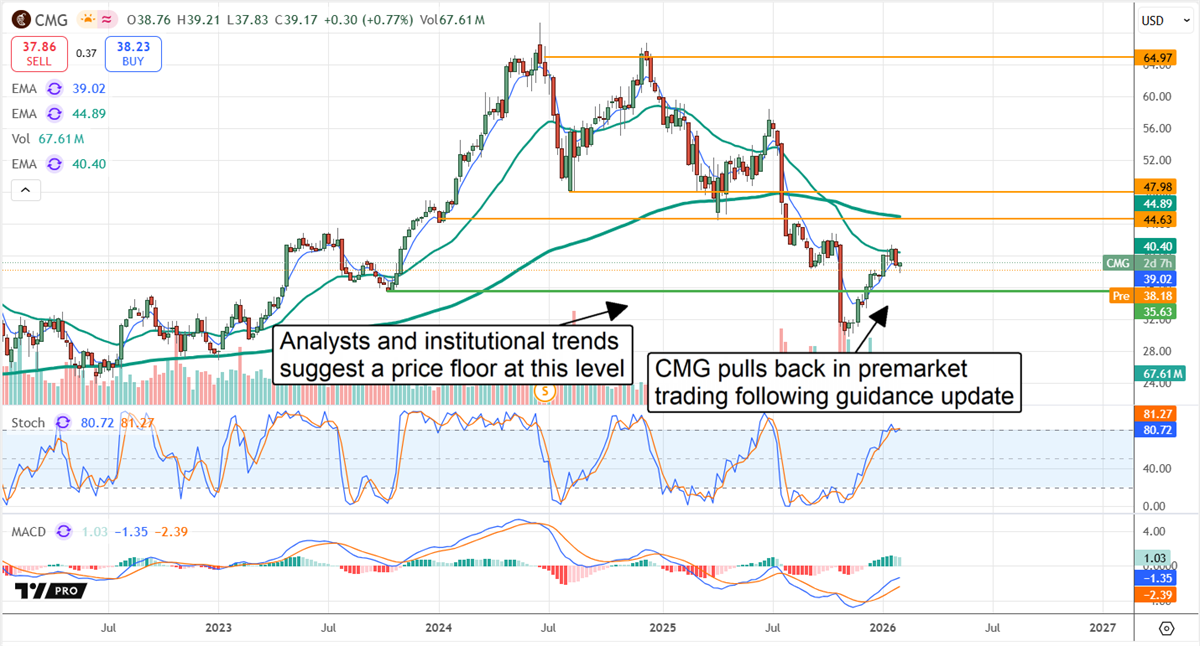
Chipotle’s Q4 results and guidancefailed to catalyze a rally, far from it, but the post-release price dip is less alarming than it seems. The price dip was partly driven by analysts who reduced their price targets, but the market is already trading at deep-value levels and is unlikely to fall significantly further. A rebound from these levels is more likely.
Trading at 32x earnings today, CMG trades at roughly 8x the projected 2035 EPS. If execution matches those forecasts, the stock could be up 200% to 300% by then, depending on the multiple investors are willing to pay.
The current analyst price target range is $35 to $45, suggesting fair value near $40. Trading in the mid-$30s, CMG stock is near its price floor, with potential for a 15% upside relative to the consensus. Institutions likewise indicate a price floor, as they bought on balance throughout 2025 and extended the trend into early 2026, running a balance of $2 bought for each $1 sold.
Analysts rate this stock as a Moderate Buy, citing brand strength, the value proposition, and the cautious tone of guidance in their updates.
Strong Quarter Overshadowed by Weak Guidance, But …
Chipotle had a decent quarter, reporting $2.98 billion in revenue, up 4.9% year-over-year (YOY). While comp sales declined by 2.5%, store count growth offset the weakness, setting the company up for a leveraged rebound when consumer habits shift. Margins were another area of relative strength, with restaurant-level margin down by 140 basis points and operating margin by 50, in line with expectations and sufficient to sustain financial health.Diluted earnings per share (EPS) were 25 cents, up about 4% year-over-year, but overshadowed by management’s tepid guidance.
The 2026 guidance states comps will improve, but only enough to sustain the 2025 pace, with system growth driven by store counts. However, management acknowledged that the guidance is cautious due to the uncertainty of the economic backdrop. Outperformance of the guidance is expected; the only question is how much.
Chipotle’s cash flow and balance sheet reveal it can continue executing its strategy and returning capital to shareholders regardless of consumer habits. The Q4 highlights include total liabilities approximately 2x equity, no unsecured debt, and a 3.5% YOY reduction in the average quarterly share count. Share count reduction is expected to continue in 2026 and is another factor underpinning the outlook for long-term share price gains. READ THIS STORY ONLINE
2,341 Wins vs. 154 Losses (Ad)

3:38 PM
You might think a 93 percent win rate sounds impossible. In traditional trading, you’d be right. But this team uses a data-driven protocol that waits for the price to come to them. In this week’s sessions, you’ll see the public trade record: 2,495 trades, 2,341 wins, 154 losses. That’s a verified 93.83 percent win rate. If you’re tired of guessing on meme coins and losing money even when you call the trend correctly, this workshop shows you how to treat crypto like a business. Every attendee receives $10 in Bitcoin and a free trade setup.RESERVE YOUR SEAT AND SEE THE STRATEGY BEHIND THE NUMBERS.
Palantir and Woodward Jumped on Earnings Beats—Here Are 3 More Setups to Watch
Written by Bridget Bennett

Earnings season keeps sending the same signal: companies that beat expectations and raise guidance are being rewarded aggressively by the market. Palantir Technologies (NASDAQ: PLTR) and Woodward Inc. (NASDAQ: WWD)offered two recent examples of that dynamic—moves that help explain why investors are increasingly focused on guidance as the primary catalyst.
Palantir’s latest earnings reportreignited enthusiasm for artificial intelligence stocks, driving a sharp upside move on strong sales and, more importantly, forward guidance. Woodward, a manufacturer of aerospace components and gas turbine systems, also surged following a strong fiscal Q1 earnings report.
Louis Navellier of InvestorPlace suggests the next big winners will be the companies that can pair strong execution with upward guidance revisions—and there are several candidates approaching their reports now that investors should keep an eye on.
Palantir: Why Guidance Beats the Rearview Mirror
Asked about Palantir’s post-earnings reaction, Navellier pointed to the company’s ability to actually monetize artificial intelligence—something many AI-focused firms still struggle to achieve.
Palantir stands out as an “AI applier,” using its software to deliver measurable results for customers rather than simply promising future potential.
Navellier also emphasized the importance of leadership when investing in transformative technologies. Palantir CEO Alex Karp was cited as a key reason for confidence in the company’s long-term trajectory.
Palantir entered the year facing skepticism. Short interest and negative media coverage intensified late last year after reports that Michael Burry had purchased put options on Palantir and NVIDIA (NASDAQ: NVDA). That narrative fueled valuation concerns and weighed on the stock despite improving fundamentals.
On the question of valuation, Navellier noted that forward-looking metrics tell a very different story. Based on forecasted earnings rather than trailing results, Palantir’s valuation appears far more reasonable, particularly when looking out two years. The latest earnings reporthelped validate that thesis, with accelerating growth and guidance supporting the long-term outlook.
Woodward’s Earnings Pop Reinforces the Pattern
Woodward benefits from multiple secular tailwinds.
Aerospace demand remains healthy, supported by record aircraft orders and expanding space exploration activity.
At the same time, the company is increasingly tied to the data center boom, supplying turbine systems that allow large operators to generate their own power rather than relying solely on utilities.
Strong earnings and upbeat guidance propelled Woodward higher, reinforcing a recurring pattern this season: companies that beat expectations and raise outlooks are attracting fresh capital.
3 Stocks Setting Up for Similar Moves
Navellier highlighted a consistent framework behind these moves. Companies that outperform tend to check several boxes simultaneously: sales growth, expanding margins, positive analyst revisions, earnings surprises, and higher guidance. When all those elements align, stocks often react sharply, as seen with both Palantir and Woodward.
That same setup appears to be forming in several companies that have yet to report.
1. Vertiv Holdings
Vertiv Holdings Co. (NYSE: VRT)operates at the center of the data center buildout, supplying water-cooled rack systems and other critical infrastructure.
The company competes in a similar space to Super Micro Computer (NASDAQ: SMCI), though Vertiv has maintained stronger relationships with Wall Street and more stable margins.
Demand trends remain exceptionally strong. Quarterly orders are rising between 20% and 35%, while year-over-year growth ranges from 50% to 65%. With data center expansion showing no signs of slowing, suppliers like Vertiv continue to benefit.
Asked about expectations for the upcoming report, Navellier said he would be disappointed if Vertiv failed to deliver at least a 15% earnings surprise. More important than the magnitude of the beat, however, is guidance. Beating expectations and raising forecasts has become the defining catalyst for outsized post-earnings moves.
Vertiv’s earnings history and ongoing analyst revisions suggest the setup remains favorable heading into its report.
2. EMCOR Group
EMCOR Group Inc. (NYSE: EME)offers a different profile. While also exposed to data center growth, EMCOR stands out as a steadier, more predictable name.
Rather than dramatic earnings swings, EMCOR delivers consistent performance and reliable execution. It supplies essential components and services tied to data center construction and infrastructure, positioning it to benefit from the same secular trends as higher-growth peers, but with lower volatility.
On volatility expectations, Navellier described EMCOR as a blue-chip-style holding. The company is expected to beat estimates and provide solid guidance, though without the explosive surprises seen in more aggressive growth stocks.
That predictability makes it an attractive complement for investors balancing higher-risk AI exposure, which, Navellier stressed, is important. While capital continues to flow heavily into AI and data center-related stocks, risk management remains critical. His approach emphasizes allocating the majority of capital to conservative and moderate-risk holdings, with a smaller portion reserved for high-risk opportunities.
Institutional accumulation—not just innovation—was identified as the key factor that ultimately makes a stock “safe.” Persistent money flow from large investors tends to support longer-term trends, even during periods of market volatility.
3. NVIDIA
The final name on the list needs little introduction.
NVIDIA Corp. (NASDAQ: NVDA)remains the dominant force in artificial intelligence hardware, with sales growth exceeding 70% and operating margins approaching extraordinary levels.
Despite its size, NVIDIA continues to deliver accelerating sales and earnings—a rare combination. The upcoming rollout of its next-generation Vera Rubin chip is expected to drive another replacement cycle, with significant improvements in speed and energy efficiency.
Navellier also addressed why NVIDIA shares do not always surge immediately after earnings, even following blowout results. Given the stock’s massive market capitalization, options activity and market-making dynamics can sometimes suppress short-term price reactions. Over time, however, NVIDIA has consistently trended higher as fundamentals reassert themselves.
Concerns raised late last year following Michael Burry’s put options contributed to a temporary narrative shift, but earnings season has served as a reset. As results and guidance continue to confirm NVIDIA’s dominance, those doubts have faded.
The Bigger Picture
From Palantir’s AI-driven breakout to Woodward’s manufacturing surprise, the market has delivered a clear message this earnings season. Strong guidance, positive revisions, and real monetization matter more than headlines or short-term narratives.
With Vertiv, EMCOR, and Nvidia all reporting soon, investors may see that pattern repeat once again. READ THIS STORY ONLINE
INVESTOR ALERT: Tiny “$3 AI Wonder Stock” on the Verge of Blasting Off (Ad)

Right now, we’re witnessing a monumental shift in the world.OUR NO. 1 AI PICK IS CURRENTLY TRADING FOR PENNIES ON THE DOLLAR COMPARED TO NIVIDIA.
More Stories
- Marathon Petroleum Company Is Ready to Sprint Higher
- The AI in a Box Trade: Hardware Is the Next Boom
- These 3 Income Stocks Are Gaining Attention Fast (Ad)
- AMD’s Post-Earnings Dip Looks Like the Buying Window Bulls Wanted
- Teradyne Inc: Sky’s the Limit for This Market, Until It Isn’t
- The Atomic Pivot: AI’s $50 Billion Power Move
- Amphenol Stock Dropped 17% After Earnings: Opportunity or Trap?
The Night Owl is a financial newsletter that provides in-depth market analysis on stocks of interest to individual investors. Published by MarketBeat and Early Bird Publishing, The Night Owl is delivered around 9:00 PM Eastern Sunday through Thursday. If you give a hoot about the market, The Night Owl is the newsletter for you.
If you have questions or concerns about your account, please don’t hesitate to contact MarketBeat’s South Dakota based support team at contact@marketbeat.com.
Unsubscribe
© 2006-2026 MarketBeat Media, LLC. All rights reserved.
345 N Reid Place, Sixth Floor, Sioux Falls, SD 57103-7078. USA..
Just For You: Post-Shutdown Market Reset: 3 Small Caps Showing Early Signals (Click to Opt-In)

 RJ Hamster