
Managing Editor’s Note: Before we get to today’s AMA, we’ve got a warning from Jeff…
He believes an upcoming Nvidia announcement could trigger a massive culling in the market… potentially sending a number of popular tech stocks into a tailspin.
That’s why Jeff is hosting an event next Thursday to brief people on what’s going on… because if you’re prepared, you could avoid the falling stocks entirely and snag the ones set to benefit from this disruption.
You can sign up with one click right here if you want to attend. We’re kicking things off at 2 p.m. on March 12… just go here to automatically sign up.
A Sign of What’s to Come

By Jeff Brown, Editor,
The Bleeding Edge

The last few weeks have been telling for investor interest in artificial intelligence. About a week ago, OpenAI announced its $110 billion funding round at an incredible $840 billion post-money valuation.
Backing the raise were Amazon for $50 billion, Softbank for $30 billion, and NVIDIA for $30 billion. It was a clean round with just those three giants investing. Amazon (AMZN) and NVIDIA (NVDA) – as customers for its semiconductors and web services – both have a vested interest in OpenAI’s success.
Softbank, however, has been eager to gain even more leverage in artificial intelligence. It famously sold its entire stake in NVIDIA for $5.83 billion last November to raise capital for future investments in AI. But that’s just a fraction of the $30 billion committed to OpenAI.
In the last 24 hours, SoftBank has been looking to raise as much as $40 million in debt to finance its $30 billion investment in OpenAI. It is being referred to as a 12-month bridge loan, which may be subtly suggesting what’s to come.
It would seem to indicate that an OpenAI IPO will happen in the coming months.
Softbank’s investment will have a six-month lockup after the IPO before it can sell shares. So it is possible for Softbank to raise the capital, invest $30 billion, and have liquidity within 12 months after lockup expiration, whereby it could sell all – or a portion – of its shares in OpenAI to pay back the loan.
Some might call that a gamble… Others might call it a brilliant way to make billions in less than a year. Either way, it is a bullish signal for what’s to come.
The OpenAI round followed a smaller $30 billion round at a $380 billion post-money valuation by competitor Anthropic, which found itself in hot water with the U.S. Department of War this week.
The Anthropic round had a long list of investors, 58 in total, that participated. They were big names as well – Accel, Baillie Gifford, Bessemer, BlackRock, Coatue, Fidelity, Founders Fund, General Catalyst, Goldman Sachs, ICONIQ, JPMorgan Chase, Lightspeed, Menlo Ventures, Morgan Stanley, NVIDIA, Sequoia, Temasek, D.E. Shaw, and TPG, among many others.
It was an odd mix of blue-chip venture capital firms invested at a very late stage, and a bunch of private equity and investment banks that tend to step into late-stage rounds as a precursor to an IPO.
Like OpenAI, an IPO feels imminent for Anthropic. These are very sophisticated investors that clearly believe that there is a whole lot of upside ahead.
Private investment rounds like this are illiquid. It’s not trading, it’s an investment. This is a sign of what’s coming.
Have a great weekend,
Jeff
Crypto Trojan Horse?
Hi Jeff,
What are your thoughts on the notion that Bitcoin and, more specifically, recent legislation such as the GENIUS and CLARITY Acts are essentially surveillance tools (precursors to CBDC) and a Trojan horse to weaponize the U.S. debt?
The argument is that the government will create synthetic demand for treasuries through stablecoins and then write off its debt at the expense of stablecoin users. Curious to hear your thoughts. Thanks for everything.
– Shivam S.
Hello Shivam,
I appreciate your question.
It’s important that we’re all thinking in this critical manner after the systematic governmental overreach we experienced during the pandemic, and not just in the U.S., but around the world.
The answer to your question has two perspectives.
It is true that during the 2021–2024 timeframe, the people running the U.S. intended to use central bank digital currency (CBDC) technology as a precursor to asserting even higher levels of government control.
The plan was to put the infrastructure in place and then proliferate digital wallets for everyone to use that could be centrally controlled by the government.
This infrastructure would be a mechanism to push out stimulus in a highly discriminatory manner in line with political ideology and punish those who do not exhibit the desired social behavior.
The plan was truly sinister. The blockchain industry was completely opposed to this plan. And thankfully, it came to a screeching halt in November 2024.
Sadly, plans similar to this persist in Europe and China to the detriment of those countries’ citizens. Most don’t fully understand what is being done, and I’m afraid it will be too late by the time they realize it.
Your point about debt, however, is an interesting topic. Yes, by implementing the GENIUS Act for stablecoins with clear rules around issuance and utilization, it created an entirely new market of U.S. Treasury buyers.
It’s actually brilliant, and something that we in the industry have been pushing for. In creating the regulatory framework that requires stablecoin issuers to maintain stable asset backing of their stablecoins (i.e., mostly U.S. Treasuries), the increase in stablecoin-related purchases of U.S. Treasuries offsets any politically motivated decreases in U.S. Treasury purchases by U.S. adversaries.
The goal, however, is not to pull the rug out from under those who bought U.S. Treasuries to back stablecoins.
We should remember that with clear regulations in place, it isn’t just digital assets companies purchasing U.S. Treasuries, it’s traditional financial institutions that have entered the digital assets space.
Today’s goal is to dramatically grow the digital assets industry in the U.S. and migrate the banking system onto blockchain technology in order to benefit from reduced transaction costs, immutability, transparency, and instant settlement times.
The U.S. now wants to lead the world in this industry and bring investment in the blockchain sector back to the U.S. after watching tens of billions of dollars of investment flee the U.S. markets during 2021–2024.
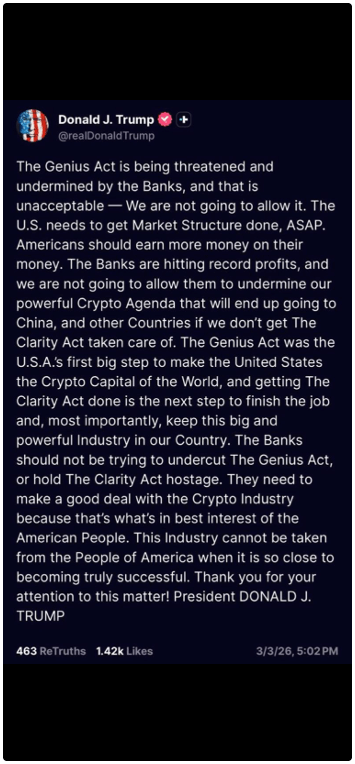
Just a few days ago, the President summed up very well the direction that he wants from the banking industry with respect to blockchain technology and digital assets.
The banks (TradFi) have been playing games for the last three months, which has been very disappointing and counterproductive. The banks have been screwing consumers by pulling in record profits and paying consumers peanuts on their deposits. The whole situation is absurd.
The game is up for traditional finance. The industry has to adapt and compete just like every other industry does.
The level of engagement right now by the industry in D.C. is incredible on CLARITY and related legislation. The work has been monumental. Designing market structure for a new class of financial assets is extremely complex. The work is getting done, and we’ll get the market structure bill passed.
After that, it’s game on for crypto.


Recommended Links
Is Jeff Flip-flopping on Nvidia?
Jeff Brown recommended Nvidia in 2016. But now he believes Nvidia is going to trigger a massive crash on March 16.Hundreds of popular stocks could freefall. ThisThursday, March 12, at 2 p.m. ET he’s revealing:
- Why he believes this crash is a sure thing
- Which types of stocks are at the highest risk
- The names of a bullish pick and a bearish pick
- And much, much more.
Plus, he’ll also reveal a solution unlike anything he’s ever revealed before. Click here to register with a single click >>>
(When you click the link, your email address will automatically be added to Jeff’s guest list.)
Elon’s $25 Trillion Tesla Call
Elon Musk just told his employees to hold Tesla shares “for dear life.” Why? He believes his latest AI breakthrough – one that is helping AI escape from our computer screens and manifest itself here in the real world – “could make Tesla a $25 trillion company.” That’s 8X bigger than Apple today. Click here to see Elon’s $25 trillion little-known plan before it goes mainstream.
The Next Generation of Nuclear?
Jeff Brown, are you tracking any of the companies developing the new Small Nuclear Reactors (SMRs)?
I’d be interested in researching if you have one you currently track?
– Howard D.
Hi Howard,
The simple answer to your question is all of them. I’ve been researching fourth-generation nuclear fission technology and nuclear fusion technology for more than a decade now. I follow every public and private company in the space of any significance and track these companies over the years.
With regards to nuclear fission SMRs, there are a bunch of companies that are making material progress towards commissioning their first reactors.
NuScale Power (SMR) is using a light water reactor design, which is an advanced, modular approach to well-established nuclear energy technology. In a similar category is Last Energy.
As far as true fourth-generation nuclear fission technology, there are a number of companies and approaches that are working quickly towards commissioning.
In the molten salt reactor category, we have Natura Resources, Valar Atomics, and Terrestrial Energy. For sodium-cooled reactors, we have Aalo Atomics and TerraPower. And there’s Oklo (OKLO) with its fast neutron microreactor and Radiant Industries with its heat pipe-cooled microreactor.
If I didn’t list a ticker, it means that the company is still private. Also, by listing these companies, it doesn’t mean that I am recommending them. This is a notoriously volatile sector that requires massive capital expenditures, with product revenues typically years into the future.
These are all exciting projects, however. We’ve never had the kind of pro-nuclear regulatory environment that exists today.
The technology is ready. And there is a clear need to increase energy production, preferably clean energy production, as quickly as possible to meet the increased energy demands from AI data center infrastructure.
The single most important input to accelerated economic growth is energy. Which is exactly why we track developments in energy technology so closely.
Grok 4.2
Warm greetings, Jeff,
In the [recent] issue of The Bleeding Edge– There Is No Free Existence… Even for an AI, you [mentioned], “…the just-released Grok 4.2 (which is insane)…”
I use Grok, so can you elaborate about the “insane” comment?
Thank you for your constant stream of knowledge. Very much appreciated.
– Thomas W.
Hello Thomas,
Something very special is happening at xAI right now with respect to Grok. No other company has scaled so quickly and efficiently to build out its AI data center infrastructure.
xAI’s extraordinary progress is the result of three distinct reasons:
- Scaling faster than any other frontier AI model company: xAI was the first to scale up to 1 gigawatt (GW) of compute in a single training cluster in the industry this January. xAI will be at 1.5 GW by next month (April) and operating 1 million GPUs in a training cluster by summer.
- The most advanced software architecture. I’ll provide more context below.
- A fanatic approach to truth and evidence-based training of the AI model. The fact is that training an AI model with mistruths, biases, and ideology results in lower-performing models at best and catastrophic errors at worst.
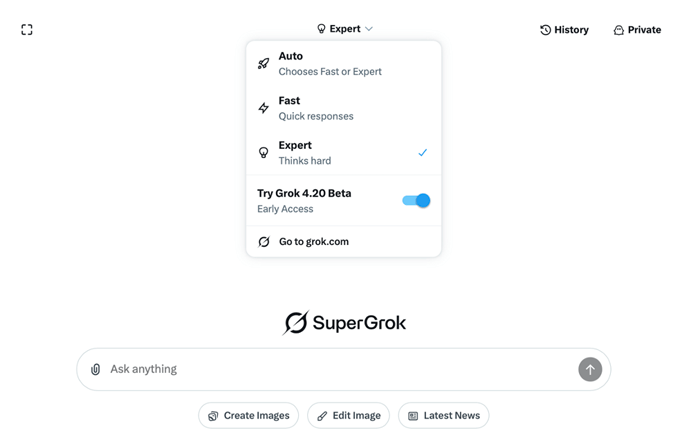
Since you use Grok, if you’d like to experiment with Grok 4.2 now, you have to toggle the switch as shown below to access the “Grok 4.20 Beta.”
Source: xAI
What’s unique about Grok 4.2 is that xAI developed an architecture that employs the use of four distinct AI agents that collaborate to respond to queries. Each agent has a different skillset and responsibility:
- Grok – responsible for coordinating the research and providing the final answer
- Harper – responsible for the deep research and verification of information
- Benjamin – responsible for topics related to mathematics, software code, and logic
- Lucas – responsible for creative thinking
Four agents with different skills and responsibilities work together, check and critique each other’s work, and produce an optimal output. It’s like having four of the most advanced AIs working in collaboration together without any bias to produce the best answer.
And for more complex queries, users can invoke the Heavy Mode, which leverages 12 more specialist agents – 16 agents in total – to solve problems. These are highly specialized. For example, one agent is a specialist in quantum chemistry, another in legal reasoning, or another in geopolitical scenario modeling.
Naturally, the more agents “working” for you, the more computational resources are required. And the more complex the problem, the same is true.
What has been proven already is that this multi-agent software architecture produces superior results compared to a single reasoning model approach. Perhaps ironically, this is also how highly performant teams of humans produce great results as well.
Also worth noting is how xAI is in a constant state of improvement with its models. It takes feedback, iterates daily, and employs updates in Grok every week. It doesn’t wait six months for its next major release of Grok. We can see it happening in real time.
Musk has publicly said that Grok 4.2 will improve by an order of magnitude from its first beta release to the formal release later this month. An order of magnitude! Absolutely insane (there’s that word again).
In short, xAI is on an accelerated path towards AGI.
Jeff
Recent Articles
Another EV Company Is About to Implode
Mar 5, 2026 • 7 min read

Mar 4, 2026 • 5 min read

Luddites vs. Effective Acceleration
Mar 3, 2026 • 5 min read


1125 N Charles St, Baltimore, MD 21201
www.brownstoneresearch.com
To ensure our emails continue reaching your inbox, please add our email address to your address book.
This editorial email containing advertisements was sent to pahovis@aol.com because you subscribed to this service. To stop receiving these emails, click here.
Brownstone Research welcomes your feedback and questions. But please note: The law prohibits us from giving personalized advice.
To contact Customer Service, call toll free Domestic/International: 1-888-512-0726, Mon-Fri, 9am-7pm ET, or email us here.
© 2026 Brownstone Research. All rights reserved. Any reproduction, copying, or redistribution of our content, in whole or in part, is prohibited without written permission from Brownstone Research.

 RJ Hamster