From our partners at SmallCaps Daily
From Australia to the U.S.: How SMX Shields Critical Minerals Amid Rising Iran-U.S. Conflict

As global tensions surge, particularly between the United States and Iran, nations are acutely aware that supply-chain certainty is a critical pillar of national security. Rare earth minerals, vital for everything from defense systems to renewable energy technologies, are at the center of this strategic struggle.
Australia, with its substantial reserves, is uniquely positioned to support U.S. demand—but only if traceability and verification can be guaranteed. There is where SMX (Security Matters) Public Limited (NASDAQ: SMX)enters the equation. SMX has a molecular identity technology rises to this challenge, embedding a secure, permanent digital signature into each material that survives all stages of processing and transformation.
This innovation allows stakeholders to confirm the origin, authenticity, and full lifecycle of rare earths, eliminating reliance on fragile paperwork or vulnerable certificates.
SMX’s solutions provide more than material authentication—they offer a safeguard against the growing threats of geopolitical conflict, industrial sabotage, and supply-chain disruption. By enabling governments, manufacturers, and investors to track materials in real-time, SMX fortifies defense supply chains, critical infrastructure, and high-security assets against risk.
Its presence in Southeast Asia, a hub of regional stability and trade, positions SMX as a trusted partner for global operations requiring resilience and transparency. As tensions in Iran escalate, SMX is not just securing materials—it is securing national interests, ensuring that essential minerals reach U.S. shores safely and reliably.
See how SMX is redefining rare earth security in an age of conflict
Just For You
PayPal Stock Halted on Stripe Rumor: Why the Narrative Just Changed
Author: Jeffrey Neal Johnson. Article Published: 2/25/2026.
Key Points
- A report that Stripe is in preliminary talks to acquire some or all of PayPal triggered a volatility halt and a fast re-rating in PYPL shares.
- The valuation gap between PayPal’s public market cap and Stripe’s private valuation helps explain why investors see meaningful upside in a deal scenario.
- The timing—during PayPal’s leadership transition—increases the odds that the board will seriously weigh strategic alternatives, including a transaction.
- Special Report: [Watch] FREE STOCK PICK for Elon Musk’s Starlink SuperIPO(From Paradigm Press)
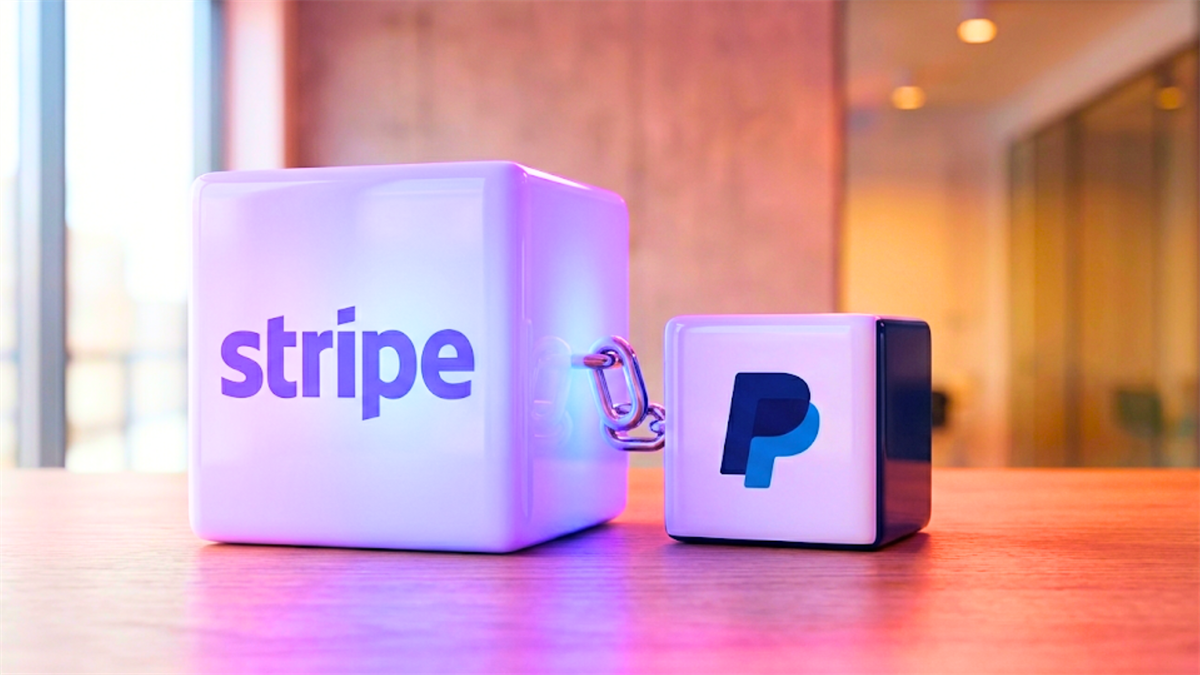
The end of February shattered the silence surrounding PayPal (NASDAQ: PYPL) stock. For months, investors watched shares drift lower after a disappointing fourth-quarter earnings report and tepid guidance for the year ahead. The narrative painted the fintech pioneer as a value trap destined for slow growth — until a volatility halt froze trading screens across Wall Street.
PayPal stock triggered a Limit Up/Limit Down (LULD) circuit breaker on Feb. 24, 2026, pausing activity as buy orders flooded the market. The catalyst was a Bloomberg report that payments giant Stripe is in preliminary talks to acquire some or all of PayPal. When trading resumed, shares closed up 6.72% at $47.01. Volume spiked to nearly 200% of the daily average, suggesting institutional participation rather than only retail speculation.
Introducing “Elon Musk’s Day-One Retirement Plan” (Ad)
Introducing “Elon Musk’s Day-One Retirement Plan”
What if you could compress a lifetime of wealth-building…
Ten… twenty… even thirty years…
Into a single 24-hour window?
It sounds absurd.
But Elon Musk is about to make it a reality with something I’m calling…“Day-One Retirement Plan.” Click here to see the details.
This episode represents a material shift in how the market values PayPal. At roughly a $43 billion market capitalization, the company looked priced for no growth. Interest from a major competitor, however, indicates PayPal’s strategic worth may be far higher than the share price implies. The rumor has effectively put a floor under the stock, turning it from a turnaround story into a high-stakes arbitrage opportunity.
Math Problem: $159 Billion vs. $43 Billion
The financial contrast between public- and private-market valuations is stark. Stripe’s most recent funding and secondary-market activity imply a valuation near $159 billion, while PayPal’s public market cap sits around $43 billion. That gap highlights a major disconnect in how fintech assets are being priced.
- Stripe: Valued at ~$159 billion. Dominates backend merchant processing but lacks a direct consumer app.
- PayPal: Valued at ~$43 billion. Dominates the consumer wallet with 400 million+ active accounts but has struggled with checkout growth.
Combining Stripe’s merchant infrastructure with PayPal’s consumer ecosystem would create an end-to-end payments powerhouse. Smart-money investors look past near-term headwinds in branded checkout growth and focus on PayPal’s massive user base and roughly $6 billion in free cash flow, trading at a price-to-earnings ratio (P/E) near 8.7x. That multiple is bargain-basement territory for a tech company, usually reserved for businesses in terminal decline — not one generating billions in cash.
Consider the data synergy: Stripe knows what merchants sell; PayPal knows who buys. Together, they would close the loop between ad impression and final transaction in a way Alphabet (NASDAQ: GOOGL) and Meta (NASDAQ: META) have pursued for years. That strategic potential helps explain the market’s positive reaction to the rumor.
The Leadership Void: Why Strike Now?
The timing of the rumor is unlikely to be accidental. PayPal is navigating a sensitive leadership transition: incoming CEO Enrique Lores, formerly of HP (NYSE: HPQ), is scheduled to take the reins on March 1, 2026. That interregnum — the period between one regime ending and another beginning — creates a window of vulnerability.
Interim CEO Jamie Miller is competent, but interim leaders are typically limited in making sweeping strategic moves or rebuffing credible buyout approaches without board involvement. An acquirer like Stripe may see an incentive to move before Lores can consolidate a standalone strategy or reorganize the business in ways that would raise the acquisition price.
Investors now face two plausible scenarios for Lores:
- The Dealmaker: Lores arrives with a mandate to maximize shareholder value quickly, potentially negotiating a sale or monetizing assets (for example, spinning off Venmo).
- The Defender: Lores fights to keep PayPal independent, arguing his turnaround plan will generate more value than any buyout premium.
Either way, the mere presence of a bidder forces the board to objectively reassess the company’s value, which typically benefits the share price.
The Bidding War: Who Else Is Watching?
If Stripe is digging into the books, other industry players likely won’t sit on the sidelines. A takeover signal opens the door to a competitive auction.
- Major Banks: Banks have capital but generally lack the consumer-facing tech stack for a seamless wallet. Buying PayPal would provide an instant, plug-and-play consumer relationship, even if integration proves messy.
- Private Equity: Financial buyers prize cash flow. A leveraged buyout could allow a PE firm to take PayPal private, restructure away from quarterly scrutiny, and potentially break the company into higher-value parts.
A sum-of-the-parts analysis suggests selling Venmo separately while keeping the core processing business could unlock value well above $47 per share. Venmo’s high engagement and younger user base alone could command a valuation that accounts for a large portion of PayPal’s current market cap.
The Floor Is In: Options Traders Make Their Move
Options market activity reinforces the bullish shift. After the halt, there was aggressive buying of call options for late-February and March expirations, indicating traders are paying a premium for rights to buy stock at higher prices — a bet that momentum will continue or that a deal announcement is imminent. That flow suggests the market expects volatility to resolve to the upside.
Technically, the rumored interest establishes a more concrete support level. Before the news, shares were trading near $38, a price reflecting a worst-case scenario. With M&A on the table, the $38–$40 range now functions as a floor. It is unlikely the stock will revisit those lows while a buyout remains plausible; any dip is likely to attract buyers seeking the spread between the market price and a potential offer.
Regulatory scrutiny is a legitimate risk. The Federal Trade Commission (FTC) would examine a deal of this scale, especially one combining Stripe and PayPal. Still, for traders focused on near-term returns, the announcement of an offer typically drives the stock to near the offer price regardless of eventual antitrust outcomes. Whether the transaction closes months or years later is a separate consideration, but the immediate re-rating creates the trading opportunity.
Asymmetric Upside: The New Rules for PayPal Stock
Tuesday’s events have materially rewritten PayPal’s investment case. The story has shifted from execution and margin recovery to asset realization and strategic consolidation. Downside risk is now cushioned by the company’s cash generation and the knowledge that deep-pocketed suitors are circling.
For investors, the risk/reward looks attractive. A deal would deliver immediate, substantial upside. If no deal materializes, the stock still appears undervalued and will be managed by a new CEO focused on unlocking shareholder value. The market has signaled that PayPal is too cheap to ignore, and the circuit-breaker halt was the alarm that brought attention back to the opportunity.
This email is a sponsored message from SmallCaps Daily, a third-party advertiser of MarketBeat. Why did I receive this email content?.
This message is a paid advertisement for SMX (NASDAQ: SMX) from SmallCaps Daily and Interactive Offers. MarketBeat Media, LLC receives a fixed fee for each subscriber that clicks on a link in this email, totaling up to $27,000. Other than the compensation received for this advertisement sent to subscribers, MarketBeat and its principals are not affiliated with either SmallCaps Daily or Interactive Offers. MarketBeat and its principals do not own any of the stocks mentioned in this email or in the article that this email links to. Neither MarketBeat nor its principals are FINRA-registered broker-dealers or investment advisers. The content of this email should not be taken as advice, an endorsement, or a recommendation from MarketBeat to buy or sell any security. MarketBeat has not evaluated the accuracy of any claims made in this advertisement. MarketBeat recommends that investors do their own independent research and consult with a qualified investment professional before buying or selling any security. Investing is inherently risky. Past-performance is not indicative of future results. Please see the disclaimer regarding SMX (NASDAQ: SMX) on Interactive Offers’ website for additional information about the relationship between Interactive Offers and SMX (NASDAQ: SMX).
If you have questions or concerns about your newsletter, please don’t hesitate to email our U.S. based support team at contact@marketbeat.com.
If you would no longer like to receive promotional emails from MarketBeat advertisers, you can unsubscribe or manage your mailing preferences here.
© 2006-2026 MarketBeat Media, LLC.
345 N Reid Place #620, Sioux Falls, SD 57103. United States..
Today’s Featured Link: How to collect $1,170 a month from silver(From Investors Alley)

 RJ Hamster