

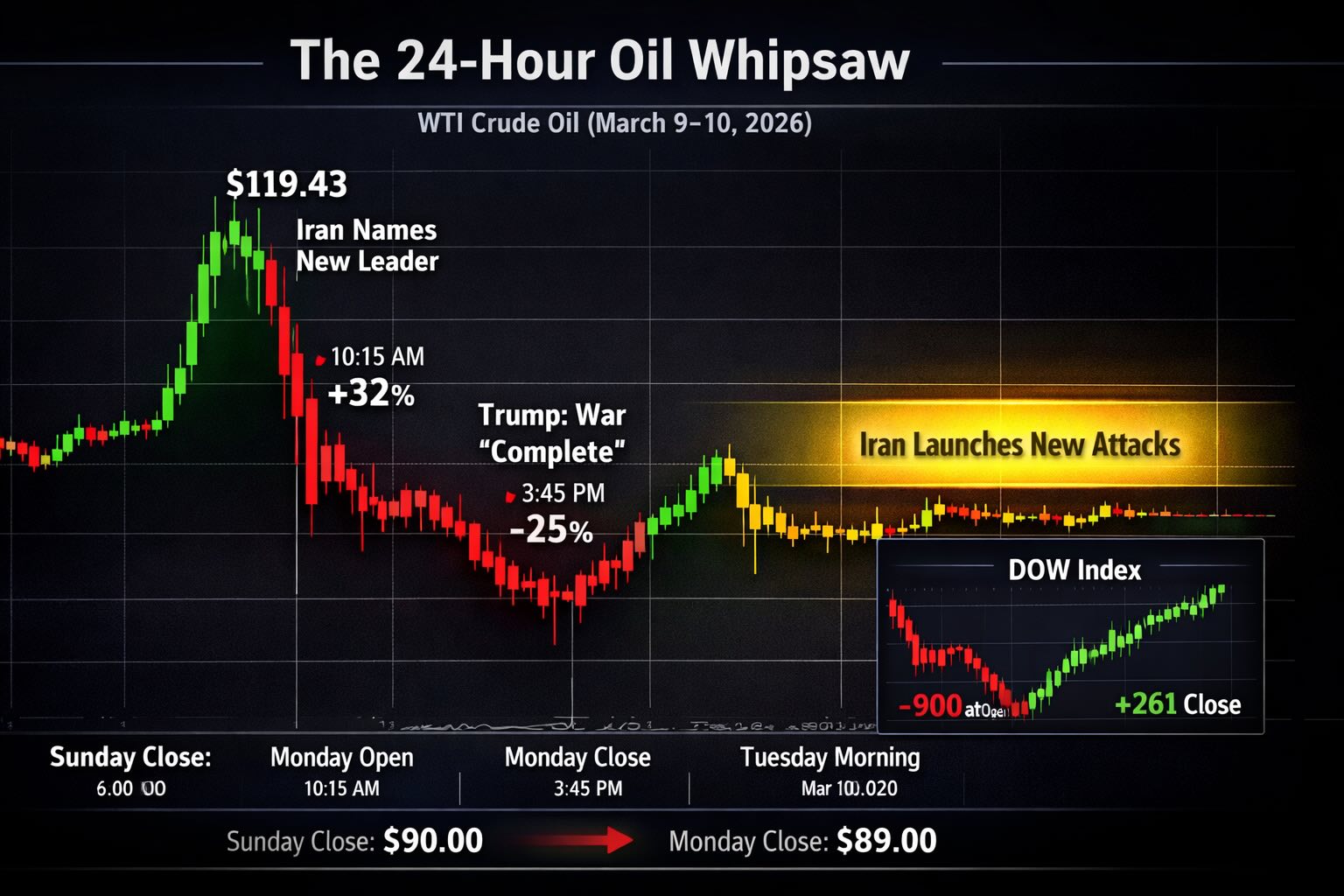
Oil prices staged one of the most dramatic reversals in history Monday, spiking to $119.43 per barrel before crashing 30% to $89 by day’s end. The Dow opened down 900 points and closed up 261. The S&P 500 fell 1.5% at the open and finished up 0.8%.
If you sold in the panic, you locked in devastating losses. If you held steady, you recovered. If you bought the dip, you made a killing.
Monday wasn’t just a wild day—it was a masterclass in how to survive (and profit from) war-driven volatility.
First: The Spike
Sunday, Iran’s Assembly of Experts selected Mojtaba Khamenei—the second son of the assassinated Supreme Leader—as the country’s new leader. Markets interpreted this as Iran digging in for a long war rather than surrendering.
Oil exploded. West Texas Intermediate crude hit $119.43 intraday, the highest price since 2022. Brent crude touched $120.
When markets opened Monday morning, panic selling began immediately. The Dow plunged 900 points. The S&P 500 dropped 1.5%. The Nasdaq fell 1.6%. Energy stocks surged while everything else bled red.
Traders who sold at the open thought they were protecting themselves from worse losses. They were wrong.
Next: The Crash
By Monday afternoon, everything reversed. President Trump told CBS News the Iran war is “very complete, pretty much.” That single comment triggered one of the fastest oil crashes in history.
Oil fell from $120 to $89—a 26% drop—in a matter of hours. Stocks reversed course. By the close, the Dow was up 261 points. The S&P 500 gained 0.8%. The Nasdaq jumped 1.3%.
Panic sellers from the morning watched in horror as the market erased their losses without them.
Then Reality Hit
Here’s the problem: Monday night, Iran launched fresh attacks on Israel, Kuwait, the UAE, Saudi Arabia, and Bahrain. A 29-year-old woman was killed when a residential building in Bahrain’s capital was struck.
Iran’s Revolutionary Guard issued a statement: “Iran will determine when the war ends.”
By Tuesday morning, oil was back around $90 and markets traded flat. Nobody knew whether to believe Trump’s “war complete” comment or Iran’s actions.
The whipsaw continues.
The Traders Who Made Money: What They Did Differently
Professional traders who profited from Monday’schaos didn’t have secret information. They followed a few simple rules that retail investors often ignore.
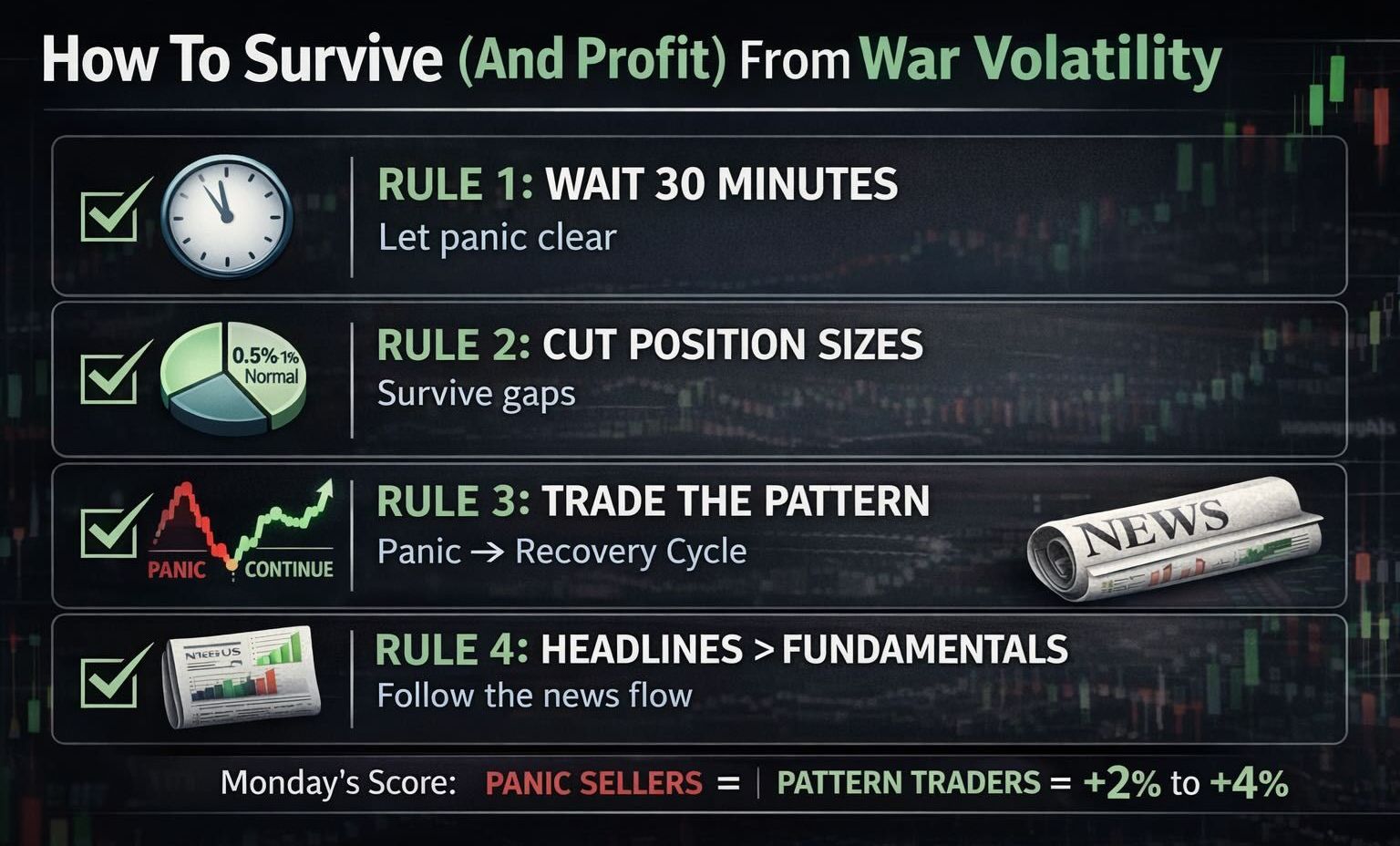
Rule 1: Never Trade the First 30 Minutes
The traders who lost money Monday sold in the first 30 minutes of trading when the Dow was down 900 points. The traders who made money waited.
Markets are most volatile in the first half-hour after major news. Emotions run high. Spreads widen. Prices whipsaw violently. It’s the worst time to make decisions.
Professional traders wait for the initial panic to clear. They let the amateurs shake out. Then they assess whether the move makes sense or if it’s an overreaction.
Monday morning was a textbook overreaction. Oil at $120 priced in a worst-case scenario: total Hormuz closure lasting months, complete supply disruption, $150-200 oil. That scenario didn’t materialize.
Rule 2: Size Positions for Volatility
During normal markets, a trader might risk 2-3% of their portfolio on a single position. During war-driven chaos, smart traders cut that to 0.5-1%.
Why? Because stop-losses don’t work in gap markets.
In March 2026, weekend escalations have caused Monday morning gaps of $10-18 per barrel. If you set a stop-loss at $100 and oil gaps down to $85 at the open, your stop triggers at $85—not $100. That’s a $15 loss instead of the $5 loss you planned for.
Smaller positions mean you can survive these gaps without catastrophic damage to your account.
Rule 3: Trade the Pattern, Not the Headline
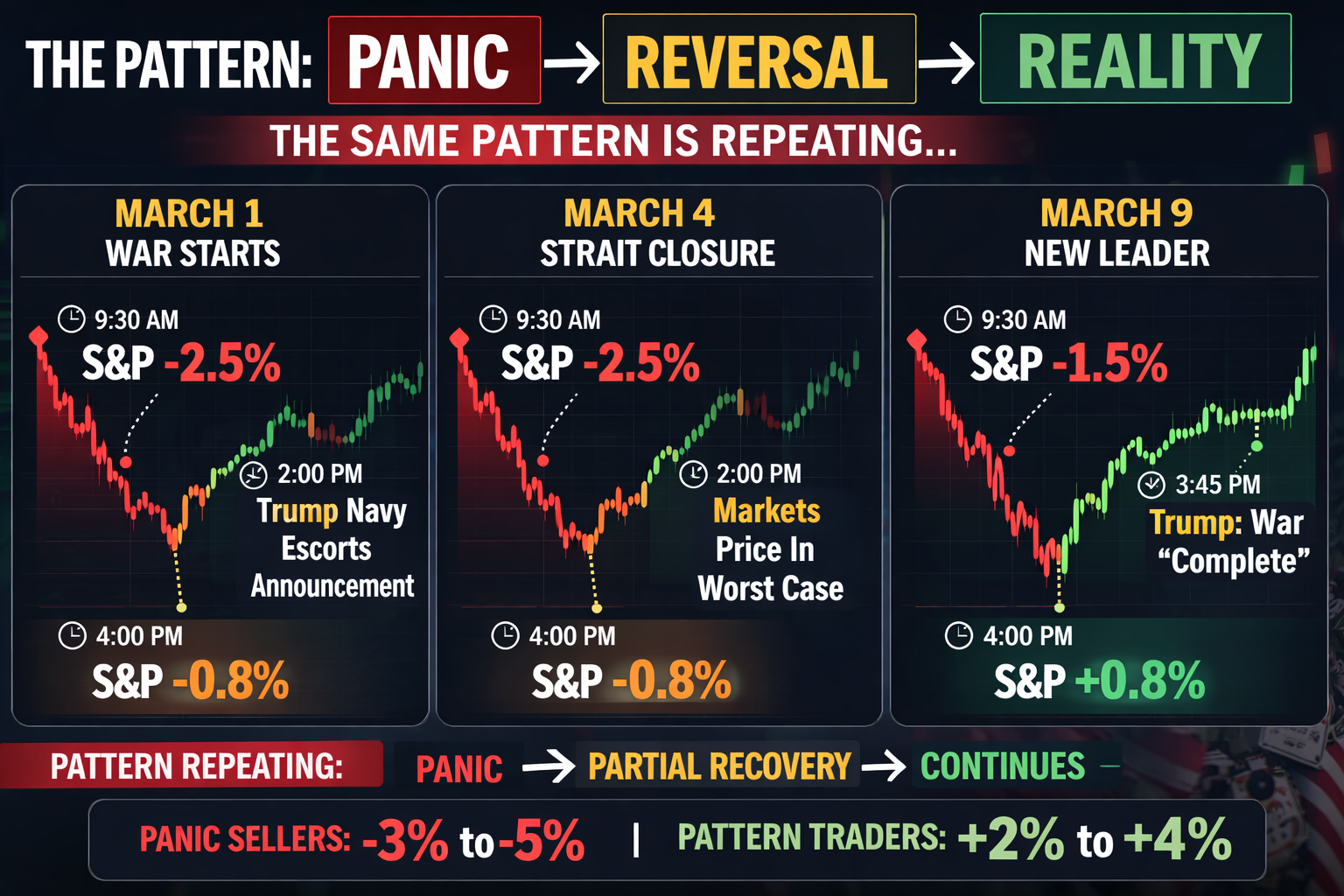
This is the third time in two weeks that markets have followed the exact same pattern:
- Day 1: War escalation → Panic selling → Markets down 2-3%
- Day 2: Trump comments or developments → Rally → Markets recover most losses
- Day 3: Reality sets in → Volatility continues
March 1 (war starts): S&P down 2.5% at open, closed down 0.8%
March 4 (Strait closure): S&P down 2.5% at open, closed down 0.8%
March 9 (new leader): S&P down 1.5% at open, closed UP 0.8%
See the pattern? Markets panic, then they adjust. The panic is predictable. The recovery is predictable.
Smart traders stopped fighting the pattern. They started buying the panic and selling the relief rally.
Rule 4: Know When Headlines Override Fundamentals
Oil’s crash from $120 to $89 had nothing to do with supply and demand fundamentals. The Strait of Hormuz is still effectively closed. Middle East production is still disrupted. Nothing changed on the ground.
What changed was perception. Trump’s comment made traders believe the war would end soon. That belief—whether accurate or not—was enough to crater the war-risk premium built into oil prices.
Professional traders know that in war markets, headlines move prices faster than fundamentals. They trade the perception, not the reality, and they’re ready to exit when perception shifts again.
Monday night’s new Iranian attacks shifted perception back toward “war continues.” That’s why oil stabilized around $90 instead of crashing to $70.
The Bottom Line
Monday taught a brutal lesson: In war-driven markets, the first move is almost always wrong. The traders who panicked and sold at the open locked in massive losses. The traders who waited, sized positions carefully, and traded the pattern instead of the headlines made money.
This pattern will repeat. There will be more war escalations, more Trump comments, more whipsaw reversals. The traders who survive—and profit—will be the ones who learn from Monday’s chaos.
The next time you see the Dow down 900 points at the open, remember: the market often reverses by close. Don’t be the panic seller who locks in losses at the worst possible moment.
Guardian Financial Publishing, 3571 Far West Blvd · Texas · Austin · 78731 · United StatesNo longer want to receive these emails. Unsubscribe

 RJ Hamster