Dear Reader,
Dr. Mark Skousen here.
I’ve worked for the CIA.
I’ve personally met four US presidents.
I’ve spent 45 years studying the markets — calling Black Monday six weeks before it happened… predicting the fall of the Berlin Wall… pinpointing the exact bottom in 2009.
But what I’m about to share with you is the boldest prediction of my career.
After meeting Elon Musk face-to-face at a private gathering of Wall Street elites, I’m now staking my reputation on one date.
March 26, 2026.
Mark it on your calendar right now!
That’s when I believe Elon will announce the SpaceX IPO — what Bloomberg is calling “the biggest listing of ALL TIME.”
I have an “access code” that lets you grab a pre-IPO stake before it happens.
But I’m only willing to share it with 500 people today. After that, you my never get the chance again.
Click here to see how to claim your “SpaceX access code”.
Yours for peace, prosperity, and liberty, AEIOU,
Dr. Mark Skousen
Macroeconomic Strategist, The Oxford Club
P.S. I don’t make predictions lightly. When I put my name on something, I mean it.
Click here before the 500 spots are gone.
This Week’s Bonus Article
Archer Aviation: The Billion-Dollar Battleground
By Jeffrey Neal Johnson. Article Posted: 2/24/2026.

Key Points
- Major institutional asset managers have increased their equity stakes in Archer Aviation, demonstrating strong confidence in its aircraft’s commercial viability.
- The strategic manufacturing partnership protects the balance sheet by absorbing the significant capital costs of infrastructure development.
- A tightening supply of available shares, coupled with high short interest, creates a market setup where positive news could trigger upward momentum.
- Special Report: [Sponsorship-Ad-6-Format3]
Volatility has returned to the electric aviation sector with a vengeance, leaving many retail investors wondering if the flight path has permanently changed. Investors in Archer Aviation (NYSE: ACHR) have experienced significant whiplash over the last 30 days, watching the stock rally to nearly $9 in late January before sliding back to about $6.93 in late February.
To the untrained eye, this roughly 20% drop looks like a warning sign. Seasoned market watchers, however, know this dramatic round-trip isn’t random market noise — it’s the result of a high-stakes clash between two powerful forces.
Skip Headlines Straight to Original Research (Ad)
Our investment research analysts are going to be releasing their next investment idea tomorrow morning, around 10:00 AM Eastern time.Add yourself to the distribution list here.
On one side, institutional investors are quietly accumulating millions of shares, betting on the company’s long-term prospects. On the other, short sellers are betting against Archer, alleging certification delays and alleging operational silence. The stock is now trapped in a defined trading range, waiting for a catalyst to break the deadlock.
That catalyst arrives this week. The market faces a binary window with two critical events: Joby Aviation’s (NYSE: JOBY) earnings report on Wednesday and Archer’s own financial update next Monday. How those two events play out will likely dictate the stock’s trajectory in the first half of 2026.
The BlackRock Backstop: A Floor for the Stock Price
While day traders react to scary headlines, the world’s largest asset managers focus on balance sheets. In late January, an SEC filing revealed a significant vote of confidence in Archer’s future: BlackRock Inc., the largest asset manager in the world, filed an amended Schedule 13G showing it has increased its passive stake in Archer to 8.1%.
For retail investors, this matters. BlackRock is not a venture-capital backer that chases moonshots — it is a risk-averse firm. For a company of BlackRock’s size to hold nearly 10% of a volatile, pre-revenue aerospace business suggests its internal due diligence contradicts the bearish narrative. Institutional investors generally have access to data, models, and management access retail traders do not. Their decision to buy during the dip implies they view the current price as a discount rather than a trap.
Backing this financial floor is Archer’s ongoing partnership with Stellantis (NYSE: STLA), arguably the company’s biggest competitive moat. Unlike some competitors forced to spend hundreds of millions building factories from scratch, Archer leverages Stellantis to absorb heavy capital costs for manufacturing infrastructure. That capital shield preserves Archer’s cash for certification and R&D. For many investors, the presence of BlackRock and Stellantis suggests that at sub-$7.00 levels the stock rests on a reasonably solid foundation.
The Price of Uncertainty: Fear as a Strategy
If institutional backing is so strong, why did the stock drop in February? The answer is market psychology. On Feb. 11, a short-seller report circulated alleging flight logs show no recent testing of the flagship Midnight aircraft and predicting FAA certification could slip to 2028, two years behind the company’s public timetable.
Markets hate uncertainty more than they hate bad news. Because Archer entered a quiet period ahead of its earnings release, management has been limited in what it can say publicly. That regulatory silence allowed the negative narrative to fester, prompting panicked retail selling and amplifying the move lower.
But this dynamic creates a classic market dislocation. Short sellers profit when prices fall, so they have an incentive to spread fear. That in turn sets a trap: if Archer can show on Monday that flight testing has continued on schedule, the basis for the sell-off collapses. Monday’s earnings call is now as much about defending the company’s integrity as it is about the financials.
Wednesday’s Warning Shot: Watching Joby Aviation
Before Archer takes the stage, investors should watch the competition. On Wednesday, Feb. 25, rival Joby Aviation reports earnings, and in emerging sectors the market leader often sets the tone for the entire group — a phenomenon traders call a sympathy trade.
If Joby misses revenue targets or announces certification delays, Archer could fall in sympathy before it even reports. A weak Joby report would bolster critics who argue the entire industry is stalled, so this is a real near-term risk.
That said, a divergence could work in Archer’s favor. Joby has recently faced headwinds, including a Sell initiation from Goldman Sachsamid valuation concerns. Joby currently trades at a premium, while many analysts view Archer as the value play. If Joby falters, capital might rotate from the expensive leader into the undervalued competitor — provided Archer can show execution is on track.
Monday’s Verdict: The $2 Billion Question
The main event is Monday, March 2, when Archer releases Q4 and full-year 2025 results. While headline algorithms will latch onto EPS, investors should treat that number cautiously. Analysts expect a loss of $0.24 per share — but profitability is not the immediate goal for a company in the certification phase.
The real signals will be two metrics: Cash Burn and Liquidity.
- Cash Burn: The whisper number is under $110 million for the quarter. Continued disciplined spending would be a strong positive.
- Liquidity: Management needs to show cash and available liquidity near $2 billion to demonstrate runway toward commercialization without immediate dilution.
Beyond the math, CEO Adam Goldstein must use the call to silence the bears. Investors will look for three specific confirmations to rebuild confidence:
- Flight logs: A clear update on Phase 4 testing to prove the aircraft is actively flying.
- Timeline: A firm rebuttal of the 2028-delay rumor and a reaffirmation of the company’s 2026 commercialization goal.
- Strategy: Progress updates on the new U.K. engineering hub and the NVIDIA (NASDAQ: NVDA) partnership to show global expansion and technical momentum.
The 17% Trap: A Coiled Spring
Tension between institutional buyers and short sellers has created a technical setup often described as a coiled spring. Short interest in Archer has risen to roughly 17% of the float — about 90 million shares sold short.
But the tradable float — the number of shares actually available to buy and sell — is smaller than headline figures suggest. BlackRock, Stellantis, and insiders hold large, typically non-trading positions, constraining available supply. That creates a risky posture for the bears.
If Archer rebuts the delay rumors Monday with credible, constructive news, short sellers could be forced to buy back shares to cover losing positions. With limited supply, that squeeze could quickly push the stock back into the $8.00–$9.00 range.
The Final Approach: Time to Choose a Side
Archer enters this week priced for imperfection at about $6.93. Downside is partially protected by institutional support from BlackRock and Stellantis, while upside is amplified by high short interest that could force a rapid cover if the company delivers positive news.
Volatility is all but guaranteed. Investors should watch Wednesday’s Joby report for early clues on the sector, but the decisive moment is Monday’s Archer update. If management executes and addresses the key concerns, institutional buyers will look prescient and the negative cloud around the stock could dissipate. This week is a time to watch the data, not the noise.
This Week’s Bonus Article
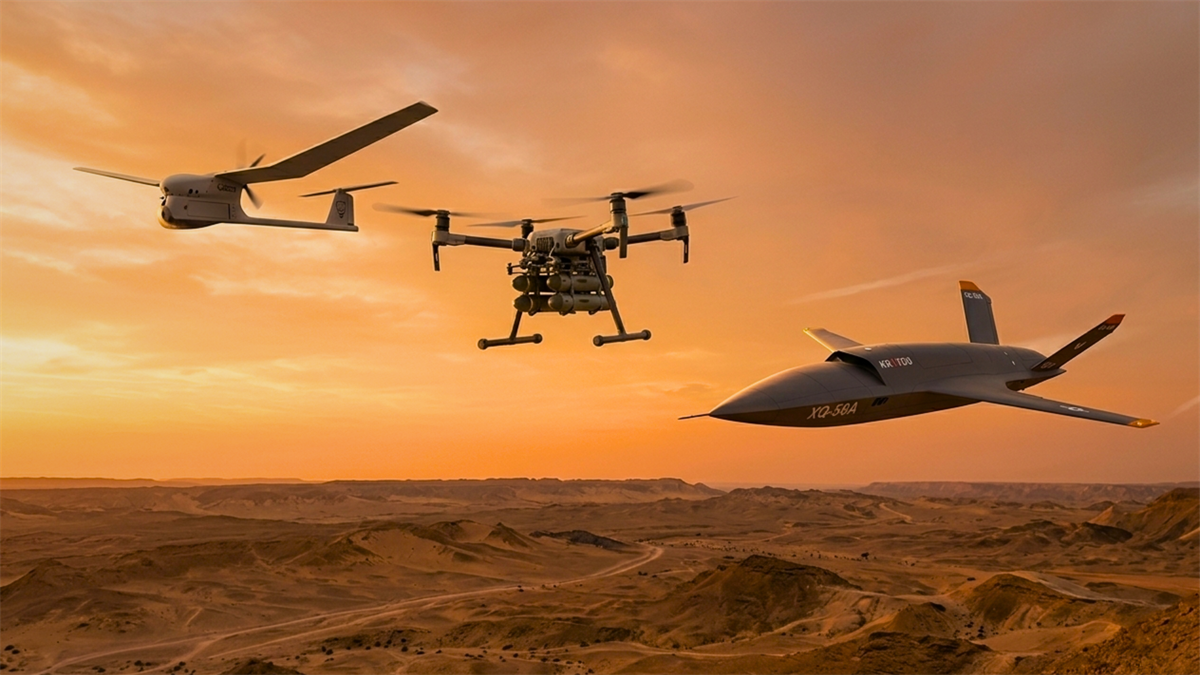
Unmanned Profits: The New Kings of the Modern Battlefield
By Jeffrey Neal Johnson. Article Posted: 3/6/2026.
Key Points
- AeroVironment’s battle-proven loitering munitions have become an essential tool for modern ground forces, driving significant revenue growth.
- Kratos is pioneering the future of air combat with its high-performance, attritable aircraft, designed to serve as a powerful force multiplier.
- Red Cat’s strategic partnerships are rapidly expanding its capabilities into new defense domains, including counter-drone systems and maritime security.
- Special Report: [Sponsorship-Ad-6-Format3]
The 21st-century battlefield looks fundamentally different from how it was just a decade ago. The new calculus of conflict is no longer solely determined by the number of tanks or fighter jets a nation possesses. Instead, strategic dominance is increasingly won through the deployment of sophisticated, cost-effective, and often expendable unmanned systems. This technological pivot has been on full display in recent global conflicts, where swarms of intelligent drones have proven capable of altering the course of entire battles—delivering precision strikes and valuable intelligence without risking a single human life.
This paradigm shift has created a distinct opportunity for investors. While the entire defense sector has garnered attention, the most direct exposure to this trend is not found within the diversified portfolios of defense conglomerates. Rather, it lies with specialized, pure-play companies whose growth is directly tethered to the success of unmanned technology.
AeroVironment: The Battle-Tested Industry Standard
Skip Headlines Straight to Original Research (Ad)
Our investment research analysts are going to be releasing their next investment idea tomorrow morning, around 10:00 AM Eastern time.Add yourself to the distribution list here.
AeroVironment (NASDAQ: AVAV) has solidified its position as an industry standard in the unmanned aerial systems (UAS) space. With deep, long-standing ties to the U.S. Department of Defense, the company is a foundational player whose technology is considered essential for modern infantry tactics. Its flagship product, the Switchblade family of loitering munitions, has become synonymous with the kamikaze drone concept, delivering precision kinetic effects that have proven highly effective on the front lines in Ukraine and other conflict zones. This real-world success is reflected in the company’s financials, with recent quarterly revenue up more than 150% year-over-year.
Recent stock volatility has been linked to headlines surrounding the U.S. Space Force SCAR program. A closer look, however, shows this is not a lost contract but a strategic renegotiation to establish a firm-fixed-price deal for a commercial product—something that could deliver more predictable, stable long-term revenue. In a clear signal of management’s confidence in future demand, AeroVironment announced a significant expansion of its manufacturing capacity. The move is designed to scale production for anticipated large orders, positioning the company to meet growing needs from the U.S. military and its allies for its proven systems.
Kratos: Building the High-Tech Future of Air Combat
Kratos Defense & Security Solutions (NASDAQ: KTOS) is carving out a niche as a high-tech innovator focused on next-generation unmanned combat aircraft. The company is a market disruptor with a portfolio of high-performance, attritable jets, including the XQ-58A Valkyrie. These systems are designed to fly as loyal wingmen alongside manned fighter jets, acting as a force multiplier by scouting, deploying weapons, and drawing enemy fire—all at a fraction of the cost of a traditional aircraft. This strategy directly addresses the Pentagon’s need to generate mass against near-peer adversaries without breaking the budget.
This ambitious vision requires substantial capital, and investors have taken note, sending the stock up more than 200% over the past year. The company recently raised over $1 billion through a public offering. While such a move can create short-term pressure on the share price, it is best understood as a strategic decision to build a war chest. These funds are intended to scale production facilities, accelerate research and development, and strengthen the company’s balance sheet to win and execute multi-billion-dollar program-of-record contracts. Further diversifying its business, Kratos has also secured orders for advanced counter-drone systems, demonstrating capability on both the offensive and defensive sides of unmanned warfare.
Red Cat: The Agile Disruptor Seizing New Domains
Red Cat Holdings (NASDAQ: RCAT) is a smaller, more agile contender in the drone space, focusing on versatile small UAS for ground forces, such as its Teal 2 system, which provides critical night-vision capabilities for individual soldiers. The company has recently drawn investor attention not just for its drones, but for a forward-thinking strategy of integrating advanced third-party capabilities to rapidly expand its market reach. The stock’s year-to-date performance, up over 80%, reflects that enthusiasm.
A key driver of this performance is a strategic partnership with Allen Control Systems. The collaboration will integrate Allen Control Systems’ Bullfrog AI-powered autonomous weapon station onto Red Cat’s platforms. The move achieves two important objectives: it propels Red Cat into the lucrative Counter-UAS (C-UAS) market, and the initial integration will be on the company’s unmanned surface vessels (USVs), expanding Red Cat from a drone-only firm into a multi-domain technology provider for both air and sea. This strategic pivot meaningfully increases the company’s total addressable market and outlines a clear path toward accelerated growth.
Finding Your Fit in the Drone Sector
Understanding the distinct profiles of these three companies is key to aligning any potential investment with an individual’s financial strategy. Each offers a different level of exposure to the drone-warfare thesis.
- AeroVironment: The Established Leader. With a market capitalization of over $11 billion, AVAV presents a more mature investment profile. Its growth is tied to proven technology and the ongoing need for militaries to procure and replenish tactical loitering munitions.
- Kratos: The High-Tech Innovator. Valued at over $15 billion, Kratos offers a higher-growth profile centered on disruptive, next-generation systems. Its future depends on securing massive, long-term government contracts for its advanced attritable aircraft.
- Red Cat: The Agile Disruptor. With a market cap under $2 billion, RCAT represents a higher-risk, higher-reward opportunity. Its smaller revenue base is offset by the potential for rapid expansion as it penetrates markets such as C-UAS and maritime defense.
A Clearer View of the 21st-Century Battlefield
The notable growth shown by these specialized drone companies is not a fleeting trend but a reflection of a fundamental, enduring shift in military strategy. While large defense conglomerates offer stability, their size dilutes the impact of any single high-growth sector. For investors seeking direct exposure to the unmanned-systems revolution, the distinct profiles of AeroVironment, Kratos, and Red Cat provide a spectrum of compelling opportunities. Together, they represent a focused way to participate in the accelerating, technology-driven future of the defense industry.
Thank you for subscribing to The Early Bird, MarketBeat’s 7:00 AMnewsletter that covers stories that will impact the stock market each day.
This email message is a sponsored message for The Oxford Club, a third-party advertiser of The Early Bird and MarketBeat.
This ad is sent on behalf of The Oxford Club. 105 W Monument St, Baltimore, Maryland 21201. If you would like to optout from receiving offers from The Oxford Club please click here
If you need help with your account, feel free to email MarketBeat’s U.S. based support team at contact@marketbeat.com.
If you no longer wish to receive email from The Early Bird, you can unsubscribe.
© 2006-2026 MarketBeat Media, LLC.
345 N Reid Pl., Suite 620, Sioux Falls, SD 57103-7078. U.S.A..
Further Reading: Elon’s about to mint $625B. Here’s how to ride along. (From Timothy Sykes)

 RJ Hamster