
How One Small Metals Firm Landed a Global Giant
It’s rare to see a small company move this fast.
In just two years, this North American explorer secured a partnership with $116B Rio Tinto, acquired four major properties, and began drilling for the metals that fuel both energy independence and defense readiness.
Learn why this fast-moving company is gaining serious momentum >
Just For You
The Copper Shortage Is Coming—These 3 Miners Are Ready
Authored by Chris Markoch. Article Published: 3/8/2026.

Key Points
- Aging global copper mines and rising electrification demand could create a structural copper supply shortage.
- Small-cap miners with operating assets or near-term projects may benefit most from rising copper prices.
- Taseko Mines, Talon Metals, and Arizona Sonoran Copper offer different ways for investors to gain exposure.
- Special Report: [Sponsorship-Ad-6-Format3]
Fear sells. But seeing a headline about a copper shortage should excite investors, not scare them—particularly those with a long-term outlook for basic materials stocks, including mining companies. The advanced age of many copper mines strengthens the case for several small-cap copper miners.
Here’s the situation: copper mines, no matter how productive, have a limited productive life. Many of the world’s largest copper mines are also among the oldest. That doesn’t mean they will stop producing, but over time each mine yields less copper per ton of rock moved.
Skip Headlines Straight to Original Research (Ad)
Our investment research analysts are going to be releasing their next investment idea tomorrow morning, around 10:00 AM Eastern time.Add yourself to the distribution list here.
That coming supply shortfall coincides with growing demand for copper, which creates opportunities for smaller miners that can bring new supply online.
Even under a “friendly” administration, permitting and building new mines is difficult, expensive, and time-consuming. Companies with existing operations or advanced projects therefore have a structural advantage—one that can drive rising asset valuations.
Small-cap stocks have been out of favor, but that is likely to change as investors seek growth in a lower-rate environment. Here are three names investors may want to consider.
Taseko Mines Expands Production in Tier-1 Jurisdictions
First up is Taseko Mines Ltd. (NYSEAMERICAN: TGB), a Vancouver-based Canadian miner. The company already operates the Gibraltar project in British Columbia, one of Canada’s largest open-pit copper producers. Taseko is guiding for output of 110–115 million pounds in 2026, up from roughly 99 million pounds in 2025.
Adding to the bullish outlook, Taseko has started copper production at its Florence in-situ copper project in Arizona, another Tier-1 jurisdiction. On March 2, the company announced it had harvested its first copper cathodes from the Florence project. This is the first new copper production from a greenfield facility in the United States since 2008.
Management expects Gibraltar’s higher-grade Connector pit to deliver stable production through at least 2029. If that proves accurate, it will give the company time to ramp up Florence production, which strengthens Taseko’s long-term appeal.
TGB stock recently closed near $7.50, above the consensus price target of roughly $5—but that estimate is based on just two analysts. Institutional ownership is low, though it has risen over the last two quarters. If Taseko meets its production targets, analysts will likely revise their estimates upward.
Talon Metals Offers High-Risk, High-Reward Potential
Talon Metals Corp. (OTCMKTS: TLOFF) is a small company with significant upside potential. The company’s leading project, the Tamarack projectin Minnesota, is a joint venture with Rio Tinto (NYSE: RIO). For investors, access to a major miner’s technical expertise and financial backing adds a measure of assurance.
Talon also operates the only nickel mine in the United States, the Eagle Mine and Humboldt Mill in Michigan, which connects the company to the battery and EV supply chain. Talon has secured an extension from Rio Tinto’s Kennecott subsidiary to complete a feasibility study and additional spending to earn up to 60% ownership, with a key environmental review milestone expected in the first half of 2026.
TLOFF stock has been an outstanding performer, gaining more than 990% over the last 12 months. It is also up more than 45% in 2026. The stock recently closed near $6.25, roughly 6.5% above the consensus price target of about $5.84.
Arizona Sonoran’s Acquisition Highlights Copper Value
Growth for small-cap miners can come organically or through acquisition. That latter path is illustrated by Arizona Sonoran Copper (OTC: ASCUF), which is being acquired by Hudbay Minerals (NYSE: HBM).
Arizona Sonoran controls 100% of the brownfield Cactus copper project in Arizona, and the acquisition will give Hudbay full control of that asset.
Combined with Hudbay’s Copper World asset, the deal creates the third-largest copper district in North America and establishes a major hub for U.S. copper production. Cactus could add roughly 103,000 tonnes of annual copper production once developed, with proven and probable reserves of 5.3 billion pounds of copper over a 20-year mine life.
Both companies’ boards have approved the agreement, which is expected to close in the second quarter of this year. That approval may dampen direct investment interest in ASCUF stock ahead of closing; after the deal is finalized, each ASCUF share will be exchanged for 0.242 of a common share of HBM stock.
Just For You
AI Panic Hits Wall Street: 3 Financial Stocks on Sale
Authored by Dan Schmidt. Article Published: 2/27/2026.

Key Points
- AI disruption fears hit the financial sector this month following news of automated tax planning tools and mass unemployment scenarios.
- While the fears of AI disruption have merit, the selloff is likely overblown and more related to a rerating of overpriced stocks.
- Many of the stocks caught in the crossfire now look attractive on valuation grounds, which could be an opportunity for value-seeking investors.
- Special Report: [Sponsorship-Ad-6-Format3]
It feels like there’s a new AI-related crisis every month. February was no different: announcements of AI tax-planning tools helped trigger a selloff in an already jittery market. Sector rotations have picked up, and high-multiple stocks have been punished for even minor stumbles. But this particular selloff looks overblown, creating potential opportunities to buy quality companies that have suddenly gone on sale.
Why Financial Firms Sold Off—And Why It’s Overblown
Two shockwaves hit the financial sector in the last three weeks, knocking down the share prices of many large-cap companies. The first came from a fintech firm called Altruist, which launched a tax-planning tool in its AI platform called Hazel. Hazel can now automate many tasks of a tax advisor, such as collecting and reviewing 1040s, 1099s, 1098s and other IRS forms and financial statements, turning hours of tedious work into minutes of number crunching.
Skip Headlines Straight to Original Research (Ad)
Our investment research analysts are going to be releasing their next investment idea tomorrow morning, around 10:00 AM Eastern time.Add yourself to the distribution list here.
A second, more speculative panic hit the market toward the end of February when Citrini Research published a piece titled The 2028 Global Intelligence Crisis. The article laid out a mass-displacement scenario for white-collar workers by 2028 that envisioned 10% unemployment and a 40% market decline. Despite a preface noting the piece describes a hypothetical scenario rather than a prediction, the report helped spark roughly a $300 billion equity wipeout, including a 20% two-day loss for International Business Machines Corp. (NYSE: IBM).
AI disruption is a legitimate long-term concern, but these two events produced outsized short-term moves that look exaggerated. Many stocks that plunged won’t be materially affected by Hazel, and the Citrini scenario represents the view of a single firm. Nervous markets often seize on headlines as an excuse to sell, and these stories likely gave investors a reason to hit the sell button. That downside panic, however, has created attractive entry points for several solid financial firms.
The three stocks below were all hit during the selloff, but a closer look suggests their businesses remain fundamentally strong despite AI-driven headlines.
Charles Schwab: Core Businesses Unaffected By Tax-Planning Software
Charles Schwab Corp (NYSE: SCHW) fell nearly 8% in a single day after the Hazel announcement, but the decline appears to be collateral damage: tax planning is a relatively small part of Schwab’s business. Most of the company’s revenue comes from asset-management fees and interest on client cash. Schwab reported record revenue in 2025, including 19% year-over-year growth in Q4 2025, and it projects 9.5%–10.5% revenue growth for 2026 with a net interest margin in the 2.85%–2.95% range.
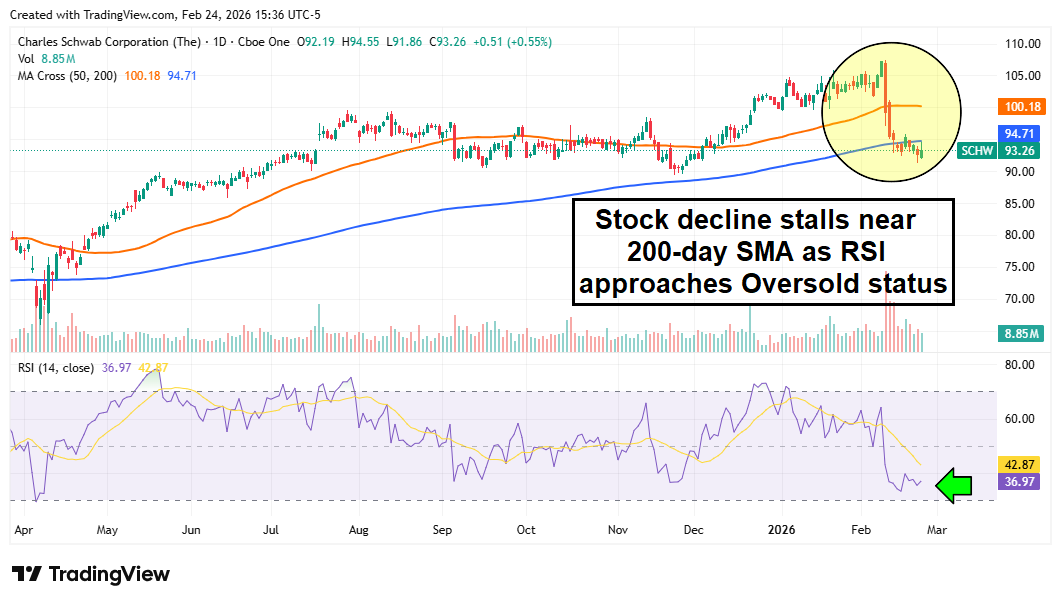
Schwab has a solid balance sheet, expanding margins and technical signs of a momentum reversal. The stock’s decline was arrested near the 200-day simple moving average (SMA), and the Relative Strength Index (RSI) suggests downward pressure is easing. A move back above the 200-day SMA would likely rekindle bullish momentum.
S&P Global: Soft Guidance Could Be a Buying Opportunity
S&P Global Inc. (NYSE: SPGI) can’t entirely blame headlines for its roughly 20% decline over the past month. The company posted solid earnings and revenue in its Q4 2025 report, and its AI initiatives continue to expand. Still, the market reacted negatively to relatively light 2026 guidance, and the stock fell about 9% after the release. Combined with the Hazel headlines, that created additional selling pressure, though S&P Global’s ratings and fund services are unlikely to be derailed by these short-term concerns.
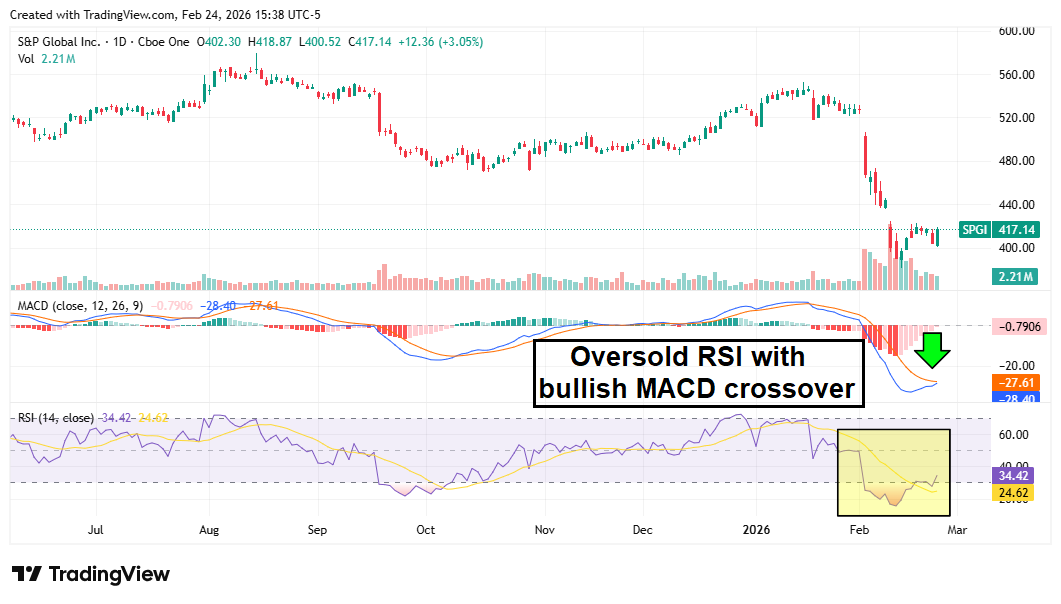
SPGI has been the hardest hit of the three names here—months of gains were erased in a few weeks—but its technical setup points to a potential rebound. The RSI is beginning to recover after falling into oversold territory, and the Moving Average Convergence Divergence (MACD) looks close to a bullish cross. The stock’s more than 3.4% gain on Tuesday—its second-largest daily rise this year—suggests selling pressure may be easing.
Raymond James: AI Could Be a Tailwind for the Independent-Advisor Model
Raymond James Financial (NYSE: RJF) slid nearly 9% after the Hazel news, but that reaction misunderstands the firm’s model. RJF’s independent advisors are more likely to adopt AI tools like Hazel to enhance their offerings rather than lose business to them. Raymond James is building its own proprietary AI platform called Rai, and after the selloff the stock trades at about 13 times forward earnings and 1.9 times sales.
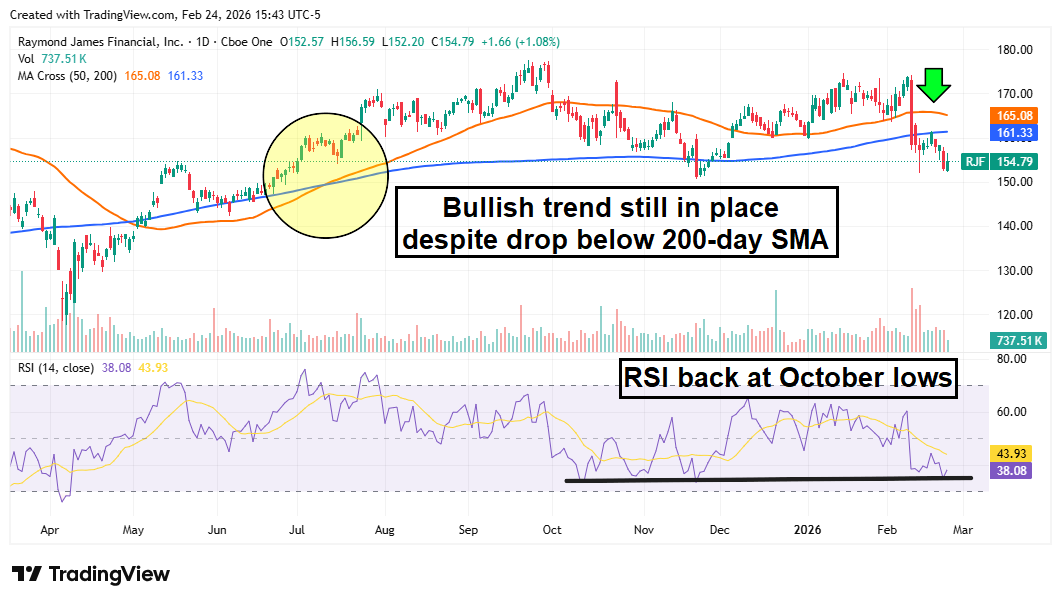
RJF shares did break below the 50-day and 200-day SMAs during their drop, but the selling hasn’t been as severe as with SPGI and SCHW, and the longer-term uptrend remains intact. Last summer’s Golden Cross still leaves the 50- and 200-day SMAs in a bullish alignment, and the RSI has only returned to the lows seen in October and December. Despite the headlines, the stock isn’t in correction territory, and its recent excursion below the 200-day SMA was brief.
Thank you for subscribing to Insider Trades Daily, which covers the most recent insider buying and selling activity from Wall Street CEO’s, CFO’s, COO’s and other insiders.
This email is a sponsored email for i2i Marketing Group, LLC, a third-party advertiser of InsiderTrades.com and MarketBeat.
We are not securities dealers or brokers, investment advisers or financial advisers, and you should not rely on the information herein as investment advice. Any investment should be made only after consulting a professional investment advisor and only after reviewing the financial statements and other pertinent corporate information. Further, readers are advised to read and carefully consider the Risk Factors identified and discussed in the profiled company’s SEC and/or other government filings. Investing in securities, particularly microcap securities, is speculative and carries a high degree of risk.
If you need help with your subscription, please don’t hesitate to contact MarketBeat’s South Dakota based support team at contact@marketbeat.com.
If you no longer wish to receive email from InsiderTrades.com, you can unsubscribe.
Copyright 2006-2026 MarketBeat Media, LLC.
345 N Reid Pl., Sixth Floor, Sioux Falls, South Dakota 57103. United States of America..

 RJ Hamster