In the early 2000s, after Elon co-founded PayPal… just $1,000 invested would’ve turned into $16,500 at its peak.
In 2016, Elon started Neuralink… even latecomers who waited until 2021 watched $1,000 grow to nearly $5,000 at its peak.
In 2023, Elon launched xAI… in just one year, a $1,000 investment would’ve transformed into nearly $10,000 at its peak.
Now, Elon is just days away from taking his newest venture to the next level…
And I’ve figured out a way for practically anyone to get in on it with just $100.
Discover the full details here.
Sincerely,
Tim Bohen
More Reading from MarketBeat
GitLab Sell-Off Overdone: AI and Cash Flow Signal a Rebound
Author: Thomas Hughes. Date Posted: 3/4/2026.
Key Points
- GitLab is well-positioned for the age of AI inference, as it enables superior outcomes at all stages of the software development lifecycle.
- Tepid guidance and a weak analyst response sent shares to long-term lows, where institutions are likely to buy.
- Cash flow is king in 2026, and GitLab has it, as evidenced by its inaugural $400 million share buyback authorization.
- Special Report: [Sponsorship-Ad-6-Format3]
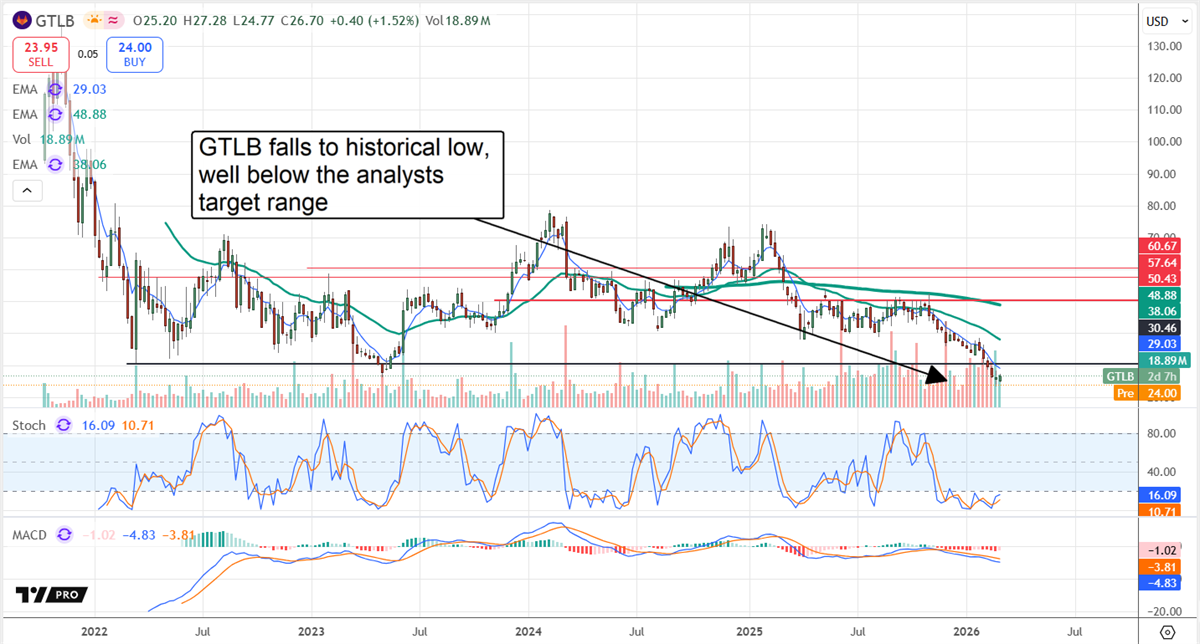
Fears of slowing growth and AI disruption drove GitLab (NASDAQ: GTLB) shares to long-term lows in early March. That sell-off—overdone from the start—has pushed the stock into ultra-deep value territory, creating an attractive buying opportunity.
While AI-related worries have clouded the near-term outlook, the company continues to grow and is well-positioned for the AI inference era. Its platform and newer products embed AI functionality across the software lifecycle, improving efficiency and outcomes while maintaining security, compliance, and governance.
Skip Headlines Straight to Original Research (Ad)
Our investment research analysts are going to be releasing their next investment idea tomorrow morning, around 10:00 AM Eastern time.Add yourself to the distribution list here.
Evidence of this positioning—and of a healthy outlook—appears in its cash flow and balance sheet, which supported an authorized share buyback. The company is cash-flow positive despite aggressive investment, expects improving cash flows, and plans to spend up to $400 million on repurchases.
That buyback represents roughly 10% of the post-release market cap, strengthening an already solid support base. Investors can reasonably expect GitLab to repurchase shares on price pullbacks, such as the early-March dip to record-low levels.
The balance sheet highlights a strong and strengthening capital position and improving shareholder value. At fiscal year-end, current assets rose across categories, with cash and equivalents well above liabilities. The company has no long-term debt, total liabilities are below equity, and equity increased about 27% for the year.
Valuation, Institutions, and Analysts Point to GTLB’s Robust Upside Potential
GitLab’s shares could double from their March lows based on consensus earnings estimates alone. Forecasts imply a high-teens to low-20s% compound annual growth rate (CAGR) through the middle of the next decade, placing the stock near 10x its 2035 consensus. In one scenario, the shares could rise at least 100% to align with broad market averages, or 200%+ to approach the multiples of established blue-chip tech peers.
Further evidence of GitLab’s value comes from institutional and analyst trends. Institutional investors, including public and private funds, own roughly 95% of the stock and have been net buyers.
MarketBeat data show institutions have been buying on balance for 13 consecutive quarters, with buying activity accelerating in 2025 and again in early 2026.
That creates a strong support base likely to remain a tailwind for the shares once a rebound gains traction.
Analysts reacted cautiously to GitLab’s fiscal Q4 2026 earnings report, but that response came against a high bar. MarketBeat tracked six revisions within 12 hours of the release: one downgrade, five price-target cuts, and one affirmation. Overall sentiment was only modestly affected.
Those six actions still imply a stance stronger than a broad Moderate Buy consensus; the price targets, while trimmed at the low end, average just below the broader consensus and imply roughly 65% upside.
GitLab Offers Mixed Guidance After Strong Report
GitLab delivered a solid fiscal year 2026 (FY2026) and Q4. The company reported $260.4 million in net revenue, up about 23.2% year-over-year and 320 basis points above consensus. Strength was driven by larger customers: revenue from large customers rose roughly 18% and from mega-sized customers about 26%, with an 8% increase across the broader customer base.
Net retention rate (NRR) was strong at 118%, and forward-looking remaining performance obligation (RPO) grew meaningfully—up 24% on a current-currency basis and 20% on a reported basis—suggesting durable growth ahead.
Margin dynamics were mixed but generally positive. Gross margin contracted by 200 basis points, but improvements in operating efficiency offset that impact. Adjusted operating marginexpanded by 300 basis points, helping drive a 42.8% increase in operating income. Higher spending did reduce adjusted EPS and free cash flow year over year; however, adjusted EPS of $0.30 beat estimates by $0.07, which undercuts a sell-the-news narrative.
Guidance was mixed: revenue guidance slightly missed consensus, while earnings guidance looked strong. The company expects more than 17% revenue growth this year and wider margins; management’s guidance for adjusted earnings was above consensus (and may be conservative). GitLab outlined five initiatives to drive growth, including expanding its go-to-market presence, accelerating client acquisition, optimizing pricing and packaging, executing its AI strategy, and other operational improvements.
Additional Reading from MarketBeat Media
These 3 Cash Flow Machines Provide Stability in Uncertain Markets
Reported by Nathan Reiff. Article Posted: 3/6/2026.

Key Points
- Cash flow generation is a key attribute of stable companies, allowing them flexibility to not only maintain operations but also to grow and to return value to shareholders via dividends or buybacks.
- Gilead Sciences and AbbVie are two large biopharma firms with a compelling history of cash flow generation, helping to facilitate continued R&D and pipeline development, among other things.
- Visa converts about half or more of its revenue to free cash flow, capitalizing on its high-margin business to facilitate growth and dividend payments.
- Special Report: [Sponsorship-Ad-6-Format3]
When companies face difficult markets, cash flow becomes a critical factor in determining their ability to survive. If a firm cannot meet its near-term obligations with the cash it has on hand, it risks serious trouble. Equally important, strong cash flow enables longer-term planning—everything from expansion and acquisitions to strategic returns of capital to shareholders.
Cash flow is only one metric among many, but it may be particularly important for investors seeking companies that can remain steady amid broad market uncertainty in 2026. The three companies below are household names and major industry players that also have strong cash-flow histories to support their plans for continued growth.
Strong Free Cash Flow Yield and Commitment to Returning Value to Investors
Elon Musk already made me a “wealthy man” (Ad)
I Met Elon Musk “Face-to-Face”
During a private gathering of Wall Street elites, I was one of two people selected to speak with Elon personally.
As a result, my research now leads me to believe Elon will announce the SpaceX IPO on this date:
March 26, 2026. Circle it on your calendar.
I’m sharing an “access code” that lets anyone grab a pre-IPO stake before it happens. This is your invitation to the biggest wealth-building event of the decade.Click Here to See how to Get Your “SpaceX Access Code”
Anchored by top-selling drugs for COVID-19, HIV, certain cancers and more, Gilead Sciences Inc. (NASDAQ: GILD) is one of the largest biopharma firms available to investors. The company generates compelling free cash flow relative to its share price—its free cash flow yield is around 6%.
Even better for investors, Gilead has committed to returning at least half of its free cash flow each year to shareholders. In 2025, including its dividend distributions, Gilead returned 63% of its annual free cash flow to stockholders.
Despite its scale and established position, Gilead has continued to grow. In Q4 2025, it beat analyst expectations for both earnings per share and revenue, propelled by legacy products and a robust pipeline. In 2026 the company expects at least four major commercial rollouts of new products, which should help diversify its revenue mix.
Gilead faces significant competition—especially in oncology, where some investors would like to see a larger contribution to total sales—but a large majority of Wall Street analysts have bullish ratings on GILD shares. Analysts also see roughly 6% upside potential even after the stock’s more than 28% rise over the past year.
Massive Dividend Growth Made Possible By Solid Cash Generation Power
Another major biopharma name, AbbVie (NYSE: ABBV), posts a free cash flow yield above 5%, which is strong for a company of its size and sector. While AbbVie operates across many therapeutic areas, one of its most compelling attractions for investors is its dividend.
AbbVie has a dividend yield that sits around 2.9%and has more than quadrupled its dividend distributions since the company’s spin-off in 2013.
Although the company reports a high dividend payout ratio—about 293%—which could concern some investors, that payout is underpinned by robust free cash flow. In 2025, for example, AbbVie generated nearly $18 billion in free cash flow while distributing roughly $11.7 billion in total dividends.
The company has demonstrated continued momentum, beating Wall Street expectations for both earnings and revenue in Q4 2025 and providing higher guidance at the time. Much of this growth has been driven by two leading drugs, Skyrizi and Rinvoq, and AbbVie continues to invest heavily in R&D to expand its pipeline.
Excellent Cash Generation Capacity Amid Consumer Resilience
Payments giant Visa Inc. (NYSE: V) operates a high-margin business that generates substantial free cash flow, often converting roughly half of its revenue into free cash flow each quarter. With strong top-line performance—a 14.6% year-over-year revenue improvement in the latest period, for example—Visa is a reliable cash machine for many investors.
Despite macroeconomic headwinds such as tariffs and inflation, Visa’s payments volume and processed transactions continue to rise, reflecting resilient consumer spending. That strength has allowed Visa to increase its dividend while maintaining a manageable payout ratio; the company currently offers a yield of 0.83% with a payout ratio near 25.1%. It’s no surprise that analysts view Visa as a solid Buy, forecasting roughly 22% upside potential going forward.
Thank you for subscribing to DividendStocks.com’s daily newsletter for dividend and income investors that covers ex-dividend stocks, new dividend declarations, dividend stock ideas, and the latest market news.
This message is a sponsored email sent on behalf of Timothy Sykes, a third-party advertiser of DividendStocks.com and MarketBeat.
If you have questions or concerns about your newsletter, please feel free to email our South Dakota based support team at contact@marketbeat.com.
If you no longer wish to receive email from DividendStocks.com, you can unsubscribe.
© 2006-2026 MarketBeat Media, LLC. All rights protected.
345 N Reid Place, Suite 620, Sioux Falls, South Dakota 57103-7078. United States of America..
Featured Link: An AI just scored 357 stocks. Here’s what it found. (Click to Opt-In)

 RJ Hamster