
Trump’s family just applied for a bank license (From Crypto 101 Media)
3 ETFs to Avoid as Oil Shock Hits Markets
Written by Dan Schmidt on March 12, 2026

Key Points
- Oil-price volatility is pressuring energy-sensitive areas like consumer discretionary, airlines, and European equities.
- Three widely traded ETFs tied to those exposures are showing weakening technicals as the conflict drags on.
- In the near term, investors may want to reduce exposure to the most fuel- and sentiment-sensitive pockets of the market.
- Special Report: Can you keep this weekend income secret between us? (From DTI Trader)
A new energy shock has struck global markets as the U.S.-Israeli war against Iran enters its second week. Oil prices briefly shot over $115 per barrel in the overnight session on Sunday, March 8, before settling back under $90 by Monday evening. Still, oil prices have jumped more than 30% in the last month, and gas prices are quickly approaching a $4 average in the U.S. Energy disruptions have a global impact, but not every country or sector is affected equally. A few market areas could feel more pressure than others, and the funds covering them are ones investors might want to sidestep while the conflict plays out.
5 Stocks Positioned for AI’s Biggest Energy Shift in Decades (Ad)
AI’s surging energy demand is creating new winners
AI workloads are scaling and data centers are expanding rapidly — driving unprecedented demand for electricity, cooling, and grid infrastructure.
Massive capital is flowing to the companies that enable AI at scale — the power producers, infrastructure owners, and critical technology suppliers behind the scenes.
In this FREE report, we reveal five publicly traded companies positioned to benefit directly from the AI energy buildout.👉 Click here to see the 5 stocks positioned for AI’s biggest energy demand shift in decades
Sectors and Asset Classes Hit Hardest By Oil Shocks
When an energy shock like an oil crisis hits, there’s a typical playbook that investors turn to seeking to offset risk. The oil and gas sector has obvious tailwinds from prices nearing $100/bbl, and consumer staples tend to hold up well when people start noticing higher prices at the pump. But three sectors that are frequently punished harder than the rest include:
- Consumer Discretionary – This sector is among the first to notice the squeeze because an oil shock is a very ‘in your face’ signal. Anyone who commutes or drives regularly feels an immediate impact as gasoline becomes increasingly expensive in a short period. Every extra dollar spent filling a gas tank is one less spent shopping online, ordering takeout, or supplying a home improvement project. Even consumers who don’t drive notice sticker shock as gas prices are visible at every intersection and convenience store, with knock-on effects on economic sentiment. Additionally, companies in the consumer discretionary industry face many input costs influenced by fuel prices, such as shipping and warehousing. If these costs increase rapidly, companies selling discretionary goods will face yet another margin headwind that can’t be fully passed on to customers.
- Airlines – Fuel costs are a significant burden, accounting for up to 35% of operating expenses. Oil shocks put the airline industry in a tight spot because fuel prices can rise overnight, while fares and route schedules are locked months in advance and can’t be adjusted quickly to offset the increase. Airlines also face a trickle-down effect from consumer sentiment; if potential travelers feel a pinch in the wallet, they’ll likely eschew destination trips for cheaper routes (or skip the vacation altogether).
- European Equities – This scenario played out back in 2022 when Russia invaded Ukraine and sent oil prices over $100/bbl in rapid fashion. We discussed Europe’s struggles to absorb oil shocks when the fighting began because it’s so dependent on energy imports and has limited domestic capacity to meet demand. Policy and geology both play a role here, but until Europe reaches a higher level of decarbonization, it will continue to feel an outsized impact from geopolitical decision-making beyond its borders.
Consider Selling These 3 ETFs as Oil Prices Go Crazy
One of the great things about ETFs is that you can find a fund for any nook and cranny of the market, and the three sectors mentioned above have plenty of liquid options. Here are three funds to consider lightening up on while the war continues in Iran.
Consumer Discretionary ETF XLY Faces Mounting Pressure
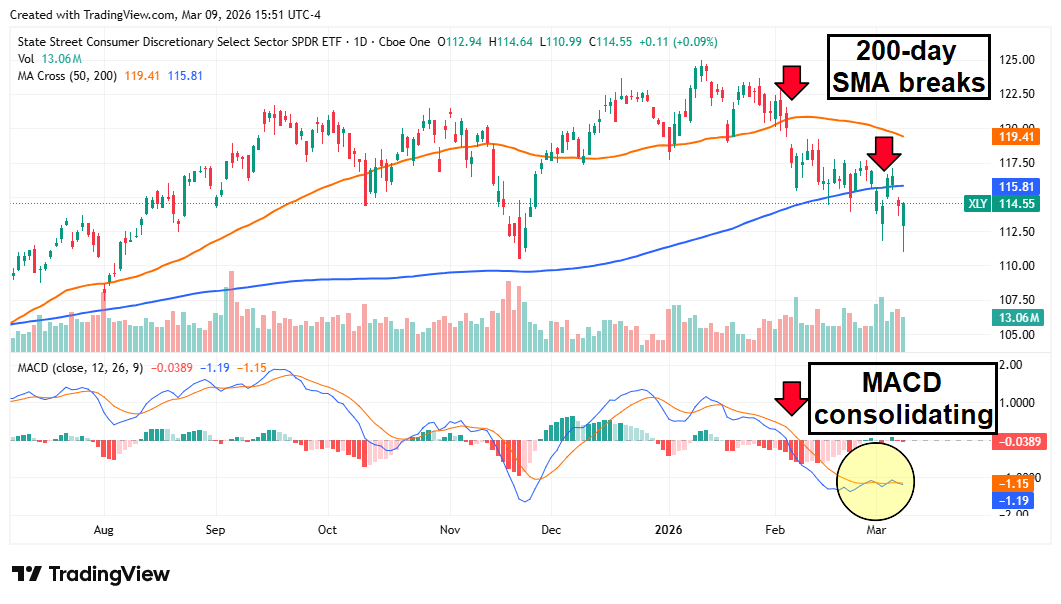
The Consumer Discretionary Select Sector SPDR Fund (NYSEARCA: XLY)is the largest ETF covering the sector by a substantial margin, boasting more than $22 billion in assets under management (AUM) and a tiny 0.03% expense ratio.
But in the current environment, its liquidity makes it an easy fund to sell, and its biggest holdings like Amazon Inc. (NASDAQ: AMZN) and Tesla Inc. (NASDAQ: TSLA) will suffer if consumers begin putting off big-ticket spending due to rising energy costs.
The ETF has collapsed over the last few weeks, taking out the 50-day and 200-day moving averages as it erases four months’ worth of gains. The Moving Average Convergence Divergence (MACD) confirms the bearish momentum, and is now consolidating with prices hovering below the 200-day. If the war proves lengthy, this consolidation could lead to more selling and new lows on XLY.
The Vanguard FTSE Europe ETF Loses Momentum as European Stocks Pull Back
The Vanguard FTSE Europe ETF (NYSEARCA: VGK) is a $30 billion fund that holds some of Europe’s most prominent public companies like Roche Holding (OTCMKTS: RHHBY), Novartis (NYSE: NVS), SAP (NYSE: SAP), and LVMH-Moet Hennessy (OTCMKTS: LVMUY).
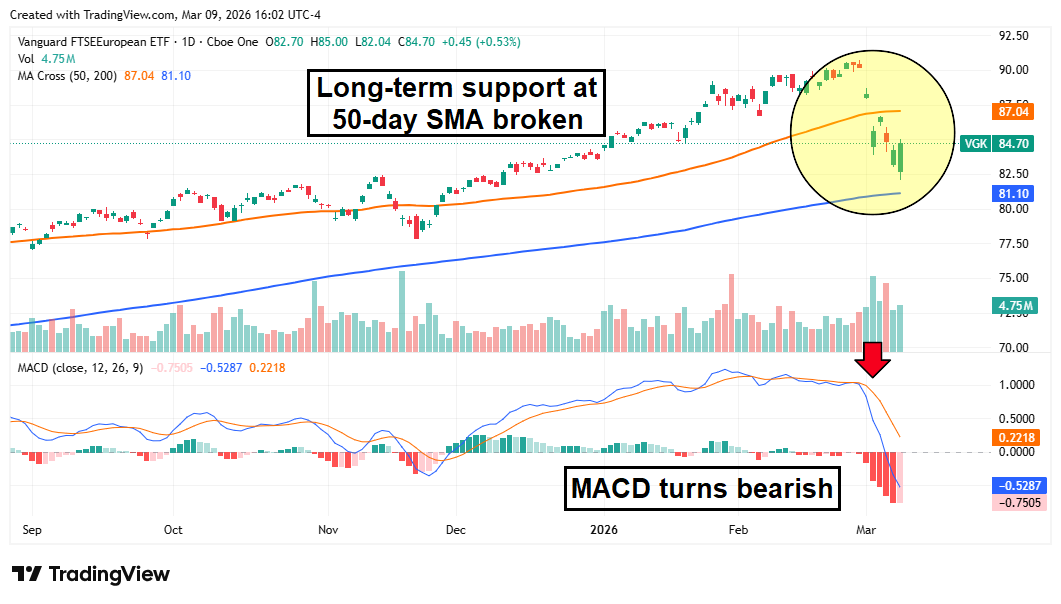
But its holdings are also concentrated in some of the most energy-sensitive countries in Europe, like Germany, France, and the U.K. European stocks have outperformed their U.S. peers over the last two years, but VGK is down more than 5% this month, and its year-to-date (YTD) gain has dwindled to just 1%.
VGK recently took out long-term support at the 50-day moving average, and the next crucial level to watch is the 200-day moving average. The MACD illustrates the speed and ferocity of the drawdown, and sellers are firmly in control of momentum now. If shares can’t hold the 200-day moving average, the downward pressure will only intensify.
The U.S. Global Jets ETF Is Vulnerable in a Risk-Off Market
The U.S. Global Jets ETF (NYSEARCA: JETS) faces several headwinds from the current situation. It’s a smaller, more expensive fund that investors likely don’t consider a core holding and will be quick to dump.
In addition to holding all the major U.S. airline stocks, JETS also holds travel stocks like Expedia Group (NASDAQ: EXPE) and TripAdvisor Inc. (NASDAQ: TRIP) that are affected by disrupted travel routes and consumer spending pullbacks.
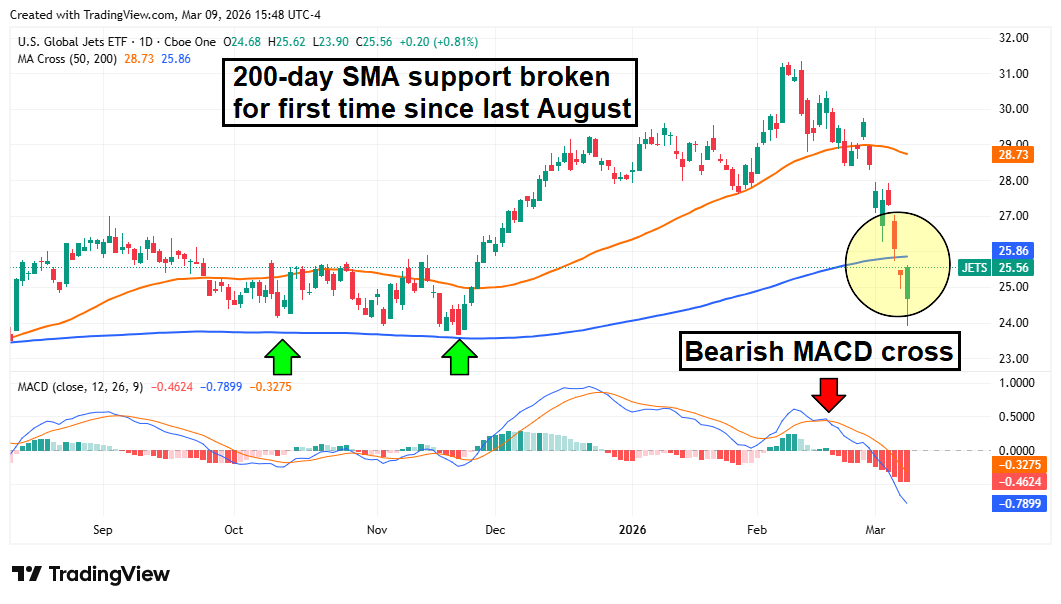
JETS is down more than 15% in the last month, and the bearish momentum isn’t showing any signs of dissipating. The stock took out the 200-day moving average during the decline, the first time since last August the fund had breached this level. The MACD is also showing more bearish signals than it has since the Liberation Day tariff debacle last April, hinting that the bottom isn’t in yet.
Read More
- Chevron Hits New Highs Due to Oil’s Rally, But Is It Sustainable?
- Don’t buy SpaceX on IPO day, do this instead (From Timothy Sykes)
- Tesla’s Big China Sales Spike Didn’t Excite Investors—Here’s Why
- Silver records prices are great. Monthly income is better (From Investors Alley)
- UiPath Fell on Good News—That Could Be the Opportunity
- NVIDIA Invests $2B in Nebius: Time to Add NBIS to Your Portfolio?
- Why 2 Small Biotechs May Hold the Key to New Cancer Treatments

Did you find this article helpful?


Thank you for subscribing to DividendStocks.com’s daily newsletter for dividend and income investors that covers ex-dividend stocks, new dividend declarations, dividend stock ideas, and the latest market news.
If you have questions or concerns about your account, don’t hesitate to contact MarketBeat’s U.S. based support team at contact@marketbeat.com.
If you no longer wish to receive email from DividendStocks.com, you can unsubscribe.
© 2006-2026 MarketBeat Media, LLC. All rights protected.
345 N Reid Place, Suite 620, Sioux Falls, South Dakota 57103. U.S.A..
Read More: 5 Stocks Positioned for AI’s Biggest Energy Shift in Decades (Click to Opt-In)

 RJ Hamster