Below is an important message from one of our highly valued sponsors. Please read it carefully as they have some special information to share with you.
Dear reader,
I recently sat down with the famous economist and best-selling author…
Who predicted the biggest stock market crashes of the last two decades…
And he’s now predicting this AI giant is about to go bust…
Trigging a full-blown AI meltdown that could wipe out 80% of the stock market.
The first time I heard about it…
I thought he was talking about Nvidia.
But it’s another company he says is far more important.
Look, the stakes here couldn’t be any higher…
Because this is the same man who predicted the 2008 meltdown…
Just three weeks before Lehman Brothers imploded and the stock market collapsed.
And the same man who predicted the Covid meltdown…
Again just three weeks before the stock market suffered the fastest drop in history.
And now he’s predicting that this coming AI meltdown will be 10 times bigger than Lehman Brothers…
….and it could send a ripple effect through the market that could crater the entire AI industry.
And he’s warning everyone to take five simple steps to prepare.
Click here to see the details.
Regards,
Aaron Gentzler
VP of Research, Paradigm Press
This Week’s Featured Article
Microsoft Positioned to Win AI Race With Dual-Model Strategy
By Chris Markoch. Article Published: 3/10/2026.
Key Points
- Microsoft chose its AI partnerships over federal compliance, continuing to offer Anthropic’s Claude despite Trump administration pressure to discontinue the product.
- Azure now powers both leading AI models, positioning Microsoft to profit whether enterprises choose Anthropic or OpenAI.
- The stock has fallen 15% in 2026 on AI bubble fears, but technical patterns suggest a potential reversal as institutional buyers accumulate shares.
- Special Report: Elon Musk already made me a “wealthy man”
The circular funding dynamics for artificial intelligence (AI) infrastructure have weighed on technology stocks. However, Microsoft’s (NASDAQ: MSFT) decision to continue integrating Anthropic into its products, despite objections from the Trump administration, highlights why its investments are paying off for users and shareholders.
Here’s the background. On March 5, the U.S. Department of Defense informed AI company Anthropic that it would label the company a supply-chain risk and discontinue the use of its products within six months. President Trump went further and called for all federal agencies to stop using Anthropic.
Silicon Valley Bank was just a warning (Ad)
In 2023, Silicon Valley Bank collapsed in just 48 hours with panicked customers draining $42 billion in a single day, but it could be nothing compared to what’s coming next—through Federal Reserve Docket No. OP-1670, the government is rolling out FedNow, an instant 24/7payment hub that over 1,500 banks have already connected to, and when money moves at the speed of light, a modern bank run won’t take days. By routing every transaction through a single centralized hub, the Fed is building the ultimate kill switch for the American banking system, and when the next financial crisis hits, the Federal Reserve could instantly freeze all transfers, withdrawals, and payments nationwide to protect the system, trapping your life savings inside.Get the 4 steps to Fed-proof your savings now
Microsoft was the first company to announce it would continue to make Anthropic products, including Claude, available to its federal government customers — with the exception of the U.S. Department of Defense.
This isn’t just a symbolic gesture. In November 2025, Microsoft committed to invest up to $5 billion in Anthropic. Anthropic, in turn, committed to purchase $30 billion of Azure compute capacity and to contract additional capacity up to one gigawatt.
It has been a mutually profitable partnership. Microsoft spends roughly $500 million per year to integrate Anthropic AI across its product suite, and it allows Azure sales teams to count sales of Anthropic AI models toward their quotas.
The benefits to shareholders extend beyond the Anthropic relationship. Microsoft also has a bullish story tied to its ongoing partnership with OpenAI.
GPT-5.4 Launch Expands Microsoft’s AI Ecosystem
On the same day Microsoft said it would stand by Anthropic, OpenAI launched ChatGPT-5.4. OpenAI is positioning GPT-5.4 as its “most capable and efficient frontier model for professional work.” It’s available as a standard model, a reasoning model (GPT-5.4 Thinking), and a high-performance variant labeled GPT-5.4 Pro.
Where the story gets more interesting is that Microsoft provides the computational horsepower for both Anthropic’s Claude and OpenAI’s ChatGPT. That has positioned Azure as the critical cloud ecosystem for much of the AI environment.
Giving customers access to both models creates a “best model for the job” scenario. Microsoft can route tasks to whichever model performs best, so it wins regardless of customer preference.
Azure’s Explosive Growth Is Being Fueled by AI Workloads
That model-agnostic position only matters if the underlying infrastructure keeps scaling — and Azure is doing exactly that. In Microsoft’s most recent earnings report, Azure surpassed $75 billion in annual revenue in fiscal 2025, growing 34% for the full year and 39% year-over-year (YOY) in the most recent quarter.
AI-related workloads embedded across the product stack — as Copilot adoption spreads through Office, GitHub, and enterprise suites — are a significant driver of that growth. That’s the flywheel investors should watch. With roughly 25% of the global cloud market and 85% of the Fortune 500 using Azure, Microsoft has become the default cloud infrastructure layer for enterprise AI adoption.
Copilot and Azure Are Creating a Powerful Enterprise Flywheel
The relationship between Microsoft’s AI products and its cloud business cannot be overstated. Every Copilot seat sold drives more Azure consumption, and every Azure contract creates a natural on-ramp for Copilot adoption. The two businesses are accelerating each other, a trend increasingly visible in Microsoft’s financial results.
CEO Satya Nadella has noted that more than 90% of the Fortune 500 now use Microsoft 365 Copilot, and the product is increasingly treated less like a chatbot add-on and more like a core enterprise platform.
That said, Copilot adoption is still in its early stages — which can be more bullish than bearish. Most organizations are running pilots and phased rollouts rather than full enterprise-wide deployments.
MSFT Stock Shows Signs of a Potential Bullish Reversal
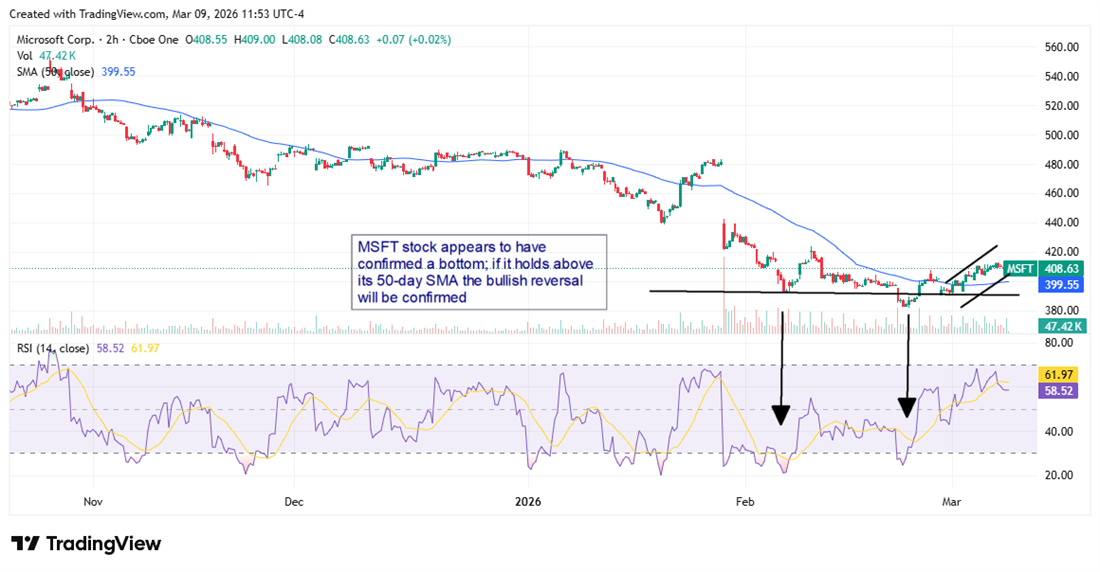
All this good news matters only if Microsoft’s stock outlook improves. MSFT stock is downmore than 15% in 2026, largely following a steep gap down after its earnings report amid renewed AI bubble fears and a broader selloff in software stocks.
There are early signs of a bottom. Upside appears limited for now, but the stock has climbed above the 50-day simple moving average (SMA). If it holds that level and builds on a recent pattern of higher highs and higher lows, investors could see confirmation of a bullish reversal.
Analysts remain bullish on MSFT. The Microsoft analyst forecasts on MarketBeat show a consensus price target of $591.95, implying nearly 45% upside. Several recent price targets are well above the consensus, and those estimates are supported by strong institutional buying in the last quarter.
This Week’s Featured Article
Insiders Step in to Buy These 3 Tanking Stocks
By Leo Miller. Article Published: 3/10/2026.

Key Points
- Insiders are buying KKR after the stock has lost over a third of its value as investors assess the risks of the firm’s investment portfolio from multiple angles.
- After surging 250% on its IPO day, Figma is trading below its opening price and has seen over $30 million in insider buying.
- Reddit is down almost 50% from its highs, and one insider is buying as the company’s financials improve.
- Special Report: Elon Musk already made me a “wealthy man”
Amid precipitous falls in their share prices, several notable stocks are flashing bullish signals via a key indicator: insider buying. That list includes a leading financial services company, a creative design disruptor, and a social media platform whose shares are up more than 300% in two years.
KKR Sees Big Insider Buying as Markets Rock Shares
KKR & Co. (NYSE: KKR) is the world’s fifth-largest alternative asset manager, overseeing more than $700 billion in assets. Yet the stock is down more than 35% from its all-time high as artificial intelligence (AI) disruption fears ripple through the market.
Elon built the impossible in 19 days. This $3B company made it happen. (Ad)
Louis Navellier put the paid version of ChatGPT head-to-head against the FREE version of Elon’s Grok, and it wasn’t even close—Grok produced dozens of picture-perfect results while ChatGPT struggled to conjure even one. In just 19 days, Elon built a system that Oracle executives said was impossible by connecting 200,000 GPUs in a 114-acre facility, creating what Nvidia’s CEO calls superhuman AI, and one tiny company’s technology 49 times smaller than Tesla was central to the entire feat.Watch the live demo and get the ticker now
Investors worry that AI could impair the businesses KKR has invested in or lent to, potentially reducing returns—concerns that are especially acute for software investments given the rise of “vibe-coding” and new AI lab products.
Despite the pullback, KKR insiders have been aggressively buying the stock. In 2026, insiders have purchased roughly $40 million of shares, and MarketBeat has not tracked any insider selling over the same period.
That confidence may reflect KKR’s assertion that its roughly $740 billion in assets under management has only about 7% exposure to software, well below its industry peers and relevant equity and credit indexes. Part of that underexposure stems from the firm’s caution in 2021, when many competitors arguably overallocated to software businesses.
Nonetheless, other risks remain—most notably concerns around the so-called “Bermuda Triangle” private credit strategies used by firms like KKR.
FIG Insider Piles in After Fall from Grace
Next is Figma (NYSE: FIG), the digital design company that has challenged Adobe (NASDAQ: ADBE).
The stock surged about 250% on its first day of trading in mid‑2025 but has since collapsed. It has given back those initial gains and then some, trading around $29 per share—below its $33 IPO price. Fears of AI disruption have weighed heavily on Figma as well.
Still, insider Reed Andrew Phillips has been buying into the weakness, acquiring more than $36 million of Figma stock in February. Phillips paid an average near $25 per share—about 15% below the stock’s current level—suggesting continued confidence.
Investors should note, however, that insider sales at Figma in 2026 total nearly $50 million, exceeding Phillips’ purchases. Nearly all of those sales were executed under pre-established 10b5-1 plans or involved other mitigating circumstances, which tempers the bearish signal they might otherwise send.
As a recently public company, many insiders will naturally seek liquidity by selling shares, and that selling can create an overhang on the stock.
RDDT: Revenue, Margins, Buybacks, and Insider Buying Are Up
Discussion platform Reddit (NYSE: RDDT) has had a wild ride since its early‑2024 IPO.
The stock jumped 48% on its first trading dayfrom the $34 IPO price and climbed to about $270 in the second half of 2025. It has since fallen roughly 50% from that peak and now trades near $140—still more than 300% above its IPO price.
AI concerns have likely contributed to some of Reddit’s biggest down days, which have often coincided with weakness in software names. Even so, Reddit has delivered rapid revenue growth—between 68% and 78% over the past three quarters—driven by advertising momentum. The company also posted its highest-ever adjusted EBITDA margin last quarter at 45%.
Management signaled confidence by announcing a $1 billion buyback authorization, and one insider added to that signal. In February, director Sarah Farrell purchased roughly $7.6 million of Reddit stock at an average price near $148—moderately above today’s level. Reddit also recorded meaningful insider selling in 2026, but, as with Figma, most of those sales were run through 10b5-1 plans.
Evaluating Insider Activity Alongside Broader Fundamental Analysis
Insider purchases at KKR, FIG, and RDDT are constructive signals for stocks that have taken significant tumbles, but they are only one piece of the puzzle. Investors should weigh insider activity alongside fundamentals—revenue and margin trends, valuation, buyback programs, management commentary—and account for broader risks such as AI disruption, private‑credit exposure, and liquidity from post‑IPO insiders.
Thank you for subscribing to Insider Trades Daily, which covers the most recent insider buying and selling activity from Wall Street CEO’s, CFO’s, COO’s and other insiders.
This email is a paid advertisement for Paradigm Press, a third-party advertiser of InsiderTrades.com and MarketBeat.
If you need help with your account, don’t hesitate to email MarketBeat’s U.S. based support team at contact@marketbeat.com.
If you no longer wish to receive email from InsiderTrades.com, you can unsubscribe.
© 2006-2026 MarketBeat Media, LLC. All rights protected.
345 N Reid Pl., Sixth Floor, Sioux Falls, SD 57103-7078. United States of America..
Featured Link: Early The Safest Investment Right Now? (It’s NOT Gold) (From Weiss Ratings)

 RJ Hamster