Unsubscribe 7 High-Yield Dividend Stocks You Need to See (From TradingTips)
Dollar Tree Planted the Seeds for Triple-Digit Gains in Q4
Written by Thomas Hughes

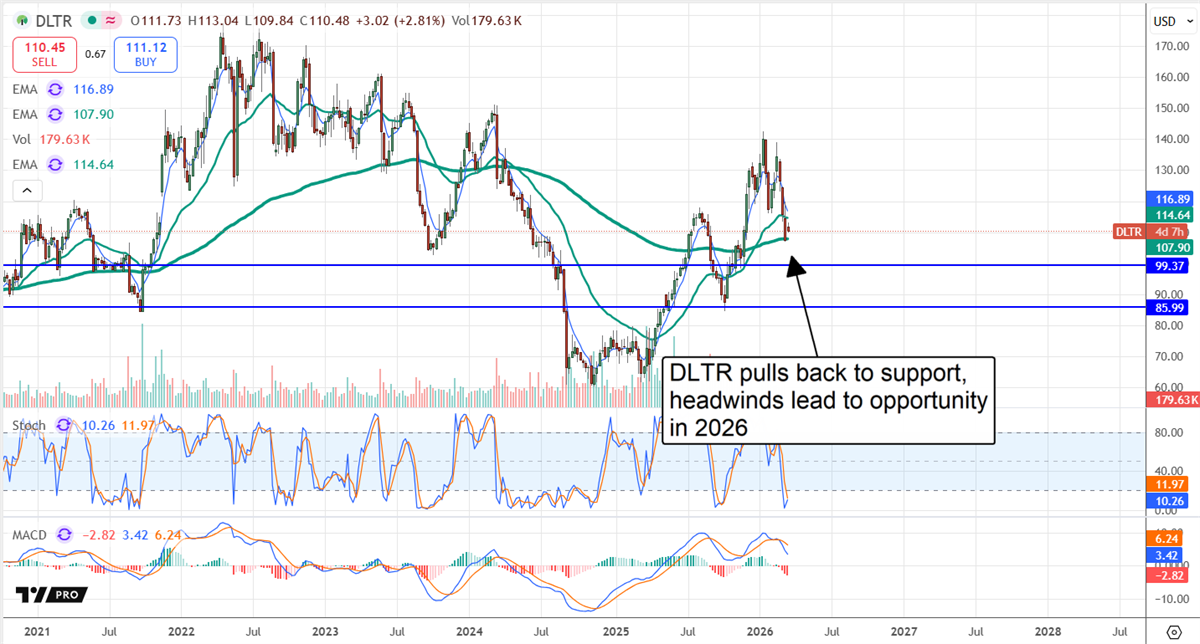
Dollar Tree’s (NASDAQ: DLTR) 2026 price action, though tepid, is almost irrelevant as the value opportunitywith shares near $110 is profound. Headwinds and risks aside, the forecasts suggest this stock trades at only 10X its 2030 consensus and 5X the 2035 forecast, providing potential for 100% to 400% upside relative to the broad market average. The only thing standing in the way is time. As it stands, the company is executing well, generating cash flow, and returning capital in value-building ways.
Dollar Tree does not pay dividends, instead choosing to aggressively repurchase shares. The fiscal 2025 activity resulted in a 7.4% average reduction in Q4 and 4.6% for the year, providing shareholders with significant leverage. The gain was offset by a slight decrease in equity; however, the 5.6% decline was marginal given the impact of buybacks and the divestiture of Family Dollar.
Critical details include a healthy cash position and low leverage. Net debt is less than 1X equity, leaving the company in a solid financial position and able to continue executing its strategy. Other pertinent details include $1.8 billion remaining under the current buyback authorization and $193 million in quarter-to-date buybacks, putting the company on track to sustain its aggressive pace in fiscal 2026.
Dollar Tree Pulls Back on Cautious Guidance
Dollar Tree had a solid fourth quarter, with revenue, excluding the impact of Family Dollar, up by 9% year over year (YOY). Strength was driven by store remodels, new stores, and an impressive 5% comp, reflecting a 6.3% increase in ticket average and 1.2% decline in traffic. Comps were also underpinned by strength in both product categories, led by a 6.2% increase in discretionary items.
Margin news was also good, with incremental improvements logged, driven in part by improved efficiency. The company’s revenue per square foot increased for the 7th consecutive year, with operational leverage improving amid turnaround efforts.
The result was a 10.7% increase in adjusted operating income and 21% increase in adjusted earnings, both accelerated relative to the revenue and more than 100 basis points (bps) better than MarketBeat’s reported consensus.
The only bad news was the company’s guidance, which came in below consensus on the top and bottom line for Q1 and the year. However, guidance is likely to be cautious, setting the stage for outperformance as the year progresses. Analysis will likely revert to a more bullish posture, providing a catalyst for a rebound that may emerge as soon as early Q2, when the Q1 earnings results are released.
Wall Street Waits for Proof as Institutional Flows Cool
Until then, the analyst responsereflects a moderated, albeit bullish, posture. The first commentaries expressed concerns about the tepid outlook while citing the positive impacts of turnaround efforts. The takeaway is that analysts remain in a wait-and-see mode, pegging the stock at Moderate Buy and forecasting a 15% upside.
Institutional activity is less supportive in early 2026. The group owns more than 97% of the shares and bought on a trailing 12-month basis, but the Q1 2026 data reflect distribution, market headwinds, and risk for investors.
Short Sellers Are a Headwind in 2026 for DLTR Shares
Short interest is another near-term risk for investors. Short interest isn’t aggressively high, but it is high enough at just over 6% to present a problem. The short sellers add strength to the institutional activity, suggesting a cap is in place until later in the year. The question is how deep a correction DLTR stock may experience before hitting bottom, which may be near $100.
Dollar Tree catalysts include ongoing restructuring and remodeling efforts. The move to multi-price-point formats resonates with consumers and is a path to unlocking margin and cash flow. There is speculation that a small dividend may be authorized later this year, which will increase interest among institutional and buy-and-hold investors. Risks include macroeconomic conditions, threats to consumer demand, and remodeling costs.
The initial price action following the release was favorable, despite the tepid guide. Shares rose nearly 1% in premarket trading, showing support at a critical exponential moving average (EMA). The 150-week EMA reflects institutional and buy-and-hold activity, suggesting a price floor of $107. In the longer term, it may take at least a quarter or two for this market to be reinvigorated and the rebound to gain traction. READ THIS STORY ONLINE
3 tickers just showed unusual early patterns. See the Trading Ideas report now. (Ad)

Spot the Signals Before They Become Obvious
We track early shifts in volume, structure, and emerging trends as they begin to form.
Trading Ideas focuses on data patterns that often develop before broader visibility. JOIN FREE — START SEEING THE DATA EARLY
Wrapping Up Profits: Karat Packaging’s Earnings Reward
Written by Jeffrey Neal Johnson
Shares of Karat Packaging Inc. (NASDAQ: KRT) have risen by more than 20% during a market move that left many investors scrambling for answers. Karat operates in a decidedly unglamorous corner of the market, manufacturing and distributing the essential disposable containers, cups, and paper bags that fuel the nation’s restaurant and foodservice industries. In a market often captivated by high-flying tech sector stocks, many investors seek to understand how a company in such a traditional sector could deliver such a healthy, single-day return.
The answer lies in Karat’s fourth-quarter earnings report that revealed far more than just strong numbers. It painted a picture of a resilient, disciplined, and strategically savvy company that is not only navigating a challenging economic environment but is actively thriving within it. The story behind Karat’s remarkable performance offers a compelling look at how operational excellence can translate directly into significant shareholder value.
The Top-Line Beat That Ignited the Rally
The initial catalyst that sent Karat’s stock price higher was its impressive top-line growth. Karat announced record fourth-quarter net sales of $115.6 million, marking a 13.7% increase compared to the same period last year. This figure comfortably sailed past Wall Street’s consensus estimate of $113.95 million, signaling to the market that Karat’s growth trajectory was accelerating faster than anticipated.
Crucially, this growth was not just driven by higher prices. It was also fundamentally driven by a significant $8.2 million increase in sales volume, a clear indicator that Karat is gaining market share and that demand for its products remains strong. Further bolstering the positive results was a notable return to pricing power.
For the first time since early 2023, Karat reported a favorable impact from its pricing and product mix, adding another $6.3 million to its revenue. This demonstrates Karat’s stronger position in the marketplace, enabling it to command better value for its products. This strength was most evident in its core customer base, where sales to chain accounts and distributors, its largest channel, jumped by an impressive 17.5%, confirming its deep and growing entrenchment in the resilient foodservice sector.
A Margin Master: Profitability Under Pressure
While strong sales grabbed the headlines, the most impressive part of Karat’s performance was its ability to protect and grow its bottom line. Karat faced a significant headwind from higher import duties and tariffs, which caused import-related costs to balloon from 8.3% of net sales to 14.5% year over year. This kind of pressure can easily erode profits, yet Karat demonstrated remarkable operational discipline.
Instead of buckling, management executed a masterful cost-control strategy. Total operating expenses actually decreased from $32.5 million to $30.9 million compared to the prior-year quarter. This was achieved through specific, targeted measures, including a $1.6 million reduction in online platform fees and a $500,000 cut in marketing expenses, all while sales were growing.
The result of this financial rigor was powerful. Despite the intense margin pressure from tariffs, Karat grew its net income by 22.8% to $7.2 million. Its earnings per share of 34 cents decisively beat the analyst consensus estimate of 28 cents. This proves Karat’s ability to convert top-line growth into tangible profit, even in a difficult cost environment. This operational discipline generates substantial cash flow, $15.4 million from operations in the fourth quarter, which confidently funds an attractive 6.69% dividend yield.
Positioned for Growth: Karat’s Playbook
Karat’s impressive quarter appears to be more than a one-time event; it is the result of a forward-looking strategy designed for durable growth. Management has issued a confident outlook for 2026, forecasting low double-digit net sales growth for the full year and anticipating continued improvement in gross margin and adjusted EBITDA margin.
Smarter Sourcing
A key element of Karat’s strategy is its intelligent and proactive approach to its supply chain. Karat has actively diversified its sourcing to de-risk its operations from geopolitical tensions and tariffs. Today, 46% of its imports come from Taiwan, with only 14% sourced from China. This foresight gives Karat a significant stability advantage.
Furthermore, Karat is successfully expanding into high-growth product categories. Its new paper bag division is gaining strong momentum and securing contracts with large national chains. This, combined with a broader push into sustainable products, has resulted in eco-friendly items now accounting for 37.3% of total revenue, up from 34.5% a year ago, perfectly positioning Karat to meet growing consumer and regulatory demand.
A Foundation for Future Value
Karat Packaging’s stock price hike was a well-earned reward for a quarter that demonstrated excellence on all fronts. Karat showcased a powerful combination of capturing strong market demand, exercising masterful cost control in the face of significant headwinds, and executing a clear and intelligent strategy for the future.
In a market constantly searching for the next big thing, Karat’s performance is a compelling reminder of the immense value that can be created by a fundamentally sound, essential business run with exceptional discipline. Its proven resilience and clear catalysts for growth establish it as a standout company to watch in the industrial sector for 2026 and beyond. READ THIS STORY ONLINE
7 High-Yield Dividend Stocks You Need to See (Ad)

7 High Yield Dividend Stocks to Buy Now 💰
Love steady payouts? This free report reveals 7 high-yield dividend stocks you need to know about. From Company #3, a tobacco giant innovating with smokeless products, to Company #4, famously known as “The Monthly Dividend Company,” these picks deliver steady income you can count on. PERFECT FOR INCOME-FOCUSED INVESTORS.
AI Wingman: Kratos & Airbus’s Game-Changing Pact
Written by Jeffrey Neal Johnson
In a specialized facility in Manching, Germany, a pivotal shift in global defense strategy is taking shape. Two American-made Kratos (NASDAQ: KTOS) XQ-58A Valkyrie drones are being prepared for a landmark 2026 flight test equipped with a sovereign European artificial intelligence (AI)-driven mission system developed by Airbus (OTCMKTS: EADSY). This transatlantic collaboration is a technical exercise, but it is also a clear indicator that the long-promised future of autonomous, collaborative warfare is arriving faster than anticipated.
Kratos: From Disruptor to Global Power Player
The Airbus partnership is a major international endorsement for Kratos, significantly de-risking its investment case by opening a direct channel into the lucrative European defense market.
For investors, this validation is backed by a continuous stream of financial results and program wins that demonstrate a company has reached a major inflection point. The evidence suggests that Kratos’s strategy of building relevant, affordable systems now, rather than just designing concepts for later, is paying off.
Kratos’s recent performance provides a clear picture of this momentum. The fourth quarter of 2025 saw organic revenue growth of approximately 20% year-over-year, an impressive figure for any company. More telling, however, is that Kratos also reported a 1.3-to-1 book-to-bill ratio for the quarter.
For investors, this is a critical metric; a ratio above 1-to-1 means a company is securing more in new orders than it is billing in revenue, indicating its backlog and future workload are actively growing. It is the clearest sign of accelerating demand.
Looking ahead, Kratos’s financial foundation appears robust, providing investors with significant visibility into future performance:
- A Secure Future: Kratos ended 2025 with a record backlog of $1.573 billion in secured future work, providing a stable revenue base.
- A Vast Horizon of Opportunity:Beyond confirmed orders, Kratos has identified a record $13.7 billion pipeline of opportunities, representing a vast pool of potential future contracts that could fuel growth for years to come.
This financial strength is directly tied to the success of its flagship platform, the Valkyrie. Before its selection for European tests, the drone was already validated in the United States, having been chosen for the U.S. Marine Corps’ MUX TACAIR Collaborative Combat Aircraft (CCA) program, where Kratos is partnered with prime contractor Northrop Grumman. This dual-continent demand for the same core platform is a powerful testament to its capabilities. In response, Kratos has announced concrete plans to scale up production from approximately 8 Valkyries per year to 40 by the end of 2028.
Furthermore, Kratos is not solely dependent on a single program. Kratos is a key player in the rapidly expanding field of hypersonics, a top Pentagon priority, with involvement in major programs such as the Multi-Service Advanced Capability Hypersonic Test Bed (MACH-TB). With revenues from its hypersonic franchise projected to potentially double to around $400 million in 2026, Kratos has demonstrated it has multiple, powerful growth drivers. This diversification provides an additional layer of stability to its high-growth narrative and helps justify a valuation focused on the immense future potential of its contract pipeline.
Airbus: Winning the Future of Air Combat
For European aerospace titan Airbus, the partnership with Kratos is a shrewd and necessary strategic move. It showcases managerial agility, addresses challenges within its legacy programs, and positions Airbus to lead Europe’s next-generation defense ecosystem.
This collaboration is being accelerated by well-publicized disagreements and delays that have hampered the Future Combat Air System (FCAS), Europe’s ambitious next-generation fighter jet program.
Rather than waiting for these complex, multinational issues to resolve, Airbus is proactively securing a loyal wingman capability for its key customers now.
By partnering with Kratos, Airbus bypasses years of costly research and development. It gains immediate access to a proven, production-ready airframe, allowing it to offer a tangible solution to the German Air Force with a target in-service date of 2029, a timeline that would be impossible if starting from scratch.
This move is also aligned with a broader, continent-wide push among European nations to fast-track the development of low-cost, autonomous systems to bolster their collective security.
This deal also fundamentally shifts Airbus’s role from a simple hardware manufacturer to a high-value systems integrator. Airbus is responsible for equipping the Valkyrie with its proprietary MARS mission system, powered by MindShare AI software. In modern defense, the true value lies not just in the airframe, but in the intelligent network that commands it. By controlling this layer, Airbus positions itself to be the central nervous system for Europe’s future combat cloud, connecting various manned and unmanned platforms. This is a more defensible and potentially more profitable position in the long run.
For investors in a large-cap industrial like Airbus, this venture represents a valuable entry into the high-growth defense tech sector. It diversifies Airbus’s portfolio beyond the cyclical commercial aviation market and hedges against risks and extended timelines associated with traditional manned fighter programs. This move adds a new, dynamic growth story and demonstrates a forward-thinking strategy to secure its relevance in the next generation of air warfare.
A Clear Approach Vector
The Kratos-Airbus partnership is one of the most tangible data points yet that the global shift to autonomous, attritable air power is happening now. This is no longer a future trend discussed in strategy documents; it is a present reality with significant budget allocations and hardware being prepared in Germany.
This collaboration solidifies Kratos’s position as a premier growth vehicle in defense technology, validating its systems and opening the door to a massive new market. Simultaneously, it showcases Airbus’s strategic foresight to secure its role as a key architect of Europe’s future defense capabilities. For investors, this alliance signals that both companies are positioned on the right side of a multi-decade paradigm shift in global security, offering a compelling case for long-term value creation as the very definition of air power is rewritten. READ THIS STORY ONLINE
Why I’m avoiding Nvidia (and buying these 3 AI stocks instead) (Ad)

Everyone’s buying Nvidia. The financial media can’t stop talking about it. Your neighbor probably owns it.
That’s exactly why I’m looking elsewhere.
See, when everyone piles into the same trade, the easy money is already gone. The real profits come from finding what the crowd is missing.CLICK HERE TO GET YOUR FREE COPY OF THIS REPORT
More Stories
- Data Storage to Data Intelligence: Everpure’s Big AI Era Rebrand
- 3 Rare Earth Stocks Quietly Building the Next Supply Chain
- Every morning, an AI ranks 357 stocks for you (Ad)
- The S&P 500’s 3 Best-Performing Stocks so far in 2026
- Apple Launches a Price War Its Rivals Can’t Afford to Fight
- 3 Companies at the Forefront of the GLP-1 Pill Wars
- Why PayPal’s Rally Faded—And What Could Restart It
The Night Owl is a financial newsletter that provides in-depth market analysis on stocks of interest to individual investors. Published by MarketBeat and Early Bird Publishing, The Night Owl is delivered around 9:00 PM Eastern Sunday through Thursday. If you give a hoot about the market, The Night Owl is the newsletter for you.
If you need assistance with your newsletter, please feel free to contact MarketBeat’s South Dakota based support team at contact@marketbeat.com.
Unsubscribe
© 2006-2026 MarketBeat Media, LLC. All rights reserved.
345 N Reid Pl., Suite 620, Sioux Falls, S.D. 57103. USA..
Read More: 3 tickers just showed unusual early patterns. See the Trading Ideas report now. (Click to Opt-In)

 RJ Hamster