Unsubscribe Quiet Moves in Key Sectors Suggest New Momentum Is Building (From Fierce Investor)
The Silver Lining to Nebius Debt Cloud
Written by Thomas Hughes
Nebius Group’s (NASDAQ: NBIS)debt load is swelling and clouding the outlook for share prices. However, as significant as debt increases are, there is a silver lining to this cloud: AI.
AI demand is swelling, underpinning a need for expansion that requires capital, which is why debt is swelling. In the end, as evidenced by recent results and developments, all Nebius needs to do is continue executing its strategy and expanding its network to realize billions in annual revenue and generate sufficient cash flow to repay its debt and unlock value for shareholders.
The new debt is due in two tranches, the first not payable until 2031, well after the company is expected to turn profitable.
Also, the overall debt load still looks manageable. The balance sheet shows that it rose at fiscal 2025 year-end but remains manageable at $4.1 billion and below 1X equity. The company plans to raise additional capital through a convertible debt offering this year, but even that would leave it in a solid position, given its growth and outlook. The company has four operational data centers and will more than double its capacity within the next 12 to 24 months, excluding expansion plans for Asia and any new developments.
New Deals Drive Robust Outlook for Nebius Revenue Growth
Nebius’ revenue growth outlook was robust before Meta Platforms (NASDAQ: META) announced plans to invest up to $27 billion over five years in advanced AI capacity. The deal is set to start in 2027 and will include five or more datacenter regions utilizing the latest NVIDIA (NASDAQ: NVDA)GPUs, the Vera Rubin lineup. Nebius needs to supply $12 billion in capacity, well within its purview, but needs to complete its buildout, including the acquisition of GPUs. At face value, the deal is worth up to $5.4 billion annually, or an approximate 50% compound annual growth rate (CAGR) in revenue over the planned period.
And Nebius is not alone in its mission to build the world’s most advanced data centers. It has partnered with NVIDIA to deploy factory-supported systems across its footprint in a multi-generational format. The takeaway for investors is that Nebius has a preferred status with the source of AI GPUs, and inroads to existing and upcoming supply, including Vera Rubin and subsequent generations. Additionally, a deal with CrowdStrike (NASDAQ: CRWD) to bring its Falcon platform to the AI cloud sets the company apart. Falcon enables enterprise-quality security for AI workloads in cross-cloud and multi-cloud environments.
Analysts Lift Targets in Wake of Nebius Deal Activity
Analyst trends are robust and underpin a healthy outlook for Nebius stock price. MarketBeat tracked several price target increases, upgrades, and coverage initiations in March, extending bullish trends and pointing to a 35% upsidefrom critical resistance targets. Takeaways include an increase in coverage, up 25% sequentially from February and 100% on a trailing 12-month (TTM) basis, and a 35% upside at the consensus.
The 35% upside target is also likely to be low, as it is up by more than 200% TTM, with recent targets pointing to the $200 level. A move to $200 is worth approximately 67% to investors and may be only the beginning of this rally. Long-term forecasts suggest this stock trades at 10X to 15X 2035 earnings targets, setting the stage for a 100% to 200% increase in stock price as the company grows into its potential.
Institutions and Short-Interest Point to Squeeze in NBIS Stock
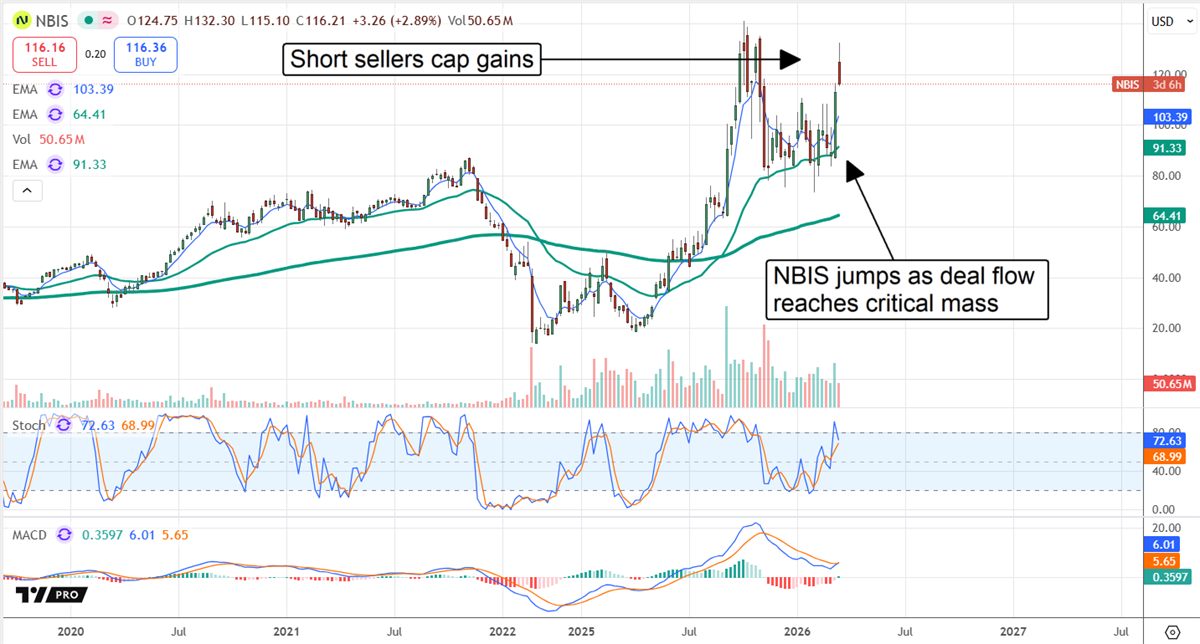
Short interest and institutional trends suggest near-term volatility and a potential short squeeze. Institutions, which collectively own about 22%, are buying aggressively at a pace of more than $2 for each $1 sold and ramping activity sequentially as the news story strengthens. At the same time, short interest is climbing, hitting a record high in late February, and is sufficient to impact price action and fuel a squeeze at 17%. The only question is the timing of the action, and it looks like a squeeze (or at least a short-covering rally) may begin soon.
Technically, this market is on track to advance. It shows resistance at the $125 level, but this is unlikely to last long, given the improving outlook. Assuming a move to new highs, the next resistance target is near $140, with clear chart space after that. The risk is that the NBIS market will wait until later in the year before hitting a new high. In this scenario, there is a risk that the price will retreat to $100 or lower before there is enough traction to set a fresh high. The next visible catalyst is the upcoming Q1 earnings report in late May. READ THIS STORY ONLINE
Markets Just Reset — See the First Small Caps Reacting (Ad)

Get the Signals People Wish They Saw Sooner
Market Maven Insights tracks under-the-radar small-cap names and sector momentum in real time—so you’re not always reacting late.JOIN FREE — START GETTING BETTER INSIGHTS
Why Credo and Astera Soared After Oracle and Broadcom’s Earnings
Written by Leo Miller

Credo Technology (NASDAQ: CRDO)and Astera Labs (NASDAQ: ALAB) are some of the fastest-growing beneficiaries of the artificial intelligence (AI) data center buildout.
As key suppliers in the data center ecosystem, the results and commentary coming from players upstream of Astera and Credo are vital to evaluating their future. Hyperscaler Oracle (NYSE: ORCL) and custom AI semiconductor stock Broadcom (NASDAQ: AVGO)are prime examples.
These two names recently reported earnings. Their better-than-expected results and some interesting commentary helped CRDO and ALAB soar. Let’s break down why, as knowing where CRDO and ALAB fit in the data center ecosystem is key to understanding their paths going forward.
How Credo and Astera Power AI Data Center Connectivity
Credo and Astera sit squarely in the AI infrastructure networking bucket. Their products help connect processing chips, like NVIDIA (NASDAQ: NVDA)graphics processing units (GPUs). These connections allow processing chips to communicate with each other and execute tasks.
Credo’s primary product is its HiWire active electrical cable (AEC). These copper-based solutions can be much longer than traditional passive copper cables while preserving signal integrity. They also use less power and are cheaper than optical cables.
Astera’s smart retimers offer similar benefits, but through chips rather than cables. Astera offers AECs too, but smart retimers are by far its largest revenue source.
The big picture is that more data centers mean more networking equipment, expanding the market that Credo and Astera can target.
This is why these stocks rose 3.2% and 7.1%, respectively, after Oracle’s latest earnings report.
Oracle’s Data Center Capacity Ramp Signals Faster Infrastructure Demand
Oracle significantly beat growth estimates in its latest report. Strong performance in Oracle Cloud Infrastructure drove this, showing that infrastructure demand is outpacing expectations.
Oracle delivered 400 megawatts of data center capacity in the quarter and indicated that the pace of this expansion will accelerate.
It plans to bring 10 gigawatts (10,000 megawatts) of capacity online over the next three years.
That would imply 3.3 gigawatts per year or double the 1.6 gigawatt annual run rate (400 megawatts per quarter) the firm just delivered. Faster data center buildouts are a big positive for Credo and Astera, which are part of the connective tissue of these facilities.
This isn’t to say whether Oracle is a Credo or Astera customer, but rather to show that the accelerating pace of data center deployment is a rising tide that will lift both ships.
AVGO Supports CRDO and ALAB’s Runway with Copper Forecast
While more data centers are a positive for Credo and Astera, the conversation is a bit more complicated than just that. Credo and Astera’s primary revenue-generating products are copper-based. The alternative to copper networking is optical solutions, which transmit data using light rather than electricity. Optical solutions can handle more data, but they also use more power and are more expensive. For these reasons, data center operators want to keep using copper-based solutions for as long as possible.
This is part of the reason why Credo and Astera also got big boosts after Broadcom’s earnings release. The two stocks rose 11.9% and 5.5%, respectively.
The gains in Credo and Astera came as Broadcom CEO Hock Tan provided some perspective on the copper versus optical battle. Tan says that in “scale-out” architectures, where data center operators place servers next to each other and connect them, they use optical networking. However, the story is different when it comes to “scale-up” architectures, where companies pack more processing chips into each server. Scale up is the domain that Credo and Astera primarily play in, though they have scale out solutions as well.
In 2028, Tan believes Broadcom’s scale-up customers will likely still be using copper. He noted that copper technology is good enough that customers don’t need to run toward highly advanced optical solutions, like co-packaged optics (CPO), at this time.
CPO describes when processing chips have optical networking components built directly into them. CPO adoption is a long-term threat to CRDO and ALAB. So, the idea that CPO adoption may be slower than some expected, according to Tan, is a positive for CRDO and ALAB. This is particularly true, as Broadcom is a leader in CPO. Because of this, Tan doesn’t necessarily have a vested interest in CPO delay; he’s simply being realistic about the timeline. This adds legitimacy to his statement.
More copper usage improves CRDO and ALAB’s ability to grow in the near term. In the meantime, they can work on expanding their optical solution set to be ready when a larger shift away from copper takes place.
CRDO & ALAB: Niche Players Benefiting From the Data Center Boom
Overall, these pieces of information from Oracle and Broadcom lend support to the outlooks of CRDO and ALAB. Going forward, investors should be aware of how the changing dynamics of copper and optical networking affect these companies.
While these are positive developments, there are also key risks to consider with these two stocks. One example is customer concentration. In 2025, five customers accounted for 84% of ALAB’s revenue. CRDO is significantly more concentrated, with two customers accounting for 87% of revenue last quarter. Should spending at just one or two customers trail off, CRDO and ALAB could be significantly affected. READ THIS STORY ONLINE
Quiet Moves in Key Sectors Suggest New Momentum Is Building (Ad)

Small Caps Are Moving First as Sectors Shift
Fierce Investor tracks the early tremors inside emerging sectors where momentum often starts. Get alerts built around real-time shifts—not hype cycles.JOIN FREE — START TRACKING NEW SECTOR MOVES
NVIDIA Rally? The Market Hasn’t Seen Anything Yet
Written by Thomas Hughes
If you think that NVIDIA’s (NASDAQ: NVDA) rally-to-date has been impressive, just wait for what comes next. News revealed at the GTC developer conference shows the AI boom is still growing, much larger and faster than expected, indicating potential for another series of triple-digit gains. It may take a minute to comprehend, but this is a series—not just one—of triple-digit gains that could be possible for this semiconductor stock.
CEO Jenson Huang said there is a trillion-dollar revenue opportunity to be realized through 2027, far larger than expected. So large, in fact, that it more than doubles the existing two-year revenue outlook, suggesting NVIDIA’s stock price has yet to be unleashed.
NVIDIA’s Stock Is Deeply Undervalued—50% Upside Is the Minimum Target
From a valuation perspective, there is a significant opportunity. NVIDIA trades at a 22X forward earnings multiple as of mid-March 2026, which provides no premium relative to the S&P 500.
NVIDIA with no premium is ludicrous, as it is the source of all things AI. Not only is its revenue growing at a wicked hot pace, but the forecasts are also too low, and many comparisons suggest large price increases to come.
Not only do blue-chip tech stocks, including NVIDIA, often trade at 30-35X forward earnings, suggesting approximately 50% upside, but the growth forecast also provides a deeper opportunity.
NVIDIA trades at only 14X its 2030 forecast and 9X its 2035 forecast, setting the stage for a 150% upside over the long-term.
Assuming the long-term forecast is too low, upside potential could be greater. If the long-term forecast is as off as the fiscal year 2027 (FY2027) and FY2028 seem to be, upside potential may run to the 300% range or higher.
Analysts Are Impressed: Institutions Accumulate NVIDIA
The analyst response to the news cannot be ignored. In the words of Wedbush Dan Ives, the trillion-dollar backlog is a stunner, and driving an outlook reset. MarketBeat tracked no analyst revisions within the first 12 hours of the release, but no sentiment trend change is expected, only strengthening of the current trend.
Other takeaways from the commentaries are that the news is a confidence booster, allaying fears about competition, and that the shift toward full-service AIis progressing smoothly.
As it stands, 53 analysts rate the stock as a consensus Buy with a 96% Buy-side bias. No analyst rates the stock as a Sell, two peg it at Hold, and the consensus price target, up more than 60% on a trailing 12-month basis, forecasts a 50% upside from March support levels. The high end, coincidentally, forecasts more than 100% upside for this market and is likely to increase as the year progresses.
Institutions have been taking advantage of NVIDIA’s price consolidation.
MarketBeat data shows them providing a solid support base with more than 60% ownership and accumulating on balance for five sequential quarters. Buying activity ramped up sequentially in 2025 and into early 2026, with a $3-to-$1 buyers-to-sellers pace. This data reflects not only a strong support but a tailwind, as they are aggressively accumulating amid broader market uncertainty.
NVIDIA Market Sets Up for Big Move: Technical Targets Converge
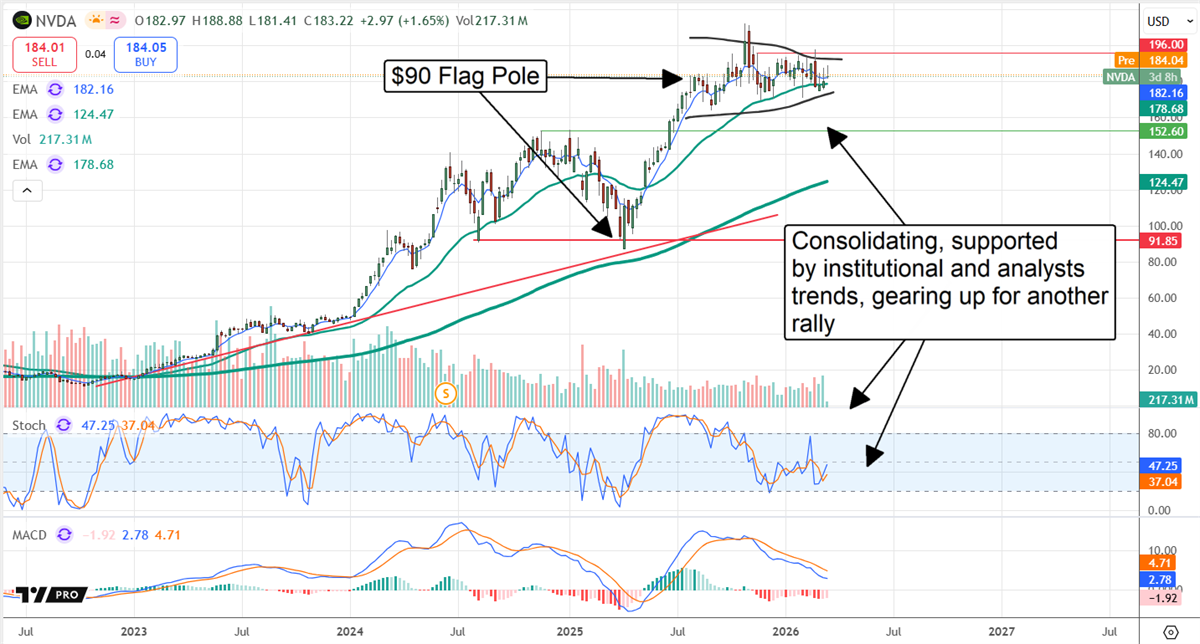
The question now is what might catalyze the next upward movement? The Q1 2027 results aren’t due until late May, leaving two months for the market to sit and stew. In this environment, anticipation and fear of missing out may drive the stock price higher, with $196 as the critical resistance level. In this scenario, NVIDIA’s price may be capped at $196 until it isn’t, and then it may quickly rise. $200 and $210 are also significant resistance targets, likely to induce volatility but unlikely to halt a price advance once it is underway.
Chart action is another factor converging on a 50% to 100% stock price movement in the near to mid-term. The past few quarters’ consolidation created a Bullish Flag on a $90 flag pole, which, coincidentally, is planted at the $90 level, suggesting a $90 to 100% upside from the $180 Flag tip. In this scenario, NVIDIA’s stock price may rise by $90, or 50%, from the $180 level as a base-case estimate, and as much as 100% at the high-end, which, coincidentally, is $360 and on track to the Street-high analyst target of $400. READ THIS STORY ONLINE
These Small Caps Just Hit Critical Inflection Levels (Ad)

See Where Market Pressure Is Building First
Market Crux tracks inflection zones and early tension points across small caps.
These signals often appear before the first fast move.GET FREE ALERTS — FOLLOW THE PRESSURE POINTS
More Stories
- Dollar Tree Planted the Seeds for Triple-Digit Gains in Q4
- Wrapping Up Profits: Karat Packaging’s Earnings Reward
- 3 tickers just showed unusual early patterns. See the Trading Ideas report now. (Ad)
- Conflict Profits: Why These 2 Chemical Stocks Are Suddenly Soaring
- Winner Winner, Chicken Dinner: El Pollo Loco’s Turnaround Recipe
- AI Wingman: Kratos & Airbus’s Game-Changing Pact
- Joby Aviation’s Golden Gate Flight Signals a New Era for eVTOL
The Night Owl is a financial newsletter that provides in-depth market analysis on stocks of interest to individual investors. Published by MarketBeat and Early Bird Publishing, The Night Owl is delivered around 9:00 PM Eastern Sunday through Thursday. If you give a hoot about the market, The Night Owl is the newsletter for you.

If you have questions about your account, please don’t hesitate to contact our U.S. based support team at contact@marketbeat.com.
Unsubscribe
© 2006-2026 MarketBeat Media, LLC.
345 N Reid Pl., Sixth Floor, Sioux Falls, SD 57103. USA..
Further Reading: 2026 Could Be the Biggest Year for Private Markets Yet (Click to Opt-In)

 RJ Hamster