
Managing Editor’s Note: On March 26, at 2 p.m. ET, our colleague – Market Wizard Larry Benedict – is sharing the trading strategy that’s been handing his subscribers weekly opportunities to pull profits out of the market…
All using a single ticker…
It’s part of his upcoming AI Chaos to Cashevent. We’ve seen a lot of flux in certain AI stocks this year, and Larry’s got decades of experience trading choppy markets and profiting through volatility.
You’ll get the strategy, the ticker, and a calendar of potential trade opportunities to come in 2026 when you join him next Thursday. You can go here to automatically sign up.
Fusion Is Going Public

Founder and CEO

I’ve been in Washington, D.C. all week for meetings and two important conferences in two industries.
It’s been an exciting week.
The Digital Chamber, of which I’ve been a member since late 2017, holds its annual D.C. Blockchain Summit in March every year.
I’ve been to almost all of them over the last decade.
There is no place that you’ll hear from more of the D.C. insiders working on digital assets policy and legislation than at this event. This year was no different.
My senior blockchain analyst, Ben Lilly, and I will be sending out our relevant notes and insights from the Blockchain Summit to our subscribers of Permissionless Investor and Neural Net Profits in the days ahead.
Needless to say, a lot is going on right now… as the industry partners with policymakers to push the market structure bill over the line and pass it through Congress.
There is an incredible sense of urgency across the industry, the White House, and representatives of Congress to get it done.
The other conference I’ve been attending is the Fusion Industry Association’s Annual Policy Conference, which also happens every year in March…
For industries whose fates are so closely tied to the regulatory environment, it is critical to be in D.C. to understand what’s actually happening.
Regulations, new legislation, and government policy directly impact an investment thesis, so ignoring that in our analysis would be a terrible mistake.
Recollections from Events Past
The Fusion Industry Association (FIA) is the nuclear fusion industry’s equivalent of The Digital Chamber for digital assets.
I’ve been attending nuclear fusion events and gatherings since 2019, when I sensed that momentum was building in the sector and the technological development was accelerating.
Back then, I could see a clear path towards not only first light – which is the first time a fusion reaction would produce a net energy output – but also an even more important path towards commercialization.
I predicted way back in 2019 that we would see the first net energy production fusion reaction before 2025.
It was a crazy prediction at the time, as the experts were predicting that it was 15–20 years out, or even more.
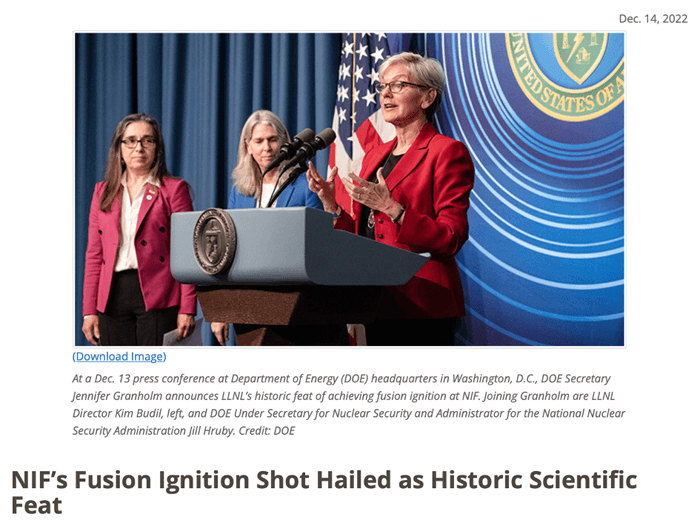
It actually happened in December of 2022, at the National Ignition Facility at the Lawrence Livermore National Laboratory.
I remember clearly watching the live press event held by the Department of Energy, where it shared the details of the historic moment.
It was truly a turning point for the industry.
Source: National Ignition Facility
Admittedly, it was a research project, but it was legitimate.
The approach using a very large facility and a number of high-powered lasers to create the fusion plasma – for a split second – is not a path towards commercialization.
But it did turn scientific theory into a proven reality.
The industry has been accelerating since then.
Fusion Fanfare
Back in 2019, nuclear fusion gatherings were a small affair.
I remember attending an event in New York City with the then-Secretary of the Department of Energy.
There were only about 40 people or so in a relatively small conference room.
Every key player in nuclear fusion was present at the time.
It was fantastic, but the sense at that time by the industry insiders was not very optimistic.
Most felt that the industry was still a long way away from commercialization, 15-20 years away.
I felt differently.
The first couple of FIA events, which started five years ago, were also very small gatherings.
This year was a breakout year.
There were more than 500 people in attendance – too many to count – by far the largest gathering to date, and a clear sign of what’s coming.
This year is special.
Since the last annual event, executive orders have been issued with unwavering support for nuclear energy in the United States.
This has empowered the Department of Energy to launch programs in support of both nuclear fission and nuclear fusion.
Another major victory has been carving out nuclear fusion as its own category of clean energy production.
This is an important distinction from a regulatory perspective that is critical for the industry to move forward. And it’s appropriate, as fusion is very different from fission.
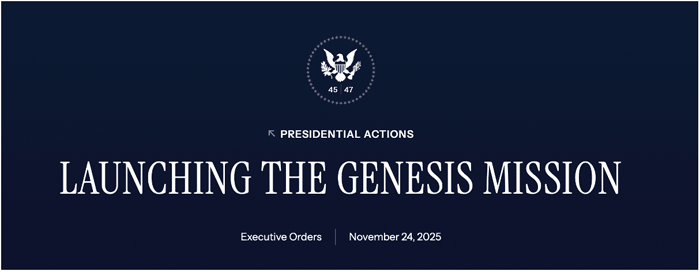
More recently, on November 24, 2025, the President issued an executive order for the GENESIS Mission, which is a national initiative to accelerate AI-driven advancements in nuclear energy, national security, and quantum computing.
One of the big topics of the conference was the application of AI to nuclear fusion systems. I was writing about this so many years ago, but almost no one in the industry was talking about it. AI will be critical not only to manage the fusion plasma, but also for a nuclear fusion reactor’s operational systems. I was excited to hear this being acknowledged at the conference this week.
Also related to the GENESIS Mission, this week, and at the FIA event, the Undersecretary for Science at the Department of Energy, Dario Gil, who also serves as the GENESIS Mission Director, announced $293 million in funding to support the GENESIS Mission objectives.
Part of that funding will, of course, go towards nuclear fusion advancements.
One panelist at the conference made a firm remark that there needs to “be a zero added on” to the level of government investment in fusion.
This suggests that billions need to be spent to accelerate development.
There was also a lot of talk about the threat of China, how much government investment is happening in nuclear fusion, and how the Chinese are working 24/7 building out nuclear fusion plants.
There was a shared sense of urgency that the U.S. must beat China in the race to secure the kind of limitless clean energy that nuclear fusion will provide.
This competitive and geopolitical threat from a clear adversary is important to acknowledge, and it is very real.
But the framework of “China is investing more than the U.S.” is not accurate, because it always leaves out the investment that is happening in the private sector.
This is what sets the U.S. apart from China.

Recommended Links
How to Turn AI-Fueled Market Chaos Into Cash in Your Pocket?
While most traders are drowning in chaos… trying to find the next hot stock in a sea of over 4,000… A small group of everyday folks has the chance to collect $500… $1,250… even $2,500 (or more)… in ONE day… using just ONE ticker. One trade in the morning. Paid automatically by 4 p.m. ET when it works. You can even be WRONG about market direction and still collect. Their edge? A low-stress system for turning AI-fueled market chaos into cash… created by “Market Wizard” Larry Benedict – the legendary trader who generated $274 million in profits and went 20 years without a losing year. The next opportunity opens NEXT WEEK. Click here to see how to use Larry’s NEW “AI Chaos-to-Cash” system on Thursday, March 26, at 2 p.m. ET.
(When you click the link, your email address will automatically be added to Larry’s guest list.)
REVEALED: The EXACT Day to Move Your Money
Wall Street legend Marc Chaikin accurately predicted the crashes in 2020 and 2022. Now, on March 25 at 8 p.m. ET, he’s stepping forward with an urgent update and timeline on the next bear market. He’ll show you exactly what’s coming… and tell you the EXACT DAY to move your money to prepare for a period of extreme pain, uncertainty, and loss. Learn more here.
The Real Numbers
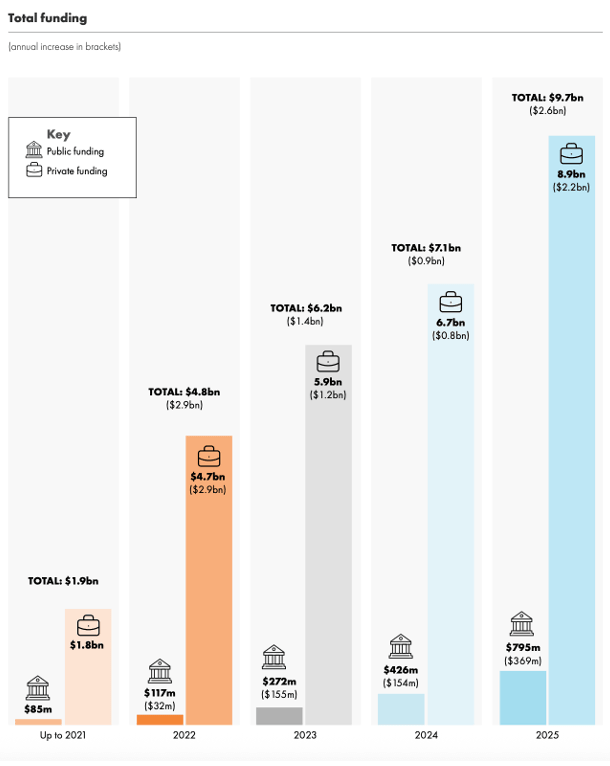
Shown below are the real numbers of what is driving nuclear fusion investment.
It’s the private sector.
Total Funding for Nuclear Fusion Through 2025
2025 Global Fusion Industry Report | Source: Fusion Industry Association
Since 2023, it is estimated that China has invested about $6.5 billion towards the commercialization of nuclear fusion technology, a number that is multiples higher than what the U.S. Department of Energy has spent in the same timeframe.
While this is true, it ignores what is happening in the private sector.
From the chart above, $2.2 billion alone was invested by the private sector in 2025, $8.9 billion to date.
The private sector investment in fusion stands well above what the Chinese government is investing, and it’s clearly accelerating year after year as we get closer and closer to commercialization.
This might raise the question for some as to whether U.S. government funding is even necessary.
It is, but for the reasons that you might not expect.
It’s not for the purpose of centralized, government-led research.
Innovation happens much faster and at a far more accelerated pace when led by private industry.
The DOE Stamp of Approval
Funding is required for the development and implementation of industry regulations.
While industry helps inform and draft those regulations, they have to be finalized and presented to policymakers by the Department of Energy (DOE).
In that way, the DOE acts as a gateway to policymakers and legislators.
Without its support, industry-only-led regulations will be nearly impossible to pass.
The second critical value in which government funding is useful is in providing early grants and large-scale loans to promising private companies in the nuclear fusion industry.
Nuclear fusion, and fourth-generation nuclear fusion for that matter, are both matters of national competitiveness and national security.
It takes a lot of capital investment to get to commercialization, especially for frontier technologies like nuclear fusion.
The vice president of research and development at fusion company Zap Energymade a salient point at the conference about this.
I’m paraphrasing here, but he said that receiving a grant from the DOE is proof for investors that you’ve been through a difficult vetting process.
It’s an indication that what you’re doing is legitimate, has a path forward, and is worthy of further investment.
Zap would understand the value of this stamp of approval from the DOE, as well as any player in the industry.
It received small grants from the DOE in 2019, 2020, and 2023.
Those grants contributed to Zap’s ability to go on to raise more than $320 million through July 2024.
Zap Energy is now valued at $1.1 billion and well on its way to developing a commercial prototype of its unique sheared flow stabilized Z-pinch fusion reactor.
But one of the most exciting topics of the conference is the proximity of not one, but two private nuclear fusion companies that will be going public this year.
At least two that I know of, as I’m confident others are already having discussions to do the same.
The First Publicly Traded Nuclear Fusion Company
Announced in December, TAE Technologies will be merging with Trump Media & Technology Group (DJT) – in a bizarre combination.
Trump Media & Technology is the parent company of Truth Social, which has minuscule revenues as a company.
It went public via a reverse merger in September 2021, and given its very limited revenues ($3.68 million in the last 12 months), it almost feels like a SPAC.
It has about $1 billion in cash on its balance sheet, very limited operations, and it is a public company.
TAE is a very exciting, private company with a great approach to nuclear fusion.
But other than capital and ease of going public via a merger with an existing public company, there is no obvious value in the merger with Trump Media and Technology.
But in reality, that’s largely what TAE needs – capital and speed to the public markets.
The current timeline is to complete the merger by mid-2026. If it goes through, I would expect the name of the company to change to TAE as well as the ticker symbol.
Before that happens, it is highly likely that General Fusion, another private fusion company, is in the process of a reverse merger with a SPAC, Spring Valley Acquisition Corp III (SVAC), and will become the first publicly traded nuclear fusion company.
The deal was announced this January, and a representative from the company confirmed at the conference that General Fusion would become the first to go public.
Accessing the public markets is a sign that nuclear fusion is going mainstream and nearing commercialization.
It also helps raise awareness with institutional investors about this critically important emerging market.
Breakthrough technologies like nuclear fusion are extremely hard and take billions of dollars of investment.
Accessing the public markets and new sources of capital are necessary to make a future of limitless, cheap, clean energy a reality for all of us.
The future is bright, a world of energy abundance – lit with the energy of the sun – as we climb the Kardashev scale.
Jeff
Recent Articles
Leveraging AI for Personalized Cancer Therapies
Mar 18, 2026 • 5 min read

NVIDIA’s Extraterrestrial Announcement
Mar 17, 2026 • 8 min read
Musk Pulls the Trigger on the TeraFab
Mar 16, 2026 • 6 min read

1125 N Charles St, Baltimore, MD 21201
www.brownstoneresearch.com
To ensure our emails continue reaching your inbox, please add our email address to your address book.
This editorial email containing advertisements was sent to peter.hovis@gmail.com because you subscribed to this service. To stop receiving these emails, click here.
Brownstone Research welcomes your feedback and questions. But please note: The law prohibits us from giving personalized advice.
To contact Customer Service, call toll free Domestic/International: 1-888-512-0726, Mon-Fri, 9am-7pm ET, or email us here.
© 2026 Brownstone Research. All rights reserved. Any reproduction, copying, or redistribution of our content, in whole or in part, is prohibited without written permission from Brownstone Research.

 RJ Hamster