Charles Payne here with an urgent opportunity:
The market just handed options traders a gift—and most people won’t even notice it.
Volatility is spiking.
And when that happens, option premiums surge.
Options traders love it.
And so do I!
Because while everyone else is watching their portfolios swing wildly and losing sleep over whether to sell, options traders are cashing in on the chaos.
Higher volatility = fatter premiums = BIGGER paychecks.
You can collect more income in one volatile week than you’d normally make in a month of calm markets.
The opportunities right now are exceptional. But they won’t last forever.
Volatility always settles down—and when it does, these premium levels disappear.
That’s why, in a few days, my team is hosting a free, live Power of Options Masterclass where we’re showing you exactly how to capitalize on these high-premium environments and what to do when the market gets cold.
You’ll learn how to collect significantly larger income checks. How to do it safely.
And how to take advantage before this window closes.
This is a live session. No charge.
The full details are on the next page…
So register here while the doors are open.

Charles Payne
Exclusive Content
S&P 500 Fires Buy Signal With 100% Accuracy Rate: What Comes Next
Authored by Thomas Hughes. Posted: 3/25/2026.

Key Points
- The S&P 500 entered oversold territory in March, triggering a buy signal with 100% accuracy.
- The index faces headwinds, but fundamentals and earnings outlook offset it.
- Oil and inflation are risks that may keep the market trending sideways in the near-term.
- Special Report: Elon Musk: This Could Turn $100 into $100,000
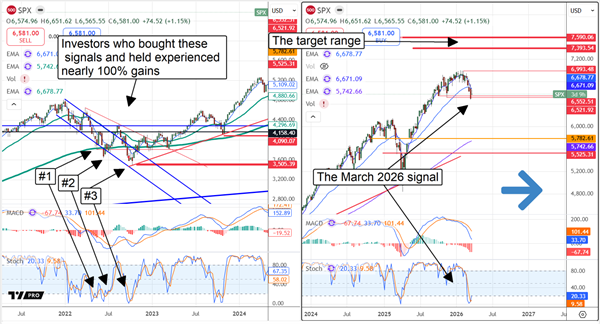
The S&P 500 moved into oversold territory on its weekly candlestick charts late in March, triggering a buying signal with a 100% accuracy rate over the trailing 15-year period. “Oversold,” as measured by the stochastic indicator, describes a market pushed below a reasonable valuation — a situation in which most sellers who needed, wanted or had an excuse to sell probably already have. That leaves a bias toward buyers, which in turn increases the likelihood of an upward move, a dynamic that the signal has already confirmed.
Technical, Analyst and Valuation Trends Converge: Upside Potential Offsets Risks
Chart watchers will note there were three similar signals in 2023. The first produced only a tepid rebound, but it was followed by two stronger signals that led to more meaningful recoveries and a full market reversal. That 2023 reversal was driven largely by AI gains and has so far produced roughly a 50% rise in the index.
Fox News calls this resource -scramble “the new arms race” (Ad)
Why is the White House suddenly building a new “Fort Knox?” Hidden inside this fortress lies a critical new resource Moody’s calls “the new oil.” Demand is doubling every 6 months, and Fox News is calling it the “new arms race.” On April 20, a major event could ignite a handful of under-the-radar stocks, setting off what could be biggest commodity boom in history.Click here for all the details.
The takeaway for investors is that current signals look similar: near-term headwinds may slow price action, but fundamentals and long-term forecasts provide support. The most likely path is consolidation within the current range followed by a renewed push higher to new highs later this year.
Analyst sentiment aligns with that outlook. Barclays is the latest firm to raise its S&P 500 target, pointing to stronger-than-expected earnings and forward forecasts that offset macro headwinds. It lifted its index target to 7,650 — a 250-point increase that places the index near the high end of its expected year-end range.
The value is there, if not uniformly across every sector. The S&P 500 trades near 20X earnings as of late March, roughly in line with long-term averages, but market leaders show deeper discounts. NVIDIA (NASDAQ: NVDA) — the single most influential stock in the market, representing about 7% of the S&P 500’s market cap — trades at roughly 20X current-year earnings, which assigns little or no premium to the world’s leading AI company.
NVIDIA and other large-cap tech names often trade in the 30X–35X range when fully valued, implying potential upside of 50%–75% from valuation expansion alone. If long-term forward earnings projections are applied — forecasts that in some scenarios place the stock at roughly 5X projected 2035 earnings — the theoretical upside over a longer horizon can be substantially larger.
S&P Set Up to Hit 7,500 This Year
The immediate support and resistance levels given for the S&P 500 Index are 6,521.92 (support) and 6,993.48 (resistance). For the S&P 500 Index tracking ETF (NYSEARCA: SPY), the equivalent price levels are about $64.72 and $69.78.
Support is expected to be significant but could be breached; if that occurs, the next support area is near 6,400 (about $64 on SPY). Resistance could also remain firm until headwinds ease, effectively capping near-term upside to roughly 471 index points (about $4.75 on SPY). Over a longer horizon, that 471-point range implies a move toward the 7,464 level for the index ($74.65 on SPY) as a baseline target, with upside toward 7,500 at the higher end of the range.
The catalyst for such a move is likely to be multifaceted, but it will be centered on the earnings outlook. Current forecasts call for sequential acceleration in earnings growth starting in Q1 2026 and extending into Q2 and Q3, with high-teens growth projected through year-end.
These trends suggest leaders such as NVIDIA will continue to outperform, helping drive a stronger finish for the market. Other, more average companies could contribute an additional few percentage points of upside — roughly 3% to 5% — as the earnings cycle progresses. Earnings season begins in mid-April with JPMorgan Chase & Company (NYSE: JPM), but the most market-moving results may come later when NVIDIA and other AI leaders report.
Among the clear risks is oil. The conflict in Iran has pushed oil toward long-term highs, feeding cost pressures and broader inflationary forces. At these levels, oil can negatively affect corporate earnings and lead to weaker guidance, which would pressure performance. High oil prices and persistent inflation also make it less likely the Fed will cut rates, presenting another hurdle for markets to overcome.
Just For You
Energy Stocks Surge on Oil Spike: Buy, Hold, or Take Profits?
Written by Chris Markoch. Article Published: 3/25/2026.
Key Points
- Energy stocks are rising amid geopolitical tensions, with volatility in oil prices creating both risks and opportunities for investors.
- Chevron, Valero, and Enbridge highlight different ways to gain exposure across upstream, midstream, and downstream segments.
- Dividend yields and pricing power make energy stocks attractive, even as investors weigh whether to take profits or remain invested.
- Special Report: Elon Musk: This Could Turn $100 into $100,000
Since hostilities against Iran escalated on Feb. 28, energy stocks have been one of the few clear winners for bullish investors. That changed briefly after a social media post by President Trump pushed the price of oil lower—and with it, many oil stocks—reminding investors that markets on a knife’s edge can move sharply on small triggers.
It’s worth noting that Chevron Corp. (NYSE: CVX)CEO Mike Wirth says markets are underpricing the potential supply shock from Iran closing the Strait of Hormuz. Wirth argues the market is trading on “scant information” and “perception.” While investors are facing a firehose of information, the accuracy of that information remains in question.
Fox News calls this resource -scramble “the new arms race” (Ad)
Why is the White House suddenly building a new “Fort Knox?” Hidden inside this fortress lies a critical new resource Moody’s calls “the new oil.” Demand is doubling every 6 months, and Fox News is calling it the “new arms race.” On April 20, a major event could ignite a handful of under-the-radar stocks, setting off what could be biggest commodity boom in history.Click here for all the details.
Investors shouldn’t simply dismiss this as an oil executive “talking his book.” Wirth runs a major integrated oil company with decades of operations in Venezuela; he has firsthand experience with what a disrupted market looks like and how long it can take to return to normal.
Even if oil avoids a worst-case outcome—like the $200-per-barrel forecast floated by Citigroup (NYSE: C)—consumers may face higher pump prices for some time. For investors who’ve stayed on the sidelines during this rally, there are still opportunities across different parts of the energy complex.
Big Oil Strength: Chevron Leads the Charge in a Tight Supply Market
On the Big Oil side, Chevron is a leading name to consider. CVX stock is up nearly 33% in 2026 and has broken out of a range it had been in since 2022.
The rally accelerated after U.S. military operations related to Venezuela; Chevron is one of the few companies permitted to operate there, which has given it a unique exposure to potential supply shifts.
It’s reasonable to ask whether CVX could pull back if hostilities in the Strait of Hormuz ease. Today Chevron trades roughly 11% above its consensus price target, but analysts have been raising those targets—most notably Piper Sandler, which boosted its target to $242 from $179.
Over the past three years, CVX has delivered a total return of about 50%. That may not thrill pure growth investors, but it underscores Chevron’s standing as a Dividend Aristocrat. For investors seeking both growth and reliable income, CVX remains attractive: even after the recent run-up, the stock yields about 3.5%, roughly $7.12 per share annually at current prices.
Refining Advantage: Valero Thrives on Volatility and Margin Expansion
If Chevron represents the upstream exposure, Valero Energy (NYSE: VLO) offers a different play: a pure refining business that can prosper when crude is volatile. That distinction makes Valero an attractive option in the current environment.
Most energy stocks move with the price of crude, but refiners like Valero make money on the spread between crude input costs and refined product prices—the crack spread. Supply disruptions that hurt producers can widen these margins and boost refiners’ profits.
Valero is the world’s largest independent petroleum refiner, operating 15 refineries across the U.S., Canada and the U.K. That scale provides a competitive moat and operational flexibility to adapt to shifting crude supply routes—an advantage if Strait of Hormuz disruptions force changes in sourcing.
VLO has climbed more than 45% in 2026 and sits about 20% above its consensus price target, though analysts have been raising forecasts. The stock looks somewhat extended, but Valero also offers steady income, with a dividend yield near 2%, about $4.80 per share annually at current prices, combining cyclical upside with income.
Midstream Stability: Enbridge Offers Income and Volume-Driven Growth
Another way to play the energy rally is through midstream companies—the pipeline operators that act like toll booths for oil and natural gas. These businesses earn fees to move product regardless of commodity prices; their returns depend primarily on volumes, not prices.
Currently, volumes are high, with throughput near record levels in early 2026, which benefits pipeline operators.
That makes Enbridge Inc. (NYSE: ENB) worth considering. The Canada-based company manages more than 18,000 miles of pipeline and handles roughly 30% of North American crude production. It also transports about 20% of the natural gas consumed in the United States.
Over the last three years ENB has returned around 80% in total, illustrating the steady performance typical of midstream firms. The consensus price target of $65 implies nearly 20% upside from current levels, and that potential is complemented by a reliable dividend that yields about 5.1%, roughly $2.78 per share annually based on current prices.
Thank you for subscribing to The Early Bird, MarketBeat’s 7:00 AMnewsletter that covers stories that will impact the stock market each day.
This email content is a sponsored email from Paradigm Direct, a third-party advertiser of The Early Bird and MarketBeat.
If you need help with your subscription, feel free to contact MarketBeat’s South Dakota based support team at contact@marketbeat.com.
If you no longer wish to receive email from The Early Bird, you can unsubscribe.
© 2006-2026 MarketBeat Media, LLC. All rights protected.
345 North Reid Place, Sixth Floor, Sioux Falls, SD 57103-7078. United States of America..
Check This Out: A personal warning from Martin Weiss (Please read)(From Weiss Ratings)

 RJ Hamster