Hi there,
A few hours ago, you requested to receive a free copy of MarketBeat’s latest report, “Analysts Agree—These Gold Picks Outshine the Rest.”
I noticed that you hadn’t opened the email we sent with your free report, so I just wanted to follow up and make sure you received it.
If you missed the initial message, you can access your free report directly by clicking the link below:
Download your report here (PDF).
If you have any trouble accessing the report, please don’t hesitate to reach out to our support team by replying to this message.
Thanks,
Jessica Mitacek
Managing Editor
MarketBeat
Further Reading from MarketBeat Media
The Arms Race Has Gone Airborne: What Investors Need to Know
Written by Bridget Bennett. Date Posted: 4/6/2026.
Key Points
- Draganfly and Palladyne AI recently completed a SwarmOS integration milestone that enables decentralized autonomous drone swarming for U.S. defense applications.
- Edge AI is transforming drone warfare by allowing drones to operate independently without internet connectivity, making GPS denial and signal jamming far less effective as countermeasures.
- The drone defense sector is entering a policy-driven super cycle, with 2027 expected to be the breakout year for meaningful revenue scale across the industry.
- Special Report: Elon Musk: This Could Turn $100 into $100,000
The next stage of drone warfare isn’t coming — it’s already here. And the investment implications are bigger than most investors realize.
Cameron Chell, CEO and Executive Chairman of Draganfly (NASDAQ:DPRO), has spent more than 25 years building drone systems for military, public safety, and commercial applications. His view on where the industry stands right now is blunt: if your offensive or defensive systems aren’t deploying autonomous, AI-enabled drones today, they’re already outdated.
Iran War Shakes Up Wall Street, Here’s How to Profit… (Ad)
Since 2009, the Dividend Machine has posted a total return of 7,056.47% – turning a $10,000 stake into more than $700,000 while the broader market struggled through multiple downturns.
With a 93% win rate since launch, this dividend-focused strategy has kept investors cashing steady checks through every crash. Bill Spetrino has released a free report outlining how to position for income no matter what the market does next.Claim your free report and see how the Dividend Machine works
That’s the thesis behind a defense-sectorsupercycle — and it’s driven not by consumer demand or hype but by geopolitics.
Edge AI Turns Drones Into Independent Decision-Makers
The concept accelerating this shift is edge AI — putting computing power directly on the drone so it can process data, make decisions, and execute missions without relying on an internet connection or cloud infrastructure. Chell says even Draganfly’s least expensive drones have compute capacity comparable to NVIDIA‘s chips.
That matters because connectivity has always been the weak link. Early countermeasures against small drones focused on jamming GPS or severing the radio-frequency link between the drone and its operator.
Edge AI removes that vulnerability. A drone with onboard intelligence can navigate by visual recognition, assess changing conditions like terrain or weather, and even abort a mission autonomously if circumstances change.
The implications extend beyond the battlefield, but it’s defense applications that are drawing the most capital right now.
Swarm Technology Changes the Math on Defense
The economics of modern drone warfare have flipped the traditional cost equation. Instead of firing a single missile system that costs millions at a target, an attacker can deploy dozens or hundreds of inexpensive drones to overwhelm defenses at a fraction of the price. No existing surface-to-air system can currently handle 50 or 500 drones arriving simultaneously, regardless of how expensive that system is.
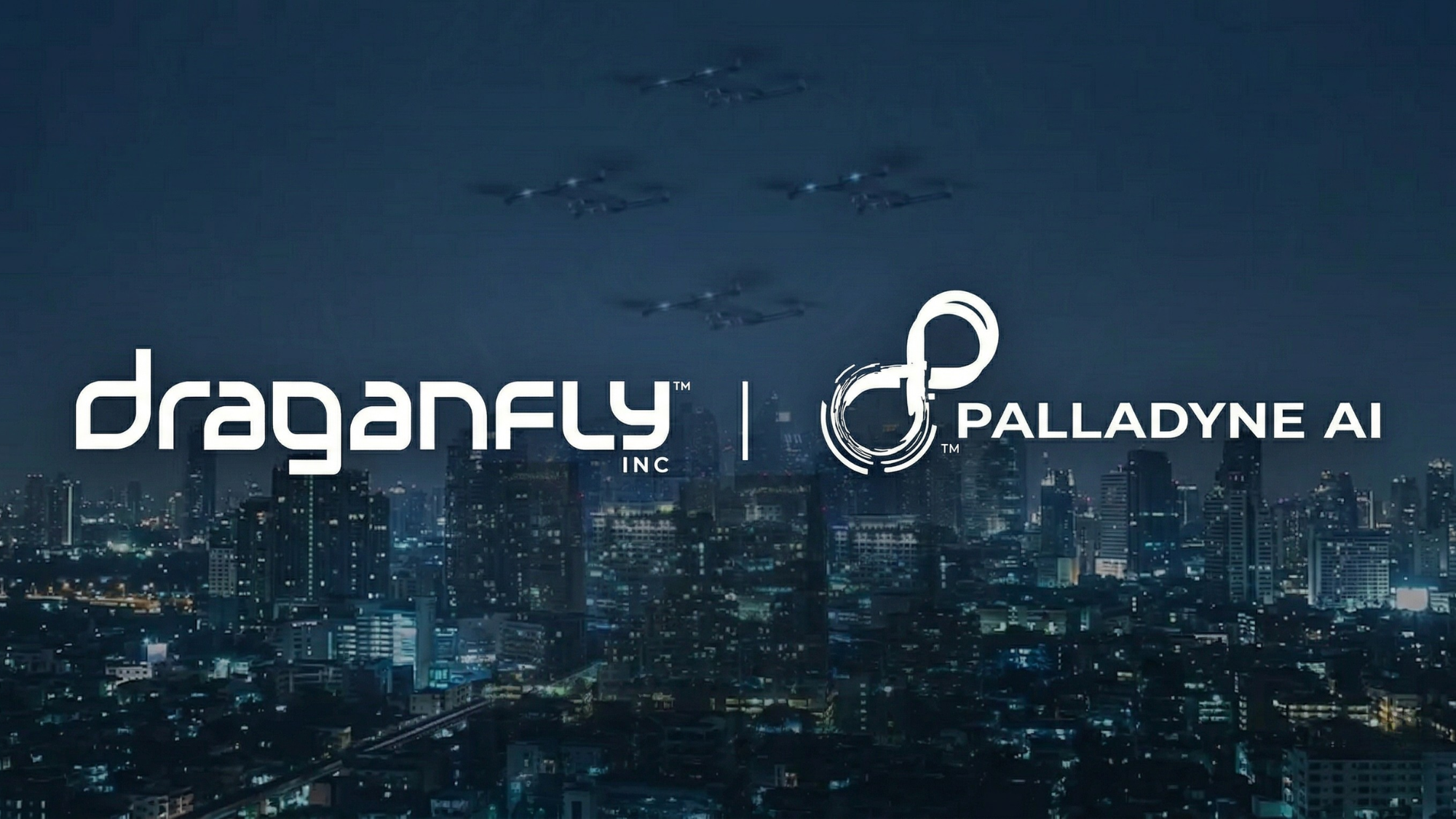
Draganfly is building toward that future through its partnership with Palladyne AI (NASDAQ:PDYN). In late March, the two companies announced a successful SwarmOS integration milestone, completing a flight simulation that validated decentralized autonomous swarming across Draganfly’s drone platforms.
Unlike traditional swarm systems that rely on a single leader drone directing the group, Palladyne’s SwarmOS enables multiple drones within a swarm to act as independent decision-makers — perceiving their environment, collaborating with teammates, and adapting in real time without continuous communication links.
That capability aligns directly with what tier-one defense customers are asking for. Draganfly recently secured a contract to provide Flex FPV drones and training to U.S. Air Force Special Operations Command units. The company also completed an exclusive capabilities demonstration for the Canadian Armed Forces after participating in Canada’s MINERVA working group — an initiative tied to Prime Minister Mark Carney’s new Defense Industrial Strategy emphasizing sovereign drone capabilities.
A Policy-Driven Super Cycle With a Long Runway
Chell calls this a policy-driven supercycle, and the distinction matters. This isn’t demand generated by consumers or a tech fad. National-security priorities are forcing governments to pour money into drone capabilities because the cost of inaction risks the security of entire nations.
The conflict in the Middle East has accelerated the timeline dramatically. That region — one of the wealthiest on the planet and home to critical, high-value infrastructure — now needs drone-defense systems immediately. The industry investment forecasts, according to Chell, are about to be exceeded by a wide margin.
For investors trying to time this cycle, the revenue picture is still early. Chell says the industry is just now seeing the leading edge of revenue scaling, with 2027 projected as the breakout year for meaningful top-line growth across the sector. Military procurement cycles that once took years have compressed to one or two, and the first sizable contract awards are starting to land.
Draganfly’s Full Product Line Is the Strategic Bet
What separates Draganfly from many competitors, Chell argues, is its full product line. The company has four drone systems in production and a fifth in development, ranging from five-inch FPV tactical drones to the Outrider — a nine-foot, dual-diesel-engine platform with seven-hour endurance and 100-pound lift capacity. All are designed to be interoperable.
That ecosystem approach matters because real-world operations rarely require just one type of drone. A surveillance mission may need a separate strike drone, a target-acquisition platform, and a logistics-delivery system. Chell says the only other company with a comparable full product line is DJI, which employs roughly 10,000 engineers.
Draganfly is also pursuing vertical integration through acquisitions to secure its supply chain and protect proprietary IP, while maintaining partnerships with sensor providers, software developers, and motor manufacturers across the broader drone ecosystem.
The Commercial Upside Beyond Defense
Defense is pulling capital into the sector now, but Chell draws a parallel to the early internet era that’s worth considering. Two decades ago the internet was replacing the yellow pages; nobody could have imagined what it would become. Chell sees a similar long-term trajectory for drones: they collect data better, communicate better, and deliver goods more efficiently than alternatives.
The transformation of military drone technology into commercial applications could be as economically significant as the internet itself. That’s a bold claim, and it will take time. But the underlying capability — autonomous machines making real-world decisions based on real-world data — has applications across agriculture, infrastructure inspection, logistics, public safety, and beyond.
For now, the investment case is straightforward: global defense budgets are expanding, procurement timelines are compressing, and companies building interoperable, AI-enabled drone ecosystems sit at the front of a multi-year spending wave. Revenue hasn’t fully materialized yet, but the contracts are starting to land.
Thank you for subscribing to MarketBeat!
We empower investors to make better trading decisions by providing up-to-the-minute financial information and unbiased market research.
If you have questions or concerns about your account, please don’t hesitate to email our U.S. based support team at contact@marketbeat.com.
If you would like to unsubscribe or change which emails you receive, you can manage your mailing preferences or unsubscribe from these emails.
© 2006-2026 MarketBeat Media, LLC. All rights reserved.
345 N Reid Place #620, Sioux Falls, S.D. 57103-7078. United States..

 RJ Hamster