Three times over the last 30 years.
That’s how often I’ve received the signal to go “all-in” on gold.
The first time was back in the 2000s…
The dot-com mania was nearing its peak, money was flooding into any and all tech stocks, and equity valuations were trading at nosebleed levels.
I was in my mid-20’s. Just starting my first business.
And although I didn’t have much capital to spare, I scrounged together as much money as I could to load up not on tech stocks… but on gold coins.
At the time, gold was despised by Wall Street.
Goldman Sachs called it “a 19th-century asset.”
One of Merrill Lynch’s top investment analysts said that it was only for “grandmothers and conspiracy theorists.”
And two of America’s leading economists at the time called it a “barren asset.”
Yet, I chose to go in at under $300 an ounce.
My second signal came in 2008 when, amidst the chaos of the financial crisis, gold prices dropped briefly below $800 an ounce… and I once again went “all-in” on gold.
And a little over a year ago, I did it again…
I moved roughly 50% of my liquid net worth into gold and Bitcoin:
Three “all-in” decisions… Each of which seemed crazy to most at the time.
But for me… it was the most obvious move to make.
Why?
It’s all thanks to an incredible secret I learned from famed economist Kurt Richebächer – the last of the true Austrian economists.
What he taught me has been incredibly accurate at predicting the price of gold over the years.
It’s helped me make an absolute killing each of the three times I went “all-in.”
And right now, it is again predicting a shocking new price for gold in the near future.
Click here to see my full prediction for gold now.
Good Investing,
Porter Stansberry
Today’s Featured Content
Hollywood’s New Cash King: Paramount’s $24B Power Play
By Jeffrey Neal Johnson. Originally Published: 4/9/2026.
Key Points
- The massive infusion of foreign equity capital creates a robust financial foundation that significantly enhances the long-term stability of the new company.
- Combining the extensive libraries of both studios produces a world class content engine capable of outperforming major global technology competitors.
- This merger establishes an elite streaming powerhouse with the necessary scale and operational efficiency to capture a larger share of the global market.
- Special Report: Elon Musk: This Could Turn $100 into $100,000
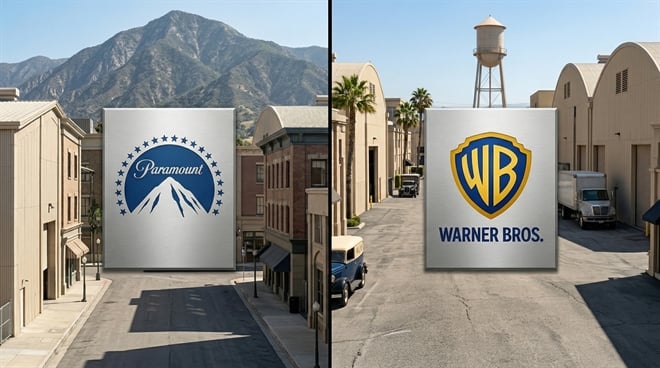
A multi-billion-dollar wave of Gulf sovereign wealth capital is poised to reshape the American media landscape. Two of Hollywood’s most iconic names, Paramount (NASDAQ: PSKY) and Warner Bros. (NASDAQ: WBD), sit at the center of a monumental shift backed by an unprecedented $24 billion equity commitment.
That financing is more than a headline; it marks a meaningful change in how media empires are built and funded. The deal creates a new heavyweight contender in the battle for streaming dominance and reshapes the landscape investors must navigate.
The Strategic Power of a Clean Balance Sheet
The primary obstacle to large-scale media mergers has long been the massive debt needed to finance them. The proposed acquisition of Warner Bros. Discovery by Paramount Skydance sidesteps that issue. The company has secured firm commitments for roughly $24 billion in equity, a fundamentally different and more stable form of capital that materially improves the transaction’s outlook.
Iran War Shakes Up Wall Street, Here’s How to Profit… (Ad)
Since 2009, the Dividend Machine has posted a total return of 7,056.47% – turning a $10,000 stake into more than $700,000 while the broader market struggled through multiple downturns.
With a 93% win rate since launch, this dividend-focused strategy has kept investors cashing steady checks through every crash. Bill Spetrino has released a free report outlining how to position for income no matter what the market does next.Claim your free report and see how the Dividend Machine works
Unlike deals financed with large loans, this equity infusion strengthens the combined company’s balance sheet from day one. It avoids saddling the new entity with heavy interest payments that can stifle growth and innovation — a persistent problem in past media consolidations.
That financial flexibility is a significant competitive advantage. Future cash flow can be devoted to what matters in the streaming wars: blockbuster content, new technology, and aggressive global marketing, rather than debt service.
The strategic de-risking of the deal has already registered with investors. On April 7, 2026, Paramount shares rose 10% to close at $10.90, a clear market signal that the financing has increased confidence in the merger’s likelihood of success by removing a major financial risk.
Building a Content Kingdom to Conquer Streaming
The strategic logic behind this roughly $110 billion merger is scale: to create a media company large enough to compete in the modern streaming era. Today’s entertainment landscape is dominated by deep-pocketed tech incumbents like Netflix (NASDAQ: NFLX) and Disney (NYSE: DIS). To go head-to-head with those rivals, a vast content library and globally recognized intellectual property are essential.
This transaction pairs Paramount’s blockbuster production capabilities — films such as “Top Gun” and “Mission: Impossible” — with Warner Bros. Discovery’s sprawling, iconic library. That portfolio spans HBO prestige television, the DC Comics universe, and a deep catalog of unscripted content from Discovery.
Combined, the companies create a content arsenal few can match. The efficiencies extend beyond content: consolidating technology platforms and marketing operations can drive meaningful cost savings and improve margins. This operational efficiency, together with a world-class content engine, builds a compelling competitive moat.
With an expected combined market capitalization approaching $80 billion, the new company would have the financial scale to invest heavily and consistently in original programming and cutting-edge technology — the core levers for attracting and retaining subscribers worldwide.
The Market’s Mixed Signals: Finding the Opportunity
The market reaction has produced a nuanced landscape with potential opportunities. Paramount rallied on the financing news, while Warner Bros. shares remained relatively stable around $27.
That suggests investors are taking a wait-and-see stance on Warner Bros. ahead of the April 23, 2026 shareholder vote and regulatory hurdles. The divergence could create a value gap, offering a chance to buy Warner Bros. before any acquisition premium is fully reflected in its share price.
Analyst ratings add another layer. Despite the financing catalyst, the consensus rating for Paramount remains a Strong Sell, although the average analyst price target of $12.85 implies roughly 17% upside from current levels.
Such disconnects can occur when Wall Street models lag transformative news. Many analysts may wait for the deal to close before fully pricing in the long-term benefits of a combined company with a reinforced balance sheet, creating an opening for forward-looking investors. While recent insider sales at Warner Bros. have drawn attention, such activity is common in pre-merger periods as executives manage their holdings and is not necessarily a bearish signal on the deal’s fundamentals.
A New Hollywood Powerhouse Is Born
The $24 billion equity infusion is not just financing a transaction; it is underwriting the creation of a financially resilient media titan. With its capital structure shored up, a clear strategic purpose, and growing market recognition, the combined Paramount-Warner entity is positioned to disrupt the streaming landscape.
The deal’s equity-first structure offers a blueprint for how legacy media can adapt and thrive in an industry dominated by tech giants. The blend of iconic Hollywood assets and substantial global capital presents a compelling story and a company that investors should watch closely going forward.
Today’s Featured Content
5 Spin-Off Stocks That Could Reward Patient Investors in 2026
By Thomas Hughes. Originally Published: 3/26/2026.

Key Points
- Spin-offs are a powerful tool that helps CEOs unleash growth and unlock value for investors.
- Five planned 2026 spin-offs fit the bill and attract bullish analyst ratings.
- The question investors must ask themselves is whether to buy the original, the spinco, or both.
- Special Report: Elon Musk: This Could Turn $100 into $100,000
Spin-offs are a powerful tool for companies, helping them streamline operations, focus on growth, and unlock shareholder value. The key question is whether a separation changes how investors evaluate the original company, the new company, or both as standalone investments.
FedEx on Track to Deliver Value-Building Savings
FedEx’s (NYSE: FDX) spin-off suggests both the parent and the new company could be attractive buys. The split separates the freight business from the core package-delivery operation, allowing each company to trade at freer valuations. A critical takeaway for potential investors in the freight company is that it could trade at a 50% or higher premium to the original entity. The freight business faces 2026 headwinds, including tepid demand, margin pressure, and expansion costs.
Iran War Shakes Up Wall Street, Here’s How to Profit… (Ad)
Since 2009, the Dividend Machine has posted a total return of 7,056.47% – turning a $10,000 stake into more than $700,000 while the broader market struggled through multiple downturns.
With a 93% win rate since launch, this dividend-focused strategy has kept investors cashing steady checks through every crash. Bill Spetrino has released a free report outlining how to position for income no matter what the market does next.Claim your free report and see how the Dividend Machine works
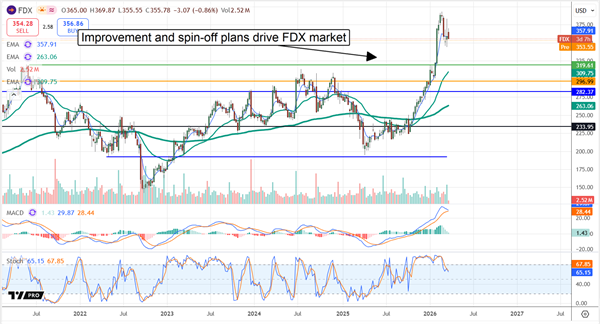
Takeaways for investors in the remaining FDX include improvements in operational quality, cash flow, and the reliability of capital returns. FedEx’s capital-return program—dividends, dividend growth, and aggressive share buybacks—remains meaningful: buybacks reduced the share count by more than 2.5% year-to-date through the end of fiscal Q3 2026. Analysts are lifting price targets ahead of the spin-off, supporting a Moderate Buy view with potential to reach new highs by mid-year.
KBR Split Enhances Focus, Unlocks Growth Avenues
KBR’s (NYSE: KBR) split, scheduled for completion in the back half of 2026, aims to separate its Sustainable Technology Solutions business from its government-facing operations. The new company will comprise the Mission Technology Solutions group, which covers defense, security, and space applications. This move is intended to unlock value: the spinco could see a 100%–200% price gain if it trades closer to defense peers rather than the parent’s ~9x multiple. Defense specialists such as Lockheed Martin (NYSE: LMT), Northrop Grumman (NYSE: NOC), and RTX (NYSE: RTX)trade at well over 20 times earnings.
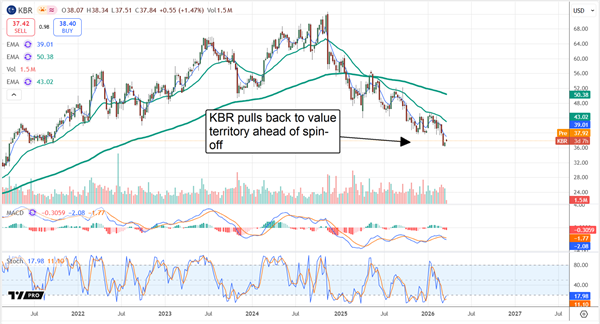
While the spinco will concentrate on defense contracts and executing its sizable backlog, the ongoing business will focus on higher-margin sustainable energy technologies. The leaner parent should benefit from faster decision-making and greater financial flexibility, enabling continued investment in growth. Analyst revisionsare mixed for 2026, but the consensus rating remains Hold and the average price target implies roughly 50% upside.
Medtronic to Spin-Off High-Growth Diabetes Unit
Medtronic (NYSE: MDT) plans to spin off its high-growth diabetes unit later this year—a move that may seem counterintuitive at first. The diabetes business is more consumer-oriented, while the core company is focused on hospital-based care, creating strategic and operational mismatches in a combined structure. The spin-off will create a pure-play diabetes equipment and supply company that can compete more effectively in its fast-growing market and could become a takeover candidate.
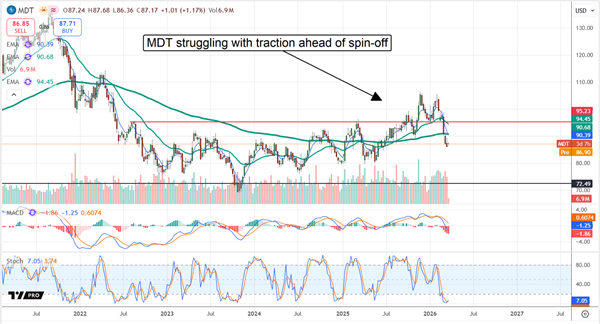
The remaining Medtronic will concentrate on higher-margin, high-growth areas such as cardiovascular devices and robotic surgery. Robotic surgery is a major growth area, led by names like Intuitive Surgical (NASDAQ: ISRG), which has sustained double-digit growth and improving operational metrics. Twenty-six analysts rate this stock a Moderate Buy. Coverage is increasing, sentiment is firm, and the consensus price target implies more than 25% upside as of late March.
Keurig Dr Pepper: Grows to Split, Unleashes Global Powerhouses
Keurig Dr Pepper (NASDAQ: KDP) has struggled for years as strengths in one segment often offset weaknesses in the other. The company plans another coffee acquisition and then to spin off the coffee business into a pure-play. That approach is expected to deliver supply-chain efficiencies and unlock growth—especially in the high-margin coffee pod market.
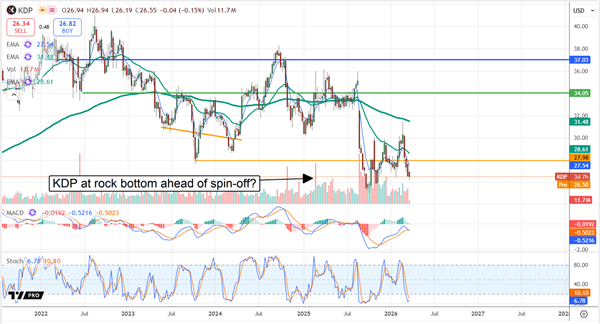
The ongoing business will become a soda-and-beverage pure-play, unencumbered by coffee-specific issues and with a stronger financial profile. It will be better positioned to focus on its higher-margin businesses and pursue acquisitions. The transaction is expected to be completed in April. Analysts are bullish, rating the stock a Moderate Buy and raising price targets ahead of the spin-off. The MarketBeat consensus price target implies roughly 35% upside, and the highest analyst targets add further double-digit potential.
Honeywell Splits to Enhance Focus With 2 Pureplay Businesses
Honeywell (NASDAQ: HON) plans to separate its aerospace business into a focused pure-play unit. That aerospace company will service defense and commercial contracts, execute on a record backlog, and improve cash flow, while the original company concentrates on industrial automation. Industrial automation sits at the center of Industry 4.0—the nexus of the Internet of Things (IoT), robotics, and AI. The split should give each company a more flexible financial position and enable strategic acquisitions to sustain long-term growth.
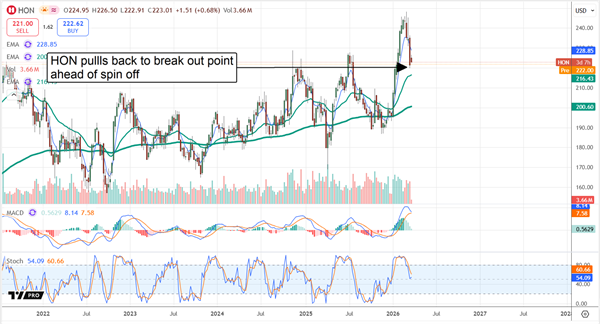
Analyst trends suggest investors are most bullish on this name. MarketBeat data shows growing coverage, firming sentiment at Moderate Buy, and an uptrend in price targets. The consensus forecast indicated about 10% upside in late March, with sentiment and target trends skewed toward the high end and likely to remain strong through year-end.
This email communication is a paid sponsorship sent on behalf of Porter & Company, a third-party advertiser of MarketBeat. Why did I receive this email?.
If you have questions or concerns about your newsletter, please email our U.S. based support team at contact@marketbeat.com.
If you would no longer like to receive promotional emails from MarketBeat advertisers, you can unsubscribe or manage your mailing preferences here.
© 2006-2026 MarketBeat Media, LLC. All rights reserved.
345 N Reid Place, Sixth Floor, Sioux Falls, S.D. 57103-7078. USA..
Link of the Day: Trump Just Backed Tech That Kills Nvidia’s Moat(From Eagle Publishing)

 RJ Hamster