I was born on 6 August 1956 in San Francisco, California to Janet and (the late) Richard Hovis.
I grew up in Santa Monica, California where I attended elementary, junior high school, and high school (graduating in 1974), in addition to involvement in sports and recreation (Little League +, the Boy’s Club ++). Further, it was in elementary school – St. Augustine’s By-the -Sea Parish School that I found, and made the choice to truly journey with God.
I attended Arizona State University from 1974 to 1977 – seeking to become an architect, however, I was not accepted, and, as such, I graduated with a Liberal Arts degree.
Upon graduation from Arizona State University, I attended Cal Poly San Luis Obispo and studied City and Regional Planning at the Master’s level. I successfully completed one (1) year in a two (2) year program – I did not complete the Master’s degree in City and Regional Planning – due to personal reasons.
I returned to Santa Monica where I started (October 1979) my career as graphic designer with Exxon Company, USA. I spent five years with Exxon Company, USA.
While working with Exxon Company, USA I was accepted into architectural school – Sci-Arc in Southern California, however, I did not attend preferring to stay with Exxon..
In 1982 I married Laura Flosi and in April 1983 we had our one and only child – Lauren Alain Hovis – a gift from God.
We moved to Phoenix, Arizona in 1984 from Los Angeles, where I went to work as a graphic designer with Kitchell CEM (from 1985 -1987).
From 1987 – 1995 I was an independent contractor, and a registered representative in mortgage finance, financial management, graphic design, and drafting.
Further, I attended the University of Phoenix and successfully obtained a Master’s in Business Administration (MBA) in 1982.
I was also a member of the Scottsdale Jaycees, where I became very involved in community events and projects.
In 1994, I accepted a cartography position with the Defense Mapping Agency in Reston, Virginia. As such, I relocated from Phoenix to Reston.
In 1998, I was accepted and worked as a Visual Information Officer with the Central Intelligence Agency. In 2002, I worked as a Support Officer until my retirement (due to a need for shoulder surgery) in September 2018.
Away from my Federal Government service, I have been involved in various organizations and activities in Northern Virginia.
In November of 2011, I married Rebecca Ouellette in Santa Monica, California. I reside in San Tan Valley, AZ with my two hamster - Jess and Timothy, our fish, our lizard - RJ Lizard., and our cats - Pearl and Grey.
As to hobbies, I enjoy playing sports, attending sporting events, mentoring individuals from financial management to hamsters, building models, photography, travel, multimedia design, managing partner for RJ Hamster, and jazz – smooth jazz to a samba or a bossa nova.
Love and God Bless,
Peter – aka RJ Hamster Jo hi
Editor’s Note: What if you could claim a stake in what’s set to be the biggest IPO ever… starting with just $500? Click here to see the detailsfrom former tech executive and angel investor Jeff Brown — the man who picked Bitcoin, Tesla, and Nvidia before they exploded higher. Or read more below.
The Wendy’s Co. (NASDAQ: WEN) delivered a double beat when it reported Q4 2025 earningson Feb. 13. However, shareholders lost their appetite for WEN stock, which pushed it to a 52-week low of $6.73. Recent headlines have helped the stock stage a rally, but it remains down nearly 51% over the last 12 months and more than 61% over the last five years.
This is a case where big numbers worked against the company. Wendy’s posted its worst same-store sales in 20 years — a hard fact for shareholders to ignore.
But has the stock become so beaten down that it represents a buying opportunity? As with many retail stocks, value can be subjective. One investor who seems to think so is hedge fund billionaire Nelson Peltz. Peltz has been a major shareholder for over two decades and is evaluating ways to enhance shareholder value. An SEC filing revealed that one option under consideration could be a takeover of the fast-food chain.
However, Wendy’s is already undergoing a transformation (Project Fresh) and has committed to closing between 5% and 6% of its locations in 2026. The company has also taken steps to make its value menu (i.e., the Biggie Bag) more competitive.
So it’s unclear what additional value Peltz might try to unlock. One tangible move could be appointing a permanent chief executive officer — the company is currently led by interim CEO Ken Cook. Still, it’s best to evaluate the stock on its current fundamentals.
Turnaround Efforts Face Macro and Consumer Headwinds
The fact that Wendy’s beat on both the top and bottom lines was legitimately better than expected, not just better than feared. Still, the steep drop in same-store sales is hard to dismiss.
The challenge is interpretation. Investors are viewing the outlook through a very murky lens. Positive economic signals exist, but much depends on which segment of the so-called “K-shaped” recovery you focus on.
Lower-income consumers are clearly under pressure. When debates center on which $5 value meal offers the most “value,” the problem may be more with consumers’ constrained budgets than with the company’s offerings.
Add concerns about GLP-1 weight-loss drugs and other structural shifts, and it’s not hard to argue that Wendy’s may be doing about as well as can be expected. In 2021, the stock traded near $20 — but that was then.
Wendy’s is forecasting relatively flat global sales growth and adjusted earnings per share (EPS) in the range of $0.56 to $0.60, which would be roughly a 32% decline if the company hits the high end of that forecast.
The company is trimming capital expenditures by approximately $10 million to $20 million and now expects free cash flow (FCF) to fall to $190 million from $205 million.
Those forecasts lean toward “more of the same,” which is a reasonable approach given that 2026 could produce a wide range of outcomes for the lower leg of the K-shaped recovery.
A Tasty Dividend or Value Trap?
One bright spot for WEN stock is its dividend.
The payout was cut nearly in half in 2025 but remains at $0.56 per share. With the stock trading around $7.70 at the time of writing, that translates to a yield of about 7.26%.
When a company reports results like Wendy’s and still offers an attractive yield, questions about sustainability naturally arise — especially given the projected drop in FCF.
That said, the dividend currently costs Wendy’s roughly $106 million annually, which appears sustainable even with the forecasted FCF decline.
Investors would be more comfortable if the payout ratio were under 50% (it’s currently about 65.88%), but based on the company’s conservative projections there’s no immediate reason to deem the dividend unsafe.
Technical Picture Suggests Rally May Be Temporary
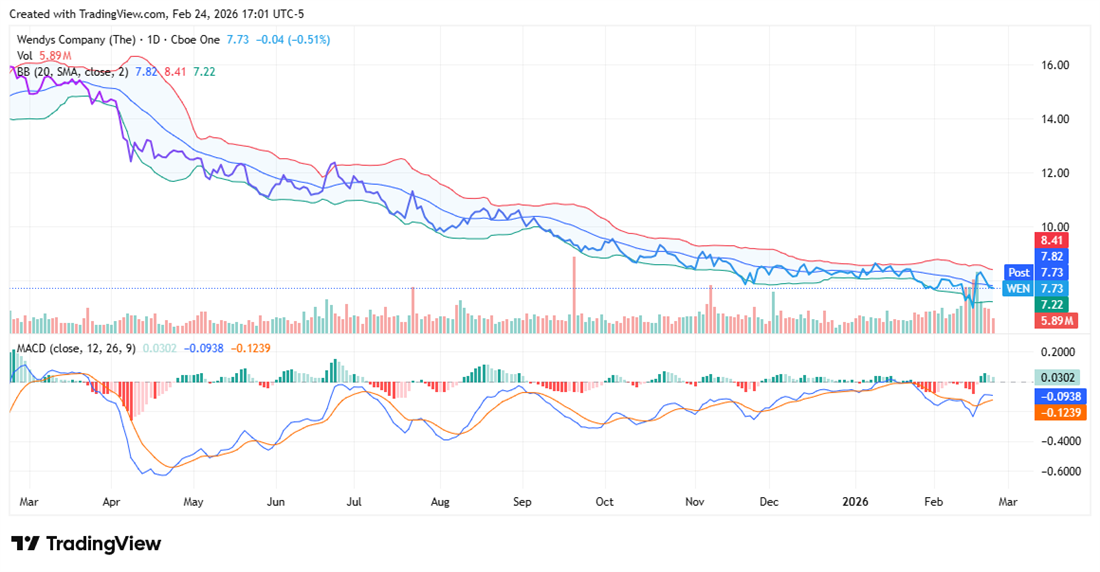
WEN stock has been in a persistent downtrend since March 2025, sliding from roughly $16 to current levels near $7.73, and spending months along the lower Bollinger Band. Price is now sitting near the 20-day simple moving average (approx. $7.82), which has acted as resistance throughout the decline rather than support.
After the sharp February sell-off and subsequent bounce, the stock has mean-reverted to the middle Bollinger Band. That suggests the oversold condition created by the pullback has already been relieved and the recent recovery looks corrective rather than the start of a sustained reversal.
The moving average convergence/divergence (MACD) supports this view. While the MACD line briefly crossed above zero during the bounce, it is rolling back over and the signal line remains deeply negative (-0.1239). Resistance at the upper Bollinger Band (approx. $8.41) remains a significant hurdle; without convincingly reclaiming that level, the path of least resistance still points downward.
Hearing that there’s “no end in sight” to the current U.S.-Iran war might not comfort investors – but that’s exactly how one Iranian official recently described it to CNN.
Markets have already felt the turbulence, and aluminum is no exception.
The metal surged almost 10% last week, hitting a three-year high as the conflict disrupted aluminum shipments from the Persian Gulf. The region supplies roughly 9% of global aluminum, so prices spiked quickly on supply fears – before an even more recent selloff brought them back down.
If the war continues to create a global aluminum shortage, mining companies could stand to benefit. Now, I am certainly not celebrating conflict in the Middle East; but we can only invest in the world as it is, not in the rose-tinted world we might prefer.
In the real world, tighter supply usually means higher prices.
And beyond the escalating conflict, aluminum demand has increased thanks to AI’s need for infrastructure and hardware.
Think of AI infrastructure like a living body: If power is the blood circulating through data center infrastructure, metals are the bones.
In effect, every ton of metal pulled from the ground is a claim on the AI buildout.
Unlike software vendors or chip designers, metals companies don’t need to guess which AI model wins or which agent framework dominates. They just need to deliver the raw materials that make the entire ecosystem possible.
Aluminum demand is accelerating. Every high-voltage line that feeds an AI data hub consumes one to two tons of aluminum per megawatt delivered. Each new stretch of long-distance transmission deepens the world’s appetite for this versatile metal. From 104 million tons of demand in 2024 to an estimated 120 million by 2030, global aluminum consumption is set to grow relentlessly.
That spells good news for one of my Fry’s Investment Report holdings: Alcoa Corp. (AA), the largest U.S.-based aluminum producer.
Toward the end of 2025, Alcoa’s prices reached a new three-year high. After suffering a tariff-induced selloff earlier in the year, Alcoa’s shares have been trending higher.
I expect that uptrend to gain momentum – driven not only by firmer aluminum prices, but also by the company’s exceptional fundamentals.
Alcoa is not just the largest American aluminum producer, but it is also among the world’s most environmentally progressive. Producing aluminum requires immense amounts of electricity, and that energy intensity is reshaping the industry.
Today, renewable energy powers roughly 87% of Alcoa’s smelting operations and about 70% of Norwegian aluminum company Norsk Hydro’s (NHYDY). This alignment with the global push toward decarbonization gives both companies a durable strategic advantage, and positions them not merely as metal producers, but as critical enablers of the cleaner, more electrified world AI will depend on.
In the end, the market may reward not those who build the virtual world, but those who power it. The AI Revolution will always need its dreamers, but it will depend on the miners that turn metal into its bones.
In the race for AI supremacy, the hyperscalers may scorch their balance sheets, but the miners will still be cashing the checks. While hyperscaler shareholders wrestle with wafer-thin cash cushions and swelling debt, metals firms operate with clearer economics.
Their business models are not theoretical. They are measurable and proven.
Therefore, for investors seeking exposure to the AI Revolution without betting on which form of intelligence will win, a mining company like Alcoa offers a compelling opportunity.
Now, let’s take a look back at what we covered here at Smart Money. Then, I’ll let you in on another way to profit in today’s unpredictable, high-pressure market.
According to InvestorPlace Senior Analyst Luke Lango, market volatility is now the default, and focusing on a stock’s valuation alone is no longer enough. In Wednesday’s essay, Luke discusses his perspective further, explaining why market phases are structural – and how to invest in the stage we’re in now, where momentum can majorly enhance returns. Click here to read more.
Luke Lango just launched a new breakthrough. It identified stocks that went on to maximum gains of 2,623%, 865%, and 2,149% in a historic test of system signals. And it just flagged a stock that he believes could jump 100% or more any day now. Get it for FREE here.
To save his followers from losing all their money in the dot-com bust, Eric Fry rotated into non-tech stocks that went up 2,159%… 1,737%… and 11,237%. Today, he’s found non-tech AI Survivor stocks positioned to soar just as high when the AI Bubble pops in 2026. Watch his free video for a list of names and tickers.
Last week, a septet of Big Tech companies signed a “Ratepayer Protection Pledge” – a pledge aimed at preventing passing AI data center-related electricity costs on to households. However, given a history of AI infrastructure driving higher electricity bills, it’s still unclear how these companies will be held to their promise to now bear those costs. Click here for more details on what this means for investors, and how to get in early on the best opportunities.
I insisted on teaching my youngest daughter one quick thing before she set off on her own after college. What I imparted to Crystal, over the course of dinner, was the basics of my investing strategy — a strategy so straightforward to learn, I called it the “ABC’s.” And in the months that followed… After Crystal moved to New York and spent her days trying to break into the film industry… She doubled the market. That’s right: my Gen-Z, art-student daughter, ran laps around the S&P 500. The year after, she did it again. Click here to discover the system my daughter used to double the S&P 500 last year!
In today’s market, the “buy great companies and wait” approach only works for investors with iron stomachs and patience for long holding periods. The biggest gains now tend to come in short, powerful bursts. And for Luke Lango, that’s helped shape his breakout system, allowing investors to profit from quick-moving stocks. Read on to learn more about how to implement Luke’s strategy.
Looking Ahead
The markets are feeling the pressure of rapid changes, leaving many investors unsettled.
That’s why I not only want to share one of my favorite stocks with you today – but also give you the opportunity to learn more about my colleague Luke Lango’sapproach for navigating this volatile environment.
In Luke’s brand-new video, he lays out why volatility isn’t fading anytime soon… why the old buy-and-hold playbook is struggling in this environment… and how he designed a momentum-driven “Stage 2” approach in order to target stocks as they begin major breakouts.
He also walks through real historical examples his system flagged early — before some of the biggest runs of the past few years.
Plus, during the event, he reveals a free breakout stock pick you can look into immediately.
Manage your account We hope this timely investment research is valuable to you. As you know the markets move fast and conditions change frequently. So please check the current issue for the most recent advice. Please note that we cannot be liable for any missed bulletins caused by overzealous filters. To ensure that you continue to receive this valuable part of your service please take a moment to add services@exct.investorplace.comto your address book.
Ratings changes for Micron Technology, Paramount Skydance, Netflix, Micron Technology, Adobe, Warner Bros. Discovery, Coinbase Global and more…Text “MarketBeat” to 68285 to get SMS breaking news alerts for stocks on your watchlist and other special reports. Learn More.
Elon did the seemingly impossible – far faster than anyone expected… And it’s sent the tech industry into PANIC MODE. ChatGPT, Claude, Google Gemini, and DeepSeek could soon become obsolete. And three little-known firms could soar 10X or higher as a result.
Bank of Nova Scotia (TSE:BNS) (NYSE:BNS) was downgraded by Canaccord Genuity Group Inc. from “buy” to “hold”. They now have a C$110.00 price target on the stock, down from C$118.00. This represents a 14.8% upside from the current price of C$95.78.First Quantum Minerals (TSE:FM) was downgraded by JPMorgan Chase & Co. from “overweight” to “underperform”. They now have a C$28.00 price target on the stock, down from C$48.00. This represents a 11.6% downside from the current price of C$31.67.Lundin Mining (TSE:LUN) was downgraded by JPMorgan Chase & Co. from “neutral” to “underweight”. They now have a C$28.20 price target on the stock, down from C$32.90. This represents a 18.7% downside from the current price of C$34.70.
Analysts’ Price Target Increases on Monday, March 9
AltaGas (TSE:ALA) had its price target raised by Jefferies Financial Group Inc. from C$49.00 to C$53.00. This represents a 11.3% upside from the current price of C$47.62.AltaGas (TSE:ALA) had its price target raised by Scotiabank from C$50.00 to C$52.00. They now have an “outperform” rating on the stock. This represents a 9.2% upside from the current price of C$47.62.AltaGas (TSE:ALA) had its price target raised by ATB Cormark Capital Markets from C$49.00 to C$52.00. They now have an “outperform” rating on the stock. This represents a 9.2% upside from the current price of C$47.62.AltaGas (TSE:ALA) had its price target raised by TD Securities from C$48.00 to C$51.00. They now have a “buy” rating on the stock. This represents a 7.1% upside from the current price of C$47.62.AltaGas (TSE:ALA) had its price target raised by National Bank Financial from C$50.00 to C$51.00. They now have an “outperform” rating on the stock. This represents a 7.1% upside from the current price of C$47.62.AltaGas (TSE:ALA) had its price target raised by Royal Bank Of Canada from C$48.00 to C$50.00. They now have an “outperform” rating on the stock. This represents a 5.0% upside from the current price of C$47.62.Aecon Group (TSE:ARE) had its price target raised by TD Securities from C$39.00 to C$47.00. This represents a 16.4% upside from the current price of C$40.39.Aecon Group (TSE:ARE) had its price target raised by ATB Cormark Capital Markets from C$35.00 to C$39.00. They now have a “sector perform” rating on the stock. This represents a 3.4% downside from the current price of C$40.39.Aecon Group (TSE:ARE) had its price target raised by Canaccord Genuity Group Inc. from C$40.00 to C$52.00. They now have a “buy” rating on the stock. This represents a 28.7% upside from the current price of C$40.39.Aecon Group (TSE:ARE) had its price target raised by National Bank Financial from C$35.00 to C$45.00. They now have an “outperform” rating on the stock. This represents a 11.4% upside from the current price of C$40.39.Cameco (TSE:CCO) (NYSE:CCJ) had its price target raised by Canadian Imperial Bank of Commerce from C$115.00 to C$202.00. This represents a 30.8% upside from the current price of C$154.42.Canfor Pulp Products (TSE:CFX) had its price target raised by Royal Bank Of Canada from C$0.50 to C$0.60. They now have a “sector perform” rating on the stock. This represents a 15.4% upside from the current price of C$0.52.Canadian Natural Resources (TSE:CNQ) (NYSE:CNQ) had its price target raised by Desjardins from C$52.00 to C$56.00. They now have a “hold” rating on the stock. This represents a 12.2% downside from the current price of C$63.75.Doman Building Materials Group(TSE:DBM) had its price target raised by Desjardins from C$11.00 to C$12.00. They now have a “buy” rating on the stock. This represents a 24.1% upside from the current price of C$9.67.Doman Building Materials Group(TSE:DBM) had its price target raised by Raymond James Financial, Inc. from C$11.00 to C$12.00. They now have a “strong-buy” rating on the stock. This represents a 24.1% upside from the current price of C$9.67.Doman Building Materials Group(TSE:DBM) had its price target raised by National Bank Financial from C$12.00 to C$12.50. They now have an “outperform” rating on the stock. This represents a 29.3% upside from the current price of C$9.67.Exchange Income (TSE:EIF) had its price target raised by Scotiabank from C$121.00 to C$129.00. They now have an “outperform” rating on the stock. This represents a 31.5% upside from the current price of C$98.11.Headwater Exploration (TSE:HWX) had its price target raised by Royal Bank Of Canada from C$11.00 to C$13.00. They now have a “sector perform” rating on the stock. This represents a 5.9% upside from the current price of C$12.27.Toronto-Dominion Bank (TSE:TD) (NYSE:TD) had its price target raised by Canaccord Genuity Group Inc. from C$147.00 to C$149.00. They now have a “buy” rating on the stock. This represents a 15.7% upside from the current price of C$128.83.Tourmaline Oil (TSE:TOU) had its price target raised by Desjardins from C$70.00 to C$74.00. They now have a “buy” rating on the stock. This represents a 16.3% upside from the current price of C$63.63.Vermilion Energy (TSE:VET) (NYSE:VET) had its price target raised by Desjardins from C$13.50 to C$16.00. They now have a “hold” rating on the stock. This represents a 2.0% upside from the current price of C$15.69.
Analysts’ Price Target Decreases on Monday, March 9
Algonquin Power & Utilities (TSE:AQN) had its price target lowered by TD Securities from C$6.50 to C$6.00. They now have a “hold” rating on the stock. This represents a 28.2% downside from the current price of C$8.36.Aecon Group (TSE:ARE) had its price target lowered by Stifel Nicolaus from C$34.25 to C$28.75. They now have a “hold” rating on the stock. This represents a 28.8% downside from the current price of C$40.39.Badger Infrastructure Solutions (TSE:BDGI) had its price target lowered by Canadian Imperial Bank of Commerce from C$86.00 to C$80.00. This represents a 25.6% upside from the current price of C$63.68.Badger Infrastructure Solutions (TSE:BDGI) had its price target lowered by Acumen Capital from C$82.25 to C$80.00. They now have a “buy” rating on the stock. This represents a 25.6% upside from the current price of C$63.68.Badger Infrastructure Solutions (TSE:BDGI) had its price target lowered by Stifel Nicolaus from C$85.00 to C$81.00. They now have a “buy” rating on the stock. This represents a 27.2% upside from the current price of C$63.68.Badger Infrastructure Solutions (TSE:BDGI) had its price target lowered by Canaccord Genuity Group Inc. from C$81.00 to C$70.00. They now have a “hold” rating on the stock. This represents a 9.9% upside from the current price of C$63.68.Badger Infrastructure Solutions (TSE:BDGI) had its price target lowered by TD Securities from C$83.00 to C$80.00. They now have a “buy” rating on the stock. This represents a 25.6% upside from the current price of C$63.68.Badger Infrastructure Solutions (TSE:BDGI) had its price target lowered by National Bank Financial from C$82.00 to C$74.00. They now have a “sector perform” rating on the stock. This represents a 16.2% upside from the current price of C$63.68.Doman Building Materials Group(TSE:DBM) had its price target lowered by Stifel Nicolaus from C$11.75 to C$11.50. They now have a “buy” rating on the stock. This represents a 18.9% upside from the current price of C$9.67.National Bank of Canada (TSE:NA) had its price target lowered by Canaccord Genuity Group Inc. from C$191.00 to C$190.00. They now have a “hold” rating on the stock. This represents a 2.6% upside from the current price of C$185.25.
Alpha Wire Daily tracks developing activity across small caps—where subtle shifts begin to take shape. These are often the setups that appear before broader attention builds.
Dynacor Group Inc. (TSE:DNG) declared a monthly dividend on Monday, March 9th. Investors of record on Tuesday, March 17th will be given a dividend of 0.0133 per share on Tuesday, March 17th. This represents a c) annualized dividend and a yield of 2.7%. The ex-dividend date is Monday, March 9th. Maple Leaf Foods Inc. (TSE:MFI) declared a quarterly dividend on Monday, March 9th. Stockholders of record on Tuesday, March 31st will be paid a dividend of 0.21 per share on Tuesday, March 31st. This represents a c) dividend on an annualized basis and a dividend yield of 3.0%. The ex-dividend date of this dividend is Monday, March 9th. This is a 10.5% increase from Maple Leaf Foods’s previous quarterly dividend of $0.19. VIEW DIVIDEND ANNOUNCEMENTS How China Accidentally Created Its Own Rare Earth Rival (ad)Last century, wars were fought over oil. The 21st century will be won or lost on rare earth elements, the digital gunpowder of modern dominance powering robotics, AI data centers, and the F-35 Lightning II, which requires 920 lbs. of rare earths just to stay in the sky. In 2024, 97% of the 1.2 million drones produced for the Ukraine conflict relied on heavy rare earth magnets processed in China, and nearly all global refining equipment is built, coded, and controlled overseas—a dangerous chokepoint that could be cut at any time. One domestic rare earth company is working to bring that leverage back to North America with a proprietary tech stack that’s 100% independent of Chinese equipment, paired with an AI-optimized refining engine to deliver 99.5% purity metals.
AltaGas (TSE:ALA) announced its quarterly results before the market opened on Friday, March 6th. The company reported $0.77 earnings per share (EPS) for the previous quarter. The company had revenue of $3.29 billion for the quarter. The stock had previously closed at C$47.62. Algonquin Power & Utilities (TSE:AQN) announced its quarterly results before the market opened on Friday, March 6th. The company reported $0.08 earnings per share (EPS) for the previous quarter. The company had revenue of $829.86 million for the quarter. The stock had previously closed at C$8.36. BCE (TSE:BCE) (NYSE:BCE) announced its quarterly results before the market opened on Friday, March 6th. The company reported $0.69 earnings per share (EPS) for the previous quarter. The stock had previously closed at C$35.24. Constellation Software (TSE:CSU) announced its quarterly results before the market opened on Monday, March 9th. The company reported $7.12 earnings per share (EPS) for the previous quarter. The company had revenue of $4.19 billion for the quarter. The stock had previously closed at C$2,959.90. McCoy Global (TSE:MCB) announced its quarterly results before the market opened on Friday, March 6th. The company reported $0.30 earnings per share (EPS) for the previous quarter. The company had revenue of $25.55 million for the quarter. The stock had previously closed at C$2.58. VIEW EARNINGS REPORTS
Best-in-Class Portfolio MonitoringView the latest news, buy/sell ratings, SEC filings and insider transactions for your stocks. Compare your portfolio performance to leading indices and get personalized stock ideas based on your portfolio.
Stock Ideas and RecommendationsGet daily stock ideas from top-performing Wall Street analysts. Get short term trading ideas from the MarketBeat Idea Engine. View which stocks are hot on social media with MarketBeat’s trending stocks report.
Advanced Stock Screeners and Research ToolsIdentify stocks that meet your criteria using seven unique stock screeners. See what’s happening in the market right now with MarketBeat’s real-time news feed. Export data to Excel for your own analysis.
MarketBeat empowers everyday investors to make better investment decisions by providing up-to-the-minute financial information and unbiased investment research.
If you need help with your newsletter, feel free to email MarketBeat’s South Dakota based support team at contact@marketbeat.com.
Online brokerage services are offered through Qtrade Direct Investing, a division of Credential Qtrade Securities Inc. Qtrade, Qtrade Direct Investing, and Write Your Own Future are trade names and/or trademarks of Aviso Wealth.
It’s a research-based look at how global developments can filter into the small-cap market.
Best, Jeff AckermanEditor, Stock News Trends
*We encourage readers to perform their own research and due diligence on any information we provide.
By clicking the link above you are opting in to receive email communication from Stock News Trends.
Advertising Disclosure: This email contains paid advertisements. This email is from our associates at Stock News Trend .
Legal Entity Information: Investing Ideas Daily is owned and operated by Darwin Investor Network, a DBA of The Darwin Agency, Inc.
Disclaimer: Nothing in this email should be considered personalized financial advice. Always conduct your own due diligence when investing. We urge you to read our full disclaimer by clicking on the terms of use link below.
Unsubscribe: You are receiving this email as part of your complimentary subscription to the Investing Ideas Daily E-Letter. If you would like to unsubscribe, you can do so by clicking on the unsubscribe link below.
Darwin Investor Network 2319 N Andrews Avenue, Fort Lauderdale, FL 33311 support@investingideasdaily.com | 1-800-496-9838
(5) Mortify therefore your members which are upon the earth; fornication, uncleanness, inordinate affection, evil concupiscence, and covetousness, which is idolatry: King James VersionChange email Bible version
The Greek word underlying “covetousness” is pleonexia,which means “the desire to have more.” This is among the ugliest of sins because it involves idolatry as well as its effects on others. The Greeks defined it as “the insatiable desire to have what rightfully belongs to others.” It is further described as “ruthless self-seeking,” the kind of attitude that the arrogant and callous person has, assuming that others and their things exist for his own benefit.
The desire for more money can lead to theft; the desire for more prestige, to evil ambition; the desire for more power, to tyranny; the desire for a person’s body, to fornication and adultery. Paul identifies covetousness as idolatry because, in the place of God, it puts self-interest for illicit things. A man sets up an idol in his heart because he desires to get something from it. So he serves it to get that something rather than to obey God’s commandment. That, very simply put, is idolatry.
The essence of idolatry is to get for the self in defiance of God. However, we have to give ourselves to God if we want to overcome illicit desires. Paul says to “mortify” (KJV) or “put to death” (NKJV) whatever is sinful. That does not mean to practice ascetic self-discipline—it means to kill. The Christian must kill self-centeredness. In his life, he must make a radical transformation, a shift of the center of his life. It is the same principle as described by Matthew 5:29. Everything that keeps a person from fully obeying God and surrendering to Jesus Christ must be surgically excised from his conduct.
The tenth commandment, then, has a function similar to the first. They both act as governors, controlling whether we keep the others.

 News for you, PeterA rocky marriage, secret affair and millions in debt: What we’ve learned so far in Kouri Richin…Over the last two weeks, jurors in Kouri Richins’ murder trial have heard wide-ranging testimony about troubles in …CNN Arnold Schwarzenegger Claims He’s Finally Making Sequels To Three Of His Classic MoviesArnold Schwarzenegger says there are plans for him to return to three of his biggest movie franchises, but is that truly p…SlashFilm Bank of America drops shock message on the stock marketThe stock market appears to be in the middle of a reset, but Bank of America feels investors shouldn’t expect a maj…TheStreet Georgia high school teacher dies after teen prank goes wrongA Georgia school district urged students not to take part in pranks. The next day, a teacher died in an apparent prank gon…USA TODAY Ahead of 2028, Sen. Cory Booker to unveil bill to make $75,000 in income tax-freeSen. Cory Booker, a potential 2028 Democratic presidential candidate, will introduce a tax bill to expand the standard ded…NBC News Kenneth Walker III signing with Chiefs after Super Bowl MVP effort with SeahawksWalker was named Super Bowl LX MVP after a 161-yard effort in the Seahawks’ win against the Patriots.Yahoo Sports Stock market today: Nasdaq wavers, Dow, S&P 500 slip as oil prices ease after spiking above $100Oil’s rise above $100 per barrel has unleashed fears of a more severe economic impact from the war in the Middle East.Yahoo Finance Popping a multivitamin could reduce your biological age by a few months — but don’t rush to the…The study adds to growing evidence that older adults might benefit from taking multivitamins, especially if their diet is …Business Insider 30-year-old chain closing all 28 restaurants in AprilA very large brand often has trouble growing new concepts because the growth path to making a meaningful impact on the bot…TheStreet To justify a $1.5 trillion market cap after its IPO, SpaceX would need to earn more than Berkshire Hat…The real moonshoot? Hitting the financial targets it would take to justify the market cap Elon Musk has been musing about.Fortune More like this
 Today’s gamePlay Crushable by Candy CrushA new daily puzzle is available to play now.
 Trending now1. Iran Strikes2. New York Yankees3. Glasgow Fire4. Jason Hughes5. ACC Tournament6. Donald Trump7. NASCAR8. India vs. New Zealand9. Emma Raducanu10. Country Joe McDonald








































 RJ Hamster