I was born on 6 August 1956 in San Francisco, California to Janet and (the late) Richard Hovis.
I grew up in Santa Monica, California where I attended elementary, junior high school, and high school (graduating in 1974), in addition to involvement in sports and recreation (Little League +, the Boy’s Club ++). Further, it was in elementary school – St. Augustine’s By-the -Sea Parish School that I found, and made the choice to truly journey with God.
I attended Arizona State University from 1974 to 1977 – seeking to become an architect, however, I was not accepted, and, as such, I graduated with a Liberal Arts degree.
Upon graduation from Arizona State University, I attended Cal Poly San Luis Obispo and studied City and Regional Planning at the Master’s level. I successfully completed one (1) year in a two (2) year program – I did not complete the Master’s degree in City and Regional Planning – due to personal reasons.
I returned to Santa Monica where I started (October 1979) my career as graphic designer with Exxon Company, USA. I spent five years with Exxon Company, USA.
While working with Exxon Company, USA I was accepted into architectural school – Sci-Arc in Southern California, however, I did not attend preferring to stay with Exxon..
In 1982 I married Laura Flosi and in April 1983 we had our one and only child – Lauren Alain Hovis – a gift from God.
We moved to Phoenix, Arizona in 1984 from Los Angeles, where I went to work as a graphic designer with Kitchell CEM (from 1985 -1987).
From 1987 – 1995 I was an independent contractor, and a registered representative in mortgage finance, financial management, graphic design, and drafting.
Further, I attended the University of Phoenix and successfully obtained a Master’s in Business Administration (MBA) in 1982.
I was also a member of the Scottsdale Jaycees, where I became very involved in community events and projects.
In 1994, I accepted a cartography position with the Defense Mapping Agency in Reston, Virginia. As such, I relocated from Phoenix to Reston.
In 1998, I was accepted and worked as a Visual Information Officer with the Central Intelligence Agency. In 2002, I worked as a Support Officer until my retirement (due to a need for shoulder surgery) in September 2018.
Away from my Federal Government service, I have been involved in various organizations and activities in Northern Virginia.
In November of 2011, I married Rebecca Ouellette in Santa Monica, California. I reside in San Tan Valley, AZ with my two hamster - Jess and Timothy, our fish, our lizard - RJ Lizard., and our cats - Pearl and Grey.
As to hobbies, I enjoy playing sports, attending sporting events, mentoring individuals from financial management to hamsters, building models, photography, travel, multimedia design, managing partner for RJ Hamster, and jazz – smooth jazz to a samba or a bossa nova.
Love and God Bless,
Peter – aka RJ Hamster Jo hi
Welcome to The Pregame Lineup, a weekday newsletter that gets you up to speed on everything you need to know for today’s games, while catching you up on fun and interesting stories you might have missed. Today’s edition is brought to you by David Adler.
What do the 2026 Cubs have in common with the 1927 Yankees and the Big Red Machine? It’s a closer comparison than you might think.
Let’s start with this: The Cubs are the best hitting team in the big leagues — by a lot. They’re also the best defensive team in the big leagues — by a lot. So that’s it, right? They can just breeze to the World Series?
Oh wait … we’re forgetting something. One tiny little thing. The pitching.
OK, it’s not so little. It’s actually a great big thing. The Cubs’ hitting and fielding might be the best in the Majors, but their pitching ranks at the bottom of the league. And that makes them one of the most intriguing playoff contenders this year.
As of the writing of the piece, Chicago’s position players were worth 34.5 Wins Above Replacement, according to FanGraphs … No. 1 in MLB by more than 10 WAR over the Dodgers.
Chicago’s pitchers, on the other hand, were only worth 3.6 WAR … dead last in MLB, in stark contrast to fellow playoff contenders like the Phillies, Dodgers, Red Sox, Yankees and Brewers, who just so happen to be the five best pitching teams, all in the 20-plus WAR territory.
That’s more than a 30-win gap between the Cubs’ position players and the Cubs’ pitchers. That’s huge. It’s historically huge.
And that’s where the ’27 Yankees and mid-’70s Reds come in. So can this year’s Cubs ride their strengths to a World Series championship, too? Read Petriello’s piece and decide for yourself.
GAME OF THE NIGHT
There are only a couple of games on tonight, but we want to highlight the White Sox vs. the Pirates (7:40 p.m. ET, MLB.TV), if only because electric pitching prospect Hagen Smith is making his first MLB start.
Smith, who was the No. 5 overall pick in the 2024 Draft, has been pitching in relief for his first month in the big leagues. But tonight, with the Sox trying to keep lowering their magic number as they cling to the AL Central lead, they’re giving the 23-year-old lefty the start.
It’ll probably be closer to an “opener” situation, but Smith is still worth watching:
He has a 0.56 ERA through his first 10 appearances.
He has 23 strikeouts in 16 innings — that’s a 12.9 K/9 — and a 37% strikeout rate.
His slider is a wipeout pitch — it drops five inches more than an average sliderand has racked up 13 K’s in 28 plate appearances while generating a 43% swing-and-miss rate.
FROM JOURNEYMAN TO TOP-10 HITTER
The best hitter on the best team in baseball is … who??
The seventh-best hitter in the Major Leagues is … who???
If you already knew the answer to this was Jake Bauers, nice job. You know ball.
But it’s still pretty crazy. First of all, it’s already a surprise that the No. 1 bat for the 91-win Brewers isn’t Jackson Chourio or Brice Turang or William Contreras or Christian Yelich.
And looking at how Bauers ranks across the whole league is even crazier.
The MLB OPS leaderboard goes: Yordan Alvarez, Pete Crow-Armstrong, James Wood, Shohei Ohtani, Willson Contreras, Junior Caminero — all stars — and then Bauers at .885, just ahead of Kyle Schwarber, Bryce Harper and Elly De La Cruz.
Bauers was a journeyman before this — basically, until this year. He bounced from the Rays to the Guardians to the Mariners to the Yankees to the Brewers, and he wasn’t nearly this good in Milwaukee at first. Now all of a sudden he’s a top-10 hitter in the game? How’d that happen?
Considering this Blue Jays team was a game away from winning the World Series last season, Miles is the last guy you’d expect to be pitching key innings for them down the stretch in 2026.
The 25-year-old was a Rule 5 Draft pick by Toronto, and around this time last year, he was just dreaming he might make it to the big leagues at some point this season.
Now he hasn’t just made it — he’s become a jack-of-all-trades for the Jays as they’ve fought their way back into the playoff race. Miles has a 2.77 ERA in 45 appearances as a rookie.
For tomorrow’s games, all players, managers, coaches and umpires will wear special caps with a “We Shall Never Forget” side patch.
And as the Yankees and Mets begin the Subway Series, both teams will wear first responder caps with team logos during their Subway Series game at Yankee Stadium.
The “When America Took the Field” documentary, which centers on baseball’s role in helping the nation heal during the aftermath of 9/11, will also premiere tonight on MLB Network at 10 p.m. ET before re-airing throughout the rest of the week.
September 10, 2025, changed America’s history forever.
One year ago, our founder, our leader, and our friend, Charlie Kirk, was assassinated while doing what he had devoted his life to: standing before young Americans and challenging them to think, to speak, and to have the courage to stand for what they believe.
There are no words that can adequately describe what this past year has been like.
We have had to learn how to carry on without the person who was at the center of everything we do. We have celebrated milestones that Charlie should have been here to celebrate. We have stood on stages where his voice should have been heard. We have watched his children grow without their father there to see it. And we have felt the weight of his absence in ways that never seem to get easier.
For the people who knew and loved Charlie, September 10 will never simply be an anniversary. It is the day our lives were changed forever.
Today, our hearts are especially with Erika, Charlie’s children, the Kirk family, and the countless people who loved him. No organization, movement, or mission can replace what was taken from them. We will never forget the unimaginable loss they continue to carry.
But we also remember Charlie for how he lived.
Charlie’s faith was at the center of who he was. He believed deeply in God and trusted that his life was guided by a meaningful purpose. Charlie’s faith in Christ was his armor, which no assassin could overcome. He believed in life everlasting, and it was this unshakable faith that gave him a courage that was impossible to miss. He was willing to walk into difficult rooms, have uncomfortable conversations, and stand firmly for what he believed because he wanted others to know the hope and truth he had in Jesus. Charlie died a martyr for Christ.
Charlie believed America was worth fighting for, that young people could change the course of a nation, and that speech would only remain free if exercised. Always leading by example, he was fearless in the pursuit of truth—no matter the cost. No one taught this generation how to fight the good fight better than Charlie Kirk.
Turning Point USA shares those beliefs and will never abandon them. Charlie never gave up, and neither will we. Turning Point USA will continue to grow and meet milestones that Charlie dreamed of.
Today, we are not focused on the chapter numbers, the headlines, or the accomplishments. Today, we remember an incredible patriot, a husband, a father, and a man whose faith gave him the courage to spend his life serving a purpose he believed was bigger than himself.
We miss him.
We grieve him.
And we will never forget him.
One year later, Turning Point USA remains committed to carrying forward the work Charlie began.
(32) And he said unto them, Go. And when they were come out, they went into the herd of swine: and, behold, the whole herd of swine ran violently down a steep place into the sea, and perished in the waters.
(13) And forthwith Jesus gave them leave. And the unclean spirits went out, and entered into the swine: and the herd ran violently down a steep place into the sea, (they were about two thousand;) and were choked in the sea. King James VersionChange email Bible version
There is great power in the Word of God (Proverbs 30:5). It can transform a person dramatically (Luke 4:4), working mightily in those who have faith in Christ (I Thessalonians 2:13). No one could have as big a problem as these men possessed by a legion of demons. Nevertheless, it took only a few words from Jesus to deliver them. In Luke 4:35-36 is another example of Jesus using the power of God’s Word to exorcise demons:
But Jesus rebuked him, saying, “Be quiet, and come out of him!” And when the demon had thrown him in their midst, it came out of him and did not hurt him. Then they were all amazed and spoke among themselves, saying, “What a word this is! For with authority and power He commands the unclean spirits, and they come out.”
The world tried many ways to restrain and control the two demon-possessed men in Gadara, but the only effective solution was God’s power through Christ. Man’s idea was to start on the outside with chains and other bonds, but Jesus began on the inside with the Word of God, which is not chained (II Timothy 2:9). Using their various “programs” to deal with evil, people only treat the symptoms. The best they can do is whitewash the outside. Christ corrects the problem at the source. So Christ is the solution, the remedy for the sin. He cleans out the inside, which is the best way to correct the problem on the outside.
When we study and accept the Word of God, we draw closer to the One who can give us access to the knowledge and power to conquer our spiritual enemy. Hebrews 4:12-13 reads:
For the word of God is living and powerful, and sharper than any two-edged sword, piercing even to the division of soul and spirit, and of joints and marrow, and is a discerner of the thoughts and intents of the heart. And there is no creature hidden from His sight, but all things are naked and open to the eyes of Him to whom we must give account.
The day of accountability is coming—at Christ’s return with power and authority—when all people, as well as Satanand all his demons, will be forced to submit to the Word of God (Revelation 19:11-16).
Investors continue to seek disciplined strategies to participate in the evolving artificial intelligence (AI) economy without paying inflated multiples for standard graphics hardware. Capital remains focused on businesses positioned to sustain steady enterprise workload expansion while maintaining reasonable valuation metrics.
Whenever a major hyperscale cloud provider partners to design tailored processors for optimized operational expenditure, the broader technology sector recalibrates expectations. Analyzing this architectural evolution illustrates how established semiconductor suppliers are pivoting into essential cloud connectivity partners, creating structural tailwinds for ongoing operational expansion.
The core driver of this market reaction centers on the commercial structure detailed in regulatory filings with the Securities and Exchange Commission. Qualcomm granted Amazon warrants to acquire up to 25 million shares of Qualcomm common stock at an exercise price of $161.26 per share.
Rather than handing out unearned equity, this arrangement ties share ownership directly to performance. An initial block of 3.75 million shares vested at signing, while the remaining 21.25 million shares vest progressively across tiers linked to Amazon Web Services’ purchases of hardware and services up to $60 billion over a 10-year window through September 2036.
Amazon is making a concerted effort to deploy custom silicon for artificial intelligence inference, selecting Qualcomm to help challenge traditional merchant accelerator models.
Beyond the Smartphone: Qualcomm Builds Its Enterprise Engine
Qualcomm has worked to navigate consumer electronics cycles, which historically weighed on its market valuation. The company’s third-quarter earnings report showed revenue of approximately $9.95 billion, down about 4% year-over-year (YOY), primarily due to a 20% YOY decline in mobile handset processor sales. This new pact provides tangible evidence that Qualcomm is diversifying away from smartphone hardware and patent licensing dependence.
Management confirmed that commercial processors designed in collaboration with Amazon Web Services are already in production, with initial revenue recognition expected in Qualcomm’s first quarter of fiscal year 2027. During the Goldman Sachs Communacopia Conference on Sept. 8, Qualcomm management reaffirmed an enterprise goal of generating $15 billion in annual data center revenue by fiscal year 2029, building upon an intermediate target of $5 billion.
Optical Connectivity Makes the Deal Bigger Than Chips
The partnership extends beyond processing units into data center networking. Qualcomm is providing Amazon Web Services with optical connectivity systems scaling up to 1.6 Terabits per second. By applying high-speed SerDes and optical digital signal processing technologies acquired through the $2.4 billion acquisition of Alphawave Semi, Qualcomm supplies the physical communication links needed to connect thousands of custom processors across server racks.
Combining energy-efficient compute logic with proprietary high-speed optics could raise switching costs over time, embedding Qualcomm more deeply into Amazon’s physical AI infrastructure across several product generations.
Trimming Token Costs: Amazon Is Targeting Lower AI Inference Costs
For Amazon, deploying custom application-specific integrated circuits targets the escalating total cost of ownership in modern computing facilities. General-purpose merchant graphics processors handle model training effectively, yet running daily inference queries across enterprise applications demands tighter power management and lower operational cost per processed token.
Co-developing dedicated inference silicon with Qualcomm allows Amazon Web Services to lower electrical demand per rack, offer attractive pricing to cloud customers, and protect cloud operating margins against rising capital expenditures.
The relationship operates in both directions. Qualcomm will expand its reliance on Amazon Web Services infrastructure by incorporating Amazon Bedrock into its internal electronic design automation tape-out processes.
Applying cloud-hosted generative AI models to complex chip layout workflows reduces design cycles from several months to a few weeks. This integration helps curb Qualcomm’s internal research costs while generating recurring cloud service billings for Amazon.
Qualcomm’s Valuation Still Leaves Room for Repricing
Examining underlying fundamentals highlights an intriguing valuation disparity. Qualcomm currently trades near 20 times forward earnings. By comparison, enterprise custom silicon designers such as Broadcom (NASDAQ: AVGO) and Marvell (NASDAQ: MRVL) frequently trade between 28 and 32 times forward earnings.
As data center revenues begin compounding during the first quarter of 2027, Qualcomm could experience multiple expansions toward the levels commanded by dedicated cloud infrastructure suppliers.
Qualcomm supports this strategic expansion with a healthy balance sheet, including a debt-to-equity ratio of about 0.46, a return on equity of roughly 38.36%, and an annualized dividend of $3.68 per share, which yields about 2.1%. For equity investors focused on dividend growth, this cash return offers downside stability as data center revenue expands.
Wall Street analysts have begun updating expectations to reflect this development. Across 38 brokerage evaluations, the consensus analyst price target stands around $204 per share, pointing to upside potential of approximately 17%. Independent firms like Rosenblatt Securities recently reaffirmed positive ratings with a price target of $235, citing enterprise diversification as the primary driver of future earnings revisions.
The 10-Year Grid Requires Patience
Investors evaluating this landscape should balance the upside against clear business risks. The 25 million-share warrant package introduces prospective share dilution of about 2.2% against Qualcomm’s equity float, with a strike price of $161.26 per share.
Because the $60 billion commercial purchasing window unfolds over a full decade, financial gains will materialize gradually rather than immediately resetting quarterly earnings. Qualcomm also faces ongoing competition from established merchant hardware suppliers for cluster allocations.
The underlying fundamentals suggest durable strategic alignment. Amazon secures specialized, energy-conscious silicon to defend cloud profitability, while Qualcomm gains an anchor customer that can drive sustained data center growth.
Investors might use short-term price pullbacks to establish or build positions, while closely watching the first-quarter 2027 earnings releases to confirm that early enterprise silicon shipments remain on schedule. READ THIS STORY ONLINE
Lance Ippolito spent nearly two decades trading the markets, appearing on MoneyShow, Cheddar TV, CNN Money, and MarketBeat.
His free guide, Options Trading Explained, covers two tickers pros call their secret weapon, Wall Street’s daily hidden edge, and a strategy that targets payouts around 4 PM ET.
When the world’s commercial jet assembly lines stall, the root cause is almost always found deep inside the foundry. For years, aviation’s recovery from the pandemic has struggled against a stubborn bottleneck: the high-pressure turbine blades, vanes, and complex engine castings at the heart of every engine.
Shares of independent casting specialist Howmet Aerospace (NYSE: HWM)retreated around 10% on market concerns that GE would now make more of its parts in-house. However, when weighing industrial realities and long-term order books, the data points to an expanding super-cycle rather than a zero-sum conflict.
Examining the structure of this acquisition shows why both companies sit in an advantageous position.
GE Aerospace Captures Captive Casting Power
High-temperature investment castings represent the most demanding manufacturing stage in modern aviation. Foundries pour specialized nickel and cobalt superalloys into intricate single-crystal airfoils designed to run at temperatures that exceed the metal’s own melting point.
These rotating blades and static vanes are essential to the CFM LEAP engine family, which equips most global narrowbody passenger jets. Because foundry output has set the pace of deliveries, owning the supplier would give GE Aerospace priority over its multi-year commercial backlog.
The transaction’s financial mechanics show GE’s balance-sheet discipline. The company intends to fund roughly $7 billion of the purchase price with cash on hand, covering the remainder through newly issued debt. Company leadership confirmed the purchase will boost adjusted earnings per share and free cash flow in the first full year after closing, leaving planned dividend distributions and capital allocation programs undisturbed. With annual revenue near $46 billion and net profit margins around 17.7%, GE Aerospace is moving idle cash into high-yield physical assets that insulate its assembly lines.
GE Aerospace Rewires Component Production
Consolidated Precision Products has an established industrial footprint, comprising more than 20 production facilities and approximately 6,600 specialized workers across North America and Europe. Integrating an outside parts supplier of this scope requires steady coordination, which GE Aerospace intends to execute through its proprietary Flight Deck operating model. This lean manufacturing discipline reduces casting defects, improves metallurgical yields, and accelerates production cycle times across complex turbine cases and airfoils.
The regulatory outlook appears relatively clear. GE Aerospace and Consolidated Precision Products have maintained an active commercial relationship for more than 15 years, giving antitrust regulators a familiar, stable operating precedent.
Executives expect to secure regulatory clearances and complete the purchase in the second half of 2027. By shifting from customer to owner-operator, GE Aerospace aims to protect its assembly schedule from third-party logistics disruptions while eliminating vendor markups on profitable aftermarket replacement parts.
Howmet’s Discount: Is the Drop a Hot-Metal Overreaction
The market responded to the transaction by sending Howmet Aerospace shares down roughly 10% to around $233 per share on elevated trading volume, as traders reassessed merchant demand.
This initial selling pressure assumes that internal sourcing at GE Aerospace will leave independent foundries with idle capacity. Industry fundamentals suggest otherwise. Casting capacity for advanced high-pressure hot sections remains in a severe multi-year deficit, with record backlogs across commercial airlines and defense programs that stretch into 2030.
A secondary demand catalyst is accelerating alongside commercial aviation: natural gas power generation. The rapid global expansion of artificial intelligence data centers demands constant, reliable baseload electricity, prompting utilities to order high-efficiency industrial gas turbines that use the same single-crystal airfoil castings used in jet engines.
Howmet Aerospace serves both end markets from a position of financial strength. The company maintains net profit margins above 20%, an operating return on equity near 34%, and a conservative debt-to-equity ratio of about 0.71.
Backed by proprietary metallurgical patents and multi-year supply agreements with alternative propulsion manufacturers such as Pratt & Whitney, Safran (OTCMKTS: SAFRY), and Rolls-Royce (OTCMKTS: RYCEF), Howmet retains durable pricing power. The recent pullback offers investors an attractive entry into an irreplaceable industrial producer.
Flight Plan for Capital: Balancing GE Scale With Howmet Value
Looking at both stocks through an analytical framework offers two complementary ways to invest in the aerospace supply chain. GE Aerospace trades near $322 per share, carrying a trailing price-to-earnings ratio around 38x and a forward multiple near 41x. Wall Street consensus holds a Moderate Buy rating on the stock, with an average price target of about $391 and top-tier estimates reaching $455. Securing Consolidated Precision Products reinforces this earnings trajectory by removing output limitations on lucrative, long-term commercial engine maintenance agreements.
Howmet Aerospace trades near 43x forward earnings, down from highs that reflected component scarcity. Analysts maintain a consensus price target of roughly $316 per share on the company, presenting around 35% potential upside from recent prices. While GE provides primary exposure to complete engine assemblies and expanding free cash flow, Howmet offers unique metallurgical intellectual property paired with balance-sheet liquidity, reflected in a current ratio of about 1.82.
The global aerospace manufacturing base is experiencing structural reorganization, but market demand for complex cast components continues to outpace factory output. Investors who evaluate this transaction objectively can look past short-term trading sentiment and recognize that securing vital manufacturing capacity strengthens the operating environment for both aerospace leaders. READ THIS STORY ONLINE
Deutsche Bank’s research team projects gold could reach $8,000 per ounce by 2031, roughly 80% above current prices, as central banks continue shifting reserves away from the U.S. dollar.
It’s not alone: JPMorgan sees $6,000 by year-end, Goldman Sachs $5,400, and UBS $5,900 by late 2026 – three major banks already forecasting gold above $5,000.
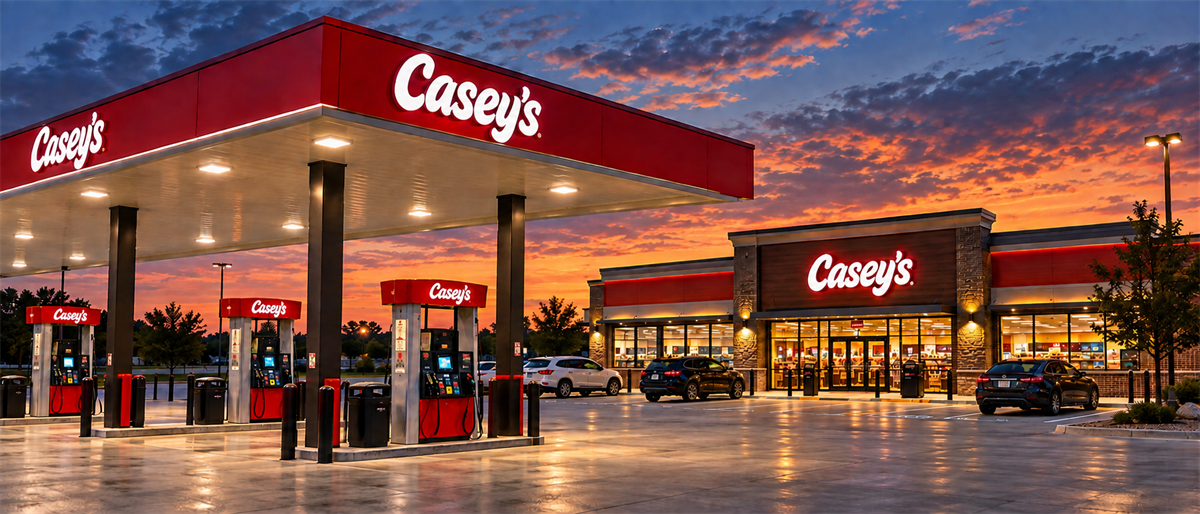
Casey’s is among the best-operated businesses on Wall Street, sustaining a fortress-quality balance sheet while investing in growth and returning capital to shareholders. Its stock price action is supported by growth, margins, margin strength, cash flow, dividends, and share buybacks, all of which are expected to continue in the coming years and point to substantial value gains for investors.
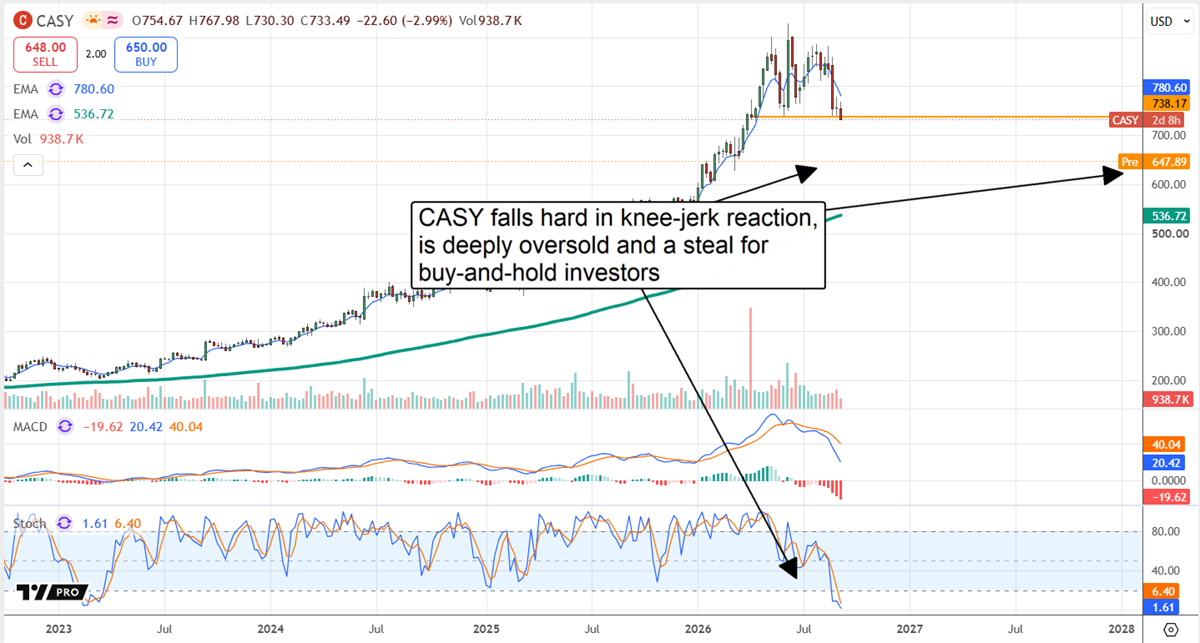
The details of the Q1 FY2027 report were more of an excuse to sell than a real trigger. While slowing growth and rising costs are a concern, outperformance, wider margins, and cash flow strength were also present, suggesting the bearish reaction is a knee-jerk response likely to be corrected quickly. The more pressing concern is the guidance, but even that provides a catalyst likely to emerge as soon as the subsequent earnings report. Guidance is positive, expecting growth, but it was maintained at the prior level rather than strengthened, which is odd given the Q1 strength. The likely outcome, however, is cautious guidance, continued strength, outperformance in Q2 and eventual improvement.
Casey’s 3-Year Plan Is Already Showing Up in Results
Casey’s General Stores revealed an ambitious three-year plan earlier this year, and the results are already starting to show. Key takeaways include a focus on food, menu offerings, customer satisfaction, store counts, and technology reminiscent of fast-casual restaurant successes such as Chipotle Mexican Grill (NYSE: CMG).
Laugh if you want, but a comparison is warranted. Casey’s is a gas station first and foremost, but it is the inside sales that drive growth, dominated by pizza and food offerings that have elevated it to 5th position in the US pizza market. Chipotle Mexican Grill’s then-CEO, Brian Niccol, accelerated growth and margin expansion with the same tactics he’s now using at Starbucks—leaning into digitization for efficiency, consumer reach, and loyalty programs, just as Casey’s is doing.
Casey’s General Store grew revenue by 24.5% to $5.69 billion on the combination of comp-store growth, new stores, and acquisitions. Revenue outpaced MarketBeat’s consensus by more than 250 basis points (bps), driven by better-than-expected comps and a faster-than-expected Fike’s integration. Inside comps grew by 3.2%, down from last year’s 4.3% but ahead of forecasts, underpinned by a 4.8% increase in food. Margin was another strength, with the inside margin improving to 42.2%. Fuel gallons sold declined marginally by 0.3%, but a substantial margin improvement offset the decline, resulting in a nearly 20% increase in segment gross profit.
Margin news is good. Operating costs rose by 8%, trailing the 24.5% top-line advance by a wide margin, leaving net earnings and GAAP earnings per share (EPS) up by 27.1% and 27.7%, respectively. Looking ahead, the company still expects solid results for the year, with inside comps forecasts up 2%-5%, but the lack of improvement helped trigger and amplify the sell-the-news event.
Analysts Remain Constructive After Casey’s Q1 Pullback
Analysts’ initial responses do not align with the stock price plunge. The few commentaries released praised the results, citing Q1 strengths such as inside sales momentum, fuel margins, and the ability to meet full-year goals, all of which deserve a price premium. As it stands, the 20 analysts MarketBeat tracks rate the stock a Moderate Buy; the data shows a Buy-side bias, no sell ratings and strong price targets. While a few late-summer price target reductions cap upside, they align with the consensus forecast, suggesting a move into the low-$900 range. The current price target of $928.53 indicates nearly 53% upside.
Institutional buyers are likely to buy this stock on the dip. They reflect strong confidence in cash flow and the capital-return outlook, owning more than 85% of the stock. They have accumulated on balance for eight consecutive quarters, ramping activity in early calendar Q3 following the three-year strategy update.
Capital returns are a significant factor, including dividends and share buybacks. The company is a Dividend Achiever, having increased its dividend for more than 25 consecutive years, and has the potential to sustain annual increases for another 25 years. The yield is low at 0.43% but reliable and compounded by growth and buybacks. Buybacks reduce the share count incrementally each quarter, except when the company preserves capital for acquisitions. There are no major acquisitions in sight, only tuck-ins and organic expansions that the company can fund with cash flow. READ THIS STORY ONLINE
Barrick Mining has spent decades building one of Nevada’s richest gold districts, anchored by Fourmile, Goldrush, and Cortez Hills, deposits that could hold up to 60 million ounces of gold.
One overlooked explorer controls 142 claims bordering Fourmile and sitting less than a mile from Goldrush. New geological modeling aims to reveal what’s beneath this largely untested ground, while a planned 5% royalty spin-off could give shareholders a separate stake in the project.READ THE FULL REPORT BEFORE THE NEXT CATALYST HITS
The Night Owl is a financial newsletter that provides in-depth market analysis on stocks of interest to individual investors. Published by MarketBeat and Early Bird Publishing, The Night Owl is delivered around 9:00 PM Eastern Sunday through Thursday. If you give a hoot about the market, The Night Owl is the newsletter for you.
(7) But if we walk in the light as He is in the light, we have fellowship with one another, and the blood of Jesus Christ His Son cleanses us from all sin. New King James VersionChange email Bible version
We know what walk means. It implies how we conduct our lives. I John is a letter written to a church congregation, and he is instructing church members that fellowship hinges on walking in the light. This is how we are to have fellowship with one another.
The context of this instruction is quite interesting. Protestantism focuses heavily on the initial forgiveness of sin that takes place upon belief at the beginning of salvation. Thus, their evangelists have altar calls. People come down before the altar and confess their sins and accept Christ as their Savior. Once they do this, these people are considered “saved” and “born again.” Their doctrine—that of eternal salvation—continues in this vein, that is, once that occurs, salvation is basically assured. So a great deal of emphasis is put on the initial repentance and forgiveness of sin.
However, notice this verse in its context. John writes, “If we walk in the light. . . .” An individual cannot walk inthe light until he is called and converted. This walking occurs after conversion. He continues, “If we walk in the light, as He is in the light, we have fellowship. . . .” The fellowship depends on what we do after the initial repentance. Amos writes, “Can two walk together, unless they are agreed?” (Amos 3:3). It cannot be done. We do not have fellowship with people that we do not agree with. Agreement is shown by the way that we conduct our lives—by the way that we behave under our belief system.
“. . . and the blood of Jesus Christ His Son cleanses us from all unrighteousness.” This phrase, in context, is the game-breaker. The apostle is teaching that further cleansing, further forgiveness, hinges on our obedience to God after we are converted, for “walking in the light” is synonymous to being obedient or living righteously. Forgiveness after conversion works exactly the same way as the forgiveness we were given before we were converted. It hinged on whether we had repented and had begun obeying God.
Clearly, salvation is a process!
What we must understand here is that forgiveness, cleansing, and even fellowship is not a once-for-all act; but it is a process—even as growing in the grace and knowledge is a process, even as the writing of God’s law on our heart is a process. Cleansing is a process. The quality of the fellowship depends upon all of these things. So, if we walk in the light, we have fellowship and His blood cleanses us.




.jpg?width=1120&upscale=true&name=OneYearLater_Popup2%20(3).jpg)




 News for you, Peter
 Today’s game
 Trending now1.