I was born on 6 August 1956 in San Francisco, California to Janet and (the late) Richard Hovis.
I grew up in Santa Monica, California where I attended elementary, junior high school, and high school (graduating in 1974), in addition to involvement in sports and recreation (Little League +, the Boy’s Club ++). Further, it was in elementary school – St. Augustine’s By-the -Sea Parish School that I found, and made the choice to truly journey with God.
I attended Arizona State University from 1974 to 1977 – seeking to become an architect, however, I was not accepted, and, as such, I graduated with a Liberal Arts degree.
Upon graduation from Arizona State University, I attended Cal Poly San Luis Obispo and studied City and Regional Planning at the Master’s level. I successfully completed one (1) year in a two (2) year program – I did not complete the Master’s degree in City and Regional Planning – due to personal reasons.
I returned to Santa Monica where I started (October 1979) my career as graphic designer with Exxon Company, USA. I spent five years with Exxon Company, USA.
While working with Exxon Company, USA I was accepted into architectural school – Sci-Arc in Southern California, however, I did not attend preferring to stay with Exxon..
In 1982 I married Laura Flosi and in April 1983 we had our one and only child – Lauren Alain Hovis – a gift from God.
We moved to Phoenix, Arizona in 1984 from Los Angeles, where I went to work as a graphic designer with Kitchell CEM (from 1985 -1987).
From 1987 – 1995 I was an independent contractor, and a registered representative in mortgage finance, financial management, graphic design, and drafting.
Further, I attended the University of Phoenix and successfully obtained a Master’s in Business Administration (MBA) in 1982.
I was also a member of the Scottsdale Jaycees, where I became very involved in community events and projects.
In 1994, I accepted a cartography position with the Defense Mapping Agency in Reston, Virginia. As such, I relocated from Phoenix to Reston.
In 1998, I was accepted and worked as a Visual Information Officer with the Central Intelligence Agency. In 2002, I worked as a Support Officer until my retirement (due to a need for shoulder surgery) in September 2018.
Away from my Federal Government service, I have been involved in various organizations and activities in Northern Virginia.
In November of 2011, I married Rebecca Ouellette in Santa Monica, California. I reside in San Tan Valley, AZ with my two hamster - Jess and Timothy, our fish, our lizard - RJ Lizard., and our cats - Pearl and Grey.
As to hobbies, I enjoy playing sports, attending sporting events, mentoring individuals from financial management to hamsters, building models, photography, travel, multimedia design, managing partner for RJ Hamster, and jazz – smooth jazz to a samba or a bossa nova.
Love and God Bless,
Peter – aka RJ Hamster Jo hi
View in your browser #MYTRILOGYLIFE Encanterra® Encanterra Leaderboard Jan 30, 2026 Featured Events Dancing with the Encanterra StarsSat, Jan 31 7:00 PM – 9:00 PM Other: Mallorca Event Center
Who doesn’t love a good dance competition?! The Utah Ballroom Dance Company will be bringing their Dancing Pros to Encanterra, pairing our Members with these professional dancers to entertain and compete to be crowned winner of Dancing with the Encanterra Stars on Saturday, January 31st at 7:00pm. Doors open at 6:00pm….View EventTribute Concert, featuring Keith Ormrod, a Tribute to Kenny ChesneySat, Feb 7 4:00 PM – 5:30 PM Other: Algarve
We are keeping the country music vibe going with our Tribute to Kenny Chesney on Saturday, February 7th, at 4:00pm, featuring Keith Ormrod and the Left of Center Band. Grab your boots and hats and scoot on down to the Algarve for a great night of music and dancing.
Kenny Chesney is an American country sing…View EventComedy Night at the ClubTue, Feb 10 7:00 PM – 9:00 PM Mallorca Events Center Room A
Comedy at the Club has been a hit with our Members for a long time, have you been to one yet? Join us on Tuesday, February 10th at 7:00pm in the Mallorca Events Center.
The comedians are superb, each bringing their own personal and unique style of comedy to the Club. And what is better than a night of laughter! Get r…View EventJukebox Bingo | Pinks & Reds NightThu, Feb 12 5:00 PM – 7:30 PM Other: Mallorca Events Center
Please be advised of an important update regarding credit card payments at the Business Ce…View PostWeekly Specials through February 1stPosted: Jan 27, 2026
Join us for these delicious weekly specials at any one of our Encanterra restaurants, good through Sunday, February 1st .
Gold Breaks Above $5,500 as Trust Becomes the New Currency — and Why Small-Cap NASDAQ Company SMX Is Emerging as the Infrastructure Play Behind the Precious Metals Rally!
As Gold and Silver Trade at Record Levels,SMXIs Positioning Itself as the Verification Backbone of a New Enforcement-Driven Metals Economy
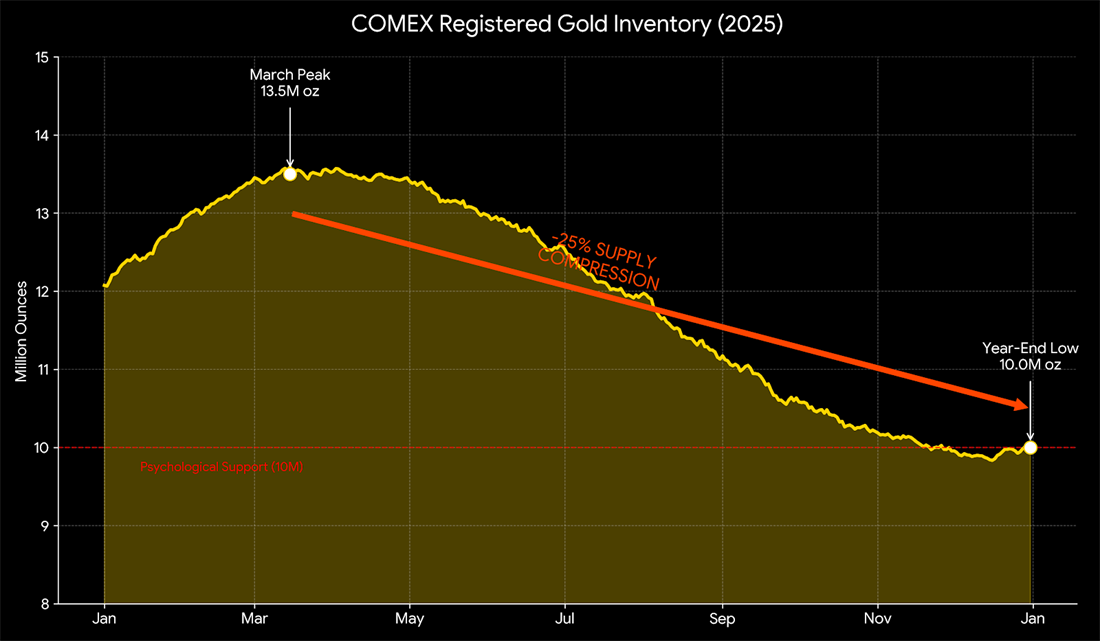
Gold has surged to a record high above $5,500, and silver continues to trade near historic levels, driven by geopolitical risk, expectations of U.S. interest rate cuts, and persistent currency pressure.
Yet beneath the price action, a deeper structural shift is unfolding. Precious metals are no longer judged solely on scarcity and demand — they are now evaluated on verifiability.
Origin, custody, recycled content, and ESG compliance have moved from optional disclosures to enforceable requirements.
As gold rallies into this new era, companies built for transparency under scrutiny stand to matter more than ever. One of them is SMX (NASDAQ: SMX).
Gold’s Rally Is About More Than Price — It’s About Proof
Gold and silver have returned to the center of global capital flows as safe-haven assets, but today’s environment is fundamentally different from past cycles. Regulators, refiners, industrial users, and institutional investors are demanding verifiable proof of origin and custody, not reconstructed narratives.
Traditional paper-based systems struggle under audits, inspections, and cross-border enforcement. In precious metals, trust is no longer assumed — it is tested. This shift is creating a new kind of infrastructure demand, and it is exactly the environmentSMXwas designed for.
What Makes SMX Different: Infrastructure, Not Hype
SMX is a small-cap NASDAQ company quietly building something far more durable than a sustainability add-on. Its mission is to become a global standard for material verification, connecting physical materials directly to blockchain-enabled digital identities. Using patented molecular identity technology, SMXembeds an invisible, chemical-based “barcode” directly into materials themselves — including gold and silver. That identity travels with the material through refining, handling, recycling, and resale, creating continuous, tamper-resistant verification that does not rely on trust, paperwork, or intermediaries.
Silver as the Proving Ground
Silver is one of the most demanding environments for verification. It is heavily traded, tightly regulated, custody-sensitive, and intolerant of error. Substitution risk, undocumented recycling, and custody gaps are not theoretical — they carry real financial and legal consequences.
SMX’stechnology was built for precisely this level of scrutiny.
Verification persists through repeated handling and inspection, making silver not just a use case, but a proving ground. SMX has designed its platform to pass where traditional systems fail.
Gold: Where Regulation, ESG, and Provenance Converge
Gold faces mounting pressure from ethical sourcing mandates, carbon accountability, recycled content requirements, and geopolitical oversight. As enforcement tightens globally, proof can no longer be retroactively assembled — it must exist at the material level.
SMX enables gold to carry its verified history from origin or recycling through refining and downstream use. Because identity is embedded directly into the metal and recorded on blockchain, verification is always present. As regulation escalates, systems that already meet enforcement standards gain relevance without needing to pivot.
From Verification Tool to Verification Platform
Most companies treat verification as a feature. SMX treats it as infrastructure.
The same core technology applies across precious metals, plastics, textiles, agriculture, electronics, and non-ferrous metals. Each deployment strengthens the platform and reduces friction for the next, allowing SMX to expand horizontally rather than chasing one-off verticals. This is how infrastructure scales — quietly, steadily, and with rising switching costs.
Why Regulation Is Becoming SMX’s Largest Catalyst
Markets shaped by regulation do not reward speed; they reward endurance. Enforcement does not arrive all at once, but once it does, participation requires compliance. SMXwas built for inspection, not persuasion.
By embedding proof directly into materials, it aligns naturally with enforcement-driven markets where liability follows the supply chain. As sustainability rules shift from voluntary reporting to mandatory compliance, entire markets become addressable almost overnight.
A Trillion-Dollar Circular Economy Opportunity
The global circular economy is estimated at $4.5 trillion, and SMX is positioning itself as a foundational enabler. By allowing materials to carry verified data on origin, recycling history, and carbon impact, SMX transforms verification from a compliance cost into a measurable asset.
The platform even enables carbon and plastic credits to be directly linked to physical materials, aligning sustainability goals with economic incentives.
Why Investors Are Paying Attention Now
SMX is not an early-stage concept. Its technology has been operational at national scale for more than a decade,originally developed by the Israeli Atomic Energy Commission and deployed by the Israeli government.
Its leadership team brings deep experience in commercialization and global execution. While blockchain has already produced multiple billion-dollar companies at the digital layer, SMXrepresents a different opportunity: blockchain embedded directly into the physical economy, where materials like gold and silver demand absolute certainty.
The Bottom Line
As gold breaks above $5,500 and silver continues its historic run, markets are demanding more than belief — they are demanding proof.
SMX does not need to convince the market of its relevance; it is already aligned with where regulation, enforcement, and capital are moving. From precious metals to plastics, SMX is turning verification into infrastructure. And infrastructure, once embedded, tends to last.
5 Stocks to Buy in February: Last Year’s Winners Aren’t Done Yet
By Thomas Hughes. Publication Date: 1/29/2026.
Summary
Many of 2025’s top-performing stocks remain well-positioned for 2026 as key trends continue to strengthen.
Analysts broadly expect double-digit upside for these names, with several positioned to challenge or set new highs.
Forward expectations may still be conservative, leaving room for a cycle of outperformance and upward revisions as catalysts play out.
2026 is well underway and off to a bullish start. The S&P 500 and other major indices are ending January at record highs, and the Russell 2000 (INDEXRUSSELL: RUT), which tracks small-cap stocks, is leading the charge. The main point: the sector rotation seen over the past 18 months is accelerating. While tech and big tech remain central to the outlook, leadership is broadening to include a wider range of names and risk profiles. Five stocks that led in 2025 still have momentum heading into 2026—and February could offer better entry points.
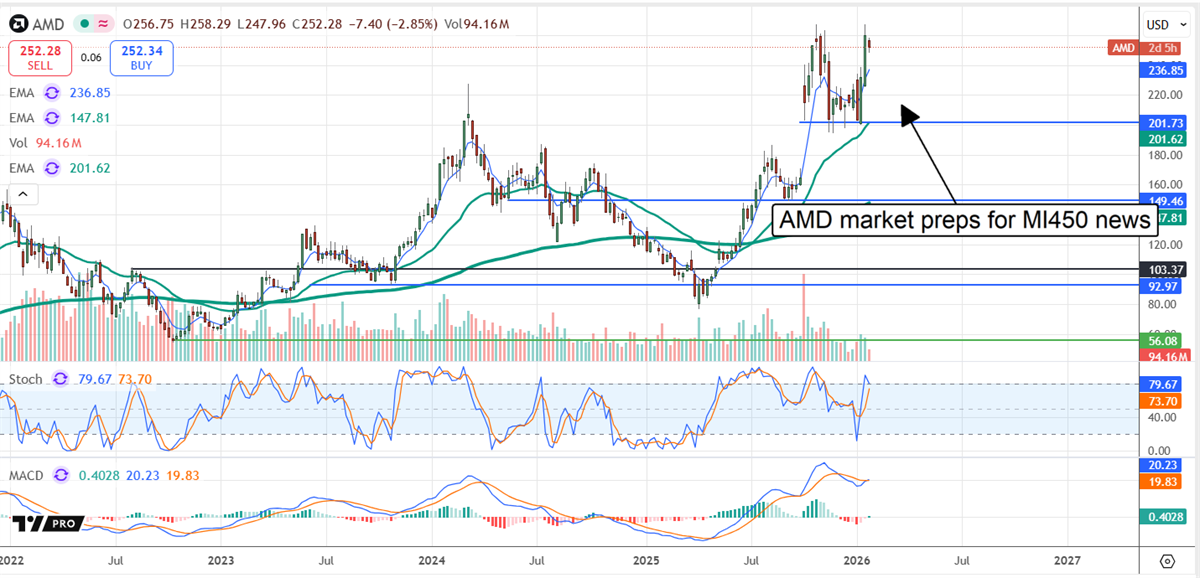
Advanced Micro Devices (NASDAQ: AMD) is ending January up more than 25% from its early-month lows. The move, which confirms support at last year’s key resistance level, reinforces the growth outlook implied by the MI450 launch. That launch, scheduled for later in the year, could produce an NVIDIA (NASDAQ: NVDA)-like outcome: a triple-digit surge in datacenter revenue and potentially systemwide growth.
A widely followed Wall Street analyst is highlighting AES Corp (AES) as a stock to watch right now, based on signals from his proprietary Power Gauge system. The model tracks factors like momentum, financial strength, and institutional activity across thousands of U.S. stocks.
He breaks down the full reasoning in a short briefing, including why AES is showing unusual strength at this stage of the market.See the full analysis here
Based on forecasts, the stock appears to be trading at a deep discount to analysts’ estimates, which may be conservative. Sentiment is nevertheless bullish, with numerous January coverage initiations, a firming Moderate Buy rating, and rising price targets. Sentiment trends suggest the stock could reach the high end of the range—roughly 35% upside as of early 2026—and that high-end targets may be raised further by year-end.
Amprius Technologies Cements Production Capacity Ahead of Q4 Release
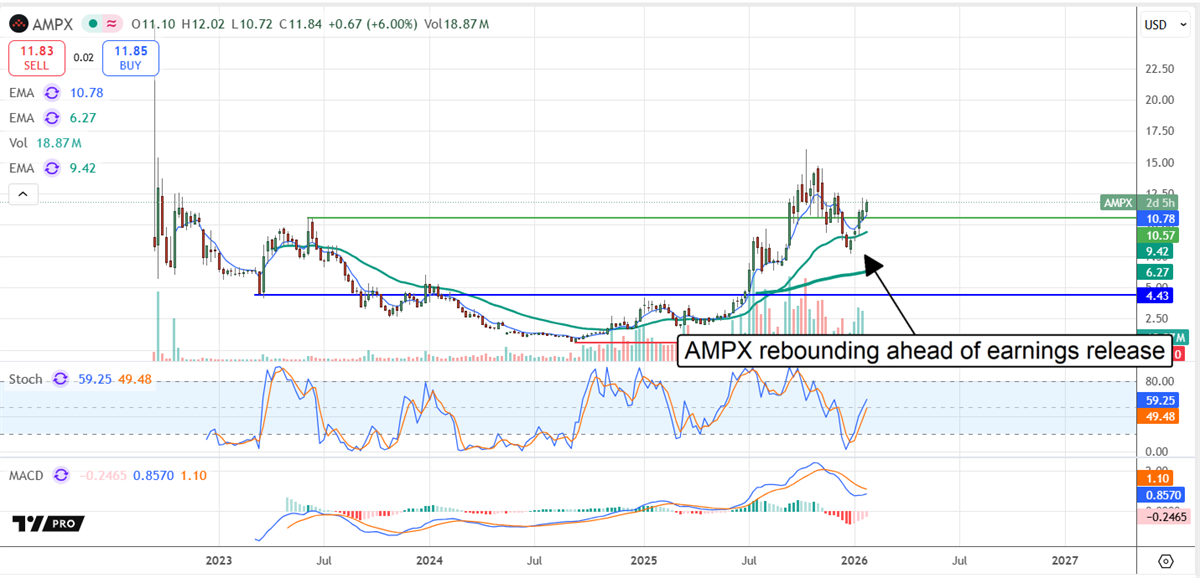
Amprius Technologies (NYSE: AMPX) is up about 50% from recent lows as investors prepare for its Q4 FY2025 earnings release, slated for late March. The report is expected to confirm a strengthening order pipeline, ramping production, and a clearer pathway to profits.
Recent news includes the addition of three South Korean battery manufacturers to its production alliance, putting Amprius ahead of schedule and well on track to meet its goals for cost reduction and lower cash burn. Analysts are optimistic, rating the stock a Moderate Buy with roughly 35% upside toward the critical resistance level near $12.
Credo Technologies Pulls Back Into Buying Opportunity
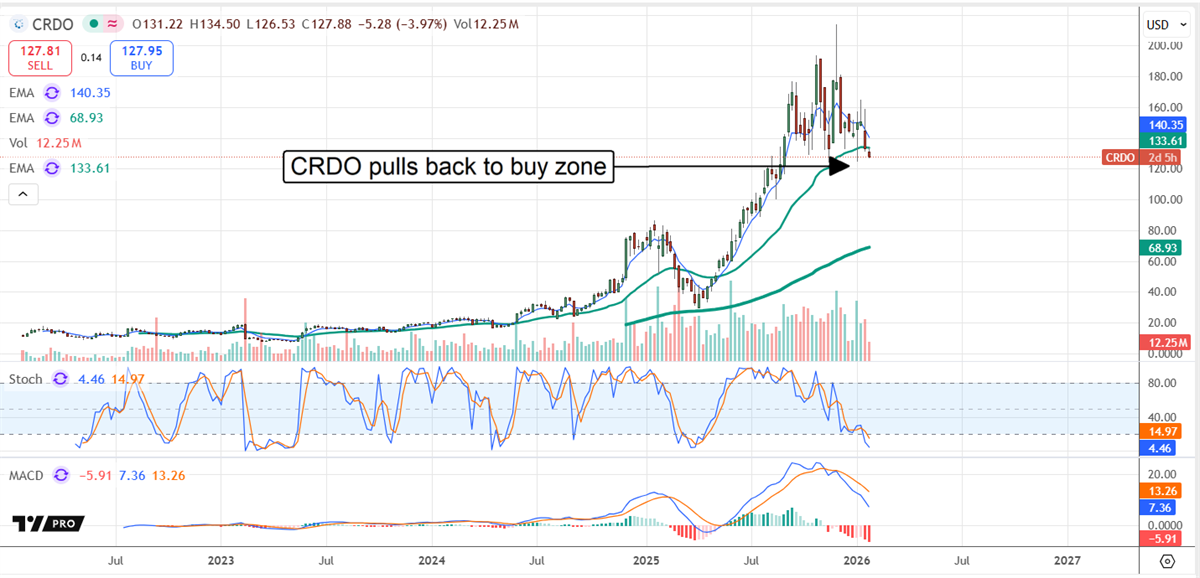
Credo Technologies (NASDAQ: CRDO)is pulling back, presenting a clear buying opportunity. The retreat runs counter to accelerating operational results and improving analyst trends. MarketBeat data show that coverage increased significantly over the trailing 12 months, sentiment firmed to Buy from Moderate Buy, and price targets trended higher.
The stock is up about 5% month-over-month in January, while consensus estimates are up nearly 200% year-over-year, implying roughly 70% upside, with many forecasts targeting the high end of the range. A potential catalyst is the Q3 FY2026 report, scheduled for early March. Credo remains central to advanced datacenter technology, AI and model inference, which should support continued strength.
Bloom Energy Blossoms Under Data Center Demand
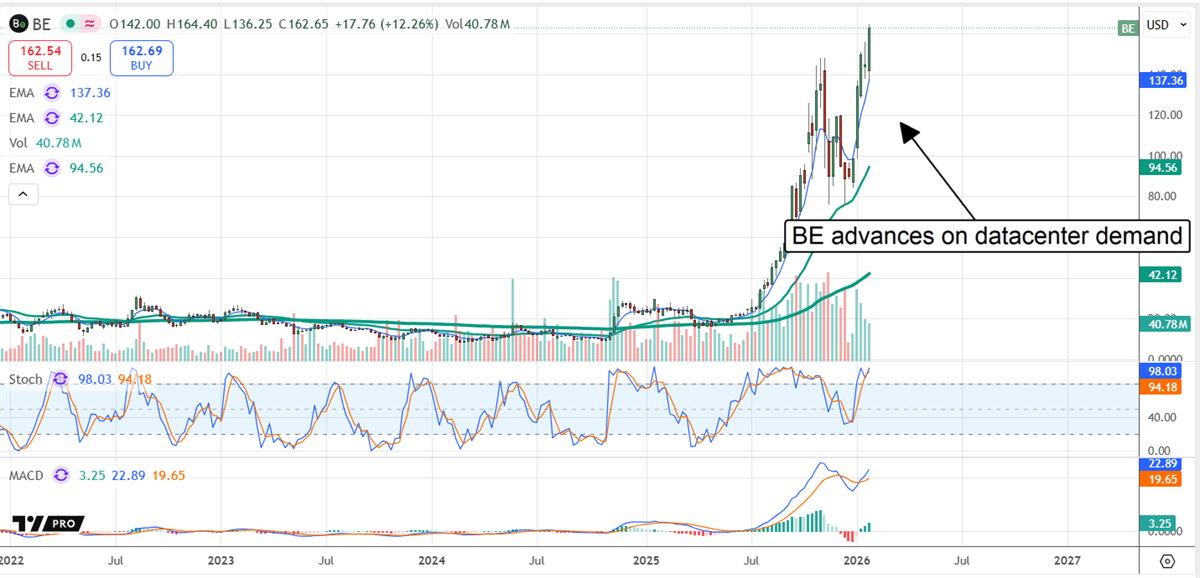
Bloom Energy (NYSE: BE) makes low-emission, high-efficiency fuel cells that are well-suited for targeted applications, including data centers where traditional grid connections can be a constraint. Its technology enables quick, lower-cost deployment and operations. While not ideal for the largest sites, rising demand is driving revenue growth and improving margins.
Bloom Energy accelerated sequential and year-over-year growth to more than 50% in Q3 and is expected to sustain high double-digit growth into Q4 FY2025 and 2026. Profit growth should outpace revenue, supporting a rapidly improving analyst outlook. The 26 MarketBeat-tracked analysts currently rate the stock as a Hold, but coverage has increased substantially over the past year, sentiment is firming (verging on Moderate Buy), and the consensus price target has risen sharply—by roughly 400%. Though it has lagged the market, January forecasts point to about 20% upside this year.
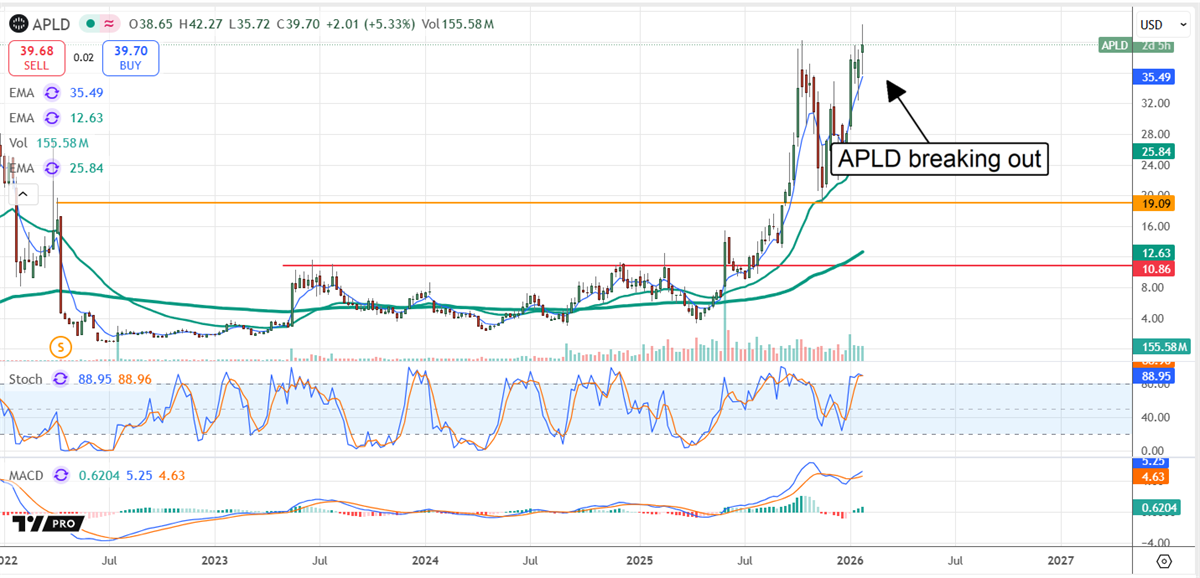
Applied Digital Breaks Out After Solid Results
Applied Digital (NASDAQ: APLD)delivered Q2 FY2026 results that the market clearly welcomed, with revenue nearly doubling year-over-year and beating consensus estimates. The strong quarter reinforced a bullish outlook that includes the completion of its second campus, expected to start coming online this year.
The second campus is largely sold out, and new contracts—such as one with CoreWeave (NASDAQ: CRWV) —suggest demand will require a third campus sooner rather than later. Analysts reacted positively, with coverage initiations, upgrades, and price-target increases pointing toward the high end of the range and implying as much as 50% upside from the breakout point.
Thank you for subscribing to The Early Bird, MarketBeat’s 7:00 AMnewsletter that covers stories that will impact the stock market each day.
This email content is a sponsored message provided by SmallCaps Daily, a third-party advertiser of The Early Bird and MarketBeat.
This message is a paid advertisement for SMX (NASDAQ: SMX) from SmallCaps Daily and Interactive Offers. MarketBeat Media, LLC receives a fixed fee for each subscriber that clicks on a link in this email, totaling up to $25,500. Other than the compensation received for this advertisement sent to subscribers, MarketBeat and its principals are not affiliated with either SmallCaps Daily or Interactive Offers. MarketBeat and its principals do not own any of the stocks mentioned in this email or in the article that this email links to. Neither MarketBeat nor its principals are FINRA-registered broker-dealers or investment advisers. The content of this email should not be taken as advice, an endorsement, or a recommendation from MarketBeat to buy or sell any security. MarketBeat has not evaluated the accuracy of any claims made in this advertisement. MarketBeat recommends that investors do their own independent research and consult with a qualified investment professional before buying or selling any security. Investing is inherently risky. Past-performance is not indicative of future results. Please see the disclaimer regarding SMX (NASDAQ: SMX) on Interactive Offers’ website for additional information about the relationship between Interactive Offers and SMX (NASDAQ: SMX).
If you have questions or concerns about your newsletter, please don’t hesitate to email our U.S. based support team at contact@marketbeat.com.
If you no longer wish to receive email from The Early Bird, you can unsubscribe.
For the first time in decades, the U.S. government is no longer standing on the sidelines of innovation – it’s actively directing it.
In today’s Friday Digest takeover, our technology expert Luke Lango explains why 2026 may look like a national mobilization, with Washington actively funding, fast-tracking, and steering the buildout needed to win the AI race.
This shift goes far beyond regulation. The government is now shaping outcomes – backing critical supply chains, clearing bottlenecks, and accelerating infrastructure tied to AI dominance.
In his essay below, Luke introduces the framework he’s using to track this transition, and highlights where the most compelling opportunities are emerging.
Enough introduction. I’ll let Luke take it from here.
Have a good evening,
Jeff Remsburg
In the early 1940s, Americans couldn’t explain why obscure chemical firms were suddenly flush with cash or why Washington cared about desert towns in New Mexico.
And in the early 1960s, few investors understood why the government was pouring billions into rockets, primitive computers, and aerospace firms most people had never heard of.
But a small group did understand. They recognized the signs of a national mobilization, positioned early, and reshaped their wealth.
That same pattern is unfolding again today.
Most investors are trying to play 2026 with a 2019 rulebook. That world is gone. The era of frictionless globalism is over.
We’ve entered a new phase where the U.S. government isn’t just regulating markets… it’s fast-tracking permits, steering contracts, and funding critical buildouts toward winning the AI race against China.
When Washington decides it can’t afford to lose, it stops debating… and starts building.
That’s how we built the atomic bomb first.
That’s how we beat the Soviets to the moon.
And that’s how we’re now responding to China’s push for AI dominance.
That’s why my team and I just released a free broadcast focused on what I believe is the most important government-backed investment opportunity of our lifetime… and the narrow window opening beforeWall Street fully connects the dots.
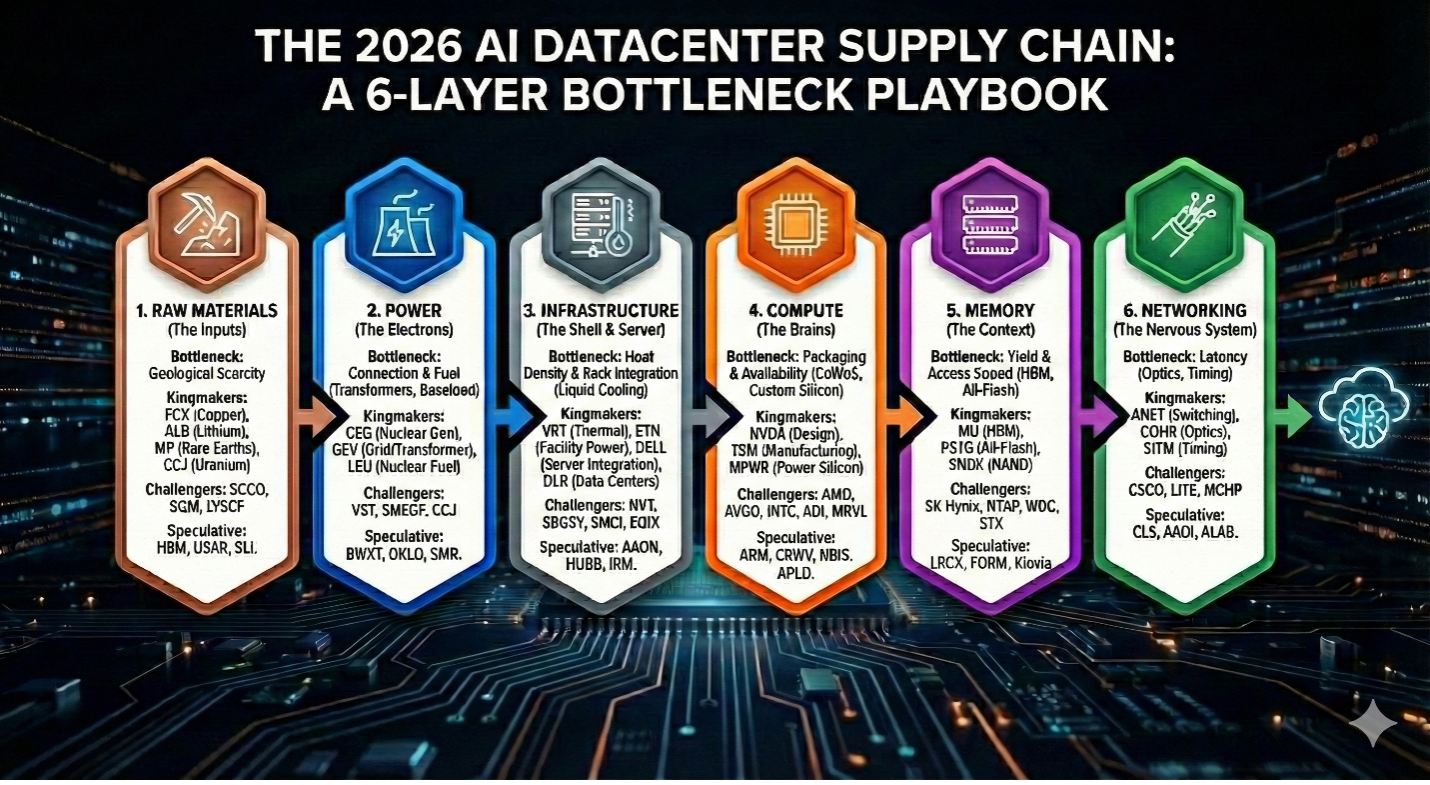
Below, I’ll show you the framework — and the six bottlenecks investors should be watching right now.
Because events like this don’t feel obvious until after the opportunity has passed.
Futurist Eric Fry says Amazon, Tesla and Nvidia are all on the verge of major disruption. To help protect anyone with money invested in them, he’s sharing three exciting stocks to replace them with. He gives away the names and tickers completely free in his “Sell This, Buy That” broadcast. Click to stream now…
From Free Markets to National Mobilization
For decades, when it came to the private sector, the prevailing belief in Washington was simple: Set fair rules, then get out of the way. The “invisible hand” would take care of the rest.
That invisible hand optimized for cheap labor, global efficiency, and short-term profits – but not national resilience. The result was a hollowed-out manufacturing base and a growing dependence on foreign rivals for the materials and technologies that now define economic and military power.
For a while, it looked like a win. Cheap goods. Higher margins. Faster growth.
That illusion has collapsed.
The U.S. has entered a new era of national mobilization. The government is setting the priorities, clearing obstacles, and backing companies that advance American AI dominance.
If a company helps achieve that goal, it gets fast-tracked approvals, government cash, and policy support.
That’s the new reality.
Over the past year, Silicon Valley has accepted that the next era is about building the modern equivalent of the Manhattan Project or Apollo Program.
In return, Washington has stopped pretending that decade-long approval processes and fragmented regulation are compatible with winning the race that will shape the next era.
This also explains why geopolitics suddenly feels louder: Supply chains are now strategy.
America has three nonnegotiable needs: massive energy, enormous quantities of raw materials, and unprecedented computing power.
And it doesn’t have enough of any of them.
So the government is acting accordingly… using diplomacy, industrial policy, and national security tools to secure energy supplies, stabilize material flows, and accelerate infrastructure buildouts. In effect, the U.S. government is helping secure the inputs AI needs: power, materials, and compute.
The 2010s investor playbook — capital-light, consumer-first growth — doesn’t fit this market. We are entering a period defined by heavy capital spending, physical constraints, and state-backed demand.
The strategy now is to own the choke points — the materials, power systems, infrastructure, and technologies that this new system cannot function without, and cannot scale fast enough on its own.
To that end, I have identified the 6-Layer AI Bottleneck Playbook.
1. The Raw Materials Layer: You can print money, but you can’t print copper — and you can’t code lithium. The physical inputs required for this buildout are in short supply. We face a 10-million-ton copper deficit over the next decade.
The Play: Own Western copper, lithium, and uranium. The ground itself is now a strategic asset.
2. The Power Layer: AI is an energy vampire. Big Tech is being forced to build its own power generation, bypassing the public grid entirely. The only solution for 24/7, carbon-free, massive-scale power is nuclear.
The Play: Own the existing nuclear fleet and the fuel cycle. They hold the keys to the energy source that fits the mission profile.
3. The Infrastructure Layer: A rack of Nvidia Blackwell chips runs so hot it would melt a standard server room. We have to retrofit the entire internet with liquid-cooling plumbing. We need new switchgear, new transformers, and massive new physical shells.
The Play: Own the companies that manage heat and physical power distribution. The “plumbers” of the AI age are about to become kings.
4. The Compute Layer: It’s no longer just about getting a raw GPU. It’s about “packaging” – the incredibly complex process of stitching the GPU and memory together on silicon. Further, the U.S. government is actively pushing American-designed custom silicon to reduce reliance on generic chips.
The Play: Own the packaging monopoly and the leaders in U.S.-designed custom silicon.
5. The Memory Layer: An AI chip without memory is useless. The new HBM (high bandwidth memory) chips are stacked vertically like skyscrapers on a microscopic scale. The manufacturing yield is terrible, and the entire global supply is sold out until 2027.
The Play: Own the domestic memory producers that have cornered the market on the high-end supply.
6. The Networking Layer: When you connect 100,000 GPUs together, copper wires are too slow. You need light. The insides of datacenters are switching from electrical cables to fiber optics and lasers.
The Play: Own the masters of optical interconnects and low-latency switching.
The Train Is Leaving
Look, I understand why this feels unsettling…
But if we lose the AI race to China, nothing else matters.
That’s why we’ve begun moving trillions of dollars – from both private coffers and the public purse – to the six bottlenecks listed above. The government is using a firehose to blast away regulatory hurdles and using its military to secure the supply lines.
In moments like this, the market rewards those who understand what’s happening and position themselves before execution begins.
During that event, I dig much deeper into this shift… breaking down what’s really happening behind the scenes, why this moment mirrors past mobilizations like Manhattan Project and Apollo Program, and how investors should be positioning as the next phase unfolds.
Luke Lango Editor, Early Stage Investor Senior Investment Analyst, InvestorPlace
Manage your account We hope this timely investment research is valuable to you. As you know the markets move fast and conditions change frequently. So please check the current issue for the most recent advice. Please note that we cannot be liable for any missed bulletins caused by overzealous filters. To ensure that you continue to receive this valuable part of your service please take a moment to add services@exct.investorplace.comto your address book.
Editor’s Note: After decades in the markets, you start to recognize when something is real – not because it’s being shouted on cable news, but because capital is already starting to move.
I see that firsthand when I spend time around investors, policymakers and business leaders – whether in Washington or at places like Mar-a-Lago – where the conversation has shifted away from whether the government should act and toward where it’s already acting.
Right now, the U.S. government isn’t just talking about AI, supply chains and national security. It’s setting timelines, identifying chokepoints and in some cases backing companies directly. Those are signals experienced investors learn not to ignore.
Below, my InvestorPlace colleague Luke Lango breaks down how this dynamic is taking shape through the Genesis Mission – why only a handful of pressure points truly matter in 2026, and how a very specific government timeline is already beginning to direct capital toward them.
Luke expands on these ideas in a free Genesis Mission broadcast for investors who want a clearer view of what’s forming and how fast it’s moving.
The American free market has officially closed for renovation.
And when it reopens, it won’t look anything like the one we once knew.
We are sprinting toward a corporate-state hybrid that looks less like 1980s Wall Street and more like 1942… when Detroit stopped making Buicks and started building B-24 bombers.
But instead of building planes, we’re building AI data.
And the Trump administration isn’t just supporting companies. It’s buying equity in them.
In just the past few months, the White House has taken…
A 10% stake in Intel Corp. (INTC) by converting CHIPS Act grants…
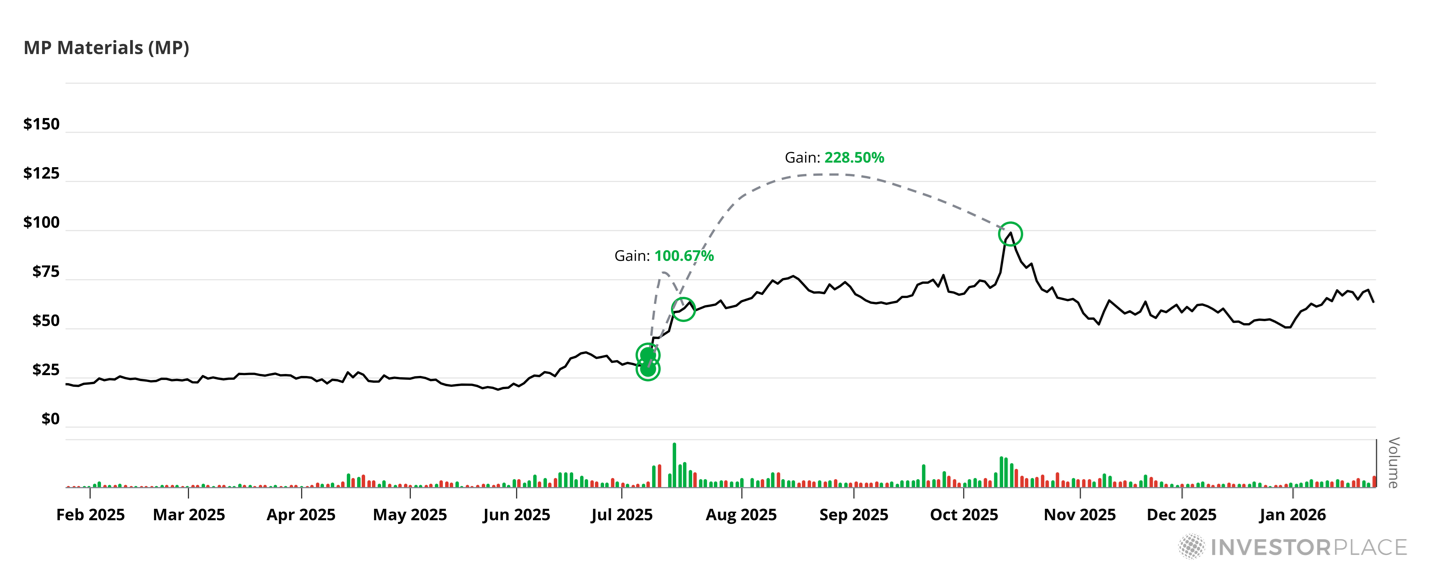
A 15% position in rare earths supplier MP Materials Corp. (MP)…
A 10% stake in Trilogy Metals Inc.(TMQ)…
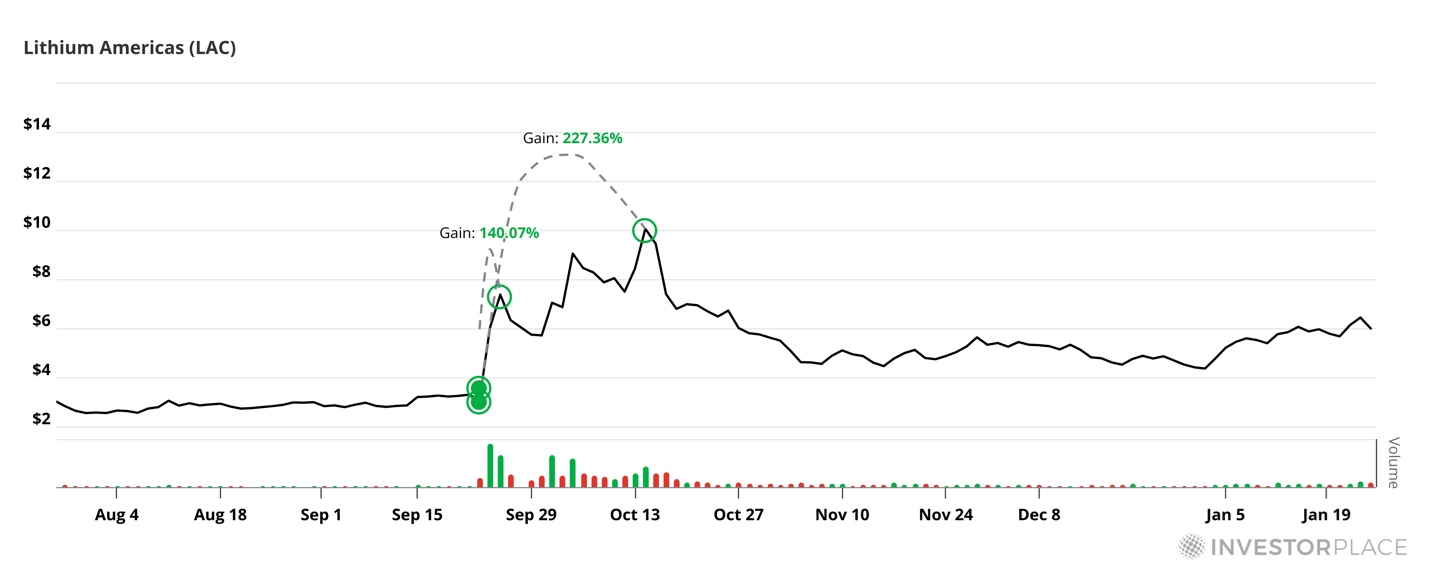
And a 10% stake in Lithium Americas Corp. (LAC).
After MP announced its partnership with the Department of Defense on July 10, 2025, the stock shot up 100% in just seven days. From peak to trough over the past six months, MP gained close to 230%.
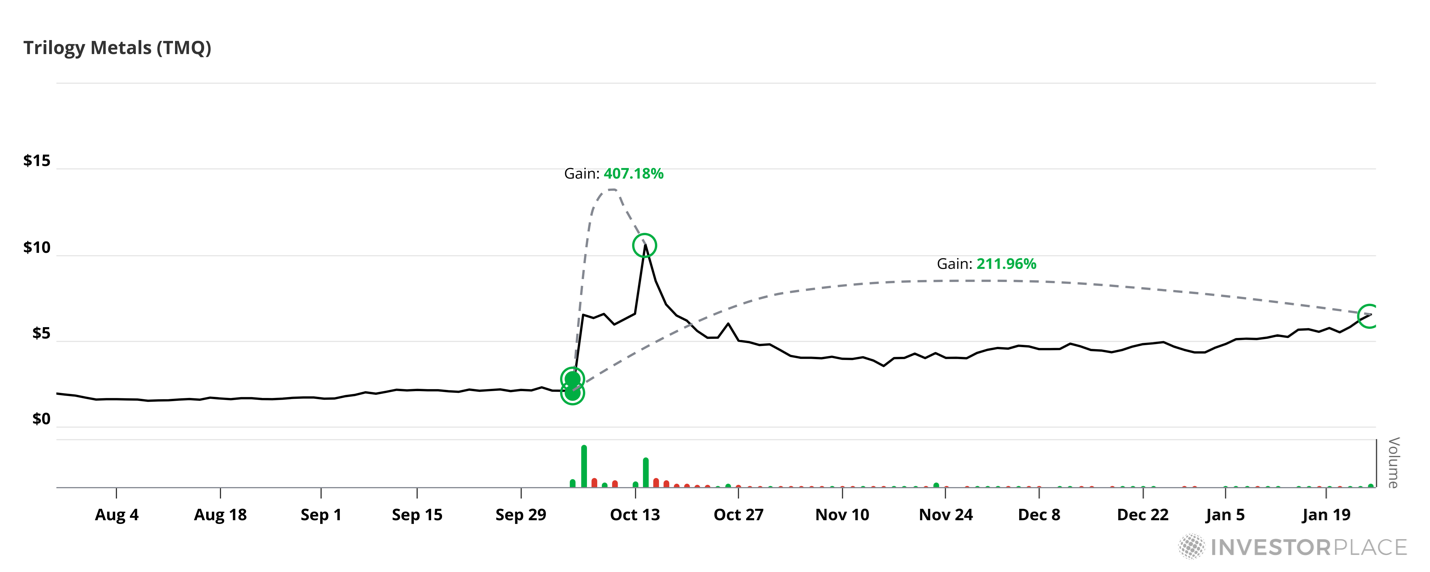
Now, take a look at TMQ before and after the Trump administration invested $35.6 million in the company:
From October 6, when the government invested in TMQ, to October 14, the stock shot up 407%! Even if you missed that initial surge, it’s still up 200%-plus since.
Then there’s LAC stock, which saw a surge of 140% a mere day after reports emerged that the Trump administration was seeking a 10% stake in the miner. From peak to trough, LAC surged nearly 230%.
But these gains in these companies were just the appetizer.
The main course is the Genesis Mission.
So, let’s dig into what the Genesis Mission is… why I believe it’s the single most important investment theme of 2026… why traditional analysis will fail you here…
And how to position your portfolio beforethis transformation becomes obvious to everyone else.
Because once it does, the easy money will be gone.
That’s when Nvidia’s silent partner could shock the world… And make a lot of people wealthy in the process. Nvidia and this partner are developing a new tech that, according to the CTO of Cloudera… “Is set to overshadow AI as the next major technological revolution.” Click here to get the details.
America’s Manhattan Project for AI Dominance
On November 24, President Trump signed an executive order launching the Genesis Mission. The financial media (still obsessing over quarterly earnings and Fed policy) referred to it as an “AI initiative.”
But the Genesis Mission isn’t about building a better chatbot. It is the Manhattan Project for AI.
It’s an acknowledgment by the White House that “letting the market decide” is how you lose a war to a command economy like China.
China doesn’t wait for a startup to secure funding to build a fusion reactor. It just builds it. Nor does it rely on market forces to secure its antimony supply. It seizes the mines instead.
That’s why the Trump administration has looked at Beijing and said, “Fine. Two can play at that game.”
Led out of the Department of Energy, the Genesis Mission will do the following:
Centralize Scientific Data
The DOE is nationalizing the world’s largest scientific datasets.
Weaponize AI
These datasets are being fed into massive, state-run AI models trained on government supercomputers to solve physics and engineering problems that would normally take decades.
Compress Timelines
The goal is to shrink 10 years of research and development into 10 months.
Pick Winners
The government will identify the companies critical to this mission, fund them, provide them with the AI, and – crucially for investors like us – likely buy equity in them.
This is a total mobilization of the U.S. industrial base. And it is targeting six strategic industries.
Only Six Sectors Matter in 2026
The Genesis Mission identifies six specific industries that will determine whether America remains a superpower or becomes a vassal state.
These are the only sectors that matter in 2026:
Biotechnology – AI-trained scientific foundation models to compress drug and materials discovery from years into months.
Critical Materials – AI-driven discovery, mining, and processing of rare earths, lithium, uranium, and antimony.
Nuclear Fission and Fusion – Reliable, 24/7 energy to power AI supercomputing at national scale.
Quantum Information Science – Solving problems classical AI cannot: optimization, simulation, cryptography.
Semiconductors and Microelectronics – Domestic control of the chips that run AI, robotics, and defense systems.
Advanced Manufacturing (Robotics and Automation) – Robotic labs and automated factories that turn AI designs into physical output.
This is the modern Manhattan Project. And Washington has already pressed “go.”
Your 270-Day Investment Window
The White House is not wasting time here.
The Genesis Mission executive order sets an aggressive timeline with specific deadlines, starting from November 24, 2025:
60 Days (Q1 2026):
The Secretary of Energy must submit a list of at least 20 specific challenges to solve within those six industries.
90 Days (approx. February 22):
Identify all available supercomputing and cloud resources that can be added to the platform.
120 Days (approx. March 24):
Identify the initial datasets and models to be used.
Develop a security plan for bringing in data from outside the government (e.g., universities and businesses).
240 Days (approx. July 22):
Review capabilities for “robotic laboratories” and automated manufacturing facilities.
270 Days (approx. Aug. 21):
Go Live: The “American Science and Security Platform” must demonstrate “initial operating capability” for at least one of the identified challenges.
1 Year (November 24, 2026):
The secretary must submit a full report on progress, user engagement, and scientific outcomes.
As far as Washington goes, that’s an all-out sprint…
The Only Trade That Matters in 2026
The U.S. government is no longer a referee. It’s an activist investor.
And now we know its playbook:
Identify a strategic bottleneck inside one of the six pillars.
Back the company that solves it — with grants, contracts, regulatory fast-tracking, and often equity.
Let the market reprice the stock violently.
We’ve already seen this pattern with Intel, MP, Trilogy Metals, and Lithium Americas… all of which doubled or tripled quickly after federal cash moved in.
And the Genesis Mission expands that playbook across six entire industries.
Essentially, it’s a government-issued roadmap showing exactly where trillions of dollars in U.S. capital are about to flow.
Just like the Manhattan Project… just like the Apollo Program… the government is building a national fortress — and selecting the companies that will form its foundation. Those companies will define the next cycle.
That’s why the smartest strategy for 2026 isn’t stock-picking based on macro guesses or Fed-watching…
It’s about aligning your portfolio with the Genesis Mission’s six industrial pillars. Ignore the noise about interest rates, GDP prints, or consumer sentiment. In 2026, there is only one balance sheet that truly matters: the federal government’s.
And Washington is preparing to deploy staggering sums – through grants, guaranteed contracts, regulatory fast-tracks, and direct equity stakes – into a very specific set of industries and companies.
Will you be positioned before the capital floods in… or will you be chasing headlines after the easy money is gone?
Because this is no longer theoretical. Here’s just one example…
The National Nuclear Security Administration has issued a Request for Information titled “Transformational AI Capabilities for National Security.” Execution is underway. Contracts are being shaped. Funding priorities are being finalized.
This confirms what insiders already knew: This is a production program, not a research project.
If you want to understand how the Genesis Mission will unfold… which companies Washington must back first… and where the real asymmetric gains are forming before institutions move…
Luke Lango Senior Investment Analyst, InvestorPlace
Manage your account We hope this timely investment research is valuable to you. As you know the markets move fast and conditions change frequently. So please check the current issue for the most recent advice. Please note that we cannot be liable for any missed bulletins caused by overzealous filters. To ensure that you continue to receive this valuable part of your service please take a moment to add services@exct.investorplace.comto your address book.
RACE REPLAY: ARCA Menards Series Debut at Lime Rock Park
Secure your Summer of Speed – 2026 Tickets & Passes on Sale Now
AutoX Club – $3,000 of tracktime for $1,500
Own Your Race Day HQ at Lime Rock Park’s Condominium Garages
RACE REPLAY: ARCA Menards Series Debut at Lime Rock Park
Stock cars are on our mind with the NASCAR Clash kicking off the season at Bowman Gray this weekend, so we’re running it back to last summer with the ARCA Menards Series debut at Lime Rock Park!
Don’t forget, ARCA Menards returns to LRP on Friday, July 10th for the Lime Rock Park 100!
Secure Your Summer of Speed in 2026 – Tickets & Passes On Sale Now
From NASCAR trucks roaring through the Berkshires, to the return of the Trans Am Memorial Day Classic, to a refreshed Historic Festival weekend and an elevated MiataCon, you won’t want to miss 2026 at Lime Rock Park!
Save big on the 2026 Autocross season on the FCP Euro Proving Grounds
Whether you’re looking to compete in the 2026 AutoX Shootout or just interested in testing your car’s limitson the FCP Euro Proving Grounds, the AutoX Club gets you more track time for less.
The AutoX Club offers $3,000 of track time for $1,500. Autocross events run from April to November, giving you more than enough opportunity each month to improve your lap time.
Click the link below to read more about membership benefits & get yours today!LEARN MORE – AutoX Club
Own Your Race-Day Home at Lime Rock Park
If Lime Rock is already your second home, make it official.
Step out of your garage and onto the circuit. The Owner’s Lounge and trackside Condominium garages give you a true home base at Lime Rock Park; secure storage, direct track access, and a private place to unwind between sessions.
A limited number of non-loft units are still available, featuring:
Spacious 20’ x 40’ bays – Comfortably fits 4 cars with lifts
True track access – Drive straight from your garage to pit lane.
Exclusive owner perks – private Owner’s Lounge with balcony and trackside viewing, Lime Rock Drivers Club incentives, plus private bathrooms
Was it formed elsewhere in the solar system and later captured by our planet’s gravitational pull?
Or did it originate here on the Earth?
In the 1960s, scientists landed on the likely answer after the Apollo missions brought back about 47 pounds of lunar rocks.
Chemically, they looked almost identical to rocks here on Earth. The most likely reason is that the Moon has terrestrial origins.
But how exactly did Earth spawn its own moon?
According to the “giant impact” hypothesis, billions of years ago, a Mars-sized planet slammed into Earth. The collision threw molten rock into orbit, where it cooled, clumped together, and began orbiting us.
This collision didn’t just create the Moon. It also knocked Earth off balance. As a result, our planet rotates on an axis tilted by about 23.5 degrees.
This is why we have seasons. As Earth tilts toward the Sun, days grow longer. As it tilts away, they grow shorter.
Those seasonal rhythms are the foundation of many of the cycles that shape our everyday lives.
We eat differently across the year as growing seasons change.
We heat our homes in winter and cool them in summer.
We plan travel, wardrobes, and big purchases around the calendar.
Open any basic guide to investing, and you’ll learn that markets move in cycles, too. Stocks rise in bull markets and fall in bear markets. They crash… then recover. Like the seasons, one cycle eventually gives way to the next.
The real edge comes from recognizing when the cycle has turned from bearish to bullish – and having the discipline to act beforethe crowd catches on.
The big question: How do we know where we are in the cycle?
If you’re like most investors, you rely on hunches, guesswork, and gut feelings. At TradeSmith, we take a different approach. We turn to the data.
Today, I’ll show you the TradeSmith tools I use to gauge where we are in market cycles.
And we’ll look at one long-ignored sector where the cycle has turned, thanks to some help from the world’s most powerful tech trend – artificial intelligence.
You can play the AI boom by buying Nvidia, Google, and other direct AI plays like everyone else. But this overlooked sector may offer the most attractive risk-reward way to play AI at this stage of the cycle – without chasing the obvious winners.
Last year, the SPDR S&P Biotech ETF (XBI) gained about 33%. That makes it one of the market’s best-performing sectors.
And so far in 2026, there have been even steeper gains for biotech companies focused on cancer drug development.
Corvus Pharmaceuticals (CRVS) and ImmunityBio (IBRX), which develop drugs to help your immune system fight the disease, have nearly tripled in value. And shares in Erasca (ERAS), which develops drugs aimed at shutting down specific genetic mutations that drive tumor growth, are also close to tripling.
It wasn’t always this way.
After peaking in early 2021, biotech got crushed. From that peak into early 2022, XBI fell as much as 55% – one of its worst drawdowns in years.
But like all cycles, that bear market ran its course. Now, we’re in a bull market in biotech again.
If you’d been following TradeSmith’s Short-Term Health indicator, you would have known when the odds began to shift.
Short-Term Health is a version of our classic Health indicator that’s “tuned” for shorter-term shifts in trends.
It fired a buy alert for XBI last year on July 14. Since then, it’s up 40%.
The signal didn’t fire at the exact bottom in April 2025. That may sound like a flaw – but it’s actually a feature.
Don’t Buy at These Extremes
Think about waves at the beach.
A wave rushes in with force, but it can only go so far before it runs out of energy. At a certain point, momentum is exhausted, and the water starts flowing back out.
Markets behave the same way. Every strong move eventually runs out of steam.
Our work is about identifying those exhaustion points – the moments when a move has gone too far and the odds begin to favor a reversal.
But there’s important nuance…
In our experience, it’s not enough to spot an extreme case and immediately bet against it. Sometimes markets stay overbought longer than you expect. Sometimes they stay oversold. Acting too early is how people get run over.
That’s why we pair cycle analysis with trend confirmation. We look for evidence that momentum has picked up and a new cycle is confirmed.
We won’t catch the entire move higher. But we won’t get wrongfooted by as many false buy signals, either.
We use proprietary software to analyze thousands of stocks, ETFs, and markets searching for these conditions.
We’re not looking for perfection. We just need the odds tilted in our favor – over and over again.
And it’s not just price momentum that’s a tailwind for biotech right now. This is shaping up to be a uniquely bullish cycle, thanks to the most powerful tech trend of our lifetimes – artificial intelligence.
AI Is Unlocking Biology’s Deepest Secrets
AI isn’t a biotech buzzword. It’s doing real work and producing real results.
That shouldn’t come as a surprise. Modern biology has become a data problem, and machines are better than humans at finding patterns inside massive datasets.
By harnessing the power of AI, biotech firms are speeding up the slowest, most expensive parts of drug discovery: identifying targets, modeling molecules, and narrowing thousands of possibilities down to a few real candidates. For example:
DeepMind’s AlphaFold has predicted more than 200 million protein structures – creating a searchable map of how the building blocks of life fold and function, something drugmakers used to spend years figuring out by trial and error.
Insilico Medicine has an AI-designed drug for idiopathic pulmonary fibrosis–a deadly lung disease that affects tens of thousands of new patients each year in the U.S. alone – that’s already reached Phase II trials.
Companies like Recursion are building drug discovery around massive datasets and AI models – backed by partnerships like its $50 million Nvidia collaboration.
And you’re going to be hearing about even more compelling stock stories as companies leverage tech to unlock biology’s deepest secrets.
For instance, AI-designed drugs are moving deeper into human trials. We’re about to see more cases like Insilico’s – AI-generated drug candidates progressing from early safety trials into mid-stage efficacy trials. That’s the point where biotech valuations start to change meaningfully.
AI also helps companies kill bad drug candidates earlier. That sounds negative, but it saves time and capital. And it shifts money toward the winners faster. Markets tend to reward that kind of efficiency.
Also, disease areas are opening up that were previously “too hard.”
Fibrosis, neurodegenerative diseases, and rare genetic disorders – are now becoming viable targets for drug discovery because models can simulate interactions humans couldn’t.
What to Do
If you’re building a portfolio for growth, biotech deserves a spot. And XBI is a great way to play it.
Instead of betting on one drug or one company, it owns dozens of U.S. biotech firms – from early-stage innovators to established names.
Crucially, it’s equally weighted, not dominated by a handful of giants. That means smaller companies – where breakthroughs and takeovers tend to happen – actually move the needle.
And what’s cool about these sector rotations is that, even when an ETF has already jumped 40%, like XBI has, there can still be plenty of stocks in that ETF that are in their Short-Term Green Zone.
And just a couple of simple filters in the TradeSmith Screener can find them for you. Platinum readers and folks who have Ideas by TradeSmith, Trade360, among other subscriptions can screen for Short-Term Health in the industry Biotechnology.
I also regularly post on my X accountwhen these cyclical shifts catch my attention. So make sure to follow me there at @KeithTradeSmith. It’s the best way to keep track of the opportunities I’m seeing in real time as I put TradeSmith’s tools through their paces.
All the best,
Keith Kaplan CEO, TradeSmith
This editorial email containing advertisements was sent to pahovis@aol.com because you are subscribed to this service. To unsubscribe or change your email preferences, please click here.
To contact Customer Service, call toll free: 866-385-2076, Mon–Fri, 9am–5pm ET, or email support@tradesmith.com.
Buy. Hold. Relax. These 10 Stocks Could Build Your 2030 Wealth (ad)Tired of chasing the market every week? Our new free report reveals 10 U.S. stocks you can confidently buy now and hold long term — handpicked by a veteran investor with over 20 years of experience and backed by deep research into megatrends like AI, EVs, and cloud tech.
Recent U.S. Insider BuyingCompanyInsider NameBuy/SellSharesTotal TransactionTransaction DateCurrent PriceSEC FilingASA ASA Gold and Precious MetalsSaba Capital Management, L.P. Major ShareholderBuy3,730 shares @ $73.15$272,849.501/27/2026$64.96ASA ASA Gold and Precious MetalsSaba Capital Management, L.P. Major ShareholderBuy57,165 shares @ $75.32$4,305,667.801/28/2026$64.96NBBK NB BancorpMary Susan Elliott DirectorBuy10,000 shares @ $18.72$187,200.001/24/2025$21.64NBTB NBT BancorpTimothy E Delaney DirectorBuy22,730 shares @ $42.97$976,708.101/28/2026$44.36NFJ Virtus Dividend, Interest & Premium Strategy FundSaba Capital Management, L.P. Major ShareholderBuy51,528 shares @ $13.47$694,082.161/27/2026$13.47NFJ Virtus Dividend, Interest & Premium Strategy FundSaba Capital Management, L.P. Major ShareholderBuy42,762 shares @ $13.50$577,287.001/28/2026$13.47THM International Tower Hill MinesGlobal Holdings L.P. Electrum Major ShareholderBuy3,153,153 shares @ $2.22$6,999,999.661/27/2026$2.72UA Under ArmourV Prem Et Al Watsa Major ShareholderBuy1,528,986 shares @ $6.24$9,540,872.641/27/2026$6.14UA Under ArmourV Prem Et Al Watsa Major ShareholderBuy1,112,119 shares @ $6.21$6,906,258.991/28/2026$6.14UAA Under ArmourV Prem Et Al Watsa Major ShareholderBuy1,528,986 shares @ $6.24$9,540,872.641/27/2026$6.27UAA Under ArmourV Prem Et Al Watsa Major ShareholderBuy1,112,119 shares @ $6.21$6,906,258.991/28/2026$6.27USAR USA Rare EarthMichael Blitzer DirectorBuy100,000 shares @ $21.44$2,144,000.001/29/2026$22.81WS Worthington SteelScott J Kelly DirectorBuy7,000 shares @ $39.11$273,770.001/27/2026$40.15Elon Warns “America Is Broke”. Trump’s Plan Inside. (ad)For the everyday American who’s worked hard to build their nest egg, Trump preserved a IRS loophole that allows you to protect your retirement savings before billions in American wealth are lost.
Download Your Free 2026 Wealth Protection Guide and execute the simple steps to protect your future.
Top Insider-Buying Stocks (Last 30 Days)CompanyShares PurchasedTotal Cost of Shares PurchasedNumber of Insider PurchasesNumber of Insiders BuyingCurrent Share PriceMarketBeat Consensus RatingMarketBeat Consensus Price TargetRead MoreSPG Simon Property Group2,192$407,712.001010$191.42Hold$194.64YORW York Water493$15,012.0077$33.36Hold$0.00CABA Cabaletta Bio127,668$286,211.0077$2.64Moderate Buy$16.25AKTS Aktis Oncology6,117,776$110,119,968.0055$19.86N/A$0.00IMRX Immuneering51,819$234,472.0055$4.73Moderate Buy$16.50INDV Indivior4,871$172,385.0055$34.99Moderate Buy$39.33ISBA Isabella Bank1,397$69,266.0065$48.25Hold$38.50ALMS Alumis1,823,527$30,999,959.0044$25.19Moderate Buy$37.50AUBN Auburn National Bancorporation205$5,553.0044$25.19Hold$0.00NEWT NewtekOne8,656$120,405.0044$13.23Hold$14.75
Top Insider-Selling Stocks (Last 30 Days)CompanyShares SoldTotal Cost of Shares SoldNumber of Insider SalesNumber of Insiders SellingCurrent Share PriceMarketBeat Consensus RatingMarketBeat Consensus Price TargetRead MoreIONS Ionis Pharmaceuticals188,795$14,753,264.001410$82.85Moderate Buy$86.45KTOS Kratos Defense & Security Solutions266,390$25,178,968.00129$104.05Moderate Buy$95.28PTCT PTC Therapeutics61,121$4,696,957.00289$75.73Moderate Buy$80.67QSR Restaurant Brands International13,701$924,066.0099$66.98Hold$77.05RNA Avidity Biosciences58,407$4,226,448.00138$72.58Hold$69.57SRRK Scholar Rock168,219$7,326,772.00108$44.15Buy$51.14LQDA Liquidia212,534$7,964,719.00108$42.41Moderate Buy$39.67APLS Apellis Pharmaceuticals115,169$2,477,931.00238$22.36Hold$33.00EQIX Equinix10,886$8,748,298.0088$819.96Moderate Buy$959.64ACN Accenture16,017$4,505,916.0097$263.16Moderate Buy$298.38More Calendars from MarketBeat and InsiderTrades.comToday’s Insider Trades CEO Purchases CFO Purchases COO Purchases Top Insider Buying Stocks Top Insider Selling Stocks Insider Trades Screener MarketBeat All Access
Thank you for subscribing to InsiderTrades.com’s Insider Trades Daily Newsletter!
We are committed to providing the most complete and most accurate coverage of corporate insider buying and selling activity disclosed to the Securities and Exchange Commission. InsiderTrades.com is a subsidiary of MarketBeat Media, LLC and MarketBeat.com.
If you have questions or concerns about your subscription, please don’t hesitate to contact MarketBeat’s South Dakota based support team at contact@marketbeat.com.
As Gold and Silver Rally into an Enforcement Era, SMX Is Quietly Building the Backbone of Material Verification
Gold’s record surge above $5,500 and silver’s continued strength reflect more than macro uncertainty — they highlight a growing problem across global supply chains: trust no longer scales.
Precious metals operate under increasing ESG mandates, regulatory oversight, and geopolitical scrutiny, exposing the limits of documentation-based systems. Markets are shifting from “trust me” to “prove it,” and that shift is reshaping how value is assigned.
Unlike most companies reacting to rising scrutiny, SMX was built specifically for materials like gold and silver, where provenance, custody, and verification are non-negotiable.
SMX (NASDAQ: SMX) was built for exactly this environment. Its molecular identity technology embeds proof directly into the material itself, creating a tamper-resistant digital twin that travels with gold, silver, and other materials throughout their lifecycle.
Proven at national scale and designed for regulated conditions, SMX is expanding horizontally across industries — positioning verification not as a cost of compliance, but as durable infrastructure markets are beginning to require.
3 Low P/E Stocks: Separating Multibaggers From a Value Trap
Written by Thomas Hughes. Publication Date: 1/16/2026.
Summary
Low P/E stocks offer value, limited downside, and potential for outsized gains if fundamentals improve, but they can also signal deeper problems.
Comcast and HP Inc. stand out with high yields, oversold conditions, and analyst support pointing to meaningful upside in 2026.
Rogers Communications trades at a discount but lacks near-term growth catalysts, with inconsistent dividend payments and muted institutional interest.
P/E — the price-to-earnings multiple — measures a stock’s value relative to its earnings and is a cornerstone of value investing. Stocks with lower P/E ratios are cheaper relative to earnings, can indicate value for investors, and have the potential for significant gains over time.
Low P/E stocks often have much of their bad news already priced in, offer limited downside versus higher-valued names, provide higher-than-average yields, and occasionally produce multibagger returns. The combination of improving fundamentals and earnings growth creates a powerful tailwind that can amplify price action as stocks are revalued and premiums expand. The risk, of course, is that some stocks are cheap for a reason—if fundamentals don’t recover, there may be little hope for price gains. Below are five low P/E stocks and whether they look like opportunities for 2026.
There are five truths reshaping America’s financial future — and ignoring them could be costly. From an overextended government and vanishing savings to AI-driven job displacement and a widening wealth divide, the warning signs are clear. But according to Porter Stansberry, these same forces are also driving one of the largest wealth transfers in history. His new exposé, The Final Displacement, reveals the economic blueprint behind these shifts — and the final step he believes every American must take to protect and grow their wealth before it’s too late.Click here to watch The Final Displacement for free
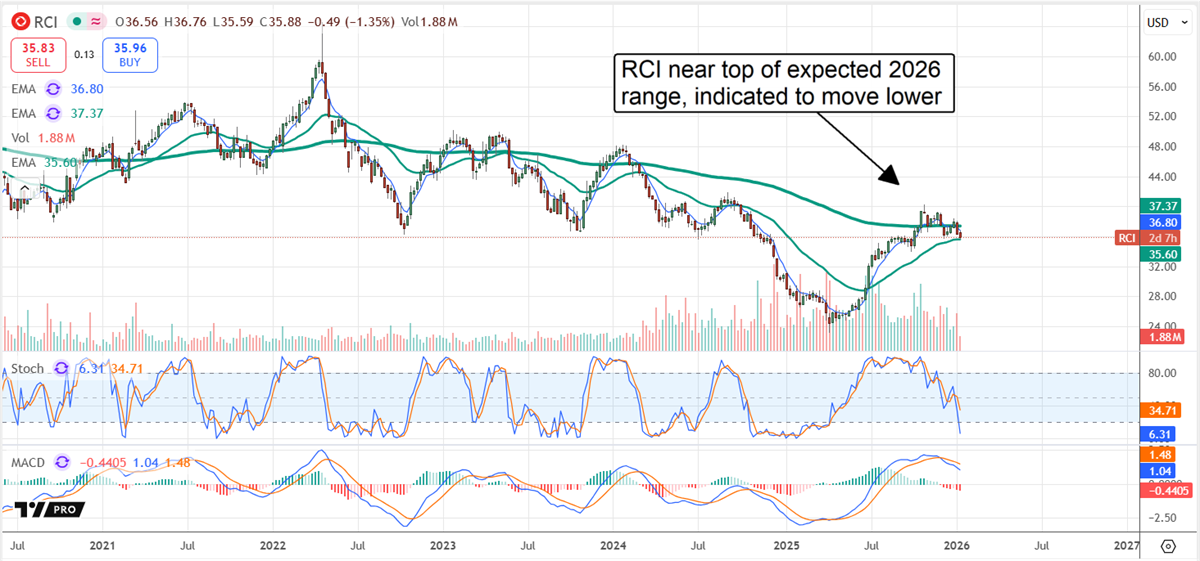
Rogers Communications (NYSE: RCI) is a Canadian communications and media company trading at about 10x current-year earnings, which—if re-rated to broader market multiples—could imply roughly 100% upside. The problem is the outlook: the company, whose dividend yields more than 4% as of early 2026, trades in line with media peers and faces a tepid near-term outlook. Both earnings growth and dividend growth are questionable; the payout record has been uneven, with irregular distributions and recent declines.
Analyst and institutional signals offer little reason to expect a strong rebound in 2026. Analysts rate it a Hold but have sharply reduced price targets over the past year, leaving the stock trading below consensus fair value. Consensus valuations as of mid-January point to potential downside. Institutional ownership is modest—about 45%—and institutions were net sellers at the start of the year.
Comcast Combines High Yield With Rebound Potential in 2026
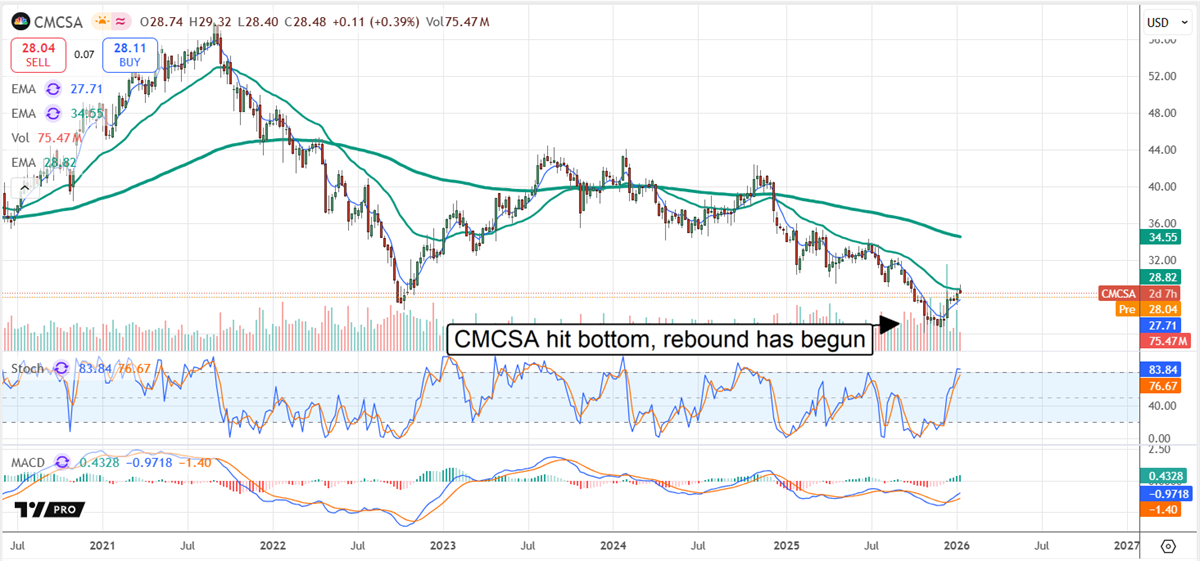
Comcast Corporation (NASDAQ: CMCSA) is another communications and media company trading at a low P/E. It trades at roughly 7x current-year earnings and yields about 4.5%. While revenue and earnings will decline because of divestitures, Comcast’s core operations are expected to grow and market expectations are modest—conditions that can set the stock up to outperform and trigger a bullish analyst revision cycle. Analysts are already relatively optimistic on the name.
An analyst reset depressed CMCSA in 2025, but two factors support a rebound in 2026. First, the stock became oversold and recent targets line up with the consensus forecastfor roughly 20% upside. Second, institutional activity is favorable: institutions own more than 65% of the stock and were net buyers early in the year, purchasing about $3 for every $1 sold in the first two weeks of January.
HP Inc. Looks Positioned for a Powerful Rebound in 2026
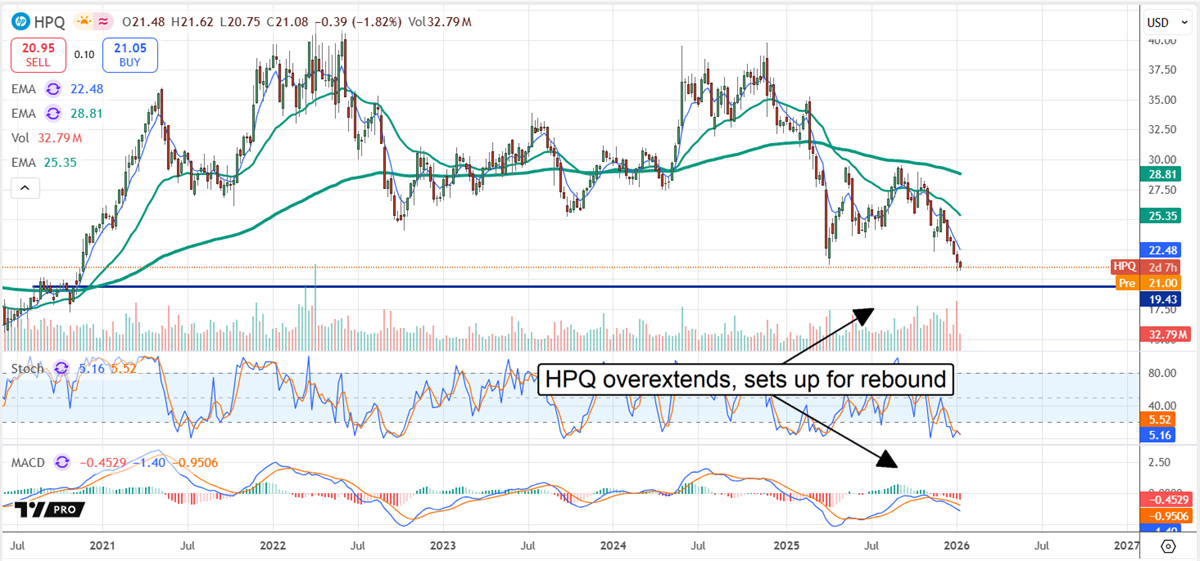
HP Inc.’s (NYSE: HPQ) share price is influenced by AI-related dynamics and by DRAM supply constraints that have limited production. Those factors prompted analysts to reset price targets, but like Comcast, HPQ appears oversold and may be setting up for a rebound. The company is expected to deliver modest growth over the next few years and generate enough earnings to support capital returns. Its dividend yielded more than 5.5% annualized as of early January, and management is expected to grow distributions: HPQ pays under 40% of earnings, has increased its dividend for 15 consecutive years and has roughly a 10% compound annual growth rate in dividends.
Analysts are optimistic. A consensus reset lowered expectations in 2025, but late-2025 and early-2026 updates have reaffirmed the outlook. Consensus implies at least ~20% upside, and reaching that level could trigger an additional 20%–30% move. Technically, HPQ sits near long-term lows while the MACD is diverging from price—an indicator that the downtrend may be weakening and bulls could be poised to regain control.
This message is a sponsored message sent on behalf of SmallCaps Daily, a third-party advertiser of MarketBeat. Why was I sent this email content?.
This message is a paid advertisement for SMX (NASDAQ: SMX) from SmallCaps Daily and Interactive Offers. MarketBeat Media, LLC receives a fixed fee for each subscriber that clicks on a link in this email, totaling up to $25,500. Other than the compensation received for this advertisement sent to subscribers, MarketBeat and its principals are not affiliated with either SmallCaps Daily or Interactive Offers. MarketBeat and its principals do not own any of the stocks mentioned in this email or in the article that this email links to. Neither MarketBeat nor its principals are FINRA-registered broker-dealers or investment advisers. The content of this email should not be taken as advice, an endorsement, or a recommendation from MarketBeat to buy or sell any security. MarketBeat has not evaluated the accuracy of any claims made in this advertisement. MarketBeat recommends that investors do their own independent research and consult with a qualified investment professional before buying or selling any security. Investing is inherently risky. Past-performance is not indicative of future results. Please see the disclaimer regarding SMX (NASDAQ: SMX) on Interactive Offers’ website for additional information about the relationship between Interactive Offers and SMX (NASDAQ: SMX).
If you have questions or concerns about your account, please don’t hesitate to email our South Dakota based support team at contact@marketbeat.com.
Chris “CJ” Johnson, Lead Host & Senior Analyst, Monument Traders Alliance
Publisher’s Note: Jon Najarian sold his first trading system for over a billion dollars.
Now he’s built something that could be even bigger.
On February 4 at 2 p.m. ET, Jon’s joining Bryan live to demonstrate his new AI Trade Monster – a patent-pending system designed to detect entries and exits before massive stock moves.
This isn’t theory. Jon’s early access group already hit six 100% winners in the first month using this tool.
During the summit, you’ll see the AI in action, learn how it works, and get Jon’s No. 1 trade recommendation completely free.
Reserve your spot now. This advantage won’t stay hidden for long.
When Costco (COST), Applied Digital (APLD), and Zoom Communications (ZM) all show up on the same bullish watchlist, you have two choices…
Ignore the signal because they’re from completely different sectors…
Or recognize what’s happening beneath the surface and dig deeper. I suggest that you do the latter right now.
We’re entering a new stage in market evolution. Artificial intelligence isn’t a future idea or one just reserved for Wall Street’s cutting-edge firms. It’s already changing how high-probability setups are spotted and traded by traders like you and me.
From Three-Ring Binders to Real-Time Signal
I’ve lived through multiple transitions in this industry. I’ve watched firsthand how technology separates the traders who adapt from those who get left behind.
Back in the early ’90s, when I worked as a broker at Prudential Securities, every trade was manual. My mentor – Andy – had me update a three-ring binder filled with graph paper that folded out with the closing prices of stocks we traded. I would use a pencil and a ruler to update prices daily from the Quotron. That’s how we found trends.
Ralph Acampora – the Godfather of Technical Analysis would add additional insight. My “news feed” came from a squawk box on my desk, broadcasting market commentary from Larry Wachtel.
If I wanted to place a trade, I’d pick up the phone, call the trading desk, write up the ticket, and walk it down the hall. All while juggling client calls and account management.
Fast forward 30 years, and the problem isn’t speed anymore. It’s an overload. What used to be a lack of information is now a lack of filtration. And that’s where artificial intelligence can come in for the assist.
Enter: Monster AI
During Wednesday’s Monument Traders LIVE event, Nate Bear and Ryan Fitzwater introduced the new Monster AI system developed by Jon Najarian’s team. Monster AI uses artificial intelligence to filter through massive volumes of market data with its proprietary modeling to generate a clean, directional outlook for any stock.
The system assigns a bullish or bearish prediction, includes a confidence score, and pairs that with a specific options trade that aligns with the forecast.
During the session, several stocks were flagged by the system – including Zoom(ZM), Corning (GLW), Costco (COST), Applied Digital (APLD), CoreWeave(CRWV) and Iren Limited (IREN).
And one in particular stood out…
My Favorite Idea from Monster AI: Corning (GLW)
Monster AI tagged Corning as a bullish trade idea on January 14, 2026, suggesting the February 20, 2026, $90 call. That paid off well. But I think there’s more.
Corning isn’t flashy, but its AI exposure and growth story are structurally strong. While it’s not building chips or training models, Corning’s fiber-optic and advanced materials technology form critical infrastructure behind the scenes.
The company supplies next-gen optical connectivity to hyperscalers like Amazon and Google, powering the high-bandwidth, low-latency environment AI workloads demand.
It’s not a headline name – but it’s critical. And based on the recent technical breakout, the market is finally starting to recognize that.
The average investor is lucky to make 10% in a year. But famed trading pioneer Jon Najarian says thanks to a recent breakthrough…
Everyday Americans can use his newest project that leverages the power of AI to help determine entries and exits BEFORE 1,000%+ stock moves within weeks.
Technically, Corning just broke out of a short-term trading range capped at $95, rallying decisively above $100. That breakout cleared a psychologically significant round-number level and shifted the stock’s 50-day moving average into a new bull market trend.
The last time GLW’s 50-day trend turned bullish was in May 2025, triggering a 96% rally into the December highs. History may not repeat exactly, but technically and fundamentally, Corning is in motion again.
YOUR ACTION PLAN
I love to leverage long-term momentum like this with a long-term call. In this case, I’m eyeing the September 18, 2026, GLW $115 calls trading just above $1,200 per contract.
This should provide enough time premium to ride volatility spikes without forcing early exits. My loss limit plan includes using technical patterns – a close below $100 or $95.
If Corning’s shares trade at $150 before May 2026, this option would be valued at approximately $3,808 per contract, based on Black-Scholes calculations.
Of course, options trading involves significant risk and is not suitable for all investors. Understand the risks and costs before engaging in any options strategies.
Today’s brutal 30% silver crash feels apocalyptic, but it’s not even close to the all-time record. On “Silver Thursday” (March 27, 1980), silver plunged over 50% in a single session – from $21 to $10.80 – when the Hunt brothers’ epic market corner spectacularly exploded.
That legendary bloodbath still holds the crown for silver’s worst single-day massacre in history.
Alex believes Palantir could be one of the “Next Magnificent Seven” Stocks. He’s comparing it to Apple, Amazon, Nvidia , which he called years before its meteoric rise.
Nothing published by Monument Traders Alliance should be considered personalized investment advice. Although our employees may answer your general customer service questions, they are not licensed under securities laws to address your particular investment situation. No communication by our employees to you should be deemed personalized investment advice. We allow the editors of our publications to recommend securities that they own themselves. However, our policy prohibits editors from exiting a personal trade while the recommendation to subscribers is open. In no circumstance may an editor sell a security before subscribers have a fair opportunity to exit. The length of time an editor must wait after subscribers have been advised to exit a play depends on the type of publication. All other employees and agents must wait 24 hours after publication before trading on a recommendation.
Any investments recommended by Monument Traders Alliance should be made only after consulting with your investment advisor and only after reviewing the prospectus or financial statements of the company.
Protected by copyright laws of the United States and international treaties. The information found on this website may only be used pursuant to the membership or subscription agreement and any reproduction, copying or redistribution (electronic or otherwise, including on the world wide web), in whole or in part, is strictly prohibited without the express written permission of Monument Traders Alliance, LLC, 14 West Mount Vernon Place, Baltimore, MD 21201.
Ratings changes for Western Digital, Tesla, Tesla, NVIDIA, Lam Research, AeroVironment, Western Digital and more…Text “MarketBeat” to 68285 to get SMS breaking news alerts for stocks on your watchlist and other special reports. Learn More.
Elon Warns “America Is Broke”. Trump’s Plan Inside. (ad)For the everyday American who’s worked hard to build their nest egg, Trump preserved a IRS loophole that allows you to protect your retirement savings before billions in American wealth are lost.
Download Your Free 2026 Wealth Protection Guide and execute the simple steps to protect your future.
MarketBeat All AccessMy MarketBeatAccount SettingsAnalyst RatingsDividend DeclarationsEarnings AnnouncementsHeadlinesInsider TradesTrade Stocks with QtradeEnd of America update (ad)There are five truths reshaping America’s financial future — and ignoring them could be costly. From an overextended government and vanishing savings to AI-driven job displacement and a widening wealth divide, the warning signs are clear. But according to Porter Stansberry, these same forces are also driving one of the largest wealth transfers in history. His new exposé, The Final Displacement, reveals the economic blueprint behind these shifts — and the final step he believes every American must take to protect and grow their wealth before it’s too late.
Analysts’ Price Target Increases on Friday, January 30
Bombardier, Inc. Class B (TSE:BBD.B) was given a new C$260.00 price target on by analysts at Desjardins. They now have a “buy” rating on the stock. This represents a 12.7% upside from the current price of C$230.68.Definity Financial (TSE:DFY) had its price target raised by analysts at Scotiabank from C$65.00 to C$80.00. This represents a 20.0% upside from the current price of C$66.68.Fairfax Financial (TSE:FFH) had its price target raised by analysts at Scotiabank from C$3,050.00 to C$3,150.00. This represents a 41.7% upside from the current price of C$2,222.43.Firan Technology Group (TSE:FTG) had its price target raised by analysts at Raymond James Financial, Inc. from C$15.00 to C$17.50. They now have an “outperform” rating on the stock. This represents a 18.2% upside from the current price of C$14.81.Rogers Communications (TSE:RCI.B) (NYSE:RCI) had its price target raised by analysts at Canaccord Genuity Group Inc. from C$55.00 to C$57.00. They now have a “buy” rating on the stock. This represents a 11.1% upside from the current price of C$51.31.Rogers Communications (TSE:RCI.B) (NYSE:RCI) had its price target raised by analysts at TD Securities from C$64.00 to C$67.00. They now have a “buy” rating on the stock. This represents a 30.6% upside from the current price of C$51.31.Saputo (TSE:SAP) had its price target raised by analysts at CIBC from C$40.00 to C$44.00. This represents a 7.7% upside from the current price of C$40.86.
Analysts’ Price Target Decreases on Friday, January 30
Coveo Solutions (TSE:CVO) had its price target lowered by analysts at TD Securities from C$12.00 to C$9.50. They now have a “buy” rating on the stock. This represents a 54.0% upside from the current price of C$6.17.goeasy (TSE:GSY) had its price target lowered by analysts at Scotiabank from C$225.00 to C$210.00. This represents a 67.3% upside from the current price of C$125.54.
Insider Transactions Disclosed on Friday, January 30
Major Drilling Group International Inc. (TSE:MDI – Get Free Report) insider Benjamin Luke Graham sold 10,000 shares of the company’s stock in a transaction dated Thursday, January 29th. The shares were sold at an average price of C$16.32, for a total transaction of C$163,200.00. Metro Inc. (TSE:MRU – Get Free Report) insider Richard Pruneau sold 2,018 shares of the stock in a transaction on Thursday, January 29th. The stock was sold at an average price of C$90.87, for a total value of C$183,375.66. Following the transaction, the insider owned 12,433 shares in the company, valued at C$1,129,786.71. The trade was a 13.96% decrease in their position. Metro Inc. (TSE:MRU – Get Free Report) insider Genevi�Ve Bich sold 4,418 shares of the business’s stock in a transaction dated Thursday, January 29th. The shares were sold at an average price of C$91.13, for a total transaction of C$402,612.34. Following the completion of the sale, the insider directly owned 35,677 shares of the company’s stock, valued at C$3,251,245.01. This represents a 11.02% decrease in their position. Ucore Rare Metals Inc. (CVE:UCU – Get Free Report) insider Randy T. Johnson sold 75,000 shares of the firm’s stock in a transaction dated Wednesday, January 28th. The shares were sold at an average price of C$9.61, for a total transaction of C$720,750.00. Following the completion of the transaction, the insider directly owned 9,951,736 shares in the company, valued at approximately C$95,636,182.96. This represents a 0.75% decrease in their ownership of the stock. Ucore Rare Metals Inc. (CVE:UCU – Get Free Report) insider Randy T. Johnson sold 60,000 shares of the business’s stock in a transaction that occurred on Thursday, January 29th. The shares were sold at an average price of C$9.28, for a total transaction of C$556,800.00. Following the transaction, the insider owned 9,891,736 shares of the company’s stock, valued at approximately C$91,795,310.08. This represents a 0.60% decrease in their ownership of the stock. VIEW INSIDER TRADES Deutsche Bank Just Raised Their Gold Target to $6,000 (ad)Gold continues hitting new record highs, but the next few weeks could be the most critical window in the metal’s history. Deutsche Bank and J.P. Morgan both raised their 2026 targets to $6,000 per ounce. Yardeni Research, who avoided gold calls for years, now sees $10,000 by decade’s end. When skeptics turn bullish, something big is happening. But nearly everyone is missing what happens on March 31st, when a 90-year-old federal law could trigger a major wealth transfer. One company owns 88 million ounces of gold worth over $431 billion yet trades for a tiny fraction of that value.
Brookfield Renewable Partners(TSE:BEP.UN) (NYSE:BEP) announced its quarterly results before the market opened on Friday, January 30th. The company reported $0.74 earnings per share (EPS) for the previous quarter. The company had revenue of $2.11 billion for the quarter. The stock had previously closed at C$40.75. Brookfield Infrastructure Partners(TSE:BIP.UN) (NYSE:BIP) announced its quarterly results before the market opened on Thursday, January 29th. The company reported $0.61 earnings per share (EPS) for the previous quarter. The company had revenue of $8.32 billion for the quarter. The stock had previously closed at C$49.23. Celestica (TSE:CLS) (NYSE:CLS) announced its quarterly results before the market opened on Wednesday, January 28th. The company reported $2.59 earnings per share (EPS) for the previous quarter. The company had revenue of $5.02 billion for the quarter. The stock had previously closed at C$384.98. Canadian National Railway (TSE:CNR) (NYSE:CNI) announced its quarterly results before the market opened on Friday, January 30th. The company reported $2.08 earnings per share (EPS) for the previous quarter. The company had revenue of $4.46 billion for the quarter. The stock had previously closed at C$131.66. Canadian Pacific Kansas City (TSE:CP) (NYSE:CP) announced its quarterly results after the market closed on Wednesday, January 28th. The company reported $1.33 earnings per share (EPS) for the previous quarter. The company had revenue of $3.92 billion for the quarter. The stock had previously closed at C$100.43. Coveo Solutions (TSE:CVO) announced its quarterly results after the market closed on Thursday, January 29th. The company reported ($0.11) earnings per share (EPS) for the previous quarter. The company had revenue of $52.18 million for the quarter. The stock had previously closed at C$6.17. CGI (TSE:GIB.A) (NYSE:GIB) announced its quarterly results before the market opened on Wednesday, January 28th. The company reported $2.12 earnings per share (EPS) for the previous quarter. The company had revenue of $4.08 billion for the quarter. The stock had previously closed at C$116.86. Imperial Oil (TSE:IMO) (NYSEMKT:IMO) announced its quarterly results before the market opened on Friday, January 30th. The company reported $1.97 earnings per share (EPS) for the previous quarter. The stock had previously closed at C$137.82. Metro (TSE:MRU) announced its quarterly results before the market opened on Tuesday, January 27th. The company reported $1.16 earnings per share (EPS) for the previous quarter. The company had revenue of $5.29 billion for the quarter. The stock had previously closed at C$90.07. Rogers Communications (TSE:RCI.A) announced its quarterly results before the market opened on Thursday, January 29th. The company reported $1.51 earnings per share (EPS) for the previous quarter. The company had revenue of $6.17 billion for the quarter. The stock had previously closed at C$51.61. Real Matters (TSE:REAL) announced its quarterly results before the market opened on Thursday, January 29th. The company reported ($0.07) earnings per share (EPS) for the previous quarter. The company had revenue of $63.87 million for the quarter. The stock had previously closed at C$6.26. Silver Bull Resources (TSE:SVB) announced its quarterly results before the market opened on Thursday, January 29th. The company reported ($0.38) earnings per share (EPS) for the previous quarter. The stock had previously closed at C$0.31. VIEW EARNINGS REPORTS
Best-in-Class Portfolio MonitoringView the latest news, buy/sell ratings, SEC filings and insider transactions for your stocks. Compare your portfolio performance to leading indices and get personalized stock ideas based on your portfolio.
Stock Ideas and RecommendationsGet daily stock ideas from top-performing Wall Street analysts. Get short term trading ideas from the MarketBeat Idea Engine. View which stocks are hot on social media with MarketBeat’s trending stocks report.
Advanced Stock Screeners and Research ToolsIdentify stocks that meet your criteria using seven unique stock screeners. See what’s happening in the market right now with MarketBeat’s real-time news feed. Export data to Excel for your own analysis.
Online brokerage services are offered through Qtrade Direct Investing, a division of Credential Qtrade Securities Inc. Qtrade, Qtrade Direct Investing, and Write Your Own Future are trade names and/or trademarks of Aviso Wealth.
 Dancing with the Encanterra Stars
 Sat, Jan 31
  7:00 PM – 9:00 PM
  Other: Mallorca Event Center
  Tribute Concert, featuring Keith Ormrod, a Tribute to Kenny Chesney
 Comedy Night at the Club
 Jukebox Bingo | Pinks & Reds Night
 New Credit Card Policy and Billing UpdatePosted: Jan 26, 2026
  Weekly Specials through February 1stPosted: Jan 27, 2026
  #MTL ShopAlways Open. Always Original. Shop exclusive Trilogy gear. Shop Now
 EventsLog in and find out about the latest events in your community. Visit Events
 BulletinsShare your interests and Buy & Sell items with your neighbors. Visit BulletinsVisit MyTrilogyLife.com © 2026 All rights reserved. Use of the Website and the E-Newsletter is subject to website Terms of Use. Please review our Privacy Policy before providing any Personal Information. If you no longer wish to receive the E-Newsletter, please adjust your settings at the Website to unsubscribe






.png)


























 RJ Hamster