Author Archives: RJ Hamster
I was born on 6 August 1956 in San Francisco, California to Janet and (the late) Richard Hovis.
I grew up in Santa Monica, California where I attended elementary, junior high school, and high school (graduating in 1974), in addition to involvement in sports and recreation (Little League +, the Boy’s Club ++). Further, it was in elementary school – St. Augustine’s By-the -Sea Parish School that I found, and made the choice to truly journey with God.
I attended Arizona State University from 1974 to 1977 – seeking to become an architect, however, I was not accepted, and, as such, I graduated with a Liberal Arts degree.
Upon graduation from Arizona State University, I attended Cal Poly San Luis Obispo and studied City and Regional Planning at the Master’s level. I successfully completed one (1) year in a two (2) year program – I did not complete the Master’s degree in City and Regional Planning – due to personal reasons.
I returned to Santa Monica where I started (October 1979) my career as graphic designer with Exxon Company, USA. I spent five years with Exxon Company, USA.
While working with Exxon Company, USA I was accepted into architectural school – Sci-Arc in Southern California, however, I did not attend preferring to stay with Exxon..
In 1982 I married Laura Flosi and in April 1983 we had our one and only child – Lauren Alain Hovis – a gift from God.
We moved to Phoenix, Arizona in 1984 from Los Angeles, where I went to work as a graphic designer with Kitchell CEM (from 1985 -1987).
From 1987 – 1995 I was an independent contractor, and a registered representative in mortgage finance, financial management, graphic design, and drafting.
Further, I attended the University of Phoenix and successfully obtained a Master’s in Business Administration (MBA) in 1982.
I was also a member of the Scottsdale Jaycees, where I became very involved in community events and projects.
In 1994, I accepted a cartography position with the Defense Mapping Agency in Reston, Virginia. As such, I relocated from Phoenix to Reston.
In 1998, I was accepted and worked as a Visual Information Officer with the Central Intelligence Agency. In 2002, I worked as a Support Officer until my retirement (due to a need for shoulder surgery) in September 2018.
Away from my Federal Government service, I have been involved in various organizations and activities in Northern Virginia.
In November of 2011, I married Rebecca Ouellette in Santa Monica, California. I reside in San Tan Valley, AZ with my two hamster - Jess and Timothy, our fish, our lizard - RJ Lizard., and our cats - Pearl and Grey.
As to hobbies, I enjoy playing sports, attending sporting events, mentoring individuals from financial management to hamsters, building models, photography, travel, multimedia design, managing partner for RJ Hamster, and jazz – smooth jazz to a samba or a bossa nova.
Love and God Bless,
Peter – aka RJ Hamster Jo hi
Genesis 3:1 – Satan’s Doubt: Undermining Trust in God’s Word and Faith
Having trouble reading this email? View it in your browser.


Genesis 3:1
(1) Now the serpent was more subtil than any beast of the field which the LORD God had made. And he said unto the woman, Yea, hath God said, Ye shall not eat of every tree of the garden?
King James Version Change email Bible version
In this first message to mankind, Satan sows seeds of doubt as to whether God can be trusted. Satan’s very first words were, “Has God indeed said. . . ?” Spoken or not, this sentiment that God is untrustworthy, and that His Word is suspect, has been a regular feature in mankind’s relationship with God ever since.
The Gnostics were no exception—in fact, they are a prime example. In its most basic sense, Gnosticism is knowing, but its knowledge, while sometimes including the Word of God, does not have it as its foundation. Instead, more than what was contained in Scripture, Gnostics valued what they experienced, what elders told them, or what they learned from “angels,” astrology, or chemistry (alchemy). Thus, we see elements of Gnosticism in Galatians: a mixture of “lucky days,” to which they ascribed spiritual significance (part of their worship prior to conversion) and a belief, brought in by Judaizers or perhaps even an “angel” (Galatians 1:8), that justification could come by works of the law.
Judaism, though it has its roots in the Old Testament, sees God’s Word through the lens of Hellenism (Greek thought) and the traditions of Jewish scholars and teachers through the centuries. The Galatian Christians gave God’s Word lip service, but did not depend on it as the source of their beliefs and practices. If they had, they would not have returned to pagan “days, months, seasons, and years,” nor believed that justification could ever result from good works—a concept that is read into the Old Testament, but not actually found there.
Similarly, the Colossian Christians were affected by an ascetic form of Gnosticism that included “ordinances” (KJV) or “regulations” (NKJV) that are not found in God’s Word but were the commandments and doctrines of men(Colossians 2:20-23), as well as demons, the “basic principles of the world” (Colossians 2:8).
This same distrust of God’s Word is readily seen in today’s Catholicism and Protestantism. The Catholic Church holds that Scripture is only one of three sources from which its dogma is derived—the other two being divine revelation and the writings and traditions of previous Catholic saints. The Bible, while generally utilized as the source of doctrine, can be easily overridden by the words of a Pope or other theologian, living or dead. Once again, human words and traditions are considered more trustworthy than God’s.
In some respects, Protestantism has a higher regard for Scripture. However, it, too, accepts the traditions of men in such beliefs as the Trinity, the immortality of the soul, going to heaven, observing Christmas and Easter, and venerating the first day of the week (which the Catholic Church rightly points out makes sense only if one accepts Rome’s authority, for there is no scriptural authority for keeping any day holy but the Sabbaths).
Modern Gnostics who believe in “progressive revelation” have also succumbed to this first of Satan’s ploys. While God does reveal things to us, the critical point is that what is revealed—if it truly comes from Him—will never contradict what He has already revealed in His Word. “God is not a man, that He should lie” (Numbers 23:19). Yet progressive revelation advocates believe that their revelations are more authoritative than the Bible, rather than complementing and harmonizing with it, making them ripe for satanic influence under the guise of God revealing something new to them. They may sincerely believe that God speaks to them, yet they simultaneously mistrust what He has already said in inspired Scripture. They tend to shy away from Bible study, concluding that they do not need it since God speaks directly to them, and if there is anything important, God will let them know.
Romans 10:17 tells us that “faith comes by hearing, and hearing by the word of God.” But Satan knows this too and believes that, if he can undermine the trustworthiness of God and the validity of His Word, he can destroy the faith necessary for salvation. Currently, the Bible’s legitimacy is undergoing an intense assault. Due to popular Gnostic writings like the Gospel of Judas and the Gospel of Thomas, as well as The Da Vinci Code book and movie, many people are questioning why we have the Bible that we do and wondering if something in the ancient apocryphal writings, if it were known, would change Christianity as we know it. Rather than quibbling about this or that point of doctrine, Satan seems to be gunning for the whole package by asserting that the Word of God is subject to the whims of men and thus cannot be trusted. At every turn, faith founded in God’s Word is being undermined.
— David C. Grabbe
To learn more, see:
Whatever Happened to Gnosticism? Part Three: Satan’s Three Heresies
Topics:
Days, Months, Seasons and Years
Commentary copyright © 1992-2026 Church of the Great God


Subscription Information
This daily newsletter was sent to you at peterhovis@me.com because you subscribed at www.theberean.org on Apr 14, 2017.
Email Preferences | Unsubscribe
Church of the Great God
P.O. Box 471846
Charlotte, NC 28247
803-802-7075
Making the Best Use of Home Equity in Retirement, Part II
 Retirement ReportsRetirement Articles
Brought to you by Eagle Financial Publications
Making the Best Use of Home Equity in Retirement, Part II
by Bob Carlson
Editor, Retirement Watch
01/04/2026
SPONSORED
Get Paid In ANY Crypto Market
Fear & Greed Index hit 9. Markets bleeding. Liquidations everywhere. Most traders panicked. We profited. One liquidity pool paid $73,130 during the crash. We earn from trading volume, not price direction. Market up? Paid. Down? Paid. Crash? Paid even more. This is how you detach from price action and profit when everyone else is losing. Stop gambling on direction. Start collecting fees like institutions do.
Learn the crash-proof system. Watch the free training.CLICK HERE…Fellow Investor,
 In last week’s edition of Retirement Watch Weekly, I shared some tips on how to put your home to work for you before and during retirement. Today, we’ll complete the list…
Another strategy to consider for your retirement plan – and it’s one that is often very misunderstood – is a reverse mortgage.
Also known as a home equity conversion mortgage (HECM) it’s a loan that is backed by the equity in your home. You don’t make loan repayments during your lifetime.
The loan is paid from the sale proceeds after the home no longer is your primary residence.
If you live a long time and the interest compounds to a large number, you won’t owe more than the equity in your home. The lender or the federal government will take the loss.
You can take the HECM / reverse mortgage as a lump sum, line of credit, or an annuity.
For example, you can arrange for a monthly annuity that will last as long as you live.
You still have to pay taxes and insurance on the home, and you’ll be responsible for maintaining it. But you receive part of your home equity in cash without having to move.
The major disadvantage of a reverse mortgage is that it is a relatively expensive way to borrow. Because of the costs, you’ll be able to borrow much less than the full equity of your home.
The percentage of the home’s value you can borrow will depend on your age and the level of interest rates when you borrow.
Here are the key points when planning how to use these reverse mortgage strategies to benefit from your home equity.
Downsizing is best done sooner rather than later..
There are social and emotional aspects to leaving a long-time home, so the longer you wait the more difficult the move and subsequent readjustment will be.
Age, of course, makes the physical act of moving more difficult. Physical limitations could make the move more expensive because you have to hire people to do things you would have done a few years earlier.
Also, the lifetime benefits of downsizing are greater when you act sooner.
The financial goals of downsizing are to increase your nest egg (resulting in higher income) and decrease monthly expenses. The sooner you make the change, the greater the lifetime financial benefits.
Retirement in a Box: From Zero to $2,500 a Month
There is a way retirees can collect thousands of dollars per month for the rest of their lives — tax-free. Plus, this tax-free income source is 100% legal and approved by the IRS.
And here’s the kicker: even if they don’t have enough money put away yet for retirement… even if they’re over age 60… they can still get thousands of dollars a month from this opportunity. Click here to find out more.CLICK HERE…Downsizing also should occur beforeusing a reverse mortgage.
If you take out a reverse mortgage and decide to downsize later, you have to pay the reverse mortgage and all its accumulated interest and fees from the sale proceeds.
Taking out a reverse mortgage will foreclose downsizing in the future for many people.
Another thing to keep in mind: A reverse mortgage is very flexible.
Traditionally a reverse mortgage was used to pay for medical expenses or home maintenance late in life when other cash sources were exhausted or to set up an annuity to supplement Social Security and any other income. Those uses still are available.
Another option is to create a reverse mortgage line of credit.
You can use the line of credit to avoid reducing your nest egg when markets are down or unexpected major expenses arise. Then, pay down the line of credit from future investment returns.
The reverse mortgage also can be used before age 70 if you’re retired, but want to maximize Social Security benefits. You can supplement nest egg withdrawals and any other income with cash from either a HECM line of credit or monthly payments for a set period of years.
If your Social Security benefits begin at 70, you can choose to repay the reverse mortgage over time or wait to have the loan paid from a future sale of the home.
I don’t want to downplay the practical and emotional aspects of your home. Too many people, however, overlook the options for managing their home equity.
There are ways you can turn your largest expense into a source of extra cash flow.
The earlier you incorporate these ideas in your retirement plan and ensure you are in the right home for the long term, the more financially secure you’ll be through retirement.To a better retirement,
Bob Carlson
Editor, Retirement Watch WeeklyEditor’s Note: Deep State bureaucrats are rushing to seize as much as 30% of your retirement savings. Unless you act now, you’re facing the greatest destruction of financial assets in your lifetime. And while this scheme benefits insiders, big banks, and elite special interests…. it could quickly bankrupt you. Thankfully, there are three quick and easy steps you can take to protect yourself and your family. Click here now to get them before it’s too late.
SPONSORED
Today’s Momentum Window: Entry or Exit? How A.I. Confirms the Right Play
We’ve discovered what can only be called the “Momentum Switchblade.”
Stocks that snap-reverse direction within days, bullish to bearish or vice versa…but only the A.I. knows which way before it happens.
The December momentum switchblades are about to execute right now, and here’s what matters: timing your entry versus exit makes all the difference.
The A.I. has identified 3 critical reversals happening today, but one is signaling something urgent…CLICK HERE…
Want More Retirement Advice?
Check out my website, RetirementWatch.com, where you’ll find hundreds of free articles covering every aspect of retirement planning.
Popular Posts:
Marital Deduction – Dos and Don’ts
The Overlooked Triple Tax Saving Tactic
10 Basic Rules for Every Estate Plan
How to Vary Spending During Retirement
New to the Retirement Watch Community: SeniorResource.com
For older adults, choosing a cell phone is not a one-size-fits-all proposition. Some seniors love the latest high-tech smartphones with high-megapixel cameras, while others prioritize simple phones with basic functions. So, the best cell phone for seniors will depend on their comfort with technology, priorities, and budget. Click here to learn about the five best cell phones for seniors.
About Bob Carlson:
 Robert C. Carlson is the author of the books The New Rules of Retirementand Retirement Tax Guide, editor and investment director of the popular retirement newsletter, Retirement Watch, and editor of the free weekly e-letter, Retirement Watch Weekly. Bob is a frequent speaker at investment conferences around the country, and you can also hear Bob as a featured guest on nationally-syndicated radio shows, such as The Retirement Hour, Dateline Washington, Family News in Focus, The Michael Reagan Show, Money Matters and The Stock Doctor.
About Us:
Eagle Financial Publications is located in Rosslyn, VA. – Blocks from the Capitol. Our products have been helping investors build their wealth for several decades. Whether you’re a long-term investor or short-term trader, you’ll find the right strategy for you, including how to earn more steady income to spend now, preserve and grow your capital to enjoy later, and whatever other investment goals you have.
Visit Our Websites:
- StockInvestor.com
- DividendInvestor.com
- DayTradeSPY.com
- CoveredCall.com
- MarkSkousen.com
- GilderReport.com
- BryanPerryInvesting.com
- JimWoodsInvesting.com
- RetirementWatch.com
- SeniorResource.com
- GenerationalWealthStrategies.com
- Visit our YouTube Channel – Eagle Investing Network
To ensure future delivery of Eagle Financial Publicationsemails please add financial@info2.eaglefinancialpublications.com to your address book or contact list.
This email was sent to peterhovis@icloud.com because you are subscribed to Dividend Investor Daily. To unsubscribe from this list please click here. To stop receiving emails simply click here. If you have questions, please send them to Customer Service. View this email in your web browser.
Legal Disclaimer: Any and all communications from Eagle Products, LLC. employees should not be considered advice on finances. Although our employees may answer your general customer service questions, they are not licensed under securities laws to address your particular investment situation. No communication by our employees to you should be deemed as personalized advice on finances.
Salem Media Group – Eagle Financial Publications | 1735 N Lynn St, Suite 500, Arlington, VA 22209-2016

The RJ Hamster morning Show
Sequoia, Starboard Buy 100M Worth of 3 Stocks

7 High-Yield Dividend Stocks You Need to See (From TradingTips)
Insider Buying: Smart Money Just Spent +$100M on These 3 Stocks
Written by Leo Miller on January 1, 2026

Summary
- DoorDash saw a rare nine-figure open-market buy tied to Sequoia Capital, a strong confidence signal—but it should be weighed against routine executive selling.
- Kenvue’s recent buying looks less like a standalone consumer-health bet and more like a view on the pending Kimberly-Clark deal and closing dynamics.
- Kymera’s $172 million add from Baker Bros followed encouraging KT-621 trial data, but the program is still early and carries typical clinical-stage biotech risk.
Insider buying can be one of the cleanest “follow-the-money” signals in the market. Over the past month or so, three names have stood out for $100 million-plus buying tied to prominent funds and well-known professional investors.
The takeaway: these trades don’t guarantee upside on their own, but they can highlight where sophisticated capital sees mispriced risk—or where a catalyst (like a merger) may be creating an opportunity.
Introducing The Early Bird Stock of the Day (Ad)
What if the next Apple or Amazon landed in your inbox… tomorrow? Imagine getting the research, numbers, and expert opinions on a stock before everyone else even has a clue. It’s like having a backstage pass to the best concert in town—but for your portfolio.Sign Up for The Early Bird Stock of the Day (Free)
Leading Venture Firm Makes $100 Million DoorDash Purchase
First up is the delivery platform DoorDash (NASDAQ: DASH). On Nov. 25 and Nov. 26, board member Alfred Lin purchased a total of just over $100 million worth of DoorDash shares.
As detailed in Lin’s Form 4 SEC filings, he did not purchase the shares for himself.
Column 7 of these filings shows that the beneficial ownership of these purchases goes to an investment fund managed by Sequoia Capital, one of the world’s most well-known venture investors, of which Lin is a partner.
This detail supports the bullish interpretation of these purchases. Sequoia made these purchases with its clients in mind.
Since investing other people’s money typically invites a higher level of scrutiny than investing one’s own money, Sequoia will not have made these purchases lightly.
That said, investors should read the signal with context. Since these purchases, DoorDash insiders have also sold around $29.5 million worth of the stock. But all of them came under 10b5-1 plans, and the predetermined nature of 10b5-1 sales significantly limits their bearish implications.
Starboard Buys KVUE Amid Kimberly-Clark Deal
The $33 billion consumer staples stock Kenvue (NYSE: KVUE) has also seen significant insider buying recently. On Dec. 11 and Dec. 12, board member Jeffrey C. Smith purchased a total of around $111 million worth of Kenvue shares, with investment fund Starboard Value LP to take beneficial ownership of the shares.
Kenvue owns a variety of over-the-counter drugs and personal care products, including Tylenol, Band-Aid, and Neutrogena.
On Nov. 3, Kenvue announced its acquisition by consumer staples giant Kimberly-Clark (NASDAQ: KMB) in a cash-and-stock deal (with the two parties guiding toward a closing in the second half of 2026, pending approval).
Kenvue shareholders will be partially compensated with Kimberly-Clark shares, and the value they will receive is largely dependent on Kimberly-Clark’s price prior to the deal’s closing.
With this in mind, the recent insider purchases are more of a bet on Kimberly-Clark than Kenvue itself. Kimberly-Clark shares are down nearly 15% on the Nov. 3announcement. Starboard likely sees this sell-off as overblown and believes that Kimberly-Clark will stage a recovery before the deal closes. This would increase the value that Kenvue investors—like Starboard—receive when the deal goes through.
4 Stocks That Could Soar Under Trump’s New Tariffs (Ad)
FREE Report: 4 “America First” Stocks Poised to Soar Under Trump’s New Tariffs
President Trump’s second term is officially underway—and during his first 100 days are already delivering bold moves on tariffs, energy, defense, and trade.Click here to get your free report, 4 “America First” Stocks That Could Soar Under Trump’s New Tarif
Biotech Investor Ups KYMR Position Significantly After Positive Trial Data
Last up is Kymera Therapeutics (NASDAQ: KYMR), which has seen the most insider buying of any stock in the last 30 days. This comes as Baker Bros. Advisors LP purchased $172.5 million worth of shares of the clinical-stage biotech company on Dec. 11. According to its latest 13F filing, Baker Bros. owns a portfolio composed almost solely of biotech stocks.
Baker Bros.’ purchase came just days after Kymera shares surged almost 42% on Dec. 8. That day, Kymera released positive results for its experimental drug KT-621, which is being developed to treat atopic dermatitis, also known as eczema.
Baker Bros. seems to have doubled down on its investment in Kymera in response.
The company added just over 2 million Kymera shares, increasing its position by around 30%, a clear vote of confidence from this institutional investor.
KT-621’s latest trial results were only in a Phase 1b study, so the drug still has a very long way to go before sniffing commercial viability. At least one institution, though, believes the company has a bright future.
Investors should note that Kymera has also seen around $21.6 million worth of non-10b5-1 plan sales since it released these results, a significant counter to the bullish Baker Bros. purchase that investors will take into consideration.
Smart Money Sends Optimistic Signals for DASH, KVUE, and KYMR
Clearly, the smart money is placing significant bets on DASH, KVUE, and KYMR. While investors should not take these purchases in isolation, they are solid bullish indicators for these three stocks.
Featured Stories
- Find the Next NVIDIA With This Semiconductor ETF
- A month before the crash (From Stansberry Research)
- D-Wave vs. IonQ vs. IBM vs. Google: Which Quantum Bets Will Win 2026?
- The free book that’s helped thousands profit with crypto (From Crypto 101 Media)
- 2026 Sector Playbook: 3 Sectors Trading Below Fair Value
- The Last Time This Happened, Qualcomm Fell 10%
- From Rust to Riches: 2 Auto Parts Names Built for 2026
Did you enjoy this article?


Thank you for subscribing to Earnings360, a morning newsletter that summarizes quarterly earnings for public companies that trade on U.S. markets.
If you need help with your account, please contact MarketBeat’s U.S. based support team at contact@marketbeat.com.
If you no longer wish to receive email from Earnings360, you can unsubscribe.
© 2006-2026 MarketBeat Media, LLC. All rights protected.
345 N Reid Place, Sixth Floor, Sioux Falls, SD 57103-7078. U.S.A..
Link of the Day: 5 Stocks That Could Double in 2026 (Click to Opt-In)
Horsehide Trivia
Peter,
Who became both the highest-paid pitcher annually and overall the moment he put pen to paper in with just a few shopping days left in 2019?
Hint: #1 His Cy Young Award win was practically assured when he put up a season where he led the league in win-loss %, ERA and ERA+. Interestingly, he had exceeded each of those numbers in previous seasons.
Hint: #2 Being drafted in the first round by the Yankees, but not near the top of the round convinced him to go to college. A National League team drafted him #1 overall three years later.
Friday’s question answered:
Q. Which bi-colored hosiery star pitcher finished in the top five of Cy Young Award voting result six times before finally capturing the top spot more than a decade after his first votes?
Hint: #1 His late CYA prompted Major League Baseball to name him his league’s Comeback Player of the Year.
Hint: #2 He reached the plateau of 2,500 career strikeouts in fewer innings pitched than any other pitcher ever had.
A. CHRIS SALE [B-R Bio]
– Ans. Sale had finished 6th, 5th (2X), 3rd & 4thw/CHW; 2nd & 4th w/BOS; before winning the Cy Young Award in 2024 w/ATL. [Changed to Red Sox in 2017 after 7 seasons with the White Sox.]
– #1 Sales in 2024 was the NL CPOY.
– #2 It took Sale only 2,026 innings to reach 2,500 K. The record previously was held by Randy Johnson, when he fanned his 2,500thbatter after 2,107⅔ innings in 1999.
FCR – Tom Galligan, Baton Rouge. Louisiana
~ D. Bruce Brown
Horsehide Trivia | 8830 Sandrope Court | Columbia, MD 21046 US
Invitation to Exclusive Webinar: Certificate in Artificial Intelligence Management System Requirements & Implementation – ISO/IEC 42001:2023
 Dear valued professional,Are you ready to stay ahead of the curve in Artificial Intelligence Management Systems? Join us for a special event on Thursday, January 8th to learn about the latest requirements according to the upcoming ISO/IEC 42001:2023 standard.This is a unique opportunity to stay informed and ensure your organization is prepared for the future of AI management. Don’t miss out on this valuable learning experience!Sincerely, Dear valued professional,Are you ready to stay ahead of the curve in Artificial Intelligence Management Systems? Join us for a special event on Thursday, January 8th to learn about the latest requirements according to the upcoming ISO/IEC 42001:2023 standard.This is a unique opportunity to stay informed and ensure your organization is prepared for the future of AI management. Don’t miss out on this valuable learning experience!Sincerely,CPD Training  Thursday, January 8, 2026 9:00 PMArtificial Intelligence Management System Requirements – ISO/IEC 42001:2023Register Thursday, January 8, 2026 9:00 PMArtificial Intelligence Management System Requirements – ISO/IEC 42001:2023Register CPD Training @ The QHSE groupUG01-F4 RAKEZ Amenity Center Al Hamra Industrial Zone-FZ – Ras Al Khaimah, Ras Al Khaimah, RAK AEUnsubscribe | Privacy Policy CPD Training @ The QHSE groupUG01-F4 RAKEZ Amenity Center Al Hamra Industrial Zone-FZ – Ras Al Khaimah, Ras Al Khaimah, RAK AEUnsubscribe | Privacy Policy |
Event Horizon Ahead as S&P Targets 8000 Peak
Sponsored content from Porter & Company
You’ve seen this movie…
A spaceship drifts too close to a black hole. Light bends. Time warps. Weird things happen. Then it crosses the event horizon (the point of no return)… and vanishes.
That’s where I believe we are in this bull market, right now.
16 years of easy money, insane gains and tech billionaires richer than God have created a gaping black hole of risk.
Now we’re past the safe zone, approaching the event horizon… the last wild rush before the immutable laws of the universe rip the whole thing apart. Don’t just take my word for it.
MarketWatch says the rally’s “moving more toward melt-up mode.”
Contrarian macrostrategist David Hunter believes the S&P could be headed for a parabolic 8000, before a brutal 80% drop.
Even Ray Dalio (a man who’s tracked 500 years of debt cycles) warns the U.S. is heading into “very, very dark times.”
Is your portfolio equipped to survive such a wild ride?
Honestly, probably not. There’s a good chance you’ll get dragged into the abyss, just like millions of others.
And don’t look to Washington to ride to your rescue. It’s too late for that. We were promised a big fix, but it never arrived.
Instead, the debts are bigger, the deficit is fatter, and core inflation is ever higher.
This market’s like a house with fresh paint and termites chewing through the foundations… it looks strong from the street with stocks at all-time highs, but beneath the surface it’s been hollowed out.
Analyst Michael Lebowitz sees “striking similarities to the dot-com melt-up of 1999” and so do I.
Back then, rate cuts acted like fuel on an already raging fire… predictably, the market got too hot and flamed out:
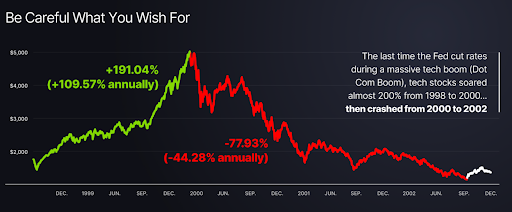
It’s happening all over again. President Trump and Scott Bessent have pressured the Fed into cutting rates, with more to come.
But history tells us that by the time desperate cuts arrive, the damage is already done. The bubble is too big. Too unstoppable. And the outcome, in my view, is inevitable.
I don’t say that as a casual observer.
For nearly 30 years I’ve built a career helping regular investors prepare for dramatic shifts in the financial system… calling Fannie and Freddie’s implosion, America’s lost AAA credit rating and the Covid inflation shock long before the headlines.
And now, I’m doing everything I can to prepare you for the coming breaking point. Most folks will be left holding the bag, loaded up on the wrong stocks at the wrong time.
That doesn’t have to be your story.
In this recent broadcast, I’ll show you:
- Why the most dangerous flaw in America’s financial system has reached a point of no return
- How Trump’s recent actions are accelerating the coming crisis
- And what I believe you must do now to avoid the worst of it – and potentially even profit from the shift
I also name three investments you can make today… assets that could see a huge influx of capital when this situation escalates.
This might be your final chance to prepare before we cross the event horizon.
Let me show you exactly what to do.
Good investing,
Porter Stansberry
Thank you for subscribing to The Early Bird, MarketBeat’s 7:00 AMnewsletter that covers stories that will impact the stock market each day.
This email communication is a sponsored message from Porter & Company, a third-party advertiser of The Early Bird and MarketBeat.
If you need help with your subscription, don’t hesitate to contact MarketBeat’s South Dakota based support team at contact@marketbeat.com.
If you no longer wish to receive email from The Early Bird, you can unsubscribe.
Copyright 2006-2026 MarketBeat Media, LLC.
345 N Reid Pl., Suite 620, Sioux Falls, South Dakota 57103. United States..
Today’s Featured Link: 5 Stocks That Could Double in 2026(Click to Opt-In)
AI Without Robots Is Just ChatGPT


AI Without Robots Is Just ChatGPT

In 1961, John F. Kennedy declared that America would go to the Moon.
This audacious goal wasn’t just about space or research but supremacy; and the Soviets weren’t allowed to reach it.
Now, six decades later, the United States is working toward another ‘moonshot.’
The Genesis Mission – a push to fuse America’s top supercomputers, scientific data, and research labs into a unified AI platform – is all about domination. And this time, instead of regulating capitalism, the federal government is commanding it.
The signal is unmistakable. We’ve seen five strategic investments in five months:
- Intel (INTC): Revitalizing America’s semiconductor backbone
- MP Materials (MP): A bid for rare-earth magnet control, essential for motors, missiles, and robots
- Trilogy Metals (TMQ): Copper, cobalt, nickel – the nervous system of electrification
- Lithium Americas (LAC): Battery sovereignty
- xLight: Strategic optics play to break foreign supply chain choke points
Industrial policy has become industrial warfare. And it’s shining a spotlight on an industry set to dominate Wall Street in 2026.
Because here’s what they’re not saying out loud…
AI without robots is just ChatGPT.
Control of supply chains, physical production, and the technologies that turn software intelligence into real-world power – that’s the actual endgame. When you map these investments onto the Genesis Mission’s strategic pillars, the government’s grand plan becomes undeniable.
The Genesis Mission: Why Robotics Is the Real Endgame
Here’s the brutal truth the White House has now internalized: AI without robots doesn’t reshuffle global power.
Robots without AI are just basic machines. But AI + robots = production dominance.
Every major Washington priority is tied to robotics. If it hopes to:
- Reshore manufacturing
- Compete with China’s labor scale.
- Offset labor shortages without igniting wage inflation
- Optimize defense logistics, infrastructure security, port automation, warehouse throughput
- And turn America’s AI lead into physical output…
Robots are essential.
And according to recent reporting from Politico, the administration is actively discussing a stand-alone executive orderto support the U.S. robotics industry in 2026.
Robotics is being elevated from ‘footnote’ to ‘pillar.’
Robotics as a Core Pillar in the Genesis Mission’s Six Strategic Industries
The Genesis Mission centers on six core industries:
- Semiconductors
- Energy (nuclear + grid + storage)
- Critical minerals
- Advanced manufacturing
- AI
- Robotics / physical automation
And if you’ll notice, robotics is the only one that physically integrates the other five.
Robots need chips, energy, magnets, copper, lithium. They automate manufacturing. They’re AI embodied – the connective tissue of the entire Genesis strategy…
Which is why the idea of a robotics-specific executive order in 2026 matters so much. It’s a declaration that Washington wants a domestic robotics champion class – and is willing to help create one.
And it’s acting with urgency because it’s acutely aware that political time is dwindling. Midterms are looming. Control of committees, budgets, and investigations shifts fast. So, the administration’s incentive is simple: Do as much as possible as quickly as possible.
Lock in programs. Commit capital. Anchor private investment to public support.
Genesis is about irreversibility.
Once factories are built, robots are deployed, contracts are signed, and ecosystems are funded, even a hostile Congress has a hard time unwinding them.
That’s why the pace has accelerated – and why robotics is taking center stage right now
Recommended Link
Buy Alert: $8 AI Stock
This building contains one of the most innovative AI-powered companies in Silicon Valley. In this video, famous tech analyst Luke Lango goes on location to share the name, ticker symbol, and full analysis what he believes will be his next big AI winner. Not too many people are paying attention to this company (you’ll see why here)… Today, you can grab a stake for just under $8 — and potentially rake in a 1,000% return. Join Luke on location in Silicon Valley for the name and ticker symbol of his #1 AI stock right now.
The Robotics Companies Best Positioned to Benefit
If Washington is serious – and the signs say it is – here’s where the upside consolidates.
The Flagship Narrative Name
- Tesla (TSLA): Like it or not, Tesla sits at the intersection of AI, manufacturing, robotics, and American optics. More than just a humanoid demo, Optimus is a political symbol. It’s a robot designed to work in U.S. factories, built by a company already reshoring aggressively.
If the administration wants a visible win – a ‘this is what an American automation looks like’ story – Tesla fits the script perfectly.
Warehouse & Logistics Automation
- Symbotic (SYM): Symbotic is one of the most important robotics companies in America: AI-driven warehouse automation, already scaled, already deployed, already saving labor.
If Washington wants to harden domestic supply chains without blowing up inflation, this is exactly the type of technology that gets subsidized, accelerated, or quietly favored in federal logistics contracts. - Teradyne (TER): Through Universal Robots, Teradyne dominates collaborative robots (‘cobots’): the kind of small- and mid-sized bots American manufacturers can deploy without rebuilding entire factories. If the goal is broad-based adoption, cobots are the fastest way there.
Service & Labor-Substitution Robots
- Serve Robotics (SERV): Serve creates last-mile delivery robots solving real economic problems: labor shortages, urban congestion, service-sector inefficiency. Practical automation.
- Richtech Robotics (RR): Hospitality and service robots to deploy in hotels, restaurants, casinos, and senior living facilities. We see this as the politically palatable version of automation: ‘robots doing the jobs nobody wants.’
Security & Infrastructure Robots
- Knightscope (KSCP): This company builds autonomous security for malls, warehouses, transit hubs, infrastructure, etc. If robotics starts flowing through DOT, DHS, or infrastructure budgets, this category could benefit fast.
The Picks-and-Shovels Layer
Now, here’s where ‘smart money’ often hides: within the critical supplies and materials that a technology needs to function.
Robots need components, like sensors, cameras, actuators, control and safety systems…
Companies like Cognex (CGNX), Keyence(KYCCF), and industrial automation backbone providers such as Rockwell Automation (ROK) quietly ride the wave when robot counts rise – regardless of which brand names win the headlines.
Why 2026 Marks the Inflection Point for America’s Robotics Industry
For years, robotics have been too early. Too expensive. Too clunky. Too slow.
But the world is different now.
AI is powerful and widespread. Hardware costs are falling. Labor is scarce and expensive. And importantly, Washington is done waiting for markets to self-correct. It’s realized that if the state doesn’t shape the next industrial era, someone else will.
So, yes – 2026 looks like the year robotics breaks out of niche status and into a national priority asset class…
Because power, productivity, and geopolitical leverage demand it.
And when Washington decides something is too important to leave to chance, markets don’t drift higher. They break out.
The smart money doesn’t wait for the official announcement. It positions before the market reprices the entire sector…
Because by then, the easy gains are gone.
Sincerely,
Luke Lango
Editor, Hypergrowth Investing
P.S. Questions or comments about this issue? Drop us a line at langofeedback@investorplace.com.

A smartphone trick to potentially grow your wallet

Dear Reader,
A market insider just revealed a remarkable new way to potentially double your money using just your smartphone.
Forget stocks. Forget crypto. And forget spending hours analyzing charts.
With Jeff Clark’s “Crossfire” method, all you need to do is make some moves on your phone, and you’re done.
With this exact strategy, you could have recently turned $1,000 into $3,200, in just seven days.
He’s now sharing exactly how you can replicate this strategy starting right now, for free.
You don’t need any trading experience.
All you need is a regular brokerage app, and Jeff’s three-step process.
Sounds too easy? That’s exactly why most people miss it.
Tap here to learn this powerful strategy now.
Regards,
Rachel Bodden
Senior Managing Editor, TradeSmith
To ensure that you continue to receive marketing emails from TradeSmith, please add info@exct.tradesmith.com to your address book.
If you no longer want to receive marketing emails from TradeSmith, please click here to unsubscribe.
If you have any questions, please don’t hesitate to contact Customer Service at support@tradesmith.com or by calling 1-866-385-2076.
© 2026 TradeSmith, LLC. All Rights Reserved. 1125 N. Charles Street, Baltimore, MD 21201
 RJ Hamster