I was born on 6 August 1956 in San Francisco, California to Janet and (the late) Richard Hovis.
I grew up in Santa Monica, California where I attended elementary, junior high school, and high school (graduating in 1974), in addition to involvement in sports and recreation (Little League +, the Boy’s Club ++). Further, it was in elementary school – St. Augustine’s By-the -Sea Parish School that I found, and made the choice to truly journey with God.
I attended Arizona State University from 1974 to 1977 – seeking to become an architect, however, I was not accepted, and, as such, I graduated with a Liberal Arts degree.
Upon graduation from Arizona State University, I attended Cal Poly San Luis Obispo and studied City and Regional Planning at the Master’s level. I successfully completed one (1) year in a two (2) year program – I did not complete the Master’s degree in City and Regional Planning – due to personal reasons.
I returned to Santa Monica where I started (October 1979) my career as graphic designer with Exxon Company, USA. I spent five years with Exxon Company, USA.
While working with Exxon Company, USA I was accepted into architectural school – Sci-Arc in Southern California, however, I did not attend preferring to stay with Exxon..
In 1982 I married Laura Flosi and in April 1983 we had our one and only child – Lauren Alain Hovis – a gift from God.
We moved to Phoenix, Arizona in 1984 from Los Angeles, where I went to work as a graphic designer with Kitchell CEM (from 1985 -1987).
From 1987 – 1995 I was an independent contractor, and a registered representative in mortgage finance, financial management, graphic design, and drafting.
Further, I attended the University of Phoenix and successfully obtained a Master’s in Business Administration (MBA) in 1982.
I was also a member of the Scottsdale Jaycees, where I became very involved in community events and projects.
In 1994, I accepted a cartography position with the Defense Mapping Agency in Reston, Virginia. As such, I relocated from Phoenix to Reston.
In 1998, I was accepted and worked as a Visual Information Officer with the Central Intelligence Agency. In 2002, I worked as a Support Officer until my retirement (due to a need for shoulder surgery) in September 2018.
Away from my Federal Government service, I have been involved in various organizations and activities in Northern Virginia.
In November of 2011, I married Rebecca Ouellette in Santa Monica, California. I reside in San Tan Valley, AZ with my two hamster - Jess and Timothy, our fish, our lizard - RJ Lizard., and our cats - Pearl and Grey.
As to hobbies, I enjoy playing sports, attending sporting events, mentoring individuals from financial management to hamsters, building models, photography, travel, multimedia design, managing partner for RJ Hamster, and jazz – smooth jazz to a samba or a bossa nova.
Love and God Bless,
Peter – aka RJ Hamster Jo hi
The U.S. Supreme Court ruled in Bush v. Gore, effectively ending the recount in Florida and awarding the presidency to George W. Bush. The Court’s controversial 5-4 decision stopped a manual recount that had been ordered in the state due to voting irregularities.
In short: A respected institutional adviser predicts gold could jump to around $20,000 an ounce… and one leading currency expert predicts a shocking $27,533 an ounce.
Here’s to our health, wealth, and a great retirement,
Dr. David Eifrig, MD, MBA Senior Partner, Stansberry Research CEO, MarketWise
Published by Stansberry Research.
You have received this e-mail as part of your optin to Stansberry Research. If you no longer wish to receive special offers from Stansberry Research, click here.
You’re receiving this e-mail at pahovis@aol.com. Stansberry Research welcomes comments or suggestions at feedback@stansberryresearch.com. This address is for feedback only. For questions about your account or to speak with customer service, call 888-261-2693 (U.S.) or 443-839-0986 (international) Monday-Friday, 9 a.m.-5 p.m. Eastern time. Or e-mail info@stansberryresearch.com. Please note: The law prohibits us from giving personalized financial advice.
The Federal Reserve announced another 25 basis-point cut, along with the authorization of fresh Treasury bill purchases to expand its reserves.
The Treasury purchasing plan softened the blow when the central bank hinted at a possible pause in the rate-cutting cycle, with an outlook of just one interest rate cut in 2026.
Wall Street waited anxiously for Fed Chair Jerome Powell’s press conference, and he suggested that the central bank has done enough to propel the labor market while leaving rates high enough to push inflation down to the 2% target.
“This further normalization of our policy stance should help stabilize the labor market while allowing inflation to resume its downward trend toward 2% once the effects of tariffs have passed through,” Powell said.
(Photo: Chip Somodevilla | Getty Images)
Powell talked about how difficult it is to navigate in the current environment. Unemployment moved higher to 4.4% in September — a jump from 4.1% in June. At the same time, the PCE index rose 2.8% in the year through September.
Naturally, the central bank sounded like it was inclined to leave rates unchanged for a while to bring both mandates to their targets.
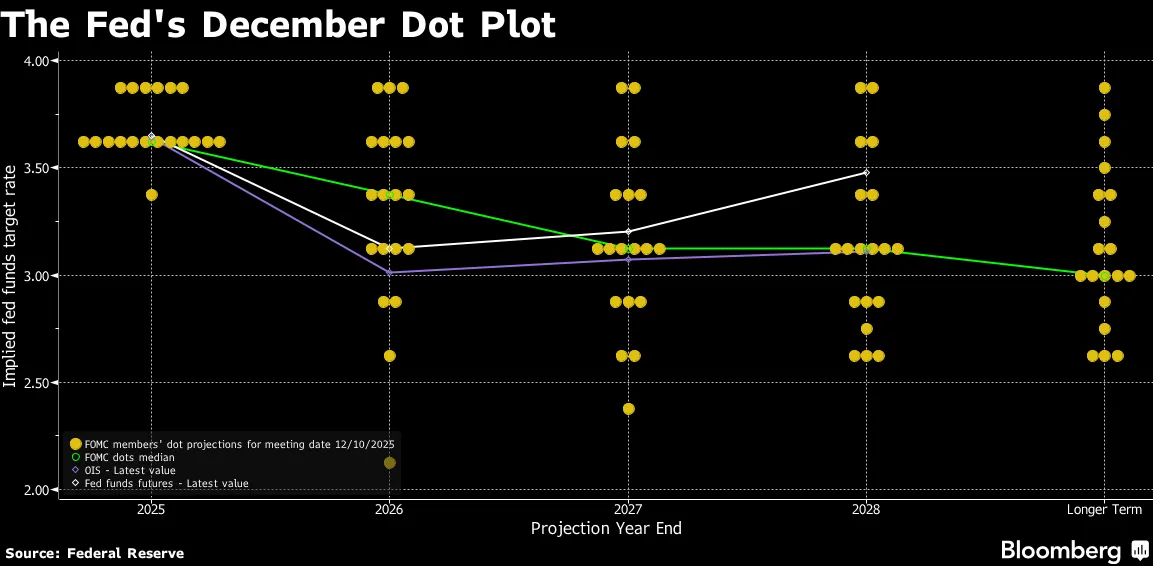
The Fed also released its quarterly projections, and officials’ median projections showed one cut in 2026, and one in 2027. There’s a big division in the outlook, with seven officials seeing no cuts in 2026, while eight signaled at least two.
(Source: Federal Reserve / Bloomberg)
All in all, it sounded like a slightly hawkish cut.
The Treasury purchasing plan was the key that avoided an outsized reaction by the market. Over the next few months, the Fed will depend on incoming data to make decisions.
“The Fed emphasized that future moves will be data-dependent, shifting firmly to a meeting-by-meeting approach,” said Daniel Siluk, a portfolio manager at Janus Henderson Investors.
“Chair Powell reinforced this stance in his press conference, noting that the Committee sees today’s cut as a ‘prudent adjustment’ rather than the start of a new cycle.”
Right now, traders will likely look at incoming economic data to try and gauge what the Fed might do in the first half of 2026. And, of course, President Trump’s next Fed Chair pick will play a big role in the market’s outlook on rates.
Down 75% from Highs: Why Trex at $35 Looks Like a Screaming Buy
Today’s Stock Pick: Trex Company, Inc (TREX)
After the Fed’s recent rate cut, the environment is looking better for small-cap stocks that rely on lower rates for a strong business cycle.
Trex is one of them.
It operates in the home improvement industry that relies on lower rates to drive spending activity.
Now, listen: We’re trying to go green in everything. And wood decks would require a lot of trees, which bucks the trend of sustainability.
What’s more, wood decks are painful to maintain.
Wood will rot, warp, and splinter. And you’ll need to paint or stain wood seasonally. And eventually, it will fade due to termites and age. Anybody who owns a wood deck will remember these splinters that can pierce your fingers or feet.
Trex is leading the revolution of using materials that are 95% recycled and reclaimed, like plastic bags, to create high-quality, attractive decks. In fact, they often look better than wood. And best of all, it requires virtually zero maintenance (except for regular cleaning) and lasts for 25+ years.
(Source: Trex)
And you can see how composite materials last longer than wood in the photo below:
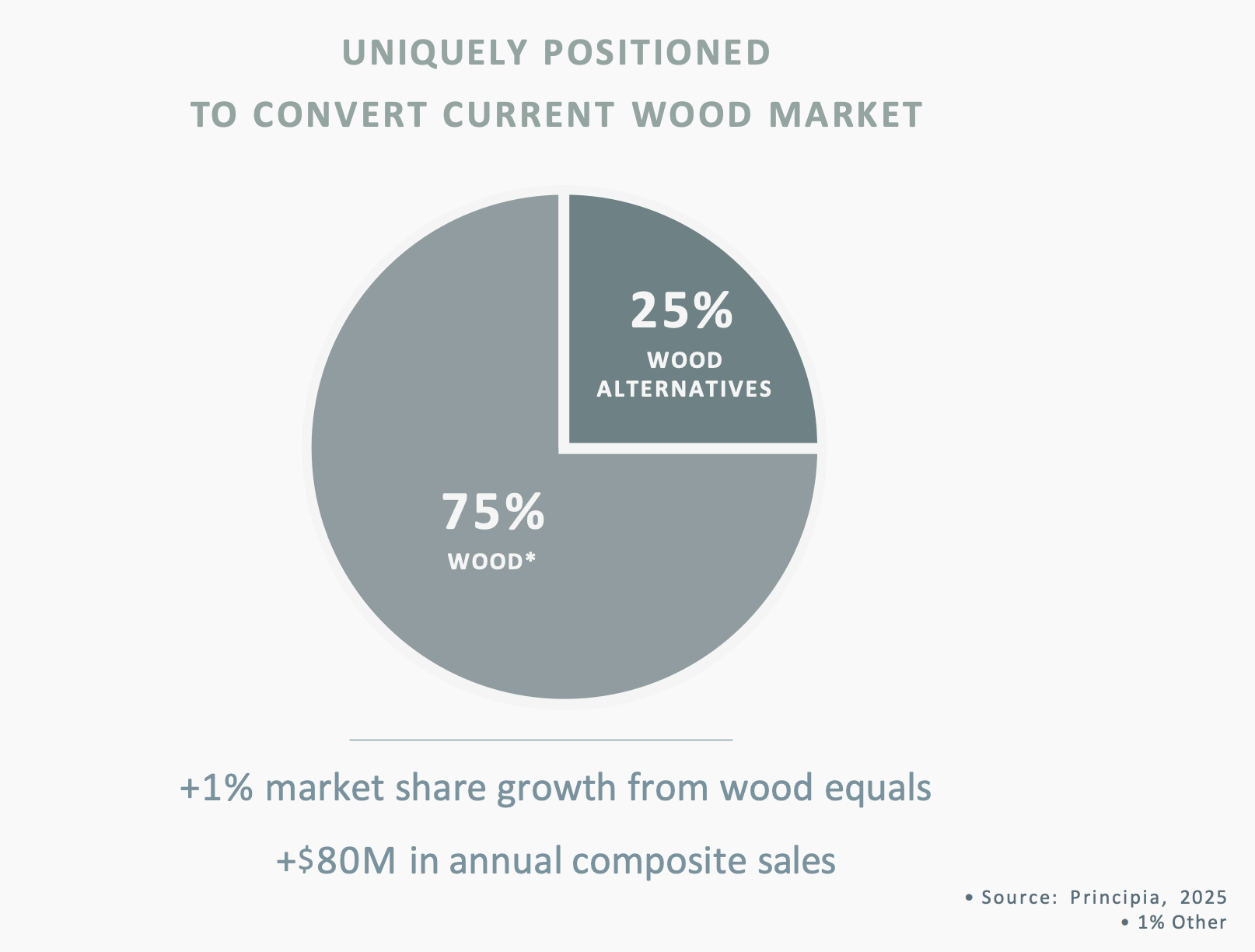
As a result, consumers are switching to composite decks more than ever. Composite has about 25% of the market share in decking, as of the most recent quarter. And composite continues to take about 2% share from wood every year.
Trex CEO Bryan Fairbanks believes that composite would eventually hold about 45-50% of the market share*:*
“…we estimate composites account for approximately 25% of the total decking market but expect it will reach 45% to 50% in the future.”
Each 1% market share would add ~$80 million to annual composite sales. Using the average of 2% growth, the composite market could grow by $160 million each year from taking the market share from wood alone.
(Source: Trex)
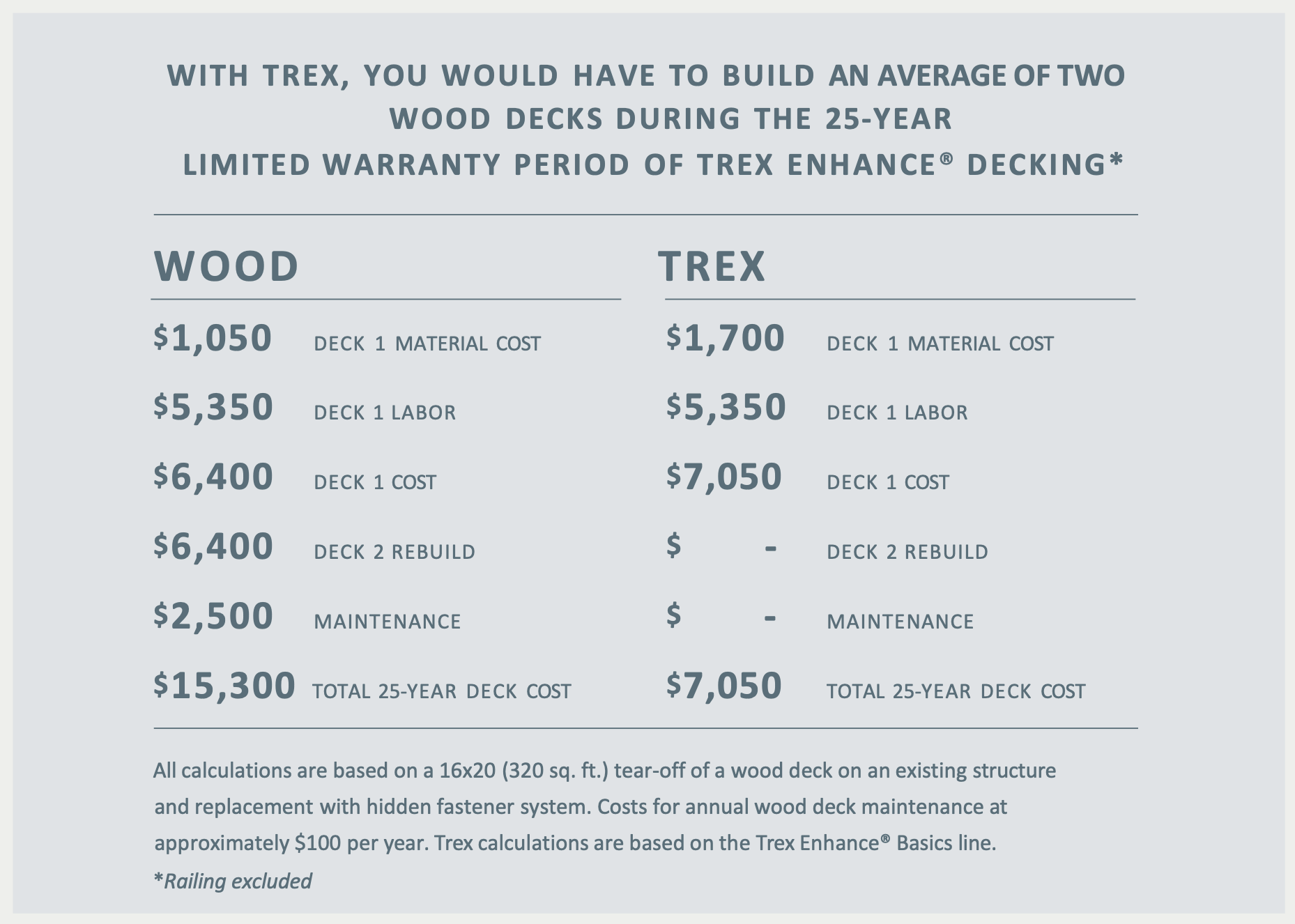
Cost comparison: Wood is slightly cheaper upfront versus composite deck, but composite wood is two times cheaper to maintain over the 25-year lifecycle.
The long-term comparison is simply a no-brainer in favor of composite deck. It lasts longer and requires far less maintenance.
(Source: Trex)
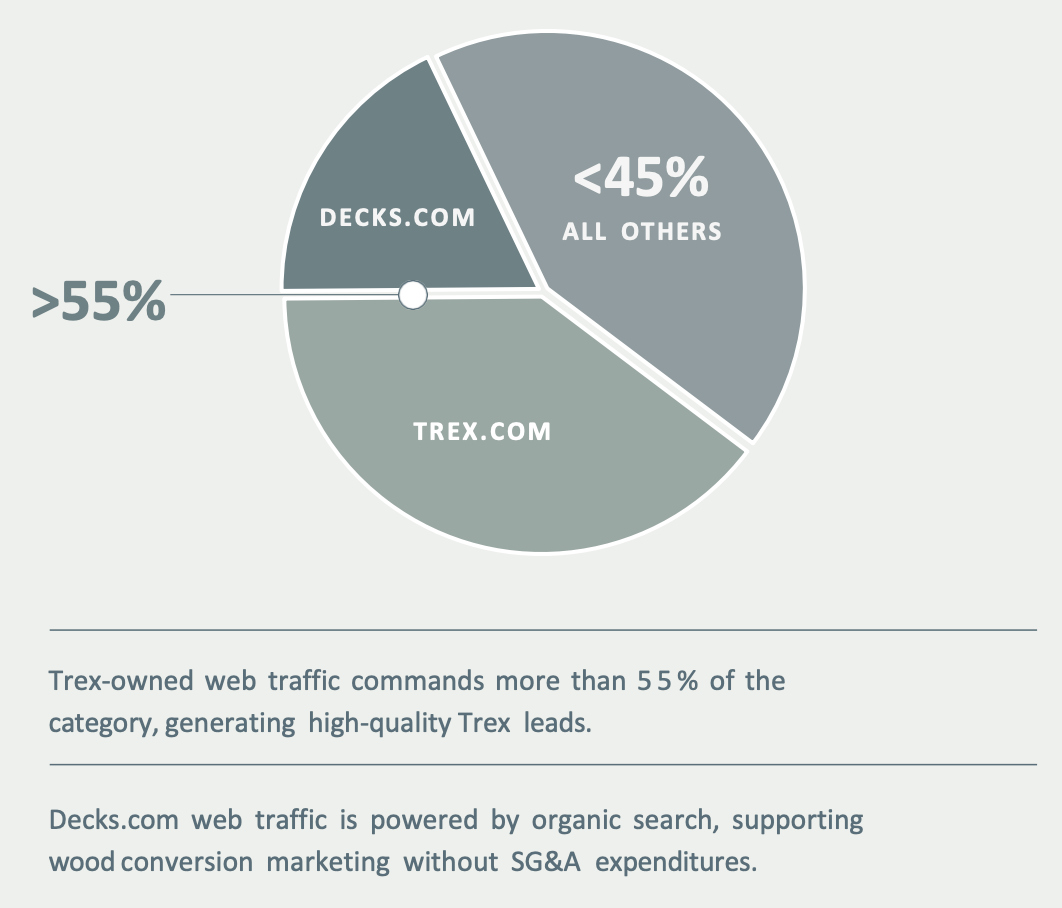
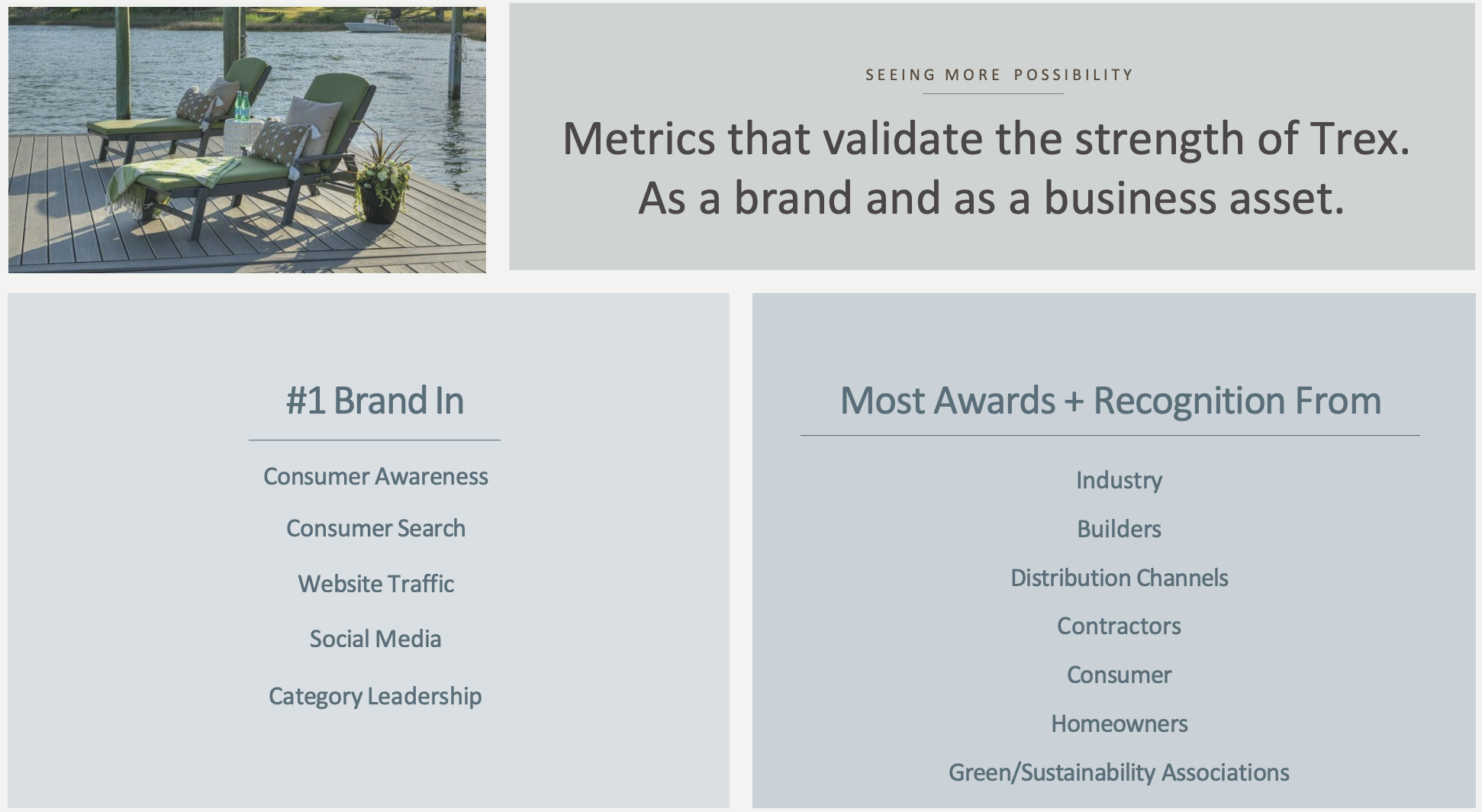
Best of all, Trex thoroughly dominates this niche in composite decks. The company commands more than 55% of category web traffic through its sites – trex.com and decks.com.
(Source: Trex)
And it won multiple prestigious awards for top products, brand awareness, sustainability, fastest-growing business, and best mid-size companies.
(Source: Trex)
Sure enough, the company grew 101%, which is nearly two times faster than the repair & remodeling market in the same period.
(Source: Trex)
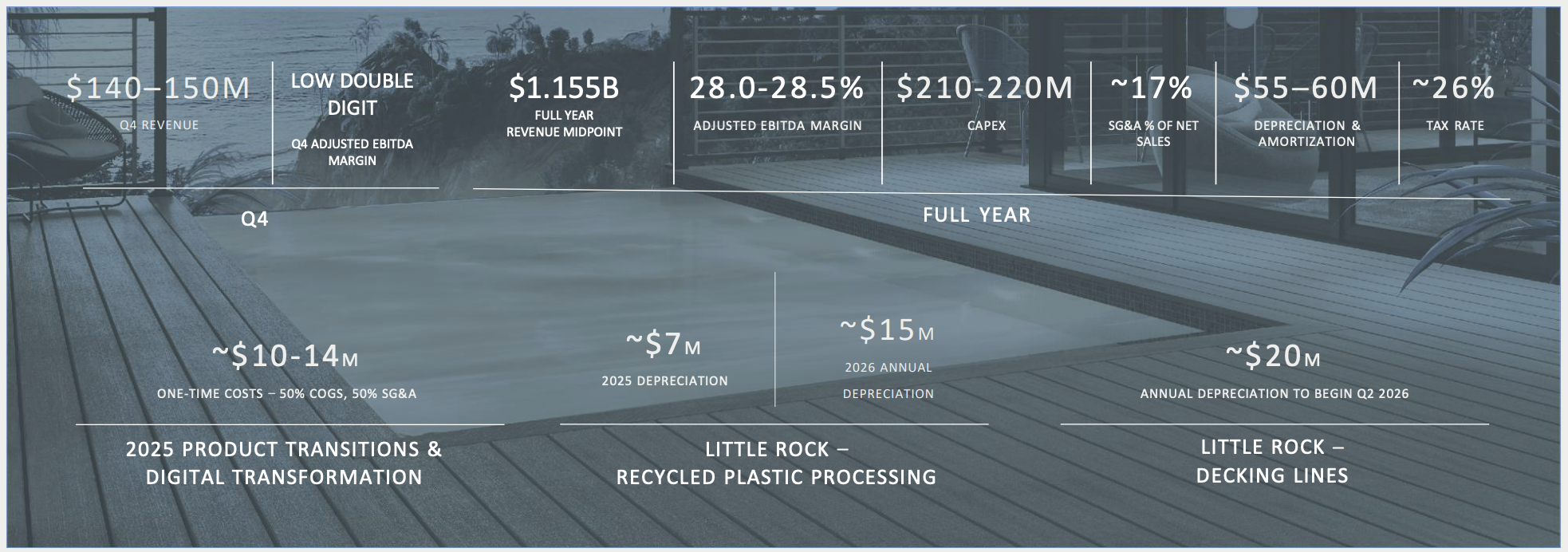
The company sees its 2025 revenue to be at $1.16 billion, which would be almost unchanged from its 2024 full-year revenue. The company is perfectly positioned to grow when the remodeling activity recovers, as the CEO said in the recent earnings call.
“I’m confident that our strategy for long-term growth positions us to realize significant gains as R&R spending recovers,” said CEO Bryan Fairbanks.
The stock is cheap: With its strong financials, dominant market share, and solid growth, Trex’s stock was formerly popular. But due to higher rates, the stock has been beaten down.
The price was at $140 in 2022, and it is now trading at $35 a share.
Its P/E ratio is just 19.
This is a good value since Trex is a rare company that is in the right trend, dominates its niche, and holds pricing power.
Bottom line: The decking industry is going through a massive change, and Trex is at the forefront of this industry. It is known as the “Apple of the composite deck,” where its products are generally accepted as the highest-quality ones in the market. So, this is a high-quality stock.
Power Metallic Mines Inc. (PNP)NF has just released blockbuster results from its Lion Zone at the Nisk Project, including 4.40 meters grading 12.18% copper (14.34% CuEqRec) within 20.40 meters of 2.91% Cu (3.58% CuEqRec). With gold breaking past $4,300 per ounce, silver over $50, and copper and battery metals surging, PNPNF sits at the intersection of booming precious metals and industrial mineral demand. The company’s fully funded 100,000-meter drilling program through 2026 aims to expand high-grade mineralization across Nisk, Lion, and Tiger zones, offering investors rare exposure to ethically sourced polymetallic resources.
Strategically located near Hydro-Québec power, the Nisk Project benefits from low operating costs, shallow deposits, and exceptional potential for carbon sequestration, aligning with green mining initiatives. As global supply constraints tighten and Fed rate cut expectations lift metals markets, PNPNF emerges as a potential North American leader in critical minerals and precious metals. Its high-grade deposits of nickel, copper, cobalt, PGEs, gold, and silver are strategically positioned to supply the green energy revolution while offering diversified exposure for investors. Backed by leading figures in mining and resource development, PNPNF benefits from strategic guidance and credibility in the global minerals market.
3 Reasons Casey’s General Stores Will Continue Trending Higher
Reported by Thomas Hughes. Date Posted: 12/10/2025.
Key Takeaways
Casey’s General Stores had a solid fiscal Q2, providing fuel for a potential 2026 rally.
Cash flow and capital returns underpin CASY’s price action.
Broad market support, including from institutions and analysts, and a tendency toward accumulation, are driving the action.
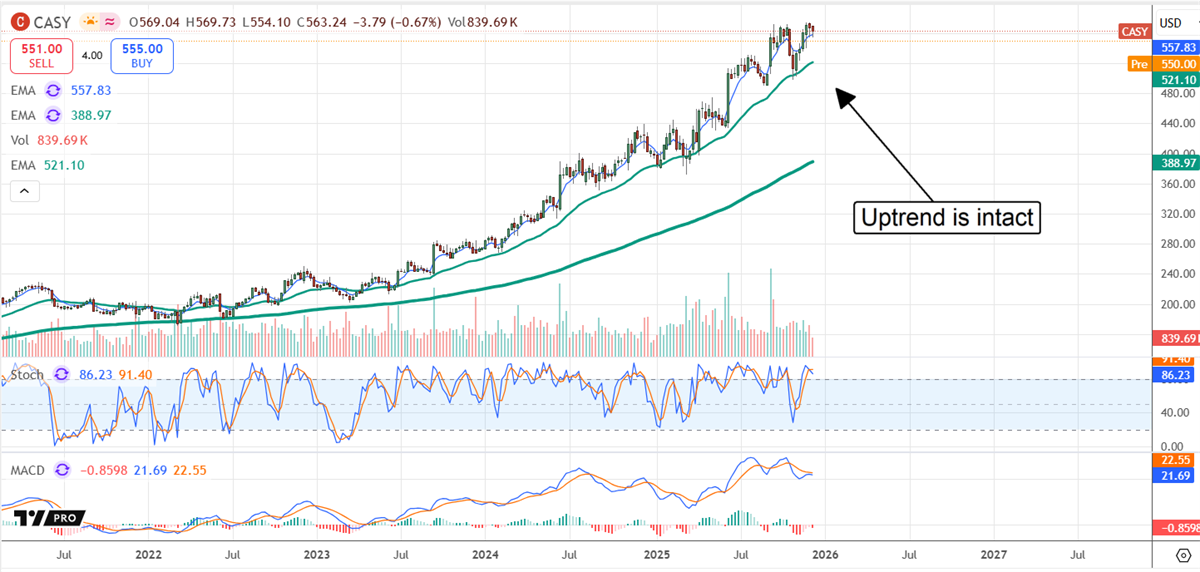
There are three reasons Casey’s General Stores (NASDAQ: CASY) stock price will likely continue to trend higher despite valuation concerns. The stock isn’t cheap as of late 2025, trading at roughly 33 times its current-year earnings. Still, that price reflects a reliable growth trajectory, which could represent meaningful upside for long-term, buy-and-hold investors.
It is trading at about 10 times its 2035 earnings outlook, implying the potential for roughly 100% upside over the coming years. Below, we explore three reasons investors might expect the stock to trend higher in 2026—growth, cash flow and capital returns, and broad market support.
Trump’s Next Real Estate Deal Could Pay YOU President Trump’s real estate deals have returned as much as 4,800%. That’s enough to turn every $1,000 into $49,000. But his next “real estate deal” is different – and much bigger. It involves federal assets worth an estimated $5.1 trillion. And any American citizen can stake their claim. The mainstream media is largely ignoring this, but a former Trump advisor just went on the record.[GET THE FULL DETAILS HERE]
Reason #1: Casey’s Revealed Momentum in Its FQ2 Report
Casey’s General Stores delivered a solid fiscal second quarter (FQ2), with earnings resultsshowing strength and momentum that are expected to carry through to year-end. Net revenue of $4.51 billion rose 14.2% year-over-year (YOY), slightly ahead of consensus, driven by new-store expansion and comp-store increases. Store count was up 9% YOY and 0.6% year-to-date (YTD), helped by last year’s acquisition of Fike’s.
Strength appeared in both the inside and outside segments, with total inside sales up 13%, inside comps up 3.3%, and fuel-gallon comps up 0.8%.
Within the inside segment, both grocery and prepared foods showed meaningful improvement, including margin expansion.
The company widened its fuel margin, which helped offset higher costs elsewhere and preserve overall profitability versus the prior year. That margin strength contributed to a 17.5% increase in EBITDA, a 14% rise in net income, and GAAP EPS of $0.33.
Notably, the $0.33 EPS was about 630 basis points above MarketBeat’s reported consensus forecast. These results support a stronger full-year profitability outlook, and operating momentum is expected to continue into 2026.
Reason #2: Casey’s Generates Healthy Cash Flows and Value
While Casey’s operates with the modest margins typical of the retail sector, its operational efficiency and balance sheet strength allow it to generate substantial free cash flow. In FQ2, positive cash flow helped strengthen the balance sheet, with assets growing faster than liabilities. Total liabilities stood at about 1.25 times equity, and shareholder equity is rising.
Shareholder equity increased roughly 8% YTD even as the company continued to return capital through dividends and buybacks.
Neither the dividend nor the buybacks are aggressive; they are disciplined and consistent. The 0.4% yield as of mid-December represents only about 10% of the earnings forecast and is expected to grow over time. The company is a Dividend Aristocrat and is on track to extend its streak toward 50 years and potential Dividend King status.
Share repurchases have been modest but steady, reducing the share count incrementally each quarter. Investors should note that Casey’s share count rose YOY earlier in the year because the company preserved capital ahead of the acquisition of Fike’s. Buybacks have since resumed, lowered the share count in FQ2, and are expected to continue in 2026.
Reason #3: Casey’s Has Broad Market Support
Beyond the earnings momentum and capital returns, broad market support has been an important tailwind for the stock’s longer-term appreciation. That support shows up in analyst coverage and institutional behavior.
Analysts who rate the stock a Moderate Buy have been nudging up their 2026 price targets, and that trend continued after the FQ2 release.
One notable update was a price-target increase from RBC to $591, above consensus and sufficient to drive a new all-time high. Institutions own roughly 85% of the shares and were net buyers in every quarter of 2026, purchasing about $2 for every $1 sold.
Thank you for subscribing to The Early Bird, MarketBeat’s 7:00 AMnewsletter that covers stories that will impact the stock market each day.
This email communication is a paid sponsorship sent on behalf of Huge Alerts, a third-party advertiser of The Early Bird and MarketBeat.
This message is a paid advertisement for Power Metallic Mines (PNPNF) from Huge Alerts and Sideways Frequency. MarketBeat Media, LLC receives a fixed fee for each subscriber that clicks on a link in this email, totaling up to $12,500. Other than the compensation received for this advertisement sent to subscribers, MarketBeat and its principals are not affiliated with either Huge Alerts or Sideways Frequency. MarketBeat and its principals do not own any of the stocks mentioned in this email or in the article that this email links to. Neither MarketBeat nor its principals are FINRA-registered broker-dealers or investment advisers. The content of this email should not be taken as advice, an endorsement, or a recommendation from MarketBeat to buy or sell any security. MarketBeat has not evaluated the accuracy of any claims made in this advertisement. MarketBeat recommends that investors do their own independent research and consult with a qualified investment professional before buying or selling any security. Investing is inherently risky. Past-performance is not indicative of future results. Please see the disclaimer regarding Power Metallic Mines (PNPNF) on Sideways Frequency’ website for additional information about the relationship between Sideways Frequency and Power Metallic Mines (PNPNF).
If you have questions or concerns about your subscription, please don’t hesitate to email our South Dakota based support team at contact@marketbeat.com.
If you no longer wish to receive email from The Early Bird, you can unsubscribe.
Copyright 2006-2025 MarketBeat Media, LLC. 345 North Reid Place, Suite 620, Sioux Falls, S.D. 57103-7078. United States..
Ratings changes for Broadcom, Broadcom, Anixa Biosciences, Olema Pharmaceuticals, Structure Therapeutics, Cytokinetics, lululemon athletica and more…Text “MarketBeat” to 68285 to get SMS breaking news alerts for stocks on your watchlist and other special reports. Learn More.
Market Swings Are Back—2 Options Plays to Watch Now (ad)Markets don’t like uncertainty — and this summer has delivered plenty of it. Political gridlock, legal disputes, and rising global tensions have fueled sharp swings across major indexes.
For active traders, though, volatility isn’t a risk — it’s opportunity. That’s why a new briefing reveals how to harness these conditions with clear, practical options strategies designed for 2025’s politically charged market.
Analyst RatingsMy MarketBeatAccount SettingsMarketBeat All AccessStock ListsStock ScreenerCalculatorsPremium ReportsBest Stocks to Buy in DecemberBNZI: Big Wins in Small-Cap AI (ad)AI-powered marketing platform Banzai International (NASDAQ: BNZI) just delivered a standout Q3, reporting $2.8 million in revenue (+163% YoY) and $11 million in ARR (+168%), while expanding gross margins to 82% and sharply reducing losses. With more than 90,000 customers — including Cisco, HP, and New York Life — BNZI is seeing accelerating adoption of its AI-driven tools like Curate, Demio, and Superblocks. Strengthened equity, a scalable recurring-revenue model, and strategic acquisitions position the company to capitalize on the $1.5 trillion marketing technology market as demand for automation surges.
$311.62 -0.81 (-0.26%) As of 12/12/2025 9:47 AM ET
Alphabet Inc. (NASDAQ:GOOGL) announced a quarterly dividend on Tuesday, October 21st. Investors of record on Monday, December 8th will be paid a dividend of 0.21 per share by the information services provider on Monday, December 15th. This represents a c) dividend on an annualized basis and a dividend yield of 0.3%. The ex-dividend date of this dividend is Monday, December 8th.
Alphabet (NASDAQ:GOOGL) had its price target raised by JPMorgan Chase & Co. ( ) (analyst Doug Anmuth) from $340.00 to $385.00. They now have an “overweight” rating on the stock. This represents a 23.2% upside from the current price of $312.43.
$647.75 -4.96 (-0.76%) As of 12/12/2025 9:47 AM ET
Meta Platforms, Inc. (NASDAQ:META) declared a quarterly dividend on Wednesday, December 3rd. Investors of record on Monday, December 15th will be given a dividend of 0.525 per share by the social networking company on Tuesday, December 23rd. This represents a c) dividend on an annualized basis and a yield of 0.3%. The ex-dividend date is Monday, December 15th.
insider Jennifer Newstead sold 519 shares of Meta Platforms stock in a transaction that occurred on Tuesday, December 9th. The stock was sold at an average price of $664.16, for a total value of $344,699.04. Following the transaction, the insider directly owned 30,215 shares of the company’s stock, valued at $20,067,594.40. The trade was a 1.69% decrease in their position. The sale was disclosed in a filing with the SEC, which is available at the SEC website.
Citigroup (NYSE:C) was upgraded by analysts at JPMorgan Chase & Co. from a “neutral” rating to an “overweight” rating. They now have a $124.00 price target on the stock. This represents a 10.2% upside from the current price of $112.52.Choice Hotels International (NYSE:CHH) was upgraded by analysts at JPMorgan Chase & Co. from an “underweight” rating to a “neutral” rating. They now have a $95.00 price target on the stock, down previously from $102.00. This represents a 4.8% upside from the current price of $90.68.Freddie Mac (OTCMKTS:FMCC) was upgraded by analysts at Wedbush from an “underperform” rating to an “outperform” rating. They now have a $13.35 price target on the stock. This represents a 21.5% upside from the current price of $10.99.Gaming and Leisure Properties(NASDAQ:GLPI) was upgraded by analysts at JPMorgan Chase & Co. from a “neutral” rating to an “overweight” rating. They now have a $53.00 price target on the stock, up previously from $52.00. This represents a 22.1% upside from the current price of $43.41.Intercontinental Hotels Group (NYSE:IHG) was upgraded by analysts at Jefferies Financial Group Inc. from a “hold” rating to a “buy” rating.The current price is $139.31.Magnolia Oil & Gas (NYSE:MGY) was upgraded by analysts at Mizuho from a “neutral” rating to an “outperform” rating.The current price is $23.34.SoundHound AI (NASDAQ:SOUN) was upgraded by analysts at Cantor Fitzgerald from a “neutral” rating to an “overweight” rating. They now have a $15.00 price target on the stock, up previously from $13.00. This represents a 21.9% upside from the current price of $12.30.CLEAR Secure (NYSE:YOU) was upgraded by analysts at JPMorgan Chase & Co. from a “neutral” rating to an “overweight” rating. They now have a $42.00 price target on the stock, up previously from $35.00. This represents a 4.2% upside from the current price of $40.31. VIEW MORE UPGRADES Companies Forced to Hand Over 90% of Profits (ad)Why Is Nobody Talking About What Just Happened at Mar-a-Lago?
He served on one of Trump’s top advisory boards… and he’s been a personal friend of the President for years… But what he just revealed at Mar-a-Lago about President Trump has made some people uncomfortable. The mainstream won’t touch this story. But if you’re an American patriot looking to build wealth, you need to hear what he’s saying.
easyJet (OTCMKTS:ESYJY) was downgraded by analysts at Kepler Capital Markets from a “buy” rating to a “hold” rating.The current price is $6.49.M&T Bank (NYSE:MTB) was downgraded by analysts at Truist Financial Corporation from a “buy” rating to a “hold” rating. They now have a $217.00 price target on the stock. This represents a 6.0% upside from the current price of $204.75.Roblox (NYSE:RBLX) was downgraded by analysts at JPMorgan Chase & Co. from an “overweight” rating to a “neutral” rating. They now have a $100.00 price target on the stock, down previously from $145.00. This represents a 9.5% upside from the current price of $91.29.Sociedad Quimica y Minera (NYSE:SQM) was downgraded by analysts at Citigroup Inc. from a “buy” rating to a “neutral” rating. They now have a $74.00 price target on the stock. This represents a 12.2% upside from the current price of $65.96. VIEW MORE DOWNGRADES This week’s 20x (missed it?) (ad)Less than 0.2% of investors know this market exists…
There’s a hidden market where crypto trades at 80-95%cheaper than mainstream exchanges. It’s called the “Native” Markets, and it’s how every crypto millionaire has made their fortune. Don’t buy at the top – get in before retail even knows:
British American Tobacco (NYSE:BTI) is now covered by analysts at Kepler Capital Markets. They set a “buy” rating on the stock.The current price is $56.81.Genpact (NYSE:G) is now covered by analysts at Susquehanna. They set a “neutral” rating and a $50.00 price target on the stock. This represents a 5.4% upside from the current price of $47.45.Huntington Ingalls Industries (NYSE:HII) is now covered by analysts at Citigroup Inc.. They set a “buy” rating and a $376.00 price target on the stock. This represents a 13.9% upside from the current price of $330.03.Palatin Technologies(NYSEAMERICAN:PTN) is now covered by analysts at Laidlaw. They set a “buy” rating and a $60.00 price target on the stock. This represents a 135.1% upside from the current price of $25.52.Science Applications International(NYSE:SAIC) is now covered by analysts at Citigroup Inc.. They set a “buy” rating and a $122.00 price target on the stock. This represents a 19.5% upside from the current price of $102.11.SouthState Bank (NYSE:SSB) is now covered by analysts at JPMorgan Chase & Co.. They set an “overweight” rating and a $115.00 price target on the stock. This represents a 20.4% upside from the current price of $95.54.Teledyne Technologies (NYSE:TDY) is now covered by analysts at Citigroup Inc.. They set a “neutral” rating and a $567.00 price target on the stock. This represents a 8.6% upside from the current price of $521.87.Tyler Technologies (NYSE:TYL) is now covered by analysts at TD Cowen. They set a “buy” rating and a $650.00 price target on the stock. This represents a 41.5% upside from the current price of $459.51. VIEW MORE NEW COVERAGE
Best-in-Class Portfolio MonitoringView the latest news, buy/sell ratings, SEC filings and insider transactions for your stocks. Compare your portfolio performance to leading indices and get personalized stock ideas based on your portfolio.
Stock Ideas and RecommendationsGet daily stock ideas from top-performing Wall Street analysts. Get short term trading ideas from the MarketBeat Idea Engine. View which stocks are hot on social media with MarketBeat’s trending stocks report.
Advanced Stock Screeners and Research ToolsIdentify stocks that meet your criteria using seven unique stock screeners. See what’s happening in the market right now with MarketBeat’s real-time news feed. Export data to Excel for your own analysis.
Gold’s Breakout Above $4,000 Sparks a Historic Bull Market — And Scorpio Gold (OTCQB: SRCRF) Could Be at the Center of Nevada’s Next Multi-Million-Ounce Discovery.
Gold’s unprecedented surge past $4,000 per ounce in 2025 has ignited a powerful new bull market in precious metals. With inflation, global uncertainty, and central banks buying at record levels, some analysts now forecast gold could hit $5,000 by 2026.
In this environment, Scorpio Gold Corporation (OTCQB: SRCRF) is emerging as a standout junior explorer — backed by industry titans Ross Beaty and Eric Sprott, who together invested CAD$8 million to accelerate development of Scorpio’s 100%-owned Manhattan District Project in Nevada’s prolific Walker Lane Trend, just 15 km south of Kinross Gold’s 15-million-ounce Round Mountain Mine!
Scorpio’s 2025 Maiden Mineral Resource Estimate outlined 740,000 ounces of inferred gold grading 1.26 g/t, marking the first modern resource in this historic district. Combined with several high-grade historical zones totaling 303,949 ounces at 5.89 g/t, and new drill results still to come, the company is poised for significant expansion.
With world-class backers, record-breaking gold prices, and a district-scale asset in America’s premier mining jurisdiction, SRCRF could be one of the biggest breakout stories of this new gold supercycle.
This email message is a paid sponsorship provided by Huge Alerts, a third-party advertiser of MarketBeat. Why did I get this email content?.
This message is a paid advertisement for Scorpio Gold Corporation (OTCQB: SRCRF) from Huge Alerts and Sideways Frequency. MarketBeat Media, LLC receives a fixed fee for each subscriber that clicks on a link in this email, totaling up to $12,500. Other than the compensation received for this advertisement sent to subscribers, MarketBeat and its principals are not affiliated with either Huge Alerts or Sideways Frequency. MarketBeat and its principals do not own any of the stocks mentioned in this email or in the article that this email links to. Neither MarketBeat nor its principals are FINRA-registered broker-dealers or investment advisers. The content of this email should not be taken as advice, an endorsement, or a recommendation from MarketBeat to buy or sell any security. MarketBeat has not evaluated the accuracy of any claims made in this advertisement. MarketBeat recommends that investors do their own independent research and consult with a qualified investment professional before buying or selling any security. Investing is inherently risky. Past-performance is not indicative of future results. Please see the disclaimer regarding Scorpio Gold Corporation (OTCQB: SRCRF) on Sideways Frequency’ website for additional information about the relationship between Sideways Frequency and Scorpio Gold Corporation (OTCQB: SRCRF).
If you need help with your account, please feel free to contact MarketBeat’s South Dakota based support team at contact@marketbeat.com.
You are receiving this email because you are subscribed to Behind the Markets. If you no longer wish to receive these emails, please unsubscribe here.
Prefer to view this content on our website? Click here.
Dear Fellow Investor,
How to Spot Excessively Oversold Opportunities
In 2005, a bizarre and tragic incident made global headlines. According to USA Today, 450 sheep in a remote Turkish village jumped to their deaths after falling off a cliff. The cause wasn’t a predator, an earthquake, or a sudden shock.
It was one sheep.
One sheep wandered too close to the drop and fell. Another followed. And suddenly, hundreds—eventually more than 1,500—blindly followed the flock, piling over the cliff’s edge simply because the others were doing it. Many didn’t survive. The ones that did lived only because they landed on the massive pile of wool beneath them.
As odd as this sounds, it’s not a rare occurrence in nature. Herd mentality is a powerful force.
And traders fall for it every day.
Most investors buy because everyone else is buying. They sell because everyone else is selling. They chase headlines, social media hype, and emotional narratives. They jump when the market jumps, panic when the market panics, and often have no idea why they’re taking action at all.
It’s one of the costliest mistakes in all of investing.
Charles Mackay captured this phenomenon more than 180 years ago in his classic, Extraordinary Popular Delusions and the Madness of Crowds. He wrote: “Men… think in herds; they go mad in herds, while they only recover their senses slowly, and one by one.”
Even though he wrote those words in 1841, they apply just as much today—arguably more. Markets now move faster, information travels instantly, and fear spreads across screens in milliseconds. The more connected we become, the stronger herd mentality gets.
But here’s the good news: herd mentality is predictable. And if you know how to identify it, you can exploit it—just as some of the world’s most successful investors have done.
The Billionaire Blueprint for Exploiting Fear and Greed
Warren Buffett has repeated one of the most valuable market principles of all time:
“Be fearful when others are greedy, and greedy when others are fearful.”
Baron Rothschild famously advised investors to “buy when there’s blood in the streets.”
Sir John Templeton, who built one of the world’s most successful global mutual funds, bought stocks at the peak of pessimism—often when markets were in total panic.
Each of these investors made fortunes by identifying moments when the crowd was acting irrationally—and doing the opposite.
But there’s one key difference between their era and ours:
They relied primarily on fundamental analysis—studying earnings, valuations, and economic conditions.
We can combine that with technical analysis, giving us a more precise way to spot major turning points.
And that leads to one of the most profitable patterns in all of trading:
The Excessively Oversold Opportunity.
This is what happens when the herd has sold so aggressively—and so emotionally—that prices fall far below reasonable value. When sentiment collapses, panic replaces logic… and that’s exactly when smart investors step in.
Let’s look at Palantir (PLTR), which recently gave investors a textbook setup.
In early November, fears of an “AI bubble” sent shares tumbling from about $210 down to $147.56—a steep drop driven almost entirely by emotion. There was no collapse in earnings. No loss of major customers. No negative guidance. Just widespread fear that AI stocks had run up “too far, too fast.”
Investors panicked… and sold. Analysts piled in with gloomy predictions… and more sold. Momentum traders saw the drop… and sold.
But here’s the irony:
The AI bubble they were terrified of still doesn’t exist. AI adoption is accelerating, not slowing. And the companies powering it—including Palantir—continue to post strong fundamentals.
So what happened next?
As the panic faded, the stock rebounded sharply—rallying to $186.47.
The real question is: How could investors have spotted this oversold opportunity before the bounce?
The Four Indicators You Must Watch
The answer lies in four key technical pivot points. Each of these signals helps reveal when fear has reached an extreme:
1. Relative Strength Index (RSI)
RSI measures the speed and magnitude of price moves.
When RSI dips to or below 30, a stock is considered “oversold.” Extreme drops toward that line often precede powerful reversals.
2. MACD (Moving Average Convergence Divergence)
MACD shows momentum.
When it dips well below its mean or crosses into deeply negative territory, it signals that selling momentum is overstretched.
3. Williams’ %R
This indicator measures overbought/oversold conditions on a scale of 0 to -100.
When it falls below the -80 line, it indicates oversold conditions.
4. Full Stochastics
Like Williams’ %R, this is another momentum indicator.
When Full Stochastics dip below 20, selling pressure is approaching extreme levels.
Now here’s where it gets interesting.
When all four indicators reach these oversold lines at the same time, it’s often a major turning point.
From precision medical robotics to autonomous industrial systems, adoption is accelerating across healthcare, defense, and supply chain operations — and capital markets are responding.
• Commercial solutions already deployed in high-growth industries • Improving analyst sentiment and institutional inflows • Exposure to a robotics market expected to exceed $200B within this decade
With momentum strengthening across the sector, timing is becoming a competitive edge.
Around November 21, every one of these indicators flashed oversold:
RSI fell to the 30-line
MACD dropped sharply below its mean
Williams’ %R sank beneath -80
Full Stochastics plunged under 20
Even more important: when you zoom out and view these indicators across one or two years of price action, a clear pattern emerges.
Each time all four indicators hit extreme oversold levels simultaneously… PLTR bounced.
This is the power of studying the herd. This is how you identify irrational selling. This is how you exploit emotionally-driven panic.
Does It Work 100% of the Time?
Of course not.
No strategy in the market is perfect. There will always be false signals, unexpected news, and periods when the herd stays irrational longer than expected.
But here’s what this method will do:
Help you avoid panic selling
Put you on the right side of sentiment
Identify price levels the crowd has pushed too far
Give you objective confirmation that selling pressure is fading
Improve timing on entries and exits
Increase your odds of capturing major reversals
When combined with solid fundamentals—just as the great investors consistently demonstrated—these technical signals become even more powerful.
And we’re not talking about Dogecoin, Shiba Inu, or any of the memecoins you’ve already heard about.
This is something different. Something with massive upside potential that’s still flying completely under the radar.
Here’s what makes this memecoin special:
–Strong community momentum building behind it right now… –Institutional interest that is rare for a memecoin… –Unique “utility” that separates it from the millions of other memecoins… –Early-stage entry point before the mainstream catches on… –Catalysts on the horizon that could send it significantly higher…
Are there any other lesser known oversold stocks that you’re buying right now? What other sectors of the market are you currently interested in? Hit “reply” to this email and let us know your thoughts!
Our mailing address is: Behind the Markets, LLC 4260 NW 1st Avenue, Suite 55 Boca Raton, FL 33431
In uncertain environments, using the best available data for stock picking is critical. That also goes for figuring out which stocks to avoid.
As Marc explains in this classic essay, his one-of-a-kind Power Gauge system shines in this area…
Giving Jon Najarian a Great Call
By Marc Chaikin, founder, Chaikin Analytics“Based on the bearish Power Gauge rating, I think the risk of a negative earnings surprise is too great.”
I said those words in 2012, as I was appearing for the first time on CNBC’s Fast Money Halftime Report.
On the panel next to me was Jon Najarian. I’m guessing you’ve heard of him…
The NFL-linebacker-turned-high-profile-trader had become a household name in the financial world by then. He would go on to sell his publishing and trading platforms, optionMONSTER and tradeMONSTER, to E-Trade just a few years later for $750 million.
Jon was at the peak of his financial career. And although I’d been making the rounds on CNBC, this was the first time we had crossed paths.
The stock we were talking about was online travel agency Priceline, which later changed its name to Booking Holdings (BKNG).
Priceline was one of Jon’s bullish trades at the time. And I had just told CNBC viewers that it looked too risky.
The thing is, I didn’t know anything about Priceline.
But I did have the Power Gauge to guide me. And that was all I needed…Recommended Links:
On December 16, legendary market veteran Marc Chaikin is officially sounding the alarm on the U.S. stock market… and will reveal the No. 1 step to take with your money BEFORE January 1 to protect yourself and prepare as hundreds of stocks could soon suffer swift, brutal sell-offs. The last time he issued a warning like this, the average investor went on to lose up to 44% of their portfolio in the months that followed. Before it’s too late, learn more here.
As one market veteran is now warning, if you want to protect yourself from the chaos surrounding the AI bubble – and potentially triple your money – you need to make this ONE move before January 1, 2026. Click here to learn more.As longtime readers know, the Power Gauge is the culmination of my life’s work.
It combines more than five decades’ worth of data-driven market research. And it packages everything I’ve learned about the markets into actionable information for every stock it processes.
So I didn’t need to know much about Priceline. I just typed in the ticker and got my report.
Immediately, I saw that Priceline was set up to release disappointing earnings. The Power Gauge made it clear.
Obviously, the interface for the Power Gauge has gotten more refined over the years. Here’s an example of another stock that the Power Gauge turned “very bearish” on recently…You’ve probably never heard of Kingsway Financial Services (KFS).
But that’s not important – because the Power Gauge has.
Each of these sliders is backed by data that can be further explored. And the data shows us that Kingsway is in a risky spot for investors right now.
That was the kind of setup I saw when I told Jon that Priceline looked like a no-go. The Power Gauge had provided me with the most important (and most relevant) information.
Again, Jon was excited about the stock. But he was a professional. And he was willing to reexamine his ideas.
The interview ended with Jon saying, “I’m going to take a harder look, since Marc Chaikin doesn’t like it.”
That was Monday, August 6, 2012. On Wednesday, the day after Priceline’s earnings, the Halftime Report did a highly unusual follow-up.
The host started by asking Jon, “Chaikin spooked you a little bit?”
“He did indeed. And I think… a lot of folks followed Mr. Chaikin. Those of us that picked up some cheap out-of-the-money puts… well, they worked out like a charm.
“Those puts went from like $1.80 last night to $15, $16,” Jon continued. “Again, great call by Marc Chaikin. And thanks, Marc, for helping me out.”
In short, the Power Gauge was right. Priceline missed earnings. And Jon listened to me, made a bet against the stock, and racked up big profits instead of taking major losses.
Now, one great call is just that – a single great call.
But it was only possible because I had the Power Gauge at my side.
The Power Gauge uses the best data available to help individual investors make consistently great calls. And my goal is to share that power with as many investors as I can.
Good investing,
Marc Chaikin
Editor’s note: Looking ahead to 2026, it’s critical that investors have the right data and tools at their disposal…
This coming Tuesday, December 16, Marc is going on camera for a big event. During it, he’ll explain why we’re likely to see a volatile ride ahead in 2026. To share the message, he’ll also be joined by a special guest who has essentially devoted his career to accurately timing the markets.
Marc and this special guest will also discuss a brand-new tool designed to safeguard your portfolio against the volatility we’re likely to see in 2026. That also includes a string of devastating “flash crashes” that could be headed for hundreds of popular stocks.
Also note that today’s edition of the Chaikin PowerFeed does not include the usual data from the Power Gauge below. Power Gauge users can still log on to the Chaikin Analytics platform to access our system’s most recent data.
Look forward to our usual PowerFeed format returning on Monday, December 15.
You have received this e-mail as part of your subscription to PowerFeed. If you no longer want to receive e-mails from PowerFeed, click here.
You’re receiving this e-mail at pahovis@aol.com.
For questions about your account or to speak with customer service, call +1 (877) 697-6783 (U.S.), 9 a.m. – 5 p.m. Eastern time or e-mail info@chaikinanalytics.com. Please note: The law prohibits us from giving personalized financial advice.
Any brokers mentioned constitute a partial list of available brokers and is for your information only. Chaikin Analytics, LLC, does not recommend or endorse any brokers, dealers, or investment advisors.
Chaikin Analytics forbids its writers from having a financial interest in any security they recommend to our subscribers. All employees of Chaikin Analytics, LLC (and affiliated companies) must wait 24 hours after an investment recommendation is published online – or 72 hours after a direct mail publication is sent – before acting on that recommendation.
This work is based on SEC filings, current events, interviews, corporate press releases, and what we’ve learned as financial journalists. It may contain errors, and you shouldn’t make any investment decision based solely on what you read here. It’s your money and your responsibility.
Identity politics have been merged into American law. This led to issues where race or gender were used to weigh guilt or innocence, and even the severity of punishment.
Health Secretary Robert F. Kennedy Jr.’s new vaccine advisory panel recommends delaying the first vaccine that’s given to many children, the Hepatitis B vaccine that’s administered pretty much as soon as they’re born.
Restorative justice policies are being practiced in schools all over the U.S. Advocates say they break the “school-to-prison” pipeline by using compassion and accountability rather than punishment for offending students.
Amidst ongoing U.S. efforts to mediate a Russia–Ukraine peace and the release of a new U.S. national security strategy that has sent shockwaves through Europe, I’m sitting down with the foreign minister of Latvia, Baiba Braze, to get her unique perspective.
Our mailing address is: The Epoch Times. 229 W. 28 St. Fl. 7 New York, NY 10001 | Contact Us
The Audio Room newsletter is one of the best ways to receive the most up-to-date information. Manage your email preferences here or unsubscribe from The Audio Room here.






























 You’ve probably never heard of Kingsway Financial Services (KFS).





 RJ Hamster