I was born on 6 August 1956 in San Francisco, California to Janet and (the late) Richard Hovis.
I grew up in Santa Monica, California where I attended elementary, junior high school, and high school (graduating in 1974), in addition to involvement in sports and recreation (Little League +, the Boy’s Club ++). Further, it was in elementary school – St. Augustine’s By-the -Sea Parish School that I found, and made the choice to truly journey with God.
I attended Arizona State University from 1974 to 1977 – seeking to become an architect, however, I was not accepted, and, as such, I graduated with a Liberal Arts degree.
Upon graduation from Arizona State University, I attended Cal Poly San Luis Obispo and studied City and Regional Planning at the Master’s level. I successfully completed one (1) year in a two (2) year program – I did not complete the Master’s degree in City and Regional Planning – due to personal reasons.
I returned to Santa Monica where I started (October 1979) my career as graphic designer with Exxon Company, USA. I spent five years with Exxon Company, USA.
While working with Exxon Company, USA I was accepted into architectural school – Sci-Arc in Southern California, however, I did not attend preferring to stay with Exxon..
In 1982 I married Laura Flosi and in April 1983 we had our one and only child – Lauren Alain Hovis – a gift from God.
We moved to Phoenix, Arizona in 1984 from Los Angeles, where I went to work as a graphic designer with Kitchell CEM (from 1985 -1987).
From 1987 – 1995 I was an independent contractor, and a registered representative in mortgage finance, financial management, graphic design, and drafting.
Further, I attended the University of Phoenix and successfully obtained a Master’s in Business Administration (MBA) in 1982.
I was also a member of the Scottsdale Jaycees, where I became very involved in community events and projects.
In 1994, I accepted a cartography position with the Defense Mapping Agency in Reston, Virginia. As such, I relocated from Phoenix to Reston.
In 1998, I was accepted and worked as a Visual Information Officer with the Central Intelligence Agency. In 2002, I worked as a Support Officer until my retirement (due to a need for shoulder surgery) in September 2018.
Away from my Federal Government service, I have been involved in various organizations and activities in Northern Virginia.
In November of 2011, I married Rebecca Ouellette in Santa Monica, California. I reside in San Tan Valley, AZ with my two hamster - Jess and Timothy, our fish, our lizard - RJ Lizard., and our cats - Pearl and Grey.
As to hobbies, I enjoy playing sports, attending sporting events, mentoring individuals from financial management to hamsters, building models, photography, travel, multimedia design, managing partner for RJ Hamster, and jazz – smooth jazz to a samba or a bossa nova.
Love and God Bless,
Peter – aka RJ Hamster Jo hi
BEIRUT (AP) — A conglomerate based in the United Arab Emirates said Monday it will take legal action against Lebanese authorities over a dispute regarding its investments in the crisis-hit country, saying it has suffered $1.7 billion in investment losses. Continue Reading ➔February 17: D-Day For The Dollar – Ad
The U.S. is taking a minority stake in an Oklahoma rare earth miner, the latest government investment in the sector as it on imports of a material used prevalently in smartphones, robotics, electric vehicles and many other high tech products. Continue Reading ➔4 Fastest Growing Blue Chip Stocks – Ad
Blue chip stocks can be an ideal addition to your portfolio if you are risk-averse. These companies enjoy a favorable reputation and historic stability in the markets. Based on the latest activity, these 4 blue chip stocks have been gaining fast.
Sami Inkinen, the CEO of Virta Health, a healthcare company valued at $2 billion, shared that he considers himself wealthy not due to his substantial net worth, but because he has paid off his $100,000 student debt. Continue Reading ➔
Information, charts, or examples contained in this email are for illustration and educational purposes only and not for individualized investment management. This message contains commercial elements, such as advertising and partner offers for which we may receive affiliate compensation. We only send these offers to those who have opted into our newsletter.
If you wish to no longer receive these offers, click on the unsubscribe link at the bottom of this email. Past performance is not indicative of future results. For these reasons, we strongly suggest trading in a DEMO/Simulated account.
The information provided by us is for educational and informational purposes only. We make no representations or warranties concerning the products, practices, or procedures of any company or entity mentioned or recommended in this email and have not determined if the statements and opinions of the advertiser are accurate, correct, or truthful.
If you use, act upon, or make decisions in reliance on information contained in this email or any external source linked within it, you do so at your own peril and agree to hold us, our officers, directors, shareholders, affiliates, and agents without fault.
2967 Dundas St. W. #990, Toronto, ON M6P 1Z2 | Phone Number: 917.672.7040
Editor’s Note: Tech legend Jeff Brown picked Nvidia in 2016 before it jumped 23,000% higher. Today, he’s recommending another explosive opportunity. While everyone has been focusing on Nvidia and other popular AI stocks, he believes a little-known company with a virtual monopoly in a key “AI metal” could hold the key to the $100 trillion AI boom. Click here for detailsor read more below.
Dear Reader,
As you can see in the picture below…
I recently traveled to a ghost town in the middle of an American desert…
Guidewire’s Buyback Could Be the Clue the Sell-Off Is Ending
Written by Thomas Hughes. Originally Published: 1/16/2026.
Article Highlights
Guidewire’s new $500M share buyback supports investor confidence and could accelerate its path to equity gains despite a rising share count.
Institutional selling in late 2025 has given way to early‑2026 accumulation, setting the stage for a potential rebound after a deep price correction.
Analyst sentiment remains bullish with a Moderate Buy consensus and upside forecasts driven by cloud migration, AI integration, and product expansion.
Share buyback authorizations, such as the one recently issued by Guidewire Software (NYSE: GWRE), are an important signal for investors and can influence stock movement because they reflect management’s confidence in growth and cash flow. The company authorized an additional $500 million, extending an earlier program that has now completed. That amount represents roughly 3.4% of Guidewire’s market capitalization, providing potential equity leverage in addition to a sentiment boost.
One caveat: the recent buybacks have not yet reduced outstanding shares meaningfully because share-based compensation has offset some repurchases. For 2025 overall, activity (including share-based comp) resulted in about a 1.5% increase in outstanding shares, though 2026 may change that trend. Q1 of fiscal 2026 (FY2026) saw only a 0.6% increase in the share count, and the company is continuing to grow while strengthening its financial position.
Institutions Are the Key to Unlocking Guidewire’s Share Price Rebound
Warren Buffett is sitting on $344 billion, the biggest cash position of his career. Meanwhile, CEOs behind America’s most powerful tech companies are selling billions in shares even as Wall Street tells everyday investors to buy the AI dip. After 46 years tracking institutional money flows, one pattern stands out: money is leaving crowded AI trades and flooding into an ignored corner of the market. The reason is power. A single AI data center uses as much electricity as a small city, and the grid can’t handle what’s coming. Institutions are quietly loading up on companies upgrading America’s power backbone.See the stocks flagged to lead the next leg of this market.
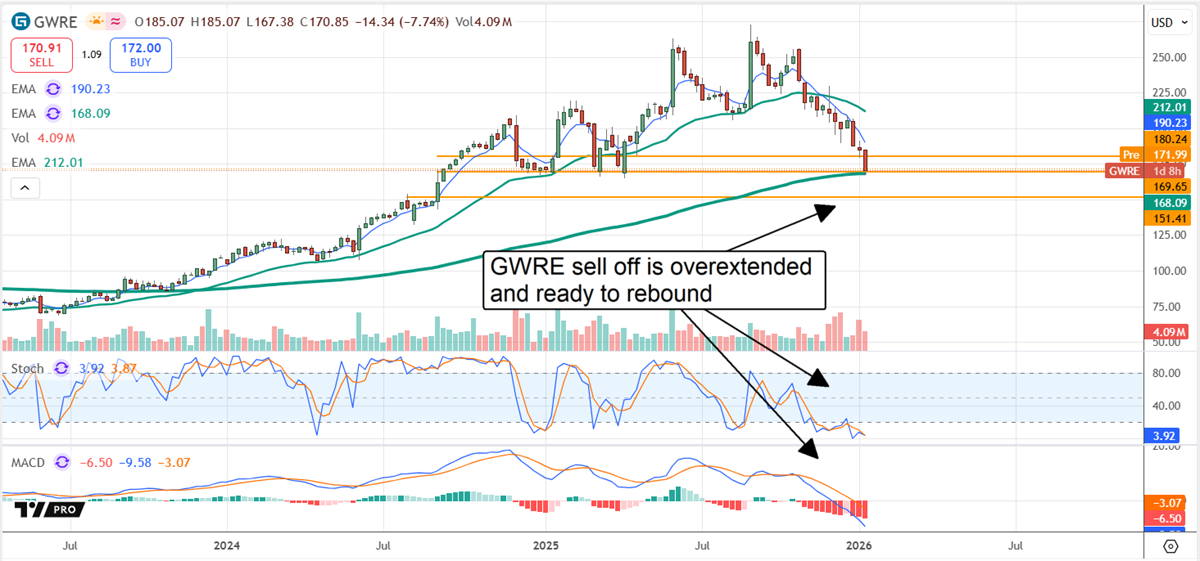
Guidewire experienced a painful price correction in Q4 2025, with the stock falling roughly 30% from its highs. MarketBeat data show that much of this was a natural profit-taking cycle that became overextended and is now poised to reverse. The Q4 selling pressure was primarily institutional; institutions (including hedge funds) — which account for the vast majority of ownership — sold heavily through 2025, coinciding with the market top.
The most likely trigger for a rebound is a reversion from distribution back to accumulation, a shift that appears to have begun. MarketBeat’s data show institutional buying of GWRE in the first two weeks of 2026, and that activity will likely accelerate as Q1 FY2026 progresses.
Valuation concerns contributed to the sell-off. At the 2025 peak the stock traded at about 65x current-year earnings and still changed hands near 58x in early 2026. Those multiples imply expectations of robust growth, and investors may remain cautious until that growth proves durable.
Guidewire’s Q1 FY2026 results delivered both top- and bottom-line beats, accelerated earnings growth, and a favorable outlook for the year. If the company continues to execute on its go-to-market strategies, there appears to be upside: investors can reasonably expect a sustained, bullish analyst revision cycle. At a modest multiple on forward earnings, the stock has room to close the gap with insurance-related peers and potentially more broadly with higher-quality tech names.
Analysts Agree Guidewire Software Looks Undervalued in Early 2026
Analyst responses to the Q1 FY2026 report were mixed — including one price-target cut, two reaffirmations, one price-target increase, and an upgrade — but the overall takeaway is constructive. Consensus among 17 analysts is a Moderate Buy, with a roughly 70% buy-rating bias and meaningful conviction behind the consensus target. Current consensus estimates imply roughly 60% upside versus the stock’s trading level.
Key 2026 catalysts for Guidewire include accelerating cloud migration, ongoing AI integration and new product development, and an expanding partner ecosystem. Cloud adoption is gaining momentum across verticals and supports the company’s revenue runway. AI features are especially appealing to insurers, who can realize operational and customer-facing efficiencies. On the partner front, Guidewire removed education fees in 2025, which has accelerated the number of platform-certified professionals and should increase platform stickiness over time.
Oversold Signals Suggest Guidewire Is Near a Turning Point
Price action in 2025 and early 2026 pushed GWRE down toward the $170 level, bringing it into alignment with its longer-term moving averages. Technical indicators such as the MACD and stochastic readings suggest the stock is deeply oversold at these levels, which coincide with the low end of analysts’ expectations and point to a potential rebound. The primary risk is a break below key support, which could extend the sell-off toward $150 before any recovery.
Thank you for subscribing to TickerReport, where we work around-the-clock to bring you the latest market-moving news.
This email message is a sponsored email sent on behalf of Brownstone Research, a third-party advertiser of TickerReport and MarketBeat.
(CVKD) Comes Backed By 7 Must See Potential Catalysts
Full Coverage Will Be Starting Early
Pull Up (CVKD) Before Tomorrow Morning…
January 26, 2026
Tuesday’s Watchlist | See Why (CVKD)Just Hit Tomorrow’s Radar
Dear Reader,
At Street Ideas, we’re always hunting for the under-the-radar names that can force their way onto the screen—especially when they’re taking aim at a space long controlled by the giants.
In the race to solve one of medicine’s longest-running challenges—preventing dangerous clots without increasing bleeding risk—one emerging player keeps stacking developments that could shift how this category evolves.
And in a $40B global market that has seen limited true innovation for decades, those kinds of steps don’t stay quiet for long.
That company is Cadrenal Therapeutics, Inc. (Nasdaq: CVKD).
And it’s just one of the reasons why (CVKD) will be topping our watchlist tomorrow morning—Tuesday, January 27, 2026.
We’re covering it for the first time, and its expanded clinical assets, operational milestones, and broader pipeline footprint have put it on our watchlist.
What caught our attention is the technical setup of (CVKD).
(CVKD) has less than 2M shareslistedas available to the public. When a company has a small float like this, the potential exists for big moves if demand begins to shift.
We have already seen this momentum in action, as (CVKD) made an approximate 20% move this month, from $6.81 on January 2 to $8.21 today, January 26, 2026.
Analyst Target Suggests Over 500% Upside Potential
Noble Capital Markets: Senior Analyst Robert LeBoyer recently reiterated a Bullish rating with a $45 target on (CVKD).
From its recent $7.36 range, this suggests a potential upside of over 500%. LeBoyer specifically cited the$3B+ peak annual revenue potential of the targeted indications.
Now here’s the key point: the recent attention isn’t coming from a single headline or a one-off catalyst—it’s coming from what the company is building underneath the surface.
In a category where most names are still fighting the same old tradeoffs, (CVKD)is pushing into areas where better tools are still badly needed.
And the further you go into the story, the clearer it becomes why this one could start showing up on more screens right now.
Targeting Unmet Cardiovascular Needs
Cadrenal Therapeutics, Inc. (Nasdaq: CVKD) is a late-stage biopharmaceutical companyfocused on addressing unmet needs in the anticoagulation and thrombosis space.
While the broader market is saturated with therapies, many patient populations remain underserved due to high bleeding risks or unpredictable metabolism.
(CVKD) is specifically targeting these gaps with a platform that spans chronic care, acute procedural risk, andimmune-mediated thrombosis.
The company’s primary focus has long beentecarfarin, a next-generationvitamin K antagonist designed for patients with End-Stage Kidney Disease (ESKD) and atrial fibrillation. These patients often cannot use modern therapies like DOACs because they are primarily eliminated by the kidneys.
By developing a therapy that is metabolized outside the major hepatic pathways, (CVKD) aims to provide more stable andpredictable anticoagulation for those who need it most.
In late 2025, (CVKD) transformed from a single-asset company into a multi-program clinical powerhouse.
The company recentlyacquired first-in-class assets that address acute care and rare immune-driven clotting conditions. This expansion has positioned (CVKD) as a versatile player in cardiovascular care, targeting conditions where current therapeutic options often fall short.
A Pipeline With Range
The core thesis for (CVKD) rests on itsdiversified pipeline, which now features three distinct late-stage programs.
The VLX-1005 Breakthrough:
On December 11, 2025, (CVKD)announced theacquisition of VLX-1005, a first-in-class Phase 2 12-LOX inhibitor. This candidate targets Heparin-Induced Thrombocytopenia (HIT), a serious immune-mediated complication of heparin therapy that can lead to life-threatening clots.
VLX-1005 is the first and only potent, highly selective inhibitor of human 12-LOX in clinical testing. This asset carries both FDA Orphan Status and Fast Trackdesignations, which are intended to expedite the development of therapies for rare and serious conditions.
During the January 2026,J.P. Morgan Healthcare Conference, management highlighted the high incidence of thrombotic complications in HIT, underscoring the urgent need for a therapeutic solution like VLX-1005.
Expanding with Factor XIa Inhibition:
The company alsoadded frunexian and EP-7327 to its portfolio in September 2025.Frunexian is a Phase 2-ready intravenous Factor XIa inhibitor designed for acute procedural scenarios, such as bypass surgery or mechanical device support where contact activation triggers clotting.
Factor XIa inhibition is a closely watched mechanism because it may reduce clotting risk whilelimiting bleeding, a major hurdle for existing anticoagulants.
Detailed Program Breakdown:
To appreciate the scale of what (CVKD) is building, one must look at the specific indications and the science driving each program.
And this is where the story starts to shift from “interesting pipeline” to “company people are suddenly paying attention to.”
(CVKD) isn’t just assembling programs on paper—it’s stacking clinical and operational signals that the market tends to notice when they show up together.
When a little-known company, like (CVKD), begins pairing late-stage readiness with fresh assets in high-need settings, visibility can change fast.
Strategic Milestone: The J.P. Morgan Healthcare Conference
Management used this stage to emphasize that HIT is not just a rare condition but a high-incidence complication that lacks a “gold standard” treatment.
By positioning VLX-1005 as the first and only selective 12-LOX inhibitor, (CVKD is effectively claiming leadership in a niche but highly critical segment of hospital-based medicine.
Furthermore, the company has emphasized itsmanufacturing progress. Completing cGMP manufacturing for tecarfarin is a major hurdle cleared.
This move signals that (CVKD is not just a research house but an operationally ready late-stage clinical developer capable of moving intopivotal trials.
Targeted Response System
As noted in recent updates, the CVKDpipeline is beginning to look less like a typical biotech and more like an “emergency response system” for the cardiovascular ward.
Whether it is a patient suffering from HIT, a patient undergoing a CABG procedure, or an ESKD patient needing long-term protection from AFib, CVKD is developing specific tools for specific crises.
This “layered approach” is something few emerging companies can match, as most focus on a single mechanism or a single indication.
7 Reasons Why (CVKD) Will Be Topping Our Watchlist Tomorrow Morning —Tuesday, January 27, 2026
1. Analyst Coverage: Analyst’s $45 target on (CVKD) suggests over 500% upside potential from recent levels.
2. Razor-Thin Float: With fewer than 2M shares available to the public, (CVKD)’s small float could witness the potential for big moves if demand begins to shift.
3. Massive Market Potential: By targeting underserved niches within the $40B anticoagulation market, (CVKD)is positioning itself where few emerging companies have comparable breadth.
4. Triple-Asset Platform: Following its recent acquisitions, (CVKD) now advances three late-stage clinical programs spanning chronic, acute, and immune-mediated cardiovascular risk.
5 First-in-Class: By adding VLX-1005, (CVKD) now holds the only selective 12-LOX inhibitor currently in clinical testing, aimed at HIT.
6. Late-Stage Readiness: With tecarfarin progressing toward a pivotal study in ESKD, (CVKD is entering a phase that could determine outcomes for high-need patient groups.
7. Regulatory Fast Tracking: The Orphan and Fast Track designations for VLX-1005 help (CVKD) push forward in a rare condition with limited therapeutic options.
Pull Up (CVKD) Before Tomorrow Morning…
(CVKD) checks multiple boxes that tend to draw serious attention when they appear together: analyst coverage pointing to a $45 target, a razor-thin float with fewer than 2M shares available to the public, and a focus on underserved niches inside a $40B anticoagulation market.
What makes the story even more compelling is the broadened three-program platform across chronic, acute, and immune-driven clotting risk—so it isn’t a one-shot narrative.
Add in VLX-1005, described as the only selective 12-LOX inhibitor currently in clinical testing for HIT, along with Orphan and Fast Track designations, and it’s easy to see why (CVKD) keeps rising on watchlists.
Pair that with tecarfarin moving toward a pivotal study in ESKD, and you have a company entering a higher-visibility phase where execution starts to matter more than promises.
We will have all eyes on (CVKD)tomorrow morning—Tuesday, January 27, 2026.
Take a look at (CVKD) before you call it a night.
Also, keep a lookout for my morning update.
Have a good night.
Sincerely,
Paul Prescott Co-Founder & Managing Editor Street Ideas Newsletter
Street-Ideas.com (“Street-Ideas” or “SI” ) is owned by 147 Media LLC, a single member limited liability company. Data is provided from third-party sources and SI is not responsible for its accuracy. Make sure to always do your own research and due diligence on any day and swing profile SI brings to your attention. Any emojis used do not have a specific defined meaning, and may be used inconsistently. We do not provide personalized in-vest-ment advice, are not in-vest-ment advisors, and any profiles we mention are not suitable for all in-vest-ors.
Pursuant to an agreement between 147 Media LLC and TD Media LLC, 147 Media LLC has been hired for a period beginning on 01/26/2026 and ending on 01/27/2026 to publicly disseminate information about (CVKD:US) via digital communications. Under this agreement, 147 Media LLC has been paid eight thousand USD (“Funds”). These Funds were part of the funds that TD Media LLC received from a third party who did not receive the Funds directly or indirectly from the Issuer and does not own stock in the Issuer but the reader should assume that the clients of the third party own shares in the Issuer, which they will liquidate at or near the time you receive this communication and has the potential to hurt share prices.
Neither 147 Media LLC, TD Media LLC and their member own shares of (CVKD:US).
Few market signals are watched as closely as the trading activity of Representative Nancy Pelosi. Over the years, the portfolio attributed to her and her husband, Paul Pelosi, has developed a near-mythical status among investors. Dubbed the Queen of Capitol Hill by traders, her disclosures are often treated as a roadmap for where smart money believes the market is heading.
A new Periodic Transaction Report, filed with the House of Representatives on Jan. 23, 2026, has just provided the first major roadmap for the new year. At first glance, the headlines might look bearish: the report shows sales of millions of dollars’ worth of major technology stocks. However, savvy investors know that headlines often obscure the truth. A detailed analysis of the filing reveals that the Pelosi portfolio is not exiting the tech market. Instead, it is executing a sophisticated reloading strategy.
The data, covering trades from late December 2025 through mid-January 2026, outlines a clear, three-part playbook. The strategy involves taking profits for tax purposes, establishing a massive defensive position in the financial sector, and using high-level leverage to double down on the artificial intelligence (AI) revolution.
The Yield Shield: A Multi-Million Dollar Bet
The most surprising twist in the 2026 portfolio update is a heavy rotation into the financial sector. On Jan. 16, 2026, the filing reveals the purchase of 25,000 shares of AllianceBernstein Holding L.P. (NYSE: AB). The value of this transaction is listed between $1 million and $5 million.
For years, the Pelosi portfolio has been defined by high-growth, high-volatility technology stocks. AllianceBernstein is the opposite. It is a global asset management firm, a traditional business model focused on managing money for others. So, why the sudden shift?
The answer likely lies in yield. AllianceBernstein is a favorite among income investors because it pays a massive dividend, historically ranging from 8% to 9%. By parking millions of dollars in this specific stock, the portfolio creates a yield shield.
However, a position like AllianceBernstein pays the investor to wait. The quarterly dividend payments provide a steady, reliable stream of cash flow that cushions the portfolio against losses in riskier sectors. This purchase signals a prudent, defensive mindset: hoping for growth, but ensuring that the portfolio gets paid regardless of what the stock market does next.
The Infrastructure Play: Why She Kept the Shares
While the portfolio added defensive armor with AllianceBernstein, it simultaneously went on the offensive in the AI sector. The filing shows that the investor exercised call options on two specific companies: Vistra Corp (NYSE: VST) and Tempus AI (NASDAQ: TEM).
To understand the significance of this, investors must understand the mechanics. When you own a call option, you have the right to buy a stock at a certain price. Often, traders will simply sell the option to pocket the cash profit. Exercising the option is different. It means the investor is choosing to pay cash to acquire the actual shares. On Jan. 16, 2026, the Pelosi portfolio took delivery of 5,000 shares of Vistra and 5,000 shares of Tempus AI.
Vistra Corp – The Power Play:This trade confirms a high-conviction belief in the AI Energy narrative. Data centers running AI models are power-hungry beasts, consuming exponential amounts of electricity. Vistra, with its robust fleet of nuclear and natural gas power plants, is a key supplier for this demand. By taking ownership of the stock, the portfolio is betting that the energy crunch is a long-term reality that will drive Vistra’s value for years to come.
Tempus AI – The Healthcare Play: This position sits at the cutting edge of science. Tempus uses artificial intelligence to analyze clinical and molecular data to help doctors make real-time decisions. The decision to hold these shares suggests confidence in the company’s recent performance. With analysts pointing to improved earnings and revenue growth, the portfolio views Tempus as a company graduating from a speculative startup to a foundational AI healthcare leader.
Immediately after selling the shares, likely a move to harvest old profits and pay tax bills, the portfolio re-entered these same positions using a financial instrument called LEAPS (Long-Term Equity AnticiPation Securities). Specifically, the portfolio bought call options expiring in January 2027.
This strategy acts as a leveraged roll. Here is the logic:
Capital Efficiency: Owning 20,000 shares of a tech giant requires millions of dollars of upfront cash. By switching to Deep-In-The-Money options, the investor can control the same number of shares for a fraction of the cost.
The Bullish Signal: You do not buy options expiring a year from now if you think the market is crashing. By purchasing contracts that run through 2027, the portfolio is effectively betting that the AI super-cycle is far from over.
Whether it is NVIDIA’s next-generation Blackwell chips, the upcoming iPhone super-cycle, or Amazon’s cloud dominance, the Pelosi portfolio has positioned itself to capture all the upside of 2026 without tying up as much cash as before.
Pelosi Portfolio Management: Don’t Exit, Optimize
The latest disclosures from the Queen of Capitol Hill provide a masterclass in portfolio construction. The 2026 Pelosi portfolio is not retreating; it is evolving. It is leaner, using options to control tech exposure efficiently, but it is also broader, diversifying into critical infrastructure and high-yield finance.
For the everyday investor, the lesson is clear. In a maturing bull market, you do not need to sell everything and go to cash. Instead, look for opportunities to optimize. Consider taking some profits from high-flying tech stocks and redeploying that capital into defensive assets like AllianceBernstein that pay dividends. At the same time, keep your exposure to the themes that matter, specifically the power and data infrastructure, building the future of artificial intelligence. READ THIS STORY ONLINE
For the electric aviation sector, 2026 has ushered in a defining market theme: the flight to quality. In the early years of the industry, investors spread capital across dozens of startups, treating the sector like a venture-capital lottery ticket. Today, that speculative phase has largely ended. The market is now ruthlessly separating winners from losers based on a single criterion: who has the resources to survive the valley of death.
For eVTOL organizations, the valley of death will be the perilous period between building a functional prototype and receiving final government certification to carry passengers. It is a phase of high cash burn and zero revenue. As this separation occurs, retail investors are looking to the smart money for clues. Institutional investors (think pension funds, sovereign wealth funds, and massive asset managers) do not typically gamble on hype. They rely on rigorous auditing, risk analysis, and deep-dive due diligence. When these giants take a significant position in a pre-revenue company, it signals that the company has passed the most stringent financial and technical tests that Wall Street offers.
For the eVTOL investor, the specific type of filing matters. Passive investors, those who believe the company is being run well and simply want to own a piece of its future growth, file a Schedule 13G. This is distinct from activist investors, who buy shares to pressure management to make changes. BlackRock’s purchase is a tacit endorsement of Archer’s current leadership and roadmap.
Owning nearly 10% of a company creates a level of stability that Archer’s press releases cannot manufacture. But why is BlackRock buying now? The answer likely lies in Archer’s resilience. In the aerospace industry, companies don’t usually fail because their technology doesn’t work; they fail because they run out of money before they can prove it works.
The Financial Fortress: $2 Billion in Protection
Archer Aviation enters 2026 with a financial profile that is arguably best-in-class for the sector. The company boasts a total liquidity position hovering near $2 billion. However, the most telling metric for risk-averse investors like BlackRock is the current ratio.
Archer reports a current ratio of 18.19. For context, a ratio of 1.0 is considered safe, meaning a company has one dollar in assets for every dollar of bills due within a year. A ratio of 18.19 is exceptional. It implies that for every dollar of short-term debt, Archer holds over $18 in liquid assets. This effectively removes the near-term risk of emergency fundraising, which often destroys shareholder value.
This financial fortress is heavily fortified by Archer’s strategic partnership with automotive giant Stellantis (NYSE: STLA).
In a typical aerospace startup, the company must burn hundreds of millions of dollars building a factory. In Archer’s case, Stellantis is absorbing the bulk of the capital costs and providing the manufacturing expertise for the high-volume facility in Covington, Georgia. This allows Archer to direct its cash almost exclusively toward research, flight testing, and certification, resulting in highly efficient capital allocation that appeals to institutional analysts.
Archer And Joby: Why Money Is Moving
The significance of the BlackRock purchase is amplified when viewed against the broader sector. A clear divergence has formed between Archer and its primary competitor, Joby Aviation (NYSE: JOBY). For years, these two companies have traded in lockstep, but 2026 has brought a decoupling.
While Archer is attracting institutional inflows, Joby has faced headwinds regarding its stock valuation. In December 2025, analysts at Goldman Sachs initiated coverage on Joby Aviation with a Sell rating. This was followed in late January 2026 by a reiteration of a sell rating from Weiss Ratings. The analysts cited concerns that Joby’s valuation was too high relative to its near-term growth prospects.
This contrast has created a classic pair trade scenario. In financial markets, a pair trade involves selling a stock that appears overvalued while buying a direct competitor that appears undervalued. The recent market data suggests a rotation of capital is underway, moving out of the premium-priced Joby and into Archer, which is increasingly viewed as a value play in the eVTOL sector. BlackRock’s timing aligns perfectly with this broader rotation, suggesting they see Archer as an undervalued asset in the space.
Friction in the Float: Bears vs. Bulls
The heavy institutional accumulation by BlackRock and Stellantis creates an interesting friction in the stock’s market mechanics, specifically regarding short sellers. Currently, short interest in Archer Aviation is high, with approximately 15% of the available shares (the float) sold short. This equates to roughly 90.4 million shares that must eventually be repurchased.
This setup creates the potential for short squeeze mechanics to play out. Here is how the mechanism would work:
Locked Supply: When long-term giants like BlackRock and Stellantis buy shares, they typically hold them for years. This removes those shares from the daily trading supply.
The Trap: If positive news drives Archer’s stock price up, short sellers start losing money. To stop the losses, they must buy shares to close their positions.
The Squeeze: Because institutions are not selling, fewer shares are available to buy. This scarcity forces short sellers to bid the price higher and higher to exit their trades, creating a feedback loop of buying pressure.
With 15% of the float shorted and supply tightening due to the BlackRock purchase, the stock is coiled like a spring.
A Convergence of Catalysts
Market reaction to these developments has already begun. Archer’s stock has shown upward mobility over the past 30 days, gaining approximately 8% before a late January sector-wide slump. Despite the sector’s downward trend in the last days of January, Archer has demonstrated resilience. This sustained strength suggests a firm price floor is being established through institutional buying.
From a technical perspective, the momentum is confirmed. The TradeSmith Health Indicator recently placed Archer in the Green Zone, a technical signal indicating that the stock has stabilized and entered a healthy, positive trend.
The investment thesis for Archer Aviation in 2026 is becoming clear. The company has secured the technology throughNVIDIA (NASDAQ: NVDA), the manufacturing capacity through Stellantis, and the financial runway through a massive liquidity pile.
Now, with BlackRock’s 8.1% stake providing the ultimate institutional seal of approval, the risks associated with the valley of death appear significantly lower.
For investors, the combination of smart money validation, comparative value against competitors, and potential short-squeeze mechanics makes Archer a standout candidate in the race for the skies. READ THIS STORY ONLINE
We’re entering a rare quiet stretch before what many expect to be a much more active IPO cycle in 2026, and this is often when early investors position themselves long before Wall Street turns its attention back to private companies. We’ve put together a straightforward guide showing how the early-stage landscape works, where opportunities are typically found, what to look for long before an IPO is announced, and which risks actually matter so you can approach this space with realistic expectations.GET INSTANT ACCESS TO THE FULL REPORT HERE
The best offense is sometimes a good defense, and that’s especially true in markets when stocks turn volatile. Defensive stocks can preserve capital in a declining market by limiting losses and supplementing portfolios with dividend income. Some market sectors offer better protection than others, and today we’ll look at one of the common defensive sectors: consumer staples.
Consumer Staples Stocks Can Protect Capital in Volatile Markets
Most investors think of gold or U.S. Treasuries (at least for now!) when the discussion turns to safe haven assets, but capital doesn’t necessarily need to exit the stock market to be protected. Some sectors are less volatile than others, while others offer income through dividends in addition to equity appreciation. And then some offer a combination of both, such as consumer staples.
Consumer staples are considered a ‘safe’ sector because they comprise companies that sell necessities rather than discretionary goods. Consumers purchase items like groceries and toiletries in a consistent, timely manner, which limits upside but offers predictable, reliable revenue. Other factors that make staples a popular investment during volatile markets include:
Steady Dividend Income – Predictable revenue leads to reliable profits, and these companies often return these profits to shareholders as dividends. Reliable earnings are key to dividend safety, and consumer staples stocks are rarely at risk of dividend cuts.
Pricing Power – The ability to pass rising costs onto consumers is crucial in the age of tariffs and inflation. Consumer staples possess a unique ability to pass on costs since there’s no substitute or ‘trade down’ for life’s necessities. A family can choose to get takeout instead of eating at a steakhouse, but they can’t forgo or substitute toilet paper, toothpaste, or soap.
Low Beta – Beta is a useful heuristic for measuring a stock’s volatility relative to a broader index or market. Low beta stocks are less volatile than the broader market, and these are the types of stocks institutional investors look for when markets get turbulent. Consumer staples often offer relief from market volatility, preserving investor capital during steep drawdowns.
3 Consumer Staples With Inelastic Product Demand
The following three stocks all have inelastic demand for their products and services, though they aren’t the traditional grocery-store items you might expect. Each company has a foothold in its niche market, offering steady income and strong dividends.
Waste Management: Strong Dividend and Irreplaceable Infrastructure
Whoever coined the phrase “one man’s trash is another man’s treasure” probably didn’t have actual trash in mind, but Waste Management Inc. (NYSE: WM)depends on American households and businesses throwing away tons of stuff every week. But Waste Management’s moat doesn’t come from trash removal as an essential service; it’s the company’s vast network of landfills that gives it a near-monopoly in many of the locations it operates.
Environmental regulations make landfill permitting extremely difficult and time-consuming to obtain, so Waste Management’s hold on market share is as safe as its dividend, which has a 52% dividend payout rate (DPR) and a 22-year history of annual payout increases.
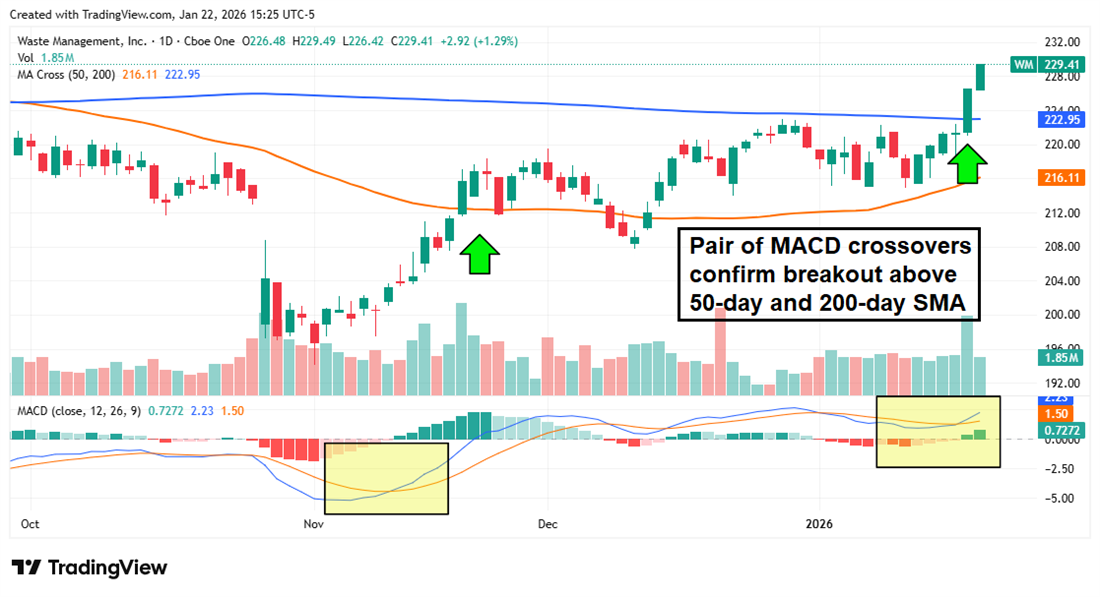
WM shares are also in the midst of a breakout, with the price eclipsing the 200-day simple moving average (SMA) for the first time since last September. The bullish trend actually began in November when the Moving Average Convergence Divergence (MACD) initiated a bullish cross, and now a second cross has confirmed the next leg up in the rally.
British American Tobacco: Deep Value With Premium Dividend
Cigarette smoking may be in secular decline, but British American Tobacco plc (NYSE: BTI)’s pivot to smokeless products like e-cigs, vapes, and nicotine pouches has reinvigorated the company’s revenue in the U.S. But, as with most tobacco companies, the appeal lies in the dividend, and BTI currently yields more than 5% with a 63% DPR. The company has raised payouts for 19 straight years, but the low growth rate means the stock often functions like a bond in bull markets.
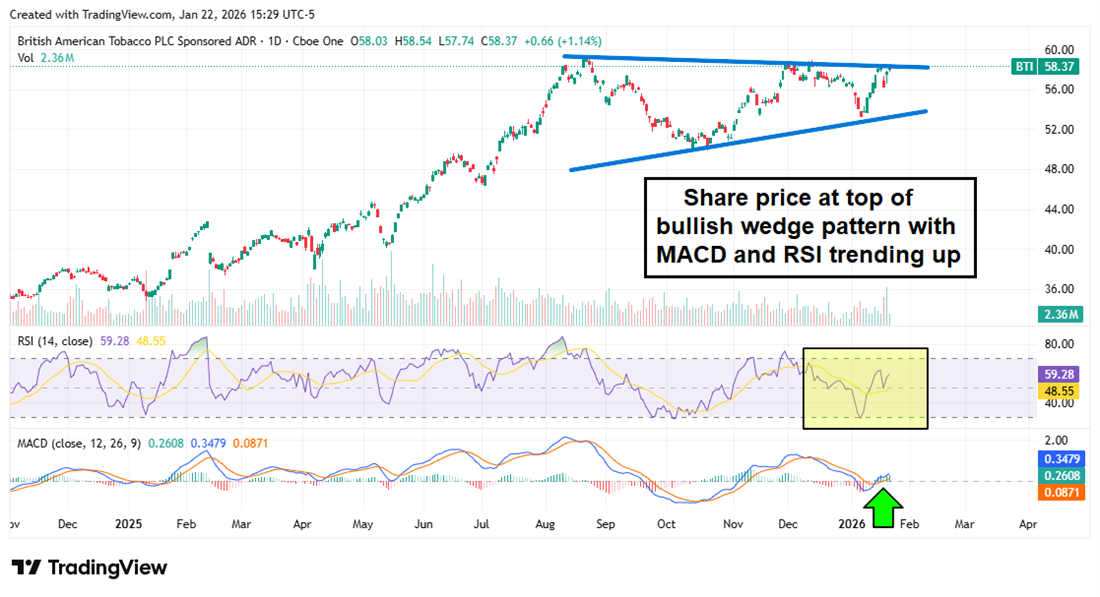
In this current bull market, BTI shares have returned nearly 60% in the last 12 months, and the stock could be ready for its next move up after a period of consolidation. A bullish wedge has formed on the chart, with the upper bound forming resistance at the previous all-time high and the lower bound making higher lows.
Traditionally, a new uptrend begins when the stock price breaks above this upper level, and the MACD and Relative Strength Index (RSI) signal that bullish momentum is gathering strength.
Service Corporation International: A Necessary Service That Can’t Be Outsourced
Here’s a company where the clients never actually know when they’re using the service. Service Corporation International Inc. (NYSE: SCI) is the largest provider of funeral and cemetery services in North America, where an aging population faces some unfortunate demographic inevitabilities. If you’re lucky enough to be unfamiliar with this business model, Service Corp accepts payment upfront for future funeral and burial arrangements, as most clients want to offload the burden of ‘deathcare’ from their loved ones before they pass. Pre-payment allows the company to build a large pool of capital that can be deployed in interest-earning vehicles.
SCI’s cash position allows it to sustain a healthy dividend, currently yielding 1.68% with a 36.7% DPR. The dividend has grown at a 10.57% annualized rate over the last five years, and the company has raised the payout for 15 consecutive years. The company also raised its 2025 cash flow guidance to the $915 million to $950 million range during its Q3 earnings report, which should help support another year of payout increases.
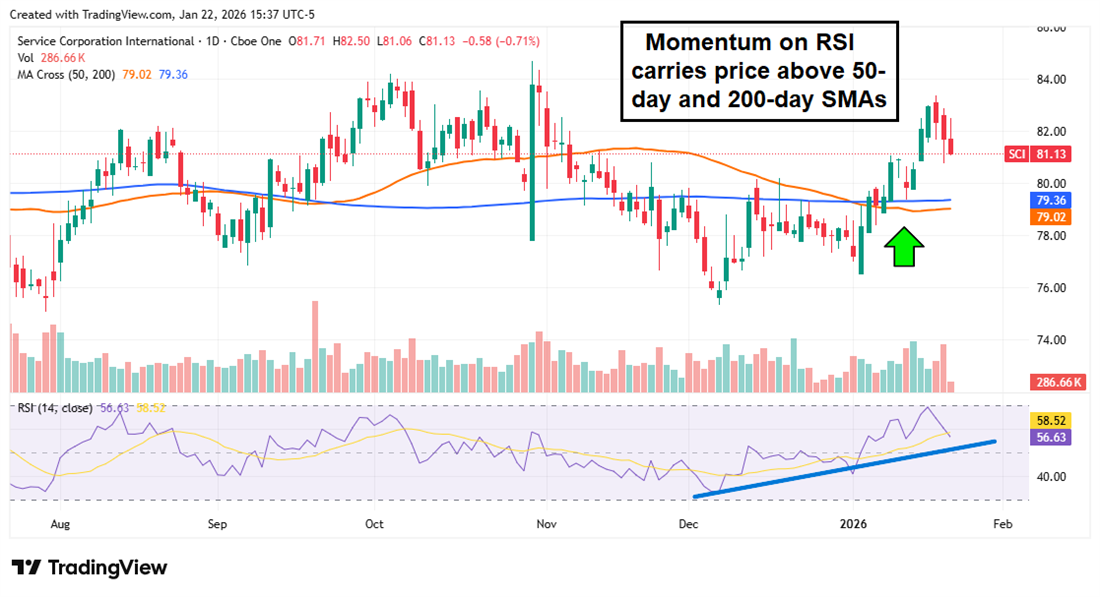
Companies like SCI usually don’t offer outsized stock returns. Still, a little capital appreciation on top of a steady dividend is ideal in volatile markets, and the chart here shows some promise. The RSI bounced off the Oversold level in December and has been trending higher ever since, and the share price has now broken through the 50-day and 200-day SMAs for the first time since late October.
Love steady payouts? This free report reveals 7 high-yield dividend stocks you need to know about. From Company #3, a tobacco giant innovating with smokeless products, to Company #4, famously known as “The Monthly Dividend Company,” these picks deliver steady income you can count on. PERFECT FOR INCOME-FOCUSED INVESTORS.
The Night Owl is a financial newsletter that provides in-depth market analysis on stocks of interest to individual investors. Published by MarketBeat and Early Bird Publishing, The Night Owl is delivered around 9:00 PM Eastern Sunday through Thursday. If you give a hoot about the market, The Night Owl is the newsletter for you.
Big Risk, Potentially Bigger Return For These 3 Leveraged ETF’s
Written by Nathan Reiff on January 18, 2026
Summary
Despite a climb of 17% in the last year in the S&P 500, market turbulence may present opportunities for leveraged ETFs to shine.
2x leveraged funds focused on silver or crude oil futures can capitalize on the precious metals rally and on quick changes in the oil market driven by geopolitical developments.
A narrowly focused leveraged play on the FANG stocks and several other major tech names provides a bet that some of these leaders will return to outperforming in 2026.
With the S&P continuing its upward climb into 2026 despite broad economic uncertainty, investors who feel bullish may be able to capitalize on ascending stocksand commodities with the help of leveraged exchange-traded funds (ETFs).
At the same time, these ETFs present an unusually high level of risk and require active investor engagement, so they’re likely not right for everyone. Two commodities funds—focused on the red-hot silver market and on crude oil, respectively—and one targeting major tech and internet companies might appeal to investors willing to make a high-risk, potentially high-reward play.
Double Leverage on Silver For Those Betting the Rally Will Continue
Active traders bullish on the day-to-day price movements of silver bullion may find it worthwhile to take a chance on the ProShares Ultra Silver ETF (NYSEARCA: AGQ). AGQ provides 2x leverage on the Bloomberg Silver Subindex, with a daily reset that ensures positions turned over each day do not suffer from compounding.
Because of the limited options for investors seeking direct exposure to silver via futures contracts, AGQ can be a useful tool for increasing access without spending additional cash. As a rolling index, the Bloomberg Silver Subindex does not own any commodities directly, but rather focuses exclusively on futures.
AGQ’s fee is on par with many other 2x leveraged commodities funds at 0.95%, so investors can expect to spend a bit more on this ETF compared to non-leveraged funds for the opportunity for greater returns.
The fund is not huge, with about $3 billion in assets under management (AUM), but it does have strong liquidity based on a one-month average trading volume above 7 million.
As a leveraged fund that resets daily, it may not make sense for investors to focus on returns over longer periods. However, given that the price of silver has nearly tripled in the last year during an incredible and sustained rally, investors expecting this trend to continue might consider AGQ a risk worth taking.
Equal-Weight Exposure to FANG+ Names, But Trading Volumes Are Low
2025 was a volatile year for the so-called FANG stocks (and many other companies adjacent to them in the tech space), but Alphabet Inc. (NASDAQ: GOOG) emerged as one standout with returns of about 65% for the year. The MicroSectors FANG+ Index 2X Leveraged ETN (NYSEARCA: FNGO) may appeal to investors expecting some of the most prominent tech names in the country to gain momentum in the new year.
Like the underlying index, FNGO assigns relatively equal weight to each holding, ensuring that the largest names by market value don’t exert an outsized influence on the fund’s performance.
Like AGQ above, FNGO has an expense ratio of 0.95% and has 2x leverage that resets on a daily basis.
Investors should consider FNGO a targeted, short-term access point to this group of companies that might perform especially well on a day in which the tech space enjoys a unique upward price catalyst. Beware, however, that liquidity may be a concern given the fund’s low average trading volume.
Gold Above $5,000 per Ounce in 2026! Here’s How to Play It…
With so many strange events happening across the economy (consumer confidence plummeting, credit-card delinquencies soaring, and more), it’s no wonder the richest investors are loading up on gold. But what you might not realize is that there’s a much better way to profit from rising gold prices – WITHOUT ever touching an ETF, mining stock, or even bullion.Get the full details here.
Despite High Cost and Risks, UCO Can Magnify Oil Gains
The beginning of 2026 could be a particularly volatile time for the oil market, as the potential for continued U.S. intervention in Venezuela and Iran is likely to keep prices moving.
Investors seeing the possibility of a big one-day increase in the price of oil should consider the ProShares Ultra DJ-UBS Crude Oil ETF (NYSEARCA: UCO), which can pay off in these cases despite its high 1.43% expense ratio.
With a healthy level of trading activity, active investors should not find it prohibitive to trade the UCO on a short-term basis, which is also necessary in the case of this fund due to its daily reset.
UCO also focuses on oil futures, which means it mostly moves in connection with the spot price of oil but will not necessarily do so all of the time.
Nonetheless, its 2x leverage is a powerful way to potentially amplify positive price changes in the oil market at a time when those are likely to be comparatively easy to find.
 Illuminating systematic strategies, actionable tips, and precise market insights for investors.WARNING: R.I.P. AI Boom (2023-2026) – Ad