I was born on 6 August 1956 in San Francisco, California to Janet and (the late) Richard Hovis.
I grew up in Santa Monica, California where I attended elementary, junior high school, and high school (graduating in 1974), in addition to involvement in sports and recreation (Little League +, the Boy’s Club ++). Further, it was in elementary school – St. Augustine’s By-the -Sea Parish School that I found, and made the choice to truly journey with God.
I attended Arizona State University from 1974 to 1977 – seeking to become an architect, however, I was not accepted, and, as such, I graduated with a Liberal Arts degree.
Upon graduation from Arizona State University, I attended Cal Poly San Luis Obispo and studied City and Regional Planning at the Master’s level. I successfully completed one (1) year in a two (2) year program – I did not complete the Master’s degree in City and Regional Planning – due to personal reasons.
I returned to Santa Monica where I started (October 1979) my career as graphic designer with Exxon Company, USA. I spent five years with Exxon Company, USA.
While working with Exxon Company, USA I was accepted into architectural school – Sci-Arc in Southern California, however, I did not attend preferring to stay with Exxon..
In 1982 I married Laura Flosi and in April 1983 we had our one and only child – Lauren Alain Hovis – a gift from God.
We moved to Phoenix, Arizona in 1984 from Los Angeles, where I went to work as a graphic designer with Kitchell CEM (from 1985 -1987).
From 1987 – 1995 I was an independent contractor, and a registered representative in mortgage finance, financial management, graphic design, and drafting.
Further, I attended the University of Phoenix and successfully obtained a Master’s in Business Administration (MBA) in 1982.
I was also a member of the Scottsdale Jaycees, where I became very involved in community events and projects.
In 1994, I accepted a cartography position with the Defense Mapping Agency in Reston, Virginia. As such, I relocated from Phoenix to Reston.
In 1998, I was accepted and worked as a Visual Information Officer with the Central Intelligence Agency. In 2002, I worked as a Support Officer until my retirement (due to a need for shoulder surgery) in September 2018.
Away from my Federal Government service, I have been involved in various organizations and activities in Northern Virginia.
In November of 2011, I married Rebecca Ouellette in Santa Monica, California. I reside in San Tan Valley, AZ with my two hamster - Jess and Timothy, our fish, our lizard - RJ Lizard., and our cats - Pearl and Grey.
As to hobbies, I enjoy playing sports, attending sporting events, mentoring individuals from financial management to hamsters, building models, photography, travel, multimedia design, managing partner for RJ Hamster, and jazz – smooth jazz to a samba or a bossa nova.
Love and God Bless,
Peter – aka RJ Hamster Jo hi
We declared it — in 1776 — with a middle finger to the Crown and a musket in hand.
And for 247 years, we’ve held the line thanks to one undeniable truth:
Freedom exists because Americans are armed.
If you’re anything like us, you don’t just believe in the 2nd Amendment —
You live it. You fight for it. And you surely drink out of it.
That’s why we engraved “1776%” into the boldest, baddest tumbler ever made:
The Freedom Tumbler
20oz of stainless steel, American grit, and zero apologies.
Whether you’re sipping bourbon, black coffee, or liberal tears — this beast keeps your drinks ice-cold for 24 hours or hot for 8.
Take it fishing, hunting, to the range, or just to Starbucks to scare the barista.
What You Get:
Double-wall vacuum insulated 18/8 food-grade stainless steel Engraved by patriots in Boise, ID Fits any truck cup holder Leak-proof lid (bumpy roads approved) Rust-proof, snowflake-proof Holds 20oz of straight freedom 30-day risk-free guarantee
Normally? $40.
Right now? Just $10.
No gimmicks. No B.S.
We’re doing this to get the message out:
We’re still 1776% sure no one’s taking our guns.
But here’s the catch…
We only set 694 tumblers asidefor this promo.
At this price, most patriots are grabbing 2 or 3 at a time.
P.S. These will sell out fast. Ships in 3–5 days from our U.S. warehouse.
If you’re not 100% satisfied, we’ll refund every penny. (But you won’t need it.)
This email is never sent unsolicited. You have received this Newsmax email because you subscribed to it or someone forwarded it to you. To opt out, see the links below.
Remove your email address from our list or modifyyour profile. We respect your right to privacy. Viewour policy.
This email was sent by: Newsmax.com 362 N. Haverhill Road West Palm Beach, FL 33415 USA
We wanted to give you a quick intraday update on our new alert SAFX.
Following our alert this morning, SAFX opened at 0.66, so far near the high of the day.
Recent news has created an opportunity for significant growth potential.
SAFX has been in a strong uptrend over the past few days alongside several big announcements this week.
On Wednesday, SAFX rallied +82% in just 1 day.
This could be just the start of a much bigger rally higher.
We are now watching for a rally above this week’s high of 0.78.
SAFX has a 200 day moving average of 0.84, +27% above today’s open.
A breakout above this level could present even more upside potential.
SAFX released news yesterday, that could be a big growth catalyst for the company:
“XCF Global Provides Update on New Rise Reno Plant Conversion”
Planned and ongoing updates to the plant include:
“Catalyst Replacement: The Isomerization Reactor is being reloaded with fresh catalyst to ensure optimal performance.”
“Equipment Modifications: Modifications intended to improve optimism and reduce the potential for spurious trips at turndown flow rates and ensure stability at SAF severity.”
“Heat Exchange Improvements: A new heat exchanger is being installed to take advantage of heat recovery to enhance product throughput and quality.”
“The catalyst delivery schedule is currently expected to proceed as planned, with the first catalyst anticipated to arrive by end of May 2026 and the second delivery of catalyst in early June 2026, supporting the anticipated commissioning of the plant in early June. The company expects these deliveries to support planned commissioning activities, subject to project conditions.”
Here are some of the company’s comments from this press release:
“We are thrilled with the progress of the New Rise Reno Plant conversion,” said Chris Cooper, CEO of XCF Global. “These updates are a testament to our commitment to innovation and sustainability. We are confident that these improvements will position us as a leader in renewable energy production.”
In addition, the company also announced:
“XCF Global and BGN Expand Strategic Relationship with Execution of Term Sheet for Renewable Fuel Tolling at XCF New Rise Renewables Reno Facility and Future Facilities”
As the company further explains:
“Under the term sheet, a tolling arrangement is expected to apply to XCF’s New Rise Renewables Reno (New Rise Reno) plant. XCF and BGN intend to evaluate opportunities to collaborate under a renewable fuel tolling framework on renewable fuel production, marketing, and distribution across multiple regions around the world, including Europe and the Middle East. The proposed framework includes a renewable fuel tolling arrangement and related offtake structures, as well as the anticipated expansion and co-branded distribution agreements, as well as joint development of renewable fuel production capacity. In addition, the proposed strategic partnership seeks to promote the use of XCF’s SAF within industry trade associations and OEM networks, and throughout the customer value chain.”
Chris Cooper, Chief Executive Officer of XCF Global, commented:
“This collaboration represents a critical step in expanding the global reach of renewable fuels. Partnering with BGN would enable us to leverage our production platform, streamline logistics, and accelerate commercialization on a global scale with a world-class partner, as we prepare to meet surging demand for sustainable aviation fuel.
“This term sheet reflects a shared vision to advance a scalable, commercially viable framework for global renewable fuel production and distribution.”
Cenan Ozmeral, President of BGN Int. US, LLC added:
“We are pleased to be partnering with US based XCF in this exciting venture. BGN and XCF share a common goal to expand access to renewable fuels and accelerate the decarbonization of the aviation industry. Together, we aim to combine XCF’s scalable production model with BGN’s marketing and distribution network to create a seamless, efficient supply chain from feedstock to finished fuel.
“BGN’s trading strength, risk management expertise, and integrated logistics network, will make SAF adoption practical and commercially viable for airlines seeking to meet tightening decarbonization targets. This is a major step, which we believe will have a significant impact on the aviation industry’s ability to reduce emissions, in one of the hardest-to-abate transport sectors.”
For a sustainable breakout higher, continue to watch for SAFX to make higher lows and higher highs.
A close near the highs could be confirmation of the continued uptrend.
We are continuing to monitor SAFX for a sustainable breakout higher.
Note: We encourage all traders and investors to develop personal trading rules that you can follow and that work for you. Always protect your downside and note that we alert extremely volatile short-term opportunities. Before investing in securities, you should always consult with your financial, tax and legal advisor and never invest money you cannot afford to lose.
DISCLAIMER:
You should read and understand this disclaimer in its entirety before joining the website or email/blog list of SmallCapStocks.com (the “Publisher”). The information (collectively the “Advertisement”) disseminated by email, text or other method by the Publisher including this publication is a paid commercial advertisement and should not be relied upon for making an investment decision or any other purpose. The Publisher is engaged in the business of marketing and advertising the securities of publicly traded companies in exchange for compensation. The track record, gains, upside, and/or losses mentioned in the Advertisement, if any, should not be considered as true or accurate or be the basis for an investment. The Publisher does not verify the accuracy or completeness of any information included in the Advertisement. While the Publisher does not charge for the SMS service, standard carrier message and data rates may apply. To unsubscribe from receiving promotional text messages to your phone sent via an autodialer, using your phone reply to the sender’s phone number with the word STOP or HELP for help.
The Advertisement is not a solicitation or recommendation to buy securities of the advertised company. An offer to buy or sell securities can be made only by a disclosure document that complies with applicable securities laws and only in the states or other jurisdictions in which the security is eligible for sale. The Advertisement is not a disclosure document. The Advertisement is only a favorable snapshot of unverified information about the advertised company. An investor considering purchasing the securities, should always do so only with the assistance of his legal, tax and investment advisors. Investors should review with his or her investment advisor, tax advisor or attorney, if and to the extent available, any information concerning a potential investment at the web sites of the U.S. Securities and Exchange Commission (the “SEC”) at www.sec.gov; the Financial Industry Regulatory Authority (the “FINRA”) at www.FINRA.org, and relevant State Securities Administrator website and the OTC Markets website at www.otcmarkets.com. The Publisher cautions investors to read the SEC advisory to investors concerning Internet Stock Fraud at www.sec.gov/consumer/cyberfr.htm, as well as related information published by the FINRA on how to invest carefully. Investors are responsible for verifying all information in the Advertisement. As an advertiser, we do not verify any information we publish. The Advertisement should not be considered true or complete.
The Publisher does not offer investment advice or analysis, and the Publisher further urges you to consult your own independent tax, business, financial and investment advisors concerning any investment you make in securities particularly those quoted on the OTC Markets. Investing in securities is highly speculative and carries an extremely high degree of risk. You could lose your entire investment if you invest in any company mentioned in the Advertisement. You acknowledge that we are not an investment advisory service, a broker-dealer or an investment adviser and we are not qualified to act as such. You acknowledge that you will consult with your own independent, tax, financial and/or legal advisers regarding any decisions as to any company mentioned here. We have not determined if the Advertisement is accurate, correct or truthful. The Advertisement is compiled from publicly available information, which include, but are not limited to, no cost online research, magazines, newspapers, reports filed with the SEC or information furnished by way of press releases. Because all information relied upon by us in preparing an advertisement about an issuer comes from a public source, it is not reliable, and you should not assume it is accurate or complete.
Owners and operators of the Publisher have been compensated nine thousand dollars by bank wire transfer on 4/10/26 for the distribution of this advertisement about SAFX dated 4/10/26. Previously, owners and operators of the Publisher have been compensated ten thousand dollars by bank wire transfer on 6/13/25 for the distribution of a prior advertisement about SAFX. The Publisher and its owners and operators hold no stocks or bonds in companies discussed in the Advertisement. Owners and operators of the Publisher own several newsletters, therefore you may receive multiple publications and emails featuring companies at different or the same time.
You are receiving this report/release because you subscribed to receive it at our website or through a third-party site. All our newsletters include an “unsubscribe” link, and you can remove yourself at any time from our newsletters by clicking on that “unsubscribe” link. You can also contact us at info@SmallCapStocks.com to change your information at any time. By your subscription to our profiles, the viewing of this profile and/or use of our website, you have agreed and acknowledged the terms of our full disclaimer and privacy policy which can be viewed at the following link:
By accepting the Advertisement, you agree and acknowledge that any hyperlinks to the website of (1) a client company, (2) the party issuing or preparing the information for the company, or (3) other information contained in the Advertisement is provided only for your reference and convenience. The advertiser is not responsible for the accuracy or reliability of these external sites, nor is it responsible for the content, opinions, products or other materials on external sites or information sources. If you use, act upon or make decisions in reliance on information contained in any disseminated report/release or any hyperlink, you do so at your own risk and agree to hold us, our officers, directors, shareholders, affiliates and agents harmless. You acknowledge that you are not relying on the Publisher, and we are not liable for, any actions taken by you based on any information contained in any disseminated email or hyperlink.
The Stock-Picking AI That Could Triple Your Money This Year
Early users could have already tripled their money every single year this AI has been live, based on the average winning trade spotted – WITHOUT having to check the news, WITHOUT watching the Fed, and WITHOUT all the stress most traders have to deal with. For now, you can try this AI yourself, completely free of charge – no email, no credit card.
A self-taught trader from rural Georgia figured out why… and he’s been flipping the script, using this hedge fund secret to make 1,140% overnight… 1,131% in 48 hours… even 325% on Tesla in a single day.
Stephen Prior, Publisher Monument Traders Alliance
Monument Traders Alliance, LLC
You are receiving this email because you subscribed to Trade of the Day. Trade of the Day is published by Monument Traders Alliance, LLC.
To stop receiving special invitations and offers from Trade of the Day, please click here. Please note: This will not impact the fulfillment of your subscription in any way.
To cancel by mail or for any other subscription issues, write us at: Trade of the Day | 14 West Mount Vernon Place |Baltimore, MD 21201 North America: 800.507.1399 | International: +1.443.353.4977 Website | Privacy Policy Keep the emails you value from falling into your spam folder. Whitelist Trade of the Day.
Please do not reply to this email as it goes to an unmonitored inbox.
Nothing published by Monument Traders Alliance should be considered personalized investment advice. Although our employees may answer your general customer service questions, they are not licensed under securities laws to address your particular investment situation. No communication by our employees to you should be deemed personalized investment advice. We allow the editors of our publications to recommend securities that they own themselves. However, our policy prohibits editors from exiting a personal trade while the recommendation to subscribers is open. In no circumstance may an editor sell a security before subscribers have a fair opportunity to exit. The length of time an editor must wait after subscribers have been advised to exit a play depends on the type of publication. All other employees and agents must wait 24 hours after publication before trading on a recommendation.
Any investments recommended by Monument Traders Alliance should be made only after consulting with your investment advisor and only after reviewing the prospectus or financial statements of the company.
Protected by copyright laws of the United States and international treaties. The information found on this website may only be used pursuant to the membership or subscription agreement and any reproduction, copying or redistribution (electronic or otherwise, including on the world wide web), in whole or in part, is strictly prohibited without the express written permission of Monument Traders Alliance, LLC, 14 West Mount Vernon Place, Baltimore, MD 21201.
Thanks for signing up for MarketBeat Daily Ratings—we’re excited to have you on board.
Every weekday, you’ll get a curated summary of new “Buy” and “Sell” ratings from Wall Street’s top-rated analysts, the latest stock news, and bonus investing content—all delivered straight to your inbox.
You’re just two quick steps away from completing your sign-up:
1. Make sure our emails go to your inbox
Gmail users: Mobile: Tap the three dots (…) in the top right and select Move to Inbox or Move to Primary Desktop: Click the folder icon at the top and select Move to Inbox or Primary
Apple Mail users: Tap our email address at the top (next to From: on mobile), then select Add to VIP
Other providers: Reply to this message and add newsletters@analystratings.net to your contacts
2. Confirm your subscription
Click this link to confirm your subscription. This verifies your account and ensures you receive your newsletters without interruption instead of getting stuck in your spam filter.
After you confirm, feel free to download our popular free report, “7 Stocks to Buy and Hold Forever” with this link.
Thanks again for subscribing—we look forward to being part of your investing journey.
Matthew Paulson Founder and CEO, MarketBeat.
P.S. If you didn’t mean to subscribe, no problem—you can unsubscribe here.
This Month’s Exclusive Story
Apple’s Hinge Cringe: Foldable Flop or Strategic Stop?
Authored by Jeffrey Neal Johnson. Article Posted: 4/9/2026.
Wall Street is watching Apple (NASDAQ: AAPL) closely as the tech giant faces mixed signals. On April 7, 2026, Apple’s share pricefell as much as 5% intraday to roughly $246, wiping a substantial amount of value off the company’s market cap, which now sits at about $3.8 trillion.
While the broader market attempts to find its footing after a recent correction, Apple is confronting its own headwinds. The main driver of the sell-off: reports that Apple’s first foldable iPhone has run into engineering problems. For investors, that raises a key question — is Apple losing its edge in hardware innovation, or is it intentionally shifting focus to higher-margin businesses?
A Crease in the Plan
Reports say the foldable iPhone failed internal durability tests. Specifically, hinges reportedly aren’t meeting Apple’s standards and the flexible displays are developing visible creases too quickly. Those issues have pushed mass production back to at least 2027, a serious setback for investors who had hoped a foldable would spark a hardware supercycle and prompt large-scale upgrades.
Louis Navellier: Don’t buy OR sell another AI stock…
Until you’ve heard this urgent AI warning from the man who called Nvidia before its 44,000% rise… According to Louis, a massive reset is coming in an obscure corner of the AI market. This $100 trillion disruption could send some of the world’s biggest AI stocks to zero… and one off-the-radar stock soaring… starting now.Click here for details and Louis’ new pick — free.
Key Points
The consistent growth of the services segment provides Apple with a robust financial foundation while maintaining high profit margins for shareholders.
New demand for high-performance computing hardware driven by artificial intelligence developers highlights Apple’s ability to adapt to emerging technology.
Strategic expansion into budget-friendly hardware segments allows the ecosystem to capture a wider range of customers and support long term growth objectives.
Meanwhile, rivals are ahead in the foldable space. Samsung (OTCMKTS: SSNLF) and Motorola (NYSE: MSI) currently dominate the market, with Samsung holding more than 50% share. By the time Apple ships its product, it may have ceded much of the high-end foldable market.
The delay leaves Apple leaning more heavily on the iPhone 17, which has posted strong sales but lacks the “wow” factor of a foldable. For a stock trading at a price-to-earnings ratio near 32X, any hint that hardware innovation is slowing can trigger quick downside.
$30 Billion in Services Revenue Provides a Cushion
Even amid iPhone concerns, Apple’s Services segment is acting as a financial buffer. Services — including iCloud and Apple Music subscriptions and App Store fees — generated a record $30 billion in revenue in the first quarter of 2026. Those offerings carry profit margins north of 70%, far higher than hardware, giving the company a steady, high-margin cash stream that helps set a valuation floor when device sales wobble.
Another bright spot is a surge in demand for the Mac Mini, driven by OpenClaw, a new platform for autonomous artificial intelligence (AI)agents. Developers building AI systems to run locally prefer the Mac Mini with the M4 Pro because its unified memory architecture — where CPU and GPU share the same memory pool — boosts performance for local AI workloads.
Demand is so strong that some Mac Mini configurations are facing shipping delays of 16 to 18 weeks. In short, while one hardware opportunity may be slipping, another is opening in AI-ready hardware.
Using Budget Laptops to Fuel Future Growth
Apple is also pursuing growth by targeting buyers who previously found its products out of reach. The MacBook Neo, starting at $599, is a strategic push into education and budget-conscious segments to expand Apple’s ecosystem.
That strategy is intentionally top-of-funnel: a lower-cost MacBook can lead customers to subscribe to iCloud, Apple TV+ and other services, increasing lifetime value even if they aren’t immediately buying $1,200 iPhones. This funnel approach supports broader user growth and helps sustain Apple’s sizable revenue base, which currently sits around $416.16 billion annually.
Patent Battles and Regulatory Speed Bumps
China remains a meaningful risk. A Chinese court recently ruled against Apple in an AI patent dispute with local company Xiao‑I, and regulatory pressure has forced Apple to pause Apple Intelligence features in the region. Those issues have weighed on the stock, contributing to its roughly 5% decline so far this year.
Still, Apple’s financial position remains robust. The company generated $54 billion in operating cash flow in the last quarter and maintains a $100 billion share buyback program announced in Q2 2025. Most analysts on Wall Street continue to assign a Moderate Buy rating, with an average price target near $297.58 — implying more than 15% upside from current levels for many experts.
Why One Product Delay Doesn’t Break Apple’s Core
The near-term outlook is neutral to bearish. The foldable iPhone delay is a legitimate concern for those looking for the next big hardware catalyst, and legal and regulatory issues in China add risk. Yet Apple’s record Services revenue and growing demand for AI-capable hardware like the Mac Mini indicate the company is evolving its business mix.
Investors should watch Apple’s next earnings report on May 7, 2026, for updates on AI product supply chains and progress resolving regulatory challenges in China. For long-term investors, Apple’s strong cash generation and moves into budget devices provide reasons for cautious optimism. While hinge problems are driving a short-term pullback, Apple’s diversified strategy may prove more resilient than a single product delay.
Thank you for subscribing to MarketBeat!
We empower everyday investors to make better financial decisions by offering real-time financial information and objective market research.
If you need help with your newsletter, don’t hesitate to contact MarketBeat’s U.S. based support team at contact@marketbeat.com.
For income investors, few things are as rewarding as receiving quarterly dividend payouts. Almost as pleasing is learning that the stocks in a yield-focused portfolio are increasing those payouts.
For shareholders of three high-profile stocks, that is precisely the case — one even announced a substantial 33% dividend increase.
Louis Navellier: Don’t buy OR sell another AI stock…
Until you’ve heard this urgent AI warning from the man who called Nvidia before its 44,000% rise… According to Louis, a massive reset is coming in an obscure corner of the AI market. This $100 trillion disruption could send some of the world’s biggest AI stocks to zero… and one off-the-radar stock soaring… starting now.Click here for details and Louis’ new pick — free.
While dividend boosts aren’t uncommon, stock price performance and dividend-yield shifts can tell very different stories. The following semiconductor lynchpin, Chinese streaming behemoth, and premium home goods retailer each tell a different tale.
Micron Boosts Its Dividend Following 300% Surge
After putting up blistering gains over the past year, Micron Technology (NASDAQ: MU) is returning to dividend increases. Shares are up about 25% year-to-date (YTD) and have gained more than 300% over the past 12 months, driven by a shortage of high-bandwidth memory chips that are critical to AI’s growth trajectory.
That demand has been an incredible tailwind. In its Q2 2026 earnings report, Micron reported revenue of $23.9 billion, surpassing estimates by almost $4 billion. The company’s guidance for the next quarter was even more impressive: at the midpoint, Micron expects revenue of $33.5 billion, which would exceed analyst expectations by more than $9 billion.
Alongside the firm’s strong performance, Micron announced a 30% increase to its quarterly dividend. The company plans to pay its next dividend on April 15 to shareholders of record on March 30.
On the surface, Micron’s indicated dividend yield—less than 0.2%—is modest. But it is notable because this is the first time in nearly four years the company has raised its dividend; the last increase was a 15% bump in mid-2022.
Micron’s return to dividend increases—and the much larger size of its latest boost—underscores how well the company has been performing. It has rewarded shareholders with roughly a 450% gain since last April’s tariff-driven sell-off.
Williams Sonoma Boosts Dividend 15% Despite Weakening Housing Outlook
Shares of Williams Sonoma (NYSE: WSM) — the owner and operator of Williams Sonoma, Pottery Barn, and West Elm — rose more than 17% YTD through early February before tumbling roughly 21% from its 2026 high.
With housing demand cooling amid still-elevated interest rates and home prices near record levels, Williams Sonoma has been pressured. The company relies on housing transactions as a key demand driver for its premium products; consumers often buy large home items alongside home purchases. Over the past several months, investor sentiment has shifted as WSM executives moderated their outlook for a 2026 housing market recovery.
In November, during the company’s Q3 2025 earnings call, CEO Laura Alber said she was “very optimistic about housing next year.” By March, on the company’s Q4 earnings call, Alber noted, “We are not building into our assumptions a meaningful housing recovery.” This shift is partly attributable to the rapid rise in oil prices driven by the conflict in Iran and the subsequent economic effects domestically and globally (Williams Sonoma operates stores in the United States, Canada, Australia, and the United Kingdom, and ships to more than 60 countries).
Higher oil prices can push up inflation, making it less likely the Federal Reserve will cut rates soon. That, in turn, keeps mortgage rates elevated, which can depress housing turnover and demand for Williams Sonoma’s products.
Still, shares are up nearly 11% over the past year, and the company continues to return capital to shareholders. Williams Sonoma recently announced a 15% dividend increase, raising its quarterly payout to $0.76 per share. The firm expects to pay the next dividend on May 22 to shareholders of record as of April 17. The stock’s indicated dividend yield now sits at about 1.5%, its highest level in nearly a year.
Tencent: Profits and Dividends Rise as Shares Fall
However, investors have pummeled the stock in 2026, sending it down more than 45% YTD. Much of the sell-off reflects rising competition: Bytedance, owner of Douyin (the Chinese version of TikTok), has rapidly expanded its Soda Music platform. Soda’s MAUs reached 120 million in September 2025, and reports indicate that figure grew to 140 million by March 2026.
Meanwhile, Tencent saw a 5% decrease in total MAUs from Q4 2024 to Q4 2025. Despite that, the company’s revenue rose about 16% year-over-year, and total operating profit increased a remarkable 53.4% year-over-year.
That growth came even as total MAUs declined, aided by a 5.3% year-over-year increase in paying users, which helped offset some user losses. But because TME’s total MAUs are shrinking, its ceiling for future paid-user growth is lower. Tencent now trades at a forward price-to-earnings (P/E) ratio of around 10x, tied for its lowest level in the past five years.
A silver lining for investors is that TME’s indicated dividend yield is near its highest level ever, roughly 2.5%, helped by the 33% dividend increase the company recently announced. The annual dividend rises to $0.24 per American Depositary Share, and TME plans to pay it “on or around” April 23 to shareholders of record on April 2.
MU’s Forward P/E Plummets as the Stock Takes Off
MU, WSM, and TME are three stocks with very different near-term performances, but all are increasing capital returned to shareholders.
Micron is among the most interesting names to watch. Even after an exceptional run, the stock’s forward P/E ratio is only about 16.87, as earnings expectations have climbed faster than the share price.
Whether the stock will face a correction if the memory shortage eases remains a key risk. For now, analysts see nearly 35% potential upsideover the next 12 months.
This Month’s Bonus Story
3 Dividend Stocks Defying the Market Downturn Amid the Iran Conflict
Reported by Nathan Reiff. First Published: 4/3/2026.
Key Points
While the S&P has dropped modestly since the start of the Iran war, some individual standouts have risen over the last month or so.
Crescent Energy and Viper Energy are two lesser-known stocks in the energy sector with potential to stand out thanks to their domestic operations.
Unum Group is unrelated to the conflict as a disability and life insurer, but it still draws interest for its dividend strength and growth potential.
The S&P 500 has fallen nearly 5% over the past month—roughly since the U.S.-Iran conflict began—yet some stocks have bucked the trend. Certain industries — airlines, for example — have been hit hard by the prospect of service disruptions and higher energy costs. Still, a number of companies — including dividend-paying names that offer passive income on top of price appreciation — may have room to run despite the turbulence.
Investors seeking momentum with income might consider Crescent Energy Co. (NYSE: CRGY), Viper Energy Partners LP (NASDAQ: VNOM), and Unum Group (NYSE: UNM).
Crescent Energy’s Domestic Position Wins Analyst Support
Louis Navellier: Don’t buy OR sell another AI stock…
Until you’ve heard this urgent AI warning from the man who called Nvidia before its 44,000% rise… According to Louis, a massive reset is coming in an obscure corner of the AI market. This $100 trillion disruption could send some of the world’s biggest AI stocks to zero… and one off-the-radar stock soaring… starting now.Click here for details and Louis’ new pick — free.
Higher oil prices can benefit some energy companies — the benchmark Energy Select Sector SPDR Fund (NYSEARCA: XLE), which tracks a large portion of the sector, is up more than 3% in the past month — but the Iran conflict doesn’t guarantee any single firm will prosper. Crescent Energy, a Permian Basin-focused exploration company, has emerged as a Wall Street favorite. Since the start of the conflict, it has received a ratings upgrade from JPMorgan Chase, higher price targets from Wells Fargo and Piper Sandler, and additional Buy-equivalent reiterations from other firms.
Analysts point to Crescent’s domestic shale operations, which could prove essential if oil shipments from the Middle East decline. Its fiscal stability and favorable geopolitical positioning help it stand out during a turbulent period.
Those potential gains from higher oil prices would add to Crescent’s recent operational progress. In the latest quarter, the company boosted production to about 268,000 BOE/d and generated roughly $239 million of levered free cash flow. With annual cash flow from its new royalties operation expected to be at least $160 million, Crescent sits at a strategic inflection point that could help it grow into a larger domestic player. Its dividend yield of about 2.5% is an added benefit that should be easier to sustain as cash flow expands.
Viper’s Royalty Focus Sets it Apart in the Energy Sector
Viper Energy is a royalties company: it does not directly produce hydrocarbons but holds royalty and mineral fee interests. Like Crescent, Viper concentrates on the Permian Basin, giving it domestic exposure that can be advantageous when international supplies are uncertain.
Analysts have adjusted their views on Viper in recent weeks, including several raised price targets, bringing the company’s consensus price target to $52.60, roughly 15% above current trading levels. Viper’s royalty model limits direct operational risk and, while it may cap some upside tied to production, it can provide steadier returns amid volatile production costs and commodity prices.
Viper’s activity over the last year has positioned it well for 2026: in 2025, the company acquiredabout $8 billion in minerals while also improving its balance sheet. The result is a dividend yield that has risen to 3.3%, alongside a significant new share repurchase program.
Big Growth Possible for an Insurer Separate From the Iran War
The sole non-energy name on this list is Unum Group, a life and disability insurer that has been affected by the broader market pullback tied to the Iran conflict. Although Unum isn’t directly linked to the geopolitical event, its relative weakness in the financials sell-off can create an attractive entry point for investors.
Management expects earnings per share (EPS) and core operations to grow about 8%–12% and 4%–7% year-over-year, respectively, in 2026. Combined with steady profitability and shareholder returns — including a dividend yield of 2.49% and nearly two decades of consecutive dividend increases — it’s clear why analysts like the company.
Unum also has upside potential near 30%, making it appealing for investors seeking growth that isn’t directly tied to the current geopolitical backdrop.
This email communication is a paid advertisement provided by StockEarnings, a third-party advertiser of MarketBeat. Why did I receive this email content?.
If you need help with your account, feel free to email our U.S. based support team at contact@marketbeat.com.
A Message from Your Corporate, Life Science, Blockchain & Big Science Community
Dear Valued Member,
Thank you for your continued commitment to our shared mission. As we reflect on another year of discovery and collaboration, we are proud to share exciting updates on the programs we have built — for you, and with you.
STEM & Technical Literacy for Professionals and Families
We know that working at the frontier of life science, blockchain, and big science demands constant learning and adaptability. That’s why our growing STEM literacy program offers hands-on workshops covering biotechnology, laboratory fundamentals, distributed ledger systems, data science, and the practical technical skills that define the industries we work in — and the world we are helping to build. Whether you are an active professional, a researcher, an entrepreneur, or a family member, these resources are designed with your real-world experience in mind.
Wellness & Healthy Living
From nutrition and fitness to mental resilience and preventive care, our health and wellness series provides evidence-based guidance tailored for the demands of high-performance professional life. The same rigor we apply to science, we apply to living well. Small daily habits can make a lasting difference — for you and your whole household.
Personal & Financial Safety
Protecting your future means more than professional achievement. Our safety workshops cover personal and home security, cybersecurity awareness, and financial literacy — including asset management, blockchain-based financial tools, investment fundamentals, and long-term wealth planning built around the unique needs of our community.
Community & Career
Connection matters deeply in industries built on collaboration and trust. Through our networking events, peer circles, and cross-disciplinary forums, members find new friendships, research partnerships, and professional opportunities that cross borders and disciplines. Our career development support — including mentorship, skills coaching, and institutional partnerships — helps professionals at every stage grow with confidence and purpose.
Together, we are building healthier, stronger, and more innovative communities — one breakthrough at a time.
With deep gratitude and continued enthusiasm,
Corporate, Life Science, Blockchain & Big Science Community Network— Sustained by Members Like You
Copyright (C) 2026 A l i e n P u p p y H a w a i i – F o r u m. All rights reserved. You are receiving this email because you opted in via our website.
Our mailing address is: A l i e n P u p p y H a w a i i – F o r u m Strother Alien Puppy Hawaii St Monroe, NE 68647 USA
That’s how often I’ve received the signal to go “all-in” on gold.
The first time was back in the 2000s…
The dot-com mania was nearing its peak, money was flooding into any and all tech stocks, and equity valuations were trading at nosebleed levels.
I was in my mid-20’s. Just starting my first business.
And although I didn’t have much capital to spare, I scrounged together as much money as I could to load up not on tech stocks… but on gold coins.
At the time, gold was despised by Wall Street.
Goldman Sachs called it “a 19th-century asset.”
One of Merrill Lynch’s top investment analysts said that it was only for “grandmothers and conspiracy theorists.”
And two of America’s leading economists at the time called it a “barren asset.”
Yet, I chose to go in at under $300 an ounce.
My second signal came in 2008 when, amidst the chaos of the financial crisis, gold prices dropped briefly below $800 an ounce… and I once again went “all-in” on gold.
And a little over a year ago, I did it again…
I moved roughly 50% of my liquid net worth into gold and Bitcoin:
Three “all-in” decisions… Each of which seemed crazy to most at the time.
But for me… it was the most obvious move to make.
Why?
It’s all thanks to an incredible secret I learned from famed economist Kurt Richebächer – the last of the true Austrian economists.
What he taught me has been incredibly accurate at predicting the price of gold over the years.
It’s helped me make an absolute killing each of the three times I went “all-in.”
And right now, it is again predicting a shocking new price for gold in the near future.
Hollywood’s New Cash King: Paramount’s $24B Power Play
By Jeffrey Neal Johnson. Originally Published: 4/9/2026.
Key Points
The massive infusion of foreign equity capital creates a robust financial foundation that significantly enhances the long-term stability of the new company.
Combining the extensive libraries of both studios produces a world class content engine capable of outperforming major global technology competitors.
This merger establishes an elite streaming powerhouse with the necessary scale and operational efficiency to capture a larger share of the global market.
A multi-billion-dollar wave of Gulf sovereign wealth capital is poised to reshape the American media landscape. Two of Hollywood’s most iconic names, Paramount (NASDAQ: PSKY) and Warner Bros. (NASDAQ: WBD), sit at the center of a monumental shift backed by an unprecedented $24 billion equity commitment.
That financing is more than a headline; it marks a meaningful change in how media empires are built and funded. The deal creates a new heavyweight contender in the battle for streaming dominance and reshapes the landscape investors must navigate.
The Strategic Power of a Clean Balance Sheet
The primary obstacle to large-scale media mergers has long been the massive debt needed to finance them. The proposed acquisition of Warner Bros. Discovery by Paramount Skydance sidesteps that issue. The company has secured firm commitments for roughly $24 billion in equity, a fundamentally different and more stable form of capital that materially improves the transaction’s outlook.
Since 2009, the Dividend Machine has posted a total return of 7,056.47% – turning a $10,000 stake into more than $700,000 while the broader market struggled through multiple downturns.
With a 93% win rate since launch, this dividend-focused strategy has kept investors cashing steady checks through every crash. Bill Spetrino has released a free report outlining how to position for income no matter what the market does next.Claim your free report and see how the Dividend Machine works
Unlike deals financed with large loans, this equity infusion strengthens the combined company’s balance sheet from day one. It avoids saddling the new entity with heavy interest payments that can stifle growth and innovation — a persistent problem in past media consolidations.
That financial flexibility is a significant competitive advantage. Future cash flow can be devoted to what matters in the streaming wars: blockbuster content, new technology, and aggressive global marketing, rather than debt service.
The strategic de-risking of the deal has already registered with investors. On April 7, 2026, Paramount shares rose 10% to close at $10.90, a clear market signal that the financing has increased confidence in the merger’s likelihood of success by removing a major financial risk.
Building a Content Kingdom to Conquer Streaming
The strategic logic behind this roughly $110 billion merger is scale: to create a media company large enough to compete in the modern streaming era. Today’s entertainment landscape is dominated by deep-pocketed tech incumbents like Netflix (NASDAQ: NFLX) and Disney (NYSE: DIS). To go head-to-head with those rivals, a vast content library and globally recognized intellectual property are essential.
This transaction pairs Paramount’s blockbuster production capabilities — films such as “Top Gun” and “Mission: Impossible” — with Warner Bros. Discovery’s sprawling, iconic library. That portfolio spans HBO prestige television, the DC Comics universe, and a deep catalog of unscripted content from Discovery.
Combined, the companies create a content arsenal few can match. The efficiencies extend beyond content: consolidating technology platforms and marketing operations can drive meaningful cost savings and improve margins. This operational efficiency, together with a world-class content engine, builds a compelling competitive moat.
With an expected combined market capitalization approaching $80 billion, the new company would have the financial scale to invest heavily and consistently in original programming and cutting-edge technology — the core levers for attracting and retaining subscribers worldwide.
The Market’s Mixed Signals: Finding the Opportunity
The market reaction has produced a nuanced landscape with potential opportunities. Paramount rallied on the financing news, while Warner Bros. shares remained relatively stable around $27.
That suggests investors are taking a wait-and-see stance on Warner Bros. ahead of the April 23, 2026 shareholder vote and regulatory hurdles. The divergence could create a value gap, offering a chance to buy Warner Bros. before any acquisition premium is fully reflected in its share price.
Analyst ratings add another layer. Despite the financing catalyst, the consensus rating for Paramount remains a Strong Sell, although the average analyst price target of $12.85 implies roughly 17% upside from current levels.
Such disconnects can occur when Wall Street models lag transformative news. Many analysts may wait for the deal to close before fully pricing in the long-term benefits of a combined company with a reinforced balance sheet, creating an opening for forward-looking investors. While recent insider sales at Warner Bros. have drawn attention, such activity is common in pre-merger periods as executives manage their holdings and is not necessarily a bearish signal on the deal’s fundamentals.
A New Hollywood Powerhouse Is Born
The $24 billion equity infusion is not just financing a transaction; it is underwriting the creation of a financially resilient media titan. With its capital structure shored up, a clear strategic purpose, and growing market recognition, the combined Paramount-Warner entity is positioned to disrupt the streaming landscape.
The deal’s equity-first structure offers a blueprint for how legacy media can adapt and thrive in an industry dominated by tech giants. The blend of iconic Hollywood assets and substantial global capital presents a compelling story and a company that investors should watch closely going forward.
Today’s Featured Content
5 Spin-Off Stocks That Could Reward Patient Investors in 2026
By Thomas Hughes. Originally Published: 3/26/2026.
Key Points
Spin-offs are a powerful tool that helps CEOs unleash growth and unlock value for investors.
Five planned 2026 spin-offs fit the bill and attract bullish analyst ratings.
The question investors must ask themselves is whether to buy the original, the spinco, or both.
Spin-offs are a powerful tool for companies, helping them streamline operations, focus on growth, and unlock shareholder value. The key question is whether a separation changes how investors evaluate the original company, the new company, or both as standalone investments.
FedEx on Track to Deliver Value-Building Savings
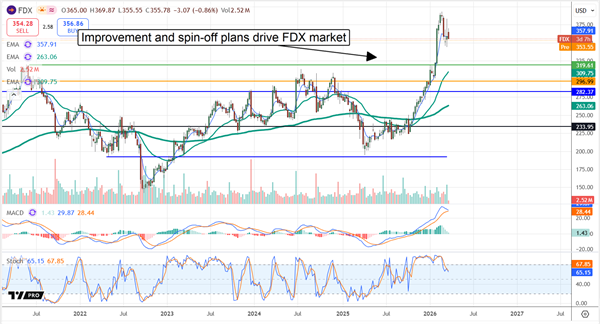
FedEx’s (NYSE: FDX) spin-off suggests both the parent and the new company could be attractive buys. The split separates the freight business from the core package-delivery operation, allowing each company to trade at freer valuations. A critical takeaway for potential investors in the freight company is that it could trade at a 50% or higher premium to the original entity. The freight business faces 2026 headwinds, including tepid demand, margin pressure, and expansion costs.
Since 2009, the Dividend Machine has posted a total return of 7,056.47% – turning a $10,000 stake into more than $700,000 while the broader market struggled through multiple downturns.
With a 93% win rate since launch, this dividend-focused strategy has kept investors cashing steady checks through every crash. Bill Spetrino has released a free report outlining how to position for income no matter what the market does next.Claim your free report and see how the Dividend Machine works
Takeaways for investors in the remaining FDX include improvements in operational quality, cash flow, and the reliability of capital returns. FedEx’s capital-return program—dividends, dividend growth, and aggressive share buybacks—remains meaningful: buybacks reduced the share count by more than 2.5% year-to-date through the end of fiscal Q3 2026. Analysts are lifting price targets ahead of the spin-off, supporting a Moderate Buy view with potential to reach new highs by mid-year.
KBR Split Enhances Focus, Unlocks Growth Avenues
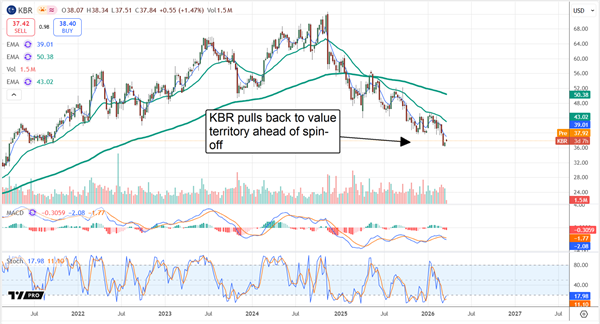
KBR’s (NYSE: KBR) split, scheduled for completion in the back half of 2026, aims to separate its Sustainable Technology Solutions business from its government-facing operations. The new company will comprise the Mission Technology Solutions group, which covers defense, security, and space applications. This move is intended to unlock value: the spinco could see a 100%–200% price gain if it trades closer to defense peers rather than the parent’s ~9x multiple. Defense specialists such as Lockheed Martin (NYSE: LMT), Northrop Grumman (NYSE: NOC), and RTX (NYSE: RTX)trade at well over 20 times earnings.
While the spinco will concentrate on defense contracts and executing its sizable backlog, the ongoing business will focus on higher-margin sustainable energy technologies. The leaner parent should benefit from faster decision-making and greater financial flexibility, enabling continued investment in growth. Analyst revisionsare mixed for 2026, but the consensus rating remains Hold and the average price target implies roughly 50% upside.
Medtronic to Spin-Off High-Growth Diabetes Unit
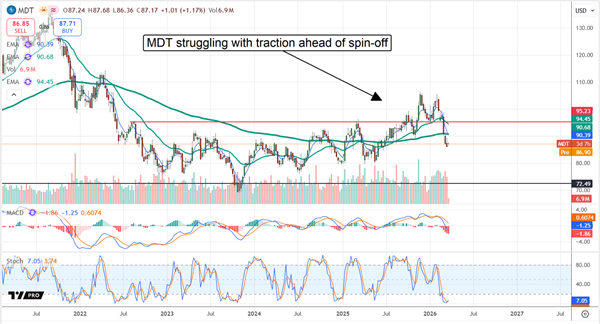
Medtronic (NYSE: MDT) plans to spin off its high-growth diabetes unit later this year—a move that may seem counterintuitive at first. The diabetes business is more consumer-oriented, while the core company is focused on hospital-based care, creating strategic and operational mismatches in a combined structure. The spin-off will create a pure-play diabetes equipment and supply company that can compete more effectively in its fast-growing market and could become a takeover candidate.
The remaining Medtronic will concentrate on higher-margin, high-growth areas such as cardiovascular devices and robotic surgery. Robotic surgery is a major growth area, led by names like Intuitive Surgical (NASDAQ: ISRG), which has sustained double-digit growth and improving operational metrics. Twenty-six analysts rate this stock a Moderate Buy. Coverage is increasing, sentiment is firm, and the consensus price target implies more than 25% upside as of late March.
Keurig Dr Pepper: Grows to Split, Unleashes Global Powerhouses
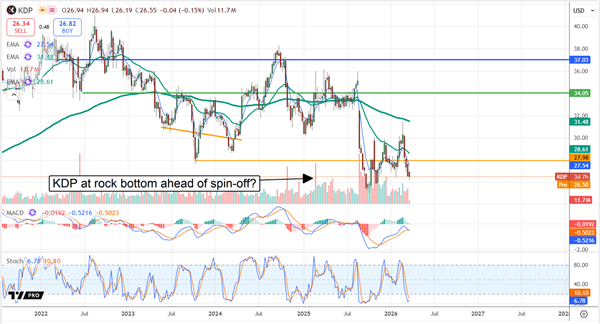
Keurig Dr Pepper (NASDAQ: KDP) has struggled for years as strengths in one segment often offset weaknesses in the other. The company plans another coffee acquisition and then to spin off the coffee business into a pure-play. That approach is expected to deliver supply-chain efficiencies and unlock growth—especially in the high-margin coffee pod market.
The ongoing business will become a soda-and-beverage pure-play, unencumbered by coffee-specific issues and with a stronger financial profile. It will be better positioned to focus on its higher-margin businesses and pursue acquisitions. The transaction is expected to be completed in April. Analysts are bullish, rating the stock a Moderate Buy and raising price targets ahead of the spin-off. The MarketBeat consensus price target implies roughly 35% upside, and the highest analyst targets add further double-digit potential.
Honeywell Splits to Enhance Focus With 2 Pureplay Businesses
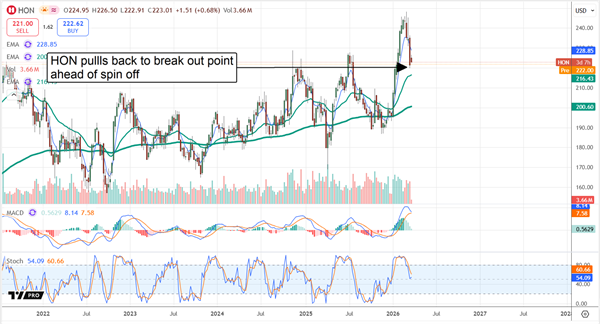
Honeywell (NASDAQ: HON) plans to separate its aerospace business into a focused pure-play unit. That aerospace company will service defense and commercial contracts, execute on a record backlog, and improve cash flow, while the original company concentrates on industrial automation. Industrial automation sits at the center of Industry 4.0—the nexus of the Internet of Things (IoT), robotics, and AI. The split should give each company a more flexible financial position and enable strategic acquisitions to sustain long-term growth.
Analyst trends suggest investors are most bullish on this name. MarketBeat data shows growing coverage, firming sentiment at Moderate Buy, and an uptrend in price targets. The consensus forecast indicated about 10% upside in late March, with sentiment and target trends skewed toward the high end and likely to remain strong through year-end.
This email communication is a paid sponsorship sent on behalf of Porter & Company, a third-party advertiser of MarketBeat. Why did I receive this email?.
If you have questions or concerns about your newsletter, please email our U.S. based support team at contact@marketbeat.com.
As you prepare for the week ahead, I wanted to bring to your attention an important matter that could significantly impact your investment success.
Upon reviewing our subscriber accounts, I noticed that your name is currently missing from our exclusive stock alert distribution list. This means that you may be missing out on valuable information and the opportunity to make well-timed investment decisions.
Our next stock alert is scheduled to be sent out tomorrow, and I want to ensure that you don’t miss out on this potentially profitable opportunity.
Joining our alert distribution list is quick and straightforward. Simply click on the link below to sign up and guarantee that you receive our future alerts:
By becoming part of our alert list, you’ll gain access to crucial insights, expert analysis, and real-time updates that can significantly influence your investment strategy.
Staying well-informed, making informed choices, and positioning yourself for financial success will become easier than ever.
Thank you for your attention, and we look forward to keeping you informed with our stock alerts!
William Bushee Vice President, MarketBeat
More Reading from MarketBeat.com
As Digital Ad Spend Hits a High, These Firms Could Reap Rewards
By Nathan Reiff. Originally Published: 4/1/2026.
Key Points
Digital ad spending could roughly triple over the next decade, and AI and other innovations may open up a range of new investment opportunities.
Capitalizing on the growth of connected TV ad sales, Magnite shares could more than double according to estimates.
DoubleVerify and Zeta Global offer crucial tools including verification and analytics services, making them essential players in the growing digital ad industry as well.
The digital ad spending market could roughly triple to about $1.6 trillion over the next decade, creating ample opportunities for companies in this fast-growing space. The landscape that was once dominated by major tech players like Alphabet (NASDAQ: GOOG) has shifted as AI-driven targeting and other innovations open room for smaller competitors to gain traction. Three companies in particular stand out for their distinctive positions in the industry—each showing demonstrable growth while trading at valuations that may be below Wall Street’s expectations.
Magnite’s CTV Dominance Could Yield Continued Strong Growth
Magnite Inc. (NASDAQ: MGNI) is a sell-side advertising platform that helps publishers monetize inventory via programmatic advertising across media channels. The company reported a strong final quarter of 2025, with total revenue of $205 million—up 6% year-over-year (YOY)—and net income that more than tripled YOY to $123 million. Management also announced a $200 million stock buyback program.
Since 2009, the Dividend Machine has posted a total return of 7,056.47% – turning a $10,000 stake into more than $700,000 while the broader market struggled through multiple downturns.
With a 93% win rate since launch, this dividend-focused strategy has kept investors cashing steady checks through every crash. Bill Spetrino has released a free report outlining how to position for income no matter what the market does next.Claim your free report and see how the Dividend Machine works
Magnite’s performance was driven largely by connected television (CTV) advertising, which grew sales at a rate of 32% (excluding political ads). The company is positioning itself as an industry leader in CTV and benefits from strong partnerships with key streaming platforms like Netflix (NASDAQ: NFLX)and Roku (NASDAQ: ROKU).
Magnite’s services are also sticky—customers tend to stay because switching to new providers is costly. Beyond the earnings strength, the company sports a price/earnings-to-growth (PEG) ratio of just 0.66, suggesting it could be undervalued relative to future growth prospects. Analysts project more than 51% in earnings gains over the next year, and consensus price targets imply more than 100% upside, with a consensus target above $24 per share.
A Critical Security Procedure Helps to Ensure DoubleVerify’s Value
Operating outside direct ad sales but essential to advertisers, DoubleVerify Inc. (NYSE: DV) provides digital media analytics, ad fraud detection, and verification services. The rise in digital ad spending boosted DoubleVerify’s business: full-year 2025 revenue rose 14% YOY to $748 million, and adjusted EBITDA margin reached 38% in the final quarter of 2025. Like Magnite, its products are sticky—DoubleVerify reported no deactivations among its top 100 customers and strong net revenue retention.
CTV impression measurement volumes are climbing rapidly, and social activation is also expanding—both trends are likely to continue fueling growth. Management guided 2026 revenue of $810 million to $826 million, representing an 8% to 10% YOY increase, and authorized a share repurchase program of up to $300 million.
DoubleVerify’s services could become even more critical if AI-generated content proliferates. More AI content may lead to greater ad fraud, increasing demand for independent verification. Analysts see more than 60% upside potential, with a consensus price target of $16.
Zeta’s Durable Growth Suggests Very Stable Demand
Zeta Global (NYSE: ZETA) is an up-and-coming player in the AI market cloud space, leveraging a large consumer database to help advertisers build and retain customers. In its latest earnings, the company demonstrated why it’s an ascendant name: shares returned more than 17% over the past year despite a slump at the start of 2026.
Revenue surged 25% YOY to $395 million in the final quarter of 2025, while full-year revenue rose 30%. Free cash flow strengthened to $165 million, up 78% YOY, and the number of super-scaled customers increased by nearly 25% over the same period.
Zeta stands out for consistency: it has posted more than four years of sequential beat-and-raise quarters, an indicator of solid demand for its products.
GAAP profitability remains a concern, but the company expects to achieve positive GAAP net income for full-year 2026 for the first time, with midpoint revenue guidance of $1.8 billion (about 35% YOY growth). Analysts also see meaningful share price upside—more than 80% potential—and the company’s new AI platform could be the catalyst that drives that growth.
More Reading from MarketBeat.com
Market Whispers: Is Molson Coors the Next Big Beverage Buyout?
By Jeffrey Neal Johnson. Originally Published: 3/30/2026.
Key Points
The recent acquisition of a popular cocktail brand highlights the company’s successful strategic expansion beyond its traditional beer portfolio.
Several key financial metrics suggest that Molson Coors is fundamentally undervalued, making it an attractive opportunity for discerning investors.
Recent share purchases by company insiders signal strong confidence in the brewer’s future prospects and its commitment to enhancing shareholder value.
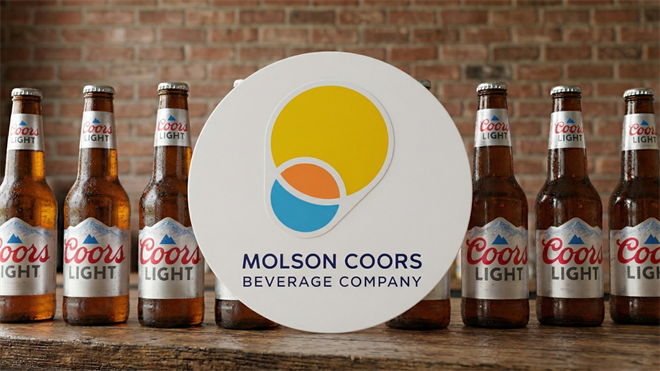
A sudden jolt of investor interest has put Molson Coors Beverage Company (NYSE: TAP) in the spotlight. Shares of the brewing giant recently rose after analyst commentary identified Molson Coors as a prime takeover target. This speculation comes as the broader beverage industry buzzes with M&A activity, prompting Wall Street to take a closer look at the numbers and strategy behind one of the consumer staples sector’s most established names.
The buyout chatter isn’t random market noise; it reflects a growing recognition of the significant value embedded within this legacy brewer. For investors, that creates a compelling situation where the market may finally be waking up to a discounted opportunity. The discussion is prompting deeper scrutiny of Molson Coors’ fundamentals, its proactive strategy and the industry trends that make it an attractive acquisition candidate.
Beyond Beer: A Perfect Target in a Changing Market
Since 2009, the Dividend Machine has posted a total return of 7,056.47% – turning a $10,000 stake into more than $700,000 while the broader market struggled through multiple downturns.
With a 93% win rate since launch, this dividend-focused strategy has kept investors cashing steady checks through every crash. Bill Spetrino has released a free report outlining how to position for income no matter what the market does next.Claim your free report and see how the Dividend Machine works
The case for a Molson Coors buyout has a strong strategic foundation. The global alcohol sector is consolidating, with major companies seeking market share and entry into faster-growing categories. Potential combinations among large players — such as chatter around Pernod Ricard (OTCMKTS: PRNDY) and Brown-Forman — underscore that trend, creating a favorable environment for further deals. In this landscape, a company with Molson Coors’ brand recognition and distribution network is a valuable asset.
Importantly, Molson Coors management is playing offense with its Horizon 2030 strategy, a clear plan to adapt to evolving consumer tastes. The most visible proof of that pivot is the recent acquisition of Atomic Brands, maker of Monaco Cocktails — a strategic push into the high-margin Ready-to-Drink (RTD) market, which is projected to grow faster than traditional beer over the next five years. This move complements an existing push into beyond-beer products, including Vizzy Hard Seltzer and a distribution partnership for Topo Chico Hard Seltzer.
That expansion serves two bullish purposes. First, it strengthens Molson Coors as a standalone company by diversifying revenue away from the slow-growth traditional beer market. Second, it makes the company’s brand portfolio far more attractive to a potential suitor. An acquirer wouldn’t just be buying legacy names like Coors Light and Miller Lite; it would gain an immediate and meaningful foothold in one of the fastest-growing beverage segments — making Molson Coors a more valuable target and increasing the rationale for a buyout at a premium.
Why Molson Coors Looks Undervalued
Beyond the strategic fit, Molson Coors’ financials suggest the company is fundamentally undervalued — precisely the kind of deep value that attracts corporate buyers and value investors alike. A closer look at the numbers reveals a compelling case built on a discounted valuation, strong cash generation and a clean balance sheet.
Discounted valuation: Key metrics indicate Molson Coors is trading below its intrinsic value. Its forward price-to-earnings ratio sits at an attractive 6.84, well below many industry peers, and its price-to-book ratio is 0.79 — a P/B below 1.0 can signal the stock is trading for less than the recorded value of its assets.
Superior cash generation: Molson Coors has a low Price-to-Cash-Flow (P/CF) ratio of just 1.52, highlighting efficient conversion of revenue into cash. Strong cash flow supports strategic acquisitions, dividends and other shareholder-friendly activities, and it makes the company appealing to potential acquirers.
A solid foundation: With a debt-to-equity ratio of 0.37, Molson Coors is not over-leveraged. That manageable debt profile reduces acquisition risk compared with competitors carrying heavier debt loads.
Rewarding shareholders: Management has shown a commitment to returning capital. The stock currently offers a dividend yield of 4.5%and a four-year track record of dividend growth, signaling financial discipline and confidence in future performance.
Strong insider confidence: Recent trading shows Molson Coors insiders have been net buyers. That activity includes a notable purchase by a director in March 2026 — a strong vote of confidence from those closest to the company’s prospects.
A Win-Win Scenario: Tapping Into a Bullish Future
For investors, Molson Coors presents a compelling, two-way opportunity for gains. The investment case doesn’t hinge on a single outcome but rather on two distinct, bullish paths that could unlock significant shareholder value.
The first, more immediate path is an acquisition. A strategic buyer could act on the compelling combination of brand assets, distribution reach and undervalued cash flows, acquiring Molson Coors at a meaningful premium to its current price.
The second path is successful execution of the Horizon 2030 strategy. If the company’s pivot into higher-growth beyond-beer categories — like RTDs — accelerates earnings, the market could re-rate the stock to a much higher valuation based on its own merits. For investors seeking a defensive position that combines steady dividend income with upside from either a takeover or operational turnaround, Molson Coors offers a bullish case grounded in tangible value and strategic foresight.
Thank you for subscribing to MarketBeat!
MarketBeat empowers everyday investors to make better trading decisions by offering up-to-the-minute financial information and objective investment research.
This email message is a sponsored email sent on behalf of MarketBeat Alerts, a third-party advertiser of MarketBeat. Why did I get this email message?.
If you have questions or concerns about your newsletter, please contact MarketBeat’s South Dakota based support team at contact@marketbeat.com.

 News for you, Peter“He’s scared. I’ll knock his brains out” – Michael Jordan on why Tiger Woods refused to play…Jordan didn’t care that Tiger was still an up-and-coming prodigy when he talked smack against the golfer.Basketball Network Adam Back explains why he’s not bitcoin creator Satoshi NakamotoThe Blockstream CEO told Yahoo Finance that the real creator of Bitcoin wouldn’t be doing interviews or speaking at confer…Yahoo Finance War-fueled inflation means stocks could struggle for the next 3 months, Wharton professor Jeremy Siege…Inflationary damage from the Iran war is already starting to hit the economy, and that means stocks could struggle for mon…Business Insider New movies to watch this weekend: See ‘Faces of Death’ in theaters, rent ‘EPiC: Elvis Presley in Conce…Sydney Sweeney’s critically lauded performance in “Christy” hits HBO Max, while the not-so-critically lauded &qu…Yahoo Entertainment ‘It’s killing everything.’ California’s truckers are buckling under country’s priciest dieselRecord diesel prices are crushing California’s truckers, forcing them to adjust to avoid losses as they grapple with the m…LA Times Fleetwood Mac cofounder Mick Fleetwood weds for the 5th time at 78The rock legend is now officially wed to Elizabeth Jordan, his partner of six years.Entertainment Weekly Defence secretary reveals month-long Russian submarine operation over cables and pipelines north of UKJohn Healey says three Russian submarines left after being monitored “24/7” by UK forces, with no damage reporte…BBC Chimpanzees in Uganda are locked in a deadly ‘civil war’ after their group split apart — and sc…The first well-observed “civil war” in wild chimpanzees reveals that shifting social ties alone can fracture a g…Live Science Louisiana GOP races to eliminate an elected office won by an exonerated manA man imprisoned for nearly 30 years before being exonerated won a landmark election in New Orleans promising to fix a jud…Associated Press Dodgers notes: Alex Vesia, Andy Pages, stadium name changeLast season the Dodgers were able to complete their quest of two straight titles without the help of their best left-hande…SB Nation More like this
 Today’s gamePlay Crushable by Candy CrushPlay, match, and spark chain reactions!
 Trending now1. Artemis Splashdown2. General Hospital3. Michigan Hockey Score4. Avignon Papacy5. Elizabeth Jordan6. Masters Cut Line7. Natasha Lyonne8. Russia-Ukraine War9. Strait of Hormuz News10. USPS News









 RJ Hamster