I was born on 6 August 1956 in San Francisco, California to Janet and (the late) Richard Hovis.
I grew up in Santa Monica, California where I attended elementary, junior high school, and high school (graduating in 1974), in addition to involvement in sports and recreation (Little League +, the Boy’s Club ++). Further, it was in elementary school – St. Augustine’s By-the -Sea Parish School that I found, and made the choice to truly journey with God.
I attended Arizona State University from 1974 to 1977 – seeking to become an architect, however, I was not accepted, and, as such, I graduated with a Liberal Arts degree.
Upon graduation from Arizona State University, I attended Cal Poly San Luis Obispo and studied City and Regional Planning at the Master’s level. I successfully completed one (1) year in a two (2) year program – I did not complete the Master’s degree in City and Regional Planning – due to personal reasons.
I returned to Santa Monica where I started (October 1979) my career as graphic designer with Exxon Company, USA. I spent five years with Exxon Company, USA.
While working with Exxon Company, USA I was accepted into architectural school – Sci-Arc in Southern California, however, I did not attend preferring to stay with Exxon..
In 1982 I married Laura Flosi and in April 1983 we had our one and only child – Lauren Alain Hovis – a gift from God.
We moved to Phoenix, Arizona in 1984 from Los Angeles, where I went to work as a graphic designer with Kitchell CEM (from 1985 -1987).
From 1987 – 1995 I was an independent contractor, and a registered representative in mortgage finance, financial management, graphic design, and drafting.
Further, I attended the University of Phoenix and successfully obtained a Master’s in Business Administration (MBA) in 1982.
I was also a member of the Scottsdale Jaycees, where I became very involved in community events and projects.
In 1994, I accepted a cartography position with the Defense Mapping Agency in Reston, Virginia. As such, I relocated from Phoenix to Reston.
In 1998, I was accepted and worked as a Visual Information Officer with the Central Intelligence Agency. In 2002, I worked as a Support Officer until my retirement (due to a need for shoulder surgery) in September 2018.
Away from my Federal Government service, I have been involved in various organizations and activities in Northern Virginia.
In November of 2011, I married Rebecca Ouellette in Santa Monica, California. I reside in San Tan Valley, AZ with my two hamster - Jess and Timothy, our fish, our lizard - RJ Lizard., and our cats - Pearl and Grey.
As to hobbies, I enjoy playing sports, attending sporting events, mentoring individuals from financial management to hamsters, building models, photography, travel, multimedia design, managing partner for RJ Hamster, and jazz – smooth jazz to a samba or a bossa nova.
Love and God Bless,
Peter – aka RJ Hamster Jo hi
From a first-time World Series champion to a blockbuster trade, here are 10 predictions for the upcoming season that seem unlikely but are definitely possible.
The first Hitter Power Rankings of the year feature almost exclusively players we just saw in the World Baseball Classic, and No. 1 on the list is also a pitcher (guess who).
Holding his friend’s sleeping 10-week-old son in his right arm, Padres fan Matt Rendina reached up with his left hand to cleanly snag a foul ball. And he is giving the ball to the baby.
Sometimes teams improve not because of additions, but because returning players reach another level. These are the clubs projected to see the most improvement from their internal options.
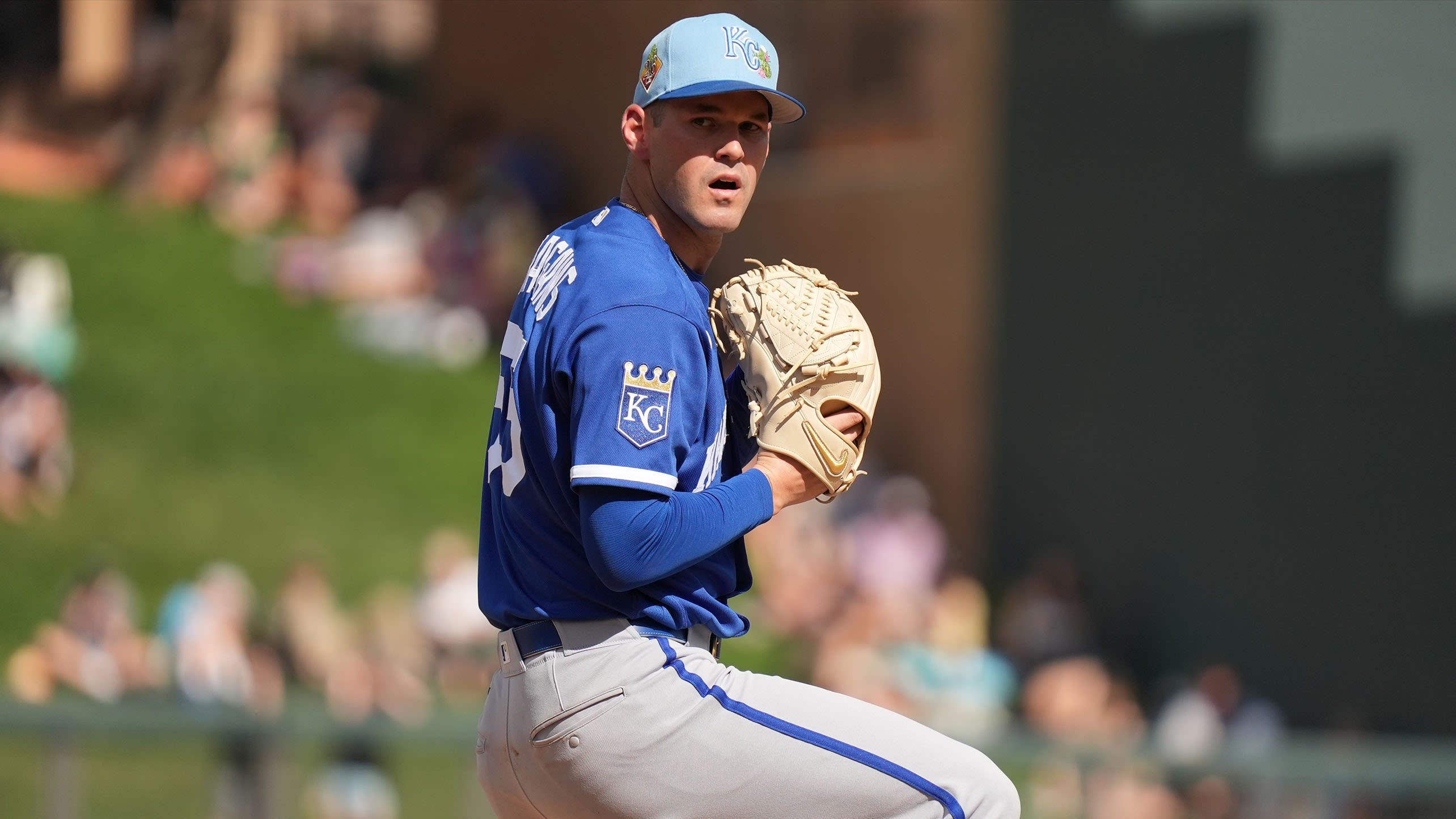
Cole Ragans was much better than his 4.67 ERA last season, and here is why he could make a run at denying Tarik Skubal a third consecutive Cy Young Award.
What’s better than watching Kyle Schwarber mash a home run? Watch him do it while eating a Schwarbomb Sundae, soft-serve ice cream topped with a strawberry Uncrustable, strawberry sauce and fruity cereal pieces.
In their penultimate home game before heading back to New York for next week’s opener, the Mets host the Cardinals in Grapefruit League action at 1 p.m. ET.
The 2026 Spring Breakout Series continues when Colt Emerson and the Mariners prospects take on Jesús Made and the Brewers prospects at 5 p.m. ET, followed by the conclusion of the Tigers prospects vs. Pirates prospects.
Lauren Wingfield Managing Editor, The Opportunistic Trader
P.S. Most investors are chasing the next hot AI stock. Always trying to guess when the next big rally will happen… spreading themselves thin watching dozens of tickers… glued to their screen all day… stressed out and exhausted.
But with Larry’s system and his AI Chaos-to-Cash Calendar… you always know when the next profit opportunity is coming.
That’s why Larry says this is as predictable as anything he’s seen in his legendary 40-year career.
Todd Littleton’s family has been farming in Gibson County, Tennessee, for three generations.
These days, he grows corn, soybeans, and wheat.
And according to an Associated Press report, he’s paying $100,000 more for fertilizer than he did last year – a 40% jump.
The reason is a narrow waterway off the southern coast of Iran that’s been all over the news – the Strait of Hormuz.
You’ve probably heard that the Strait normally carries roughly a fifth of the world’s oil and a fifth of its liquefied natural gas. But about one-third of global seaborne trade in fertilizers also normally passes through it.
Then there’s polyethylene – the clear, flexible plastic in the bag your groceries came home in, the lining inside your milk carton, and the tubing in an IV drip. Eighty-five percent of Middle East polyethylene exports move through the same channel.
So does about a third of the world’s helium. It’s the gas semiconductor factories use to make the chips inside every phone, laptop, and AI server on the planet.
None of those critical commodities are moving right now. Any ship that passes through the Strait risks becoming a target of missile and drone attacks by Iran’s Islamic Revolutionary Guard Corps.
As I detailed on my quarterly call with TradeSmith’s top-tier Platinum members earlier this week, it’s one of four major challenges facing the bull market on Wall Street.
Taken together, they explain why the market has been swinging hundreds of points on single headlines… and why it’s gotten a lot of investors feeling twitchy.
Which brings me to the question I kept hearing on the call: “Should I sell?”
Most folks will answer that question the wrong way. They let the headlines decide for them and panic sell. Or they freeze and watch a manageable loss become a serious one.
Neither is a plan. Today, I’ll give you one. Including the sectors to look at that actually thrive in this kind of market.
First, let’s take a look at the other factors pressuring this bull market.
Today, we’re sharing a “forecast calendar” for 2026. It shows you when the biggest stock jumps could occur this year – to the day – with an 83% backtested accuracy. Last year alone, you could have doubled your money 13 times with it across our work. We urge you to use it by April 15 to prepare for a colossal event coming to stocks.
Three Other Major Challenges to the Bull Market
The Strait of Hormuz is the most visible pressure point for this market. But it isn’t the only one. On my call with Platinum members, I walked through three others.
1. The Fed Is Trapped
When oil prices spike, inflation follows. Every 10% rise in oil adds about 0.4 percentage points to global inflation, according to the International Monetary Fund.
WTI crude – the U.S. benchmark – has shot up roughly 40% since the strikes on Iran began on Feb. 28. That means this oil spike alone is pushing up inflation by more than 1.5 percentage points.
That puts the Fed in a tough spot. Cut rates to support a slowing economy, and you risk an even bigger inflation spike. Hold rates – or raise them – and you risk choking off growth, right when the stock market is spluttering.
2. The Consumer Gets Squeezed
Consumer spending is roughly 70% of the U.S. economy. When gas prices rise, there’s less in the wallet for everything else.
That money doesn’t get spent at restaurants, clothing stores, or car dealerships. It goes into the gas tank instead.
Higher fuel costs also push up utility bills and airfares. Groceries cost more. Consumers – already carrying record credit card debt – have less room to maneuver.
And when spending slows, corporate revenues slow. When revenues slow, earnings disappoint. And when earnings disappoint, investors reprice stocks.
3. The AI Paradox
This one is more nuanced. It’s also even more important for understanding where we are in this cycle.
AI is transforming how businesses operate. That’s real. But the market has been pricing in the upside without fully reckoning with the downside.
Take the mass layoffs at payments company Block (XYZ). It’s the firm behind Square and Cash App that Twitter cofounder Jack Dorsey now runs.
Last month, he announced he was cutting 4,000 staff – 40% of his workforce. In his letter to shareholders, he didn’t mince his words. “Intelligence tools,” he wrote, “have changed what it means to build and run a company.”
The press ran this as an AI disruption story. And it is. But it also has knock-on effects for the economy.
Those laid-off workers are also consumers. They have mortgages…. car payments…. grocery bills. They also eat in restaurants… go to the mall… and go on vacations. When they lose their jobs, they pull back on spending.
Multiply that across the economy and the consumer engine powering economic growth will stall.
That’s the AI paradox. The same efficiency gains that send individual stocks soaring are eroding the consumer base that the economy runs on.
It’s a troubling picture. And I get why folks are worried. But there’s a way to handle this without letting your emotions get the better of you.
Panic Is Not a Strategy
When headlines are this loud, the instinct is to sell your stocks and move to cash. I’ve been investing long enough to know that instinct is usually wrong.
My approach: Don’t sell based on headlines or on emotions. Instead, be systematic, and let the data decide.
That’s the whole point of the tools we’ve built at TradeSmith. They exist to keep your emotions from running the show.
Here’s the framework I use.
Step 1: Check Long-Term Health.
This is your first and most important question for your long-term holdings. Is a stock you own still in a Green Zone?
Long-Term Health measures whether a stock is moving within its normal range of behavior – its individual volatility “fingerprint.” As long as it’s in the Green Zone, the long-term trend is intact. Temporary drawdowns, however gut-wrenching, are not a reason to sell.
If a stock you own has entered a Red Zone, that’s a different story. The trend has broken down. That’s when you sell – not because the headlines scared you, but because the data confirms the move is real.
Right now, none of the major U.S. indexes are in Long-Term Health Red Zones. But the Dow has entered a Yellow Zone.
That’s a sign that a momentum shift is underway in the 30 industrial stocks that make up the Dow. But a bearish trend hasn’t been confirmed.
Think of it like the warning light on your car’s dashboard. The engine isn’t broken yet. But something’s changed, and it’s worth paying attention.
Step 2: Check your VQ Stop Loss.
If you’re already a TradeSmith subscriber, every position in your portfolio should have a stop loss set at its Volatility Quotient (VQ) – the level at which a pullback stops being normal and starts being a warning sign.
If your stop hasn’t been hit, you have no reason to sell. The VQ is designed to keep you in winning positions through the inevitable turbulence while protecting you from the losses that can permanently impair a portfolio.
If your stop has been hit, sell – and don’t second-guess it.
Step 3: Check Short-Term Health for what to do next.
Once you’ve assessed what you own, the next question is where to look for opportunity.
Short-Term Health helps you spot stocks and sectors where short-term momentum is breaking down. It also shows you the stocks and sectors where it’s turning positive – the early movers in a new cycle.
Right now, that’s key. This environment is genuinely challenging for many parts of the market. But it’s a powerful tailwind for others.
Where to Buy Now
Not all stocks suffer in a high-oil, high-inflation environment. Some thrive. Here’s where TradeSmith’s signals are pointing.
The sectors with the wind at their backs:
Energy producers – ExxonMobil (XOM), Chevron (CVX), ConocoPhillips (COP). When oil prices rise, their revenues rise with them. These are direct beneficiaries.
Oilfield services – Halliburton (HAL) and Schlumberger (SLB). Higher prices mean more drilling. More drilling means more demand for the equipment and expertise these companies provide.
Defense – Defense spending is already elevated, and it tends to stay that way. Defense contractors are a natural port in this particular storm.
Domestic LNG exporters – The U.S. is the world’s largest liquefied natural gas exporter. With global gas prices spiking, U.S. exporters are selling into a very hungry market.
Uranium and nuclear – When oil and gas supplies are disrupted and prices spike, energy alternatives get repriced. Nuclear is no exception.
The key point: You don’t need to make big macro bets to navigate this environment. You just need to know which parts of your portfolio are exposed – and which aren’t.
That’s what our tools are designed to tell you.
All the best,
Keith Kaplan CEO, TradeSmith
P.S. I’ve been tracking a broader set of warning signs in the market, based on our Short-Term Health indicator. And I’ve put together a presentation that every investor should see laying out what comes next – and how to position yourself ahead of the market’s next big moves.
It isn’t all about protecting your downside risk – although that’s key. As I showed you today, Short-Term Health can also help you make smarter moves ahead of emerging bullish trends.
Energy and defense are among those bullish outliers. But they’re not alone.
This editorial email containing advertisements was sent to pahovis@aol.com because you are subscribed to this service. To unsubscribe or change your email preferences, please click here.
To contact Customer Service, call toll free: 866-385-2076, Mon–Fri, 9am–5pm ET, or email support@tradesmith.com.
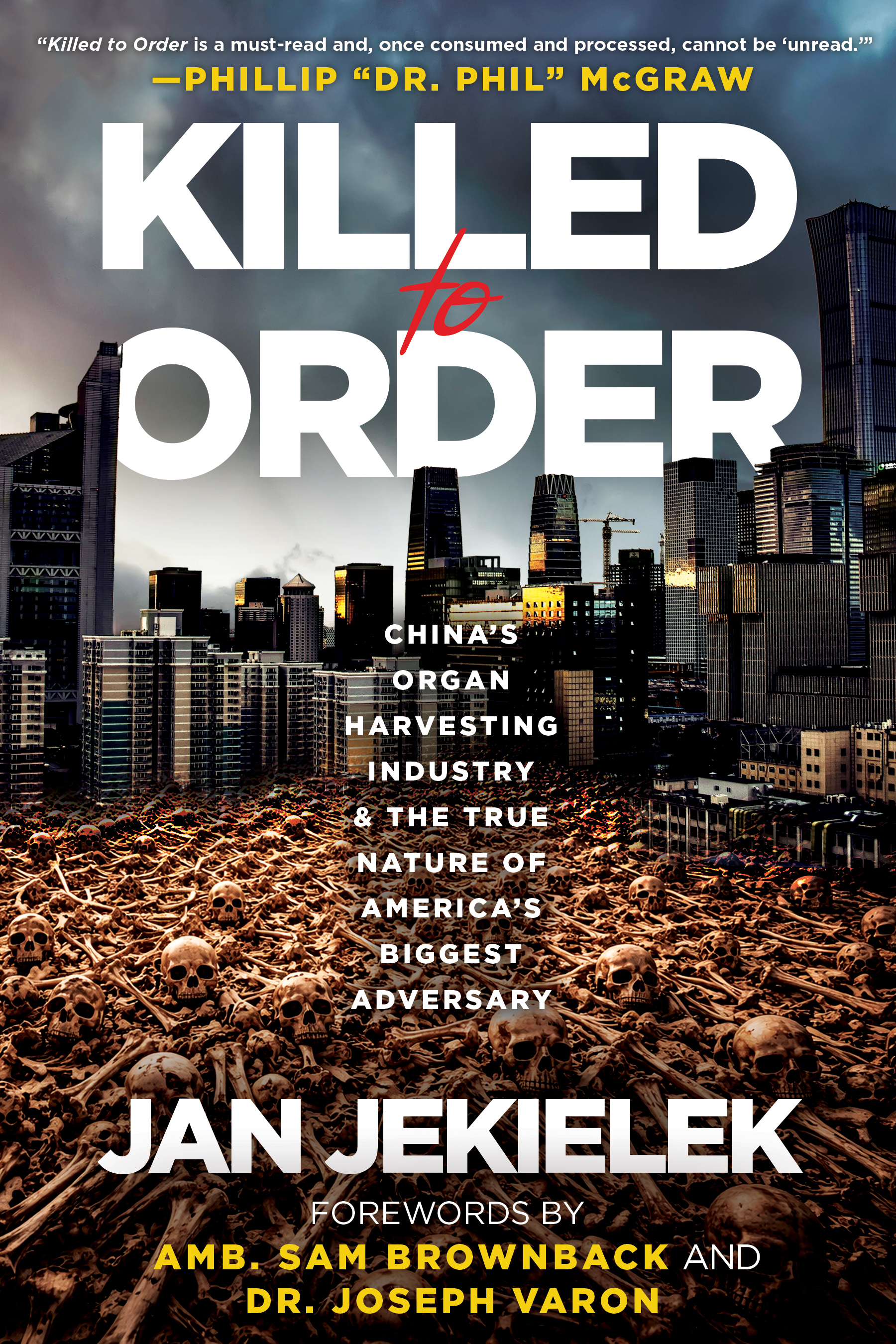
You think you know what China’s forced organ harvesting is about—think twice.
Most people don’t know when it all began. They don’t know how many lives have been lost. And they never heard one single testimony.
Now, there’s a chance to reconsider.
After spending two decades researching, interviewing, and documenting evidence from the earliest available testimonies to the latest ‘impossible’ survivor, Jan Jekielek, Epoch Times’s senior editor, has built a compelling case. He’s ready to share with the world—through his new book: Killed to Order, poised to be one of the most important nonfiction books of the year.
In Jan’s own words, “My goal is to get Killed to Order onto the NYT bestseller list. Not for vanity, but because it forces national attention. It gets this story onto shelves, into libraries, and into conversations that otherwise wouldn’t happen.”
Remember World War II? Despite growing evidence of the Holocaust, many people remained indifferent or unaware of the full scale of the mass murder. Had the circumstances been different, the story might have ended differently.
The moment of truth has once again arrived.
The world is now waiting for you to respond.
Killed to Order was released on March 17, 2026. Order yours today!
Latest comment from Killed to Order’s book release event:
“It began with waging a war on their ancestors. That’s what the Cultural Revolution was. Then it was a war on their posterity. That’s their children. That’s what the one-child policy was. And what is organ harvesting? It’s cannibalism. They ate their ancestors. They ate their children. And now the CCP is eating itself.”
—Jason Jones
filmmaker; human rights activist; president and founder of HERO, Inc.
Watch news clip of the book release event at the Trump–Kennedy Center on March 16 here:
This ad is sent on behalf of NewMarket Health Publishing, LLC. P.O. Box 913, Frederick, MD 21705, USA. If you would like to unsubscribe from receiving offers from NewMarket Health Publishing, LLC, please click here.
This email is never sent unsolicited. You have received this Newsmax email because you subscribed to it or someone forwarded it to you. To opt out, see the links below.
Remove your email address from our list or modifyyour profile. We respect your right to privacy. Viewour policy.
This email was sent by: Newsmax.com 362 N. Haverhill Road West Palm Beach, FL 33415 USA
For one weekend in August 1969, Woodstock looked like the start of something big.
Sure, it was messy. It was loud. It was far from polished. But the vibe people felt was unmistakable.
It felt like the future had arrived. The possibilities were endless.
Then, later that year, came Altamont.
What was supposed to be another landmark concert turned into something much darker. So dark, in fact, that many historians still call it “the day the 1960s died.”
Every great boom has skeptics waiting for a moment like that. The moment when the dream cracks. The moment when the hype gives way to disappointment.
For the past year or so, plenty of doubters have been looking for that moment in artificial intelligence. They have called it a bubble. They have warned that spending on chips and data centers has peaked. They have argued that the AI boom is already running out of road.
I bring this up because NVIDIA Corporation’s (NVDA) annual GTC conference has been referred to as the “Woodstock of AI.”
And this week, the company delivered a very strong message to the doubters.
Instead of showing cracks in the AI story, NVIDIA showed that the buildout is getting bigger, broader and more deeply embedded in the economy than most investors realize.
Founder and CEO Jensen Huang used the event to make a simple point: The next phase of AI will not be smaller than the first. It could be much bigger, especially as inference and so-called agentic AI begin to scale.
In today’s Market 360, I’ll explain why the “peak AI” crowd still has this story wrong, why NVIDIA remains one of the great companies of our time, and why the biggest profits in the next phase of this boom may go not just to the household names, but also to the companies controlling the key bottlenecks.
Why the “Peak AI” Crowd Is Wrong
The “peak AI” crowd is looking at the wrong thing.
They are still focused on training. They are still asking whether the Big Tech hyperscalers will keep spending at the same pace to build the next giant model. For the record, they are. Estimates peg their spending to amount to somewhere between $600 billion and $750 billion this year alone.
But that is yesterday’s question.
This is why Huang went on to deliver a prediction that would sound absolutely shocking if it came from anyone else (or any other company).
NVIDIA says it sees at least $1 trillion in revenue from its Blackwell and Rubin chips through 2027.
Why? Because, at GTC, NVIDIA made clear that the new battleground is inference. In plain English, that means running AI models in the real world, at scale, over and over again.
So, NVIDIA did not just show off a faster chip. It rolled out the Vera Rubin platform as a full AI factory, with racks for GPUs, CPUs, storage and networking. It talked about AI as a complete system, not a single product.
That is not the language of a company preparing for a slowdown. It is the language of a company that believes demand is still accelerating.
The company is pushing deeper into inference, enterprise software and networking. It is also locking up key parts of the next supply chain through multiyear optics partnerships with companies like Lumentum Holdings Inc.(LITE) and Coherent Corp. (COHR).
Louis Navellier says a massive wealth transfer is underway — and it’s accelerating faster than anything he’s seen in nearly five decades on Wall Street. He’s named the 10 companies positioned to capture it. Watch His Briefing Now.
The Rise of Agentic AI
Now, GTC also highlighted something else.
One of the biggest themes at GTC was agentic AI.
This is the idea that AI will not just answer a question and stop. It will take a goal, break it into steps, use tools, make decisions, monitor results and keep working in the background.
An open-sourced AI assistant called OpenClaw is leading the way.
It has become wildly popular among the tech community, allowing users to create and deploy AI agents — digital assistants that can do more than answer a single prompt.
Jensen Huang put it this way: “Every company in the world today needs to have an OpenClaw strategy, an agentic system strategy. This is the new computer.” He also said OpenClaw “made it possible for us to create personal agents” and that “the implication is incredible.”
That is a big statement. But it helps explain why NVIDIA is so bullish. They are giving you a glimpse of the future.
The company introduced NemoClaw as a way to help the fast-growing OpenClaw ecosystem become more useful and more secure for business users. NVIDIA says NemoClaw adds privacy and security controls for those always-on agents.
That may sound like a software story.
And it is, in the long run. But right now, it is really an infrastructure story.
Because AI agents are hungry. They do not just answer one question and stop. They keep running. They pull data. They make decisions. They trigger follow-up actions. They create a much larger and more persistent inference load.
So, if agentic AI takes off the way NVIDIA believes it will, then demand for compute, storage, networking and reliable power could rise a lot further from here.
Preparing for the Next Phase of AI
The big takeaway here is that GTC was not AI’s Altamont moment.
It was another reminder that this boom is alive and well.
But it was also a reminder that the next phase may not look exactly like the first. NVIDIA will remain one of the great winners. But as this buildout spreads, investors should keep a close eye on the chokepoints – the places where demand is exploding, supply is tight and pricing power can shift in a hurry.
That is often where the real money gets made.
Because AI runs on more than just GPUs. It runs on electricity, memory, networking, cooling, interconnects and raw materials. And the parts of that supply chain that cannot be scaled overnight may become some of the most profitable places to invest.
You can throw money at a problem. But you cannot instantly create more grid capacity. You cannot magically eliminate networking constraints. You cannot wish away shortages in memory, optics, cooling equipment or other critical inputs.
Those bottlenecks matter because they can shape who wins, who loses and where the next outsized profits show up.
That is exactly why I want to point you to a special presentation from my InvestorPlace colleague Eric Fry.
Eric believes the next wave of AI profits may not go where most investors expect. Instead, they could flow to a handful of companies tied to the hidden bottlenecks that every major AI player now depends on.
In his presentation, Eric lays out the full case for where these chokepoints are forming, why they matter and how investors may be able to profit from them.
The Editor hereby discloses that as of the date of this email, the Editor, directly or indirectly, owns the following securities that are the subject of the commentary, analysis, opinions, advice, or recommendations in, or which are otherwise mentioned in, the essay set forth below:
Coherent Corp. (COHR) and NVIDIA Corporation (NVDA)
Manage your account We hope this timely investment research is valuable to you. As you know the markets move fast and conditions change frequently. So please check the current issue for the most recent advice. Please note that we cannot be liable for any missed bulletins caused by overzealous filters. To ensure that you continue to receive this valuable part of your service please take a moment to add services@exct.investorplace.comto your address book.
We’re continuing to look for the next double and triple-digit opportunity this month.
A new NASDAQ alert is coming tomorrow morning, Friday at 9:30 AM ET.
Right now, we are tracking several under-the-radar NASDAQ and NYSE names, and tomorrow’s alert stands out.
Based on the technical chart structure, we believe this alert has strong potential to deliver meaningful upside.
Plus, this company has a history of delivering sharp rallies and multiple developments this week.
Be ready tomorrow morning, Friday at 9:30 AM ET.
To get all of our updates in real-time – Click hereto sign-up for free text alerts to your phone. (*We do not charge for this service, but standard carrier message and data rates may apply.)
Please make sure our emails are landing in your inbox, not spam, so you do not miss the alert.
All alerts are released only during normal market hours to ensure all subscribers get the same fair access and to avoid after-hours volatility.
See you tomorrow morning!
SmallCapStocks Team
DISCLAIMER:
You should read and understand this disclaimer in its entirety before joining the website or email/blog list of SmallCapStocks.com (the “Publisher”). The information (collectively the “Advertisement”) disseminated by email, text or other method by the Publisher including this publication is a paid commercial advertisement and should not be relied upon for making an investment decision or any other purpose. The Publisher is engaged in the business of marketing and advertising the securities of publicly traded companies in exchange for compensation. The track record, gains, upside, and/or losses mentioned in the Advertisement, if any, should not be considered as true or accurate or be the basis for an investment. The Publisher does not verify the accuracy or completeness of any information included in the Advertisement. While the Publisher does not charge for the SMS service, standard carrier message and data rates may apply. To unsubscribe from receiving promotional text messages to your phone sent via an autodialer, using your phone reply to the sender’s phone number with the word STOP or HELP for help.You are receiving this report/release because you subscribed to receive it at our website or through a third-party site. All our newsletters include an “unsubscribe” link, and you can remove yourself at any time from our newsletters by clicking on that “unsubscribe” link. You can also contact us at info@SmallCapStocks.com to change your information at any time. By your subscription to our profiles, the viewing of this profile and/or use of our website, you have agreed and acknowledged the terms of our full disclaimer and privacy policy which can be viewed at the following link: www.SmallCapStocks.com/Disclaimer and www.SmallCapStocks.com/Privacy-Policy
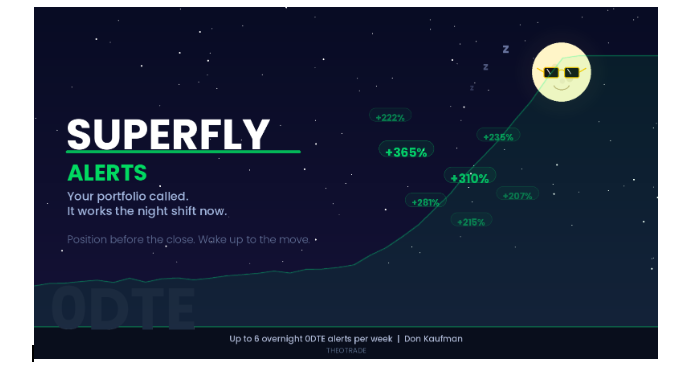
Your portfolio called. It works the night shift now.
Most 0DTE traders spend all day chasing moves that already happened. Don Kaufman’s SUPERFLY ALERTS flip the script — position before the close, let the overnight pressure do the heavy lifting, and wake up to the kind of repricing most traders only notice after it’s too late.
We’re talking +365% on TSLA. +310% on META. +235% on GOOGL. Not every trade. But when the setup is there, the overnight effect can be explosive.
Up to 6 alerts per week. Live mastermind. Private trading room. Weekly strategy sessions.
Tony Rago hit day done on micros before most traders finished their first coffee. 474 handles total.
The session looked ugly. NQ gapped below the 200-day moving average and the weekly open.
Tony read it differently. The advance/decline line showed no real sellers. Just noise from crude and metals dragging the tape lower.
That single read gave him the confidence to buy when everyone else was frozen.
In today’s Live Trading Room session replay, you’ll see:
How Tony used the AD line to filter noise from signal on a gap-down open. Gold dropped $336. Crude pushed toward 98. The AD wasn’t confirming sellers. That read changed everything.
The 412 support level and opening range break that set up the entire trade. Tony targeted 426 long with 500 as the goal. It took multiple attempts and two scratch trades before the level held.
Why he double-clicked six micro contracts at the exit for 300 handles. Break-and-retest of 412, add at 435, ride to 500. Tony walks through each decision and why he scaled the way he did.
The micro contract framework that turns volatile sessions into controlled risk. On minis, the same execution would have been a $9,000 day. Micros let you hold without flinching when a trade goes ten handles against you.
Tony scratched two trades before the winner printed. Most traders would have stopped or reversed short.
He kept reading the AD, kept trusting 412, and let the opening range break do the work.
Helping You Become a Better Trader…it’s What We Do. Experience TheoTrade® Today!
Whether you are a beginning, intermediate, or active trader, you will find a treasure chest of valuable trading education resources, both free and paid, that will help take your trading to the next level. We are committed to helping you become the best trader you can be.
Disclaimer: Neither TheoTrade.com or any of its officers, directors, employees, other personnel, representatives, agents or independent contractors is, in such capacities, a licensed financial adviser, registered investment adviser, registered broker-dealer or FINRA |SIPC |NFA-member firm. TheoTrade does not provide investment or financial advice or make investment recommendations. TheoTrade is not in the business of transacting trades, nor does TheoTrade agree to direct your brokerage accounts or give trading advice tailored to your particular situation. Nothing contained in our content constitutes a solicitation, recommendation, promotion, or endorsement of any particular security, other investment product, transaction or investment.Trading Futures, Options on Futures, and retail off-exchange foreign currency transactions involves substantial risk of loss and is not suitable for all investors. You should carefully consider whether trading is suitable for you in light of your circumstances, knowledge, and financial resources. You may lose all or more of your initial investment. Opinions, market data, and recommendations are subject to change at any time. Past Performance is not necessarily indicative of future results.
TheoTrade
PO Box 24790 Christiansted, Virgin Islands 00824 1 (800) 256-8876
Managing Editor’s Note: On March 26, at 2 p.m. ET, our colleague – Market Wizard Larry Benedict – is sharing the trading strategy that’s been handing his subscribers weekly opportunities to pull profits out of the market…
All using a single ticker…
It’s part of his upcoming AI Chaos to Cashevent. We’ve seen a lot of flux in certain AI stocks this year, and Larry’s got decades of experience trading choppy markets and profiting through volatility.
You’ll get the strategy, the ticker, and a calendar of potential trade opportunities to come in 2026 when you join him next Thursday. You can go here to automatically sign up.
I’ve been in Washington, D.C. all week for meetings and two important conferences in two industries.
It’s been an exciting week.
The Digital Chamber, of which I’ve been a member since late 2017, holds its annual D.C. Blockchain Summit in March every year.
I’ve been to almost all of them over the last decade.
There is no place that you’ll hear from more of the D.C. insiders working on digital assets policy and legislation than at this event. This year was no different.
My senior blockchain analyst, Ben Lilly, and I will be sending out our relevant notes and insights from the Blockchain Summit to our subscribers of Permissionless Investor and Neural Net Profits in the days ahead.
Needless to say, a lot is going on right now… as the industry partners with policymakers to push the market structure bill over the line and pass it through Congress.
There is an incredible sense of urgency across the industry, the White House, and representatives of Congress to get it done.
The other conference I’ve been attending is the Fusion Industry Association’s Annual Policy Conference, which also happens every year in March…
For industries whose fates are so closely tied to the regulatory environment, it is critical to be in D.C. to understand what’s actually happening.
Regulations, new legislation, and government policy directly impact an investment thesis, so ignoring that in our analysis would be a terrible mistake.
Recollections from Events Past
The Fusion Industry Association (FIA) is the nuclear fusion industry’s equivalent of The Digital Chamber for digital assets.
I’ve been attending nuclear fusion events and gatherings since 2019, when I sensed that momentum was building in the sector and the technological development was accelerating.
Back then, I could see a clear path towards not only first light – which is the first time a fusion reaction would produce a net energy output – but also an even more important path towards commercialization.
I predicted way back in 2019 that we would see the first net energy production fusion reaction before 2025.
It was a crazy prediction at the time, as the experts were predicting that it was 15–20 years out, or even more.
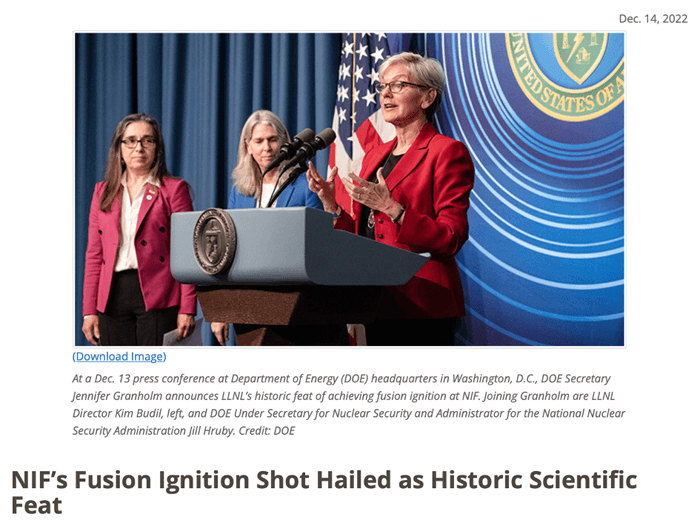
It actually happened in December of 2022, at the National Ignition Facility at the Lawrence Livermore National Laboratory.
I remember clearly watching the live press event held by the Department of Energy, where it shared the details of the historic moment.
It was truly a turning point for the industry.
Source: National Ignition Facility
Admittedly, it was a research project, but it was legitimate.
The approach using a very large facility and a number of high-powered lasers to create the fusion plasma – for a split second – is not a path towards commercialization.
But it did turn scientific theory into a proven reality.
The industry has been accelerating since then.
Fusion Fanfare
Back in 2019, nuclear fusion gatherings were a small affair.
I remember attending an event in New York City with the then-Secretary of the Department of Energy.
There were only about 40 people or so in a relatively small conference room.
Every key player in nuclear fusion was present at the time.
It was fantastic, but the sense at that time by the industry insiders was not very optimistic.
Most felt that the industry was still a long way away from commercialization, 15-20 years away.
I felt differently.
The first couple of FIA events, which started five years ago, were also very small gatherings.
This year was a breakout year.
There were more than 500 people in attendance – too many to count – by far the largest gathering to date, and a clear sign of what’s coming.
This year is special.
Since the last annual event, executive orders have been issued with unwavering support for nuclear energy in the United States.
This has empowered the Department of Energy to launch programs in support of both nuclear fission and nuclear fusion.
Another major victory has been carving out nuclear fusion as its own category of clean energy production.
This is an important distinction from a regulatory perspective that is critical for the industry to move forward. And it’s appropriate, as fusion is very different from fission.
More recently, on November 24, 2025, the President issued an executive order for the GENESIS Mission, which is a national initiative to accelerate AI-driven advancements in nuclear energy, national security, and quantum computing.
One of the big topics of the conference was the application of AI to nuclear fusion systems. I was writing about this so many years ago, but almost no one in the industry was talking about it. AI will be critical not only to manage the fusion plasma, but also for a nuclear fusion reactor’s operational systems. I was excited to hear this being acknowledged at the conference this week.
Also related to the GENESIS Mission, this week, and at the FIA event, the Undersecretary for Science at the Department of Energy, Dario Gil, who also serves as the GENESIS Mission Director, announced $293 million in funding to support the GENESIS Mission objectives.
Part of that funding will, of course, go towards nuclear fusion advancements.
One panelist at the conference made a firm remark that there needs to “be a zero added on” to the level of government investment in fusion.
This suggests that billions need to be spent to accelerate development.
There was also a lot of talk about the threat of China, how much government investment is happening in nuclear fusion, and how the Chinese are working 24/7 building out nuclear fusion plants.
There was a shared sense of urgency that the U.S. must beat China in the race to secure the kind of limitless clean energy that nuclear fusion will provide.
This competitive and geopolitical threat from a clear adversary is important to acknowledge, and it is very real.
But the framework of “China is investing more than the U.S.” is not accurate, because it always leaves out the investment that is happening in the private sector.
While most traders are drowning in chaos… trying to find the next hot stock in a sea of over 4,000… A small group of everyday folks has the chance to collect $500… $1,250… even $2,500 (or more)… in ONE day… using just ONE ticker. One trade in the morning. Paid automatically by 4 p.m. ET when it works. You can even be WRONG about market direction and still collect. Their edge? A low-stress system for turning AI-fueled market chaos into cash… created by “Market Wizard” Larry Benedict – the legendary trader who generated $274 million in profits and went 20 years without a losing year. The next opportunity opens NEXT WEEK. Click here to see how to use Larry’s NEW “AI Chaos-to-Cash” system on Thursday, March 26, at 2 p.m. ET. (When you click the link, your email address will automatically be added to Larry’s guest list.)
Wall Street legend Marc Chaikin accurately predicted the crashes in 2020 and 2022. Now, on March 25 at 8 p.m. ET, he’s stepping forward with an urgent update and timeline on the next bear market. He’ll show you exactly what’s coming… and tell you the EXACT DAY to move your money to prepare for a period of extreme pain, uncertainty, and loss. Learn more here.
The Real Numbers
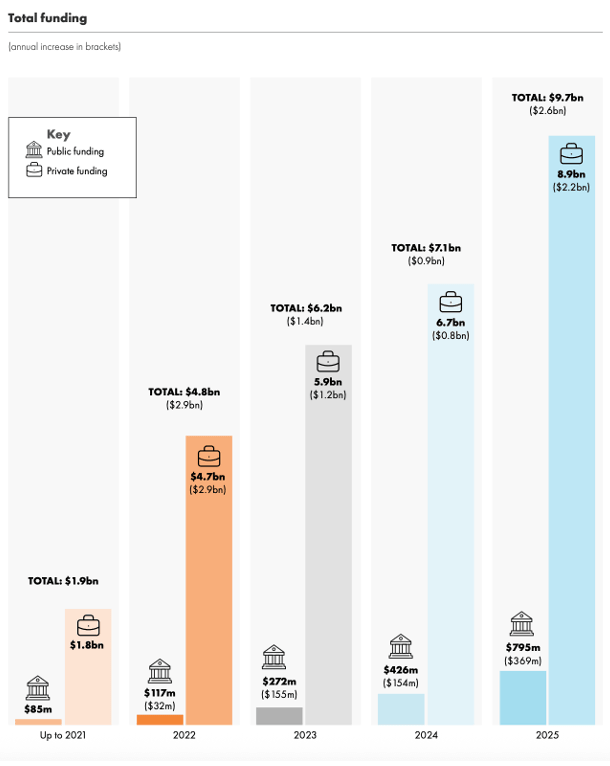
Shown below are the real numbers of what is driving nuclear fusion investment.
It’s the private sector.
Total Funding for Nuclear Fusion Through 2025
2025 Global Fusion Industry Report | Source: Fusion Industry Association
Since 2023, it is estimated that China has invested about $6.5 billion towards the commercialization of nuclear fusion technology, a number that is multiples higher than what the U.S. Department of Energy has spent in the same timeframe.
While this is true, it ignores what is happening in the private sector.
From the chart above, $2.2 billion alone was invested by the private sector in 2025, $8.9 billion to date.
The private sector investment in fusion stands well above what the Chinese government is investing, and it’s clearly accelerating year after year as we get closer and closer to commercialization.
This might raise the question for some as to whether U.S. government funding is even necessary.
It is, but for the reasons that you might not expect.
It’s not for the purpose of centralized, government-led research.
Innovation happens much faster and at a far more accelerated pace when led by private industry.
The DOE Stamp of Approval
Funding is required for the development and implementation of industry regulations.
While industry helps inform and draft those regulations, they have to be finalized and presented to policymakers by the Department of Energy (DOE).
In that way, the DOE acts as a gateway to policymakers and legislators.
Without its support, industry-only-led regulations will be nearly impossible to pass.
The second critical value in which government funding is useful is in providing early grants and large-scale loans to promising private companies in the nuclear fusion industry.
Nuclear fusion, and fourth-generation nuclear fusion for that matter, are both matters of national competitiveness and national security.
It takes a lot of capital investment to get to commercialization, especially for frontier technologies like nuclear fusion.
The vice president of research and development at fusion company Zap Energymade a salient point at the conference about this.
I’m paraphrasing here, but he said that receiving a grant from the DOE is proof for investors that you’ve been through a difficult vetting process.
It’s an indication that what you’re doing is legitimate, has a path forward, and is worthy of further investment.
Zap would understand the value of this stamp of approval from the DOE, as well as any player in the industry.
It received small grants from the DOE in 2019, 2020, and 2023.
Those grants contributed to Zap’s ability to go on to raise more than $320 million through July 2024.
Zap Energy is now valued at $1.1 billion and well on its way to developing a commercial prototype of its unique sheared flow stabilized Z-pinch fusion reactor.
But one of the most exciting topics of the conference is the proximity of not one, but two private nuclear fusion companies that will be going public this year.
At least two that I know of, as I’m confident others are already having discussions to do the same.
The First Publicly Traded Nuclear Fusion Company
Announced in December, TAE Technologies will be merging with Trump Media & Technology Group (DJT) – in a bizarre combination.
Trump Media & Technology is the parent company of Truth Social, which has minuscule revenues as a company.
It went public via a reverse merger in September 2021, and given its very limited revenues ($3.68 million in the last 12 months), it almost feels like a SPAC.
It has about $1 billion in cash on its balance sheet, very limited operations, and it is a public company.
TAE is a very exciting, private company with a great approach to nuclear fusion.
But other than capital and ease of going public via a merger with an existing public company, there is no obvious value in the merger with Trump Media and Technology.
But in reality, that’s largely what TAE needs – capital and speed to the public markets.
The current timeline is to complete the merger by mid-2026. If it goes through, I would expect the name of the company to change to TAE as well as the ticker symbol.
Before that happens, it is highly likely that General Fusion, another private fusion company, is in the process of a reverse merger with a SPAC, Spring Valley Acquisition Corp III (SVAC), and will become the first publicly traded nuclear fusion company.
The deal was announced this January, and a representative from the company confirmed at the conference that General Fusion would become the first to go public.
Accessing the public markets is a sign that nuclear fusion is going mainstream and nearing commercialization.
It also helps raise awareness with institutional investors about this critically important emerging market.
Breakthrough technologies like nuclear fusion are extremely hard and take billions of dollars of investment.
Accessing the public markets and new sources of capital are necessary to make a future of limitless, cheap, clean energy a reality for all of us.
The future is bright, a world of energy abundance – lit with the energy of the sun – as we climb the Kardashev scale.
To ensure our emails continue reaching your inbox, please add our email address to your address book.
This editorial email containing advertisements was sent to peter.hovis@gmail.com because you subscribed to this service. To stop receiving these emails, click here.
Brownstone Research welcomes your feedback and questions. But please note: The law prohibits us from giving personalized advice.
To contact Customer Service, call toll free Domestic/International: 1-888-512-0726, Mon-Fri, 9am-7pm ET, or email us here.































.png)











 RJ Hamster