I was born on 6 August 1956 in San Francisco, California to Janet and (the late) Richard Hovis.
I grew up in Santa Monica, California where I attended elementary, junior high school, and high school (graduating in 1974), in addition to involvement in sports and recreation (Little League +, the Boy’s Club ++). Further, it was in elementary school – St. Augustine’s By-the -Sea Parish School that I found, and made the choice to truly journey with God.
I attended Arizona State University from 1974 to 1977 – seeking to become an architect, however, I was not accepted, and, as such, I graduated with a Liberal Arts degree.
Upon graduation from Arizona State University, I attended Cal Poly San Luis Obispo and studied City and Regional Planning at the Master’s level. I successfully completed one (1) year in a two (2) year program – I did not complete the Master’s degree in City and Regional Planning – due to personal reasons.
I returned to Santa Monica where I started (October 1979) my career as graphic designer with Exxon Company, USA. I spent five years with Exxon Company, USA.
While working with Exxon Company, USA I was accepted into architectural school – Sci-Arc in Southern California, however, I did not attend preferring to stay with Exxon..
In 1982 I married Laura Flosi and in April 1983 we had our one and only child – Lauren Alain Hovis – a gift from God.
We moved to Phoenix, Arizona in 1984 from Los Angeles, where I went to work as a graphic designer with Kitchell CEM (from 1985 -1987).
From 1987 – 1995 I was an independent contractor, and a registered representative in mortgage finance, financial management, graphic design, and drafting.
Further, I attended the University of Phoenix and successfully obtained a Master’s in Business Administration (MBA) in 1982.
I was also a member of the Scottsdale Jaycees, where I became very involved in community events and projects.
In 1994, I accepted a cartography position with the Defense Mapping Agency in Reston, Virginia. As such, I relocated from Phoenix to Reston.
In 1998, I was accepted and worked as a Visual Information Officer with the Central Intelligence Agency. In 2002, I worked as a Support Officer until my retirement (due to a need for shoulder surgery) in September 2018.
Away from my Federal Government service, I have been involved in various organizations and activities in Northern Virginia.
In November of 2011, I married Rebecca Ouellette in Santa Monica, California. I reside in San Tan Valley, AZ with my two hamster - Jess and Timothy, our fish, our lizard - RJ Lizard., and our cats - Pearl and Grey.
As to hobbies, I enjoy playing sports, attending sporting events, mentoring individuals from financial management to hamsters, building models, photography, travel, multimedia design, managing partner for RJ Hamster, and jazz – smooth jazz to a samba or a bossa nova.
Love and God Bless,
Peter – aka RJ Hamster Jo hi
Nebius’ 1.2 GW Win: A $20B Bet on AI Infrastructure
Submitted by Jeffrey Neal Johnson. Originally Published: 3/5/2026.
Key Points
The approval of a new AI factory represents a pivotal milestone for Nebius, positioning the company as a key enabler for the entire AI ecosystem.
This major infrastructure project directly supports the company’s aggressive growth targets by meeting the overwhelming and secured customer demand for AI compute.
This landmark project validates the company’s focused strategy on AI infrastructure, earning positive notice and strong price targets from Wall Street analysts.
The company has secured approval to build a large AI factory in the United States — a project with power capacity comparable to some of the largest data centers worldwide. This is more than a construction project: it’s the cornerstone of Nebius’s new corporate identity and a validation of its strategy to become a key provider of global AI infrastructure.
Louis Navellier put the paid version of ChatGPT head-to-head against the FREE version of Elon’s Grok, and it wasn’t even close—Grok produced dozens of picture-perfect results while ChatGPT struggled to conjure even one. In just 19 days, Elon built a system that Oracle executives said was impossible by connecting 200,000 GPUs in a 114-acre facility, creating what Nvidia’s CEO calls superhuman AI, and one tiny company’s technology 49 times smaller than Tesla was central to the entire feat.Watch the live demo and get the ticker now
At the center of this plan is a 400-acre campus in Independence, Missouri, set to become a hub for AI activity and to create more than 1,300 local jobs. The most important figure for investors is the facility’s potential power capacity: up to 1.2 gigawatts (GW). In an industry measured by computing power, access to electricity at that scale is a strategic advantage — 1.2 GW is enough to power a large city.
For the AI sector, electricity is a critical and scarce resource. Over the past year the conversation has focused on high-powered GPUs, but as chip supplies recover the limiting factor is increasingly the physical space and massive electrical infrastructure needed to run them. Companies can have the best algorithms, but without reliable, large-scale power their ambitions are constrained. By securing this capacity, Nebius has claimed a vital piece of the infrastructure puzzle and positioned itself as an enabler for the broader AI ecosystem.
This Missouri factory is the flagship project of the reoriented Nebius. The company has transformed from its past as the diversified tech conglomerate Yandex N.V. into a focused, pure-play AI infrastructure provider. The shift concentrates resources on capturing what Nebius sees as the single largest market opportunity today, and this tangible project is the clearest proof point of that new focus.
From Power to Profit
Investors want to know how this infrastructure spend converts to revenue. The answer lies in the current supply-and-demand imbalance in AI computing. During its fourth-quarter 2025 earnings call, Nebius said its available computing capacity was sold out months in advance. Demand for AI infrastructure is intense, with customers committing to longer-term contracts and paying premiums to secure capacity.
In this environment, building and powering new data centers is the most direct way to capture revenue. The Missouri project is central to Nebius’s plan to meet demand and hit its targets. Management has guided to an annualized revenue run rate (ARR) of $7 billion to $9 billion by the end of 2026. ARR extrapolates current recurring revenue over a year and gives a forward-looking view of business scale; reaching this target depends on bringing new capacity online.
Such growth requires heavy capital investment. Nebius outlined a capital expenditure plan of $16 billion to $20 billion for 2026. About 60% of that funding is already secured through cash on hand, operating cash flow, and large upfront payments from long-term customer agreements. With a strong balance sheet and limited existing debt, the company appears positioned to finance the remainder without taking on excessive risk. This is a structured expansion backed by confirmed customer demand rather than a speculative gamble.
A Clear Runway for Growth
Approval of the Missouri AI factory is a major de-risking event for Nebius. What was once an ambitious plan on paper is now a visible project with government and community support, giving investors a concrete milestone to track. It validates the company’s strategy to claim a leadership position in the high-demand world of AI infrastructure.
Wall Street has noticed. The stock carries a Moderate Buy consensus rating from analysts, with an average price target of $143.22. That target implies meaningful upside from current levels and reflects confidence in the company’s growth path. Analyst targets range from $84 to $211, showing varied opinions but also a robust bullish case. The investment thesis is further supported by Nebius’s technology assets, including autonomous-vehicle developer Avride and edtech platform TripleTen, which add strategic depth.
With its strategy validated and capacity expansion visibly underway, the near-term focus for investors will be execution. This milestone project gives Nebius a clear runway to strengthen its role — not merely as a participant, but as a critical pillar of the global AI revolution.
Today’s Exclusive Article
Warm Winter Hit Vail’s Earnings. What Does It Mean for the Stock?
Submitted by Jennifer Ryan Woods. Originally Published: 3/11/2026.
Key Points
An unusually warm winter and historically low snowfall in the Rockies led Vail Resorts to miss fiscal second-quarter earnings expectations and cut its full-year guidance, with skier visits falling 12% as limited snowpack reduced available terrain at key resorts.
Although Vail’s stock has struggled in recent years, falling more than 60% from its 2021 peak, analysts still see significant upside, with the average 12-month price target of about $171 implying more than 25% potential gains from current levels.
Investor sentiment remains divided, as short interest has climbed to nearly 12% of the public float even while the company’s 6.6% dividend yield may help support the stock.
A historically warm winter weighed on ski resort operator Vail Resorts Inc. (NYSE: MTN), producing disappointing fiscal Q2 2026 resultsand prompting the company to cut its full-year guidance. Shares fell after the report was released following the market close on March 9 but later recovered; trading the next day was marginally positive, with the stock hovering near $135 on above-average volume as investors digested the earnings miss and updated outlook.
Investor sentiment remains mixed. Despite the weather-driven setback, analysts still see meaningful upside, though rising short interest suggests some investors are skeptical about the company’s near-term prospects.
In 2023, Silicon Valley Bank collapsed in just 48 hours with panicked customers draining $42 billion in a single day, but it could be nothing compared to what’s coming next—through Federal Reserve Docket No. OP-1670, the government is rolling out FedNow, an instant 24/7payment hub that over 1,500 banks have already connected to, and when money moves at the speed of light, a modern bank run won’t take days. By routing every transaction through a single centralized hub, the Fed is building the ultimate kill switch for the American banking system, and when the next financial crisis hits, the Federal Reserve could instantly freeze all transfers, withdrawals, and payments nationwide to protect the system, trapping your life savings inside.Get the 4 steps to Fed-proof your savings now
On the earnings call, Chief Executive Robert Katz said the disappointing quarter and reduced guidance reflected “the most difficult weather environment in the Rockies we have ever seen.” Snowfall and snowpack were at or near historic lows, he added, surpassing the dismal conditions of fiscal 2012, which had previously been considered the region’s worst season. Those poor conditions contributed to a 12% decline in visits.
The Colorado-based company, which operates more than 40 mountain resorts including flagship destinations such as Vail Mountain, Beaver Creek Resort and Breckenridge Ski Resort, reported earnings of $5.87 per share, down from $6.56 a year earlier and missing estimates by $0.18.
Revenue for the quarter totaled $1.08 billion, a 4.7% year-over-year decline and more than $27 million below estimates. Because the Rockies generate the lion’s share of Vail’s resort EBITDA, historically low snowfall in that region had a disproportionate impact on results.
Epic Pass and Diversified Resorts Help Cushion the Blow
In the earnings release, Katz said that despite a “worst-case weather scenario,” the decline in lift revenue was modest, reflecting the strength and resilience of Vail’s operating model. Strong growth in the Epic Pass program, which lets skiers pay up front for access to multiple resorts, helped stabilize revenue. Pass holders account for roughly 75% of visits each year, providing a steadier stream of income even in difficult seasons. The company’s expansion into more geographically diverse locations also helped mitigate the effect of regional weather swings.
Given ongoing uncertainty around weather — which continues to limit available terrain at some resorts — Vail lowered its fiscal 2026 net income outlook to $144 million–$190 million, down from a prior range of $201 million–$276 million. The company maintained its quarterly dividend of $2.22 per share, saying this year’s cash-flow decline does not reflect the business’s long-term cash-generating ability. At about a 6.6% yield, the dividend could attract income-focused investors and provide some support to the stock.
Shares Have Struggled Despite Analysts’ Expected Upside
Vail’s stock has fallen sharply since its all-time high of roughly $372 in November 2021. In early February it dipped to about $126, off more than 66% from the peak. Over the past year the shares are down more than 11%, while the leisure and recreational services industry gained over 10% and the Invesco Leisure and Entertainment ETF (NYSEARCA: PEJ) rose more than 18%. Vail trades at a price-to-earnings ratio just under 20, above the industry and broader consumer discretionary average of around 17.
Analysts are divided. Of 13 covering the stock, four rate it Buy, eight Hold and one Sell. After the results, three analysts trimmed price targets: Barclays to $138 from $140, Truist Financial to $217 from $234, and Stifel Nicolaus to $172 from $175. Despite those cuts, the average 12-month target remains well above the current price — the $171 consensus implies more than 25% upside from roughly $133.
Short interest has risen, suggesting increased skepticism about the near-term outlook. As of Feb. 13, about 4.19 million shares were sold short, representing nearly 12% of the public float — roughly double the level a year earlier.
For investors, Vail’s outlook may hinge on whether the weather-driven weakness is temporary. If visitation normalizes and the pass-based model continues to provide revenue stability, analysts’ upside could materialize. In the meantime, the sizable dividend and the company’s diversified footprint may help support the stock through a challenging season.
This email communication is a paid sponsorship from Behind the Markets, a third-party advertiser of MarketBeat. Why did I get this email content?.
If you need assistance with your newsletter, please don’t hesitate to contact MarketBeat’s South Dakota based support team at contact@marketbeat.com.
Med-X is preparing for a Nasdaq listing (MXRX)—but by the time the bell rings, it may be too late. Already generating $6.4M in revenue, its Nature-Cide line is sold e-commerce giants like Amazon, Walmart, and Kroger and is expanding into 41+ markets.
As regulators, consumers, and climate pressure push the $17B pest control industry natural, Med-X is positioned to lead. Right now, shares are just $4.00 through a limited Reg A+ offering.
*Disclosures: This is a paid advertisement for Med-X’s Regulation A+ Offering. Please read the offering circular at invest.medx-rx.comCLICK HERE…Fellow Investor,
One of the most important decisions for those 65 or older is the choice of Medicare coverage. The first big decision is whether to enroll in original Medicare or a Medicare Advantage plan.
It is expected that in 2026, half or more of Medicare beneficiaries will be enrolled in Advantage plans instead of original Medicare.
There are pluses and minuses to each, and I’ve covered them in detail in past issues of Retirement Watch, episodes of the Spotlight Series and my books.
But it’s important to give enough weight to the long-term consequences, and many beneficiaries don’t do that. For example, consider coverage of short term nursing home care.
Neither Medicare option covers long term stays in a nursing home that are needed primarily for custodial care. But Medicare does cover up to 100 days in a nursing home or skilled nursing facility that’s needed after being in a hospital for at least three days.
This type of care typically is for rehabilitation or recovery after a major surgery or illness. The individual isn’t ready to go home but doesn’t need to stay in a hospital.
In original Medicare, you, your doctor and perhaps other medical providers decide whether you should go to a nursing facility and for how long.
But when you’re enrolled in an Advantage plan, the plan decides how much rehabilitation is going to be covered.
Advantage plans tend to deny, or limit stays in nursing homes compared to the care received by original Medicare participants, according to a recent report from the Kaiser Family Foundation. Government data indicate that nursing home stays are among the services most frequently denied by Advantage plans.
Though original Medicare would cover the stays, the Advantage plans can rule them “medically unnecessary” and deny coverage. Another long-term issue is your ability to change from an Advantage plan to original Medicare.
The rules allow you to change plans each year during open enrollment, such as by switching from an Advantage plan to original Medicare.
But as a practical matter, you could end up with less coverage if you switch. Original Medicare Part B has a number of coverage gaps.
The most significant gap, other than prescription drugs, is the 20% coinsurance amount on most types of covered care. You’re on the hook for the 20%, with no dollar limit.
That’s why original Medicare participants should obtain a Medicare supplement (also known as Medigap) policy that covers most of the gaps in original Medicare.
They also should have a Part D prescription drug policy. In your initial Medicare enrollment period, insurers are required to sell you the Medigap policy of your choice, regardless of your health history. But after the initial enrollment period, the guaranteed issue no longer applies.
The insurers can review your medical history or require a medical exam. Based on the results, an insurer can decline to issue you a policy or charge you a higher premium. States can provide additional consumer protections for purchasers of Medigap policies.
It’s already destroying the retirements of more Americans than anything else on the planet…
And forcing nearly half of all seniors to visit a food pantry or use food stamps just to eat.
America’s top retirement researcher has the solution.
Click here to get the full story.CLICK HERE…Currently, four states (Connecticut, Massachusetts, Maine and New York) extend the guaranteed-issue rule to Medigap applicants outside their initial enrollment periods.
A number of people initially sign up for Advantage plans because they expect lower out-of-pocket costs and want the additional benefits, such as vision and dental care.
But some beneficiaries want to switch to original Medicare after they develop health problems, because they want to select their medical providers and don’t want the plan to decide if they can see specialists or have certain tests and treatment.
Though Medicare allows a switch from an Advantage plan to original Medicare during the open enrollment period, as a practical matter it might not be available.
The beneficiary might not be able to obtain a Medicare supplement policy to cover the gaps in Medicare.
If you switch to original Medicare and can’t obtain an affordable Medigap policy, you’ll be responsible for all the coverage gaps in Medicare Part B. That might make the switch unaffordable and compel you to stay in an Advantage plan.
You might have a similar problem if you move. Advantage plans are local.
There might be an attractive Advantage plan available where you live now. But if you move to another area later in retirement, you must choose from the Advantage plans available in that area.
There’s no guarantee an attractive Advantage plan will be available to you. Your best option might be original Medicare, but you might not be able to buy a good Medicare supplement.
Or you could sign up for an attractive Advantage plan when first enrolling in Medicare. But the plan could change its terms and be less attractive, or the insurer might stop offering the plan.
Again, you must find a new Advantage plan or switch to original Medicare and hope you’ll qualify for a Medigap policy.To a better retirement, Bob Carlson Editor, Retirement Watch WeeklyEditor’s Note: Deep State bureaucrats are rushing to seize as much as 30% of your retirement savings. Unless you act now, you’re facing the greatest destruction of financial assets in your lifetime. And while this scheme benefits insiders, big banks, and elite special interests…. it could quickly bankrupt you.
New to the Retirement Watch Community: SeniorResource.com
For many, gardening isn’t just a hobby – it’s a lifestyle! Of course, it’s fun to have the latest and greatest equipment, and gratifying to see your hard work come to fruition! But with the prices of just about everything going way up, it won’t be long until all our favorite things become too expensive. That’s why we’ve put together these thrifty tips! Click here for our favorite gardening hacks so you can keep on growing.
About Bob Carlson:
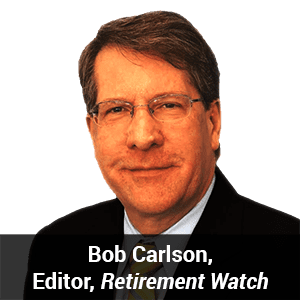
Robert C. Carlson is the author of the books The New Rules of Retirementand Retirement Tax Guide, editor and investment director of the popular retirement newsletter, Retirement Watch, and editor of the free weekly e-letter, Retirement Watch Weekly. Bob is a frequent speaker at investment conferences around the country, and you can also hear Bob as a featured guest on nationally-syndicated radio shows, such as The Retirement Hour, Dateline Washington, Family News in Focus, The Michael Reagan Show, Money Matters and The Stock Doctor.
About Us:
Eagle Financial Publications is located in Rosslyn, VA. – Blocks from the Capitol. Our products have been helping investors build their wealth for several decades. Whether you’re a long-term investor or short-term trader, you’ll find the right strategy for you, including how to earn more steady income to spend now, preserve and grow your capital to enjoy later, and whatever other investment goals you have.
To ensure future delivery of Eagle Financial Publicationemails please add financial@info2.eaglefinancialpublications.com to your address book or contact list.
This email was sent to peterhovis@icloud.com because you are subscribed to Dividend Investor Daily. To unsubscribe from this list please click here. To stop receiving emails simply click here. If you have questions, please send them to Customer Service. View this email in your web browser.
Legal Disclaimer: Any and all communications from Eagle Products, LLC. employees should not be considered advice on finances. Although our employees may answer your general customer service questions, they are not licensed under securities laws to address your particular investment situation. No communication by our employees to you should be deemed as personalized advice on finances.
Salem Media Group – Eagle Financial Publications | 1735 N Lynn St, Suite 500, Arlington, VA 22209-2016
After Italy continued its undefeated run and Venezuela ousted defending champion Japan in a thriller to wrap up the quarterfinals, the semis begin tonight with the U.S. vs. D.R.
How loaded are the rosters for tonight’s semifinal game between the USA and Dominican Republic? Of the 41 players to receive MVP votes last season, 18 will be on hand.
Every game has felt like a party for the Dominican Republic’s Classic squad, and the entire nation is along for the ride as it seeks its second tournament title and first since 2013.
After watching Vladimir Guerrero Jr. rise to the occasion last October, Blue Jays manager John Schneider is not surprised to see his star first baseman put on a show in the World Baseball Classic.
Tarik Skubal was excited when he learned he was going to start against fellow multiple Cy Young Award winner Max Scherzer, and then he got to meet him for the first time after the game.
MLB Network is live from Miami before and after tonight’s WBC semifinal game. Join Greg Amsinger, Harold Reynolds, Dan Plesac and Chris Young for highlights, interviews, news and more. Coverage begins at 6 p.m. ET.
(10) To whom shall I speak and give warning, That they may hear? Indeed their ear is uncircumcised, And they cannot give heed. Behold, the word of the LORD is a reproach to them; They have no delight in it. (11) Therefore I am full of the fury of the LORD. I am weary of holding it in. ” I will pour it out on the children outside, And on the assembly of young men together; For even the husband shall be taken with the wife, The aged with him who is full of days.
(13) ” Because from the least of them even to the greatest of them, Everyone is given to covetousness; And from the prophet even to the priest, Everyone deals falsely. (14) They have also healed the hurt of My people slightly, Saying, “Peace, peace!” When there is no peace. (15) Were they ashamed when they had committed abomination? No! They were not at all ashamed; Nor did they know how to blush. Therefore they shall fall among those who fall; At the time I punish them, They shall be cast down,” says the LORD. New King James VersionChange email Bible version
God indicts the entire nation for its covetousness. A major reason why coveting is so dangerous is shown by our credit system, which is based on the premise of possessing something before one is actually able to afford it.
In this profit-producing scheme, advertising is credit’s companion. The marketer’s purpose is to speed up the business, possession, and profit cycle. However, in reality over the long haul, credit actually slows things down and makes items more expensive because the credit must be paid for through interest in addition to the item’s original price. It also creates greater debt, enslaving the debtor to the creditor. This same principle is at work in every other unlawful act of which coveting is a part.
Who will listen to this reality? Through America’s almost insanely massive and ever-growing indebtedness, God is demonstrating that people simply will not heed either sound human or divine advice because their minds are driven by the desire to have whatever it is that they want right now. It has a grip on the heart so strong that nothing yet has been able to break it.
This tenacious hold is why tithing comes as such a shock when people learn that God requires it. Many are living way over their heads. When they learn of tithing, the penalty for their earlier stealing from God greatly influences current spending. They must then learn to pay in adversity, sacrificing as they go on in obedience.
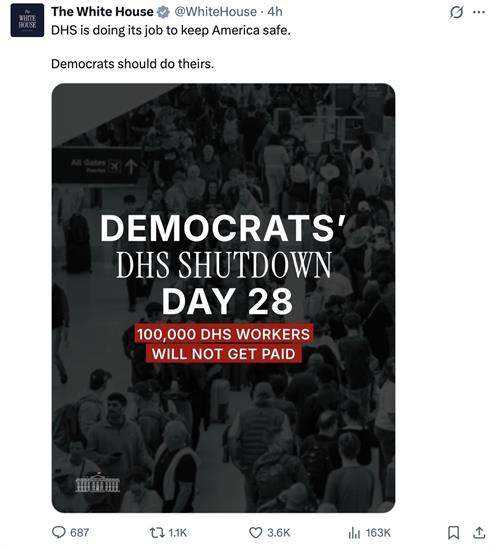
Democrats Vote Again to Shut Government Down, Threaten National Security, Ruin Family Vacations, Force TSA Employees to Work Without Pay
Once again this week, Senate Democrats voted to block funding for portions of the federal government.The Department of Homeland Security — the agency responsible for protecting Americans from terrorism, securing our borders, and safeguarding our airports — is being held hostage because Democrats refuse to pass a clean funding bill. They would rather shut down critical security operations than give up leverage for their open-border, soft-on-crime agenda.
At some point, this stops being politics and becomes outright irresponsibility. That point is now.
Here in Arizona, families are feeling it firsthand. Spring break is underway, and Easter travel is approaching. Parents planning trips with their children and grandparents hoping to spend the holiday with family are now being warned to expect major delays at airport security. Vacations families saved for all year are being disrupted before they even begin because Democrats in Washington can’t keep the government open.
Meanwhile, the TSA officers standing at those checkpoints aren’t getting paid — while the Democrats responsible for the shutdown continue collecting their salaries on schedule.
In fact, the situation has become so severe that some TSA officers working without pay have reportedly begun accepting grocery store gift cards just to feed their families. Think about that: the men and women responsible for keeping explosives off airplanes are relying on gift cards to buy groceries while Washington Democrats continue drawing full taxpayer-funded salaries.
But the danger goes far beyond airport delays. The United States faces a heightened national security threat environment. We are in the middle of an escalating conflict involving Iran, and intelligence officials have warned about the possibility of retaliatory attacks and radicalized actors being called to action.
Nearly 20 million illegal aliens crossed our border during the previous administration’s disastrous open-border policies. Many were released into the interior with little to no vetting.
Among them were illegals from countries hostile to the United States — including Iran. According to federal officials, more than 1,600 Iranian illegals crossed the southern border during the Biden administration. That should alarm every American concerned about national security. The Iranian regime actively sponsors terrorism worldwide. Allowing thousands of its citizens to enter illegally with limited vetting is not just reckless — it is a massive intelligence failure.
And now we are beginning to see why it matters.
As I noted in last week’s newsletter, ICE officials recently arrested an illegal alien from Iran convicted of first-degree murder and drug trafficking right here in Pima County, Arizona. Authorities are still working to determine his intentions. That alone should be chilling. When someone from a hostile regime slips into the country illegally and is later apprehended inside the United States, the obvious question becomes: Why was he here?
Sleeper cells do not announce themselves. They wait. They blend in. They stay quiet. And when tensions escalate abroad — as they are now with Iran — those individuals can be called to action.
Here’s my point: at the very moment the United States faces that kind of threat environment, Democrats in Washington have decided this is the time to shut down the department responsible for protecting the homeland. That is beyond reckless.
Instead of strengthening border enforcement, Democrats spent years fighting deportations, expanding asylum loopholes, and attacking the agents tasked with keeping dangerous individuals out of this country. Now they are willing to leave DHS shuttered — weakening airport security, straining counterterrorism resources, and leaving frontline personnel unpaid.
It is a stunning inversion of priorities.
While American families stand in endless TSA lines and federal security officers work without paychecks, Washington Democrats are digging in to protect policies that allowed millions of illegal crossings in the first place — including criminals and potential national security threats.
Arizonans trying to take their kids on spring break shouldn’t have to wonder whether airport security is understaffed because Democrats in Washington are playing political games. Families flying home for Easter shouldn’t spend half their day stuck in security lines while DHS is caught in a partisan standoff.
And Americans certainly shouldn’t be forced to accept a weakened homeland security posture at the exact moment terrorist threats are rising.
The first duty of government is to protect its citizens. Right now, Democrats in Washington are failing that test.
Stop the Obstruction. Pass the SAVE America Act — Even if It Means Nuking the Filibuster
The House has already done its job. Last month, we passed the SAVE America Act — a simple, commonsense bill requiring proof of citizenship and voter ID for federal elections. The American people overwhelmingly support it — 85% according to a recent poll — because they understand a basic truth: only American citizens should vote in American elections.
Now the Senate plans to take up the bill next week. But everyone in Washington already knows how that vote will end. Unless the filibuster is eliminated, the SAVE America Act is doomed before debate even begins. Senate Democrats will use the 60-vote rule to block it — just as they have used the filibuster to obstruct nearly every serious attempt to secure our elections and restore confidence in the system.
President Trump understands exactly what is at stake. Over the weekend, he announced he will refuse to sign new legislation until Congress sends the SAVE America Act to his desk, declaring the bill the top legislative priority and saying it “supersedes everything else.” That is the kind of leadership the American people elected him to provide.
The House passed this legislation months ago because protecting election integrity is not a partisan issue — it is a national obligation. But in the Senate, Democrats have deliberately stalled the bill because they would rather block basic election safeguards than allow a fair up-or-down vote.
Why? For one simple reason: voter ID and citizenship verification stand in the way of how they…ahem…“win” elections.
Let’s be clear about what is happening. Democrats spent years trying to eliminate the filibuster when it stood in the way of their own agenda. Now they are hiding behind it to stop commonsense election integrity legislation supported by the overwhelming majority of Americans.
But Democrats are only half the problem. The other half is a handful of RINOs in the Senate who continue to treat the filibuster like a sacred tradition while Democrats use it as a political weapon. While the left blocks everything from election integrity to border security, some Republicans seem more concerned with protecting Senate “norms” than delivering results.
Americans didn’t send us to Washington to preserve Senate customs. They sent us to defend their elections.
If Senate Democrats plan to kill the SAVE America Act next week using the filibuster, Senate Republicans need to stop acting like spectators and change the rules.
The House has spoken. President Trump has made this a top priority. And the American people overwhelmingly support ensuring that only U.S. citizens vote in federal elections. Pass the SAVE America Act. And if the filibuster stands in the way, it’s time to nuke it. 🇺🇸
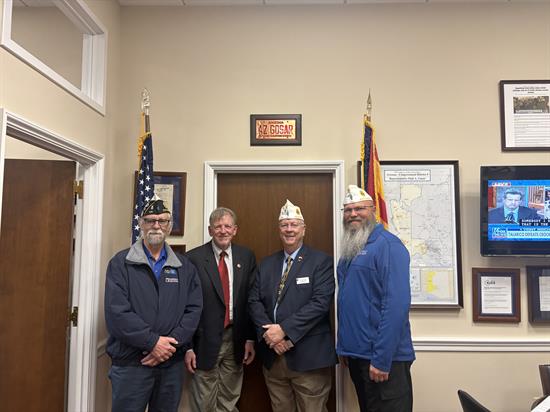
Gosar Meets with Arizona American Legion Delegation
I recently had the honor of meeting with representatives of the Arizona American Legion during their annual Washington, D.C. Conference and I appreciate them taking the time to visit Capitol Hill. As the largest veterans service organization in the state—representing more than 33,000 Arizona veterans and over 75,000 members including family organizations—the Arizona American Legion plays a vital role in advocating for those who served our nation. I appreciated the opportunity to hear directly from them and remain committed to supporting Arizona’s veterans and the issues important to the more than 18 million veterans across the United States.
District Highlight: Honoring Those Who Served in Bullhead City
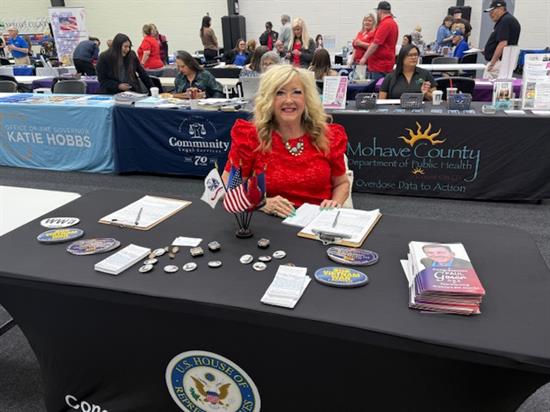
My amazing District Director, Penny Pew, had the honor to recently attend the Bullhead City Veterans Stand Down and spend time with the brave men and women who have served our country. Events like this provide critical support to veterans by connecting them with essential services, resources, and a community that cares deeply about their well-being. I’m grateful to the organizers, volunteers, and local partners who make this event possible and who work tirelessly to ensure our veterans receive the respect, assistance, and gratitude they have earned through their service to our nation.
Deadline Approaching for Congressional Art Competition Submissions
The 2026 Congressional Art Competition is underway, and I invite creative high school students from Arizona’s 9th Congressional District—grades 8 through 12, including homeschool, online, and alternative programs—to show off their artistic talents. My office is still accepting submissions through Wednesday, April 1, 2026.
Each spring, the Congressional Institute hosts this nationwide visual art competition to celebrate and inspire young artists across the country. Since it began in 1982, more than 650,000 students have participated. The winning artwork from our district will be proudly displayed for an entire year in the United States Capitol—a truly unique honor. This competition is a fantastic opportunity to highlight the creativity, passion, and talent of Arizona’s next generation of artists, and I encourage every student with a love for art to participate. See the above flyer for more information and details about this year’s art competition! 🎨
Tweet of the Week:
Photo of the Week:
📸 CW Kyle from Surprise, AZ sent in the amazing picture of the Colorado River just north of Lake Havasu. Gorgeous! Thanks for sharing, CW.
Do you want the chance for your photograph to be featured as our “Picture of the Week?” If so, send your best shots along with a brief description to Anthony.foti@mail.house.gov. Remember to include your name and where you live.
⚠ Warning!! The Gosar Weekly Newsletter is meant for discerning readers with above-average intelligence. We link to interesting stories. We get stories a couple different ways: Google alerts, a third-party aggregator and sometimes readers send stuff. We don’t vouch for every publication or every author. If we link to a story, it is because of that story. The views expressed in any of the publications do not represent any promotion, endorsement or reflection of Congressman Gosar’s views. While we try our best, we cannot guarantee every news organization spouting hatred, animosity or divisiveness will be filtered from appearing in the Gosar Weekly Newsletter. We will endeavor to prevent that from happening by never linking to Fake News organizations including CNN, MSNBC, CNBC, Rolling Stone, the Arizona Republic, the Arizona Mirror, Media Matters or the New Republic. WEBSITE | UNSUBSCRIBE | CONTACT MEShare on Facebook | Share on TwitterWashington, DC Office 2057 Rayburn HOB Washington, DC 20515 Phone: (202) 225-2315Goodyear 1300 S. Litchfield Road Suite 115-H Goodyear, AZ 85338 Phone: 623-707-0530



 News for you, Peter
 Today’s game
 Trending now1.

 One of the most important decisions for those 65 or older is the choice of Medicare coverage. The first big decision is whether to enroll in original Medicare or a Medicare Advantage plan.
 Robert C. Carlson is the author of the books The New Rules of Retirementand Retirement Tax Guide, editor and investment director of the popular retirement newsletter, Retirement Watch, and editor of the free weekly e-letter, Retirement Watch Weekly. Bob is a frequent speaker at investment conferences around the country, and you can also hear Bob as a featured guest on nationally-syndicated radio shows, such as The Retirement Hour, Dateline Washington, Family News in Focus, The Michael Reagan Show, Money Matters and The Stock Doctor.





































 RJ Hamster