The man who invented one of the most popular buying and selling indicators on Wall Street says this stock could soon benefit from a big surge in Wall Street “smart money.”
It’s a system that shows you stock ratings of thousands of companies that trade on the U.S. market… built by a Wall Street legend who’s been profiled on CNBC for the accuracy of his predictions and recommendations.
The last time he used his system to issue a free recommendation, it went on to soar 100%.
This ad is sent on behalf of Chaikin Analytics, 201 King Of Prussia Rd., Suite 650, Radnor, PA 19087. If you would like to optout from receiving offers from Chaikin Analytics please click here.Stockguru LLC (dba InvestingDistrict), 2563 cherry hill ln, Hermitage, PA 16148, United StatesYou may unsubscribe or change your contact details at any time.
New sell signals outnumber buys nearly 5-to-1 – even as the ceasefire rally lifts prices
The stocks with the highest Quantum Scores are pulling back to buy-the-dip levels
Our Platinum members have been beta-testing a new trading tool – and next week, you can try it, too
Talk about a close call…
Late Tuesday night – roughly 90 minutes before his 8 p.m. deadline to “end” Iranian civilization – President Trump agreed to a two-week ceasefire.
The deal, brokered by Pakistan, suspends U.S. and Israeli strikes in exchange for Iran reopening the Strait of Hormuz – the narrow waterway that normally carries about a fifth of the world’s oil and natural gas supplies.
Iran’s foreign minister confirmed the agreement, writing that safe passage through the Strait would resume “via coordination with Iran’s Armed Forces.”
Markets didn’t wait for the ink to dry. S&P 500 futures jumped 2.6% overnight. That’s the kind of move that, if it holds, would mark the index’s best day of the year.
Emerging-market stocks rallied the most since 2022, with the iShares Core MSCI Emerging Markets ETF (IEMG) up 5.8% premarket Wednesday.
And Brent crude oil – the international benchmark – plunged 14% to about $94 a barrel. That’s its sharpest one-day drop since the war began.
This is the clearest risk-on signal the market has sent in 2026.
If the ceasefire holds and a more lasting deal gets done in this two-week window, stocks could see a more sustained lift. It might even be enough to take them out of the 2026 rut and into new highs.
Or… the truce could all fall apart. Israel has just launched the largest wave of strikes against Iran’s ally in Lebanon, Hezbollah, since the war began. There are even reports of rogue Iranian missiles hitting targets in the UAE and Kuwait – likely due to the decentralized nature of Iran’s military.
We don’t pretend to be Middle East experts. And we have no clue what’s next for Iran. So the question for us at TradeSmith remains the same: Which stocks are worth buying – and which should be avoided – based on what the data says?
It was supposed to be confidential… But it’s become the worst-kept secret on Wall Street. Right now, 21 banks are lining up to underwrite the $1.75 TRILLION deal – JPMorgan, Goldman Sachs, Morgan Stanley. June is the target date for launch… That gives everyday Americans a small window to get positioned before Wall Street insiders gobble up all the profits. Click here to claim your Pre-IPO SpaceX “Access Code”
The buy-sell divide in our system tells an interesting story…
Let’s start with a scan of the most recent Short-Term Health signals across the S&P 500, Dow, and the tech-packed Nasdaq 100, as well as the mid-cap S&P 400, and small-cap S&P 600.
Short-Term Health is TradeSmith’s most sensitive trend indicator. It looks at how a stock or index has been trading and then flags the kind of abnormalities that signal shifts in momentum.
Green means buy. Yellow means caution. Red means sell.
Over the last seven days, five stocks across all five of those indexes flashed new Green Zone buy signals. And they’ve all occurred over the last two days:
Car rental company Avis Budget Group (CAR) leads the list – up 74.9% in a week after its Green signal fired. But we’d caution you against diving into this one.
CAR seems to be in the midst of a short squeeze. That’s when stocks that are heavily bet against come into the crosshairs of buyers who look to force shorts out of position. Green signal or not, this one warrants caution.
Meanwhile, trucking logistics firm Landstar Systems (LSTR) and chip designer Arm Holdings (ARM) also triggered new buys in recent days, alongside server maker Hewlett Packard Enterprise (HPE) and internet infrastructure company VeriSign (VRSN). These signals are all much more genuine – not a product of an artificial push.
Five new buy signals in the last week sounds healthy… until you look at the flip side.
Over the same stretch, 23 stocksflashed new Red Zone sell signals. Here are the five most recent:
Storage REIT Public Storage (PSA), medical device maker Edwards Lifesciences (EW), discount retailer Dollar General (DG), hospital operator Tenet Healthcare (THC), and building equipment company Carrier Global (CARR).
Five different industries, all flashing short-term sell signals at the same time.
Also note that several of these stocks are up over the last week. PSA gained 3.1%. Dollar General rose 2.6%. Tenet Healthcare climbed 3.1%.
Rising prices with fresh sell signals might seem like a contradiction. But when a stock is moving higher while Short-Term Health turns Red, it means the rally isn’t supported by the kind of sustained momentum that healthy uptrends produce.
There’s also the fact that we’re seeing 23 new sell signals versus five new buys over the past week. That’s nearly 5-to-1 in favor of the bears.
Today’s ceasefire rally is welcome news – but underneath it, the market is still under stress.
All the more reason to stay choosy about what you buy.
Here are five stocks worth buying on this dip…
But let’s say you’re bullish and want to buy the dip. How do you find the stocks worth buying in a market like this?
By stacking multiple confirming signals on top of each other.
We started with our Short-Term Health Green Zone filter – stocks in healthy uptrends.
But let’s add two more filters:
Stocks that have pulled back over the last week, meaning they’re trading at a short-term discount
Stocks that have a Quantum Score of 90 or higher
If you’ve been with us for some time, you’ll know that the Quantum Score looks for unusually large institutional money flows into stocks with strong fundamental growth rates.
The result is a list of stocks that are in confirmed uptrends (in Short-Term Health Green Zones) that are temporarily marked down and backed by strong fundamentals and institutional buying pressure (high Quantum Score).
Here are the top five:
Two names stand out.
United Therapeutics (UTHR) scores a 97.7 – one of the highest Quantum Scores in our entire database. It’s been in the Green Zone for more than four weeks and is down 4.6% over the last week.
UTHR is a biotech focused on organ transplants. It’s definitely not a headline name unless you’re deep in the biotech rabbit hole.
But a 97.7 score puts UTHR in the top 3% of all stocks we track. And a short-term pullback in a stock this strong is the textbook setup for buying the dip – not a reason to run.
Antero Resources (AR) scores a 95.9 and has been in the Green Zone for more than a month. It’s down 4.2% over the last week.
Antero is one of the largest natural gas producers in Appalachia. Regular readers will recognize the name. We flagged it as a new Short-Term Health Green signal back in early March, right before the Iran war pushed energy prices sharply higher.
Now, a ceasefire could take some of the urgency out of the energy trade. But Antero’s strength isn’t built solely on the war premium – it’s backed by strong fundamentals and sustained by institutional buying. A dip in a stock this highly rated, still holding its Green Zone, is worth a close look regardless of what happens in the Persian Gulf.
The other three names on the list – specialty metals manufacturer Carpenter Technology (CRS), midstream energy company Kinetik Holdings (KNTK), and respiratory drug maker Innoviva (INVA) – all score above 93 on the Quantum Score and remain in the Green Zone despite their recent pullbacks.
There’s no unifying theme tying these together, like we saw with energy and semiconductors earlier this year.
Instead, we’re seeing a broadening out, where stocks with momentum and institutional buying are at a recent discount.
And the approach we just used – layering multiple TradeSmith tools to narrow the field – is about to get a whole lot more powerful.
We’re launching the most advanced trading tool we’ve ever built…
For the past several months, our Platinum subscribers have had early access to a revolutionary new trading tool we’ve developed.
And starting next Wednesday, April 15, we’re giving you and your fellow TradeSmith Daily readers the chance to test drive a beta version for free.
You’ve heard of how the FBI uses behavioral profiling to catch criminals. They study patterns of past behavior to predict what a suspect is likely to do next.
Most investors don’t realize it. But every stock has its own behavioral profile, too – its own habits, quirks, and tells.
And once you learn how to read that profile, the market starts to look less like chaos and more like a place where patterns govern what happens next.
That’s what our new trading tool does. It builds a behavioral profile of more than 2,000 stocks – and scans them every day for the specific patterns that have historically preceded big moves.
This isn’t just a revolutionary piece of trading software. This is a whole new way to think about markets… and a new way to make money.
Whereas fundamental analysis asks what a company is worth… and technical analysis asks how it’s trading… this new approach looks at how this specific stock behaves – and when that behavior signals a big move.
And the results have blown us away. In a one-year backtest, the approach outperformed the S&P 500 by 3-to-1.
I won’t go into too much detail here. Our CEO, Keith Kaplan, will be revealing the tool at a launch event on Wednesday, April 22.
And I’ll be passing on a sign-up link here in TradeSmith Daily next Wednesday, a week ahead of the launch. So make sure to tune in for your chance to “test drive” our new software for free.
To building wealth beyond measure,
Michael Salvatore Editor, TradeSmith Daily
This editorial email containing advertisements was sent to pahovis@aol.com because you are subscribed to this service. To unsubscribe or change your email preferences, please click here.
To contact Customer Service, call toll free: 866-385-2076, Mon–Fri, 9am–5pm ET, or email support@tradesmith.com.
Vladimir Putin already took an aggressive stance against President Trump for threatening BRICS nations and now he is showing he is serious.
Russia’s president said, “The use of the dollar as a world currency gives the U.S. a lot of money… Thanks to the dollar, U.S. continues to exploit other economies of the world for their benefit.”
What used to be a Putin-driven attack is quickly turning into a global attack against the dollar.
The cards are starting to stack against the dollar…
Trump warned that losing this BRICS battle would be like losing a war.
Well, this war has reached our shores, and it looks like we are getting closer to losing…
Creating a crushing blow to the dollar’s valuation and subsequently your buying power and retirement.
While the mainstream media may not be sounding the alarm about this new aggressive attack against President Trump and the U.S. financial system, former Trump adviser John Browne is hitting the air waves.
John Browne has been warning Americans to prepare for a price shock — but now it is much worse than even he expected.
Americans have no choice but to IMMEDIATELYtake action.
Those who don’t will be financially devastated.
The window to prepare yourself against the anti-dollar coalition is closing fast.
This email is never sent unsolicited. You have received this Newsmax email because you subscribed to it or someone forwarded it to you. To opt out, see the links below.
Remove your email address from our list or modifyyour profile. We respect your right to privacy. Viewour policy.
This email was sent by: Newsmax.com 362 N. Haverhill Road West Palm Beach, FL 33415 USA
Jeff Brown has uncovered a revolutionary AI breakthrough buried inside Tesla’s labs.
One that is helping AI escape from our computer screens and manifest itself here in the real world all while creating a 25,000% growth market explosion.
We last looked at food maker General Mills(NYSE: GIS) in October.
At the time, the stock had a generous 4.9% yield. Today, the yield is 6.5% – and it’s not because the dividend has increased. The stock has been a disaster.
The 26% drop in the price of General Mills shares over the past six months has caused the yield to climb significantly higher. As a result, some investors may be willing to sit and wait while they collect that big dividend.
But is that dividend as reliable as a bowl of General Mills’ Cheerios?
In addition to the cereal that virtually every toddler in America has mushed into the couch, General Mills has many other household-name brands, like Betty Crocker, Cinnamon Toast Crunch, and Wheaties.
When I analyzed General Mills’ dividend safety in October, it received a “D” rating because free cash flow was falling.
The situation hasn’t gotten any better. In fact, it’s worse. It’s like expecting to be served Count Chocula and getting a heaping bowl of Raisin Nut Bran instead.
Folks just aren’t buying as much Green Giant, Lucky Charms, and Pillsbury as they used to. Revenue declined by half a billion dollars between fiscal 2023 and 2025. Wall Street expects sales to plummet even further from 2023’s peak of $20.1 billion to $18.4 billion in fiscal 2026 and to $18 billion in 2027.
That drop is hurting free cash flow, which is the lifeblood of dividends.
Companies need to generate cash in order to pay shareholders.
Earnings are nice, and they help to support a stock’s price. But earnings include all kinds of noncash items, such as depreciation. Dividends are not paid out of earnings, but out of cash flow.
In 2025, free cash flow dropped from $2.5 billion to $2.3 billion. At the time I covered General Mills in October, free cash flow was forecast to decline to less than $2.2 billion in fiscal 2026. Today, that projection has fallen all the way to below $1.8 billion.
Last year, General Mills paid out 56.2% of its free cash flow in dividends. That’s fine. I’m good with anything below 75%.
This year, if the forecasts are correct, General Mills will be bumping right up against that threshold with a 74.1% payout ratio. It’s still okay, but it’s getting a bit close for comfort.View larger image
General Mills does have a good dividend-paying track record. It has paid shareholders a dividend for 128 years and has raised the dividend every year since 2021.
Is that enough to earn an upgrade from the Safety Net model?Finish Reading Here
It just signed a deal to get its tech in Apple’s iPhone until 2040! Online commenters are debating if this brand-new company will be the 7th trillion dollar stock. Details on the controversy here.
You are receiving this email because you subscribed to Wealthy Retirement. Wealthy Retirement is published by The Oxford Club.
Questions? Check out our FAQs. Trying to reach us?Contact us here. Please do not reply to this email as it goes to an unmonitored inbox.
Nothing published by The Oxford Club should be considered personalized investment advice. Although our employees may answer your general customer service questions, they are not licensed under securities laws to address your particular investment situation. No communication by our employees to you should be deemed personalized investment advice. We allow the editors of our publications to recommend securities that they own themselves. However, our policy prohibits editors from exiting a personal trade while the recommendation to subscribers is open. In no circumstance may an editor sell a security before subscribers have a fair opportunity to exit. The length of time an editor must wait after subscribers have been advised to exit a play depends on the type of publication. All other employees and agents must wait 24 hours after publication before trading on a recommendation.
Any investments recommended by The Oxford Club should be made only after consulting with your investment advisor and only after reviewing the prospectus or financial statements of the company.
Protected by copyright laws of the United States and international treaties. The information found on this website may only be used pursuant to the membership or subscription agreement and any reproduction, copying or redistribution (electronic or otherwise, including on the world wide web), in whole or in part, is strictly prohibited without the express written permission of The Oxford Club, LLC, 105 West Monument Street, Baltimore, MD 21201.
A last-minute ceasefire pulls us back from the brink… the Dow surges 1,200 points… the S&P reclaims a critical line in the sand… Luke Lango says the AI bull market resumes today… and what investors should watch next
The Dow has jumped more than 1,200 points, the S&P 500 is up 2.5%, and the Nasdaq has rocketed more than 3% higher.
Meanwhile, oil prices are doing the opposite – plunging 16% on the day.
It’s all due to the two-week ceasefire between the U.S. and Iran reached last night, with roughly 90 minutes to spare before President Trump’s 8 p.m. deadline.
If you read yesterday’s Digest, you know how close we came to the edge…
Trump had set a hard deadline for Iran to reopen the Strait of Hormuz. U.S. forces had already struck military targets on Kharg Island the night before. Trump had posted an ominous warning on Truth Social: “A whole civilization will die tonight, never to be brought back again.”
Then, at approximately 6:30 p.m., came the post that avoided the worst.
How the deal came together
Here’s what Trump posted on Truth Social:
Based on conversations with Prime Minister Shehbaz Sharif and Field Marshal Asim Munir of Pakistan, and wherein they requested that I hold off the destructive force being sent tonight to Iran, and subject to the Islamic Republic of Iran agreeing to the COMPLETE, IMMEDIATE, and SAFE OPENING of the Strait of Hormuz, I agree to suspend the bombing and attack of Iran for a period of two weeks.
Pakistan, which has been leading negotiations throughout this conflict, appears to have been the critical last-minute broker.
Prime Minister Sharif had publicly urged Trump to extend his deadline by two weeks to allow diplomacy to advance, and he simultaneously asked Iran to reopen the Strait.
Iran’s Supreme National Security Council confirmed on Wednesday that it had accepted the ceasefire. Talks are set to begin in Islamabad on Friday.
The language from Tehran came with some pointed caveats. “This does not signify the termination of the war,” Iran’s statement read. “Our hands remain upon the trigger, and should the slightest error be committed by the enemy, it shall be met with full force.”
Meanwhile, the Strait itself remains a complicated question…
Iran’s foreign minister confirmed that ships may transit the waterway over the next two weeks – but “via coordination with Iran’s Armed Forces and with due consideration of technical limitations.”
Before this conflict, more than 100 ships passed through daily in a decades-old traffic system that required no such coordination. What those “technical limitations” mean in practice is not yet clear.
The U.S. military has halted all offensive operations against Iran, though defensive measures remain in effect. In fact, early this morning, both Israel and the United Arab Emirates sounded missile alerts despite the announced ceasefire – a reminder that in the Middle East, the gap between a declared peace and an actual one can be significant.
The U.S. government pumped more than $1 billion into Intel. The stock popped 128%. It pumped $400 million into MP Materials. The stock popped 200%. It bought 10% of Trilogy Metals. The stock popped 500%. And now, Trump has chosen this AI stock for a $1 billion payday. Click here for the full story and stock pick (free).
Still, the market is rejoicing
Today’s price action tells you everything about how much fear had been priced into assets over recent weeks.
Brent crude has plunged from around $110 to $95 as I write – on pace for its biggest single-day drop since COVID. And West Texas Intermediate is down roughly 16%.
Meanwhile, all three major indexes are surging. And something important is happening that goes beyond a single day’s headlines.
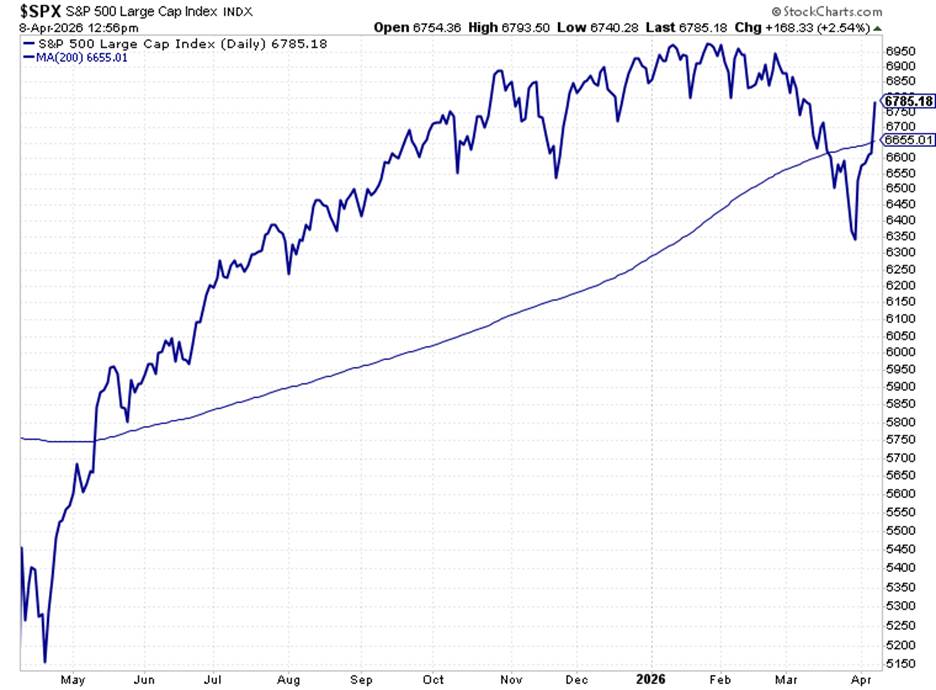
As of yesterday’s close, the S&P was trading below its 200-day moving average – a critical technical line that divides bull market behavior from bear market behavior. Senior market analyst Brian Hunt has written that stocks “below their 200-day moving average are ‘on the wrong side of the tracks.’ It’s the ugly part of town.”
Well, as you can see below, with this morning’s surge, we’re back in the pretty part.
This is big.
Markets that reclaim their 200-day MA after falling below it – especially on heavy volume and a fundamental catalyst – often see sustained follow-through. It’s not guaranteed, but we’re encouraged.
Meanwhile, the bond market is pricing in sunnier skies as well.
Treasury yields are falling as investors bet that lower energy costs could give the Federal Reserve room to cut interest rates later this year – a scenario that had looked increasingly slim just days ago when Brent crude was threatening to push toward $130.
So, is today a time to buy?
Yesterday, we featured our technology expert Luke Lango, editor of Innovation Investor, and his three-scenario framework for how this conflict would resolve.
He had assigned Outcomes 1 and 2 – a deal or a unilateral U.S. withdrawal – a combined probability of 80-85%.
This morning, Luke is calling it clearly: we got the TACO (Trump Always Chickens Out). Better still, in his view, it’s not a tactical pause – it’s the beginning of the end of the conflict.
Here’s Luke:
TACO Tuesday delivered. Trump “chickened out” last night with an apocalypse-averting Truth Social post that we think marks the beginning of the end of the Iran War.
We didn’t just get a TACO last night — we got the TACO. The big one. The one that ends the war.
In our view, the war is now effectively over. The AI bull market resumes today. And it is time to deploy the dry powder.
Luke’s confidence in that call rests on a detailed reading of Trump’s actual language – not just the headline.
He walks through it (Trump’s posts in bold):
“We have already met and exceeded all Military objectives.”This is the victory declaration. Trump is publicly stating –– on the record, with hundreds of ReTruths — that the military mission is complete…
“Double sided CEASEFIRE.” This is not a pause, not a delay, not a suspension pending review. A ceasefire is a mutual agreement to stop fighting.
“A 10 point proposal from Iran… almost all points agreed.” Iran came back with its own proposal. The U.S. considers it a workable basis. This is a deal being consummated, not a delay being manufactured.
“Longterm PEACE with Iran and PEACE in the Middle East.” Trump is framing this as his legacy foreign policy achievement. You don’t frame a tactical delay as a legacy achievement.
In light of this, Luke is recommending that his subscribers buy the dip.
He sent out a handful of Buy Alerts this morning – but with a specific focus: AI and high-growth names only. Not the broader economy.
He writes that oil prices will fall, but not to pre-war levels like $65. It’ll be low enough to recharge AI stocks but not revitalize the flagging U.S. consumer.
Back to Luke on how this war has changed the investment landscape:
The bifurcation in markets becomes permanent as a result of this war.
The AI Boom and other high-growth investment themes are the stocks we want to own as the fear premium comes out and the fundamental premium comes back in.
The rest of the economy will continue to struggle.
I agree with Luke’s analysis, and I’m most encouraged by the idea of Trump wanting to secure his legacy as a peacemaker in the region. That’s a significant motivator for keeping this ceasefire alive.
Still, this is the Middle East. And two weeks is a short runway.
That doesn’t rain on today’s rally. The ceasefire is real, the market reaction is rational, and the technical picture has meaningfully improved.
But if you’re buying today, it’s worth a moment of forethought: are you making a more speculative trade you’ll want to exit if the next two weeks disappoint? Or are you adding a longer-term holding you’ll keep even if volatility returns?
Knowing the answer – and your exit plan – before you pull the trigger today is the best way to sidestep potential regret tomorrow.
The bottom line
It’s a big day…
The ceasefire that few thought would arrive in time actually did, and the markets are responding accordingly.
We’ll be watching the Islamabad talks closely when they begin Friday, and we’ll keep you updated as the picture develops.
But for now, let’s take a breath and appreciate the fact that the worst-case scenario didn’t happen.
Have a good evening,
Jeff Remsburg
P.S. One thing we’re hearing more and more from readers lately…
“It feels like the market is moving faster than ever.”
And they’re right. Between AI-driven moves and sharp reversals, the old buy-and-hold approach is getting harder to rely on by itself. That’s why our colleagues at Stansberry Research just put together a new event, Market Tremors 2026, focused on a different approach — one built around identifying short-term opportunities and acting on them quickly using alternative data.
It’s a very different mindset… but one that may be better suited for today’s market environment. If you’ve been feeling that shift, it’s worth checking out.
Manage your account We hope this timely investment research is valuable to you. As you know the markets move fast and conditions change frequently. So please check the current issue for the most recent advice. Please note that we cannot be liable for any missed bulletins caused by overzealous filters. To ensure that you continue to receive this valuable part of your service please take a moment to add services@exct.investorplace.comto your address book.










 RJ Hamster