This is Kevin Vander with “10XProTrader” delivering you your new premarket breakout alert for today’s trading session.
Wall Street is Showing Major Interest in TDIC, QUCY, FCHL this Morning!
Dreamland Limited (NASDAQ: TDIC) is surging in pre-market this morning, make sure you have it pulled up on your trading screen.
Quantum Cyber N.V. (NASDAQ: QUCY) is surging in pre-market this morning, make sure you have it pulled up on your trading screen.
Fitness Champs Holdings Limited (NASDAQ: FCHL) is surging in pre-market this morning, make sure you have it pulled up on your trading screen.
Kevin Vander
Chief Strategist, 10XProTrader
@ 2026 10XProTrader.. All Rights Reserved. You are receiving this e-mail as part of your subscription to 10XProTrader. Nothing in this email should be considered personalized fina·ncial advice. 10XProTrader is neither a registered inve·stment adviser nor a broker/dealer. Readers are advised that this electronic publication is issued solely for information purposes only and should not be construed as an offer to s·ell or the solicitation of an offer to b·uy any sec·urity. 10XProTrader is a fina·ncial publisher that does not offer any personal fina·ncial advice or advocate the p·urchase or s·ale of any sec·urity or inve·stment for any specific individual. This communication is not a sponsored adv·ertisement.
@ 2026 10XProTrader, 340 Royal Poinciana Way Suite 317, Palm Beach, FL 33480, United States of America
Featured: The Fed Chair Vote Is Here. Don’t Look Away. Sponsored
This Pre-IPO Window Is Closing. Why 7,000+ People Got In Early.
Round closes May 14th, 2026
Not every company makes it from seed to public markets. The ones that do tend to share a pattern: real users, real revenue, strategic partners locked in, and a clear path to liquidity.
Immersed is partnered with the tech giants and checks every box.
THE IMMERSED SCORECARD✓4,000% valuation growth since founding ✓$28M+ raised from over 7,000 retail investors ✓NASDAQ ticker reserved: $IMRS. Path to public markets is clear. ✓Strategic partnerships with Meta, Microsoft, Qualcomm, and Samsung✓No. 1 productivity app in the Meta Quest Store, 1.5M+ active users ✓Covered in Time, Wired, Forbes, CNET, and TechCrunch
This is a paid advertisement for Immersed Regulation A+ offering. Please read the offering circular at invest.immersed.com
The valuation is set by the Company and there is currently no public market for the Company’s Common Stock. NASDAQ ticker “IMRS” has been reserved by Immersed and any potential listing is subject to future regulatory approval and market conditions. Investor references reflect factual individual or institutional participation and do not imply endorsement or sponsorship by the referenced companies. Forward-looking statements appear here based on current information. They involve known and unknown risks, uncertainties, and other factors that may cause outcomes to differ.
FEATURED
The Fed Chair Vote Is Here. Don’t Look Away.
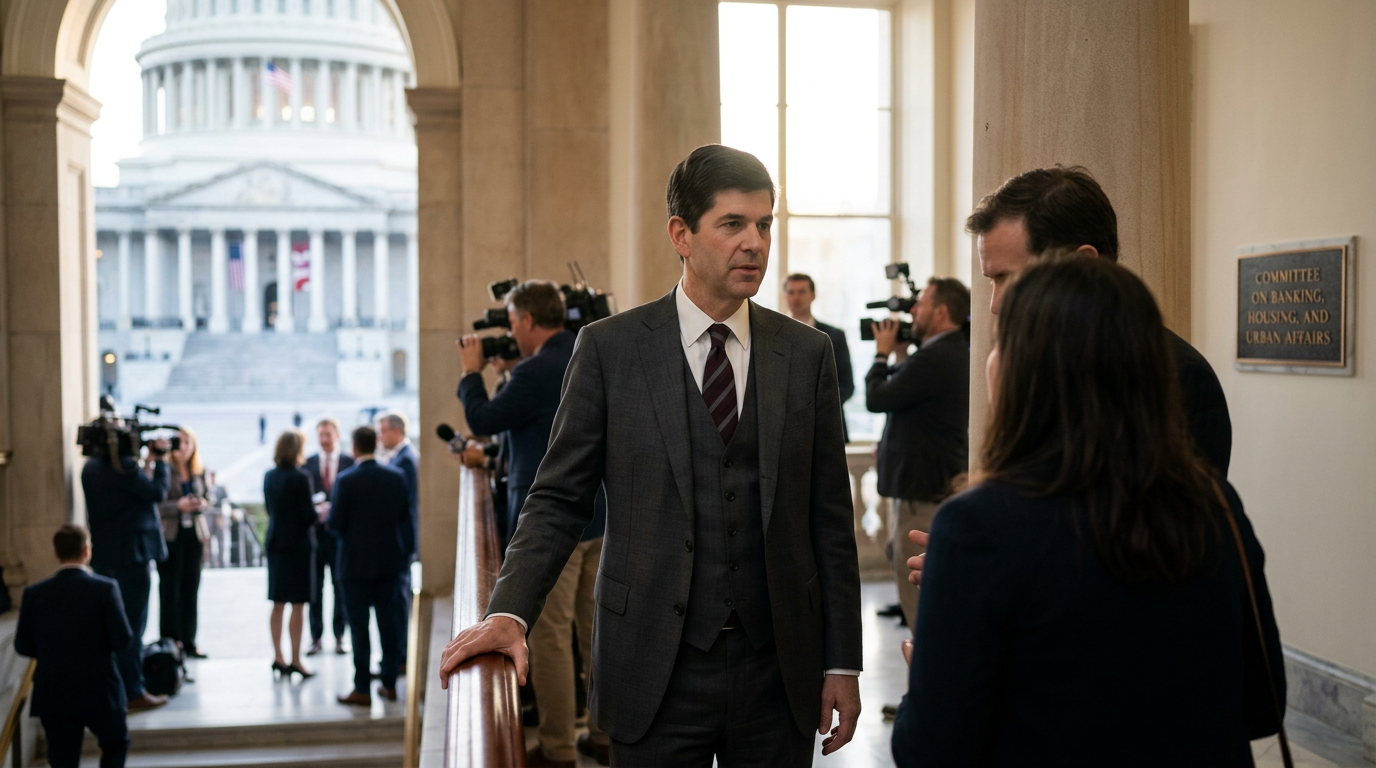
The Senate voted 51-45 yesterday to confirm Kevin Warsh to the Federal Reserve’s Board of Governors. One Democrat crossed the aisle – Sen. John Fetterman of Pennsylvania. Every Republican who showed up voted yes. The chair vote, which is a separate confirmation, is expected as soon as tonight or tomorrow, ahead of Jerome Powell’s term expiring on Friday, May 15.
This is not a small thing.
The Federal Reserve hasn’t had a leadership transition this politically charged in decades. And the person stepping into that chair has already told anyone who would listen that he wants what he calls “regime change” at the central bank. Not a tweak. Not a pivot. A structural overhaul of how the institution operates, communicates, and coordinates with the Treasury.
So let’s talk about what’s actually changing, what probably isn’t, and where the market is getting ahead of itself.
Who Is Kevin Warsh
Warsh, 55, is not a newcomer. He served on the Fed’s Board of Governors from 2006 to 2011, spanning the global financial crisis, and built a reputation during that stretch as an inflation hawk who was skeptical of the Fed’s expanding mandate and balance sheet. He graduated from Stanford and Harvard Law, spent years at Morgan Stanley in M&A, then moved into the Bush White House as a special assistant for economic policy. After leaving the Fed in 2011, he spent time as a Hoover Institution fellow and as an adviser to Stanley Druckenmiller.
Trump nominated him in late January of this year. The path to confirmation got complicated fast.
Sen. Thom Tillis (R-NC), a Banking Committee member, blocked the nomination until the Justice Department concluded its criminal investigation into Powell over testimony he gave to the Senate about the Fed’s $2.5 billion headquarters renovation. The DOJ dropped that investigation late last month. Tillis confirmed he was ready to vote yes. The Banking Committee advanced Warsh on a party-line vote, and the full Senate followed yesterday.
Slight tangent, but it matters – Powell is actually staying. He told reporters he will remain on the Board as a rank-and-file governor, which would make him the first outgoing Fed chair in more than 75 years to do so. His governor term runs through January 2028. His stated reason: protecting the institution from what he described as “legal attacks” threatening the Fed’s ability to conduct monetary policy without political interference. That’s a real dynamic Warsh will have to manage from day one.
Sponsored
Wall Street Issues Dire Warning to Clients
Wall Street has issued a chilling warning for anyone with money in the U.S. stock market right now. Top analysts at these banks say a big event is coming that could both wipe out the market and keep it down for 10 years or longer. What can you do? A new tech breakthrough from a firm in Baltimore, Maryland may hold the answer.
Here’s where it gets interesting. Warsh’s public positioning has shifted meaningfully from his earlier hawkish days. During his confirmation hearing on April 21, he expressed openness to lower rates – not because the economy demands it, but because he believes a smaller Fed balance sheet, tighter coordination with Treasury on non-monetary policy, and productivity gains from AI could create room to ease. In a November 2025 Wall Street Journal op-ed, he wrote that AI would be “a significant disinflationary force.” Senators pressed him on whether that view held given the current energy shock. He gave no clean answer.
Deutsche Bank analysts put it more precisely: Warsh should not be read as structurally dovish. His views “have tended to skew hawkish relative to others.” The argument that a smaller balance sheet creates room for rate cuts is a long-horizon thesis. It doesn’t move rates in June.
What he confirmed during the hearing:
He wants to shrink the Fed’s balance sheet. He believes doing so will help temper inflation and over time open the door to lower borrowing costs.
He floated the idea of reducing the number of annual FOMC meetings from eight. He said four isn’t enough, and more than four is appropriate – but he declined to commit to eight. That’s a bigger operational shift than it sounds.
He told senators Trump never asked him to predetermine any interest rate decision. He pledged independence. Sen. Warren called him a “sock puppet.” He denied it.
He said he will divest the majority of his roughly $100 million in assets before confirmation, with the rest within 90 days.
Trump, for his part, told CNBC he would be “disappointed” if Warsh doesn’t cut rates. That comment is already priced into the political backdrop. What it actually means for monetary policy is a different question entirely.
Where Rates Stand Right Now
The Fed cut 75 basis points total in the final three meetings of 2025, landing the federal funds rate at the current target range of 3.50%–3.75%. Since then, the FOMC has held rates steady for three consecutive meetings in January, March, and April 2026 – all in line with expectations. The April vote was notably fractured: an 8-4 dissent, the first time since October 1992 that four officials disagreed with a single FOMC decision.
The friction point is inflation. A surge in energy prices tied to the U.S.-Israel war on Iran has pushed inflation higher and complicated the Fed’s path. Financial markets are currently pricing roughly a one-in-three chance of a rate hike by December. That’s not a base case – it’s a tail risk that’s grown large enough to be worth watching. The FOMC minutes from March showed that a majority of participants judged that upside risks to inflation had increased, and that a prolonged Middle East conflict would likely lead to more persistent energy price increases passing through to core inflation.
The Fed’s next scheduled meeting is June 16–17. That will almost certainly be Warsh’s first as chair.
The Independence Question Is the Real Story
Here’s what most of the coverage is underweighting. The structural tension isn’t really about whether rates go up or down in June. It’s about whether the Federal Reserve’s decision-making process remains insulated from the executive branch over a multi-year horizon.
Warsh has proposed tighter coordination between the Fed and Treasury on non-monetary policies. Trump has attempted to fire at least one Biden-era Fed governor – a case currently before the Supreme Court. The DOJ investigated the sitting Fed chair. Powell is staying on the board specifically to push back on what he sees as institutional erosion. And Warsh, whatever his intentions, was nominated by an administration that has been explicit about wanting the Fed aligned with its economic agenda.
Worth noting: the Fed chair has only one of twelve votes on the FOMC. Warsh can advocate – but he cannot unilaterally cut rates. Any meaningful policy shift requires building a coalition among governors and regional Fed presidents. Several of those seats are held by Biden nominees. The board dynamics are not going to be frictionless.
That’s the part people skip. Warsh is a persuader-in-chief, not a sole decision-maker.
Sponsored
Wall Street is calling it the “Warsh Shock.” Here’s how to profit from it…
Larry Benedict isn’t scrambling. He’s seen this before.
He says the Warsh Shock is setting up the most predictable wealth-building window he’s seen in 20 years… and there’s one ticker right at the center of it.
The chair confirmation vote lands as early as tonight – ahead of Powell’s May 15 term expiration. After that, the immediate calendar looks like this:
June 16–17: First FOMC meeting under Warsh. No rate move is expected, but the statement language and press conference will get intense scrutiny. Any shift in tone from Powell-era communication will move markets.
Balance sheet trajectory: Warsh has been clear that he wants the balance sheet smaller. How aggressively and on what timeline is the first real policy signal investors should track.
Meeting frequency: If Warsh moves toward fewer than eight annual FOMC meetings, that changes forward guidance mechanics and how markets price rate expectations throughout the year.
FOMC composition: The Supreme Court case on firing Fed governors is unresolved. If the court rules in the administration’s favor, the board’s composition could shift in ways that matter for the vote count on any contentious decision.
Energy and inflation: None of the above matters much if CPI keeps climbing. The Iran-driven energy shock is the wildcard that could force Warsh’s hand before any structural reforms gain traction.
What’s interesting is that the market’s immediate reaction to Warsh’s April 21 hearing was muted and slightly negative. The S&P 500 and Nasdaq each fell roughly 0.4% that day, pausing a rally that had pushed both indexes to record highs. Nothing about that reaction screamed “investors love this.” It said: investors are uncertain, and uncertainty at the Fed is a premium risk right now given the inflation backdrop.
Bottom line: Warsh gets the title. What he does with it is the question that won’t be answered in a single press conference or a single FOMC statement. The June 16 meeting is the first real data point. Between now and then, watch the communication style, watch the balance sheet language, and watch what happens with the Supreme Court case. The structural changes Warsh is talking about – a Treasury-Fed accord, fewer meetings, a smaller balance sheet – are multi-year projects, not quarter-to-quarter trades. The market will price in expectations long before any of it materializes.
The chair is new. The inflation problem is not.
– The Cheap Investor
This content is for informational purposes only and should not be considered financial advice. Investing involves risk.
The Cheap Investor is a publication of Investing Media Solutions, LLC.
Artificial intelligence was supposed to become the ultimate asset-light software revolution.
Instead, it increasingly appears to be becoming an infrastructure arms race.
That distinction matters enormously.
The market still largely assumes hyperscalers eventually transition from: aggressive AI investment to massive margin harvesting.
But the economics emerging underneath machine-scale compute may suggest something very different: continuous infrastructure expansion, persistent thermal scaling, and structurally elevated capex requirements.
That’s where Vertiv becomes important.
The company sits directly inside one of the most unavoidable bottlenecks in the AI economy: cooling the machines.
As GPU rack-density rises and inference workloads expand, thermal-management systems are becoming increasingly strategic across hyperscale infrastructure environments. AI clusters built around next-generation accelerators consume dramatically more power — and generate dramatically more heat — than traditional cloud architecture.
The machines still need to stay cool.
That may sound operationally simple.
Economically, it may become one of the most important infrastructure constraints in the entire AI system.
Most investors still appear to view AI infrastructure demand primarily as a powerful semiconductor cycle.
Our ALDI framework suggests something more structural may be forming: a long-duration physical rebuild of the AI economy itself.
ALDI SCORES — Vertiv (VRT)
• ALDI Pressure: 94 The scale of AI infrastructure expansion increasingly suggests corporations expect machine intelligence to become deeply embedded throughout enterprise systems, creating persistent demand for compute-intensive infrastructure
• ALDI Score: +86 Vertiv appears structurally positioned inside one of the most unavoidable bottlenecks in the AI economy: thermal management and cooling systems required to support rising machine-density and hyperscale AI clusters
• Mispricing Score: +39 (Buy) The market recognizes Vertiv as an AI infrastructure beneficiary, but may still underestimate how structurally persistent cooling and thermal-management demand could become underneath continuous AI infrastructure escalation
ALDI Pressure (0–100) measures how intense AI-driven labor disruption is within a company; ALDI Score (–100 to +100) measures whether a company benefits or is harmed by that disruption; Mispricing Score (–100 to +100) measures the gap between underlying reality and market expectations. Scores above +20 indicate Buy opportunities, below –20 indicate Sell signals.
The most durable AI investments may not ultimately be the companies attempting to dominate artificial intelligence itself.
They may be the firms quietly monetizing the physical infrastructure the hyperscalers cannot avoid building.
AI Investor Pro analyzes how AI-driven labor disruption is reshaping margins, infrastructure demand, organizational scaling and long-term market leadership. Our focus is not generic AI commentary — it is identifying where the market may still be underpricing the second-order economic effects of artificial intelligence.Share on:Facebook|Threads|X|LinkedIn
Just Announced | (Nasdaq: FMST)Expands Its Uranium Zone And Starts A New Drill Program This Morning
Dear Reader,
We have been watching this one closely — and what just crossed the wire this morning gives us even more reason to keep our eyes on it.
Foremost Clean Energy Ltd. (Nasdaq: FMST)just announced the successful completion of its 2026 drill program at the Hatchet Lake South Uranium Project in the eastern Athabasca Basin region of northern Saskatchewan — and the results are continuing to build on what has been an encouraging run of exploration progress.
Here is what stood out: the final drill fence of the program returned a new mineralized intercept in hole TF-26-36, intersecting 0.18% eU₃O₈ over 2.9 metres and extending the northern extent of uranium mineralization by approximately 100 metres. Across the full 2026 program, uranium mineralization was intersected in six drillholes across four of five drill fences completed — including the high-grade interval of 1.0% eU₃O₈ over 1.4 metresreturned earlier in the program.
And the story does not stop there.
Approximately 600 metres of conductive strike length remains open to the south and largely untested — meaning the Tuning Fork Uranium Zone still has significant room to grow.
CEO Jason Barnard called the results a“strong foundation for follow-up drilling” and confirmed the company has already commenced drilling at the Richardson SE target on Hatchet Lake North, where more than 5 kilometres of untested electromagnetic conductor strike length are waiting to be evaluated.
This is an active, moving exploration story in one of the world’s most recognized uranium jurisdictions — and (FMST) is on our watchlist right now.
If you missed our earlier coverage, keep reading to quickly get up to speed on why we’re so excited to be highlighting (FMST) today.
=====
At Street Ideas, we spend a lot of time tracking early shifts before the broader market fully catches on—and this morning, Wednesday, May 13, 2026, Foremost Clean Energy Ltd. (NASDAQ: FMST) has forced its way back onto our radar in a major way.
The uranium sector has been quietly tightening for months, but the story around (FMST) appears to be accelerating fast following two back-to-back press releases over the last three weeks that significantly expanded the scope of its exploration story.
The latest drill updates now point to a rapidly growing high-grade uranium zone confirmed across multiple drill fences inside one of the most important uranium jurisdictions on the planet.
With fewer than 12M shareslistedas available to the public, a $9M exploration budget, and fresh geophysical data now pointing toward a second active drilling front, the setup heading into the summer months deserves a close look.
A Company Built for This Moment
Foremost Clean Energy (NASDAQ: FMST) is a North American uranium and lithium exploration companystrategically positioned to benefit from the accelerating demand for reliable, carbon-free energy.
The company holds an option fromDenison Mines Corp to earn up to 70% interest in 10 uranium properties—with up to 51% at Hatchet Lake—spanning over 330,000 acres in the Athabasca Basin of northern Saskatchewan, one of the world’s most uranium-rich jurisdictions.
This region is historically known to host some of the richest uranium deposits on the planet, with average grades running 10X to 100X higher than the global average while supplying approximately 15% of the world’s primary uranium output.
The company’s data-driven exploration strategy is backed by decades of historical drilling and geophysical data from Denison, providing a validated roadmap for targeting high-potential mineralized trends.
Beyond uranium, (FMST) also controls a large land position in Manitoba’s Snow Lake district—a region the company refers to as“Lithium Lane”—offering dual-commodity exposure to both the nuclear renaissance and the electrification movement.
AI Meets the Uranium Bottleneck
The story behind (FMST) is inseparable from the energy crisis quietly building behind the AI boom.
Data centers already consume roughly 1.5% of global electricity—and that consumption is accelerating at approximately 30% per year. The grid simply cannot keep up.
Nuclear power has emerged as the only scalable, always-on, carbon-free solution capable of meeting data center baseload demand.
With Russia maintaining a dominant position in global processed uranium supply, the push for secure, Tier-1 North American sources has become a matter of national security, not just market economics.
That is the structural wind at (FMST)’sback.
What Just Put (FMST) Back on Our Radar
Two significant developments have unfolded in the past three weeks—and taken together, they materially strengthen (FMST)’s exploration thesis.
These results build directly on the 2025 discovery in hole TF-25-16. Step-out drilling across three separate drill fences has now expanded the mineralized footprint of what is officially designated the “Tuning Fork Uranium Zone” to over 150 metres of strike length—a compelling demonstration of system continuity in an area that remains open in multiple directions.
To date, a total of 10 diamond drill holes spanning 2,113 metres have been completed at the zone.
Five of those holes returned uranium mineralization meeting or exceeding the reporting threshold of 0.05% eU₃O₈.
What stands out just as much: every single completed hole encountered anomalous radioactivity above 2x background andhydrothermal alteration at the Athabasca unconformity—a geological fingerprint consistent with the district’s most significant deposits.
As President and CEO of Foremost, Jason Barnard stated, the results “demonstrate the growing scale of the system” and the company is “well positioned to keep expanding this area through continued drilling.”
CLK Uranium Property: Geophysics Points the Way
On May 5, 2026, (FMST) released a second update that opens an entirely new front in the exploration story.
The first was a helicopter-borne MobileMT electromagnetic and magnetic survey covering 808 line-kilometresacross the 136 km² property block, mapping conductive and resistive anomalies from surface to depths exceeding 900 metres.
Both datasets are now being integrated to define high-priority drill targets near historical hole CLG-D1, which intersected approximately 1.01% U₃O₈ at 862 metres depth from visible pitchblende stringers just below the unconformity.
The CLK Property is already fully permitted for a multi-phase program including up to 30 diamond drill holes—meaning the company can move quickly once targets are defined.
Financial and Structural Profile
Heading into its most active exploration season, (FMST)’s capital position is solid. The company closed a Canaccord Genuity-led bought deal private placement on March 31, 2026, raising approximately C$5.75M in aggregate gross proceeds to fund qualifying Canadian exploration through December 2027. The 1,690,200 flow-through units were priced at C$3.40 each, with each unit including one common share and one-half warrant exercisable at C$4.40 until March 2028.
The company’s total2026 exploration budgetstands at approximately $9M, with roughly 11,500 metres of total drilling planned across all projects—making this its most operationally active year to date. Insider alignment is tight: management and directors hold approximately 4.65% of shares, and when combined with Denison’s 17.06%strategic stake, roughly 21.71% of the company is held by aligned insiders and a major institutional partner.
With fewer than 12M shares available to the public, (FMST)’s small float could see the potential for big moves if demand begins to shift.
7 Reasons (FMST) is Topping Our Watchlist This Morning
Wednesday, May 13, 2026…
1. Nuclear Is Booming: The Bank of America recently identified nuclear energy as a potential $10T market in the coming years, and (FMST) is positioned in one of the world’s most uranium-rich regions to potentially benefit from that wave.
2. Big Tech Needs Power: Meta, Google, Amazon, and Microsoft are collectively pouring an estimated $650B into AI infrastructure in 2026 alone, and (FMST)is exploring for the uranium needed to fuel the nuclear power those data centers increasingly depend on.
3. America’s Supply Gap: The U.S. produced less than 1% of its own uranium needs in 2024 while reactor buyers acquired over 50M lbs—a massive domestic shortfall that makes North American explorers like (FMST)increasingly relevant.
4. Drill Program Delivering:(FMST)’s2026 drill program at Hatchet Lake has now confirmed uranium mineralization across 150 metres of strike length, with the zone still open in multiple directions and more results pending.
5. Small Float: With fewer than 12M shares available to the public, (FMST)has one of the tighter floats in the sector, which historically means a smaller number of shares need to change hands to move the needle.
6. Fully Funded: With approximately C$5.75M raised through a bought deal in March 2026, (FMST) has the capital in place to execute its largest exploration program to date without needing to immediately raise additional funds.
7. Nvidia Just Went Nuclear:(FMST) is advancing uranium exploration at a moment when even Nvidia has begun partnering with nuclear start-up Oklo—a signal that the world’s most influential tech companies are now directly linking their future to nuclear energy.
The case for Foremost Clean Energy (NASDAQ: FMST) comes together quickly when you step back and look at the full picture.
Bank of America sees nuclear as a potential $10T market. The biggest names in tech are spending $650B on AI infrastructure that ultimately needs reliable, carbon-free power to run. The U.S. is producing less than 1% of its own uranium while buying over 50M lbs from foreign sources every year.
And now Nvidia—one of the most closely watched companies in the world—is linking its future directly to nuclear energy.
Against that backdrop, (FMST) is actively drilling in one of the world’s most uranium-rich jurisdictions, has just confirmed mineralization across 150 metres of strike length at Hatchet Lake with results still pending, and closed a fresh C$5.75M financing to fund the work.
With fewer than 12M shares available to the public, the company is built lean at a moment when the macro tailwinds behind uranium have rarely been this well-defined.
The fundamentals, the timing, and the operational momentum are all pointing in the same direction.
We have all eyes on (FMST) this morning—Wednesday, May 13, 2026.
Take a look at (FMST) this now, before the bell rings.
Also, keep a look out for my next update—it could be hitting very shortly.
Sincerely,
Paul Prescott Co-Founder & Managing Editor Street Ideas Newsletter
Street-Ideas.com (“Street-Ideas” or “SI” ) is owned by 147 Media LLC, a single member limited liability company. Data is provided from third-party sources and SI is not responsible for its accuracy. Make sure to always do your own research and due diligence on any day and swing profile SI brings to your attention. Any emojis used do not have a specific defined meaning, and may be used inconsistently. We do not provide personalized in-vest-ment advice, are not in-vest-ment advisors, and any profiles we mention are not suitable for all in-vest-ors.
Foremost Clean Energy Ltd. (FMST:US) (FAT:CA) previously changed their company name from Foremost Lithium Resource & Technology Ltd. (FMST:US) (FAT:CA)
Pursuant to an agreement between 147 Media LLC and TD Media LLC, 147 Media LLC has been hired for a period beginning on 05/13/2026 and ending on 05/13/2026 to publicly disseminate information about (FMST:US) (FAT:CA) via digital communications. Under this agreement, TD Media LLC has paid 147 Media LLC seven thousand five hundred USD (“Funds”). To date, including under the previously described agreement, 147 Media LLC has been paid forty eight thousand USD (“Funds”). These Funds were part of the twenty two thousand five hundred USD funds that TD Media LLC received from a third party named LFG Equities Corp. who did receive the Funds directly or indirectly from the Issuer and does not own stock in the Issuer but the reader should assume that the clients of the third party own shares in the Issuer, which they will liquidate at or near the time you receive this communication and has the potential to hurt share prices.
Neither 147 Media LLC, TD Media LLC and their member own shares of (FMST:US) (FAT:CA).
Still On It | (Nasdaq: MBRX) Pops Approx. 12% And Krypton Street is Still Covering It
Dear Reader,
The update on Moleculin Biotech, Inc. (Nasdaq: MBRX) is here — and the early move this morning says a lot.
(MBRX) alreadyreached $2.61 today, marking an approximate 12% move off yesterday’s $2.32range — and Krypton Street has had its eyes on it all morning.
The catalyst is this morning’s major clinicalannouncement, confirming the first MIRACLE trial unblinding remains on track before June 30, 2026 — with a composite complete remission rate exceeding 40% and an approximate 30% complete remission ratecontinuing to outperform the historical cytarabine benchmark of roughly 17-18%.
(MBRX) is not flying under the radar anymore — and Krypton Street wants to make sure you are not either.
Take a few minutes to scroll down and get the full picture on why (MBRX)earned the top spot on our watchlist today.
=====
Krypton Street is tracking a little-known Phase 3 biotech that could be approaching one of its most important clinical milestones yet.
Preliminary blinded data from the first 30 subjects showed a 40% composite complete remission rate, approximately67% above the historical response rate for standard cytarabine alone, while management has publicly stated interim Phase 3 data is expected later this quarter.
That is part of the reason why Moleculin Biotech, Inc. (Nasdaq: MBRX) just hit our radar and is climbing toward the top of this morning’s watchlist—Wednesday, May 13, 2026.
But keep in mind, (MBRX) has less than 6M shareslisted as available to the public. When companies have small public floats like this, the potential exists for big moves if demand begins to shift.
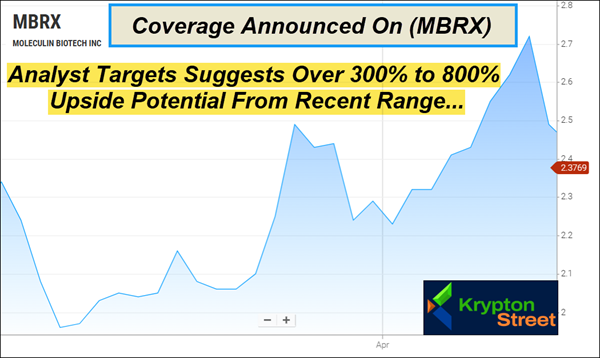
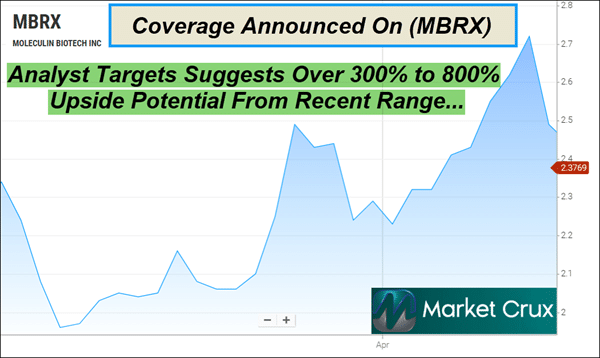
Recently, (MBRX) made an approximate 50% move in just over a month when it went from around $1.79 on March 9 to $2.72 on April 14, according to Barchart.
That kind of setup is exactly what can put a little-known biotech under a much brighter spotlight in a very short window.
And with a pivotal clinical update now expected before quarter-end, (MBRX)could start to draw attention from more than just our desk.
Analyst Targets Point To 300%–800% Upside Potential…
Sara Nik ofH.C. Wainwright has a $22 target on (MBRX), which suggests over 800% upside potential from its recent $2.40 range. Jason McCarthy ofMaxim Group reiterated a $10 target less than two weeks ago, which suggests over 300% upside potential from current levels.
Two covering analysts, two significant targets, one imminent data readout.
(MBRX) ended 2025 with $8.9M in cashand raised an additional $8.3M in gross proceeds through financing activities in Q1 2026. Management hasconfirmed it expects combined resources to fund planned operations into Q3 2026 — through and beyond the anticipated MIRACLE interim readout.
But the analyst targets and near-term clinical timing are only part of the story.
To understand why (MBRX) is drawing this level of attention, you have to look at the science behind the pipeline itself.
A Pipeline Built for Cancers That Fight Back
Moleculin Biotech, Inc. (Nasdaq: MBRX) is a Houston-based, late-stage pharmaceutical company developing therapeutic candidates for hard-to-treat tumors and viruses.
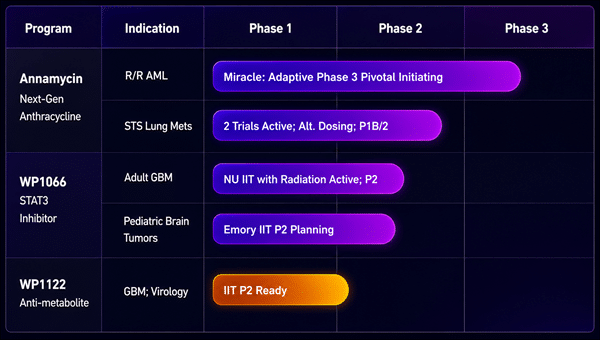
Its lead program,Annamycin (naxtarubicin), is a next-generation anthracycline engineered with two critical advantages over older agents like doxorubicin: it is designed to avoid multidrug resistance mechanisms, and it lacks the cardiotoxicity that has long constrained the use of conventional anthracyclines.
Across more than 100 patients treated in Moleculin’s clinical programs to date, no associated cardiotoxicity has been reported — a documented safety differentiator that could matter considerably in regulatory and commercial discussions.
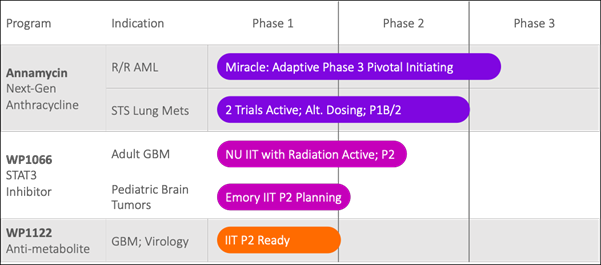
Annamycin is being evaluated in theMIRACLE trial — a pivotal, global Phase 2B/3 study combining Annamycin with cytarabine (AnnAraC) for adult R/R AML patients following induction therapy.
The trial is enrolling across eight countries in the United States and Europe.
The company has also completed a successful Phase 1B/2 study (MB-106) that, with FDA input, it believes has substantially de-risked the regulatory pathway toward a potential new drug approval.
Beyond AML, the pipeline includes Annamycin forsoft tissue sarcoma lung metastases; WP1066, an immune and transcription modulator targeting brain tumors and other cancers; and WP1122, an antimetabolite being explored for viral indications.
(MBRX) is a multi-indication platform with AML leading the charge.
The Market Moleculin Is Targeting
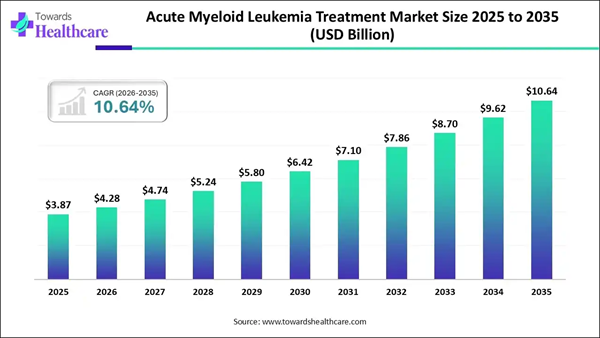
The globalAML treatment market was valued at approximately $3.87B in 2025and is projected to expand at a CAGR of roughly 10.6%, reaching an estimated $9.62B by 2034.
The American Cancer Society estimates 22,010 new AML diagnoses in the United States in 2025 alone, with approximately 11,090 expected deaths. For the relapsed or refractory subset — Moleculin’s specific target population — the unmet need is especially severe: standard high-dose cytarabine (HiDAC) produces complete remission rates of only around 17-18%, leaving the vast majority of patients without durable responses.
That is the gap AnnAraC is designed to fill.
The preliminary blinded 40% composite complete remission rate observed across the first 30 MIRACLE subjects — of whom approximately 35% had already failed prior venetoclax-based therapy, among the most resistant patients — supports the view that AnnAraC may be performing meaningfully above the standard of care. Full unblinded confirmation is expected this quarter.
A Cascade of Recent Potential Catalysts
On May 8, 2026, Moleculinannounced a new Hong Kong patent (No. 40073244) covering its proprietary method of reconstituting liposomal Annamycin, extending IP protection through June 25, 2040.
The timing is deliberate.
CEO Walter Klempstated directly: “This level of patent protection is made all the more important given the expected timing of our first Phase 3 clinical data release later this quarter.”
(MBRX)’s global IP now spans four continents.
On April 23, new preclinical data presented at theAACR Annual Meeting 2026 showed Annamycin extending survival by more than 60% in metastatic pancreatic cancer preclinical models, with significantly greater tumor tissue accumulation than doxorubicin (p<0.0001), and evidence of CD8+ and CD4+ T cell infiltration — suggesting potential to activate immune responses in notoriously cold tumors.
An abstract highlighting Annamycin data has also been accepted for poster presentation at the 2026 ASCO Annual Meeting, one of oncology’s most influential annual gatherings, placing Annamycin in front of a global clinical audience at exactly the right moment.
May 13, 2026: 7 Reasons Why (MBRX) Has Earned The Top Spot On Our Watchlist This Morning…
1. Recent Momentum: After moving from around $1.79 on March 9 to $2.72 on April 14, (MBRX) already showed an approximate 50% move in just over a month.
2. Small Float: With fewer than 6M shares listed as available to the public, (MBRX)’s small float could witness the potential for big moves if demand begins to shift.
3. Analyst Targets: With targets of $10and $22, (MBRX) has analyst coverage which suggests over 300% to 800% upside potential from its recent $2.40 range.
4. Clinical Timing: With MIRACLE interim data expected later this quarter, (MBRX)has a near-term readout that could draw added attention.
5. Early Signal: Based on preliminary blinded results from the first 30 subjects, (MBRX) showed a 40% composite complete remission rate.
6. Patent Coverage: Following a new Hong Kong patent extending protection through June 25, 2040, (MBRX) now has global IP spanning four continents.
7. Capital Position: After ending 2025 with $8.9M in cash and raising another $8.3M in Q1 2026, (MBRX) says resources should fund planned operations into Q3 2026.
Get (MBRX) On Your Radar While It’s Still Early…
Taken together, the setup surrounding (MBRX) is difficult to ignore right now. Between the small public float, the recent approximate 50% move in just over a month, analyst targets ranging from $10 to $22, and a pivotal MIRACLE interim data readout expected later this quarter, multiple factors are beginning to converge at the same time.
Add in the preliminary 40% compositecomplete remission rate, capital resources projected into Q3 2026, and expanding patent protection across four continents, and it becomes clear why (MBRX) just hit our radar.
(MBRX) has our full attention this morning.
Take a look at (MBRX) while it’s still early.
My next update could be on the way shortly, so keep watch.
Sincerely,
Alex Ramsay
Co-Founder / Managing Editor
Krypton Street Newsletter
KryptonStreet.com (“KryptonStreet” or “KS” ) is owned by Media 1717 LLC, a single member limited liability company. Data is provided from third-party sources and KS is not responsible for its accuracy. Make sure to always do your own research and due diligence on any day and swing profile KS brings to your attention. Any emojis used do not have a specific defined meaning, and may be used inconsistently. We do not provide personalized in-vest-ment advice, are not in-vest-ment advisors, and any profiles we mention are not suitable for all in-vest-ors.
Pursuant to an agreement between Media 1717 LLC and TD Media LLC, Media 1717 LLC has been hired for a period beginning on 05/13/2026 and ending on 05/13/2026 to publicly disseminate information about (MBRX:US) via digital communications. Under this agreement, TD Media LLC has paid Media 1717 LLC seven thousand five hundred USD (“Funds”). To date, including under the previously described agreement, Media 1717 LLC has been paid thirty seven thousand five hundred USD (“Funds”). These Funds were part of the seventy five thousand USD funds that TD Media LLC received from a third party named JRZ Capital LLC who did receive the Funds directly or indirectly from the Issuer and does not own stock in the Issuer but the reader should assume that the clients of the third party own shares in the Issuer, which they will liquidate at or near the time you receive this communication and has the potential to hurt share prices.
Neither Media 1717 LLC, TD Media LLC and their member own shares of (MBRX:US).
Still Watching (Nasdaq: MBRX) | Why The Approx. 12% Move Is Just Part Of The Story
Dear Reader,
Market Crux has one name at the top of its radar this morning — and it has already moved approximately 12%.
Moleculin Biotech, Inc. (Nasdaq: MBRX)hit $2.61 today, up from yesterday’s $2.32range — a move that started the moment this morning’s clinicalupdatecrossed the wire.
The release confirmed the first MIRACLE trial unblinding is on track before June 30, 2026, with preliminary blinded data continuing to significantly outperform historical benchmarks — a composite complete remission rate exceeding 40%and an approximate 30% complete remission rate against a historical cytarabine rate of roughly 17-18%.
The data is holding, the date is set, and (MBRX) is already responding.
Scroll down for everything Market Cruxhas been tracking on (MBRX) since the news dropped this morning.
=====
Market Crux has its eye on a little-known Phase 3 biotech that appears to be closing in on what could be the most consequential clinical milestone in its history. Preliminary blinded results from the first 30 trial subjectscame in at a 40% composite complete remission rate — roughly 67% above the historical response rate for standard cytarabine alone — and management has since confirmed that interimPhase 3 datais expected before the end of this quarter.
Those are two of the reasons Moleculin Biotech, Inc. (Nasdaq: MBRX) just hit our radar this Wednesday morning, May 13, 2026.
But keep in mind, (MBRX) has less than 6M shareslisted as available to the public. When companies have small public floats like this, the potential exists for big moves if demand begins to shift.
Recently, (MBRX) made an approximate 50% move in just over a month when it went from around $1.79 on March 9 to $2.72 on April 14, according to Barchart.
That kind of setup is exactly what can put a little-known biotech under a much brighter spotlight in a very short window.
And with a pivotal clinical update now expected before quarter-end, (MBRX)could start to draw attention from more than just our desk.
Analyst Targets Point To 300%–800% Upside Potential…
Sara Nik ofH.C. Wainwright has a $22 target on (MBRX), which suggests over 800% upside potential from its recent $2.40 range. Jason McCarthy ofMaxim Group reiterated a $10 target less than two weeks ago, which suggests over 300% upside potential from current levels.
Two covering analysts, two significant targets, one imminent data readout.
(MBRX) ended 2025 with $8.9M in cashand raised an additional $8.3M in gross proceeds through financing activities in Q1 2026. Management hasconfirmed it expects combined resources to fund planned operations into Q3 2026 — through and beyond the anticipated MIRACLE interim readout.
But the analyst targets and near-term clinical timing are only part of the story.
To understand why (MBRX) is drawing this level of attention, you have to look at the science behind the pipeline itself.
What Is Actually Inside The (MBRX) Pipeline
Moleculin Biotech, Inc. (Nasdaq: MBRX) is a Houston-based, late-stage pharmaceutical company developing therapeutic candidates for hard-to-treat tumors and viruses.
Its lead program,Annamycin (naxtarubicin), is a next-generation anthracycline engineered with two critical advantages over older agents like doxorubicin: it is designed to avoid multidrug resistance mechanisms, and it lacks the cardiotoxicity that has long constrained the use of conventional anthracyclines.
Across more than 100 patients treated in Moleculin’s clinical programs to date, no associated cardiotoxicity has been reported — a documented safety differentiator that could matter considerably in regulatory and commercial discussions.
Annamycin is being evaluated in theMIRACLE trial — a pivotal, global Phase 2B/3 study combining Annamycin with cytarabine (AnnAraC) for adult R/R AML patients following induction therapy.
The trial is enrolling across eight countries in the United States and Europe.
The company has also completed a successful Phase 1B/2 study (MB-106) that, with FDA input, it believes has substantially de-risked the regulatory pathway toward a potential new drug approval.
Beyond AML, the pipeline includes Annamycin forsoft tissue sarcoma lung metastases; WP1066, an immune and transcription modulator targeting brain tumors and other cancers; and WP1122, an antimetabolite being explored for viral indications.
(MBRX) is a multi-indication platform with AML leading the charge.
A $9.62B Market By 2034 — And A Treatment Gap
That Still Exists Today
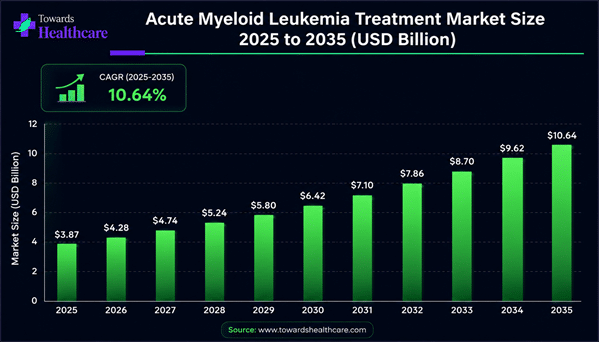
The globalAML treatment market was valued at approximately $3.87B in 2025and is projected to expand at a CAGR of roughly 10.6%, reaching an estimated $9.62B by 2034.
The American Cancer Society estimates 22,010 new AML diagnoses in the United States in 2025 alone, with approximately 11,090 expected deaths. For the relapsed or refractory subset — Moleculin’s specific target population — the unmet need is especially severe: standard high-dose cytarabine (HiDAC) produces complete remission rates of only around 17-18%, leaving the vast majority of patients without durable responses.
That is the gap AnnAraC is designed to fill.
The preliminary blinded 40% composite complete remission rate observed across the first 30 MIRACLE subjects — of whom approximately 35% had already failed prior venetoclax-based therapy, among the most resistant patients — supports the view that AnnAraC may be performing meaningfully above the standard of care. Full unblinded confirmation is expected this quarter.
Recent Milestones
On May 8, 2026, Moleculinannounced a new Hong Kong patent (No. 40073244) covering its proprietary method of reconstituting liposomal Annamycin, extending IP protection through June 25, 2040.
The timing is deliberate.
CEO Walter Klempstated directly: “This level of patent protection is made all the more important given the expected timing of our first Phase 3 clinical data release later this quarter.”
(MBRX)’s global IP now spans four continents.
On April 23, new preclinical data presented at theAACR Annual Meeting 2026 showed Annamycin extending survival by more than 60% in metastatic pancreatic cancer preclinical models, with significantly greater tumor tissue accumulation than doxorubicin (p<0.0001), and evidence of CD8+ and CD4+ T cell infiltration — suggesting potential to activate immune responses in notoriously cold tumors.
An abstract highlighting Annamycin data has also been accepted for poster presentation at the 2026 ASCO Annual Meeting, one of oncology’s most influential annual gatherings, placing Annamycin in front of a global clinical audience at exactly the right moment.
Here Are 7 Reasons Why (MBRX) Is Leading Our Watchlist On This Wednesday Morning—May 13, 2026
1. The Float Is Smaller Than Most Realize: With fewer than 6M shares listed as available to the public, (MBRX)’s small float could witness the potential for big moves if demand begins to shift.
2. Approximately 50% In Just Over A Month : After moving from around $1.79 on March 9 to $2.72 on April 14, (MBRX)already showed an approximate 50% move in just over a month.
3. Analyst Targets: With targets of $10and $22, (MBRX) has analyst coverage which suggests over 300% to 800% upside potential from its recent $2.40 range.
4. Clinical Timing: With MIRACLE interim data expected later this quarter, (MBRX)has a near-term readout that could draw added attention.
5. Early Signal: Based on preliminary blinded results from the first 30 subjects, (MBRX) showed a 40% composite complete remission rate.
6. Patent Coverage: Following a new Hong Kong patent extending protection through June 25, 2040, (MBRX) now has global IP spanning four continents.
7. Balance Sheet Ready: After ending 2025 with $8.9M in cash and raising another $8.3M in Q1 2026, (MBRX) says resources should fund planned operations into Q3 2026.
Now Is The Time To Get (MBRX) On Your Screen…
Taken together, the setup surrounding (MBRX) is difficult to ignore right now. Between the small public float, the recent approximate 50% move in just over a month, analyst targets ranging from $10 to $22, and a pivotal MIRACLE interim data readout expected later this quarter, multiple factors are beginning to converge at the same time.
Add in the preliminary 40% compositecomplete remission rate, capital resources projected into Q3 2026, and expanding patent protection across four continents, and it becomes clear why (MBRX) just hit our radar.
All eyes at MarketCrux are on (MBRX) right now.
Pull up (MBRX) while it’s still early.
Keep an eye on your inbox — my next update could arrive sooner than you think.
Sincerely,
Gary Silver
Managing Editor,
MarketCrux
MarketCrux.com (“MarketCrux” or “MC” ) is owned by Headline Media LLC, MC is not responsible for its accuracy. Make sure to always do your own research and due diligence on any day and swing profile MC brings to your attention. Any emojis used do not have a specific defined meaning, and may be used inconsistently. We do not provide personalized in-vest-ment advice, are not in-vest-ment advisors, and any profiles we mention are not suitable for all in-vest-ors.
Pursuant to an agreement between Headline Media LLC and TD Media LLC, Headline Media LLC has been hired for a period beginning on 05/13/2026 and ending on 05/13/2026 to publicly disseminate information about (MBRX:US) via digital communications. Under this agreement, TD Media LLC has paid Headline Media LLC seven thousand five hundred USD (“Funds”). To date, including under the previously described agreement, Headline Media LLC has been paid thirty two thousand five hundred USD (“Funds”). These Funds were part of the seventy five thousand USD funds that TD Media LLC received from a third party named JRZ Capital LLC who did receive the Funds directly or indirectly from the Issuer and does not own stock in the Issuer but the reader should assume that the clients of the third party own shares in the Issuer, which they will liquidate at or near the time you receive this communication and has the potential to hurt share prices.
Neither Headline Media LLC, TD Media LLC and their member own shares of (MBRX:US).
When the leaders of the world’s two largest economies sit down for talks, markets pay attention. When those talks include the CEOs of two of America’s most valuable tech companies,…
The market just experienced a reality check that’s forcing investors to rethink everything they thought they knew about the next two years. Following a surprisingly hot inflation…
“I recently visited Mar-a-Lago… And now I’m prepared to put my reputation on the line. One investment I just uncovered could be my biggest winner of all… It involves President Trump, Elon Musk, trillions of dollars, China… And a MAJOR upgrade to the artificial intelligence revolution. If you buy just one stock in 2026, I urge you to make it this one.” – Louis Navellier
The semiconductor sector got a double dose of optimism this week. First, Nvidia’s Jensen Huang accepted an invitation to join President Trump’s upcoming diplomatic visit to China. Second,…
Alibaba just posted one of the most dramatic profit drops I’ve seen from a major tech company. Core profitability collapsed 84% in the March quarter, and management’s explanation was…
Wall Street legend Marc Chaikin’s award-winning system turned bearish on software stocks two months before they crashed this year. Now, he’s warning that one AI lab’s breakthrough could CRASH the Nasdaq while igniting a $500 trillion wealth transfer. He’s found a little-known $40 “pre-IPO backdoor” into the private startup behind this economic sea change.
(Privacy Policy/Disclosures)Advertising Disclosure: This email contains paid advertisements. This email is from our associates at Investment News Daily.
Legal Entity Information: Investing Ideas Daily is owned and operated by Darwin Investor Network, a DBA of The Darwin Agency, Inc.
Disclaimer: Nothing in this email should be considered personalized financial advice. Always conduct your own due diligence when investing. We urge you to read our full disclaimer by clicking on the terms of use link below.
Unsubscribe: You are receiving this email as part of your complimentary subscription to the Investing Ideas Daily E-Letter. If you would like to unsubscribe, you can do so by clicking on the unsubscribe link below.Darwin Investor Network 2319 N Andrews Avenue, Fort Lauderdale, FL 33311 support@investingideasdaily.com | 1-800-496-9838Investing Ideas Daily | Privacy Policy | Terms of Use Unsubscribe | View Online
A New Kind of Defense Opportunity is Building a Multi-Domain AI Platform for Modern Warfare—This is Why NASDAQ Small Cap Defense Company VisionWave (VWAV) May Be Worth Watching Early!
As warfare becomes faster, smarter, and more automated, companies enabling these capabilities are moving into the spotlight. VisionWave Holdings, Inc. (NASDAQ: VWAV)is developing a platform designed to support this shift, combining sensing technologies, AI-driven analytics, and autonomous drones into a unified system.
This approach reflects how modern defense is evolving—toward connected, intelligent networks rather than standalone tools. The battlefield is changing fast—and NASDAQ: VWAV is positioning itself where the next wave of defense spending is expected to flow. The company isn’t just building products—it’s building a platform designed for how wars are fought today, not how they were fought yesterday.
Beyond technology development, VWAV is actively building pathways to growth. From strategic transactions like its SaverOne collaboration to expansion into global markets and early-stage moves into energy exploration, the company is broadening its reach across multiple high-demand sectors. While still early, its alignment with key defense and infrastructure trends is putting it on more investors’ radar.
While larger defense names dominate headlines, NASDAQ: VWAV is quietly aligning with the technologies shaping the future of combat.
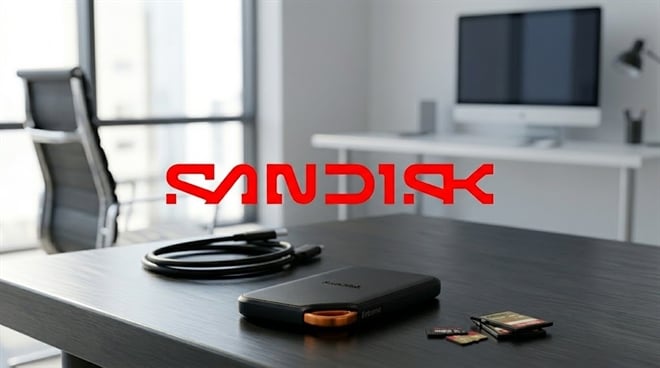
SanDisk Earnings Crush Estimates With 251% Revenue Surge
By Ryan Hasson. Article Published: 5/1/2026.
Key Points
SanDisk’s fiscal Q3 2026 revenue of $5.95 billion rose 251% year over year, easily topping the $4.55 billion consensus estimate.
The company signed five multi-year customer agreements, with over a third of fiscal 2027 bit supply already contracted, providing durable revenue visibility.
Despite guiding fiscal Q4 revenue of $7.75 billion to $8.25 billion, well above consensus, SNDK shares declined modestly in after-hours trading.
Sandisk (NASDAQ: SNDK) has been one of the market’s most remarkable stories over the past year. Heading into its fiscal Q3 2026 earnings report on April 30, the stock had already surged nearly 360% year to date and more than 3,300% over the past year. That made it one of the most extraordinary performers in the market over that stretch. The thesis driving the move, of course, has been AI-related.
The AI data center buildout is creating massive, structural demand for enterprise NAND flash storage, and SanDisk sits at the center of it. For the third consecutive quarter, results sharply topped estimates as the memory shortage and supply crunch continue.
Sandisk’s fiscal Q3 results were, without exaggeration, one of the strongest earnings reports of this earnings season. Revenue came in at $5.95 billion, up 251% year over year and 97% sequentially.
The results crushed the consensus estimate of $4.55 billion and blew past the high end of management’s own guidance range of $4.4 billion to $4.8 billion. Non-GAAP EPS of $23.41 beat the $14.36 consensus by 63%, up sharply from $6.20 in the prior quarter and reversing a small loss in the same quarter a year ago.
The margin story was equally compelling. GAAP gross margin expanded to 78.4%, up from just 22.5% a year earlier, a 55.9 percentage point improvement in 12 months. Non-GAAP operating margin reached 70.9%, up from 37.5% sequentially. The company ended the quarter with $3.73 billion in cash and a zero-debt balance sheet after fully repaying its term loan. Management capped the quarter by announcing a $6 billion share buyback authorization.
The segment driving it all was Datacenter. Revenue in that segment surged 233% sequentially and 645% year over year to $1.46 billion, led by TLC products and early readiness for the upcoming QLC Stargate launch. The Edge segment, which includes client and mobile applications, more than doubled sequentially to $3.66 billion, up 295% year over year. Consumer revenue grew 44% year over year to $820 million.
A New Business Model Built for Durability
Beyond the headline numbers, the most strategically significant development from the earnings call was the progress on Sandisk’s New Business Model. The company ended Q3 with three signed multi-year agreements in place and revealed that it signed two additional agreements in the fiscal fourth quarter. Collectively, these contracts are backed by firm financial commitments from customers, providing revenue visibility and earnings durability that the prior spot-market-driven model could never offer.
More than a third of fiscal 2027 bit supply is already contracted under these arrangements. CEO David Goeckeler described the quarter as a fundamental inflection point, where technology leadership is enabling a deliberate shift toward the highest-value end markets, backed by a model built for structurally higher and more durable earnings power. The numbers make that case without much further argument.
The Guidance Is Equally Impressive
If the Q3 results were exceptional, the Q4 guidance was right there with them. Management guided fiscal Q4 revenue of $7.75 billion to $8.25 billion, compared with prior consensus of $6.49 billion. Non-GAAP EPS guidance was $30 to $33, versus a prior consensus of approximately $22.70. Non-GAAP gross margin guidance of 79% to 81% implied further expansion from Q3’s already elevated levels.
The Selloff and the Technical Setup
Despite all that, the stock fell in after-hours trading following the release. Heading into earnings, SNDK had already priced in significant optimism, hitting a fresh all-time high during the intraday session. After a parabolic run of that magnitude over the prior 12 months, even a report that beats every metric can trigger profit-taking. That is especially true in SNDK’s case, given that it was extended from its medium-term key simple moving averages and up almost 73% in April alone.
From a technical perspective, the more interesting question now is what the stock does next. After such an extraordinary run, some digestion and consolidation would be entirely healthy. A period of base-building above the rising 20-day SMA, allowing the stock to work off its overbought condition while the fundamental story continues to develop, could set up a constructive platform for the next leg.
This email communication is a paid sponsorship from Equiscreen, a third-party advertiser of MarketBeat. Why did I get this email content?.
This message is a paid advertisement for VisionWave Holdings (NASDAQ: VWAV) from Huge Alerts and Interactive Offers. MarketBeat Media, LLC receives a fixed fee for each subscriber that clicks on a link in this email, totaling up to $14,000. Other than the compensation received for this advertisement sent to subscribers, MarketBeat and its principals are not affiliated with either Huge Alerts or Interactive Offers. MarketBeat and its principals do not own any of the stocks mentioned in this email or in the article that this email links to. Neither MarketBeat nor its principals are FINRA-registered broker-dealers or investment advisers. The content of this email should not be taken as advice, an endorsement, or a recommendation from MarketBeat to buy or sell any security. MarketBeat has not evaluated the accuracy of any claims made in this advertisement. MarketBeat recommends that investors do their own independent research and consult with a qualified investment professional before buying or selling any security. Investing is inherently risky. Past-performance is not indicative of future results. Please see the disclaimer regarding VisionWave Holdings (NASDAQ: VWAV) on Interactive Offers’ website for additional information about the relationship between Interactive Offers and VisionWave Holdings (NASDAQ: VWAV).
If you need assistance with your subscription, don’t hesitate to email MarketBeat’s U.S. based support team at contact@marketbeat.com.
Editor’s Note: Join us tomorrow at 1pm ET for The Final Melt-Up – an urgent investment broadcast with all of the senior Porter & Co. analysts. Below, Porter explains why you cannot miss tomorrow’s broadcast.
We’re in the midst of one of its most intense rallies ever.
This is a period that will likely be referenced for decades to come.
Since the “lows” of March 30, the S&P 500 has added $9 trillion in 47 days – roughly the equivalent of the combined annual GDP of India and Britain – in less than two months.
But I believe this rally is a warning, not a victory.
What we’re seeing is the result of an enormous, global credit inflation.
Investors are panic buying, desperate to get back into financial assets that can protect them from the ongoing currency debasement that has gutted their standard of living over the past decade.
And I believe we are in the very last days of an enormous sovereign credit bubble, which has been the greatest inflationary period in the history of the world’s economy.
One you must prepare for now.
And I suspect these mounting risks are something many of you have felt… but perhaps can’t put your finger on just yet.
It’s that feeling you can’t shake – despite the recent all-time highs and so-called “booming economy” – that our country is dangerously close to the precipice.
That nagging sense that… no, everything is not okay. And I want you to know that if you’re feeling that way, you’re not alone and you’re not being paranoid. No. What you are sensing is real.
I feel it too.
And I believe we’re in an extraordinarily dangerous period.
As you’ll likely be aware, I’ve been writing about these threats since late last year – laying my thesis out piece by piece – but the ongoing war in Iran has greatly accelerated my timeline.
Tomorrow, during our all-hands broadcast, I’m finally going to connect all the dots for you because when you see the full picture… when you see how all these threads come together…
I think you’ll understand what’s at stake here.
And why I’ve moved to what I called Defcon III.
My personal scale for how serious the risks are becoming. I first moved here in mid March. At the time, the war in Iran had just begun, oil was surging, and I could already see the chain reaction forming.
Since then, despite the ceasefires, talk of re-opening the Strait of Hormuz, and claims of victory from the Trump administration, things have gotten far worse.
Not on the surface perhaps. But underneath the veneer, the cracks are spreading. The underlying economic damage is done and while you may not have felt it yet… mark my words… you will.
Because while the ceasefire has stopped additional kinetic destruction of energy infrastructure in the Middle East, it has not restored vessel flows through the Strait of Hormuz.
Indeed, as the U.S. Navy has now belatedly imposed a blockade on Iranian-allied vessels seeking to transit the Strait… the chokehold on the movement of oil, LNG, nitrogen fertilizers, sulfur, and helium has gotten more severe… not better.
Our Persian Gulf allies that rely on these flows to fund their economies continue to be strangled, which is why the UAE recently asked the U.S. Federal Reserve for a substantial dollar swap line.
Meanwhile, the blockage of flows through the Strait is also wreaking havoc in the economies of our allies such as Japan, South Korea, India, and NATO members in Europe, all of whom are massive energy importers.
Just recently, Germany’s flagship airline Lufthansa announced that it will be canceling 20,000 flights this summer and shutting down its short-haul subsidiary CityLine due to the skyrocketing cost of jet fuel.
But mass flight cancellations are just the beginning: industrial supply chains across Asia and Europe are already seizing up because of the ongoing Hormuz crisis.
And I could go on and on with the ongoing risks that investors are ignoring.
However, and this is the part that’s going to catch most folks off guard, despite everything I just told you, stocks are still soaring to all-time highs:
Speculation is rising everywhere. Call-option volume is through the roof. Crypto is heating up. Risk assets across the board acting like nothing’s wrong. Equity allocation just hit its highest level in five years.
None of this is a contradiction to our thesis.
In fact, this is exactly what every melt-up in history has looked like in its final innings.
The market only rolls over after one final, violent burst higher… the burst that sucks in every last skeptic and conservative investor despite their gut screaming don’t do it.
Case in point: in the last 12 months of the late-1920s melt-up, the Dow added another 59% on top of a market that had already doubled… before it gave back 89% over the next three years.
In the final 14-month run of the dot-com boom, the Nasdaq more than doubled… going from 2,200 to over 5,000. Then it plunged 78%… taking a generation of retirements with it.
In the 18 months leading up to the 2008 crisis, the S&P set new all-time highs and the experts told everyone the U.S. economy was fundamentally sound. Before the market collapsed 57%.
Not in a group meeting. Not on a group call. Privately. One by one. Each of them having seen the same warning signs in their sector and each of them having come to the same conclusion:
One unifying investment idea.
A major macro thesis that is not only already unfolding… but is rapidly accelerating… and that we believe has just reached a dangerous tipping point.
This isn’t about an individual equity or recommendation but a looming event that could impact your finances more than anything else over the next six to 12 months.
What I’m calling The Final Melt-Up.
And tomorrow at 1pm ET we’re going to lay everything out for you.
I’ve asked all of the senior Porter & Co. analysts to join me in the studio to unpack exactly what’s happening and how they’re preparing for this final melt-up – and the inevitable melt-down.
Together, we’ll unpack the financial forces that are converging… how each analyst independently arrived at the same conclusion… their predictions for what comes next…
And, most importantly, how you can simultaneously protect your downside and maximize your upside potential in what could be one of the most consequential market moments in years.
What to buy… what to sell… what we believe comes next…
We’ll unravel it all tomorrow at 1pm ET during The Final Melt-Up.
My team will send you the link once we’re all in the studio and ready to start.
So mark your calendar: Tomorrow, Thursday May 14 @ 1pm ET.
I’ll see you there.
Good investing,
Porter Stansberry
P.S. If you’re struggling to square the circle of what your gut is telling you versus this intense stock market rally… just remember in the aftermath of Bear Stearns collapse… the S&P 500 rallied 15%.
The collapse of that storied investment bank was, of course, an early canary in the coalmine for the Global Financial Crisis but the market didn’t crash until months later when Lehman’s collapse exposed the truth about the financial system.
You have received this e-mail as part of your subscription with Porter & Company, LLC. If you no longer want to receive special offers from Porter & Company, LLC, unsubscribe here.
Porter & Company, LLC welcomes comments or suggestions at support@porterandcompanyresearch.com. For questions about your account or to speak with customer service, call 888-610-8895 Monday-Friday, 9 a.m.-5 p.m. Eastern time.
Please note: The law prohibits us from giving personalized financial advice.
Disclaimer: Nothing in this email should be considered personalized financial advice. Do not consider any communication between you and Porter & Company, and its employees or writers as financial advice. This work is based on SEC filings, current events, interviews, corporate press releases, and what we’ve learned as financial journalists. It may contain errors, and you shouldn’t make any investment decision based solely on what you read here. Insight is provided to help readers gain knowledge and experience. All investments carry risk. Readers should not trade if they cannot handle a loss and should not trade more than they can afford to lose. Consider consulting with a professional before making investment decisions. Please be aware that by accessing this publication, you acknowledge and agree that Porter & Co. and its editors and affiliates may, at any time, buy or sell securities discussed in this publication without prior notice. This may result in potential conflicts of interest, as Porter & Co., its editors, and affiliates may have a financial interest in the securities mentioned. The views expressed in this publication are subject to change without notice and reflect the personal opinions of the authors and speakers.
By submitting a response or feedback, you hereby grant Porter & Co. the right to use, reproduce, and publish your feedback in any and all marketing materials, including but not limited to online platforms, print advertisements, and promotional content. Your review may be edited for clarity and length, but the substance of your feedback will remain unchanged. Please note that your personal information will be kept confidential and will not be disclosed without your explicit consent. If you have any questions or concerns regarding this agreement, please contact us at support@porterandcompanyresearch.com or to speak with customer service, call 888-610-8895 Monday-Friday, 9 a.m.-5 p.m. Eastern time.
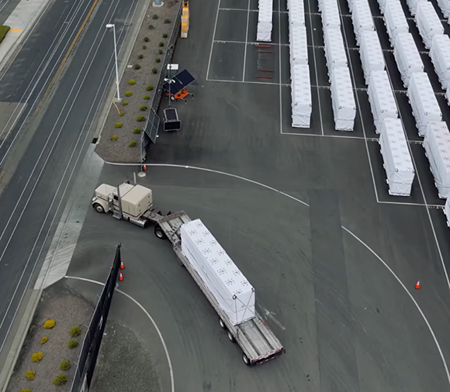
Which is why he believes they will go down as Elon’s greatest-ever invention… his biggest ever disruption.
On July 22, Elon is expected to share this new venture with the world.
Once he does, this is going to be everywhere — from Fox Business to your family’s group chat.
Adam believes investors who get positioned before that date could walk away wealthier than they ever thought possible. Everyone else will be reading about it after the stocks have already run.
He’ll show you exactly what Elon is building, what’s inside these strange white crates… and he’ll give you the name and ticker of one of his top picks to play it — completely free.
You are receiving this email because you subscribed to Trade of the Day Wake-Up Watchlist. Trade of the Day Wake-Up Watchlist is published by Monument Traders Alliance, LLC.
To stop receiving special invitations and offers from Trade of the Day Wake-Up Watchlist, please click here. Please note: This will not impact the fulfillment of your subscription in any way.
Please do not reply to this email as it goes to an unmonitored inbox.
Nothing published by Monument Traders Alliance should be considered personalized investment advice. Although our employees may answer your general customer service questions, they are not licensed under securities laws to address your particular investment situation. No communication by our employees to you should be deemed personalized investment advice. We allow the editors of our publications to recommend securities that they own themselves. However, our policy prohibits editors from exiting a personal trade while the recommendation to subscribers is open. In no circumstance may an editor sell a security before subscribers have a fair opportunity to exit. The length of time an editor must wait after subscribers have been advised to exit a play depends on the type of publication. All other employees and agents must wait 24 hours after publication before trading on a recommendation.
Any investments recommended by Monument Traders Alliance should be made only after consulting with your investment advisor and only after reviewing the prospectus or financial statements of the company.
Protected by copyright laws of the United States and international treaties. The information found on this website may only be used pursuant to the membership or subscription agreement and any reproduction, copying or redistribution (electronic or otherwise, including on the world wide web), in whole or in part, is strictly prohibited without the express written permission of Monument Traders Alliance, LLC, 14 West Mount Vernon Place, Baltimore, MD 21201.