Don’t worry, it’s nothing scary. You could even say it’s all gain and no pain.
But first, some context: There is a popular myth that it takes 21 days to break a habit.
Surely there are many habits we all would be better off breaking. But as an investor, there are particular habits that could be holding you back from reaching maximum profits.
An important one is perspective.
My “macro” approach to investing, for example, utilizes a broad “topdown” perspective to pinpoint opportunities. By examining the global big-picture trends that drive huge, multiyear moves in entire sectors of the market, I’m able to discover some moneymaking opportunities that a non-global perspective might miss.
Admittedly, U.S. stocks have delivered world-beating results for nearly two decades, but many American investors assume this delightful trend will continue long into the future.
No matter what happens next, investors should never remain “overweight” in U.S. stocks and bonds simply because they are familiar.
So, here’s where my challenge comes in.
Over the next 21 days, which brings us neatly to the end of the month, I challenge you to adjust your investing habit and look beyond U.S. markets.
Over the span of a full market cycle, a dose of international exposure can provide a helpful diversification to your portfolio, while also growing your wealth.
For 40 years, Louis Navellier has had a front-row seat to history’s greatest wealth creation events. His proprietary stock grading system — what some have called “Wall Street’s FICO score” — has helped transform everyday Americans into millionaires. During one remarkable 15-year stretch, his recommendations turned every $1 invested into $41. These aren’t just claims. They’re documented successes that have led major financial institutions to pay a fortune for Louis’ insights. But what he’s seeing now is unlike anything in his four decades on Wall Street.
To be clear, I’m by no means bearish on the United States. I think we’re still the ground zero of innovation and capitalistic dynamism.
But it doesn’t mean there aren’t other opportunities in other countries.
Let’s take a look across the Atlantic Ocean…
For decades, Europe built its economic model around openness – cross-border trade, export dependence, global supply chains, and trans-Atlantic reliability. That model worked beautifully when the global system was stable.
It works less well when trade becomes political.
Energy shocks… supply-chain disruptions… war in Ukraine… and now growing policy unpredictability from the U.S. have all delivered the same message: Europe can no longer assume that external commerce will always be reliable.
So, Europe has begun prioritizing intra-European trade and supply chains.
Over the span of decades, global investors have learned a simple reflex: When in doubt, buy America. Its companies were always among the world’s most dynamic, innovative, and profitable enterprises… and still are.
However, in a world where trade is fragmenting, policy is unpredictable, and alliances are increasingly transactional, Europe’s emphasis on internal commerce and strategic autonomy becomes a valuable asset.
In fact, we’re already seeing a pullback in U.S. reliance following last week’s India-European Union (EU) deal, which dramatically lowered tariffs on EU imports into India, creating the world’s largest free trade zone.
By itself, that’s not some headline. But it isa part of a mosaic where we’re seeing capital attempt to flow around the U.S. – instead of into the U.S.
As an investor, if you’re not monitoring other countries’ behaviors and what they’re doing with their capital, then there’s a good chance you’re missing out on some opportunities.
So, I’d like to share how I’ve reaped the benefits of investing in international stocks – and how you can, too…
Putting My Challenge Into Practice
You don’t want to ignore something just because it’s a habit, nor do you want to behave a certain way out of routine or limited perspective.
That’s why I challenge you – for the next 21 days – to begin widening your investment approach. Simply adding several non-U.S. stocks can bolster returns in today’s market.
In fact, my global macro perspective allowed me to identify a current international holding in Fry’s Investment Report at the ideal time – a luxury and lifestyle company now up 56% in 10 months.
At Fry’s Investment Report, I also recommend several foreign ETFs that are currently capturing double-digit gains and outpacing the S&P 500 by a wide margin, as I advised members to ride the potential of their countries’ transformations.
Manage your account We hope this timely investment research is valuable to you. As you know the markets move fast and conditions change frequently. So please check the current issue for the most recent advice. Please note that we cannot be liable for any missed bulletins caused by overzealous filters. To ensure that you continue to receive this valuable part of your service please take a moment to add services@exct.investorplace.comto your address book.
In a world where partisan and biased reporting has become commonplace, you can always count on The Epoch Times for a refreshing dose of factual, honest journalism without spin. When you don’t feel like reading the news, pick up a daily tip from us. From how to make honey-fermented garlicfor a healthier gut to what elevated vitamin B12 levels might say about your body, our health coverage is deep and extensive. You will find your kind of healthy changes to make right away. Yet what makes you truly love The Epoch Times may be none of the above. It is our talks on art, culture, and history that move hearts. At nighttime or on an indolent Sunday afternoon, find yourself indulging in a fascinating read on stories you have been longing for: a trip to the Allegheny Mountains for America’s oldest retreat for healing; see the restoration of the Sistine Chapel where Michelangelo’s true colors were revealed; a young lady struggling to find peace after the loss of her father finally found healing—through a hawk… The list is endless. The inspiration is infinite.
Subscribe to The Epoch Times with our Flash Sale Rate
A federal appeals court has sided with the Trump administration in upholding a policy that mandates detention without bond hearings for illegal immigrants in the United States who entered without…
Almost 2,000 truckers deemed to be unqualified to drive on U.S. roads have been removed, with several arrested and many vehicles put out of service, the Department of Transportation (DOT)…
They talked about locking in control over energy, nuclear power, space technology, and high-tech industries — the exact tools that decide who runs the global system.
As global tensions are rising, U.S. influence keeps shrinking.
China is quietly helping Russia survive sanctions.
And Europe is making trade deals with Beijing.
When energy, money, and technology move away from the U.S., everyday Americans pay the price.
And unfortunately, most people won’t see this coming until the damage is done.
While mainstream media has ignored his warning, putting millions at risk,one man has seen this on the horizon for months…
Wall Street insider John Browne, a one-time adviser to President Trump, as well as a regular Newsmax contributor, is warning of this imminent crisis — millions of Americans could see their purchasing power collapse if they don’t prepare now.
That’s why he’s urging Americans to Take 15 minutes and read this IMPORTANT BREIFING.
In his latest warning,Browne reveals the EXACT steps you can take to prepare for a collapse of the U.S. dollar.
This email is never sent unsolicited. You have received this Newsmax email because you subscribed to it or someone forwarded it to you. To opt out, see the links below.
Remove your email address from our list or modifyyour profile. We respect your right to privacy. Viewour policy.
This email was sent by: Newsmax.com 362 N. Haverhill Road West Palm Beach, FL 33415 USA
Planning for retirement raises many questions. Have you considered how much it will cost, and how you’ll generate the income you’ll need to pay for it? For many, these questions can feel overwhelming, but answering them is a crucial step forward for a comfortable future.
This email is never sent unsolicited. You have received this Newsmax email because you subscribed to it or someone forwarded it to you. To opt out, see the links below.
Remove your email address from our list or modifyyour profile. We respect your right to privacy. Viewour policy.
This email was sent by: Newsmax.com 362 N. Haverhill Road West Palm Beach, FL 33415 USA
Our Morning Brief newsletter is one of the best ways to receive the most up-to-date information. Manage your email preferences here or unsubscribe from Morning Brief here.
This ad is sent on behalf of NewMarket Health Publishing, LLC. P.O. Box 913, Frederick, MD 21705, USA. If you would like to unsubscribe from receiving offers from NewMarket Health Publishing, LLC, please click here.
This email is never sent unsolicited. You have received this Newsmax email because you subscribed to it or someone forwarded it to you. To opt out, see the links below.
Remove your email address from our list or modifyyour profile. We respect your right to privacy. Viewour policy.
This email was sent by: Newsmax.com 362 N. Haverhill Road West Palm Beach, FL 33415 USA
After gaining less than 4% in 2025 and finishing second-worst among the S&P 500’s 11 sectors, consumer staples stocks are staging a comeback this year.
Just over a month into 2026, the consumer staples sector has posted a gain of nearly 9%, trailing only the energy and materials sectors’ gains of nearly 12% and 10%, respectively.
While the rotation out of tech has benefited those defensive sectors, so too have the year-to-date (YTD) performances of two of America’s largest retailers.
Target (NYSE: TGT) and Walmart (NASDAQ: WMT) have posted YTD gains of nearly 11% and more than 13%, respectively. And with both corporations now under new leadership, arguments can be made in favor of both as investors hope consumer staples’ early success this year continues.
Walmart Picks a Familiar Face to Succeed McMillon
On the back of a more than 24% gain in 2025, Walmart joined the $1 billion market cap club on Tuesday, Feb. 3—just three days into the tenure of newly appointed president and CEO John Furner.
Furner, who took the reins on Feb. 1, is following in the footsteps of Doug McMillon, who served as Walmart’s fifth CEO for 12 years and began with the company as a summer stock associate in his first job as a 17-year-old in 1984.
McMillon notably led Walmart through its digital transformation, making the company’s membership-based Walmart+ a leading competitor to Amazon (NASDAQ: AMZN) while maintaining its warehouse segment Sam’s Club as a leading competitor of Costco (NASDAQ: COST).
When the company reports its Q4 fiscal year 2026 (FY2026) earnings on Feb. 19, it will reflect the final quarter of McMillon’s run as CEO—a legacy that Furner will look to build upon, including 14 earnings and revenue beats in the past 16 quarters.
Furner, who in 1993 also began working for Walmart as an hourly associate, will look to continue his predecessor’s track record of EPS growth, which stood at 44.08% and 26.18% the past two years.
Perhaps the biggest challenge facing the new CEO will be maintaining Walmart’s unprecedented growth while successfully implementing AI. Until then, investors can look forward to a steadily increasing yield. The Dividend King has now increased its payout for 53 consecutive years, while maintaining a healthy payout ratio of less than 33% to go along with an annualized five-year dividend growth rate of 3.17%.
Target’s New CEO Faces an Uphill Battle
Conversely, new Target CEO Michael Fiddelke—who previously served as the company’s COO—has a more challenging landscape to navigate after taking over on Feb. 1.
The company’s previous CEO, Brian Cornell, stepped down after 14 years of service, the tail end of which was marked by a less-than-desirable financial performance stemming from declining consumer sentiment, a struggling grocery line that has seen shoppers prioritize competitors like Walmart and Costco, and a sustained slump in higher-margin discretionary goods amid ongoing inflation.
The result has been shares losing more than 57% from their five-year high in August 2021, exacerbated by revenue losses in 2023 and 2024 and negative EPS in 2024.
Target has missed earnings expectations in three of the past seven quarters, with revenue missing in five of those quarters.
For patient investors who believe Target’s forward price-to-earnings ratio of 12.80 signals better performance ahead, the stock—a Dividend King like Walmart—yields 4.10% versus its peers’ 0.74%, along with an annualized five-year dividend growth rate of 11.30%.
What Analysts Think of Walmart and Target
Given the stock’s recent success and consumer staples’ inelastic demand, analysts are bullish on WMT, with 32 of the 34 covering the stock assigning it a Buy rating. However, Walmart’s average 12-month price target of $123.93 suggests nearly 3% downside.
On the other hand, the majority of the 34 analysts covering Target assign it a Hold rating to go along with an average 12-month price target of $103.21, or more than 7% potential downside.
According to Target’s current short interest of 3.79% of the float, Wall Street’s bears foresee more downside risk than they do for Walmart, whose current short interest stands at just 0.50%.
However, one notable advantage for Target is that the smart money has piled into the stock, with institutional ownership of nearly 80% resulting in more than $12 billion in inflows over the past 12 months versus just shy of $7 billion in outflows. Walmart’s institutional ownership is notably lower at less than 27%, but inflows of more than $52 billion over the past 12 months are more than double the outflows of nearly $24 billion.
Target scores higher than 87% of companies evaluated by MarketBeat, ranking 43rd out of 201 stocks in the retail/wholesale sector, while Walmart ranks 86th out of 201 and scores higher than 72%.
But Walmart’s big edge comes via its TradeSmith financial health score, which has seen the company in the Green Zone for more than nine months, compared to Target, which has spent the majority of the past year in the Red Zone.
Uber (NYSE: UBER) stock retreated to the buy zone in early Q1 2026, and signs indicate it can take investors on a ride they’ll like. Boosted by recent earnings results, analyst trends, and institutional buying, this stock represents a profitably growing tech company relevant today and for the future.
Focused on ride-sharing and final-mile services, Uber’s future is tied to autonomous driving and the application of physical AI. Partnerships include NVIDIA (NASDAQ: NVDA) for infrastructure and platform support, as well as major AV developers such as Waymo and Aurora, which already have AVs in operations.
Uber Drives Away With Record Free Cash Flow in 2025
Uber’s Q4 earnings left something to be desired, with adjusted earnings per share (EPS) falling short of estimates; however, the results were strong overall. Revenue of $14.73 billion was up 20.2% compared to the prior year, sustaining its 20% growth pace for another quarter, and outperformed analyst consensus by a slim margin.
Growth was driven by an 18% increase in active users, compounded by a 3% increase in trips per user. Trips were up 22%, bookings were up 22%, and margins expanded. Mobility grew by 20% and Delivery saw a 26% gain, underpinning the longer-term outlook.
The earnings and profitability news was mixed. Adjusted earnings fell short of expectations, setting the stage for the post-release stock price drop despite significant year-over-year (YOY) improvement. That miss overshadowed what was otherwise a strong quarter, highlighted by expanding margins and record cash flow.
Critical details included a 35% increase in adjusted EBITDA, a 46% increase in adjusted operating income, a 25% increase in net income, and a 65% increase in free cash flow (FCF), totaling $2.8 billion.
Guidance was another sticking point for investors. Uber expects a typical seasonal step-down from Q4, but the 2026 guidance still implies roughly 19% growth versus the same quarter last year, with adjusted earnings of 68 cents.
The 68 cents was below consensus; however, that figure reflects wider margins and is likely cautious. Momentum in Q4 will likely carry into the current quarter and potentially strengthen as the yearprogresses. Recent news from Washington points to de-escalation in trade relations, moderating inflation, and accelerating global economic activity.
Free Cash Flow Drives Analysts and Institutional Interest
Revenue growth is central to the stock price outlook, but cash flow is more so. The company’s 2025 pivot to improving free cash flow enabled a robust repurchase plan that is reducing the count semi-aggressively. With the share count down about 1.5% on average for both the quarter and the year, that pace looks likely to continue in 2026, boosting per-share results.
Institutional interest affirms Uber’s potential for investors. The group owns more than 80% of UBER shares and bought on balance throughout 2025, providing a support base and tailwind for price action.
The trend has persisted in early Q1 2026, with activity accelerating to a $2 bought for each $1 sold, suggesting strong support at price points aligned with technical support and trend targets.
Regarding the analysts, some moderated price targets emerged following the guidance update, but no significant change to the outlook was noted.
There is some concern about near-term margin pressure, but bookings, operational leadership, pricing power, and longer-term forecasts outweigh it.
The analyst consensus remains a Moderate Buy, sentiment is firming, and the consensus, up 20% in the last 12 months, forecasts a 40% upside and new all-time highs.
Uber Points to Hard Bottom After Guidance Update
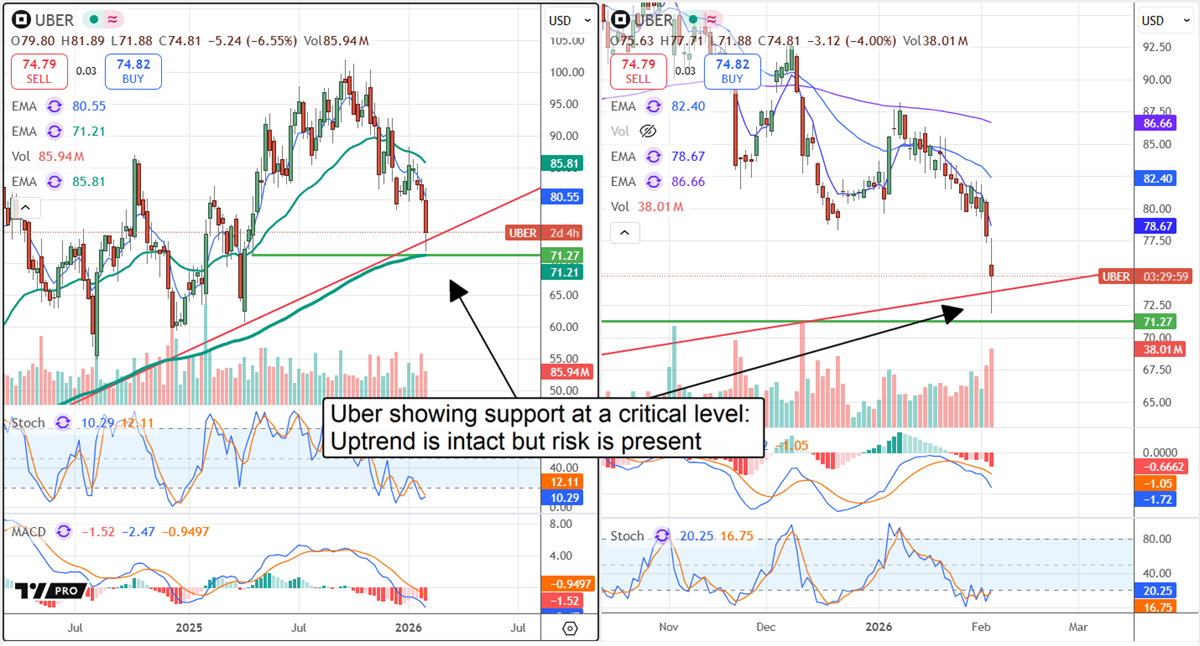
The price action in UBER stock isn’t bullish at first glance, with shares down a moderate single-digit amount, but a closer inspection reveals support at critical levels.
Both the daily and week-to-date candles show support with long lower wicks; the lower wick is notably longer on the daily chart than the upper one. This signal amounts to a market unsure of where it is going but reasonably sure that lower prices aren’t the right move. The market can rebound quickly in this scenario, but there is a risk of it breaking the trend and becoming range-bound until potent catalysts emerge.
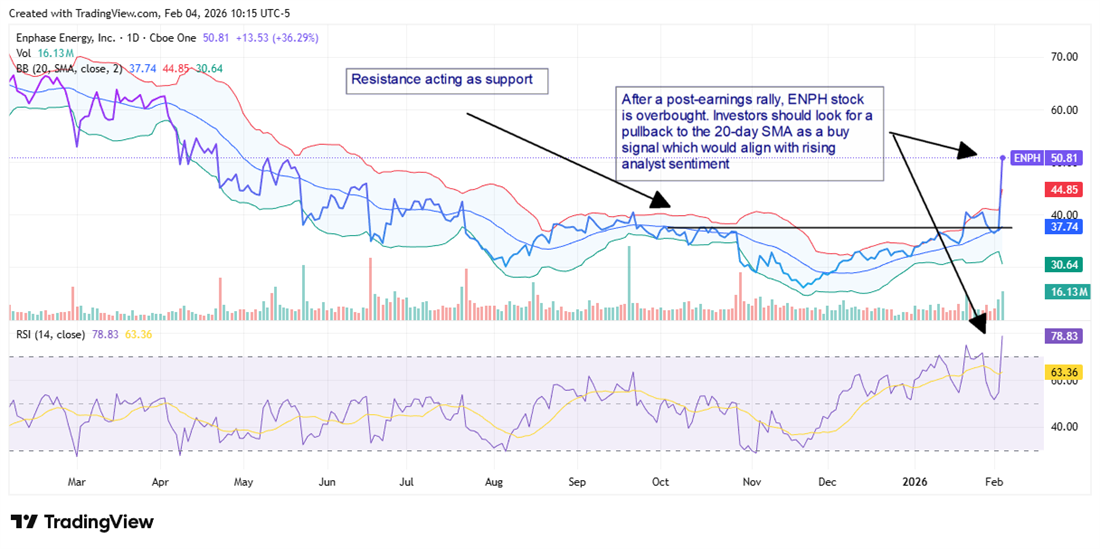
Enphase Energy (NASDAQ: ENPH) was up more than 50% in early trading on Feb. 4, the day after the company delivered its quarterly earnings for the fourth quarter. Enphase beat on the top and bottom lines, with adjusted earnings per share (EPS) coming in at 71 cents on revenue of $343.32 million. That beat expectations of 59 cents in EPS on revenue of $340.45 million.
That said, on a year-over-year (YOY) basis, revenue was down about 10%. Yet, investors are pushing the stock higher. They seem to agree with Enphase management’s optimism that the current quarter may mark a bottom for the company as tariff pressures continue to ease.
Supporting that outlook, management raised its first-quarter revenue forecast to a range of $270 million to $300 million. The prior forecast was for $250 million. Furthermore, chief executive officer (CEO) Badrinarayanan Kothandaraman announced that Enphase was nearly 90% booked to the midpoint of its revenue guidance.
At the high end of that forecast, revenue would be up approximately 13% YOY. However, if the company is correct in saying that next quarter represents the trough, then it’s easier to see why investors were enthusiastic after a mostly bullish report.
The Ace Up Enphase’s Sleeve
Investors are also paying attention to Enphase’s emerging role in using its distributed energy ecosystem to help free up grid capacity for power‑hungry data centers, an area management has highlighted as a growth opportunity.
On the earnings call, Kothandaraman explicitly tied Enphase’s long‑term R&D roadmap to the data‑center build‑out. He noted that hyperscale operators are moving toward 800‑volt DC architectures and said Enphase is evaluating next‑generation front‑end power‑conversion designs that can efficiently step medium‑voltage AC at 13.8 kV to 34.5 kV down to 800‑volt DC before power reaches AI racks.
While he stopped short of giving specific product timelines, management framed behind‑the‑meter resources and virtual power plants as a “critical evolution” of the business as data‑center demand threatens to overwhelm local grids.
That commentary dovetails with recent remarks from Enphase’s marketing leadership, who see tech and data‑center developers subsidizing residential solar‑plus‑storage to unlock grid capacity in constrained markets. Third‑party analysis cited by the company suggests that this model could free up tens of gigawatts of effective capacity if large customers help fund distributed systems, potentially giving Enphase a new demand channel for its batteries, inverters, and emerging load‑management products.
For investors in the energy sector, this adds a longer‑duration AI and data‑center angle on top of the more traditional residential‑solar recovery thesis and helps explain why the market is willing to look through a 10% year‑over‑year revenue decline in the near term.
Beware of the Squeeze
Enphase delivered a strong report, and the stock was up about 16% for the year heading into the earnings report. That was a relief to any investor who held on through an ugly 2025.
But does it justify a 35% increase in the company’s stock price post earnings? It does if traders have to cover short positions. Short interest in ENPH stockis around 22% as of this writing. That’s not massive, but it’s significant and is certainly enough fuel to accelerate a post-earnings rally.
That said, ENPH stock is overbought after this sharp move higher. The Enphase analyst forecasts on MarketBeat show that several analysts have either upgraded ENPH stock or raised their price targets.
However, while most of the new targets are above the current consensus price of $44.53, they provide little to no upside from where the stock has bounced.
That means investors who are looking to get involved should wait for a pullback. That may happen in the next several days as some traders will look to take profits after this strong move higher.
Marathon Petroleum Company Is Ready to Sprint Higher
Written by Thomas Hughes on February 3, 2026
What You Need to Know
Marathon Petroleum Company is well-positioned to drive value in 2026 as margin strength and cash flow enable capital returns.
Buybacks aggressively reduce the share count each quarter.
Analysts and institutions support this market and point to record-high stock prices later this year.
Marathon Petroleum Company (NYSE: MPC) was poised to advance ahead of its Q4 earnings release, and the report triggered the move. Affirming the company’s strong position in petroleum refining and the strength of its capital return, the report catalyzed a trend-following signal with the potential to take this market to new highs. The dividend, as attractive as it is, isn’t the only driver, as share buybacks are part of the picture.
A key factor for investors is Marathon Petroleum’s approximately 70% stake in subsidiary MPLX. MPLX is a midstream limited partnership whose business is to collect fees and pay dividends. The dividend is substantial, yielding 7.8% on its own, and is sufficient to more than cover MPC’s own substantial payment.
Marathon’s dividendyield was approximately 2.25% as of early February. Alongside MPLX’s dividend income and Marathon’s healthy cash flow, that supports aggressive share buybacks, the primary driver of long-term price action.
MPC’s buybacks in Q1 and throughout 2025 reduced its average diluted share count by about 6.5% for the quarter and roughly 10% for the year, a pace likely to continue in 2026. Regarding the dividend, distribution increases are also expected. The company has increased payments for four consecutive years and has the capacity to continue the trend.
It could be in your 401(k) anchoring your portfolio.
But our independent Weiss Ratings, which have correctly called nearly every major financial event of the 21st century, just slapped this popular stock with a “SELL”.
Marathon Petroleum had a solid Q4, with revenue falling only 0.1% year-over-year, outpacing consensus by 300 basis points (bps). The strength was driven by refining and marketing, as well as strong margins.
Margins are the critical detail, as they were stronger than expected, producing leveraged strength in the bottom-line result.
The adjusted earnings came in at $4.06, or nearly 50% above the consensus forecast, with utilization and efficiency highlighting business quality. The company achieved 94% utilization and a 105% margin capture rate.
Guidance was also favorable. While no revenue or earnings estimates were given, the outlook for gasoline suggests margins will remain elevated, suggesting another strong year for MPC.
The company’s focus is on high-return capital projects, margin-enhancing efficiencies, and capital return. Projects include new capacity for transport, processing, and treatment in high-margin businesses.
Marathon Analysts Point to Record Stock Price Highs
Marathon Petroleum’s analysts responded favorably to the news, highlighting the Q4 strength and potential for momentum to build in 2026. While no revisions were issued immediately after the report, the chatter aligns with trends of increasing analyst coverage, firming sentiment, and a rising price target. Consensus assumed a 10% upside ahead of the release, with the high-end pegged at $220, in line with record highs.
Institutional activity aligns with the uptrend, suggesting downside risk is limited. The group owns nearly 90% of the stock and bought on balance in 2025. While selling outpaced buying in Q4 2025, the balance reverted to accumulation in early 2026, helping to put a market bottom in place following the Q4 2025 sell-off. The top three holders are fund managers Vanguard, BlackRock, and State Street Capital, which collectively own 30% of the stock.
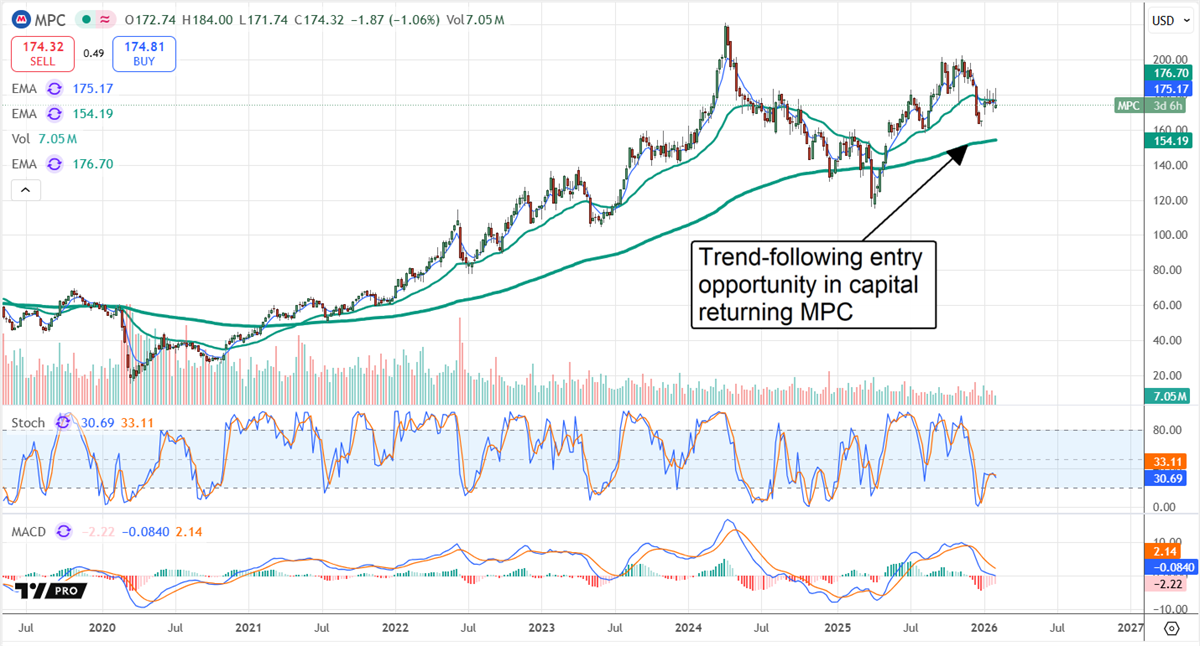
The post-release price action has been favorable. MPC price advanced following the release, extending a rebound that began in early 2026. The movement shows support at a pair of long-term EMAs, signaling a trend-following entry for investors.
The price is likely to trend higher, potentially reaching the $200 level by mid-2026 and record highs soon after. In the long term, fresh all-time highs seem inevitable due to institutional interest and share buybacks. The dwindling share count and improving equity leave no other option.
Thank you for subscribing to DividendStocks.com’s daily newsletter for dividend and income investors that covers ex-dividend stocks, new dividend declarations, dividend stock ideas, and the latest market news.
If you need help with your account, feel free to contact our U.S. based support team at contact@marketbeat.com.
If you no longer wish to receive email from DividendStocks.com, you can unsubscribe.
Blue chip stocks can be an ideal addition to your portfolio if you are risk-averse. These companies enjoy a favorable reputation and historic stability in the markets. Based on the latest activity, these 4 blue chip stocks have been gaining fast.
From renewed debate over Greenland’s strategic value to warnings about U.S. credit risk and clashes over crypto regulation, the weekend spotlighted political and financial tensions shaping Washington’s agenda. Continue Reading ➔Why Trump’s “Smart Dollar” Could Rewrite the Rules – Ad
Lucrative investment opportunities are always found in real estate. Real estate stocks can be an alternative way to invest in this area, without needing to purchase property. Here are the hottest stocks in this field.
Rollovers in retirement accounts are at record levels, but most are happening without professional guidance. Clients are seeking simplicity and coordination, creating opportunities for advisors. Continue Reading ➔
Information, charts, or examples contained in this email are for illustration and educational purposes only and not for individualized investment management. This message contains commercial elements, such as advertising and partner offers for which we may receive affiliate compensation. We only send these offers to those who have opted into our newsletter.
If you wish to no longer receive these offers, click on the unsubscribe link at the bottom of this email. Past performance is not indicative of future results. For these reasons, we strongly suggest trading in a DEMO/Simulated account.
The information provided by us is for educational and informational purposes only. We make no representations or warranties concerning the products, practices, or procedures of any company or entity mentioned or recommended in this email and have not determined if the statements and opinions of the advertiser are accurate, correct, or truthful.
If you use, act upon, or make decisions in reliance on information contained in this email or any external source linked within it, you do so at your own peril and agree to hold us, our officers, directors, shareholders, affiliates, and agents without fault.
2967 Dundas St. W. #990, Toronto, ON M6P 1Z2 | Phone Number: 917.672.7040


















































 Illuminating systematic strategies, actionable tips, and precise market insights for investors.
 RJ Hamster