Up 150 Percent from a PLTR Options Trade? Here’s How It’s Been Happening

Hey Trader,

Some stocks drift sideways for months.,

Others trend slowly.

And then there are rare moments when a stock develops the perfect combination of liquidity, volatility, and institutional interest that makes it an exceptional trading vehicle.

Right now, Palantir (PLTR) is one of those stocks.

Over the past several years, Palantir has quietly transformed itself from a niche government contractor into one of the most important data and artificial intelligence infrastructure companies in the world.

Its platforms help governments, military agencies, and major corporations process enormous datasets and turn them into real-time operational decisions.

That means PLTR sits directly at the intersection of several of the market’s most powerful themes:

• Artificial Intelligence
• National Security Technology
• Big Data Infrastructure
• Enterprise Software

When institutional money flows into these themes, PLTR often becomes one of the most actively traded stocks in the market.

And that type of activity is exactly what short-term options traders look for.

Because when a stock develops strong momentum and high liquidity, the options can move very quickly.

Which is why we built a strategy specifically designed to target those bursts of momentum.

Yesterday, the PLTR 142 Calls hit +137.50% on the remainder of the position (after hitting +100% on the first piece) for a total return of +$1,150. 

(example is allocating up to $1k per trade, past performance doesn’t guarantee future results) 

The system responsible for that trade is called PLTR Options Trader, 

and it is laser-focused on trading short-term options on Palantir using precise intraday signals. 

Instead of scanning hundreds of charts, the system concentrates on one powerful stock and waits for specific technical conditions to appear.

The result is a structured strategy designed to capture momentum moves that can develop very quickly.

But before I go any further…

I recently hosted a special training session where I walked traders through exactly how this strategy works.

If you’d like to see the full breakdown, including chart examples and trade reviews…

Tap here to watch your replay of the event.

Inside that presentation I explained why PLTR has become such an attractive stock for options traders.

For starters, the stock tends to produce strong directional bursts when momentum builds.

Those bursts can translate into meaningful percentage moves in short-term options.

But the key is having a clear framework for identifying those setups.

That’s exactly what the PLTR Options Trader system was designed to do.

Here’s how the strategy works.

Every weekday morning, our system scans the chart for potential signals during a defined time window between 10:00 AM and 11:00 AM Eastern. 

That scanning window allows us to focus on the most actionable price movement while avoiding much of the random market noise that occurs earlier in the session.

The strategy itself uses a combination of two indicators:

• PercentR Zones
• ADX Pattern Analysis 

We divide the PercentR indicator into thirds.

The top third and bottom third of the range can act as bullish zones, depending on how the ADX trend pattern is behaving.

There are also situations where the system identifies bearish setups, particularly when PercentR spikes above certain thresholds.

The exact settings we use are not the common defaults most traders are familiar with.

And those proprietary inputs are part of what allows the system to produce such distinctive signals.

Subscribers receive the exact rules and settingsso they can replicate the strategy.

All trades are executed using next-week options contracts, which historically have averaged less than $2.00 per contract over the past 12 months.

That structure allows the strategy to target meaningful percentage moves while keeping the capital requirement relatively modest.

Trades are typically held five days or less, and positions are closed by 3:00 PM ET on the fifth day if they have not exited earlier.

Another important component of the strategy is how the position is managed.

The system begins with a +100% target on half of the position. 

Once that first portion closes, the trade becomes effectively risk-free on the remaining contracts.

From there, the second half of the position is allowed to run, with the possibility of larger gains if momentum continues.

Over time, this structure has produced a variety of outcomes.

Here are several trade examples generated by the strategy.

+100% and +124.68% on the PLTR 195 Calls
+129.03% and +170.97% on the PLTR 170 Calls
+100% and +207.84% on the PLTR 86 Calls
+121.30% and +622.22% on the PLTR 52 Calls
+100.57% and +315.25% on the PLTR 111 Calls

Those were all call trades.

But the system also identifies bearish opportunities when conditions align.

For example…

+100% and +312.88% on the PLTR 87 Puts.

Of course, not every trade will be profitable.

Losses do occur.

Like the PLTR 102 Calls closed at a -51.30% loss.

But that is part of the strategy design.

By taking partial profits early and allowing runners to develop, the system is structured so that larger winners can outweigh smaller losses over time. 

In fact, since January 1st of 2024, these trades have produced…

Over $21k in cumulative returns,

By allocating up to $1,000 per trade within a $5,000 model portfolio.

That equates to a +429% return on the model portfolio during that period. 

Past performance does not guarantee future results.

But it does illustrate how powerful this strategy has been during favorable conditions.

Another benefit traders appreciate is the simplicity of execution.

This is not a strategy that requires watching charts all day.

The system focuses on a defined morning scan window, then alerts subscribers when a qualifying signal appears.

On average, the strategy has generated 6 to 8 trades per month.

Which means there is typically a steady flow of opportunities without overwhelming traders with constant activity.

Now the question becomes…

How can you start receiving these trades? 

Today we are opening the doors to a special quick-start package for PLTR Options Trader. 

Here’s what you receive…

– 24 Months of Real-Time PLTR Options Trade Alerts
Sent via email and mobile notification.

– The PLTR Options Trader Settings & Rules Sheet
So you can replicate the exact inputs used by our system.

– Weekly Video Market Updates
Where I share insights on the broader market and recent trades.

– Unlimited Email Access to Our Research Team
So you can ask questions whenever you need clarification.

The total retail value of this package is $7,128.

($297 per month for 24 months)

But for a limited time, we are offering the complete package for $1,997. 

And there’s more…

When you apply the promo code PLTR1000

You’ll take $1,000 off instantly. 

Which brings the final price down to just:

$997! 

That is two full years of PLTR Options Trader alerts plus all included resources.

And there is also a performance commitment attached to this offer.

If your first PLTR Options Trader alert does not make you at least $1,500 in profit, then you will receive LIFETIME ACCESS to the service for free. 

(Allocating up to $1k per trade, based on the model portfolio. Lifetime access refers to the lifetime of the subscriber. If this product is ever discontinued, access may be transferred to a comparable offering. Trading involves risk and losses will occur. Past performance does not guarantee future results. Once Lifetime Access is granted, no additional fees will be due to BigTrends for this product.)   

You do not need to take the first trade in order to qualify for the commitment! 

We will track the results and will automatically apply your bonus time if needed. 

To summarize…

After your first PLTR Options Trader signal closes, one of two things will happen.

You will either have a +150% profit in your pocket (+$1,500 on a $1,000 allocation)


or

You will receive lifetime access to the PLTR Options Trader alert service at no additional cost! 

Tap here to claim your trades and performance commitment.

Now here’s the final breakdown…

– Real-Time PLTR Options Trade Alerts – 24 Months

– Weekly Video Updates

– Full Strategy Settings and Rules Sheet

– Unlimited Email Support

Total Retail Value: $7,128

Your Price Today: $997 with Promo Code PLTR1000 

But please don’t wait too long.

This offer is limited to the first 17 traders who claim access.

Once those spots are filled, the offer will close.

Trade Well,

Price Headley
Founder and CEO of BigTrends

P.S.

If you’re serious about trading PLTR options with a structured approach…

This strategy gives you a framework designed to identify momentum signals quickly and act on them with discipline.

Use promo code PLTR1000 right now and secure 24 months of PLTR Options Trader alerts for just $997. 

And remember…

If your first alert doesn’t generate at least $1,500 in profit, then you will receive lifetime access to the service for free! 

If yesterday’s +$1,150 winner was your first trade then you would have been upgraded to LIFETIME access, at no additional charge! 

Tap here to claim your PLTR Options Trader package before this window closes.

Yes, Give Me Access to PLTR Options Trader + a $1,000 Instant Gift Card, a Performance Commitment and More!

The information above reflects the track record of each of BigTrends.com’s trade alerts for this product during the period of time identified.

Stocks and options trading have large potential rewards, but also large potential risk. You must be aware of the risks and be willing to accept them in order to invest in the stocks and options markets. Don’t trade with money you can’t afford to lose. BigTrends.com does not represent that any account will or is likely to achieve profits or losses similar to those discussed. The past performance of any trading system or methodology is not necessarily indicative of future results. All trades, patterns, charts, systems, etc., discussed are for illustrative purposes only and not to be construed as specific advisory recommendations. Information shown is intended for informational purposes only.

BigTrends.com is a publisher and the information provided through its products and services are for informational purposes only. To the extent any such information is deemed to be advice, such information is impersonal and not tailored to the investment needs of any specific person.

BigTrends.com is not restricted from owning individual securities or options. In addition, certain BigTrends.com affiliates and employees may, from time to time, have long and short positions in, or buy or sell the securities, or derivatives thereof, of companies mentioned in BigTrends.com’s products and may take positions inconsistent with the views expressed by BigTrends.com.

Facebook
Twitter

Unsubscribe

HIA Corp. 201 West Vine Street Lexington, Kentucky 40507 United States

The Coming Currency Collapse

Issue #60, Volume #3The Coming Currency CollapseBy Porter Stansberry • Tuesday 21, April 2026View in browser

Inside today’s Daily Journal…

  • Essay: The Coming Currency Collapse
  • A rare upward adjustment to EPS earnings
  • Global debt explodes
  • Trump authorizes support for LNG and electricity
  • Chart Of The Day… MSCI
  • Today’s Mailbag

This Is Not An Opinion – This Is The Historical Record

Editor’s note: On Friday, Porter shared part 1 of a three-part Journal about William Strauss and Neil Howe’s generational theory, which proposes that history runs in 80-plus-year cycles, divided into four distinct phases or Turnings.

To be clear, Porter wrote, this is not a prophecy. This is pattern recognition. And the fourth period – the “Crisis” period – began in 2008. And since each turning lasts around 21 years, that means 2029 will see the final, climatic end of this generational crisis.

Porter begins part 2 today…

The “Crisis” period began in September 2008…

Our money supply (M2) has grown from roughly $8 trillion in 2008 to $22.44 trillion – a 180% increase in the currency supply in 17 years

Federal debt has erupted to almost $40 trillion. Debt-to-GDP has crossed 120%, shattering the 1946 record that had stood for 80 years. Net interest on the national debt has passed $1 trillion annually – larger than the entire defense budget, and nearly triple what it was just five years ago.

This is not a cyclical downturn. This is the final storm. The only path forward is a complete financial reset.

If the financial signatures of the ordinary turnings are clear, the signature of the Fourth Turning – the Crisis – is emphatic to the point of brutality.

What always happens at the end of the Fourth Turning is the complete collapse of the sovereign’s existing debt and currency regime. And these changes go way back in Western Civilization – long before democrats and republicans and Democrats and Republicans.

The best, most illustrative example was the destruction of the Knights Templar.

In the 13th century, King Philip IV of France was the most powerful monarch of his age. But endless wars with Flanders and England gutted his treasury. He tried every expedient the medieval state allowed. See if this sounds familiar…

First, he debased the currency.

Between the 1290s and 1306 Philip IV systematically reduced the silver content of the French livre. When the economy began to seize up from the resulting inflation, the value of French sterling collapsed by more than 60%, forcing Philip to order the mass confiscation of private silver plate for re-minting.

Americans did the same when silver soared to $50 in 1980 and when it soared again to $100 this year.

Second, he expropriated his creditors one class at a time.

In 1291 King Philip arrested the Lombard merchant-bankers who had extended him vast loans against future taxes, seized their assets, and extracted 250,000 livres tournois by forcing them to purchase French nationality.

What do you think U.S. President Donald Trump is doing by starting a trade war with China? And have you seen Trump’s Gold Cards? You can buy U.S. citizenship for $5 million.

Third, on July 22, 1306 – the fast of Tisha B’Av – he arrested every Jew in France in a single coordinated dawn raid of roughly 100,000 people.

Philip IV expelled the Jews with only the clothes on their backs and 12 sous each, auctioned off their homes and belongings, and, crucially, transferred every debt owed to them onto the Crown’s books.

I know, you think that can’t happen in America. What do you think all of the demands for reparations are really about?

After running out of every other option, on September 14, 1307, Philip IV sent sealed orders to every bailiff in France, to be opened simultaneously a month later.

At dawn on Friday, October 13, 1307, roughly 15,000 Templar Knights across France, including Grand Master Jacques de Molay, were arrested in a single coordinated strike. Why? Gold of course. The king seized the knights’ treasury. And all the king’s debts to the Knights Templar vanished. On March 18, 1314, Jacques de Molay was burned alive on an island in the Seine in view of Notre-Dame, the pyre deliberately constructed of slow-burning green wood. This is why, even today, Friday the 13th is a feared day.

Read the sequence again with modern eyes and the financial architecture of a Fourth Turning is unmistakable:

unsustainable sovereign debt → currency debasement → expropriation of foreign creditors → expropriation of domestic creditors → dynastic and geopolitical collapse.

Philip IV ran the complete Fourth Turning financial playbook in less than 25 years, in the 13th century, and every element of it – every single one – has been repeated in every sovereign debt crisis since.

This is not medieval. It isn’t a renaissance pattern. It’s not a modern pattern. This is a human pattern and human nature does not change.

The saeculum that Strauss and Howe mapped is simply the local expression, in one civilization, of an arithmetic that governs every state powerful enough to borrow and too proud to pay.

When the debts become impossible to repay, the sovereign always – always – turns on his creditors.

The only questions are who the creditors are, what name is given to the confiscation, and what comes next.

  • The Revolutionary Fourth Turning (1773–1794) The Continental Congress, lacking the power to tax, paid for the Revolution by printing $241 million in Continental currency. By 1780 the bills were worth one-40th of their face value. By May 1781 they “ceased to circulate as money” altogether. The Crisis was resolved only by the constitutional convention of 1787 and Alexander Hamilton’s sound-money restoration. A new monetary order had to be built from ash.
  • The Civil War Fourth Turning (1860–1865) In December 1861 President Abraham Lincoln suspended specie convertibility. In February 1862 Congress passed the Legal Tender Act, authorizing $150 million in “greenbacks.” Union inflation hit 25% in 1863 and 1864. In the Confederacy, the money supply rose 20-fold and an item that cost $1 in 1861 cost $92 in 1865. Federal debt grew from $65 million to $2 billion in five years. The Crisis was resolved only by a new monetary order – the National Banking Acts – that rebuilt the dollar around federal supremacy.
  • The Great Depression Fourth Turning (1929–1946) From 1929 to 1933, debt-to-GNP exploded from 16.4% to 42.3%. On April 5, 1933, President Franklin Roosevelt signed Executive Order 6102, making private ownership of monetary gold a crime. On June 5, 1933, Congress abrogated the gold clause in every private and public contract in America. In 1934 the price of gold was revalued from $20.67 to $35 an ounce — an overnight 69% devaluation of the dollar by government fiat. A new monetary order was imposed on the world.

The pattern is unmistakable: every Fourth Turning climax in Anglo-American history has been a mass confiscation of purchasing power, engineered by the state, to liquidate debts that could not otherwise be paid.

This is not an opinion… This is the historical record.

The names change – Continentals, greenbacks, gold clauses – but the mechanism is identical: when the arithmetic of the old regime becomes impossible, the currency is sacrificed to save the state.

Which brings us to 2029.

Tell me what you think: porterstansberrydirect@gmail.com

On Thursday, in part 3 of the Journal, Porter will complete his discussion of the Fourth Turning, when he explains why the current trajectory of American fiscal policy cannot go on forever. As a result, he says, it will stop.

Good investing,

Porter Stansberry
Stevenson, Maryland

3 Things To Know Before We Go…

1. Analysts shrug off war concerns and raise earnings estimates. Historically, Wall Street analysts revise earnings estimates down going into each reporting period, providing a low bar for corporate America to step over. This year, however, analysts have bucked this trend and raised 2026 earnings estimates 5% over the preceding 12 months. The rising estimates are mostly concentrated among chipmakers, which benefit from the AI infrastructure buildout. At least so far, the global energy crunch caused by the war in Iran has not impacted this year’s strong outlook for S&P 500 earnings.

2. The last time the world carried this much debt, it had just finished fighting Hitler. Global government debt is projected to hit 102% of GDP by 2031, a level the world hasn’t seen since World War II. U.S. federal debt is tracking to 142% of GDP by 2031, and China’s debt is climbing toward 127%. All this means that global interest payments are projected to rise from 3% of GDP today to 5% by 2031… this is money that cannot build infrastructure, cannot fund innovation, cannot drive growth. The global economy is no longer being grown – it’s being borrowed. Own real assets: gold, energy, productive land, businesses that can raise prices. Do not own long-dated sovereign debt.

3. Trump invokes the Defense Production Act to fund coal, LNG, and the electric grid. On Monday, the president authorized the U.S. Energy Department to channel funds toward coal-fired power plants, liquefied natural gas (“LNG”) infrastructure, refineries, and grid equipment such as transformers and turbines. The framing is national defense, but the motivation is obvious. Voter angst over the rising cost of gasoline and electricity – inflamed by the Iran war and AI power demand – threatens Republican control of Congress in November’s mid-term elections.

Chart Of The Day… Index Leader MSCI

Index and analytics giant MSCI (MSCI) reported Q1 2026 this morning: revenue and EPS both rose around 14%, with a 59.3% adjusted EBITDA margin – the kind of printing-money profitability that defines a true compounder – and recurring subscription retention at 95.4%. This is exactly why MSCI is a Complete Investor recommendation: the toll booth is always open, and every time money moves in global markets, MSCI clips a coupon.

To see more recommendations like this, to receive buy-and-sell alerts, and to watch Porter and his team’s monthly editorial Roundtable, become a Complete Investor subscriber by going here now.

Mailbag

On Friday last week, Porter shared the first Daily Journal on “The Fourth Turning.” Readers share their thoughts…

“The Fourth Turning”

Joe P. writes:

Porter: I have been reading the book. It is indeed a very scary future. Most people are sleepwalking right into the chaos. Unfortunately, the signs are everywhere. The government and media are huge propaganda machines. It will end badly. I have read several of your books, which point out the same thing. Thanks for giving us guidance in these trying times.

“Feedback On The Fourth Turning”

Michael Y. writes:

Your assessment is completely correct. I have been working for 30 years, gradually putting together roughly the same assessment of the Fourth Turning. Mine is based on being a scientist with curiosity about history, politics, economics, and generational dynamics.

I look forward to reading your next article.

I believe so strongly in my own findings and related authors (Howe) that I have spent a lifetime preparing for and investing my savings in ways to prepare for the coming social, political, and economic storm.

Now, with it fast approaching, friends and family are only now coming to understand what I have been saying for years. Being vindicated is bittersweet. However, the storm approaching is so vast, I honestly wish I had been wrong.

In last week’s Daily Journal, Porter emphasized the financial and crime-ridden disaster that is New York, explaining that he plans to move to Winter Park, Florida.

“It Wasn’t Exceptionalism, It Was Capitalism – And It’s Over”

Rob C. writes:

Great post. A friend of mine shared it with me and I’ve since shared it with many other people.

I’m a 66-year-old recently retired father of three and the son of a career naval officer. Lived mostly on the East Coast, including Virginia Beach, Newport, Rhode Island, and then Jacksonville. I ended up as a University of Florida graduate and have resided in Florida for most of my adult life.

I have three early-20s college graduates and luckily, I’ve convinced all of them to stay away from New York City. They’re all gamefully employed in the southeast.

My note is mostly to share my thoughts on relocating to Florida. I’m familiar with most of the state and have lived in three of the four major cities, including in Winter Park. Like most states today it boils down to being in the right zip code no matter where you are.

When it comes to Florida, there are basically about eight to 10 towns that I think are the best. For what it’s worth here they are. Basically these are organized in zone:Jupiter, Tequesta, Hobe SoundPonte Vedra or Atlantic BeachWinter Park or WindermereSouth TampaNaples

For what it’s worth, I actually lived in Winter Park right out of college and have been there throughout my younger years as my grandparents lived a block off of Park Avenue behind St. Margaret Mary Catholic Church. It’s a beautiful spot, especially the Park Avenue and Rollins College area.

There are other nice small towns throughout the state but the key for me is an airport nearby.

Thanks again for your writings, and best of luck to you and your relocation.

Please note: The investments in our “Porter & Co. Top Positions” should not be considered current recommendations. These positions are the best performers across our publications – and the securities listed may (or may not) be above the current buy-up-to price. To learn more, visit the current recommendations page of the relevant service, here. To gain access or to learn more about our current recommendations, call our Customer Care team at 888-610-8895 or internationally at +1 443-815-4447.


www.PorterandCompany.com |  support@porterandcompanyresearch.com | 888-610-8895

You have received this e-mail as part of your subscription with Porter & Company, LLC. If you no longer want to receive e-mails, unsubscribe here.

Porter & Company, LLC welcomes comments or suggestions at support@porterandcompanyresearch.com. For questions about your account or to speak with customer service, call 888-610-8895 Monday-Friday, 9 a.m.-5 p.m. Eastern time. 

Please note: The law prohibits us from giving personalized financial advice.

© 2026 Porter & Company, LLC,. All rights reserved. Any reproduction, copying, or redistribution, in whole or in part, is prohibited without written permission from Porter & Company, LLC.

Disclaimer: Nothing in this email should be considered personalized financial advice. Do not consider any communication between you and Porter & Company, and its employees or writers as financial advice. This work is based on SEC filings, current events, interviews, corporate press releases, and what we’ve learned as financial journalists. It may contain errors, and you shouldn’t make any investment decision based solely on what you read here. Insight is provided to help readers gain knowledge and experience. All investments carry risk. Readers should not trade if they cannot handle a loss and should not trade more than they can afford to lose. Consider consulting with a professional before making investment decisions. Please be aware that by accessing this publication, you acknowledge and agree that Porter & Co. and its editors and affiliates may, at any time, buy or sell securities discussed in this publication without prior notice. This may result in potential conflicts of interest, as Porter & Co., its editors, and affiliates may have a financial interest in the securities mentioned. The views expressed in this publication are subject to change without notice and reflect the personal opinions of the authors and speakers.

By submitting a response or feedback, you hereby grant Porter & Co. the right to use, reproduce, and publish your feedback in any and all marketing materials, including but not limited to online platforms, print advertisements, and promotional content. Your review may be edited for clarity and length, but the substance of your feedback will remain unchanged. Please note that your personal information will be kept confidential and will not be disclosed without your explicit consent. If you have any questions or concerns regarding this agreement, please contact us at support@porterandcompanyresearch.com or to speak with customer service, call 888-610-8895 Monday-Friday, 9 a.m.-5 p.m. Eastern time. 

Industrials are selling off. One of them shouldn’t be.

Industrials are selling off. One of them shouldn’t be. 

The market is missing what AI is doing under the surface 

The selloff in industrials today has been broad and largely indiscriminate. 

Concerns around slowing growth, cyclical exposure, and global demand have pushed capital out of the sector. But in doing so, the market is treating all industrial companies the same. 

They are not the same anymore. 

We’ve been digging beneath the surface of these businesses using a different lens—one that most of the market is not applying. 

AI is not just a productivity story. It is a labor story. It is estimated that between 30% and 50% of white-collar work could be disrupted by artificial intelligence over the coming decade, with some industry leaders warning that up to half of entry-level roles could disappear within just a few years. That shift will not impact all companies equally. Some will see their cost structures collapse and margins expand. Others will see demand erode as their customers lose income. The difference between those outcomes is what the AI Labor Disruption Index is designed to measure. 

Today’s pick comes directly out of that framework. 

ALDI SCORES — Honeywell (HON)
• ALDI Pressure: 72
AI-driven labor disruption is active and accelerating inside the business
• ALDI Score: +42
The company benefits directly from replacing labor and enabling automation
• Mispricing Score: +38 (Buy)
The market is pricing cyclical risk while missing structural margin expansion 

ALDI Pressure (0–100) measures how intense AI-driven labor disruption is within a company, with higher values indicating faster and more structural change; ALDI Score (–100 to +100) measures whether a company benefits or is harmed by that disruption; Mispricing Score (–100 to +100) measures the gap between underlying reality and market expectations. Scores above +20 indicate Buy opportunities, below –20 indicate Sell signals, and values in between are considered Hold.

What’s happening inside industrials is not just a demand cycle. It’s a transformation of how output is produced. 

Companies like Honeywell are not simply navigating a slowdown. They are actively reducing reliance on labor through automation, software integration, and AI-enabled systems. That shift is structural, and it compounds over time. 

The market is still valuing them as cyclical manufacturers. 

That’s where the opportunity is. 

Get the Full Breakdown + Actionable Analysis Here

AI Investor Pro is built on a simple premise: the labor disruption caused by AI is the single most important economic force shaping markets for the foreseeable future. Most analysis looks at AI through the lens of efficiency and growth. Almost no one is analyzing what happens when large parts of the workforce are systematically displaced. That shift will ripple through income, demand, asset prices, and capital flows. It is likely the most significant economic transformation in over a century, and it needs to be priced into everything. That is what we do.AI Investor Pro

© 2026 AI Investor Pro 

228 Park Ave S, #29976, New York, New York 10003, United States

UnsubscribePowered by beehiiv

Report abuseTerms of Service 

While Elon tweets about UBI, these investors collect 10% a year

Dear Reader, 

Elon Musk has been tweeting about universal basic income for almost a decade. 

“There will be universal high income,” he told a Paris tech conference in 2024.  

Last December he posted: “There will be no poverty in the future. No need to save money.” 

Easy to say when you’re the richest man on the planet. 

But Musk isn’t wrong. He’s just early. 

Someday, AI might make guaranteed income possible — whether it’s $500 a month or $4,000. But that could be 20 years away. 

So while you wait for AI to deliver your government check, which may be 20 years from now,  I want to show you something that actually exists today. 

I call it the Patriot Income Plan or P.I.P. for short. 

It’s funded entirely by America’s oil and gas infrastructure, and it pays 10% a year, 42 separate payments a year, to everyone who owns units. 

One investor collects $4,800 a month. Another, $4,200 a month. I even found one investor pulling in over $25,000 a month. Elon can wait for the robots. You don’t have to. 

The next P.I.P. payout is days away. 

Enrollment is easy.  

Sincerely, 

Robert Kiyosaki 
Editor, The Kiyosaki LetterRobert Kiyosaki Freedom Financial News

© 2026 Freedom Financial News, an imprint of Freedom Financial Research, LLC 

435 Merchant Walk Square, Ste 300-64 
Charlottesville, VA 22902, United States 

UnsubscribeTerms of Service 

Who are they and why it matters

If you choose to no longer receive our free newsletter and daily market updates, click here to UNSUBSCRIBE

Disseminated on Behalf of Pacific Ridge Exploration (TSXV: PEX | OTCQB: PEXZF)  

Hey trader, 

Before we go deeper on the drill targets and the resource, there’s something about Pacific Ridge that most people gloss over.

Pacific Ridge is a Fiore Group company.

That name matters. Here’s why.

The Fiore Group was founded by Frank Giustra — one of the most decorated mining financiers in Canadian history. 

He co-founded Silver Wheaton, now Wheaton Precious Metals. That company invented the precious metals streaming business model and today carries a market cap north of $30 billion. He helped build Wheaton River Minerals into the company that eventually merged with Goldcorp — by 2014, the fourth-largest gold producer in the world.

He’s in the Canadian Mining Hall of Fame. He holds the Order of Canada and the Order of British Columbia.

And he’s been saying publicly that the copper supply crisis is unlike anything the mining world has faced in a generation.

Most micro-cap exploration companies operate without institutional infrastructure, without seasoned capital markets networks, without the kind of backing that gets financing rounds oversubscribed in difficult markets.

Pacific Ridge isn’t like most micro-cap exploration companies.

It has the backing. The asset is compelling. The macro is aligned.

And the foundation behind it has been here before.

Read the full special report if you haven’t yet — this context changes how the whole story reads.

READ THE FULL REPORT →

Tomorrow we’re going deeper on Pacific Ridge’s second project — and the drill result from last year that stopped our research team cold.

— The Traders on Trend Research Desk

FULL DISCLOSURE & DISCLAIMER

Traders on Trend is a marketing company operated under FinPubMax Media LLC. We have been compensated by or on behalf of Pacific Ridge Exploration Ltd. (TSXV: PEX | OTCQB: PEXZF | FSE: PQW) to produce and distribute this report. This compensation represents a conflict of interest. Any information we share about the company is in the form of a paid advertisement — not independent research, not independent analysis, and not journalism.

This report is provided for informational purposes only. Nothing in this report constitutes financial, investment, tax, or legal advice. This is not a solicitation to buy or sell any security. Do not interpret anything in this report as a recommendation to purchase or sell shares of Pacific Ridge Exploration Ltd. or any other security.

All investment decisions carry risk. Small-cap and micro-cap securities are speculative and highly volatile. You may lose your entire investment. Past performance is not indicative of future results.

All statements in this report are based on publicly available information — company press releases, NI 43-101 technical reports, securities filings, and publicly available market data — and are believed to be accurate as of the date of publication. We make no guarantee of their accuracy. Forward-looking statements are subject to risks and uncertainties that could cause actual results to differ materially from those described.

Mineral resources described in this report are Inferred Mineral Resources under NI 43-101 standards. Inferred resources have a lower level of confidence than Indicated or Measured resources. Mineral resources are not mineral reserves and do not have demonstrated economic viability. There is no certainty that all or any part of the mineral resources will ever be converted into mineral reserves.

SEC Rule 17(b) Disclosure: Traders on Trend / FinPubMax Media LLC has received cash compensation in connection with the preparation and distribution of this report.

Nothing in this disclaimer limits or waives the rights of any reader under applicable securities law.

Always conduct your own research and due diligence. Consult a licensed financial professional before making any investment decision. 

Disclaimer:

Trading foreign exchange, stocks, options, or futures on margin carries a high level of risk, and may not be suitable for all investors. Before deciding to trade, you should carefully consider your objectives, financial situation, needs and level of experience.

This newsletter provides general information that does not take into account your objectives, financial situation or needs. The content of this newsletter or our website must not be construed as personal advice. FinPub Max Network is not registered or licensed by any governing body in any jurisdiction to give investing advice or provide investment recommendation.

The possibility exists that you could sustain a loss in excess of your deposited funds and therefore, you should not speculate with capital that you cannot afford to lose. You should be aware of all the risks associated with trading on margin. You should seek advice from an independent financial advisor.

Any past performance presented is not necessarily indicative of future success.

Always do your own research and consult with a licensed investment professional before making an investment. This communication should not be used as a basis for making any investment.

Advertising Disclosure: This email contains paid advertisements and we have been paid in some fashion to send this advertisment to our readers.

If you do not wish to receive this email, then we apologize for the inconvenience. You can immediately discontinue receiving this email by clicking on the unsubscribe link and you will no longer receive this email.  If you have any questions, please send an email with your questions to Editor@tradersontrend[.com]

We strongly urge you to read our full disclaimer @ tradersontrend[.com]/legal-disclaimer/

This publication is part of the FinPub Max Network
TradersOnTrend is copyright (© 2026) of FinPub Max Network. All Rights Reserved
United States Post Office. P.O. Box 184 500 Venetia Rd. Pennsylvania 15367-9998This email was sent to pahovis@aol.com. Don’t want to receive these emails anymore? UnsubscribeTraders on Trend, 343 Center Grange Road, Monaco, PA 15061
Anthropic’s Suspicious Leak

Anthropic’s Suspicious Leak

Jeff Brown

Jeff Brown

Founder and CEO


Late last week, one of the leading frontier AI model companies – Anthropic – released its latest version of its leading AI model – Claude Opus 4.7.

It can be hard to keep up with all the latest developments and releases of leading frontier AI models these days.

They are happening every month now.

The Opus 4.7 release was largely unremarkable.

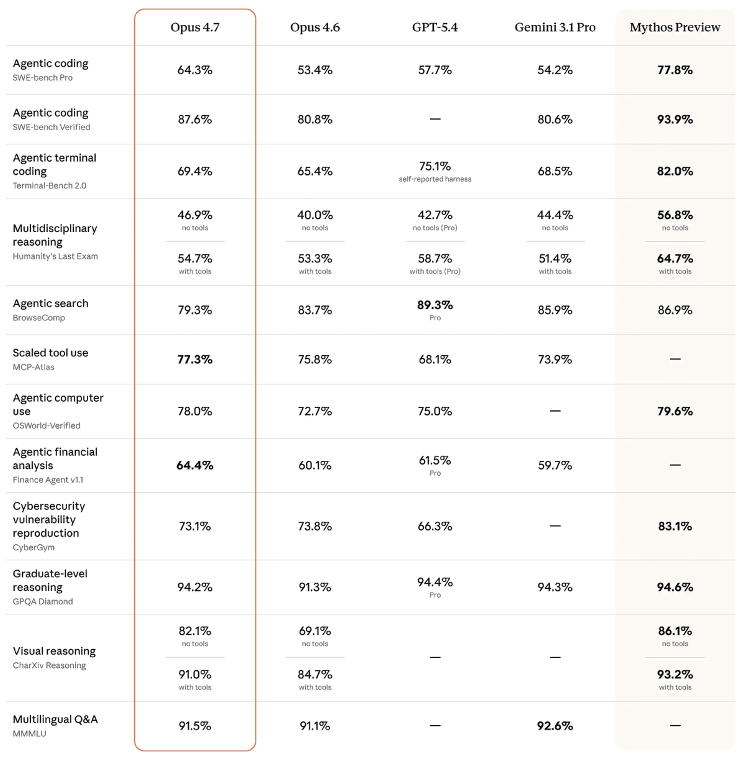
Its benchmark scores, highlighted in the left column below, showed modest improvements in all but two categories compared to its predecessor, Opus 4.6.

Source: Anthropic

Anthropic positioned Opus 4.7 as better at software engineering, an area that Anthropic has been leading the industry in.

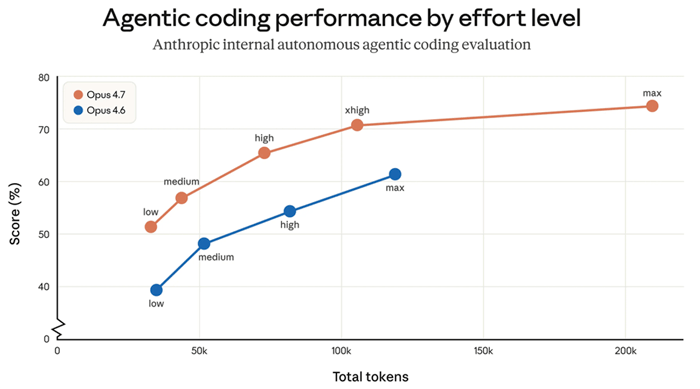
It also indicated that Opus 4.7 is even better at accomplishing real-world tasks, as evidenced in the chart below showing the improved performance of its agentic coding by computational effort.

Source: Anthropic

While not a breakthrough, there are still some impressive changes.

But the announcement was completely overshadowed by news of a far more powerful AI model that Anthropic has been developing in the lab.

That development is now known as Claude Mythos.

A Step Change in AI Performance

An internal memo from Anthropic was leaked in late March concerning Mythos, in which Mythos is spoken of as a “step change” in AI performance.

Those are big words that imply serious implications.

Whispers of artificial general intelligence (AGI) surfaced.

So did negative comments from naysayers, suggesting that it was just a marketing ploy, that Anthropic doesn’t have access to enough computational resources to get there… and that the company needs to raise additional capital.

Ironically, both positions can be accurate at the same time.

After all, the end game isn’t AGI. It’s artificial superintelligence (ASI).

AGI, from my analysis, is already here. It’s just not widely used.

It’s primarily in the AI laboratories, being refined and being shared with a small number of customers and government agencies.

AGI is what gives AI companies and investors the confidence and commitment to lean in, swing harder, and commit to ASI.

After the leak of Mythos in March, there wasn’t anything that Anthropic could do to suppress the now-public knowledge of the model.

So it went so far as to provide a peek at the capabilities, which are shown in the benchmark table above as “Mythos Preview” shown in the column on the far right.

The Mythos Preview benchmark scores are not only notably higher than Opus 4.7 in all categories, but they are also significantly higher than OpenAI’s GPT 5.4 – in all but one category.

Now, to be clear: The Mythos model is not yet generally available to the public. It’s still in the lab and available to a small cohort of early-access users.

By all accounts, Mythos is the model that looks to be a major step up from anything Anthropic has released to date.

But that’s not why it got so much attention.

Too Powerful for Public Release

As it turns out, Mythos is extremely good at cybersecurity.

More specifically, it can be leveraged as a powerful tool that can independently and autonomously find and exploit vulnerabilities in software and networks.

In the wrong hands, it could be an absolute nightmare.

Which is why it has been positioned as an AI that is “too powerful for public release.”

As an analyst, I find the timing of the leak to be highly suspicious.

The tech is real, but there is a game being played by Anthropic. These events reveal Anthropic’s agenda.

After all, in early March, the U.S. Department of War (DOW) deemed Anthropic to be a supply chain risk.

That came as a result of Anthropic’s politics and insistence on dictating how its software can and cannot be used by the U.S. government.

Anthropic’s AI models are very well-known for being programmed with bias on many issues, which creates inherent and sometimes unknown risks in the outputs of these models.

Designating Anthropic as a supply chain risk was a reasonable stance for the DOW to take.

This set Anthropic on a path of a series of actions as a response to the blacklisting by the DOW, including:

  • Issuing a lawsuit against the DOW, due to the supply chain risk designation (note: a federal appeals court in D.C. denied Anthropic’s request to block the DOW blacklisting).
  • Anthropic launched Project Glasswing –a project that provides access to Mythos to key IT players in the industry, like Amazon Web Services (AWS), Broadcom (AVGO), Cisco (CSCO), CrowdStrike (CRWD), Google (GOOGL), Microsoft (MSFT), NVIDIA (NVDA), Palo Alto Networks (PANW), and several more. The purpose of Glasswing is to use Mythos for cybersecurity, not cyberattacks.
  • “Leaked” the news of the Mythos model in a way that positions it as too powerful to release to the public, and a massive risk to today’s information technology systems.

What’s interesting here is that while the DOW blacklisting of Mythos means that Anthropic’s technology is excluded from DOW contracts, it still allows other government agencies to work with and evaluate the technology.

And it appears that is exactly what is happening.

image
image

Recommended Links


Legendary Trader Makes the Boldest Prediction of His 40-year Career

In 2020, Larry Benedict told CNBC the market was about to fall. Few believed him. Within weeks, markets dropped 34% but his readers had the chance to make 62%. In 2022, he predicted the worst market in a generation. He went 11-for-11. One trade returned 117% in under a month. Now he’s speaking out again… and he says what’s coming makes both of those look like a warm-up. Click here to hear his new prediction and get his #1 ticker free.


Log Into This $5,000 AI Signals Trading System

Each morning, it shows you the day’s most profitable trades – 90 minutes before they occur. In this 2026 beta test, it posted gains of 37.7% in 33 days on GNRC, 22% in six days on ALB, 21.4% in four days on DECK, and dozens more. Click here to try it on 2,467 stocks today (no purchase required).


Stress Testing

The National Security Agency (NSA) is working with Mythos to stress test its own systems against future cyberattacks.

In the right hands, a powerful tool like Mythos can enable governments, companies, and even individuals to harden their IT networks against bad actors.

The realities of Mythos’ newfound capabilities reveal a stark reality of the world we have just entered.

That being:

  • Using AI for cyberattacks enables even low-skilled bad actors to become effective in breaking into networks.
  • The number of cyberattacks will significantly increase with these tools.
  • With the automation that Mythos is capable of, brute force attacks become simple, given enough computational resources (i.e., money).
  • Powerful AI can quietly iterate on its attacks, poking and probing until it finds a way to achieve its end goal.
  • The reality is that bad actors can move faster with this technology than organizations can to employ this technology as a defense.

The above is almost certainly why Anthropic has not released Mythos to the public, and why it is allowing the NSA and Project Glasswing partners to get an early look to prepare for the deluge of cyberattacks to come.

The news has been well-received by the markets for cybersecurity companies.

AGI Is Not the End Goal

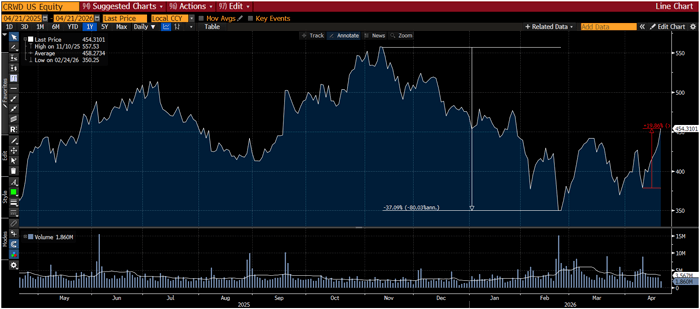
CrowdStrike, for example, fell 37% from November through February on the belief that Anthropic would become a competitor rather than a partner.

And since Glasswing was launched, the stock has bounced about 20%.

1-Year Chart of CrowdStrike (CRWD)

Perhaps the most visible indication that what Anthropic has is real is the announcement yesterday that Amazon (AMZN) will be investing up to another $25 billion in Anthropic.

This is on top of $8 billion that it has already invested in the leading AI company.

Part of the deal with Anthropic also stipulates that Anthropic will spend more than $100 billion on Amazon Web Services over the next 10 years.

This is real money, with limited leverage (debt).

Amazon not only has the cash for investment… it has most of the cash for the $200 billion worth of CapEx that it will spend primarily on AI infrastructure this year.

It’s also why Anthropic needs to access the public markets this fall.

It has raised about $61 billion to date, plus an additional $5 billion in the short-term from Amazon, with as much as $20 billion more to follow.

But that’s just for Anthropic’s near-term goals.

Getting to ASI is a whole other story. That will require a massive capital raise in an IPO, which is currently targeted for October this year.

Jeff

Recent Articles

The Next Quantum Milestone

Apr 20, 2026 • 5 min read

Trump’s Crypto Sideshow

Apr 20, 2026 • 5 min read

Another Massive AI Deal

Apr 17, 2026 • 9 min read

1125 N Charles St, Baltimore, MD 21201
www.brownstoneresearch.com

To ensure our emails continue reaching your inbox, please add our email address to your address book.

This editorial email containing advertisements was sent to pahovis@aol.com because you subscribed to this service. To stop receiving these emails, click here.

Brownstone Research welcomes your feedback and questions. But please note: The law prohibits us from giving personalized advice.

To contact Customer Service, call toll free Domestic/International: 1-888-512-0726, Mon-Fri, 9am-7pm ET, or email us here.

© 2026 Brownstone Research. All rights reserved. Any reproduction, copying, or redistribution of our content, in whole or in part, is prohibited without written permission from Brownstone Research.

Privacy Policy | Terms of Use

A New Category of Auto Repair Is Emerging – Fast

Unsubscribe

Sponsored content from i2i Marketing Group, LLC

What If You Didn’t Have to Replace Your Car Battery?

For over a century, the auto industry has followed the same model.

You drive. You maintain. You replace.

But electric vehicles are beginning to change that equation.

Because the most important part of the vehicle, the battery. doesn’t fail all at once.

It degrades.

And that opens the door to something entirely new. A new category of service.

Not replacement…But restoration. Diagnostics. Rebalancing. Recovery.

This is where the industry is quietly heading next.

And one company is already building for it.

Why this matters today:

  • A massive installed base of EVs is beginning to age
  • Battery replacement is one of the highest ownership costs
  • Existing service networks would offer rapid adoption

This isn’t just an incremental improvement.

It’s the early stages of a shift in how vehicles are maintained.

Discover the company while it’s still early >


Today’s Bonus Article

Intel Went From Market Reject to Musk’s AI Partner — What Happens Next?

By Sam Quirke. Article Posted: 4/13/2026. 

Key Points

  • Intel has surged more than 220% since last summer and 50% since the end of March, with the latest leg driven by its involvement in Elon Musk’s Terafab AI chip project.
  • Partnering with Tesla, SpaceX, and xAI has boosted its credibility, but analysts remain split on how much near-term upside remains. 
  • With shares starting to look overbought ahead of earnings, the setup might lean toward caution rather than exuberance. 
  • Special Report: Wall Street banks are fighting over one IPO (From Behind the Markets)

Tech giant Intel Corp (NASDAQ: INTC) has staged one of the most dramatic turnarounds in the market over the past couple of quarters. Having been at multi-year lows this time last year and almost a byword for disappointment, Intel shares are now on the verge of a five-year high — up more than 220% since last August.

Those gains have accelerated in recent weeks, adding roughly a 50% increase since the end of March alone.

The latest leg higher was driven by news this week that Intel is joining Elon Musk’s Terafab AI chip production project alongside his Tesla Inc (NASDAQ: TSLA), SpaceX, and xAI companies. That development injected new excitement into the story, positioning Intel at the center of one of the most ambitious artificial intelligence (AI) infrastructure initiatives currently being built.

The REAL Reason Trump is Invading Iran (Ad)

For a moment…

Forget about Trump’s ties to Israel.

Forget about reports of Iran’s nuclear program.

Because my research has led me to believe we’re risking World War 3 with Iran for a completely different reason.Click here to find out what it is.

The question now is whether this renewed momentum still has room to run, or whether the stock has already priced in much of the upside ahead of its next earnings report on April 23. Let’s take a closer look.

A Narrative Shift Is Underway

While the Terafab update is newsworthy, the most important change in Intel’s story over the past year has been the shift in perception around its foundry business. What was once viewed as a long-term, uncertain turnaround effort is increasingly framed as a credible path back to relevance in the semiconductor industry.

Intel Foundry Services gaining traction as a supplier in the broader AI ecosystem is evidence of that shift. Once considered an “also-ran,” Intel is re-entering conversations about the next phase of technology growth instead of being dismissed as lagging its younger, more nimble peers. That change in perception has driven a significant re-pricing of the stock, even as many underlying improvements remain in their early stages.

Terafab Has Put Intel Back in the Spotlight

The Terafab announcement has been a welcome catalyst for bulls. Intel’s involvement alongside Tesla, SpaceX, and xAI has eased bearish concerns about its turnaround and effectively validated its role in the emerging AI supply chain. These are some of the most aggressive players in the AI space, and their choice to work with Intel signals the company is being taken seriously at the highest level.

Considering Intel shares have gained close to 20% since the news broke, the market appears to be taking it seriously as well. At the same time, analysts are not fully aligned on how to interpret the shift. Firms such as KeyCorp have leaned into the opportunity, reiterating their Buy rating and raising their price target to $70 — still implying meaningful upside ahead of the company’s upcoming report.

Others, like Cantor Fitzgerald and Wells Fargo, have taken a more cautious stance, issuing Hold or equivalent ratings that reflect uncertainty about how quickly the new narrative will translate into financial results.

The Rally Has Moved Faster Than the Fundamentals

From the sidelines, the skeptics have a reasonable point. Intel’s story has improved dramatically since this time last year, but the stock has moved even faster.

A 220% rally — and the roughly 50% surge since the end of March — suggests a significant amount of optimism is already priced in. The Terafab news accelerated that move, but it also raised expectations at a time when much of the underlying progress is still early.

Key elements of the bull case, including the success of the foundry business and the economics of projects like Terafab, remain largely unproven. Execution risk is still meaningful, and the path to realizing Intel’s full potential has yet to become clear. That creates an exciting, but potentially risky, situation in which a strong emerging narrative outpaces the fundamentals.

Earnings Will Be the Next Major Test

Intel’s next earnings report, due on April 23, will be closely watched. After such a sharp run higher, investors will look for confirmation that the narrative shift is backed not only by a clear vision from management but also by tangible progress.

If Intel can deliver on those fronts, the rally could extend further, supported by both momentum and improving fundamentals. In that scenario, the stock could still be undervalued and attractive to buyers ahead of the report.

Conversely, the risk and scale of a potential pullback would increase if the report disappoints. For investors on the sidelines, that makes for an interesting setup: the long-term opportunity may be increasingly compelling, but the risk of near-term volatility could outweigh the potential for immediate gains.


This message is a sponsored email for i2i Marketing Group, LLC, a third-party advertiser of MarketBeat. Why did I get this email?. 


We are not securities dealers or brokers, investment advisers or financial advisers, and you should not rely on the information herein as investment advice. Any investment should be made only after consulting a professional investment advisor and only after reviewing the financial statements and other pertinent corporate information. Further, readers are advised to read and carefully consider the Risk Factors identified and discussed in the profiled company’s SEC and/or other government filings. Investing in securities, particularly microcap securities, is speculative and carries a high degree of risk.


If you need help with your newsletter, feel free to contact MarketBeat’s South Dakota based support team at contact@marketbeat.com.

If you would no longer like to receive promotional emails from MarketBeat advertisers, you can unsubscribe or manage your mailing preferences here.

© 2006-2026 MarketBeat Media, LLC. All rights protected.
345 North Reid Place #620, Sioux Falls, South Dakota 57103. USA..

The biggest rivalry in baseball is back

The Lineup: Pregame Edition

Tuesday, April 21

View Online

Aaron Judge and Ben Rice lead the Yankees against Roman Anthony, Willson Contreras and the Red Sox.

Welcome to The Pregame Lineup, a weekday newsletter that gets you up to speed on everything you need to know for today’s games, while catching you up on fun and interesting stories you might have missed. Today’s edition is brought to you by David Adler.

Baseball’s No. 1 rivalry is back tonight. 

The Yankees and Red Sox face off in a three-game series at Fenway Park, their first meeting since the 2025 American League Wild Card Series.

The Yanks got the best of Boston in that playoff matchup, taking down the Sox in a winner-take-all Game 3 at Yankee Stadium. The Bronx Bombers are also off to the better start this season — the Yankees enter this week’s showdown in first place in the AL East at 13-9, while the Red Sox are tied for last with the Blue Jays at 9-13.

Tonight’s series opener in Boston starts at 6:45 p.m. ET (TBS/MLB.TV), and you can find all the info on the rest of the series here.

But these are three big things we’ll be watching for: 

1) Will New York’s 1-2 punch keep it going? 

The Yankees have the top slugging duo in the Majors right now. One half of that duo is obviously Aaron Judge, whose nine home runs are one behind Yordan Alvarez for the MLB lead. The other half is Ben Rice, who’s building on his breakout 2025 with eight homers already in ’26 and an MLB-best 1.276 OPS. Judge and Rice have the most home runs of any pair of MLB teammates.

Rice has four home runs in 18 career regular-season games against the Red Sox (plus one in last year’s playoffs), while Judge has 34 home runs in 117 games against Boston (plus a pair in the 2018 postseason), easily the most of any active player against the Red Sox. 

2) Can Roman Anthony get hot?  

Anthony looked like a budding star as a rookie last season and in the World Baseball Classic this year for Team USA. But he hasn’t been at his best yet in 2026 — the 21-year-old is off to a .234 start at the plate with just one home run through his first 21 games. This would be a big series for Anthony to get going. 

3) How will Cam Schlittler do in his first start at Fenway? 

Speaking of young guns: Schlittler, who starts Thursday’s series finale for New York, has looked dominant to start the season (1.95 ERA, 36 strikeouts in five starts). And there’s going to be a lot of hoopla surrounding the 25-year-old flamethrower’s first career start at Fenway. Schlittler grew up a Red Sox fan in Massachusetts, and he’s embraced the Yanks-Sox rivalry — including stepping up in Game 3 of the Wild Card Series last October and eliminating the Red Sox with an eight-inning, 12-strikeout scoreless gem. 


GAMES OF THE NIGHT

Besides Yankees-Red Sox, here are three games to watch tonight. For info on how to watch every game this season, go to MLB.com/Watch. 

Reds at Rays (6:40 p.m. ET, MLB.TV) 

The NL Central has been the best division in baseball so far this season. All five teams have a winning record — and leading the pack are the Reds in first place at 15-8. Cincinnati is on a four-game winning streak and sends breakout 23-year-old Chase Burns to the mound today. 

Twins at Mets (7:10 p.m. ET, MLB.TV)

The Mets are on an 11-game losing streak, their worst since the 2004 season. If anyone can put a stop to it, it’s the team’s young ace, Nolan McLean, who gets the ball for the opener at Citi Field. The electric rookie has a 2.28 ERA and 28 strikeouts in 23 2/3 innings through four starts and just went pitch-for-pitch with Dodgers ace Yoshinobu Yamamoto his last time out.

If McLean can play stopper, a huge reinforcement is coming for the Mets after that: Juan Soto should be back from the injured list tomorrow, a source told MLB.com’s Anthony DiComo.

Dodgers at Giants (9:45 p.m. ET, MLB.TV) 

Yankees-Red Sox isn’t the only rivalry series this week. The Dodgers and Giants, who form another one of MLB’s classic rivalries, also meet for the first time this season starting tonight. The player to watch for L.A. in this one is Yamamoto, who’s pitching like a Cy Young contender.  

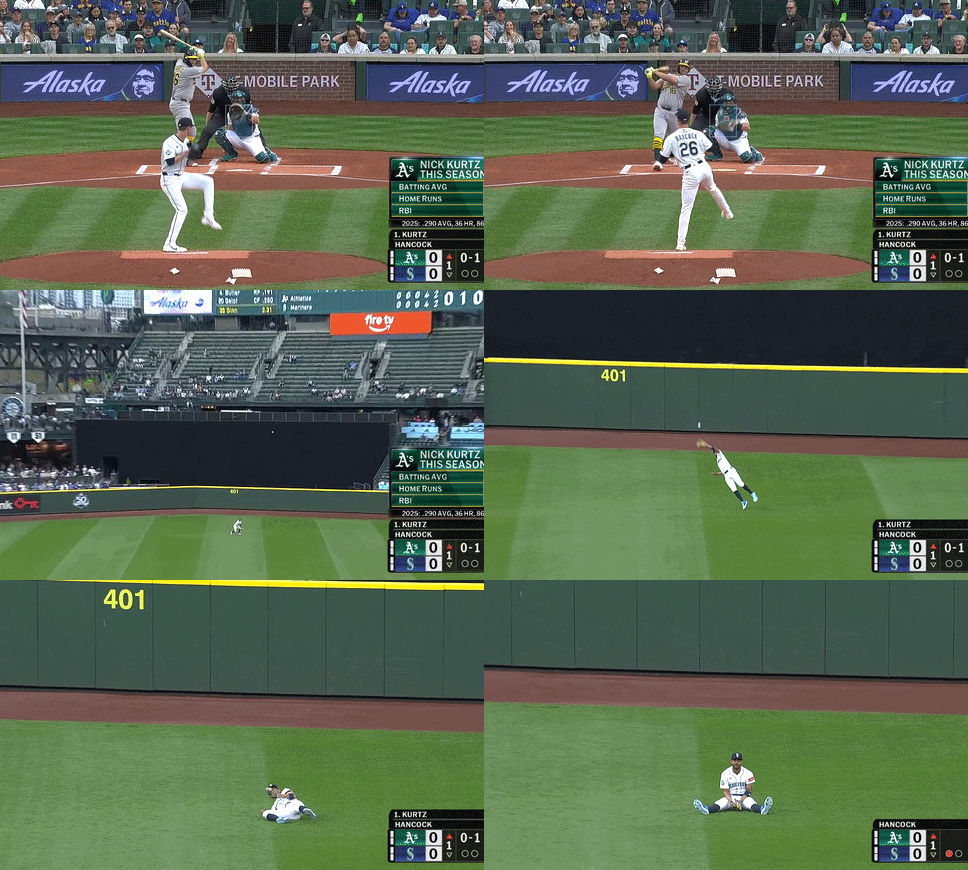
J-ROD VS. A 108 MPH KNUCKLEBALL

Julio Rodríguez pulled off one of the craziest catches of the year in center field in Seattle yesterday. Just watch: 

An animated GIF of Julio Rodríguez's catch vs. a knuckleball line drive

No, you’re not seeing things. It’s not an optical illusion. That line drive off the bat of Nick Kurtz really was a knuckleball. A 108 mph knuckleball.  

It started off as a frozen rope to Rodríguez’s left, only to tail back at the last second to his right. But the Mariners star made an incredible recovery to make the grab.

Here’s what the trajectory of the ball looked like, using Statcast’s 3D tracking: 

An animated GIF with Statcast 3D tracking of Julio Rodríguez's catch

Luckily for Seattle, nothing escapes J-Rod’s No Fly Zone. Not even that witchcraft. 

WHO SHOULD CLOSE FOR DÍAZ-LESS DODGERS?

Edwin Díaz

The Dodgers might have MLB’s best record at 16-6, but the defending champs just took a big blow: closer Edwin Díaz, one of the team’s marquee free-agent signings this offseason, is having surgery to remove loose bodies from his pitching elbow and won’t be back until after the All-Star break. 

So who should close for the Dodgers in Díaz’s absence? They haven’t named a replacement closer, but here are the big three arms who could combine to fill the role. (Spoiler: It’s not going to be Roki Sasaki.) 

1) LHP Tanner Scott 

Scott was supposed to be the Dodgers’ closer last year, but he struggled in his first season in L.A. and couldn’t hold onto the job. But Scott’s been much better in 2026, with a 1.04 ERA through 10 outings and eight strikeouts with zero walks. He could get another crack at the ninth.

2) LHP Alex Vesia

One of the Dodgers’ most reliable arms out of the ‘pen, Vesia has yet to allow a run this season in 10 appearances and has 10 K’s in 8 2/3 innings. The veteran southpaw has one of the best rising fastballs in baseball and L.A. often looks to him to get the biggest outs of a game.

3) RHP Blake Treinen

Treinen was Old Reliable for the Dodgers for so long. Now 37 years old, he’s still a strong late-inning option with his vintage sinker-sweeper combo, and had started the season with eight straight scoreless outings before a rocky one against the Rockies on Sunday. 

STREAK TRACKER

Shohei Ohtani and Mason Miller

There are two big streaks going around the Majors right now. We’re keeping track of them here. 

Shohei Ohtani’s on-base streak 

Currently at: 52 games 

AL/NL record: Ted Williams, 84 games (1949)

Ohtani extended his streak to 52 consecutive games yesterday with a third-inning single off the Rockies’ Jose Quintana. With one more game, Ohtani will tie Shawn Green (2000) for the second-longest streak in Dodgers history. (Duke Snider has the longest at 58 games in 1954.) 

Fun fact: Shohei has now passed Babe Ruth’s career-best 51-game on-base streak from 1923. 

Mason Miller’s scoreless innings streak

Currently at: 32 2/3 innings 

AL/NL record: Orel Hershiser, 59 innings (1988)

Reliever record (Expansion Era): Gregg Olson, 41 innings (1989-90)


The Padres were off yesterday, so Miller’s streak stays one inning shy of Cla Meredith’s franchise record. San Diego faces the Rockies tonight at 8:40 p.m. ET (MLB.TV).  

THE DODGERS x CONVERSE: LA EDITION

Yoshinobu Yamamoto holding the LA Dodgers Chuck 70 shoe

Last week, the Dodgers dropped a collab with Converse and UNDEFEATED, introducing the Brooklyn Dodgers Chuck 70 — a new version of the classic Chuck Taylor All-Star shoe in honor of the back-to-back World Series champs. 

Today, Part 2 of the collab dropped: A Los Angeles Dodgers edition, featuring the Dodgers’ iconic “LA” logo instead of the Brooklyn “B.” (The drop also features Yoshinobu Yamamoto introducing the shoe.) 

The LA variation launches this Saturday at UNDEFEATED physical stores and Undefeated.com. The shoe will then be available at converse.com, MLBShop.com, the MLB Flagship Store in NYC and the Dodgers Team Store next Monday.


Bryan Horowitz has the story on Converse and UNDEFEATED’s love letter to Dodgers culture.  


Facebook
Instagram
Twitter
YouTube
TikTok
Snapchat

© 2026 MLB Advanced Media, L.P. MLB trademarks and copyrights are used with permission of Major League Baseball. Visit MLB.com. Any other marks used herein are trademarks of their respective owners.

Please review our Privacy Policy.

You (pahovis@aol.com) received this message because you registered to receive commercial email messages from MLB.com.

Please add info@marketing.mlbemail.com to your address book to ensure our messages reach your inbox. If you no longer wish to receive commercial email messages from MLB.com, please unsubscribe  or log in and manage your email subscriptions.

Postal Address: MLB.com, c/o MLB Advanced Media, L.P., 1271 Avenue of the Americas, New York, NY 10020.

Your book is inside

APRIL 21, 2026   |   READ ONLINE

In case you missed it…

…make sure you get your free “Simple Options Trading For Beginners” book before your link expires.

I eventually plan to charge money for this training, so do yourself a favor and download it now…

That way, no matter what it costs in the future, you’ll have a free copy.

Sound good?

FREE: Simple Options Trading For Beginners << Get It Now

Good Trading,
Bill Poulos

p.s. Go here to save a copy of your “Simple Options Trading For Beginners” book while it’s still free..

Update your email preferences or unsubscribe here

345 N Reid Place #620
Sioux Falls, SD 57106, United StatesTerms of Service 

Your Invitation to the Taxpayers’ Union

View in Browser

Resource Stock Digest

The Hidden Tax Burden Crushing America’s Upper-Middle Class


April 21, 2026

Dear Reader,

Happy Tax Month to those who celebrate, which should be no one. 

Remember, this nation had no income tax until 1913, which in one of humanity’s worst coincidences is the year the Federal Reserve was clandestinely created. 

Your editor continues to wonder when the Taxpayers Union will go on strike. 

The government, of course, is insolvent. We’re now at $39 trillion in debt, and that doesn’t include the unfunded promises. That’s over $111,000 for every man, woman, and child under our spacious skies. 

I, and many of you, often pay that much — or more — annually in taxes.

Still, from sea to shining sea, politicians are promising “free” stuff while insisting those of us with hard-won means don’t pay our fair share. 

On the right, Trump accounts, which promise a $1,000 U.S. Treasury deposit for American children born between 2025–2028, starting on the Fourth of July this year. 

On the left, “free” tuition and childcare and utility bills and more. 

Both sides perpetually fund the bottomless war machine. 

God bless America. 

Snarky missive aside, one of the main themes of this decade is going to be the government digging into your wallet. I’ve said this for years, and the theme is picking up pace.

Washington state, where I moved nine years ago specifically because the state constitution forbids an income tax, has now in fact passed an income tax. And that’s on top of passing a capital gains tax a few years ago. Legislators and litigators used semantics, calling it an ‘excise tax’ instead of an ‘income tax’ to get around the law of the land. Howard Shultz, of Starbucks fame, promptly left the state earlier this year for Florida, which has more sun and lower taxes. Jeff Bezos made the move years ago. 

You’ve undoubtedly heard about California’s “Billionaire Tax,” which has caused a further flight of wealth and business from the most populous state in the country. 

You and I are not billionaires. But we are rich. And there’s an important distinction that needs to be made there.

This C$8 Million Company Just Bought the Key That Unlocks 12,000 Abandoned Gold Mines in Nevada

Nick and Gerardo are finalizing a private placement at C$0.25 per share in a tiny Nevada-focused gold company.

The chairman – who founded a NASDAQ-listed uranium producer and has built gold mills before – just acquired a processing mill worth over $10 million for a fraction of that.

workers in a mine

The IPO is slated for October at C$0.50… a built-in double before the company even starts trading. Click here to join now.

For years, the chorus of ‘tax the rich’ has grown. We’re told to “pay our fair share.” Washington state senator Noel Frame recently referred to “the wealthy few” as “the villain.”

There are problems with this framing. 

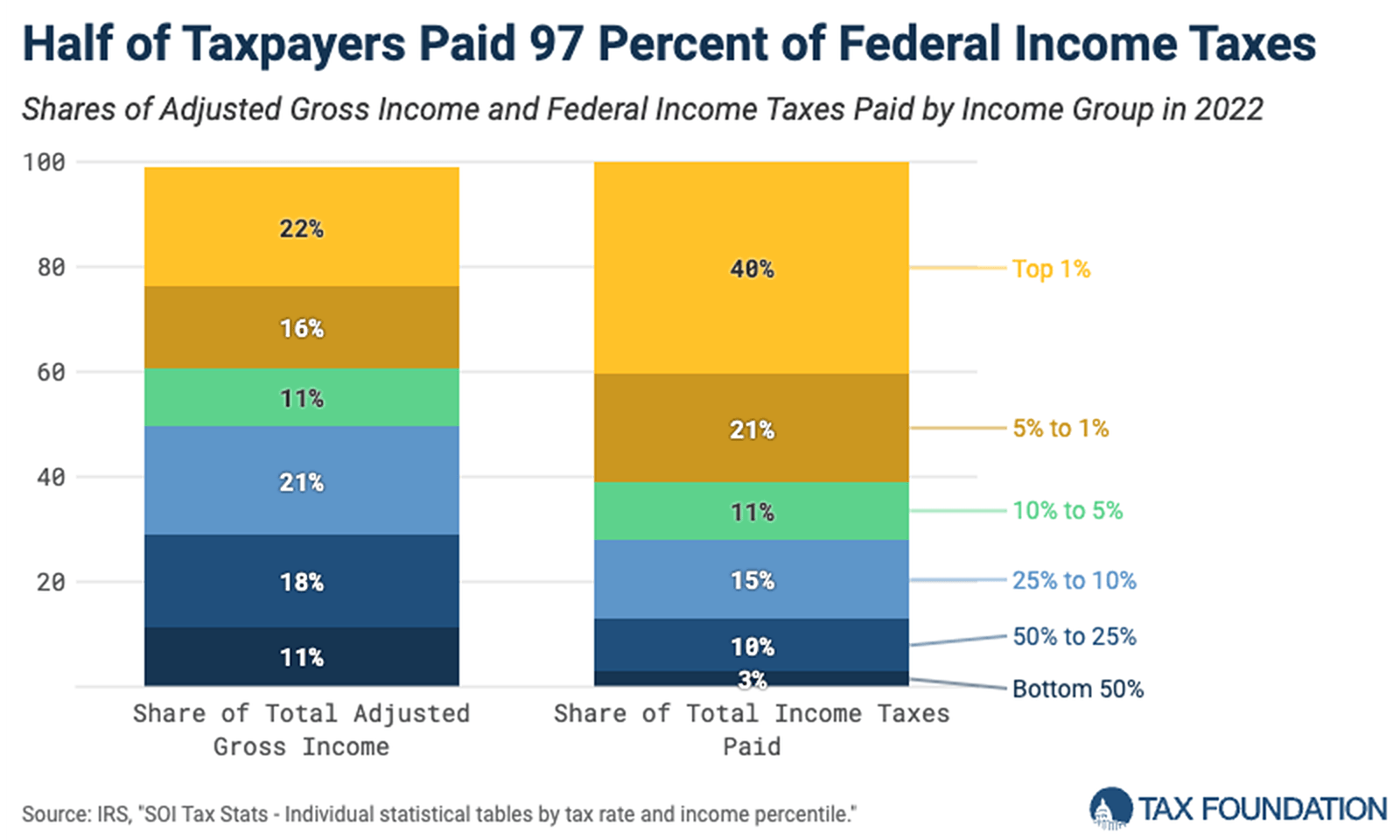
The top 1% of earners are paying 40% of the taxes collected. That’s people with an adjusted gross income (AGI) of $663,164 and above. They also pay the highest effective tax rate at 26%. 

Those between the top 5th and 1st percentiles are paying 21% of the taxes. That’s people who earn between $261,591 and $663,164. That group has the second-highest tax rate at 18.8%. 

Taxpayers with AGI between the 10th and 5th percentiles ($178,611 and $261,591) are paying 11% of the taxes with a tax rate of 14.3%.

And those in the 25th to 10th percentile income range — between $99,857 to $178,611 AGI — are paying 15% of the taxes with a rate of 10.7%. 

So the top 25% of income earners are paying 87% of the taxes. They are all paying progressively higher tax rates. And, with the exception of the $178,611 and $261,591 income cohort — they are all paying a higher share of their income than the bottom 50%.

Income tax diagram

If you take the data at face value and ask, “who is carrying the heaviest burden relative to what they earn?” — the answer isn’t the bottom and it isn’t the top.

It’s the upper-middle: roughly the 25th to 1st percentile, or the households making about $100K to $660K AGI.

That’s the group that is fully exposed to the progressive system while no longer being shielded by low brackets and credits.

That’s the group getting squeezed by both sides. 

That’s us. It’s not Bezos and Schultz.

We’re too “rich” for meaningful credits or subsidies. But we’re not rich enough for sophisticated tax structuring to move the needle dramatically.

Profiting as the Broader Indexes Fall

Market-wide shocks have wiped out profits and destroyed stock values, and the trend may just be starting.

But with the right kind of portfolio construction, it’s possible to mitigate much of the damage.

We’ve done just that, and are up 8% year-to-date versus and S&P that is down overall. 

Click here to access the latest issue of Foundational Profits and learn how we did it and will continue to do it.

Going from the bottom 50% to the 25th–2nd percentile, the rate goes up 3X to 5X. But going from the 2nd to the 1st, the rate doesn’t even double. 

I think this is one reason you get some billionaires and inheritees who embrace higher taxes while millionaires rarely do.

Consider this intro to a recent — partially taxpayer-funded — PBS article:

Chuck Collins figures he won life’s lottery by inheriting vast sums of money through his great-grandfather Oscar Mayer’s processed meat company, but rather than fight to protect every dime Collins has helped push to hike taxes on the ultrarich like himself.

He was successful in helping implement a higher tax in Massachusetts on income over $1 million, and the idea has already taken hold in a handful of other blue states, including California, Maryland, Minnesota and New Jersey.

Notice how the word “ultrarich” creeps in there, though I doubt you’d consider yourself so. It’s that broad brush that paints you and I as the aforementioned ‘villains’ while running small businesses, not international conglomerates. 

There’s a stark difference in taxes paid by a plumbing company owner and a venture capitalist, as this recent Bloomberg article points out. Consider this graphic:

taxes graphic

At the state level, you can bet your pre-tax dollar that income limits for these taxes won’t hold at a million. They will be lowered in the future, which is why Washington state lawmakers refused to include language preventing them from doing so when they passed the income tax earlier this year. 

And even if you are in a position to flee, which is tough for rooted families who are rich — but not ultrarich — states are now trying to create a Hotel California of taxation. The National News Desk reported earlier this month that:

Across the country, at least ten states are now exploring or have already passed an exit or wealth tax in order to combat revenue losses from residents fleeing to lower tax areas. That includes California, New York, Washington, and Michigan.

According to recent IRS Service Data from 2022-2023, due to migration from blue to red states, California lost just under $12 billion and New York, $9.9 billion. While Florida gained $20.5 billion and Texas $5.5 billion. Data also showed California lost nearly 230,000 residents.

My advice remains the same as it’s been for years. Remain vigilant on the tax issue. Fight it at the ballot box whenever you can. Be vocal about it. Get a good — and willing to be creative — accountant and/or tax attorney. Learn about business deductions and trusts. Move if you are willing and able. 

Sorry for the wandering rant. But it irks me as one of the ten-to-two-percenters who get lumped in with the billionaires, labeled a financial villain, and am told to pay my fair share while already writing large checks to the government, donating a percentage of our small company’s profits every month, and covering 100% of our employees’ health insurance premiums. If taxes keep going up, some of that altruism might be on the chopping block. And I loathe thinking about how the government would allocate the capital given the squandering we habitually see from congress. 

Maybe I should open a daycare.

(Editor’s Note: This piece was part of the April issue of Foundational Profits, which helps individuals manage their long-term portfolios by showing exactly how I’m managing mine, complete with a live portfolio and allocation weights. The open portfolio is currently up 38% and the closed portfolio is up 44% for the year. See how to become a member here.)

Nick Hodge

Call it like you see it,


Nick Hodge
Editor, Resource Stock Digest 

Nick specializes in private placements and speculations in early stage ventures, and has raised tens of millions of dollars of investment capital for resource, energy, cannabis, and medical technology companies. Read his full article archive here. Follow Nick on X @nickchodge. Stay updated by saving our new email address Here’s how to update your contacts to ensure you continue receiving our emails from editor@resourcestockdigest.com:

Click here for instructions from additional email providers.For Customer Service, please email us at editor@resourcestockdigest.com. 

Resource Stock Digest
2250 Double Creek Dr #5669
Round Rock, TX 78665 USA

The email was sent to pahovis@aol.com. To no longer receive these emails, unsubscribe here.

No statement or expression of opinion, or any other matter herein, directly or indirectly, is an offer or the solicitation of an offer to buy or sell the securities or financial instruments mentioned. Resource Stock Digest does not provide individual investment counseling, act as investment advisors, or individually advocate the purchase or sale of any security or investment. Subscribers should not view this publication as offering personalized legal or investment counseling. Investments recommended in this publication should be made only after consulting with your investment advisor and only after reviewing the prospectus or financial statements of the company in question. This letter is not intended to meet your specific individual investment needs and it is not tailored to your personal financial situation. Nothing contained herein constitutes, is intended, or deemed to be – either implied or otherwise – investment advice. Neither the publisher nor the editors are registered investment advisors. This letter reflects the personal views and opinions of the editor and that is all it purports to be. While the information herein is believed to be accurate and reliable it is not guaranteed or implied to be so. Neither Resource Stock Digest, its related companies, employees, nor anyone else, accepts any responsibility, or assumes any liability, whatsoever, for any direct, indirect or consequential loss arising from the use of the information in this letter. The information contained herein is subject to change without notice, may become outdated and may not be updated. Resource Stock Digest, entities it controls, family, friends, employees, associates, and others may have positions in securities mentioned, or discussed, in this letter, and may increase or decrease those positions at any time. No part of this letter/article may be reproduced, copied, emailed, faxed, or distributed (in any form) without the express written permission of Resource Stock Digest. Unauthorized reproduction of this newsletter or its contents by Xerography, facsimile, or any other means is illegal and punishable by law. All rights reserved. Copyright © 2026 Click here to view our Terms & Conditions and Privacy Policy.