Iran Conflict Spikes Oil, Pressures Key Sector Funds

DividendStocks.com Newsletter

Unsubscribe

Trump’s family just applied for a bank license (From Crypto 101 Media)


3 ETFs to Avoid as Oil Shock Hits Markets

Written by Dan Schmidt on March 12, 2026 

Oil barrels leaking in warehouse with downward price chart overlay.

Key Points

  • Oil-price volatility is pressuring energy-sensitive areas like consumer discretionary, airlines, and European equities.
  • Three widely traded ETFs tied to those exposures are showing weakening technicals as the conflict drags on.
  • In the near term, investors may want to reduce exposure to the most fuel- and sentiment-sensitive pockets of the market.
  • Special ReportCan you keep this weekend income secret between us? (From DTI Trader)

A new energy shock has struck global markets as the U.S.-Israeli war against Iran enters its second week. Oil prices briefly shot over $115 per barrel in the overnight session on Sunday, March 8, before settling back under $90 by Monday evening. Still, oil prices have jumped more than 30% in the last month, and gas prices are quickly approaching a $4 average in the U.S. Energy disruptions have a global impact, but not every country or sector is affected equally. A few market areas could feel more pressure than others, and the funds covering them are ones investors might want to sidestep while the conflict plays out.

5 Stocks Positioned for AI’s Biggest Energy Shift in Decades (Ad)

AI’s surging energy demand is creating new winners

AI workloads are scaling and data centers are expanding rapidly — driving unprecedented demand for electricity, cooling, and grid infrastructure.

Massive capital is flowing to the companies that enable AI at scale — the power producers, infrastructure owners, and critical technology suppliers behind the scenes.

In this FREE report, we reveal five publicly traded companies positioned to benefit directly from the AI energy buildout.👉 Click here to see the 5 stocks positioned for AI’s biggest energy demand shift in decades

Sectors and Asset Classes Hit Hardest By Oil Shocks

When an energy shock like an oil crisis hits, there’s a typical playbook that investors turn to seeking to offset risk. The oil and gas sector has obvious tailwinds from prices nearing $100/bbl, and consumer staples tend to hold up well when people start noticing higher prices at the pump. But three sectors that are frequently punished harder than the rest include:

  • Consumer Discretionary – This sector is among the first to notice the squeeze because an oil shock is a very ‘in your face’ signal. Anyone who commutes or drives regularly feels an immediate impact as gasoline becomes increasingly expensive in a short period. Every extra dollar spent filling a gas tank is one less spent shopping online, ordering takeout, or supplying a home improvement project. Even consumers who don’t drive notice sticker shock as gas prices are visible at every intersection and convenience store, with knock-on effects on economic sentiment. Additionally, companies in the consumer discretionary industry face many input costs influenced by fuel prices, such as shipping and warehousing. If these costs increase rapidly, companies selling discretionary goods will face yet another margin headwind that can’t be fully passed on to customers.
  • Airlines – Fuel costs are a significant burden, accounting for up to 35% of operating expenses. Oil shocks put the airline industry in a tight spot because fuel prices can rise overnight, while fares and route schedules are locked months in advance and can’t be adjusted quickly to offset the increase. Airlines also face a trickle-down effect from consumer sentiment; if potential travelers feel a pinch in the wallet, they’ll likely eschew destination trips for cheaper routes (or skip the vacation altogether).
  • European Equities – This scenario played out back in 2022 when Russia invaded Ukraine and sent oil prices over $100/bbl in rapid fashion. We discussed Europe’s struggles to absorb oil shocks when the fighting began because it’s so dependent on energy imports and has limited domestic capacity to meet demand. Policy and geology both play a role here, but until Europe reaches a higher level of decarbonization, it will continue to feel an outsized impact from geopolitical decision-making beyond its borders.

Consider Selling These 3 ETFs as Oil Prices Go Crazy

One of the great things about ETFs is that you can find a fund for any nook and cranny of the market, and the three sectors mentioned above have plenty of liquid options. Here are three funds to consider lightening up on while the war continues in Iran.

Consumer Discretionary ETF XLY Faces Mounting Pressure

The Consumer Discretionary Select Sector SPDR Fund (NYSEARCA: XLY)is the largest ETF covering the sector by a substantial margin, boasting more than $22 billion in assets under management (AUM) and a tiny 0.03% expense ratio.

But in the current environment, its liquidity makes it an easy fund to sell, and its biggest holdings like Amazon Inc. (NASDAQ: AMZN) and Tesla Inc. (NASDAQ: TSLA) will suffer if consumers begin putting off big-ticket spending due to rising energy costs.

The ETF has collapsed over the last few weeks, taking out the 50-day and 200-day moving averages as it erases four months’ worth of gains. The Moving Average Convergence Divergence (MACD) confirms the bearish momentum, and is now consolidating with prices hovering below the 200-day. If the war proves lengthy, this consolidation could lead to more selling and new lows on XLY.
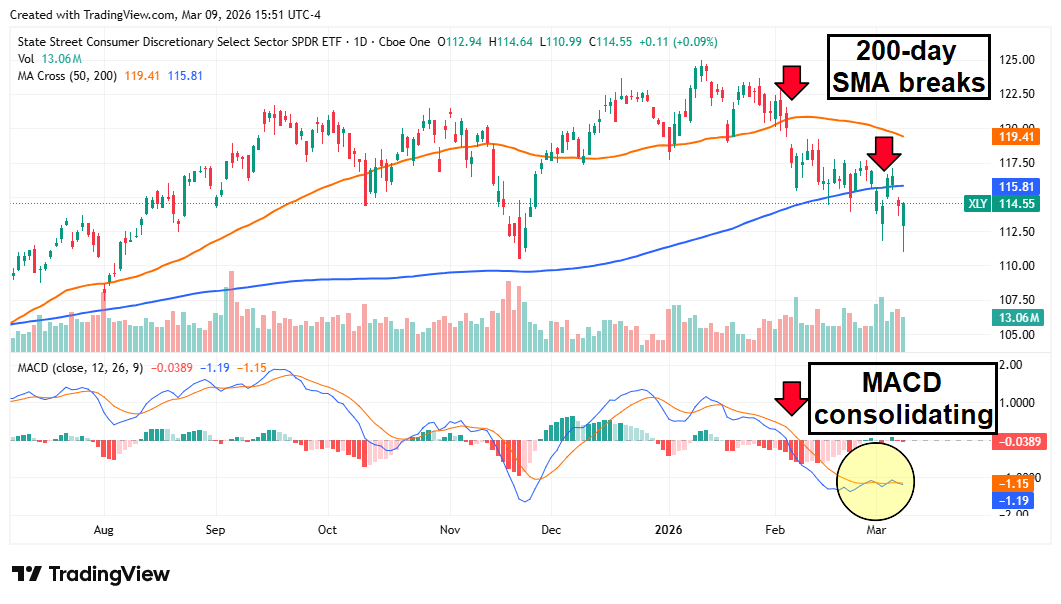
XLY consumer discretionary ETF chart shows 200-day SMA break as MACD consolidates, signaling caution.

The Vanguard FTSE Europe ETF Loses Momentum as European Stocks Pull Back

The Vanguard FTSE Europe ETF (NYSEARCA: VGK) is a $30 billion fund that holds some of Europe’s most prominent public companies like Roche Holding (OTCMKTS: RHHBY)Novartis (NYSE: NVS)SAP (NYSE: SAP), and LVMH-Moet Hennessy (OTCMKTS: LVMUY).

But its holdings are also concentrated in some of the most energy-sensitive countries in Europe, like Germany, France, and the U.K. European stocks have outperformed their U.S. peers over the last two years, but VGK is down more than 5% this month, and its year-to-date (YTD) gain has dwindled to just 1%. 

VGK recently took out long-term support at the 50-day moving average, and the next crucial level to watch is the 200-day moving average. The MACD illustrates the speed and ferocity of the drawdown, and sellers are firmly in control of momentum now. If shares can’t hold the 200-day moving average, the downward pressure will only intensify.
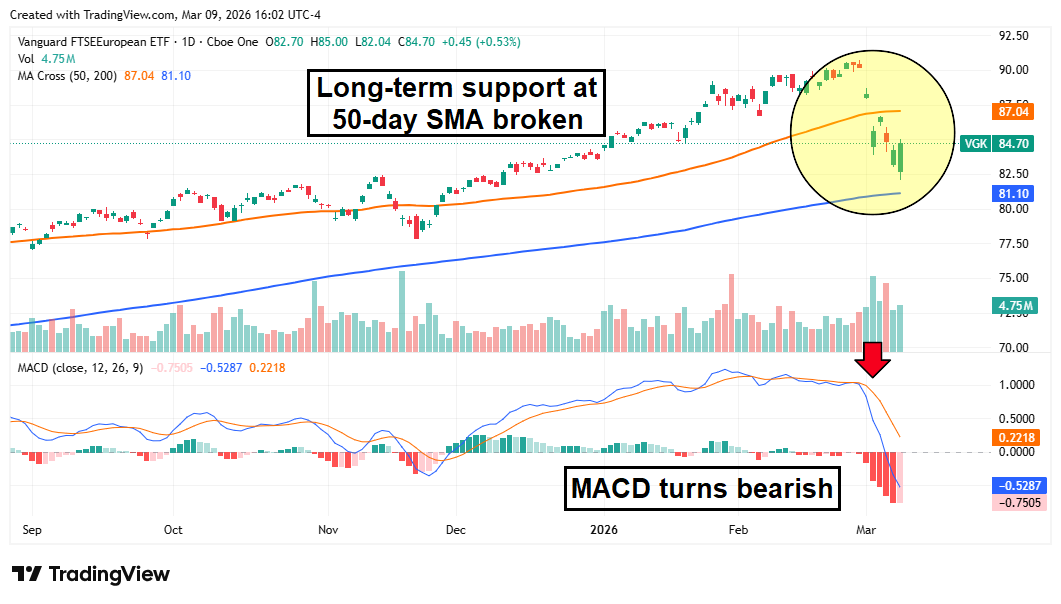
Vanguard FTSE Europe ETF (VGK) chart shows break below 50-day SMA support as MACD turns bearish.

The U.S. Global Jets ETF Is Vulnerable in a Risk-Off Market

The U.S. Global Jets ETF (NYSEARCA: JETS) faces several headwinds from the current situation. It’s a smaller, more expensive fund that investors likely don’t consider a core holding and will be quick to dump.

In addition to holding all the major U.S. airline stocks, JETS also holds travel stocks like Expedia Group (NASDAQ: EXPE) and TripAdvisor Inc. (NASDAQ: TRIP) that are affected by disrupted travel routes and consumer spending pullbacks.

JETS is down more than 15% in the last month, and the bearish momentum isn’t showing any signs of dissipating. The stock took out the 200-day moving average during the decline, the first time since last August the fund had breached this level. The MACD is also showing more bearish signals than it has since the Liberation Day tariff debacle last April, hinting that the bottom isn’t in yet.
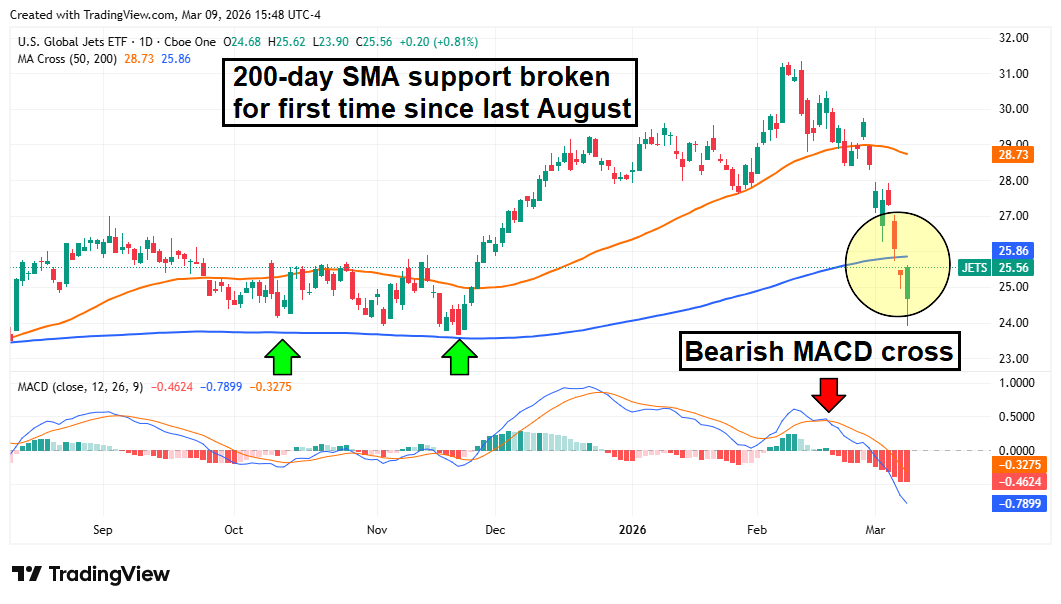
U.S. Global Jets ETF (JETS) chart shows 200-day SMA support break and bearish MACD cross, signaling weakness.

Read this article online ›

Read More

MarketBeat All Access is the premier all-in-one stock research solution that helps you identify the best stocks, monitor your portfolio, and keep track of the market.

Did you find this article helpful?

I liked this article.
I did not like this article.

Thank you for subscribing to DividendStocks.com’s daily newsletter for dividend and income investors that covers ex-dividend stocks, new dividend declarations, dividend stock ideas, and the latest market news.

If you have questions or concerns about your account, don’t hesitate to contact MarketBeat’s U.S. based support team at contact@marketbeat.com.

If you no longer wish to receive email from DividendStocks.com, you can unsubscribe.

© 2006-2026 MarketBeat Media, LLC. All rights protected.
345 N Reid Place, Suite 620, Sioux Falls, South Dakota 57103. U.S.A..

Read More: 5 Stocks Positioned for AI’s Biggest Energy Shift in Decades (Click to Opt-In)

Sheriff Gives Nancy Guthrie Case Update; Cuban Regime Confirms New Development

The Epoch Times
Sheriff Gives Nancy Guthrie Case Update
Cuban Regime Confirms New Development
We are only three days away.
image alt
Why Strait of Hormuz Conflict Could Hit Wallets and Plates | Michael Mische

March 13, 2026 TODAY IN HISTORY The first popular and widespread image of Uncle Sam cartoon appears in The Lantern. 1852 TOP STORIES Sheriff Gives Nancy Guthrie Case Update 

SHARE*     READ MORECuban Regime Confirms New Development 

SHARE*     READ MOREUPCOMING EXCLUSIVE EVENT We are only three days away. 

Join acclaimed journalist Jan Jekielek and comedian and actor Rob Schneider for an unforgettable evening of unfiltered truth on one of the darkest crimes the world has ever seen—China’s state-run, murder-for-organs industry—and its surprising ties to the West. 

Location: Trump Kennedy Center, Washington, D.C.
When: March 16, 6 p.m.
Admission: FREE 

The first 1,000 attendees will receive a freecopy of “Killed to Order.” 

RSVP NOW »Why Strait of Hormuz Conflict Could Hit Wallets and Plates | Michael Mische 

Share

       WATCH NOW

Top Myopia Treatments: Natural Remedy, Medicine, Lifestyle | Dr. Rani Banik

Top Myopia Treatments: Natural Remedy, Medicine, Lifestyle | Dr. Rani Banik 

Share

       WATCH NOWHEALTH 

10 Minutes of Core Training to Reboot Your Metabolism

10 Minutes of Core Training to Reboot Your Metabolism 

When a Headache Signals a Warning–and How to Help Prevent It

When a Headache Signals a Warning–and How to Help Prevent It INSPIRING 

Circles of Genius: Math and Art Across Six Centuries

Circles of Genius: Math and Art Across Six Centuries LIFESTYLE 

Focaccia

Focaccia EPOCH FUN Freecell SolitaireArrange cards by suit in ascending order to win.PLAYSpot the DifferenceFind the differences between 2 images.PLAYWord WipeCreate words to eliminate tiles.PLAY

Share this email with a friend. 

Forward 

Received this email from a friend? 

Subscribe 

Trouble viewing this email? 

View in browser Copyright © 2026 The Epoch Times, All rights reserved. The Epoch Times. 229 W. 28 St. Fl. 7 New York, NY 10001 | Contact Us * When sharing an article, giftaccess@TheEpochTimes.com is added to the list of recipients. If your friend is not already a subscriber, we will send them a special link for free access to the article. 

Our Good Evening newsletter helps you catch up on the big stories of the day followed by lifestyle and uplifting content. Manage your email preferences here or unsubscribe from Good Evening here

Your Night Prayer

Learn More About St. Peter as Pope

Logo Truthly

Today’s Night Prayer is brought to you by Truthly

Catholic “AI for good.” Instant answers and guidance to any question or problem. Try free for 7 days.

A Night Prayer

Jesus Christ, my God, I adore You and thank You for all the graces You have given me this day. I offer You my sleep and all the moments of this night. I place myself and all my loved ones, wherever they may be, in Your sacred side and under the mantle of Our Blessed Mother. Let Your holy angels stand watch and keep us in peace. Amen.

Subscribe to the Morning Offering video podcast

Quote of the Day

“I will all the more gladly boast of my weaknesses, that the power of Christ may rest upon me. For the sake of Christ, then, I am content with weaknesses, insults, hardships, persecutions, and calamities; for when I am weak, then I am strong.” -2 Corinthians 12:9-10 

Today’s Meditation

“In Baptism, therefore, we first receive the great spiritual treasure of sanctifying grace. Our spiritual tradition also calls this deifying grace or habitual grace. It is called deifying grace since it literally makes us “like God” in Jesus Christ. It is also called habitual grace since it dwells within us, it takes up a habitation—a residence—in our souls.” —A Journey to Mount Carmel, Fr. Jeffrey Kirby, S.T.D., pg. 9

An excerpt from A Journey to Mount Carmel

Ever wish you had clear, trustworthy answers about your Catholic faith—right when you need them?

Truthly is the Catholic AI app built to help you learn, live, and share the faith with confidence. With daily reflections, guided lessons, and instant, reliable answers, Truthly makes Catholic teaching simple, practical, and part of everyday life.

Whether you’re deepening your own journey or helping others encounter the Gospel, Truthly gives you the clarity and confidence to share the beauty of the Church with those around you.

Start your FREE trial today and explore what Truthly has to offer. Now available on all Android devices!

Learn More 

Recommended Products

Sterling Silver Sapphire & Garnet Sacred Heart & Divine Mercy Ring

Sterling Silver Sapphire & Garnet Sacred Heart & Divine Mercy Ring

St. Peter's Basilica Dove Window Glass Ornament

St. Peter’s Basilica Dove Window Glass Ornament

Examination of Conscience

The daily examination of conscience is an ancient Catholic practice. It’s very simple, and it’s designed to help us identify our sins and weaknesses so that we can improve and grow stronger in the spiritual life, while providing an excellent ongoing preparation for regular Confession. It consists of taking a few minutes at the end of the day to prayerfully review our actions in the light of God’s commandments, followed by the Act of Contrition.

 Reflect on the victories and losses

Actively reflecting on the high and low points of the day can help you live more intentionally and bring a renewed sense of resolve into the following day.

  • Review your actions, words, and thoughts today. Did you actively guard yourself against temptation? Where did sin creep in?
  • In what moments did you practice virtue and moral courage?
  • Were you attuned to the Holy Spirit’s promptings today? Where did you feel His inspiration?
  • Ask Him for the graces necessary to follow His Will more purposefully tomorrow.

 Act of Contrition

O my God, I am heartily sorry for having offended Thee, and I detest all my sins because of Thy just punishments, but most of all because they offend Thee, my God, Who art all good and deserving of all my love. I firmly resolve with the help of Thy grace to sin no more and to avoid the near occasions of sin. Amen.

 Practice gratitude

It is God’s love that has brought you into existence and to this exact moment. Practice looking for His hand in your day. 

  • Where did you feel His loving gaze upon you today?
  • What people or moments helped you see God in your life?
  • Thank God for all these moments!
  • Ask Him to help you recognize His blessings and providence tomorrow.

 Renew your commitment to Christ

Remember: our Faith is founded upon a Person—Christ! Renew your personal love and devotion to Him.

  • Thank God for the gift of His Son Jesus and our call to be His disciples.
  • Tell the Lord of your desire to know Christ more personally.
  • If possible, set an intention for your day tomorrow. Ask Our Lord to guide you in this act.
  • Pray a Hail Mary, Our Father, or another beloved prayer.

Rest with God

My people will abide in a peaceful habitation, in secure dwellings, and in quiet resting places. — Isaiah 32:18

Compline

Read Now 

Want to help your organization reach 2.6 million Catholics? Click here to consider sponsoring future Night Prayers!

Please add NightPrayer@goodcatholic.comto your address book or list of approved senders.

Unsubscribe | Privacy Policy | Contact Us

Can’t see this email? View in Your Browser

Good Catholic

A service of the Network

615 E Westinghouse Blvd Charlotte, North Carolina 28273 US

© 2026 Trinity Road, LLC. All rights reserved.

Where To Eat Now: Our Top 50 Phoenix Picks

Trouble viewing email? Click here
You are subscribed to this newsletter as: peterhovis@icloud.com

follow

READ THE ISSUE ONLINELEARN MOREMORE PROMOTIONS

The Definitive Guide to the Valley’s Best DiningThe wait is officially over. Our food writers have scoured the Valley, narrowing the field to the absolute best of the best: The Phoenix New Times Top 50 Restaurants

This isn’t just a list; it’s a snapshot of Phoenix’s evolving culinary identity. From refined special-occasion destinations and high-end newcomers to the “can’t-live-without” neighborhood gems and standout counter-service spots, these 50 picks represent the gold standard of flavor, ambiance, and service in Arizona.

In a city overflowing with talent, we spotlighted the places that define how we eat right now. Whether you’re looking for a bold new taste or a comforting classic, this curated list is your roadmap to the most exceptional dining experiences the city has to offer.

Where To Eat Now: Our Top 50 Phoenix Picks

 FOLLOW

Manage Profile | Unsubscribe

To ensure you receive our emails, please add inbox@phoenixnewtimes-insider.com to your address book.
You are receiving this advertisement newsletter because you have signed up on our website or at an event, participated in a promotion, or purchased a ticket to an event. Thank you for your patronage.
© 2026 Phoenix New Times, LLC. All rights reserved.
1201 E. Jefferson
Phoenix, AZ 85034

The Market Just Split in Two (URGENT)

Something unusual is happening beneath the surface of the stock market.

On TV, everything still looks fine.

The news says “buy.” The indexes look safe.

Below the surface, a war is starting.

Big money is fleeing one group of stocks…

And piling into another.

This kind of split has only happened a handful of times in the last 125 years.

Each time, one side of the market eventually broke down hard.

But the other side? It made people very, very rich.

10x… 20x… even 30x winners.

We are at that breaking point right now.

I’m going on camera to show you exactly which side is which.

[Watch Now]

Stay sharp,

JC Parets, CMT
Founder, TrendLabs


Wednesday’s Featured News

The AI Land Grab: Why SMCI’s Drop Is Your Gain

By Jeffrey Neal Johnson. Publication Date: 2/25/2026. 

Super Micro Computer logo displayed on a server rack inside a modern AI data center, highlighting AI infrastructure and cooling technology.

Key Points

  • Super Micro Computer continues to deliver record-breaking revenue growth as demand for artificial intelligence hardware infrastructure accelerates globally.
  • Management is executing a strategic land grab to secure a massive customer base that will rely on their ecosystem for the next decade of computing.
  • Super Micro Computer is pivoting to monetize high-margin liquid-cooling solutions that are essential for operating next-generation AI processors.
  • Special Report: [Sponsorship-Ad-6-Format3]

Fear can cloud judgment on Wall Street. Over the past few months a wave of caution has gripped the artificial intelligence (AI) hardware sector. Investors increasingly worry that the “picks and shovels” trade—the strategy of buying companies that build the physical infrastructure for AI—is coming to an end. As a result, stock prices across the sector have slipped on anticipation of slower spending.

Yet a closer look at the numbers tells a different story. There is a sizable disconnect between market sentiment and business reality, and nowhere is that more obvious than with Super Micro Computer (NASDAQ: SMCI).

Skip Headlines Straight to Original Research (Ad)

Our investment research analysts are going to be releasing their next investment idea tomorrow morning, around 10:00 AM Eastern time.Add yourself to the distribution list here.

As of late February, Super Micro shares are trading in the $30–$32 range, well below their 52-week highs and signaling deep investor skepticism. Still, the company recently reported a record quarter, with revenue for the second quarter of fiscal 2026 reaching $12.68 billion.

That represents a staggering 123% increase year over year.

The company is not shrinking; it is expanding rapidly. The gap between this outsized revenue growth and the falling stock price has created an unusual situation: investors are fleeing because profit margins have tightened, but they may be missing the broader strategy. This margin compression appears not to be a sign of failure but a deliberate land grab aimed at securing a dominant position in the next decade of AI infrastructure.

The Cost of Dominance: Why Margins Are Down

To assess the opportunity, investors must first acknowledge the bad news. In the most recent quarter, Super Micro’s gross margin fell to 6.4%. Gross margin measures the percentage of revenue remaining after the direct costs of manufacturing goods. Historically, Super Micro has posted margins closer to 12% or higher, which helps explain the heavy selling pressure on the stock.

Context matters. The decline isn’t the result of inefficient factories or wasteful spending; it stems from a fierce pricing battle with Dell Technologies (NYSE: DELL). Both companies are aggressively competing to win large contracts from hyperscalers—the massive cloud and AI builders that are rapidly scaling their data centers.

To put the magnitude of these deals in perspective, one customer accounted for 63% of Super Micro’s revenue last quarter. To secure such contracts against a giant like Dell, Super Micro chose to sharply lower prices—a classic land-grab tactic.

Why Sacrifice Profit?

Accepting lower profits now can lock in a large and sticky customer base for the future. This strategy makes sense for three reasons:

  • Stickiness: Once complex server racks and systems are installed, switching vendors is costly and disruptive.
  • Scale: More than $12 billion in revenue in a single quarter provides the cash flow to expand manufacturing and logistics quickly.
  • Duopoly potential: Aggressive pricing pressures smaller competitors out of the market, narrowing competition to a few large suppliers—principally Super Micro and Dell.

The Razor and Blade Model: Monetizing the Cooling

If servers are being sold at thin margins, where will the profits come from? The answer is a familiar business model: the razor-and-blade approach. Sell the base product cheaply (the server) and monetize the complementary, higher-margin products and services over time.

For Super Micro, the “blades” are its Data Center Building Block Solutions (DCBBS). The company is shifting beyond just selling server chassis to offering the full ecosystem required to operate them.

As AI accelerators from NVIDIA (NASDAQ: NVDA)and AMD (NASDAQ: AMD) grow more powerful, they generate enormous heat. Traditional air cooling can’t keep pace, pushing data centers toward Direct Liquid Cooling (DLC)—an area where Super Micro has expertise.

The Profit Pivot

While servers themselves may carry low margins today, the infrastructure required to cool and power them is significantly more profitable.

  • The tech: Liquid cooling systems, coolant distribution units (CDUs), power distribution shelves, and management software.
  • The margins: Management says DCBBS products have gross margins north of 20%.
  • The growth opportunity: In the first half of the fiscal year, these solutions contributed roughly 4% of total profit; management expects to at least double that contribution by the end of calendar 2026.

This pivot is central to the bullish case: Super Micro has already installed the servers, and it is well positioned to upsell higher-margin cooling, power and management solutions to the same customers.

A $10 Billion Signal: Why Inventory Is Gold

Bearish investors have also flagged the company’s balance sheet, where inventory has swollen to $10.6 billion. In many businesses, large inventory can signal waning demand and the risk of markdowns.

But the AI hardware market is currently defined by scarcity—not surplus. There is a global shortage of advanced components, and having inventory on hand is a competitive advantage. Holding roughly $10 billion in ready-to-ship hardware allows Super Micro to fulfill orders faster than competitors waiting on parts. That speed-to-market is valuable for clients racing to deploy and iterate AI models.

The Roadmap Ahead

The inventory build also signals preparation for an upgrade cycle expected later in 2026:

  • NVIDIA: The launch of the Vera Rubin platform.
  • AMD: The rollout of Helios solutions.

These next-generation chips should trigger another wave of system replacements and expansions. By accumulating inventory now, Super Micro is positioned to ship updated systems immediately. Management has raised full-year revenue guidance to at least $40 billion, indicating confidence that this inventory will convert into sales rather than sit idle.

A Discounted Leader: Valuation Meets Opportunity

The easy-money phase of the AI hardware trade is over; the market has moved from hype to execution. Investors are demanding evidence that companies can manage costs while sustaining growth.

With shares depressed, Super Micro’s valuation looks more attractive relative to its growth. The price-to-earnings ratio has fallen to about 23x—a typical multiple for a steady manufacturing business—yet the company is delivering revenue that more than doubled year over year.

Analysts have taken note. Firms such as Rosenblatt Securities have maintained Buy ratings with price targets near $55, implying meaningful upside from the current ~$30 level.

Risks around margins and the costly competition with Dell are real. But the underlying growth story remains intact. Super Micro is building the physical backbone of the AI economy. For investors willing to look past short-term noise and wait for the higher-margin infrastructure strategy to play out, the current sell-off could represent a rare discount on an industry leader.


Wednesday’s Featured News

The Aging of America Could Make HCA Healthcare a Long-Term Winner

By Nathan Reiff. Publication Date: 3/8/2026. 

Elderly patient reviewing tablet with nurse in clinic waiting room, symbolizing rising healthcare demand from aging

Key Points

  • HCA Healthcare has strong earnings growth, volume gains, and adjusted EBITDA gains, among other metrics, revealing strong fundamentals despite coming up short of analyst revenue estimates last quarter.
  • The company’s 2026 guidance suggests room to grow in several areas, though threats remain.
  • HCA’s recent rally may leave little room for short-term growth, but the stock could appeal to investors with longer-term healthcare demand trends in mind.
  • Special Report: [Sponsorship-Ad-6-Format3]

Shifting demographics in the United States mean adults at retirement age or older will outnumber minors sometime in the coming decade, and that growing population will drive substantially higher healthcare spending. That shift creates a significant opportunity for investors who can take a long-term view and position themselves for an expected, multi-year increase in medical-care demand.

HCA Healthcare (NYSE: HCA) stands to be a primary beneficiary of this trend because of its large network of hospitals, surgery centers, urgent-care locations and other facilities. The company is already seeing robust demand and utilization, and investors focused on long-term sector dynamics may find HCA increasingly compelling.

A Mixed Earnings Report Masks Fundamental Strengths

Skip Headlines Straight to Original Research (Ad)

Our investment research analysts are going to be releasing their next investment idea tomorrow morning, around 10:00 AM Eastern time.Add yourself to the distribution list here.

HCA’s latest earnings report for Q4 2025 was mixed, similar to results reported by many other healthcare firms. The company comfortably beat analyst expectations for earnings per share (EPS), posting $8.01—an improvement of almost 29% versus the consensus of $7.37.

Revenue growth of 6.7% year over year (YOY), however, came in a bit softer than expected. Analysts had forecast quarterly revenue of $19.7 billion; HCA reported revenue roughly $158 million below that figure. The slower momentum reflected several headwinds, including policy shifts, the expiration of premium tax credits and changes in uninsured rates.

Despite those pressures, HCA’s results highlight important underlying strengths. The company recorded its 19th consecutive quarter of volume growth, adjusted EBITDA rose 11% YOY, and adjusted EBITDA margin expanded by 80 basis points. Patient utilization is at record levels—about 47 million patient encounters in 2025—helping to boost operating cash flow by roughly 20% for the full year.

Signs of Potential From HCA’s Guidance

HCA’s forward guidance may appeal to prospective investors. For 2026, management expects revenue of $76.5 billion to $80 billion and adjusted EBITDA of $15.55 billion to $16.45 billion. Diluted EPS is projected at $29.10 to $31.50.

The company also plans to deploy capital: it raised its 2026 CapEx outlook to as much as $5.5 billion and authorized a $10 billion share-repurchase program. Current shareholders are being rewarded with a higher payout as well—HCA increased its quarterly dividend by 8.3%, to $0.78 (a yield of about 0.54% and a payout ratio near 10.15%).

Management is banking on continued improvement in admissions to support the outlook. Same-facility admissions improved 2.4% YOY in the quarter, and same-facility revenue per equivalent admission rose 2.9%. For 2026, HCA expects equivalent admissions to increase another 2% to 3%.

The Risks Remaining For HCA

HCA’s momentum does not eliminate risks. Executives expect adjusted EBITDA to be pressured by an estimated $600 million to $900 million in 2026, in part due to changes to health insurance exchanges. State supplemental payments are another headwind: the company anticipates a $250 million to $450 million decline in supplemental net benefits for the year.

To counter these impacts, HCA has launched a $400 million resiliency program aimed at revenue integrity, capacity management and cost discipline—leveraging AI and digital investments where possible. How effective those initiatives will be remains to be seen.

Still, Wall Street appears reasonably confident in HCA’s ability to navigate a challenging environment. Analysts expect the company to grow earnings by more than 12% next year, and roughly two-thirds of the 25 analysts covering the stock currently rate it a Buy or equivalent. Several analysts have already raised price targets or reiterated bullish ratings in 2026.

Shares are up nearly 14% year-to-date in 2026, which may limit near-term upside. But as HCA positions itself for an anticipated long-term increase in healthcare demand, it could represent an attractive opportunity for long-term investors.

Thank you for subscribing to Earnings360, a morning newsletter that summarizes quarterly earnings for public companies that trade on U.S. markets.

This email content is a paid advertisement from Trend Labs, a third-party advertiser of Earnings360 and MarketBeat. 

If you need help with your subscription, please contact our South Dakota based support team at contact@marketbeat.com.

If you no longer wish to receive email from Earnings360, you can unsubscribe.

Copyright 2006-2026 MarketBeat Media, LLC. All rights protected.
345 N Reid Pl. #620, Sioux Falls, S.D. 57103. USA..

From Our Partners: [How To] Invest Pre-IPO In SpaceX With $100! (From Paradigm Press)

The 2-Year Success Story Shaking Up the Metals Market

How One Small Metals Firm Landed a Global Giant

It’s rare to see a small company move this fast.

In just two years, this North American explorer secured a partnership with $116B Rio Tinto, acquired four major properties, and began drilling for the metals that fuel both energy independence and defense readiness.

Learn why this fast-moving company is gaining serious momentum >


Just For You

The Copper Shortage Is Coming—These 3 Miners Are Ready

Authored by Chris Markoch. Article Published: 3/8/2026. 

Open-pit copper mine with haul trucks on terraced benches.

Key Points

  • Aging global copper mines and rising electrification demand could create a structural copper supply shortage.
  • Small-cap miners with operating assets or near-term projects may benefit most from rising copper prices.
  • Taseko Mines, Talon Metals, and Arizona Sonoran Copper offer different ways for investors to gain exposure.
  • Special Report: [Sponsorship-Ad-6-Format3]

Fear sells. But seeing a headline about a copper shortage should excite investors, not scare them—particularly those with a long-term outlook for basic materials stocks, including mining companies. The advanced age of many copper mines strengthens the case for several small-cap copper miners.

Here’s the situation: copper mines, no matter how productive, have a limited productive life. Many of the world’s largest copper mines are also among the oldest. That doesn’t mean they will stop producing, but over time each mine yields less copper per ton of rock moved.

Skip Headlines Straight to Original Research (Ad)

Our investment research analysts are going to be releasing their next investment idea tomorrow morning, around 10:00 AM Eastern time.Add yourself to the distribution list here.

That coming supply shortfall coincides with growing demand for copper, which creates opportunities for smaller miners that can bring new supply online.

Even under a “friendly” administration, permitting and building new mines is difficult, expensive, and time-consuming. Companies with existing operations or advanced projects therefore have a structural advantage—one that can drive rising asset valuations.

Small-cap stocks have been out of favor, but that is likely to change as investors seek growth in a lower-rate environment. Here are three names investors may want to consider.

Taseko Mines Expands Production in Tier-1 Jurisdictions

First up is Taseko Mines Ltd. (NYSEAMERICAN: TGB), a Vancouver-based Canadian miner. The company already operates the Gibraltar project in British Columbia, one of Canada’s largest open-pit copper producers. Taseko is guiding for output of 110–115 million pounds in 2026, up from roughly 99 million pounds in 2025.

Adding to the bullish outlook, Taseko has started copper production at its Florence in-situ copper project in Arizona, another Tier-1 jurisdiction. On March 2, the company announced it had harvested its first copper cathodes from the Florence project. This is the first new copper production from a greenfield facility in the United States since 2008.

Management expects Gibraltar’s higher-grade Connector pit to deliver stable production through at least 2029. If that proves accurate, it will give the company time to ramp up Florence production, which strengthens Taseko’s long-term appeal.

TGB stock recently closed near $7.50, above the consensus price target of roughly $5—but that estimate is based on just two analysts. Institutional ownership is low, though it has risen over the last two quarters. If Taseko meets its production targets, analysts will likely revise their estimates upward.

Talon Metals Offers High-Risk, High-Reward Potential

Talon Metals Corp. (OTCMKTS: TLOFF) is a small company with significant upside potential. The company’s leading project, the Tamarack projectin Minnesota, is a joint venture with Rio Tinto (NYSE: RIO). For investors, access to a major miner’s technical expertise and financial backing adds a measure of assurance.

Talon also operates the only nickel mine in the United States, the Eagle Mine and Humboldt Mill in Michigan, which connects the company to the battery and EV supply chain. Talon has secured an extension from Rio Tinto’s Kennecott subsidiary to complete a feasibility study and additional spending to earn up to 60% ownership, with a key environmental review milestone expected in the first half of 2026.

TLOFF stock has been an outstanding performer, gaining more than 990% over the last 12 months. It is also up more than 45% in 2026. The stock recently closed near $6.25, roughly 6.5% above the consensus price target of about $5.84.

Arizona Sonoran’s Acquisition Highlights Copper Value

Growth for small-cap miners can come organically or through acquisition. That latter path is illustrated by Arizona Sonoran Copper (OTC: ASCUF), which is being acquired by Hudbay Minerals (NYSE: HBM).

Arizona Sonoran controls 100% of the brownfield Cactus copper project in Arizona, and the acquisition will give Hudbay full control of that asset.

Combined with Hudbay’s Copper World asset, the deal creates the third-largest copper district in North America and establishes a major hub for U.S. copper production. Cactus could add roughly 103,000 tonnes of annual copper production once developed, with proven and probable reserves of 5.3 billion pounds of copper over a 20-year mine life.

Both companies’ boards have approved the agreement, which is expected to close in the second quarter of this year. That approval may dampen direct investment interest in ASCUF stock ahead of closing; after the deal is finalized, each ASCUF share will be exchanged for 0.242 of a common share of HBM stock.


Just For You

AI Panic Hits Wall Street: 3 Financial Stocks on Sale

Authored by Dan Schmidt. Article Published: 2/27/2026. 

Calculator, stacked financial documents, and coins with green stock chart overlay representing financial sector volatility and AI-driven market selloff.

Key Points

  • AI disruption fears hit the financial sector this month following news of automated tax planning tools and mass unemployment scenarios.
  • While the fears of AI disruption have merit, the selloff is likely overblown and more related to a rerating of overpriced stocks.
  • Many of the stocks caught in the crossfire now look attractive on valuation grounds, which could be an opportunity for value-seeking investors.
  • Special Report: [Sponsorship-Ad-6-Format3]

It feels like there’s a new AI-related crisis every month. February was no different: announcements of AI tax-planning tools helped trigger a selloff in an already jittery market. Sector rotations have picked up, and high-multiple stocks have been punished for even minor stumbles. But this particular selloff looks overblown, creating potential opportunities to buy quality companies that have suddenly gone on sale.

Why Financial Firms Sold Off—And Why It’s Overblown

Two shockwaves hit the financial sector in the last three weeks, knocking down the share prices of many large-cap companies. The first came from a fintech firm called Altruist, which launched a tax-planning tool in its AI platform called Hazel. Hazel can now automate many tasks of a tax advisor, such as collecting and reviewing 1040s, 1099s, 1098s and other IRS forms and financial statements, turning hours of tedious work into minutes of number crunching.

Skip Headlines Straight to Original Research (Ad)

Our investment research analysts are going to be releasing their next investment idea tomorrow morning, around 10:00 AM Eastern time.Add yourself to the distribution list here.

A second, more speculative panic hit the market toward the end of February when Citrini Research published a piece titled The 2028 Global Intelligence Crisis. The article laid out a mass-displacement scenario for white-collar workers by 2028 that envisioned 10% unemployment and a 40% market decline. Despite a preface noting the piece describes a hypothetical scenario rather than a prediction, the report helped spark roughly a $300 billion equity wipeout, including a 20% two-day loss for International Business Machines Corp. (NYSE: IBM).

AI disruption is a legitimate long-term concern, but these two events produced outsized short-term moves that look exaggerated. Many stocks that plunged won’t be materially affected by Hazel, and the Citrini scenario represents the view of a single firm. Nervous markets often seize on headlines as an excuse to sell, and these stories likely gave investors a reason to hit the sell button. That downside panic, however, has created attractive entry points for several solid financial firms.

The three stocks below were all hit during the selloff, but a closer look suggests their businesses remain fundamentally strong despite AI-driven headlines.

Charles Schwab: Core Businesses Unaffected By Tax-Planning Software

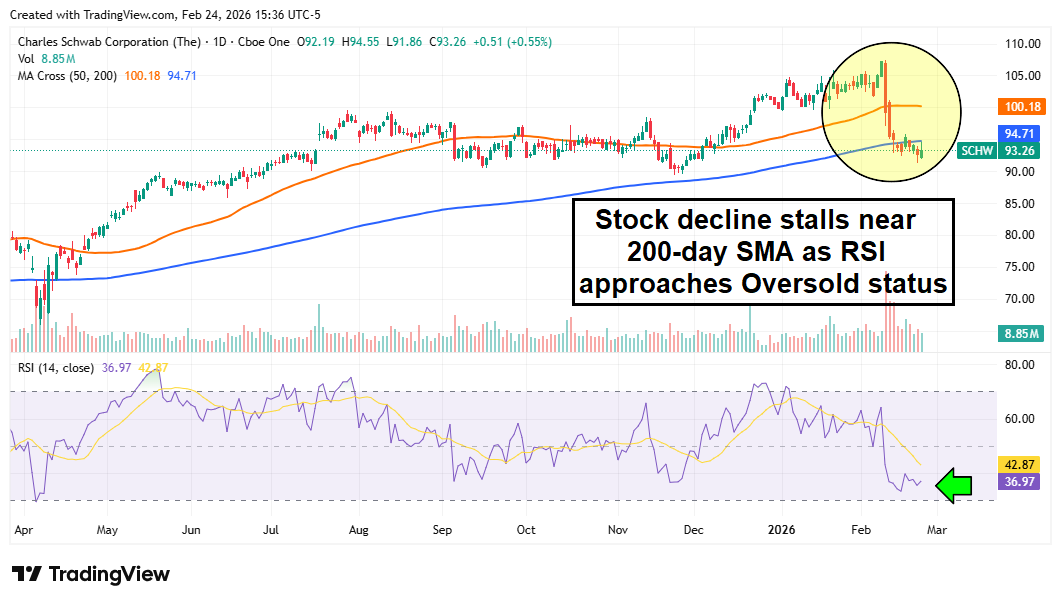
Charles Schwab Corp (NYSE: SCHW) fell nearly 8% in a single day after the Hazel announcement, but the decline appears to be collateral damage: tax planning is a relatively small part of Schwab’s business. Most of the company’s revenue comes from asset-management fees and interest on client cash. Schwab reported record revenue in 2025, including 19% year-over-year growth in Q4 2025, and it projects 9.5%–10.5% revenue growth for 2026 with a net interest margin in the 2.85%–2.95% range.

SCHW chart displaying the stock nearing oversold status under the 200-day SMA.

Schwab has a solid balance sheet, expanding margins and technical signs of a momentum reversal. The stock’s decline was arrested near the 200-day simple moving average (SMA), and the Relative Strength Index (RSI) suggests downward pressure is easing. A move back above the 200-day SMA would likely rekindle bullish momentum.

S&P Global: Soft Guidance Could Be a Buying Opportunity

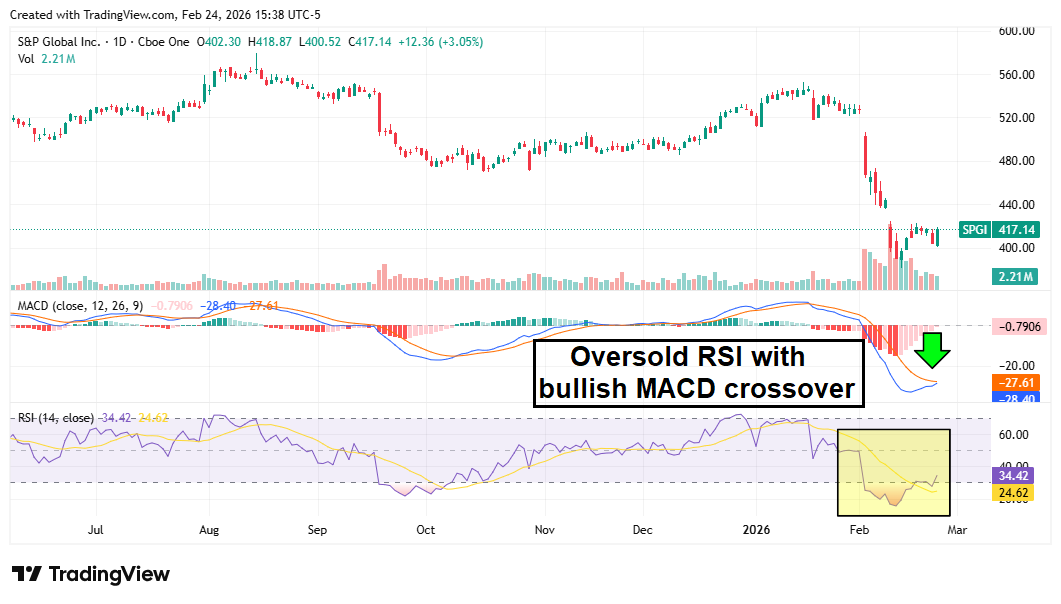
S&P Global Inc. (NYSE: SPGI) can’t entirely blame headlines for its roughly 20% decline over the past month. The company posted solid earnings and revenue in its Q4 2025 report, and its AI initiatives continue to expand. Still, the market reacted negatively to relatively light 2026 guidance, and the stock fell about 9% after the release. Combined with the Hazel headlines, that created additional selling pressure, though S&P Global’s ratings and fund services are unlikely to be derailed by these short-term concerns.

SGPI chart showing the stock with an oversold RSI.

SPGI has been the hardest hit of the three names here—months of gains were erased in a few weeks—but its technical setup points to a potential rebound. The RSI is beginning to recover after falling into oversold territory, and the Moving Average Convergence Divergence (MACD) looks close to a bullish cross. The stock’s more than 3.4% gain on Tuesday—its second-largest daily rise this year—suggests selling pressure may be easing.

Raymond James: AI Could Be a Tailwind for the Independent-Advisor Model

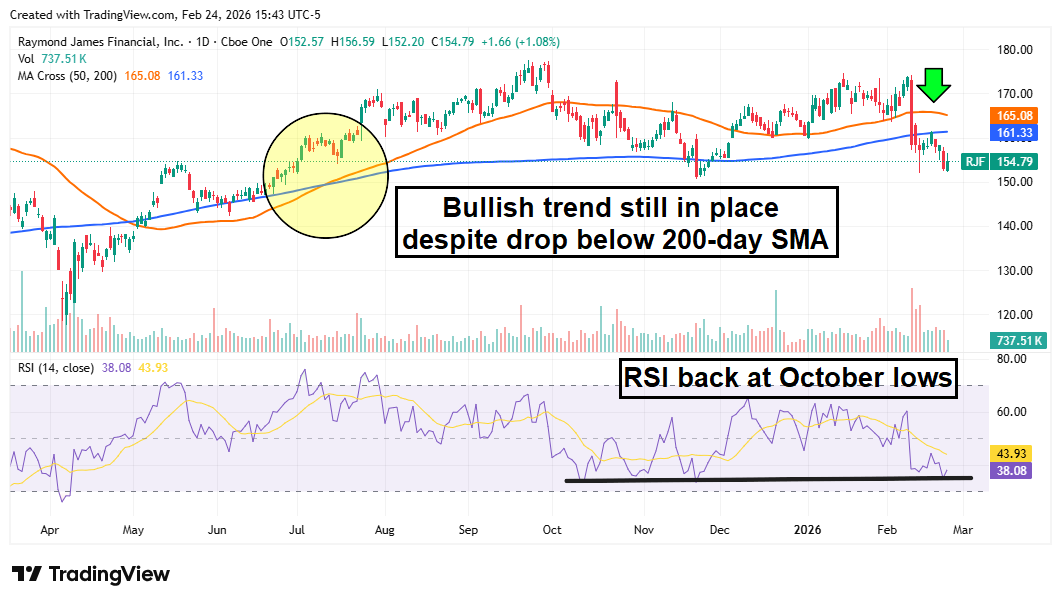
Raymond James Financial (NYSE: RJF) slid nearly 9% after the Hazel news, but that reaction misunderstands the firm’s model. RJF’s independent advisors are more likely to adopt AI tools like Hazel to enhance their offerings rather than lose business to them. Raymond James is building its own proprietary AI platform called Rai, and after the selloff the stock trades at about 13 times forward earnings and 1.9 times sales.

RJF chart showing a bullish stock trend intact, albeit with the RSI back at October lows.

RJF shares did break below the 50-day and 200-day SMAs during their drop, but the selling hasn’t been as severe as with SPGI and SCHW, and the longer-term uptrend remains intact. Last summer’s Golden Cross still leaves the 50- and 200-day SMAs in a bullish alignment, and the RSI has only returned to the lows seen in October and December. Despite the headlines, the stock isn’t in correction territory, and its recent excursion below the 200-day SMA was brief.

Thank you for subscribing to Insider Trades Daily, which covers the most recent insider buying and selling activity from Wall Street CEO’s, CFO’s, COO’s and other insiders.

This email is a sponsored email for i2i Marketing Group, LLC, a third-party advertiser of InsiderTrades.com and MarketBeat. 


We are not securities dealers or brokers, investment advisers or financial advisers, and you should not rely on the information herein as investment advice. Any investment should be made only after consulting a professional investment advisor and only after reviewing the financial statements and other pertinent corporate information. Further, readers are advised to read and carefully consider the Risk Factors identified and discussed in the profiled company’s SEC and/or other government filings. Investing in securities, particularly microcap securities, is speculative and carries a high degree of risk.


If you need help with your subscription, please don’t hesitate to contact MarketBeat’s South Dakota based support team at contact@marketbeat.com.

If you no longer wish to receive email from InsiderTrades.com, you can unsubscribe.

Copyright 2006-2026 MarketBeat Media, LLC. 
345 N Reid Pl., Sixth Floor, Sioux Falls, South Dakota 57103. United States of America..

Trump’s DHS Nomination Ignites Fresh Hope for Faithful Border Vigilance u2013 God’s Hand at Play?

Faith and Freedom Report

Trump’s DHS Nomination Ignites Fresh Hope for Faithful Border Vigilance u2013 God’s Hand at Play?

Thrilling update or something. Wait, no: Headline, only.nnWait, the output must be just the headline text.nnGenerate one.Biblical Voices Rise Against a Concerning New Threat to Gospel Witness and Faith Freedom

Europe’s Believers Confront Growing Shadows of Persecution u2013 Where Is God’s Light Shinning Brightest?

Faith Under Fire: Emerging Threat to Biblical Free Speech Challenges Christians to Stand Strong

God’s Truth Endures Amid Reports of Churches Turning to Mosques

A Fresh Wave of Faith Hits Streams with Jesus Loves Updates

Ryan Gosling Explores Sacrifice and Hope in a Faith-Inspired Sci-Fi Blockbuster

Want us to stop receiving emails? Unsubscribe here.
To manage your email preferences, click here.

600 N Broad Street, Suite 5 #3872, Middletown, DE 19709

© 2026 FaithFreedomReport.com. All rights reserved.

Let’s Flashback to Year 1955

American History

1955

Dont Miss What Happened On This Day!

More American History

Entertainment History

1826

Dont Miss What Happened On This Day!

More Entertainment History

Sports History

1983

Dont Miss What Happened On This Day!

More Sports History

World History

1985

Dont Miss What Happened On This Day!

More World History

DISCLAIMER

You have signed up to receive emails from todaysflashback.com and agreed to receive our daily newsletters which include promotions. Content labeled as “SPONSORED” may be a third-party advertisement and is not endorsed or warranted by any individual or company as a whole.

© 2024 Todays Flashback. All Rights Reserved.
2803 Philadelphia Pike Suite B #1340 Claymont, DE 19703, USA

Unsubscribe.

Is your Social Security and Medicare strategy built for today’s retirement?

Is your Social Security and Medicare strategy built for today’s retirement?

For years, the conventional wisdom on Social Security was simple: wait until 70 to maximize your benefit, pick a Medicare plan at 65, and revisit it occasionally.

But the retirement landscape in 2026 looks different. Longer life expectancies, rising healthcare costs, and a flood of conflicting advice from financial media have made these decisions feel far more complicated—and the stakes far higher.

That’s why we’re offering our free guide1 to help you navigate Social Security and Medicare with clarity, not guesswork. You’ll learn:

  • Why the “claim at 62 vs.70” Social Security debate misses the point
  • How to think through the claiming decision based on your specific situation
  • A breakdown of Medicare’s structure and your main coverage options
  • The Medicare trends retirees should know in 2026
  • Plus, how both these decisions fit into a broader retirement income and investment strategy

Mitch on the Markets

Talk to a Zacks Wealth Advisor today. 

1 Zacks Investment Management reserves the right to amend the terms or rescind the free Looking To Retire In 2026? Your Guide to Social Security and Medicare Decisions That Matter offer at any time and for any reason at its discretion.

Past performance is no guarantee of future results. Inherent in any investment is the potential for loss. Zacks Investment Management, Inc. is a wholly-owned subsidiary of Zacks Investment Research. Zacks Investment Management is an independent Registered Investment Advisory firm and acts as an investment manager for individuals and institutions. Zacks Investment Research is a provider of earnings data and other financial data to institutions and to individuals.

This material is being provided for informational purposes only and nothing herein constitutes investment, legal, accounting, or tax advice, or a recommendation to buy, sell or hold a security. Do not act or rely upon the information and opinions given in this document without seeking the services of competent and professional investment, legal, tax, or accounting counsel. Publication and distribution of this document is not intended to create, and the information and opinions contained herein does not constitute, an attorney-client relationship. No recommendation or advice is being given as to whether any investment or strategy is suitable for a particular investor. It should not be assumed that any investments in securities, companies, sectors, or markets identified and described were or will be profitable. All information is current as of the date of herein and is subject to change without notice. Any views or opinions expressed may not reflect those of the firm as a whole.

Any projections, targets, or estimates in this document are forward looking statements and are based on the firm’s research, analysis, and assumptions. Due to rapidly changing market conditions and the complexity of investment decisions, supplemental information and other sources may be required to make informed investment decisions based on your individual investment objectives and suitability specifications. All expressions of opinions are subject to change without notice. Recipients should seek financial advice regarding the appropriateness of investing in any security or investment strategy discussed in this document.

Certain economic and market information contained herein has been obtained from published sources prepared by other parties. Zacks Investment Management does not assume any responsibility for the accuracy or completeness of such information. Further, no third party has assumed responsibility for independently verifying the information contained herein and accordingly no such persons make any representations with respect to the accuracy, completeness or reasonableness of the information provided herein. Unless otherwise indicated, market analysis and conclusions are based upon opinions or assumptions that Zacks Investment Management considers to be reasonable.

Any investment inherently involves a high degree of risk, beyond any specific risks discussed herein.

It is not possible to invest directly in an index. Investors pursuing a strategy similar to an index may experience higher or lower returns, which will be reduced by fees and expenses.

Privacy Policy  |  Unsubscribe


Logo: Zacks Investment Research

Is your Social Security and Medicare strategy built for today’s retirement?

For years, the conventional wisdom on Social Security was simple: wait until 70 to maximize your benefit, pick a Medicare plan at 65, and revisit it occasionally.

But the retirement landscape in 2026 looks different. Longer life expectancies, rising healthcare costs, and a flood of conflicting advice from financial media have made these decisions feel far more complicated—and the stakes far higher.

That’s why we’re offering our free guide1 to help you navigate Social Security and Medicare with clarity, not guesswork. You’ll learn:

  • Why the “claim at 62 vs.70” Social Security debate misses the point
  • How to think through the claiming decision based on your specific situation
  • A breakdown of Medicare’s structure and your main coverage options
  • The Medicare trends retirees should know in 2026
  • Plus, how both these decisions fit into a broader retirement income and investment strategy

Mitch on the Markets

Talk to a Zacks Wealth Advisor today. 

1 Zacks Investment Management reserves the right to amend the terms or rescind the free Looking To Retire In 2026? Your Guide to Social Security and Medicare Decisions That Matter offer at any time and for any reason at its discretion.

Past performance is no guarantee of future results. Inherent in any investment is the potential for loss. Zacks Investment Management, Inc. is a wholly-owned subsidiary of Zacks Investment Research. Zacks Investment Management is an independent Registered Investment Advisory firm and acts as an investment manager for individuals and institutions. Zacks Investment Research is a provider of earnings data and other financial data to institutions and to individuals.

This material is being provided for informational purposes only and nothing herein constitutes investment, legal, accounting, or tax advice, or a recommendation to buy, sell or hold a security. Do not act or rely upon the information and opinions given in this document without seeking the services of competent and professional investment, legal, tax, or accounting counsel. Publication and distribution of this document is not intended to create, and the information and opinions contained herein does not constitute, an attorney-client relationship. No recommendation or advice is being given as to whether any investment or strategy is suitable for a particular investor. It should not be assumed that any investments in securities, companies, sectors, or markets identified and described were or will be profitable. All information is current as of the date of herein and is subject to change without notice. Any views or opinions expressed may not reflect those of the firm as a whole.

Any projections, targets, or estimates in this document are forward looking statements and are based on the firm’s research, analysis, and assumptions. Due to rapidly changing market conditions and the complexity of investment decisions, supplemental information and other sources may be required to make informed investment decisions based on your individual investment objectives and suitability specifications. All expressions of opinions are subject to change without notice. Recipients should seek financial advice regarding the appropriateness of investing in any security or investment strategy discussed in this document.

Certain economic and market information contained herein has been obtained from published sources prepared by other parties. Zacks Investment Management does not assume any responsibility for the accuracy or completeness of such information. Further, no third party has assumed responsibility for independently verifying the information contained herein and accordingly no such persons make any representations with respect to the accuracy, completeness or reasonableness of the information provided herein. Unless otherwise indicated, market analysis and conclusions are based upon opinions or assumptions that Zacks Investment Management considers to be reasonable.

Any investment inherently involves a high degree of risk, beyond any specific risks discussed herein.

It is not possible to invest directly in an index. Investors pursuing a strategy similar to an index may experience higher or lower returns, which will be reduced by fees and expenses.

Privacy Policy  |  Unsubscribe