Sun Devil Giving Day is Thursday, March 19

March 19 is Sun Devil Giving Day! 

Please save the date for Sun Devil Giving Day on Thursday, March 19.

ASU’s biggest philanthropic event of the year is an opportunity for the Herberger community to come together in support of the students, programs, and creative work that define our Institute.

We hope you will consider making a gift to an area of Herberger that matters most to you. Download a calendar invite below to receive a reminder on Thursday, March 19.

Add to: 

Google Calendar Outlook Calendar

The Herberger Institute comprises ASU FIDM and ASU FIDM Museum; the School of Art; The Design School; The Sidney Poitier New American Film School; The GAME School; the School of Music, Dance and Theatre; and the ASU Art Museum.

You are receiving this email because you subscribed to receive information about news and events from the ASU Herberger Institute for Design and the Arts OR because you are a current student, alum, faculty or staff member in the Herberger Institute community. Stay in-the-know about our 1,000+ events each year.

This email was sent to: peter.hovis@gmail.com

Forward to a friend | Update Profile | Unsubscribe
View this email online

ASU Herberger Institute for Design and the Arts
PO Box 872102, Tempe, AZ, 85287-2102, USA

Copyright © 2026 Arizona Board of Regents | Privacy statement

Biggest Trading Breakthrough For 2026

Unsubscribe here


Dear Fellow Trader,

There’s a moment every trader dreams about.

It’s that day when something finally clicks…and everything becomes simpler.

For me, that moment came when I made the incredible discovery I named E-180.

It’s NOT…

  • A chart pattern
  • A lagging indicator
  • Or something that requires hours glued to a screen

Instead, it’s a backdoor way to detect shifting trader sentiment in real time…before it shows up in the market.

And the results are mind-blowing.

Not just because of the triple-digit winners…

But because it allowed me to go more than two months without a single losing trade!

That level of consistency is what finally made monthly withdrawals realistic.

If you’re curious how this works…And what it could mean to you…

I’ve explained everything step-by-step in a very entertaining way.

When you see how it works, I’ll bet you’ll be as excited as me.

YES – Show Me the Details 

Wishing You Endless Prosperity,


Ian Cooper
TradeWins Logo

Chart of the Day: $200 Oil is Now a Strong Possibility

There are fears we’ll see $100, even $200 oil.

And unfortunately, the higher end of that range is looking more and more likely.

According to Energy Secretary Chris Wright the U.S. Navy is not ready to begin escorting oil tankers through the Strait of Hormuz. …Read More


© 2026 Tradewins Publishing. All rights reserved. | Disclaimer | Privacy Policy | Terms and Conditions | Contact Us

NOTICE: Auto-trading, or any broker or advisor-directed type of trading, is not supported or endorsed by Ian Cooper. The information provided by Ian Cooper in its various materials, including trading recommendations, newsletters and educational publications is not customized or personalized for any particular person or risk profile. Past results are not necessarily indicative of future results. Results presented can vary and may not be typical for all subscribers. There are substantial risks involved with investing in the stock and options market, including the risk of total loss. You should only trade or invest “risk capital” – funds you can afford to lose.This email was sent to peter.hovis@gmail.com by kimwaller@tradewins.com

TradeWins Publishing Corp. 528 North Country Rd., St. James, NY 11780

1-Click Unsubscribe | Edit Profile | Manage Subscriptions | Report Spam

Elon’s Private AI Empire: The Backdoor Under $100

Dear Reader,

Elon Musk’s “AI Everywhere” project isn’t inside Tesla—it’s a private venture with a global network of 150+ facilities embedding autonomous AI into devices everywhere.

Musk believes this could propel Tesla to become the most valuable company ever, worth more than Apple, Microsoft, Nvidia, Amazon, and Google combined.

Private ventures like this are usually locked for elites, but I’ve found a legitimate brokerage backdoor—under $100, no special requirements, just a regular account.

Musk’s history proves he turns underdogs into giants:

  • PayPal → Peter Thiel turned $1,700 into $55 million.
  • SpaceX → valuation up 349,900% ($1,000 now worth over $3.4 million).
  • Tesla → 22,000%+ since IPO ($1,000 to over $220,000).
  • xAI → $0 to $230 billion in under two years.

This private play follows the same playbook—using Tesla’s proven autonomous AI “copy-pasted” across the world.

Watch my full video—I explain the story and give you 3 steps to profit, including how to claim that backdoor stake before the summer regulatory shift.

Click here now—time is short.

Here’s to the future,

Matt McCall

P.S. Ignore this and you could miss the biggest Musk-driven opportunity since Tesla’s early days.


Special Report

Warm Winter Hit Vail’s Earnings. What Does It Mean for the Stock?

Written by Jennifer Ryan Woods. First Published: 3/11/2026. 

Skier carving down a sunny alpine ski resort slope with chairlifts and a large mountain village below, illustrating the ski resort industry and winter tourism.

Key Points

  • An unusually warm winter and historically low snowfall in the Rockies led Vail Resorts to miss fiscal second-quarter earnings expectations and cut its full-year guidance, with skier visits falling 12% as limited snowpack reduced available terrain at key resorts.
  • Although Vail’s stock has struggled in recent years, falling more than 60% from its 2021 peak, analysts still see significant upside, with the average 12-month price target of about $171 implying more than 25% potential gains from current levels.
  • Investor sentiment remains divided, as short interest has climbed to nearly 12% of the public float even while the company’s 6.6% dividend yield may help support the stock.
  • Special ReportElon Musk: This Could Turn $100 into $100,000

A historically warm winter weighed on ski resort operator Vail Resorts Inc. (NYSE: MTN), producing disappointing fiscal second-quarter 2026 results and forcing the company to cut full-year guidance. Shares initially fell after the report, which was released following the market close on March 9, though they later recovered. The day after the release, the stock traded marginally higher around $135 on above-average volume as investors digested the earnings miss and the revised outlook.

Investor sentiment remains mixed. Despite the weather-driven setback, many analysts still see meaningful upside, while rising short interest suggests some investors are skeptical about the company’s near-term prospects.

Warm Winter Hits Earnings and Skier Visits

Elon’s Private AI Empire: The Backdoor Under $100 (Ad)

Elon Musk’s AI Everywhere project isn’t inside Tesla—it’s a private venture with a global network of 150+ facilities embedding autonomous AI into devices everywhere, and Musk believes this could propel Tesla to become the most valuable company ever, worth more than Apple, Microsoft, Nvidia, Amazon, and Google combined. Private ventures like this are usually locked for elites, but I’ve found a legitimate brokerage backdoor under $100 with no special requirements, just a regular account, and this private play follows the same playbook as PayPal, SpaceX, Tesla, and xAI using Tesla’s proven autonomous AI copy-pasted across the world.See the 3 steps to profit before the summer regulatory shift

On the company’s earnings call, Chief Executive Robert Katz said the disappointing quarter and reduced guidance reflect “the most difficult weather environment in the Rockies we have ever seen.”

Snowfall and snowpack were at or near historic lows, he said, exceeding the poor conditions of fiscal 2012 that had been considered the worst in the region. The poor ski conditions led to a 12% decline in visits.

The Colorado-based company, which operates more than 40 mountain resorts including Vail Mountain, Beaver Creek and Breckenridge, reported earnings of $5.87 per share. That compared with $6.56 per share a year earlier and missed estimates by $0.18.

Revenue for the quarter totaled $1.08 billion, down 4.7% year over year and about $27 million below estimates. Because the Rockies generate the lion’s share of Vail’s resort EBITDA, historically low snowfall in that region had an outsized impact on results.

Epic Pass and Diversified Resorts Help Cushion the Blow

In the earnings release, Katz said the decline in lift revenue was relatively modest given the “worst-case weather scenario,” highlighting the resilience of Vail’s operating model. Strong growth in the Epic Pass program — which lets skiers pay upfront for access to multiple resorts — provided stability. Pass holders account for roughly 75% of visits annually, helping smooth revenue even in tough seasons. The company’s expansion into more geographically diverse locations also helped blunt the impact of regional weather.

Because weather continues to limit available terrain at some resorts, Vail lowered its fiscal 2026 net income outlook to $144 million–$190 million, down from the prior $201 million–$276 million forecast. The company maintained its quarterly dividend of $2.22 per share, saying this year’s cash-flow decline does not change the business’s long-term cash-generation ability. The dividend, which yields roughly 6.6%, may help attract income-focused investors and provide some support to the share price.

Shares Have Struggled Despite Analysts’ Expected Upside

Vail’s stock has fallen substantially since its all-time high of about $372 in November 2021. In early February this year the shares dropped to roughly $126 — a decline of more than 66% from the peak. Over the past 12 months, shares are down more than 11%, while the leisure and recreational services industry rose over 10% and the Invesco Leisure and Entertainment ETF (NYSEARCA: PEJ) gained more than 18%. Vail trades at a price-to-earnings ratio just under 20, above the industry and broader consumer discretionary averages near 17.

Analysts are mixed. Of 13 covering the stock, four rate it Buy, eight Hold and one Sell. After the results, three analysts lowered their price targets: Barclays to $138 from $140, Truist Financial to $217 from $234, and Stifel Nicolaus to $172 from $175. Even with those cuts, the consensus 12-month target of $171 implies roughly 25% upside from the current share price of about $133.

Short interest has risen, reflecting growing skepticism among some investors. As of Feb. 13, roughly 4.19 million shares were sold short, representing nearly 12% of the public float — about double the level a year earlier.

For investors, Vail’s outlook will likely hinge on whether the weather-driven weakness is temporary. If visitation normalizes and the pass-based model continues to provide steady revenue, analysts’ upside could materialize. In the near term, the company’s high dividend yield may help support the shares during what has been a difficult season.


Special Report

The New War Portfolio: 3 Stocks Built for a High-Tech War

Written by Jeffrey Neal Johnson. First Published: 3/8/2026. 

Modern naval warship cruising across open ocean waters at sunrise, viewed from above, showcasing advanced defense technology and military maritime power.

Key Points

  • Palantir’s artificial intelligence platform is becoming the essential command-and-control engine for modern intelligence operations.
  • AeroVironment’s combat-proven unmanned systems deliver unparalleled precision and tactical agility on the modern battlefield.
  • Northrop Grumman’s extensive backlog and advanced platforms offer investors stable exposure to long-term, strategic defense programs.
  • Special ReportElon Musk: This Could Turn $100 into $100,000

Increasing geopolitical instability worldwide is acting as a powerful catalyst for the defense industry. This is more than a cyclical increase in spending; it marks a structural inflection point. A new defense doctrine is emerging—one where success depends less on mass and more on information superiority, precision, and autonomous action. For investors, that implies a durable, long-term trend: the most compelling growth stories will be companies enabling a smarter, data-centric approach to national security.

Why This Time Is Different for Defense Spending

Defense budgets are being reshaped to reflect 21st-century conflict. Funding is shifting toward technologies that deliver a decisive intelligence and operational edge: artificial intelligence (AI) to process data at machine speed, unmanned systems that can be deployed with agility, and resilient networks that connect platforms and sensors. This is not merely a short-term spike in procurement; it is a structural reallocation of capital toward the technology of modern warfare, creating a sustained tailwind for companies at the forefront of this transition.

Palantir: Turning Battlefield Chaos Into Clarity

The rise of the “Useless Class” (Ad)

Famed historian Yuval Noah Harari recently issued a warning that should send a shiver down the spine of every American. He predicts the emergence of a massive new useless class. These aren’t just people who are temporarily unemployed. These are people who have become economically irrelevant. As Luke Lango and I just exposed in our recent interview, we have reached the singularity. For the first time in 250 years, intelligence has been decoupled from labor. During America’s first 1776 moment, the steam engine replaced muscle. In this new 1776 moment, AI is replacing the human mind.

This is why you see the Magnificent 7 tech giants adding trillions in value while the real economy feels like it’s in a death spiral. The divide is widening. On one side: the useless class who cling to old-world skills. On the other: the new aristocracy who own the assets of the technological republic. Luke and I have identified the three specific money moves our research indicates you must make to ensure you stay on the winning side of this divide.See the three moves to stay on the winning side of AI

In modern military operations, data is the most valuable ammunition, and Palantir Technologies (NASDAQ: PLTR) supplies the system to aim it. The company has positioned itself as the central nervous system for intelligence, converting vast streams of battlefield information into actionable insight.

Palantir’s Artificial Intelligence Platform (AIP) functions as a command-and-control engine, fusing data from satellites, drones, and soldiers into a single, real-time operational picture that gives commanders a decisive edge. In this environment, anticipating an adversary’s move seconds before it happens is a critical advantage.

Demand for this capability is surging. Palantir’s recent financial results showed a roughly 70% year-over-year revenue increase in its last reported quarter, underscoring rapid growth.

While Palantir’s deep relationships with the U.S. Department of Defense provide a stable foundation of government revenue, an expanding commercial business is equally important for investors. Growth in the private sector demonstrates the broader applicability of its technology and helps diversify revenue streams, reducing reliance on government spending cycles. That dual approach supports a more resilient business model capable of capturing growth across the economy.

  • Key Investment Takeaway: Palantir offers direct exposure to the high-growth AI-in-defense theme, reflecting a premium valuation tied to its critical role and accelerating adoption.

AeroVironment: The Unmanned Tip of the Spear

AeroVironment (NASDAQ: AVAV) has emerged as a leading provider of small unmanned systems that are proving indispensable in modern conflicts.

Its platforms deliver precision and agility that larger, costlier systems cannot match. Flagship products like the Switchblade loitering munition—often described as a “kamikaze” drone—provide a see-and-strike capability that allows operators to identify and engage targets with exceptional accuracy.

That capability is complemented by a portfolio of reconnaissance drones, including the Puma and Raven systems, which deliver critical intelligence, surveillance, and reconnaissance (ISR) without exposing pilots to risk.

This strategic importance is reflected in the company’s financial performance. In its second-quarter 2026 earnings report, AeroVironment reported revenue growth of more than 150% year over year, signaling strong demand. The company has already announced plans for domestic manufacturing expansion, indicating management’s expectation of sustained, high-volume orders from the U.S. military and allies. Close attention to major contract negotiations—such as the Space Force SCAR program—underscores the Pentagon’s interest in the company’s next-generation technologies.

  • Key Investment Takeaway: As a go-to provider of combat-proven tactical drones, AeroVironment stands to benefit directly from rising demand for unmanned systems, positioning it as a primary beneficiary of this doctrinal shift.

Northrop Grumman: The Backbone of Modern Warfare

While Palantir delivers intelligence and AeroVironment provides tactical effects, Northrop Grumman (NYSE: NOC) builds the advanced, resilient platforms that undergird the ecosystem.

The company leads strategic programs designed for the information age, most notably the B-21 Raider. That platform is more than a stealth bomber: it’s a data-fusing, networked asset built to operate and connect the battlespace in contested environments. Its role is to ensure the data streams systems like Palantir’s rely on remain available.

For investors, Northrop Grumman’s financial strength provides a stable anchor. The company maintains a large, growing backlog of about $95.7 billion, offering long-term revenue visibility and insulating it from short-term market swings.

Its leadership in the space domain, illustrated by programs like DARC for deep-space surveillance, is critical to maintaining information superiority. That technological edge is paired with a 22-year history of consecutive dividend increases, yielding roughly 1.22%. Trading at a P/E of approximately 26, Northrop Grumman presents a more traditional valuation than many high-growth tech plays, signaling financial stability and a commitment to shareholder returns.

  • Key Investment Takeaway: Northrop Grumman is a stable, blue-chip way to access this theme, offering exposure to advanced defense programs along with the security of a large backlog and a reliable dividend.

A Modern Portfolio for a New Reality

Technology has rewritten the rules of conflict, and investment strategies must adapt. The complementary strengths of Palantir’s AI-driven analysis, AeroVironment’s tactical execution, and Northrop Grumman’s foundational platforms create a powerful combined effect. These companies are not only responding to current events; they are building the future of defense.

As nations prioritize technological superiority, the triad of data, drones, and advanced defense systems presents a compelling, forward-looking investment thesis. The shift to a technology-first defense posture is not a fleeting trend but a multi-decade transformation, placing these three companies at the forefront of a new and persuasive investment cycle.

Thank you for subscribing to Insider Trades Daily, which covers the most recent insider buying and selling activity from Wall Street CEO’s, CFO’s, COO’s and other insiders.

This email content is a paid sponsorship provided by NXT Wave Research, a third-party advertiser of InsiderTrades.com and MarketBeat. 

If you have questions about your subscription, feel free to email MarketBeat’s South Dakota based support team at contact@marketbeat.com.

If you no longer wish to receive email from InsiderTrades.com, you can unsubscribe.

© 2006-2026 MarketBeat Media, LLC. 
345 North Reid Place, Suite 620, Sioux Falls, S.D. 57103-7078. United States..

See Also: ALERT: Drop these 5 stocks before the market opens tomorrow! (From Weiss Ratings)

Tomorrow morning’s stock alert

Good day,

Our research team is preparing to release our next stock idea tomorrow morning, just before 12:00 PM Eastern.

As a reminder, we send this pick first to investors who subscribe to receive The Early Bird Stock of the Day via text message. Then, it goes out the following morning to our email newsletter subscribers.

If you’d like to see the idea before it reaches the broader audience, now is the time to join. Many subscribers told us they appreciated getting early access, and our most recent pick drew a strong response.

The Early Bird Stock of the Day is a free service from The Early Bird and MarketBeat. To add yourself to the SMS distribution list and make sure you’re included in tomorrow’s release, simply click the link below:

Get The Early Bird Stock of the Day

Best regards,
The Early Bird Team


Today’s Exclusive Article

3 Stocks With the Most to Gain From Tariff Relief

By Dan Schmidt. Article Published: 3/2/2026. 

Cargo ship unloading containers at U.S. port with American flag, symbolizing tariff rollback and renewed trade.

Key Points

  • The Supreme Court struck down President Trump’s sprawling tariff regime under the IEEPA.
  • While other tariffs remain and Trump quickly enacted new ones, the decision provides significant relief and newfound policy predictability for many U.S. firms.
  • Five Below, Ross Stores, and FedEx Corp are three of the companies that stand to benefit most from tariff reductions (and potential refunds).
  • Special ReportElon Musk: This Could Turn $100 into $100,000

Tariff drama is again dominating market headlines after the Supreme Court struck down the strictest rates. While the news is broadly bullish for many retailers, the muted market reaction may have left investors puzzled. Here’s why the market responded the way it did, and why the ruling still creates opportunities for several stocks that are no longer in the trade-war crosshairs.

Where the Tariff Situation Currently Stands

On Feb. 20, the Supreme Court ruled againstPresident Trump’s use of the International Emergency Economic Powers Act (IEEPA) to impose sweeping tariffs without Congressional consent. In a 6-3 decision, the Court found that the President exceeded his authority under IEEPA and ordered that all tariffs imposed under that law be vacated immediately.

The rise of the “Useless Class” (Ad)

Famed historian Yuval Noah Harari recently issued a warning that should send a shiver down the spine of every American. He predicts the emergence of a massive new useless class. These aren’t just people who are temporarily unemployed. These are people who have become economically irrelevant. As Luke Lango and I just exposed in our recent interview, we have reached the singularity. For the first time in 250 years, intelligence has been decoupled from labor. During America’s first 1776 moment, the steam engine replaced muscle. In this new 1776 moment, AI is replacing the human mind.

This is why you see the Magnificent 7 tech giants adding trillions in value while the real economy feels like it’s in a death spiral. The divide is widening. On one side: the useless class who cling to old-world skills. On the other: the new aristocracy who own the assets of the technological republic. Luke and I have identified the three specific money moves our research indicates you must make to ensure you stay on the winning side of this divide.See the three moves to stay on the winning side of AI

Following the ruling, the administration enacted new 10% tariffs under Section 122 and said the existing tariffs under Section 232 would remain in place. According to a Penn Wharton analysis, the new effective tariff rate is 9.1%, down from the roughly 9.8% rate that applied for much of 2025. Companies facing tariffs will welcome relief, but that relatively small decline helps explain why markets barely reacted.

The Section 122 tariffs have important limitationsthat the IEEPA ones did not. Section 122 tariffs cannot be targeted to specific countries, the rate cannot exceed 15%, and they do not stack on top of other tariffs (such as Section 232). Most importantly, they are temporary: after 150 days the President must request an extension from Congress, which is unlikely to be approved with midterm elections only weeks after the expiration.

Another wild card is the prospect of refunds. IEEPA tariffs collected an estimated $175 billion, and companies seeking refunds must file suit in the Court of International Trade. Refunds would be a windfall for many firms that had baked higher import costs into their 2026 plans. Refunds, combined with further rate reductions after the 150-day window under Section 122, would represent a double tailwind for the stocks that faced the most tariff pressure.

3 Stocks That Benefit From Tariff Cancellations (and Potential Refunds)

The market’s recovery in the final eight months of 2025 likely reflected expectations that the Supreme Court would limit the administration’s tariff authority. Regardless, tariffs materially affected the following three companies, and any rollback of those measures — along with possible refunds — could have meaningful implications.

Five Below: Immediate Relief on China Imports

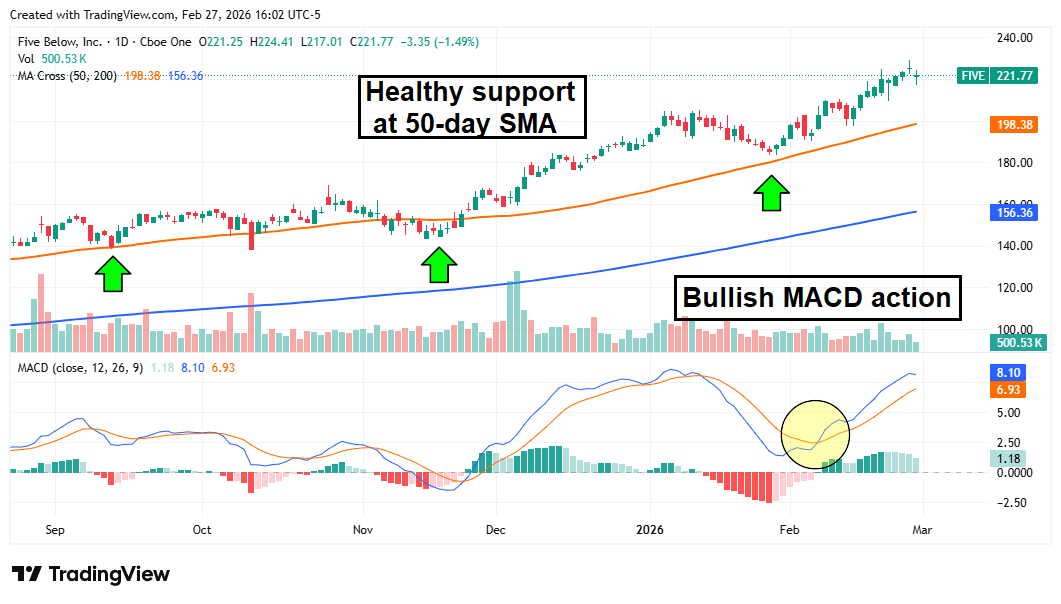
Five Below Inc. (NASDAQ: FIVE) faced serious margin pressure from tariffs because most of its products are imported from China and its low-price strategy prevents it from passing costs on to customers.

The chain targets young, highly price-sensitive shoppers, so every tariff increase directly hit Five Below’s margins. Revoking the harshest rates on China therefore provides immediate relief.

Equally important, the Supreme Court’s decision restores some predictability and reduces the threat of escalating duties, such as last spring’s Liberation Day tariffs.

FIVE chart displaying the stock strongly supported above the 50-day SMA, with bullish MACD action.

Five Below reported fiscal Q3 2026 results in December that were strong, but management warned of a potential 240-basis-point decline in operating margin due to tariff costs. The company will release fiscal Q4 results on March 18; while the tariff relief is unlikely to affect those numbers, fiscal 2027 projections should look better than they did last quarter. Reflecting that view, JPMorgan raised its price target to a Street-high $259 — roughly 15% above current levels.

Ross Stores: Margin and Inventory Benefits

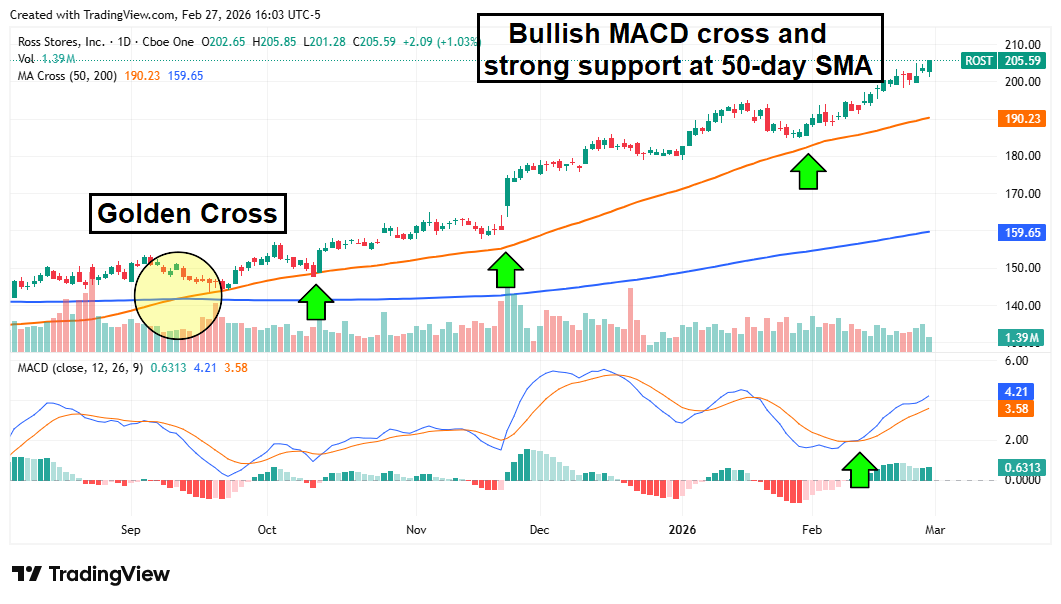
Ross Stores Inc. (NASDAQ: ROST) also benefits from the tariff decision, though more indirectly than Five Below. While over half of Ross’s merchandise originates in China, Ross itself does little direct importing; it buys overstocks from other U.S. brands that have already paid duties.

Many retailers front-loaded inventory last year to avoid tariff exposure and may now be willing to offload that inventory to resellers like Ross at deeper discounts. Ross has said tariffs reduced earnings by about 16 cents per share in fiscal 2025.

ROST chart showing a bullish Golden Cross formation in September, with strong support at the 50-day SMA in early March.

Investors will watch Ross’s March 3 earnings report for updated guidance now that the IEEPA tariffs have been struck down. Analysts were optimistic heading into the report: five firms raised price targets in February, including a Street-high $232 from JPMorgan on Feb. 23.

FedEx: Trade-Volume Recovery and First-Mover Advantage on Refunds

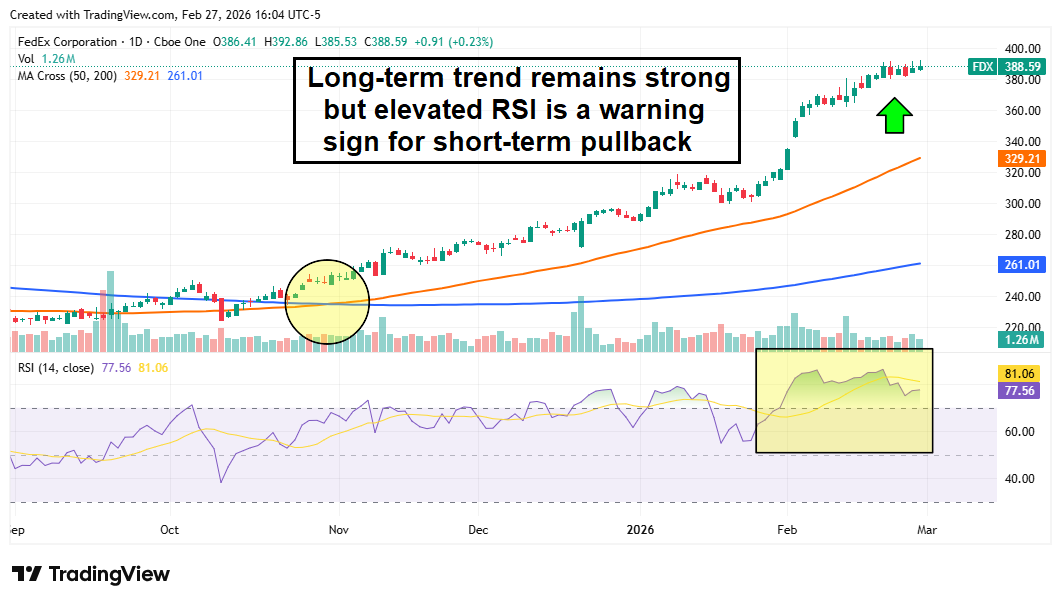
FedEx Corp. (NYSE: FDX) will not get the same margin relief that retailers might, but it stands to gain in other ways.

The biggest benefit is a likely normalization of operations on the lucrative China-to-U.S. route. FedEx executives estimated tariffs caused about a $1 billion revenue headwind during the 2025 fiscal year — a shortfall that should be easier to manage now that IEEPA tariffs are gone.

FDX chart displaying a strong long-term trend in the stock, albeit with an elevated RSI.

FedEx was also the first company to sue the U.S. government for a refund after the Supreme Court decision. If successful, the firm could be eligible for up to $1 billion in tariff relief and could earn goodwill by returning some of that windfall to shippers. One caution: FDX appears overbought on the Relative Strength Index (RSI), so a pullback to the 50-day moving average might offer a more stable entry point for new positions.


Special Report

The Real Reason Eli Lilly Is Pouring $3 Billion Into China

Reported by Jeffrey Neal Johnson. Article Posted: 3/13/2026. 

Lilly logo on lab-style graphic with neon rings.

Key Points

  • Eli Lilly is committing $3 billion over a decade to expand manufacturing in China, targeting a GLP-1 market that some analysts estimate could reach $14 billion by 2030.
  • The investment is designed to close a manufacturing gap with Novo Nordisk while building cost advantages against more than 60 domestic Chinese competitors developing rival GLP-1 drugs.
  • Local production also hedges against supply chain risks tied to trade friction, a vulnerability that recent global GLP-1 shortages have already exposed.
  • Special ReportElon Musk: This Could Turn $100 into $100,000

Eli Lilly and Company (NYSE: LLY) is a titan of the pharmaceutical industry, a position reinforced by the monumental success of its GLP-1 diabetes and obesity drug franchise. With products like Mounjaro and Zepbound transforming patient care and generating blockbuster sales, Lilly’s stock has climbed into the top ranks of the S&P 500.

In a move that signals long-term ambition, Lilly has announced a $3 billion, decade-long commitment to expand manufacturing operations in China. That decision prompts a key question for shareholders: in a complex global landscape, why make such a substantial bet on China now? The answer reflects strategic foresight and outlines a clear blueprint for Lilly’s future growth.

Why China? An Unprecedented Market Opportunity

The rise of the “Useless Class” (Ad)

Famed historian Yuval Noah Harari recently issued a warning that should send a shiver down the spine of every American. He predicts the emergence of a massive new useless class. These aren’t just people who are temporarily unemployed. These are people who have become economically irrelevant. As Luke Lango and I just exposed in our recent interview, we have reached the singularity. For the first time in 250 years, intelligence has been decoupled from labor. During America’s first 1776 moment, the steam engine replaced muscle. In this new 1776 moment, AI is replacing the human mind.

This is why you see the Magnificent 7 tech giants adding trillions in value while the real economy feels like it’s in a death spiral. The divide is widening. On one side: the useless class who cling to old-world skills. On the other: the new aristocracy who own the assets of the technological republic. Luke and I have identified the three specific money moves our research indicates you must make to ensure you stay on the winning side of this divide.See the three moves to stay on the winning side of AI

To understand Lilly’s strategy, investors must first appreciate the scale of the opportunity. This investment responds to a market too large to ignore. China faces a significant public health challenge, with an estimated 141 million people living with diabetes. The country also has more than 600 million adults who are classified as overweight or obese—the largest such population in the world. As the middle class expands and healthcare spending rises, demand for effective treatments is expected to increase substantially.

That creates a vast and largely untapped pool of potential patients for Lilly’s leading medications. The financial upside is immediate and significant: market forecasts project China’s GLP-1 market to surge, with some analysts estimating it could reach roughly $14 billion by 2030. This rapid expansion makes China a critical long-term growth engine for Lilly’s injectable products and for its next wave of innovation, including the oral candidate orforglipron. For a daily oral medication to succeed at scale, efficient, high-volume local manufacturing is not just advantageous—it is essential. Securing this market is vital to maintaining global leadership.

Lilly’s Great Wall: A Strategy for Supply and Supremacy

Lilly’s investment serves a dual strategic purpose: it builds a defensive shield against external risks while creating an offensive capability to secure market dominance. This proactive approach should reassure investors about management’s ability to navigate a complex global environment and protect future earnings.

The Geopolitical Shield

First, the move acts as a defensive shield by strengthening the supply chain. The U.S. pharmaceutical industry remains heavily dependent on China for Active Pharmaceutical Ingredients (APIs), the core components of many drugs. In an era of trade friction and potential export controls, that dependence is a vulnerability. By establishing a robust presence in China, Lilly reduces the risk of supply interruptions, mitigates exposure to trade disputes or logistics disruptions, and helps ensure a stable supply of medicines to Chinese patients—while supporting more predictable revenue streams for shareholders.

The Competitive Weapon

Second, the investment is an offensive tool in a fiercely competitive market. Lilly faces a two-front challenge in China. Its main global rival, Novo Nordisk (NYSE: NVO), already has an established manufacturing footprint in the country. Lilly’s investment is necessary to level the playing field and compete on supply, speed, and scale.

Equally important is the rise of local competitors: over 60 domestic Chinese pharmaceutical companies are developing their own GLP-1 therapies. That will exert downward pressure on prices in the years ahead. By manufacturing locally and partnering with domestic experts like Pharmaron, Lilly can achieve greater cost efficiencies and pricing flexibility—allowing it to defend market share against lower-cost alternatives, preserve long-term margins, and build a durable competitive moat.

Why This Move Secures Future Returns

Ultimately, this multi-billion-dollar strategy reinforces the bullish investment case for Eli Lilly. It is about more than expanding sales; it is about building a durable, defensible, and highly profitable business over the long term. Capturing a meaningful share of China’s GLP-1 market could translate into billions of dollars in annual revenue, providing a long runway for growth that supports Lilly’s premium valuation.

This kind of forward-looking capital deployment helps explain why Wall Street sentiment remains largely positive. The analyst consensus for Lilly’s stock is a Moderate Buy, with an average price target near $1,230. That optimism reflects the current success of Mounjaro and Zepbound and the expectation that management will continue to take strategic actions to secure future growth. The China investment is a tangible validation of that confidence.

By establishing a powerful third pillar of global growth alongside the U.S. and Europe, Lilly is not merely expanding—it’s diversifying and strengthening its enterprise. For investors, this $3 billion commitment is less a gamble than a calculated foundation for the company’s next decade of growth, further solidifying Eli Lilly’s position as a global pharmaceutical leader and making a compelling case for its long-term value.

Thank you for subscribing to MarketBeat!

We empower everyday investors to make better investment decisions by offering up-to-the-minute financial information and objective market research.

This email content is a sponsored email for The Early Bird, a third-party advertiser of MarketBeat. Why did I get this message?

If you need assistance with your newsletter, please don’t hesitate to email MarketBeat’s U.S. based support team at contact@marketbeat.com.

If you would like to unsubscribe or change which emails you receive, you can manage your mailing preferences or unsubscribe from these emails.

© 2006-2026 MarketBeat Media, LLC. All rights reserved.
345 North Reid Place #620, Sioux Falls, South Dakota 57103. United States..

Just For You: ALERT: Drop these 5 stocks before the market opens tomorrow! (From Weiss Ratings)

March 17: St. Patrick’s Day, Meir Leads Israel, Yale Tragedy

A 5th-century missionary’s death evolved into a global celebration—rivers dyed green, parades everywhere, and Irish heritage claimed by anyone who wants to join.At 70, Golda Meir became Israel’s first female prime minister—and proved that gender doesn’t determine whether someone can lead a nation through existential crisis.Annie Le was murdered days before her wedding in a Yale research building—exposing the vulnerability that persists even in supposedly secure spaces.

https://this.dayinhist.com/ · 3095 HW 101 N Ste 11 · Unit #4013 · Gearhart · Oregon · 97138

Preferences   |   Unsubscribe

This email was sent to peter.hovis@gmail.com.

Click here to view the online version.

Let’s Flashback to Year 1755

American History

1755

Dont Miss What Happened On This Day!

More American History

Entertainment History

1861

Dont Miss What Happened On This Day!

More Entertainment History

Sports History

1976

Dont Miss What Happened On This Day!

More Sports History

World History

1537

Dont Miss What Happened On This Day!

More World History

DISCLAIMER

You have signed up to receive emails from todaysflashback.com and agreed to receive our daily newsletters which include promotions. Content labeled as “SPONSORED” may be a third-party advertisement and is not endorsed or warranted by any individual or company as a whole.

© 2024 Todays Flashback. All Rights Reserved.
2803 Philadelphia Pike Suite B #1340 Claymont, DE 19703, USA

Unsubscribe.

Welcome to Recommended Reads

WELCOME TOWe’re glad you’re here!We’re glad to welcome you to Recommended Reads! As a subscriber, you no longer have to sift through countless websites and social feeds to find the web’s best content — all you have to do is check your email. Easy.

Recommended Reads sends you trending stories and hand-picked articles daily, transforming your inbox into a gateway to all that’s worth reading. Welcome to a better, simpler, more curated internet. Your next edition will arrive soon! ♡

CONFIRM YOUR EMAILIf you would not like to receive future recommendations
please click here to unsubscribe.WAS THIS EMAIL FORWARDED TO YOU?I’d like to unsubscribe from all emails.Contact Us  |  Privacy Policy  |  Terms of UseCopyright © 2025 Recommended Reads. All rights reserved.
325 North LaSalle Street, Suite 200, Chicago, IL 60654 

💼 Chilly response

March 17, 2026   |   Read online


Good morning.

The Fast Five → Trump gets chilly responsefrom allies over demand on Hormuz, Nvidiasees $1 trillion AI chip demand by 2027, traders getting nervous over Iran’s $200 oil warning, Americans are spending $300M more on gasoline this month, and BofA agrees to settleclaims it aided Epstein crimes… 

📌 A new interview has gone viral after a former hedge fund manager revealed his AI bubble trading strategy. It has nothing to do with buying gold, silver, crypto, real estate… or any other conventional investment. See this strategy in action here »
(from Brownstone Research)

Calendar: Full Calendar »

  • Today:
    Pending Home Sales, 10:00A 
  • Tomorrow:
    Producer Price Index, 8:30A
    FOMC Interest-Rate Decision, 2:00P
    FOMC Press Conference, 2:30P 

Your 5-minute briefing for Tuesday, Mar 17:

BEFORE THE OPEN

As of market close 3/16/2026.

Pre-Market:

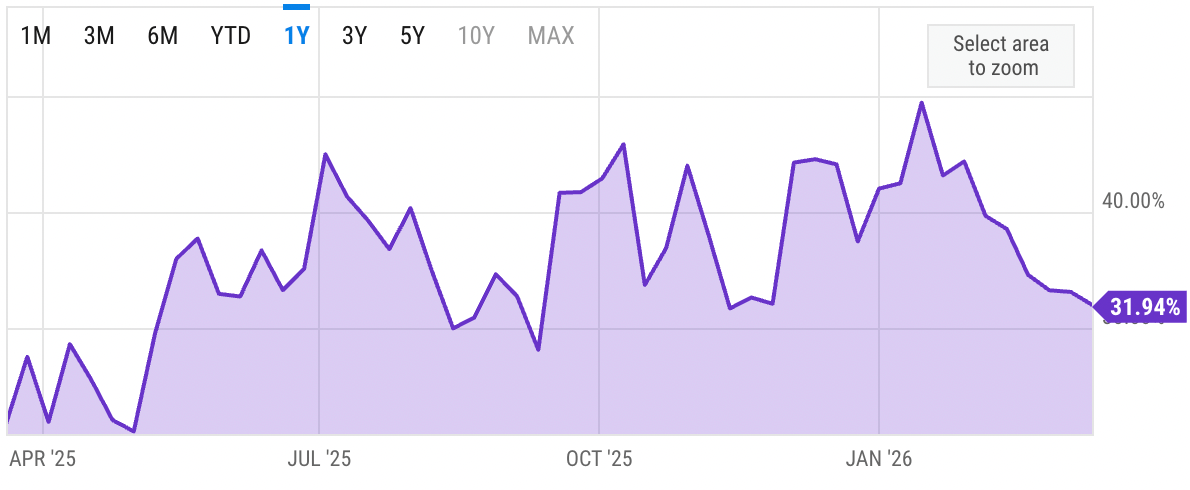
US Investor % Bullish Sentiment:
↓ 31.94% for Week of MAR 12 2026

Previous week: 33.06%

Market Wrap:

  • Futures near flat Dow -47, S&P -0.1%, Nasdaq -0.2% 
  • Monday rebound S&P +1%, Dow +388, Nasdaq +1.2% 
  • All 11 S&P sectors higher led by tech 
  • Nvidia +1.7% as Huang sees $1T AI system demand 
  • Oil cooled Brent $100, WTI $93 after recent surge 
  • Markets watching Iran war and Hormuz 
  • Today: Lululemon, Docusign, Oklo earnings; Fed decision tomorrow 

EARNINGS

Here’s what we’re watching this week: 

Full earnings calendar »

MARKET ALERT FROM BROWNSTONE RESEARCH

Financial Reckoning 2026

A massive crisis is brewingas FOUR major market forces converge. 

One former hedge fund manager says it could be far worse than the dot-com crash… or the 2008 financial crisis. 

Mag Seven losses of up to 80-90% are possible. 

Go here to see the action steps you must take today.

– a sponsored message from Brownstone Research –

HEADLINES

Trump Gets Chilly Response from Allies Over Demand on Hormuz

Trump said he’s asked seven countries to send ships to ensure the narrow shipping lane stays open during the war with Iran. And so far he’s not gotten any takers. One NATO ally even refused to get involved.

Nvidia Sees AI Chip Demand Reaching $1 Trillion by 2027

The company had previously forecast that the chips would bring $500 billion in sales by the end of 2026.

  • Wall Street ends higher as traders return to AI stocks (more)
  • Traders are getting nervous about Iran’s $200 oil warning (more)
  • Trump says he’ll delay his much-anticipated trip to China (more)
  • Saudis give oil buyers Red Sea option due to Hormuz crisis (more)
  • Bond investors turn risk-averse ahead of Fed meeting (more)
  • US manufacturing output increases; homebuilder sentiment ticks up (more)
  • Oil prices slide 3% as some ships transit Strait of Hormuz (more)
  • Gold eases as conflict-driven inflation fears counter dollar softness (more)
  • Americans are spending $300M more on gasoline than a month ago (more)
  • Gurley on AI bubble: A lot of people got rich quick and a reset is coming (more)
  • Nebius jumps 14% after company inks $27B deal with Meta (more)
  • Uber to roll out Nvidia-powered self-driving taxis in 2027 (more)
  • BofA agrees to settle claims it aided Epstein crimes (more)
  • Small businesses are pushing back against private equity (more)
  • Private credit strains ripple through Wall Street as investors grow wary (more)
  • Saks Global secures $300 million bankruptcy funding (more)

DEALFLOW

M+A | Investments

  • Apple acquires video editing company MotionVFX to boost subscribers
  • Google acquires Wiz
  • Drone-maker AeroVironment buys ESAeroin $200M deal
  • Too Lost receives strategic investment from GoldState Music

VC

  • Frore Systems, a thermal tech company, announced it has achieved Unicorn status following the close of a $143M Series D funding
  • Scanner, a security data platform, raised $22M in Series A funding
  • Ironlight Group, a fintech company, raised $21M in Series A funding
  • Halcyon, an AI platform for energy, raised a $21M in Series A funding
  • Great Sky, a provider of computing hardware solutions, raised $14M in Seed funding
  • Zero RFI, an AI-native platform targeting the construction industry, raised $13.8M in Seed funding
  • Nadia Care, a maternal health company, raised $12M in funding
  • AgZen, an MIT spinout bringing droplet-level control to agricultural spraying, raised $10M in Series B funding
  • Understood Care, an AI-native patient advocacy platform, raised $5M in Seed funding
  • Certiv, a cybersecurity startup, raised $4.2M in Pre-Seed funding
  • Eileen Inc., a retail technology platform, raised $1M in Pre-Seed funding

CRYPTO

  • Bitcoin touches a six-week high as investors pour into ETFs (more
  • Strategy buys $1.6B in Bitcoin as holdings surpass 761,000 BTC (more
  • Ether surges 10%, leading crypto rebound as ETF demand picks up (more

BULLISH BITES

📈  Hedge fund manager’s “weird” AI bubble strategy. * 

😱 AI CEOs are scaring America. 

👀  Inside a $42B private-credit black box: More black boxes. 

🎥 Oscars mask a Hollywood in crisis

🏖 What it’s like to stay at the most exclusiveresort in the US. 

DAILY SHARES

Have feedback or a suggestion?
💌 Send us a messageLike this briefing? Subscribe here » 

*sponsored message

Disclaimer: Market Briefing© is a news publisher. All statements and expressions herein are the sole opinions of the authors or paid advertisers. The information, tools, and material presented are provided for informational purposes only, are not financial advice, and are not to be used or considered as an offer to buy or sell securities; and the publisher does not guarantee their accuracy or reliability. Please conduct your own research and consult an independent financial adviser before making any investments. Neither the publisher nor any of its affiliates accepts any liability whatsoever for any direct or consequential loss howsoever arising, directly or indirectly, from any use of the information contained herein. Assets mentioned may be owned by members of the Market Briefing team. 

Update your email preferences or unsubscribe here

99 Wall St, Ste 314
New York, NY 10005, United StatesPowered by beehiivTerms of Service 

Peter, it’s on the other side.

The Growth You Want Is Waiting on the Other Side of Discomfort

Last weekend, my daughter Reagan (8) completed her first year of cheerleading, and I couldn’t be prouder of her.

If you know Reagan, you know she’s naturally a bit shy. The thought of performing routines in front of packed gyms during basketball games was intimidating for her.

When the season first started, she didn’t want to do it. It was new. It pushed her outside of her comfort zone. It meant standing in front of hundreds of people with all eyes on her.

But she did it anyway.

There were practices after school. Long nights learning routines. Repetition after repetition to get the timing right. Then came the games: packed gyms, loud crowds, halftime routines, and the pressure of performing as a team.

And Reagan showed up.

Even on the mornings when she wanted to sleep in.

Even on the days when she didn’t feel like going.

Even when the routines were difficult and the nerves were real.

She kept showing up. She kept practicing. She kept getting better.

And something incredible happened along the way.

Her confidence grew. She became more comfortable. She started talking about the friendships she was building with the other girls on the team.

What started as something intimidating became something she was proud to be part of.

As a father, watching that transformation was powerful.

Here is a video of one of her halftime routines. Reagan is the girl in the back row with the white socks pulled up.

Watching her out there reminded me just how far she’s come in a single season.

Moments like that make you realize that growth almost always begins on the other side of discomfort.

Scripture reminds us: “Let us not become weary in doing good, for at the proper time we will reap a harvest if we do not give up.” — Galatians 6:9

Reagan didn’t quit when it felt uncomfortable. She stayed committed. She showed up. And over time, confidence replaced fear.

There’s a powerful lesson in that for every adult, especially for those of us leading companies, teams, and organizations.

Success rarely starts with confidence. It starts with commitment.

You show up when it’s uncomfortable.

You do the work when you don’t feel like it.

You stay disciplined when quitting would be easier.

And eventually, growth follows.

Watching Reagan push through her fear reminded me of something we all need to remember: the things that stretch us are often the things that shape us.

Here’s my challenge for you today: Identify the thing you’ve been avoiding in your life because it’s uncomfortable.

The leadership opportunity. The bold step of faith. The conversation you know you need to have. The calling God may be placing on your heart.

Then do what my daughter did this season.

Step onto the floor.

Show up anyway.

Put in the work.

Refuse to quit.

Because the confidence you’re looking for is often waiting on the other side of obedience.

Let’s Meet in Charlotte

I love meeting the people who read my newsletters and follow me on social media. Every day I have the privilege of sharing truth, encouragement, and bold Biblical perspective with thousands of believers across the country. Behind every subscription is a real person pursuing Christ in the middle of a challenging world. Meeting you face-to-face is powerful because it turns words on a screen into real fellowship, prayer, and Kingdom relationships. 

One of the best places to do that is the C-Suite for Christ Spring Savior Summit in Charlotte from May 12–14. These Summits have quickly become some of the most powerful gatherings in the movement. It is three days of unapologetic worship, Biblical teaching, executive fellowship, and Spirit-filled conversations with leaders serious about living boldly for Christ in the marketplace.

The Bible reminds us in Hebrews 10:24–25: “And let us consider how we may spur one another on toward love and good deeds, not giving up meeting together… but encouraging one another.” That’s exactly what happens at a Savior Summit. Believers come together, strengthen one another, pray for one another, and leave fired up to advance the Kingdom in their businesses, families, and communities. 

I would genuinely love the opportunity to shake your hand, pray with you, and thank you personally for being part of this mission. Join us in Charlotte. Let’s worship together. Let’s fellowship together. And let’s boldly advance the cause of Christ together.GET YOUR TICKETS TODAY

Cold Calling Isn’t Dead—
You’ve Just Been Lied To

The demise of cold calling has been greatly exaggerated. For decades people have been declaring it “dead,” yet the truth is the exact opposite: cold calling remains the single greatest relationship-building tool ever created in business. Why? Because it forces something most people avoid: real human interaction. No algorithms. No hiding behind emails. No waiting for leads to magically appear. 

Just one professional reaching out to another and starting a conversation that can change both of their lives. Nearly 20 years ago I founded The Cold Call Coach, and since then I’ve had the privilege of serving thousands of professionals in more than 100 countries. The results speak for themselves. Businesses have been built, careers have been launched, and countless people have discovered that the fastest way to opportunity is simply having the courage to pick up the phone.

So why do so many people insist cold calling is dead? Because most people are afraid of rejection, and it’s easier to declare something obsolete than it is to master it. The truth is that the people who dominate their industries still use it relentlessly. I proved this years ago when I wrote The Secrets to Cold Call Success, a best-selling book that continues to transform lives and livelihoods around the world. 

I want to put this book in your hands. It’s yours free, just cover $13.95 for shipping and handling. Simply reply to this email, type “Cold Call” in the body of the message, and we’ll send you an invoice. Read it. Apply it. And watch what happens when you learn the skill that most people are too intimidated to even attempt. I am confident your life will change as a result.Boldly In His Name,

Paul M. Neuberger
Founder & CEO
paul@paulmneuberger.comCopyright © 2026 The Cold Call Coach, All rights reserved.
List Used for Testing

Our mailing address is:

The Cold Call Coach

683 Dove Ct

Colgate, WI 53017

Add us to your address book

Want to change how you receive these emails?
You can update your preferences or unsubscribe from this list.

View this email in your browser

The Growth You Want Is Waiting on the Other Side of Discomfort

Last weekend, my daughter Reagan (8) completed her first year of cheerleading, and I couldn’t be prouder of her.

If you know Reagan, you know she’s naturally a bit shy. The thought of performing routines in front of packed gyms during basketball games was intimidating for her.

When the season first started, she didn’t want to do it. It was new. It pushed her outside of her comfort zone. It meant standing in front of hundreds of people with all eyes on her.

But she did it anyway.

There were practices after school. Long nights learning routines. Repetition after repetition to get the timing right. Then came the games: packed gyms, loud crowds, halftime routines, and the pressure of performing as a team.

And Reagan showed up.

Even on the mornings when she wanted to sleep in.

Even on the days when she didn’t feel like going.

Even when the routines were difficult and the nerves were real.

She kept showing up. She kept practicing. She kept getting better.

And something incredible happened along the way.

Her confidence grew. She became more comfortable. She started talking about the friendships she was building with the other girls on the team.

What started as something intimidating became something she was proud to be part of.

As a father, watching that transformation was powerful.

Here is a video of one of her halftime routines. Reagan is the girl in the back row with the white socks pulled up.

Watching her out there reminded me just how far she’s come in a single season.

Moments like that make you realize that growth almost always begins on the other side of discomfort.

Scripture reminds us: “Let us not become weary in doing good, for at the proper time we will reap a harvest if we do not give up.” — Galatians 6:9

Reagan didn’t quit when it felt uncomfortable. She stayed committed. She showed up. And over time, confidence replaced fear.

There’s a powerful lesson in that for every adult, especially for those of us leading companies, teams, and organizations.

Success rarely starts with confidence. It starts with commitment.

You show up when it’s uncomfortable.

You do the work when you don’t feel like it.

You stay disciplined when quitting would be easier.

And eventually, growth follows.

Watching Reagan push through her fear reminded me of something we all need to remember: the things that stretch us are often the things that shape us.

Here’s my challenge for you today: Identify the thing you’ve been avoiding in your life because it’s uncomfortable.

The leadership opportunity. The bold step of faith. The conversation you know you need to have. The calling God may be placing on your heart.

Then do what my daughter did this season.

Step onto the floor.

Show up anyway.

Put in the work.

Refuse to quit.

Because the confidence you’re looking for is often waiting on the other side of obedience.

Let’s Meet in Charlotte

I love meeting the people who read my newsletters and follow me on social media. Every day I have the privilege of sharing truth, encouragement, and bold Biblical perspective with thousands of believers across the country. Behind every subscription is a real person pursuing Christ in the middle of a challenging world. Meeting you face-to-face is powerful because it turns words on a screen into real fellowship, prayer, and Kingdom relationships. 

One of the best places to do that is the C-Suite for Christ Spring Savior Summit in Charlotte from May 12–14. These Summits have quickly become some of the most powerful gatherings in the movement. It is three days of unapologetic worship, Biblical teaching, executive fellowship, and Spirit-filled conversations with leaders serious about living boldly for Christ in the marketplace.

The Bible reminds us in Hebrews 10:24–25: “And let us consider how we may spur one another on toward love and good deeds, not giving up meeting together… but encouraging one another.” That’s exactly what happens at a Savior Summit. Believers come together, strengthen one another, pray for one another, and leave fired up to advance the Kingdom in their businesses, families, and communities. 

I would genuinely love the opportunity to shake your hand, pray with you, and thank you personally for being part of this mission. Join us in Charlotte. Let’s worship together. Let’s fellowship together. And let’s boldly advance the cause of Christ together.GET YOUR TICKETS TODAY

Cold Calling Isn’t Dead—
You’ve Just Been Lied To

The demise of cold calling has been greatly exaggerated. For decades people have been declaring it “dead,” yet the truth is the exact opposite: cold calling remains the single greatest relationship-building tool ever created in business. Why? Because it forces something most people avoid: real human interaction. No algorithms. No hiding behind emails. No waiting for leads to magically appear. 

Just one professional reaching out to another and starting a conversation that can change both of their lives. Nearly 20 years ago I founded The Cold Call Coach, and since then I’ve had the privilege of serving thousands of professionals in more than 100 countries. The results speak for themselves. Businesses have been built, careers have been launched, and countless people have discovered that the fastest way to opportunity is simply having the courage to pick up the phone.

So why do so many people insist cold calling is dead? Because most people are afraid of rejection, and it’s easier to declare something obsolete than it is to master it. The truth is that the people who dominate their industries still use it relentlessly. I proved this years ago when I wrote The Secrets to Cold Call Success, a best-selling book that continues to transform lives and livelihoods around the world. 

I want to put this book in your hands. It’s yours free, just cover $13.95 for shipping and handling. Simply reply to this email, type “Cold Call” in the body of the message, and we’ll send you an invoice. Read it. Apply it. And watch what happens when you learn the skill that most people are too intimidated to even attempt. I am confident your life will change as a result.Boldly In His Name,

Paul M. Neuberger
Founder & CEO
paul@paulmneuberger.comCopyright © 2026 The Cold Call Coach, All rights reserved.
List Used for Testing

Our mailing address is:

The Cold Call Coach

683 Dove Ct

Colgate, WI 53017

Add us to your address book

Want to change how you receive these emails?
You can update your preferences or unsubscribe from this list.