Our analysts just went through every sector, chart, and earnings trend to find the 10 stocks most likely to dominate the rest of this year – and they compiled them all in the Top 10 Best Stocks to Own in the Second Half of 2026.
In this freereport, you’ll discover companies primed for a Fed-fueled rally – from AI powerhouses to dividend machines. These names are already attracting billions in institutional inflows, so this is your chance to position early. [ad]
For years, America’s biggest banks have been telling you they have no choice but to pay you interest rates as low as 0.4% (that’s the national average).
Now, suddenly… Elon is exposing many of these bankers for the sharks they really are. He’s not offering double… or triple… or even five times the interest… But 15 times the national average – at 6% per year. This is just one of the radical ways Elon’s new bank is disrupting the financial sector…
Tanker traffic through Hormuz has collapsed. LNG capacity is offline. Countries are already rationing fuel. Energy shocks don’t stay contained – they spread through the entire economy. As a market technician, I’ve studied these cycles for decades, and they always lead to monetary response – and currency pressure.
A new restaurant design, better tasting food and drinks, consumer-led innovation and improved customer service are the four cornerstones of the new plan.
Privacy Policy | Advertiser DisclosureDISCLAIMER: Stocks and options trading have large potential rewards, but also large potential risk. You must be aware of the risks and be willing to accept them in order to invest in the stocks and options markets. Don’t trade with money you can’t afford to lose. This is neither a solicitation nor an offer to Buy/Sell stocks or options. No representation is being made that any account will or is likely to achieve profits or losses similar to those discussed in this report. The past performance of any trading system or methodology is not necessarily indicative of future results. All trades, patterns, charts, systems, etc., discussed in this report are for illustrative purposes only and not to be construed as specific advisory recommendations. Information contained in this correspondence is intended for informational purposes only and was obtained from sources believed to be reliable. Information is in no way guaranteed. No guarantee of any kind is implied or possible where projections of future conditions are attempted.
Stockguru LLC (dba InvestingDistrict), 2563 cherry hill ln, Hermitage, PA 16148, United StatesYou may unsubscribe or change your contact details at any time.
Stephen Prior, Publisher, Monument Traders Alliance
Dear Reader,
Last chance.
No messing around.
Do you want to get exposure to SpaceX pre-IPO or not?
A venture capitalist – who, along with his partners, is a SpaceX shareholder – is doing something extraordinary.
And we wanted to share it with you.
He’s discovered a backdoor. This is a 4-letter ticker symbol that gives you pre-IPO exposure to SpaceX, the biggest and most valuable private company in the world, in a regular brokerage account.
Stephen Prior, Publisher Monument Traders Alliance
P.S. Elon’s track record speaks for itself. His earliest investors saw gains like:
Zip2: 132,000% gains
PayPal: 9,500% gains
Tesla: 1,210,000% gains
SpaceX may be the final chapter in Elon’s billionaire-making legacy.
Monument Traders Alliance, LLC
You are receiving this email because you subscribed to Trade of the Day. Trade of the Day is published by Monument Traders Alliance, LLC.
To stop receiving special invitations and offers from Trade of the Day, please click here. Please note: This will not impact the fulfillment of your subscription in any way.
To cancel by mail or for any other subscription issues, write us at: Trade of the Day | 14 West Mount Vernon Place |Baltimore, MD 21201 North America: 800.507.1399 | International: +1.443.353.4977 Website | Privacy Policy Keep the emails you value from falling into your spam folder. Whitelist Trade of the Day.
Please do not reply to this email as it goes to an unmonitored inbox.
Nothing published by Monument Traders Alliance should be considered personalized investment advice. Although our employees may answer your general customer service questions, they are not licensed under securities laws to address your particular investment situation. No communication by our employees to you should be deemed personalized investment advice. We allow the editors of our publications to recommend securities that they own themselves. However, our policy prohibits editors from exiting a personal trade while the recommendation to subscribers is open. In no circumstance may an editor sell a security before subscribers have a fair opportunity to exit. The length of time an editor must wait after subscribers have been advised to exit a play depends on the type of publication. All other employees and agents must wait 24 hours after publication before trading on a recommendation.
Any investments recommended by Monument Traders Alliance should be made only after consulting with your investment advisor and only after reviewing the prospectus or financial statements of the company.
Protected by copyright laws of the United States and international treaties. The information found on this website may only be used pursuant to the membership or subscription agreement and any reproduction, copying or redistribution (electronic or otherwise, including on the world wide web), in whole or in part, is strictly prohibited without the express written permission of Monument Traders Alliance, LLC, 14 West Mount Vernon Place, Baltimore, MD 21201.
You will also start getting our daily newsletter that will keep you updated on important market news in less than 5 minutes. Each newsletter will cover:
Market Drivers: Key business and stock headlines moving the tape.
Breakout Finds: Stock reports on tickers with upside potential.
Investing Ideas: Fresh opportunities from our partner network.
To access the report you just downloaded, click on the link below.Open Your Report
P.S. Reply with a quick ‘hey’ so we stay out of spam. To keep us in your inbox, use these whitelisting steps.
Information, charts, or examples contained in this email are for illustration and educational purposes only and not for individualized investment management. This message contains commercial elements, such as advertising and partner offers for which we may receive affiliate compensation. We only send these offers to those who have opted into our newsletter.
If you wish to no longer receive these offers, click on the unsubscribe link at the bottom of this email. Past performance is not indicative of future results. For these reasons, we strongly suggest trading in a DEMO/Simulated account.
The information provided by us is for educational and informational purposes only. We make no representations or warranties concerning the products, practices, or procedures of any company or entity mentioned or recommended in this email and have not determined if the statements and opinions of the advertiser are accurate, correct, or truthful.
If you use, act upon, or make decisions in reliance on information contained in this email or any external source linked within it, you do so at your own peril and agree to hold us, our officers, directors, shareholders, affiliates, and agents without fault.
2967 Dundas St. W. #990, Toronto, ON M6P 1Z2 | Phone Number: 917.672.7040
Iran stops negotiations… how high could oil go?… Jonathan Rose’s three IPO red flags… Elizabeth Warren pushes AI taxes and higher capital gains taxes… the data that undercuts her jobs argument…
As I write on Monday near lunch, U.S. oil prices have surged 7%, with West Texas Intermediate Crude jumping to nearly $94 a barrel and Brent crude approaching $97 a barrel.
Driving the price action is news that Tehran is halting negotiations with the U.S. and threatening to fully close the Strait of Hormuz in response to Israel’s escalating ground offensive in Lebanon.
The headline arrives at a fragile moment in the Middle East. Despite an uneasy ceasefire that took effect in early April, U.S. warplanes struck Iranian radar and drone facilities on Qeshm Island over the weekend. Meanwhile, Iran launched missiles and drones at Kuwait. Both sides claimed the other fired first.
Despite what appears to be a deteriorating geopolitical situation, yesterday, President Trump posted on Truth Social:
Iran really wants to make a deal…
Just sit back and relax, it will all work out well in the end.
Whether that optimism is warranted is unclear. Axios reported over the weekend that Trump had requested several amendments to the draft agreement his envoys had reached with Iranian officials. Apparently, nuclear commitments and the scope of sanctions relief are two key issues.
As oil jumps higher this morning, the markets are pricing in uncertainty more than reassurance. And the range of outcomes here is wide.
Rystad Energy’s head of geopolitical analysis told CNBC that a full breakdown in talks – with fighting resuming in earnest – could send Brent to $180 a barrel by August. On the other hand, a comprehensive deal could see prices fall back toward $70 by year-end.
It’s a striking thought that this Strait – barely 21 miles wide at its tightest point – largely controls the fate of global energy markets, inflation forecasts, and economic growth across three continents.
The name is “Golden Dawn.” That’s what President Trump’s team is calling America’s new Manhattan Project — but for AI. It will span more than 700 miles — making it by far the largest AI infrastructure project ever built. When Trump flips the on switch, Louis Navellier believes it will trigger a $100 trillion reset of the AI markets. For investors who get ahead of it, the timing could mean everything. Louis’ revealing the one stock at the center of it all right here.
“They robbed us. That’s the only way I can put it.”
That’s our trading expert Jonathan Rose, referring to what happened with the Figma Inc. (FIG) IPO – which we detailed in Friday’s Digest.
Here’s Jonathan’s quick recap if you missed it:
A performance-based trigger almost no one knew about was in place.
The stock opened 158% above the threshold, and so the trigger fired on Day 1. By 36 days later, the people who understood the structure were selling at $80.
Eight months later, Figma was at $22 – down 81% from the peak and 33% lower than the IPO price itself.
That structure wasn’t an accident. It was the playbook.
This story echoes a saying I heard somewhere along the way…
“IPO” doesn’t stand for “Initial Public Offering,” but rather “Initial Public Offloading” – a time when insiders dump their shares to the unsuspecting public.
An IPO wave is on the way – at a scale we’ve never seen. SpaceX, Anthropic and OpenAI represent over $3 trillion in combined valuation coming to market, each structured by the same investment banks using the same mechanics.
Given this, Jonathan just flagged five warning signs that a deal is built for insiders, not you. I want to share three with you.
Three IPO red flags to watch for
The first thing to check is the float. If less than 10% of shares are being offered, Jonathan says be careful:
Small floats create artificial scarcity. They amplify the first-day pop. They give insiders more shares to sell into the secondary lockup expirations.
Second, ignore the “oversubscribed” bragging. Back to Jonathan:
A massively oversubscribed deal that prices below where it should clear is a deal that’s been deliberately underpriced to produce a pop.
Third – and this is the one almost nobody does – search the S-1 for “Early Release Condition” or “performance-based release.”
Here’s Jonathan on what to look for:
If the lockup releases additional shares at a price 25% above IPO, and the company prices low enough to guarantee the trigger, you’re looking at the Figma structure.
This is part of your defensive playbook – but what about offense?
Jonathan recommends investors buy the IPO family, not the headline.
Every AI IPO in this pipeline has publicly traded proxies you can own today. The logic of owning the family works two ways…
These companies hold direct equity stakes that rise in value as the IPO prices higher, and when Wall Street starts assigning enormous valuations to a sector, the public peers get repriced too – analysts are forced to update their comparables overnight.
SpaceX has Alphabet Inc. (GOOGL), which holds a 6.11% stake – exposure that becomes suddenly visible once SpaceX starts trading publicly. Anthropic has Amazon.com Inc. (AMZN) and Nvidia Corp. (NVDA) as major investors. OpenAI has Microsoft Corp. (MSFT) as its cloud and equity partner.
No lockup risk. No allocation lottery. No premium built on a deliberately restricted float.
Jonathan has taken this a step further
His unusual trading activity scanner – which identifies concentrated institutional positioning before the crowd arrives – is now paired with veteran trader Marc Chaikin’s institutional Money Flow indicator.
When both indicators confirm the same name, that’s their Convergence Trigger. It’s a powerful way to find the most attractive stock opportunities swirling around massive market events like IPOs before the bell ever rings.
Last week, the two experts went live to walk through exactly how this Convergence Trigger works – and shared specific setups already flashing today.
Bottom line: Three trillion dollars in AI “Initial Public Offloadings” is on the way. Be smart about how you play it.
Now, all the money being made – whether from IPOs or the AI trade broadly – is widening the wealth gap in America. And that’s producing the exact policy response I predicted in January…
At the start of the year, as our analysts were unveiling their 2026 predictions for the market, I made one of my own
This year will bring a wave of new, controversial legislative proposals aimed at investment wealth – proposals that may not pass immediately, but will introduce a new layer of policy risk investors will have to price in.
Behind my prediction was our ever-widening K-shaped economy, where Americans with assets grow wealthier while those without watch inflation erode their purchasing power.
Data from the Federal Reserve shows that in April, the gap between these two groups set a record…
The top 1% of households now own 31.9% of all U.S. wealth. This is the highest share on record since the Fed began tracking it in 1989. Meanwhile, the bottom 50% holds a mere 2.5% of the nation’s wealth.
History shows that large and persistent economic splits don’t stay contained. Over time, they tend to produce policy responses. That was the basis for my prediction.
With that context, let’s jump to Senator Elizabeth Warren’s (D-Mass.) op-ed published in Time last Wednesday. These are select quotes:
It’s time to tax AI and invest in people…
Taxing AI is one way we make sure the winnings from AI benefit all Americans…
We need to level the playing field by raising taxes on corporations and capital gains…
There is no denying that AI is already changing the labor market…
Now, we could analyze Warren’s op-ed from all sorts of angles. But let’s zero in on the last point about the labor market…
What’s the truth about AI jobs losses?
If you’re a longtime Digest reader, you know I’ve spent years flagging the risk of an AI-driven jobs apocalypse. The early data and commentary from AI experts pointing in that direction have been hard to ignore – and I’ve never been shy about sharing it.
But one thing I’ve always tried to be is honest, even when new evidence pushes back on old assumptions. And lately, that’s exactly what’s been happening.
So, let’s look at the actual data.
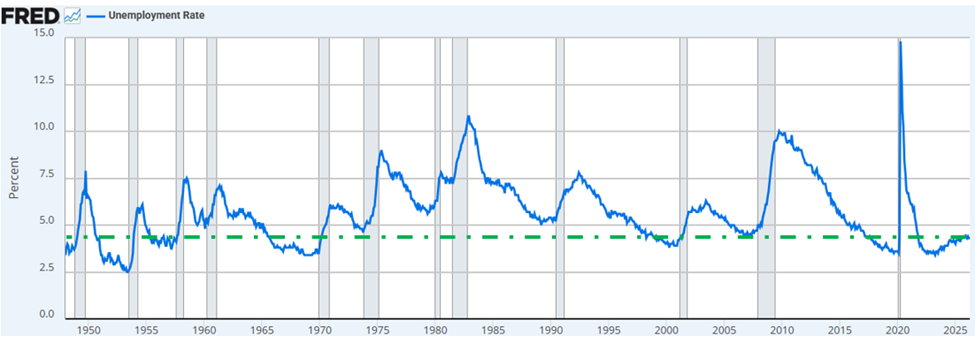
First, we’re three years into the age of AI, and yet the national unemployment rate still sits at 4.3%.
As you can see below, this is one of the lowest rates on record dating back to 1950.
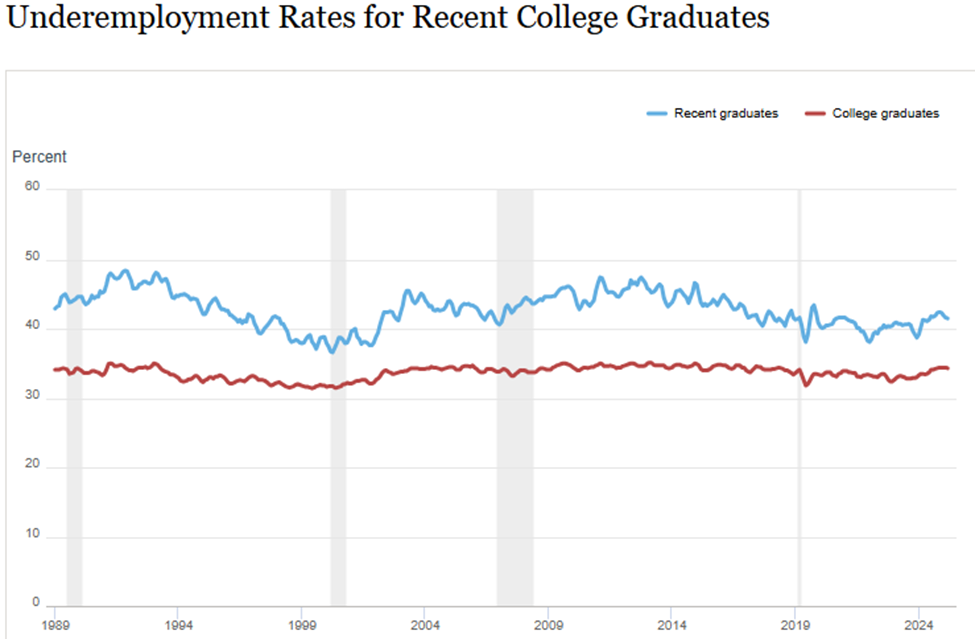
Second, as I covered in last Wednesday’s Digest, Federal Reserve data on college graduate unemployment and underemployment show both metrics are running roughly in line with their 30-year averages.
For example, here’s the underemployment rate for recent graduates and college graduates dating back to 1990 as a reminder.
These statistics don’t support the crisis picture Warren’s framing implies, or recent headlines about “graduation boos” – students booing commencement speakers who mentioned AI – even as the underlying employment data remained sturdy.
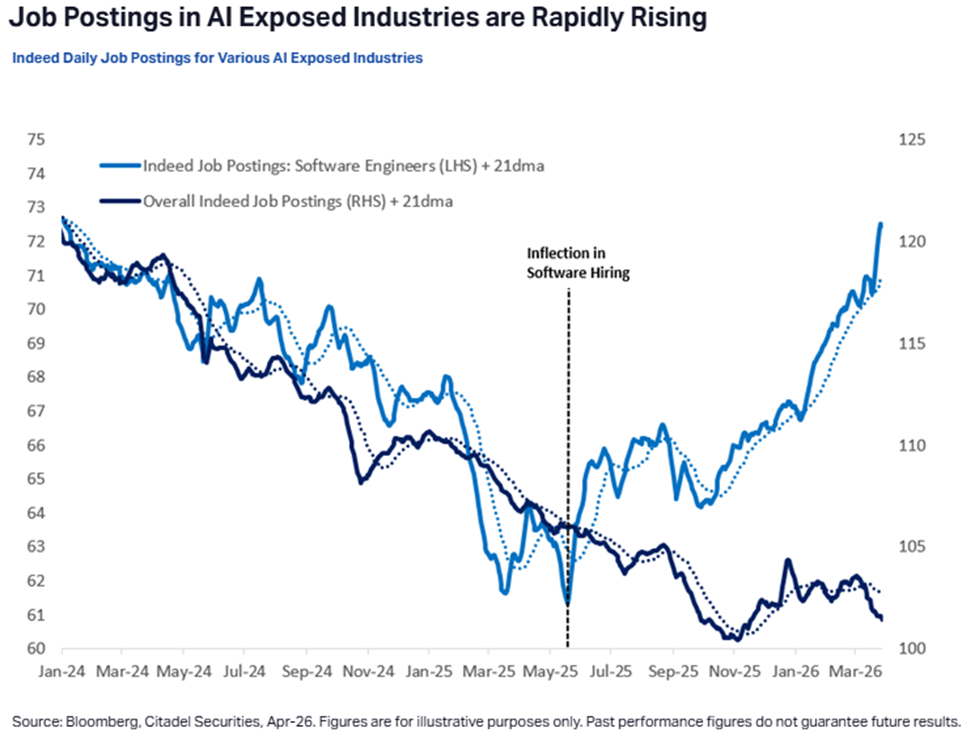
Third, let’s look at what the actual job-posting data show – starting with the report from Citadel Securities that I featured in last Friday’s issue of Investing Insider.
The short version: hiring in several AI-exposed industries isn’t collapsing – in some cases, it’s accelerating.
As one example, the chart below shows a dotted vertical line labeled “Inflection in Software Hiring” around May 2025 – right as AI capabilities were accelerating dramatically.
Software-engineer hiring has climbed since then, now up 18% from that inflection point. The most AI-exposed occupation in the economy is seeing some of the fastest hiring growth.
If AI were already displacing knowledge workers on a broad scale, this isn’t the kind of chart we’d expect to see.
Even where layoffs are real, the story is complicated
The tech sector has seen heavier layoffs in recent months. But there’s more to it than the headlines…
Do you remember the Swedish “buy now, pay later” fintech giant Klarna (KLAR)?
It slashed its workforce by 22% and bragged that its AI chatbots could do the work of 700 customer service agents and marketing staff.
Well, after facing a decline in service quality and customer trust, the company backtracked on the aggressive cuts and initiated a recruitment drive to bring human workers back into customer support roles.
Even Sam Altman and Dario Amodei, CEOs of OpenAI and Anthropic are walking back their previous doom-and-gloom forecasts for job cuts.
Here’s Fortune from last week:
Altman said he was “pretty wrong” about AI’s economic impact—a reversal from his June 2025 warnings that entry-level roles were at serious risk.
Amodei, who once claimed AI could eliminate 50% of white-collar jobs, now says automation may actually expand the work people do.
Interesting timing as these companies gear up to go public…
Now, I’m not saying that displacement won’t eventually accelerate – but the current data simply aren’t there, and the experts are drastically changing their tune.
If you’re an Investing Insider subscriber, click here to log in and read the full analysis and piece from Citadel. You’ll come away with a better idea of what’s really happening – and how to position your portfolio.
If you’re not yet an Investing Insidersubscriber, this is a service where I interview our analysts, break down research from major Wall Street firms, and translate it all into the risks and portfolio implications that don’t fit in the Digest. Click here to learn more.
Where does all this end up?
The data today show that the job-loss narrative is running well ahead of the actual job-loss numbers.
In other words, though it could change in the future, Elizabeth Warren’s assertion that “there is no denying that AI is already changing the labor market” is wrong – there’s plenty to deny it.
But when it comes to the consequences for your portfolio, she doesn’t need to be right – she just needs to be persuasive.
So, where does this leave us today?
Stay long – but eyes open to public sentiment and political framing.
Have a good evening,
Jeff Remsburg
Manage your account We hope this timely investment research is valuable to you. As you know the markets move fast and conditions change frequently. So please check the current issue for the most recent advice. Please note that we cannot be liable for any missed bulletins caused by overzealous filters. To ensure that you continue to receive this valuable part of your service please take a moment to add services@exct.investorplace.comto your address book.
There’s someone at the table you don’t know very well. A friend of a friend.
And in passing, you hear him say something that almost makes you spill your drink…
He says he’s been making gains of 100%, 200%, even 500% on trades in the stock market.
What’s more, he says some of these gains have come in a matter of months…
Others in weeks…
And some in just days.
At first, it sounds outlandish. Maybe even impossible.
You don’t want to cause an embarrassing scene, so you let it go. But in the back of your mind, you’re thinking: This guy has to be full of it.
And honestly, I wouldn’t blame you for being skeptical.
If some random person at dinner told me he was pulling triple-digit gains from the market in days or weeks, I’d probably raise an eyebrow too.
But what if he wasn’t exaggerating?
What if there really was a way to spot fast-moving trades and make triple-digit gains before most investors even know which way is up?
That’s where my friend and InvestorPlace colleague Jonathan Rose comes in.
Jonathan is a veteran trader who spent more than 16 years trading on the Chicago trading pits. That means he didn’t learn how markets move from a textbook – he learned it in the middle of the action – watching billions of dollars flow through the market in real time.
And over the past year, he’s used that experience to help his followers target some truly remarkable gains, like…
209% in only 13 days from Lyft…
959% in 31 days from Albemarle Corp…
And 1,234% in only 12 days from MP Materials.
Now, I realize numbers like that can sound hard to believe. But that’s exactly why I wanted to sit down with Jonathan for this week’s Navellier Market Buzz.
Because he has a very specific way of finding these opportunities.
He follows what he calls Wall Street’s “hidden bets” – the unusual trading activity that can tip off where big money is moving before the headlines catch up.
And when he spots the right setup, he can use a short-term trading strategy to potentially boost the gains from a stock move by 500% or more.
That’s why I think you’ll want to hear what he has to say. And after you watch, I also encourage you to check out Jonathan’s latest presentation with Marc Chaikin.
Together, they’ll show you how Jonathan’s strategy combines with Marc’s Money Flow indicator to identify stocks where the big money may already be lining up.
Click the image below to watch my chat with Jonathan now.
If you haven’t already, click here to subscribe to my YouTube channel. And if you’d like to learn more about Jonathan, check out his YouTube channel here.
One of the biggest themes from my conversation with Jonathan is that the strategy involved with making gains like this doesn’t have to be as complicated as many people think.
In fact, Jonathan has repeatedly said that some of his most successful followers started with very little experience.
They’re not professional traders. They’re not glued to a screen all day. Instead, they’re following a proven process.
That process is the heart of the new presentation Jonathan recently hosted with veteran market analyst Marc Chaikin of Chaikin Analytics.
Together, they’ve developed a new “Convergence” signal that combines Jonathan’s “Unusual Options Activity” scanner with Marc’s “Money Flow” indicator to identify winning opportunities in today’s volatile market.
In the presentation, they’ll explain exactly how it works, why it may be useful in today’s volatile market and reveal five stocks currently meeting their criteria.
Manage your account We hope this timely investment research is valuable to you. As you know the markets move fast and conditions change frequently. So please check the current issue for the most recent advice. Please note that we cannot be liable for any missed bulletins caused by overzealous filters. To ensure that you continue to receive this valuable part of your service please take a moment to add services@exct.investorplace.comto your address book.
Welcome to The Pregame Lineup, a weekday newsletter that gets you up to speed on everything you need to know for today’s games, while catching you up on fun and interesting stories you might have missed. Today’s edition is brought to you by David Adler.
Ronald Acuña Jr. and Juan Soto have been linked since they were rookies in 2018, when it became immediately clear that, despite Acuña being just 20 years old and Soto just 19, these were two of the future faces of Major League Baseball.
The friendly rivalry between the two players has only blossomed over the years, as both Acuña and Soto have, indeed, become superstars.
So right now, it’s only fitting that they’re heating up at the exact same time.
Soto has hit nine home runs in his last 15 games for the Mets, batting .382 with a 1.341 OPS over that span.
And Acuña? He’s homered in four consecutive games for the Braves, with five total homers and four stolen bases in those last four games. That’s the power-speed star we know and love.
Soto’s Mets and Acuña’s Braves are in very different places as the calendar flips to June, but it’s fun to see the two of them playing at the top of their game, just like old times.
Soto is doing his best to drag the Mets back into contention. This weekend, his Sunday grand slam was the swing that punctuated New York’s sweep of the Marlins, the team’s best offensive series of the year. But the Mets are still in fourth place in the NL East at 26-33.
The Braves, on the other hand, are the only team in the Majors with 40 wins. Acuña’s power surge helped them get to that mark over the weekend.
If you were looking for something else Aaron Judge is awesome at, besides “breaking home run records” and “winning MVP trophies” and “being the most dangerous hitter on the planet” … well, we’ve got something for you.
Judge has been really good at ABS challenges, too.
And it’s not just about the 6-foot-7 slugger picking out the missed calls at the bottom of the strike zone, where umpires have historically had a tough time calling his zone accurately, just because Judge is so tall even compared to other Major League hitters.
Judge isn’t challenging a ton of calls, but he’s shown a good eye for picking out the ones he’s going to win, in situations where flipping those called strikes to balls matters a lot.
And on the flip side, he’s also shown restraint at not challenging the pitches he shouldn’t — called strikes that other hitters with worse eyes might challenge … and would lose. That’s also valuable. Judge doesn’t waste the Yankees’ challenges by pulling the trigger at the wrong time.
If there’s anyone who could possibly have a case to win Pitcher of the Month over a guy who just threw 39 innings without allowing a single run, it’s the Miz … who also just won his first career Player of the Week Award.
The Brewers flamethrower barely missed out on a scoreless month of his own — Misiorowski pitched 38 1/3 innings in May and only allowed one lonely run. That’s a 0.23 ERA. But the big thing is the strikeouts: The Miz racked up 57 K’s in May, a full dozen more than Sánchez.
And while Sánchez’s stuff is nasty in its own right, particularly his changeup, Misiorowski has the most purely explosive stuff in baseball.
Consider this: Misiorowski threw 241 pitches 100 mph or faster in May. Since pitch tracking began in 2008, that is by far the most triple-digit heaters thrown by a pitcher in a single month.
Most 100+ mph pitches in a single month
2008-present
241 — Jacob Misiorowski, May 2026
175 — Jordan Hicks, August 2018
160 — Aroldis Chapman, August 2016
139 — Aroldis Chapman, July 2016
139 — Mauricio Cabrera, July 2016
139 — Joel Zumaya, June 2009
The Miz also set the record for most 100-plus mph strikeouts in a single month in the pitch-tracking era. Thirty-six of his K’s were on triple-digit fastballs, which is 15 more than any other pitcher (Chapman had 21 in July 2012).
Every game, it seems like, Misiorowski does something mind-boggling when it comes to velocity — like in his last start of May, when he threw 20 straight 100-plus mph fastballs to start the game.
Now we’ll just have to wait and see how he ups the ante in June.
AROUND THE LEAGUE THIS WEEKEND
A monkey off a superstar’s back, a souvenir for the Tarps Off crowd and more highlighted the action around the Majors this weekend.
• Fernando Tatis Jr. finally — finally! — hit his first home run of the season on Saturday. The Padres superstar had gone his first 238 plate appearances of 2026 without homering. It was almost unbelievable. But Tatis took out 55 games’ worth of frustration with one swing, crushing a 114 mph, 451-foot blast for home run No. 1.
• Pete Crow-Armstrong, hearing “Overrated!” chants from Cardinals fans in St. Louis on Saturday, responded by blasting a home runstraight to the rowdiest part of the ballpark — the “Tarps Off” section where the most enthusiastic, and shirtless, fans congregate. That’s gotta be the best way to silence the haters.
• Even the Bronx Bombers don’t put up innings like this every day. The Yankees scored 13 runs in the third inning against the A’s yesterday, tied for their biggest inning in 106 years. The only time the Yanks have ever scored more than 13 runs in an inning was on July 6, 1920, when Babe Ruth & Co. put up 14 in the fifth inning against the Washington Senators.
• The Dodgers got the series win in their NLDS rematch vs. the Phillies, thanks to a postseason-esque performance by Yoshinobu Yamamoto in the rubber game. The Dodgers ace struck out 10, a season high, over 5 1/3 scoreless innings.
THE NEW KID ON THE BLOCK
The Mariners’ new kid is making us nostalgic for the Mariners’ old Kid.
Twenty-year-old Colt Emerson, Seattle’s top prospect and MLB Pipeline’s No. 5 overall, smacked his second big league home run over the weekend. But more importantly: Emerson’s sweet lefty swing is evoking the sweet lefty swing of all sweet lefty swings: Ken Griffey Jr.’s.
Now Emerson just has to hit, oh, about 600 more homers to really copycat Griffey. We believe in you, kid.
THIS IS BIG MAC’S YARD
The original Backyard Baseball game, released in 1997, was not merely popular at the time. The computer game, in which players drafted teams from a group of neighborhood kids, has become something of a cultural touchstone for a generation of fans since it cut to the essence of what makes the national pastime special and accessible for everyone.
The player everyone remembers is the legendary Pablo Sanchez, but sequel Backyard Baseball 2001 added MLB superstars to the mix. The Cardinals’ representative was, of course, Mark McGwire. And if you’re a St. Louis fan who has fond memories of this game and/or the Big Mac era, tomorrow is your night.
Fans who purchase a special ticket for the Cardinals’ game against the Rangers on Tuesday get an exclusive McGwire Backyard Baseball Bobblehead. Not within shouting distance of Busch Stadium? Not to worry: the Rays, Giants and Pirates all have Pablo Sanchez Bobblehead Nights on the schedule in the next couple of months.
Every fan has a bucket list. Most never finish it. We’re changing that.
In partnership with T-Mobile, we’re sending one winner and their favorite person on the ultimate tour of America’s storied Ballparks. The seats are waiting. You just have to bring the company.ENTER NOW
NO PURCHASE NECESSARY TO ENTER OR WIN. Starts 12:00am ET on June 1, 2026 and ends 11:59pm ET on September 7, 2026. Open to legal residents of the United States (including its commonwealths, territories, and possessions) and Canada (excluding Quebec) who are of legal age of majority. Sixty-six (66) prizes to be awarded. Odds of winning depend on the number of eligible entries received. Online entry only. Limit one (1) entry per person. Void where prohibited. Restrictions apply; see Official Rules atwww.mlb.com/journeyto30sweeps. Sponsor: MLB Advanced Media, L.P.
If there is a single “gift” I would provide to every Porter & Co subscriber, it is the ready ability to distinguish between an average business and a great business.
Great businesses, like truly beautiful women, are rare. And for investors seeking to build real, lasting wealth, finding them is everything. With a great business, time is in your favor. With a great business, every recession is only an opportunity to gain share. With a great business, you don’t ever worry about competitors – they simply come and go.
I’ve written an entire book showing you exactly how to identify a great business. It’s called Warren’s Mistakes, and it walks readers through how Warren Buffett beat the S&P 500 by 11% per year for 30 years. He did it with a portfolio of America’s greatest businesses: Coke, American Express, The Washington Post Company, Gillette, McDonald’s, Disney, and Moody’s.
Of course, the best way to learn anything, as Berkshire Hathaway (BRK) vice chair Charlie Munger explained constantly, is to invert. That’s why my book doesn’t merely explain Buffett’s success, it focuses on his mistakes.
While I must admit it is unlikely that I will ever get you to read my book, I hope I can at least show you some of the lessons in it by looking carefully at the deal Berkshire announced today, the purchase of Taylor Morrison Home (TMHC).
Taylor Morrison is America’s sixth-largest homebuilder. Berkshire is paying $72.50 per share in cash — a 24% premium to where the stock closed Friday. That equals an enterprise value of $8.5 billion. And it values the business, on an enterprise basis, at roughly 10.7x 2025’s $791 million in net income. In the press release, Berkshire’s new CEO, Greg Abel, called Taylor Morrison “a best-in-class national homebuilder.”
Unfortunately, for Berkshire shareholders, it’s not. It isn’t even close. And I’d bet long-time readers of my work know what Berkshire should have bought instead.
In November 2007, in the depths of the housing collapse, I explained to investors why there’s only one homebuilder in America worth owning – NVR (NVR). Not because the others weren’t cheap – they were all cheap, down more than 50% from their highs. But because only one of them is a genuinely great business. I called NVR “not only the best company in the homebuilder sector” but “one of the truly exceptional businesses in the world.”
NVR went bankrupt in the early 1990s. It owned too much land and thus had too much debt to survive the 1990-91 recession. The experience turned its managers into fanatics about capital discipline.
Necessity is the mother of invention. As the company emerged from bankruptcy, it didn’t have enough capital to buy huge swaths of land. So it had to partner with developers. In the process, it invented the “land-lite” housing model. NVR doesn’t own raw land. It pays small, non-refundable deposits to option finished lots from third-party developers. It only takes title when someone is ready to buy a house. If a market sours, NVR walks away and forfeits the deposit. It never gets stuck holding billions in depreciating dirt.
The result, as I wrote in 2007, was “the highest returns on assets in the sector” and a balance sheet that was “nearly debt-free.”Those facts are still true today. NVR was trading around $400 a share when I recommended it in 2007. It trades above $6,000 today – despite a big recent drawdown as the housing market has suffered over the last two years.
It isn’t hard to compare NVR to Taylor Morrison, although doing so feels like picking on a retarded kid. In 2025, NVR earned a 44% return on invested capital (“ROIC”) and a 33% return on equity (“ROE”). Taylor Morrison earned 11% ROIC and 13% ROE. Over the full decade from 2016 through 2025, NVR’s ROIC averaged roughly 50%. Taylor Morrison’s averaged about 9%.
NVR earns 50 cents of operating profit for every dollar of capital employed. Taylor Morrison can’t crack a double-digit return on capital. So… why would anyone ever want to own that business?
Keep in mind, they build houses in the same country, at similar prices, to similar customers, at nearly identical gross margins – around 23% last year. The difference is not what they sell. It’s how much capital they have to bury in the ground to sell it.
You can see exactly where the capital goes. Taylor Morrison ended last year with $6.5 billion of inventory – land and houses – on its balance sheet. NVR, while generating more revenue, carried $1.7 billion of inventory. NVR turns its inventory more than 4x a year; Taylor Morrison turns it less than once. NVR converts a sale to cash in about 71 days. Taylor Morrison takes 376 days – its money sits trapped in dirt for more than a year before it comes back.
And the balance sheets tell the rest of the story. NVR ended 2025 with $1.9 billion in cash and negative net debt. NVR maintains a net cash position. Taylor Morrison carries net debt of more than 1x earnings before interest, taxes, depreciation, and amortization (“EBITDA”). One company is built to survive the next downturn and buy when everyone else is forced to sell. The other will spend the next bust the way the bad builders spent the last one: negotiating with its bankers.
But that’s not the real advantage.
What you’ll learn when you read Warren’s Mistakes is the enormous advantage capital efficient businesses have over time. You see, because NVR uses so little capital, it can return almost all of it. The company shovels mountains of cash into buybacks – $1.8 billion of stock repurchased in 2025 alone. Over the last decade, NVR shrank its share count 25% and drove earnings per share 4x – from about $104 to $437.
That is a compounding machine. And it is going to continue compounding, whether this housing slump lasts another year or another decade.
Taylor Morrison buys stock too: shares of other marginal builders, most recently William Lyon Homes and AV Homes. How’s that working out? It’s a bigger pile of capital that is generating meager 9% returns. That is not value creation. That is empire-building, which is exactly what Greg Abel is doing at Berkshire.
Ironically, this isn’t the first time Berkshire has made this mistake.
In 2003, Berkshire paid $1.7 billion to take Clayton Homes private. And, just like today, what Berkshire got was a capital-hungry, marginal business. Clayton is a manufactured-housing company bolted to a high-interest lender. How does it make money? It sells trailer homes to poor people. The homes depreciate faster than the loans amortize. Sure, poor people need somewhere to live, but this is a very tough business because, quite simply, its product doesn’t create any value for the people who buy it. It’s clearly a business that Berkshire shouldn’t have ever bought.
And it didn’t just buy Clayton – it has invested heavily in growing it. It built Clayton’s mortgage portfolio from $5.4 billion in 2003 to more than $13 billion today. It bought up the plants, stores, and loan books of failed competitors, too. The real capital employed by Berkshire into Clayton today isn’t $1.7 billion – it’s more like $13 billion to $15 billion.
These enormous, ongoing capital investments are what Berkshire’s conglomerate model is designed to hide. Let me explain.
Measured against the original $1.7 billion check, Clayton looks like a triumph: its roughly $1.9 billion of pre-tax earnings in 2024 is more than the entire purchase price! But once you count all the capital Berkshire has sunk into Clayton – the loan book, the factories, the competitors it bought – the return on capital employed collapses to roughly 12% to 14% pre-tax, or about 9% to 11% after tax. That is a mediocre, single-digit-to-low-double-digit business. It is, in other words, the same 9% return as Taylor Morrison.
But what if Berkshire had just bought the best business in the industry, NVR, and never invested another penny?
NVR earns a 44% ROIC – roughly 3x to 4x the return Clayton Homes generates on capital. Had Berkshire taken the same $1.7 billion it spent on Clayton equity in 2003 and simply bought NVR, that stake would be worth about $22 billion today – a 13-fold gain – without another dollar invested, because NVR funds itself and hands its cash back (via share buybacks).
Run those same returns with the full $13 billion to $15 billion Berkshire has tied up in Clayton, and the delta becomes obscene. The realistic, conservative cost of choosing Clayton over NVR is somewhere north of $50 billion in forgone value. Berkshire didn’t just pick the wrong horse. It spent two decades shoveling feed into it.
Now with the Taylor Morrison deal, Abel says Berkshire intends to “unify our site-built homebuilding operations into a combined platform.” In other words: take the bad manufactured-housing bet, staple a capital-heavy, single-digit-return site-built homebuilder to it, and call the combination “strategy.” This is the entire conglomerate fantasy expressed in a single deal. And it won’t work.
What Berkshire should do is spin off or sell Clayton Homes and invest the capital into America’s best homebuilder, a company that creates tremendous value for its customers and its shareholders. That’s NVR.
Here is the part that should make every Berkshire shareholder wince.
Berkshire’s entire genius – the thing that made it the greatest compounding story in the history of American capitalism – was using insurance float to buy wonderful businesses. Float is other people’s money: premiums collected today against claims paid years from now. It costs almost nothing, and it grows. Buffett’s insight was that you could take that nearly free capital and invest it in the best businesses in the world – Coca-Cola, American Express, GEICO, See’s Candies – capital-light compounders that throw off cash.
A naive investor will look at Taylor Morrison trading below book value and call it a bargain. But the book value is the disease, not the cure. You are paying 90 cents on the dollar for $6.5 billion of slow-turning land that earns 9%. Buffett, of all people, taught us that price-to-book is meaningless once a business stops needing the capital.
Strip away the names, and the deal is depressingly familiar. Berkshire passes on the wonderful, capital-light, publicly traded compounder. It pays a premium for the capital-hungry, low-return business. It takes the bad business private, where its poor economics can hide. And it calls the whole thing a long-term commitment to housing.
It is the railroad and the utilities all over again.
P.S. Porter & Co. analysts are aligned on one common thesis… That in one way or another we are due for a major financial reset. Porter invited each of them to discuss the melt-up and eventual meltdown – and the video discussion they recorded last month offering all the details is coming down at midnight. Click here to watch it now and learn what Porter, Tech Frontiers editor Erez Kalir, and Distressed Investing’s Marty Fridson have to say… and hear what analyst Justin Brill thinks about a new publication he is spearheading to help investors weather the storm.
Presented By: Paradigm Press
Oil Prices Could Send These Three Stocks Soaring
If the turmoil in the Middle East has you rushing to buy oil stocks right now – STOP and read this.
The biggest gains from the last oil crisis didn’t come from oil companies.
The top-performing energy stocks were tiny. Practically unknown. And every major oil company in America was completely dependent on them.
Today, it’s the exact scenario— except the scale is roughly 13,000 times larger.
Editor’s Note: Keep in mind, we only accept advertising from publishers we know to offer well-researched ideas vetted by a legal team, excellent customer service, and reasonable refund policies. Paradigm Press is one such partner. We do not, however, under any circumstances make any representations about their investment ideas or strategies, nor will we warrant them as equal to our own. We do recognize that the markets are tempestuous and, at times, ideas that we may not endorse prove valuable.
Things To Know Before We Go
1. Artificial Intelligence (“AI”) stocks fuel the bull market.Goldman Sachs has created two market indexes that split the S&P 500 into a basket of AI-related and non-AI-related stocks. Since February 27, the day before the market correction sparked by the Iran War, the basket of AI stocks has provided all of the gains while non-AI stocks have generated a negative return – a theme we’ve seen for the past three years.
2. AI is taking over the world’s bond markets. AI hyperscalers – including Alphabet (GOOG), Amazon (AMZN), Meta Platforms (META), and Microsoft (MSFT) – have doubled non-dollar debt issuance to 30% of their total bond funding this year, according to Bank of America. Alphabet, in particular, is now the fourth-largest pound-sterling corporate borrower and a top-10 issuer in euros, yen, and Swiss francs – setting borrowing records across all four currencies to fund the trillions it plans to spend on AI data centers. Every major bond market on Earth is now long the AI trade.
3. New Fed chair wants a new inflation ruler. Federal Reserve Chair Kevin Warsh is looking to trim the parts of the inflation metric with the most extreme monthly price moves. To do so, he points to the Dallas Fed’s personal consumption expenditures (“PCE”) formula that measured inflation at 2.3% in April, a full point under the 3.3% core PCE, dumping the energy shock the Iran war is causing. The economists who built the PCE measure are warning Warsh off from doing this, noting it will badly understate persistent inflation.
Chart Of The Day… Virgin Galactic Holdings (SPCE)
Shares of cash-burning space-tourism firm Virgin Galactic (SPCE) have nearly tripled in the past week, reportedly on speculation that investors may mistakenly buy the stock thinking it’s Elon Musk’s SpaceX, which is set to trade under the ticker SPCX following its widely anticipated initial public offering (“IPO”) later this month.
Mailbag
In Friday’s Daily Journal Justin Brill wrote about how the crypto space has been changing in the last few years, gaining wider adoptrion by key financial institutions. Readers share their thoughs…
“Crypto” — Hugh S. Writes:
Justin and Porter:
Thanks for this and you are so right. Hang on for the ride.
This is going to be bigger than TPL.
Readers have continued to write in about Porter’s new, now best-selling book, which he published last month. 2029: The End of Americais available on Amazon.
“Europe Versus America” — Lee B. Writes:
2029: The End of America, like all of your work, is thoroughly researched, well documented, cogently argued, and interesting to read. Any thoughts on how subscribers in Europe might be affected differently, if at all? Do you think the Euro will fare any better than the dollar? Thanks
“Cantillion Geography” — Bill W. Writes:
Hey Porter
You said, ‘Tell me what you think of today’s Journal… good, bad, or anything inbetween.’
Okay: You nailed it.
Here’s my proofs:
#1. In 1969, the local Safeway grocery store offered me a bagging job right out of high school, a union job! I declined because I was going to be out of the country for two years and wanted to have some fun first. I returned in 1972 and wanted to get married. So I went back to Safeway to grab that bagging job: “Sorry, we don’t have any openings right now.” I couldn’t get that same job, or any other, because Nixon killed the dollar whilst I was overseas, and jobs dried up. By the time I got gainfully employed, my fiancé dropped me! Her dad said, “The bum doesn’t have a job. And I’ll pay for your out-of-state college tuition!” I don’t blame her – marry a guy with no job? Don’t blame her one bit. I felt like a bum, too, because I was a hard worker and could not find work. So I painted houses to get through college.
#2. In 1975, I bought a house in Los Angeles for $48,500. Four years later, I sold it for $149,000 and moved out of state.
#3. We moved two more times between 1980 and 1993, each time, making money (correction, “harvesting inflation”).
#4. In 1993, we bought a house in Alexandria, Virginia, for $174,000. We sold it in 2014 for $525,000. Note that we lived in your Washington, D.C., Cantillon area for 28 years. We both worked for a couple of members of Congress, then moved on to the lobbying shops where I was a policy analyst and Karen was a speechwriter for a) the Republican National Committee, b) President Bush, and c) two industries: insurance and manufacturers of wooden pallets and containers. We were in that lower-middle rung of the advocacy industry – not among the ones making millions.
Summary: I’ve lived through much of what your article talks about, and lived inside the Cantillion geography. You nailed it.
Porter & Co. Market Snapshot
PriceFriday’s ReturnYear-to-Date ReturnS&P 500 Index$7,580.060.22%11.2%Gold per ounce$4,560.500.99%3.5%Bitcoin$73,372.52-0.32%-19%Oil (West Texas Intermediate) per barrel$87.36-1.34%63%Berkshire Hathaway (BRK)$710,900.00-0.67%-5.8%Porter’s Permanent Portfolio–0.21%-1.6%The Better Than Berkshire Index–0.86%2.1%YieldFriday’s ChangeChange Year-to-DateU.S Treasury 30-Year Yield4.97%0 bps13 bpsPrices as of 4:00 pm ET May 29, 2026 | bps = basis points (or 0.01%)*A Complete Investor risk rating of 1 is defined as a “low risk, high allocation” security, while positions rated closer to a 5 are higher risk. Porter & Co.’s top-ranked positions include those rated either 1 or 2 in Complete Investor portfolio.
Porter & Co. Top Positions
PublicationTickerDescriptionTotal ReturnComplete InvestorBWXTBWX Technologies243%Tech FrontiersQUREuniQure237%Complete InvestorBTC/USDBitcoin172%Complete InvestorARMARM Holdings155%Tech FrontiersSGMTSagimet Biosciences135%Tech FrontiersROIVRoivant Sciences133%Tech FrontiersQUREuniQure131%Complete InvestorPMPhilip Morris120%Distressed InvestingPTONPeloton Interactive114%Tech FrontiersTGTXTG Therapeutics109%Prices as of 4:00 pm ET May 29, 2026
Please note: The investments in our “Porter & Co. Top Positions” should not be considered current recommendations. These positions are the best performers across our publications – and the securities listed may (or may not) be above the current buy-up-to price. To learn more, visit the current recommendations page of the relevant service, here. To gain access or to learn more about our current recommendations, call our Customer Care team at 888-610-8895 or internationally at +1 443-815-4447.
Porter & Company, LLC welcomes comments or suggestions at support@porterandcompanyresearch.com. For questions about your account or to speak with customer service, call 888-610-8895 Monday-Friday, 9 a.m.-5 p.m. Eastern time.
You have received this e-mail as part of your subscription with Porter & Company, LLC. If you no longer want to receive e-mails, unsubscribe here.
Please note: The law prohibits us from giving personalized financial advice.
Disclaimer: Nothing in this email should be considered personalized financial advice. Do not consider any communication between you and Porter & Company, and its employees or writers as financial advice. This work is based on SEC filings, current events, interviews, corporate press releases, and what we’ve learned as financial journalists. It may contain errors, and you shouldn’t make any investment decision based solely on what you read here. Insight is provided to help readers gain knowledge and experience. All investments carry risk. Readers should not trade if they cannot handle a loss and should not trade more than they can afford to lose. Consider consulting with a professional before making investment decisions. Please be aware that by accessing this publication, you acknowledge and agree that Porter & Co. and its editors and affiliates may, at any time, buy or sell securities discussed in this publication without prior notice. This may result in potential conflicts of interest, as Porter & Co., its editors, and affiliates may have a financial interest in the securities mentioned. The views expressed in this publication are subject to change without notice and reflect the personal opinions of the authors and speakers.
By submitting a response or feedback, you hereby grant Porter & Co. the right to use, reproduce, and publish your feedback in any and all marketing materials, including but not limited to online platforms, print advertisements, and promotional content. Your review may be edited for clarity and length, but the substance of your feedback will remain unchanged. Please note that your personal information will be kept confidential and will not be disclosed without your explicit consent. If you have any questions or concerns regarding this agreement, please contact us at support@porterandcompanyresearch.com or to speak with customer service, call 888-610-8895 Monday-Friday, 9 a.m.-5 p.m. Eastern time.