twentytwowords.com
Category Archives: Uncategorized
HE’s JOINING CHRIST! This Is The Power Of FAITH

HE’s JOINING CHRIST! This Is The Power Of FAITH
Cancer BOMBSHELL – It’s The End… Christians In Mourning
BREAKING: Horrific Disaster – Numbers Going Up… Pray For America
FBI Swarms – Trump Catches Evildoer…
Daily Christian News
Affiliated with American Digest Media
539 W. Commerce St #1610
Dallas, TX 75208 DCN2
United States
This email was sent to PETER.HOVIS@GMAIL.COM
why did I get this?unsubscribe from this listupdate subscription preferences
Daily Christian News · 1328 Highpoint Way · Roanoke, TX 76262 · USA
Your free book is about to disappear.


Don’t miss your chance to get Portraits of a Pastor: The 9 Essential Roles of a Church Leader—FREE until March 16.
Plus, 10 more titles on sale for under $14,including:
- Worn Out by Obedience: Recovering from Spiritual Fatigue
- For the Mouth of the Lord Has Spoken: The Doctrine of Scripture
- A Commentary on the New Testament from the Talmud and Hebraica (4 vols.)
Have Questions? Talk Them Over with a Logos Product Expert.
Or call us at 888-398-9481Email us →
Join the Newly Revamped Logos Community
Find help and study ideas from thousands of Logos users.Join now →
You are subscribed to receive emails from Logos.
You can manage your preferences or unsubscribe at any time.
315 Prospect St, #759 Bellingham, WA 98225 US
Contact Us Privacy Policy
© 2026 Faithlife. All rights reserved.
Peter, see this week’s trending books from Logos
When it comes to books, we can’t pick favorites—but you can. So here are some of the most popular books this week selected by readers like you:Portraits of a Pastor: The 9 Essential Roles of a Church Leader
🔥 8,628 bought this week
As a pastor, do you feel like you’re wearing too many hats? If you’re a pastor, you know the tension of balancing (or trying to) the many roles and expectations that come with leading a church.
Regular Price: $5.99
100% off through Mar 16
Your price: $0.00
Learn moreA Commentary on the New Testament from the Talmud and Hebraica (4 vols.)
🔥 106 bought this week
John Lightfoot’s Commentary on the New Testament from the Talmud and Hebraica uses rabbinical literature to comment on the text of the New Testament, and to help modern readers understand the textual background from within the framework of Jewish literature.
Regular Price: $31.99
59% off through Mar 16
Your price: $13.12
Learn moreAn Introduction to the Study of Paul, 3rd ed.
🔥 101 bought this week
This tried and tested introduction to Paul needs little introduction of its own—After considering Paul’s importance and influence, and the important sources for the study of Paul, the volume covers the following key topics: the earliest period of Christianity – from Jesus to Paul; Paul’s life before and after his ‘conversion’; his individual letters; the major elements of his theology; his attitude to Israel and the Jewish law; perspectives on the Pauline assemblies, including their socio-economic location, meeting places, and attitudes towards women; and Paul’s legacy in the New Testament and beyond..
Regular Price: $25.99
58% off through Mar 16
Your price: $10.92
Learn moreTrue Discipleship: The Art of Following Jesus
🔥 90 bought this week
If we truly believe Jesus Christ is not only the Son of God, but also our Savior and Lord, it is reasonable for others to expect to see proof of our commitment in the way we live.
Regular Price: $19.99
50% off through Mar 16
Your price: $10.00
Learn moreDisciplines of a Godly Man (Updated Edition)
🔥 72 bought this week
No man will get anywhere in life without discipline―and growth in godliness is no exception.Seasoned pastor R.
Regular Price: $18.99
21% off
Your price: $14.99
Have Questions? Talk Them Over with a Logos Product Expert. Call us at 888-398-9481Or email us →
Join the Newly Revamped Logos Community
Find help and study ideas from thousands of Logos users.Join now →
You are subscribed to receive emails from Logos.
You can manage your preferences or unsubscribe at any time.
315 Prospect St, #759 Bellingham, WA 98225 US
Contact Us Privacy Policy
© 2026 Faithlife. All rights reserved.
🌟 Actress, Producer, Director
On March 15, 2026:
1975 From Desperate Housewives to Director’s Chair
On March 15, 1975, Eva Longoria was born—an actress who became a household name as Gabrielle Solis on Desperate Housewives. Beyond acting, she expanded into producing, directing, and advocacy, building a dynamic career both in front of and behind the camera. Want more birthdays that shaped pop culture? Roll the spotlight below!
Snoozed your inbox this morning?
Catch up on what else went down in history today!
44 BCE When Daggers Doomed the Republic They Meant to Save
1869 The Team That Made Baseball a Business
1965 A Southern President Speaks the Movement’s Words
🚨IMPORTANT: Clicks are the best way for us to know you’re actively enjoying this newsletter. Please click any link in this newsletter if you would like to continue receiving This Day in History! If you want something easy to click, here’s a link to today’s facts: What Happened on This Day in History?
Read Morehttps://this.dayinhist.com/· 3095 HW 101 N Ste 11 · Unit #4013 · Gearhart · Oregon · 97138Preferences | UnsubscribeThis email was sent to peter.hovis@gmail.com.Click here to view the online version.
The 4.99% VIX-Bond Yield Convergence That Hasn’t Happened Since 2008

March 15, 2026
The 4.99% VIX-Bond Yield Convergence That Hasn’t Happened Since 2008
When fear and rates meet, something breaks. History says it’s coming.
When the Fed Cuts, These Go First
The rate-cut rally is already taking shape, and our analysts just pinpointed 10 stocks most likely to lead it.
They’ve dug through every chart, sector, and earnings trend to find companies positioned for explosive upside once the Fed eases.
From AI innovators to dividend aristocrats, these are the names attracting billions in early institutional money.
Miss them now, and you’ll be chasing the rally later.
Get the Top 10 Best Stocks to Own in 2026 — free today before the next leg higher begins >>
Markets Process a Perfect Storm ⚡
Here’s a number that should make you pause: VIX at 25.39 while the 10-year yield sits at 4.24%. That 0.85-point gap is the narrowest we’ve seen since the financial crisis.
When fear and bond yields converge, markets are pricing two contradictory outcomes simultaneously. Investors are buying Treasuries for safety while the VIX screams about volatility ahead. This week’s brutal combination — GDP revised down to 0.7%, core inflation still at 3.1%, and oil’s wild ride from $93 to nearly $100 — has created the textbook setup for what bond traders call “the big break.”
WEEKLY DAMAGE REPORT
S&P 500: -1.52% Friday, -2.8% for week
Russell 2000: -2.12% Friday, -4.1% for week
Treasuries: 10Y yield down 75 basis points
Investor Signal: The last time VIX and 10-year yields were this close, Lehman Brothers collapsed six weeks later. That’s not a prediction — it’s a reminder that when markets price fear and flight-to-safety simultaneously, something structural is shifting.
Fear gauge spikes as markets process stagflation signals
Elon Musk: “The Only Thing That Can Solve It”
In a bombshell interview, Elon Musk declared that AI and robotics are “the only thing” that can solve America’s $38 trillion debt crisis.
He predicts it will happen within three years.
One Wall Street veteran has identified a single fund at the center of this AI buildout – and you can get in for less than $20.
See what Musk didn’t tell you >>
The Stagflation Signal Gets Louder
Treasury bonds surge on economic slowdown fears
Friday’s economic data dump painted the clearest picture yet of what economists have been whispering about for months. Fourth-quarter GDP growth revised down from 1.2% to 0.7%— that’s not a minor adjustment, that’s an economy hitting the brakes hard. Meanwhile, core PCE inflation stuck at 3.1% refuses to budge toward the Fed’s 2% target.
The bond market’s reaction was immediate and brutal. TLT surged as yields collapsed, with the 10-year Treasury diving 75 basis points in a single session. That’s the kind of move that happens when institutional money managers suddenly realize they’ve been pricing the wrong scenario entirely.
THE 1970S PLAYBOOK
GDP Growth: 0.7% (target: 2.5%)
Core Inflation: 3.1% (target: 2.0%)
Oil: $93.43 (up from $70 in January)
Investor Signal: When growth slows and inflation persists, traditional portfolio allocations break down. The 60/40 stock-bond split assumes bonds hedge equity risk — but in stagflation, both assets can fall together.
History offers a roadmap. During the 1970s stagflation period, energy and utilities were among the few sectors that delivered positive real returns. This week’s sector performance hints at that rotation beginning: XLE up 0.93% while the S&P dropped 1.52%, and XLU gaining 0.71% in a sea of red.
SECTOR ROTATION SIGNALS
Energy (XLE): +0.93% vs S&P -1.52%
Utilities (XLU): +0.71% defensive play
Tech (XLK): -1.84% growth premium shrinks
Investor Signal: The early signs of stagflation positioning are already visible. Smart money isn’t waiting for the textbooks to confirm what the data already shows — they’re rotating into real assets and inflation-resistant sectors while growth multiples still hold.
LEAKED:
April 30th: The Trump Finale No One Saw Coming
Trump has signed 220 Executive Orders in one year…more than almost every U.S. president in history.
Now, on April 30th…He’s preparing to sign what sources say will be his final one.
A White House leak suggests this won’t just erase Biden’s legacy…
It will trigger a $2 trillion initiative to radically reshape America forever.
While making fortunes for those who are prepared for what’s coming.
The details are shocking. But you can’t miss this.
What March Brings Next
The week ahead brings three catalysts that could push this VIX-bond convergence to its breaking point. Tuesday’s Producer Price Index will show whether January’s inflation was a fluke or the new baseline. Wednesday’s Fed meeting minutes from their last session could reveal how seriously policymakers are taking the stagflation risk. And Friday’s retail sales data will confirm whether consumers are finally pulling back as economic growth stalls.
MARCH CATALYSTS
Tuesday: PPI data (inflation check)
Wednesday: Fed minutes (policy pivot?)
Friday: Retail sales (consumer strength)
The institutional positioning for this scenario is already underway. Energy stocks with pricing power, utilities with regulated returns, and Treasury bonds as the ultimate hedge against economic contraction. The 2026 playbook might look surprisingly similar to 1974 — and that’s not necessarily bearish if you’re positioned correctly.
Investor Signal: Watch that VIX-bond yield gap. When fear and flight-to-safety converge below 0.5 points, something structural breaks. History says we’re closer than most investors realize.
Thanks for reading. See you tomorrow.
— David Mercer, Senior Market Analyst
Update your email preferences or unsubscribe here
© 2026 Stable Financial Publications
1013 Centre Road Suite 403-D
Wilmington, DE 19805, United StatesTerms of Service
2 Stocks to Buy to “Future-Proof” Your Portfolio


2 Stocks to Buy to “Future-Proof” Your Portfolio
Tom Yeung here with your Sunday Digest.
Last fall, InvestorPlace Senior Analyst Eric Fry made the call:
It was time to sell… sell… sell the first wave of AI stocks.
In Fry’s Investment Report, his flagship stock-picking service, that meant getting out of:
- Oracle Corp. (ORCL) for a 27% gain
- Advanced Micro Devices Inc. (AMD) for a 110% gain
And in Leverage, his options trading service, that meant taking partial or remaining gains on:
- Coupang Inc. (CPNG) calls for a 100% gain
- Teradyne Inc. (TER) calls for a 600% gain
- Corning Inc. (GLW) calls for a 1,000% gain
The timing was spot-on. Since then, we’ve seen shares of hundreds of AI-related stocks get crushed. Companies that were once considered AI leaders, like Salesforce Inc. (CRM) and Intuit Inc. (INTU), are down roughly a third. Even the mighty AMD and ORCL have seen their valuations fall back to Earth as the early bottlenecks of the AI Revolution come unstuck. Oracle now trades at half of its peak prices.
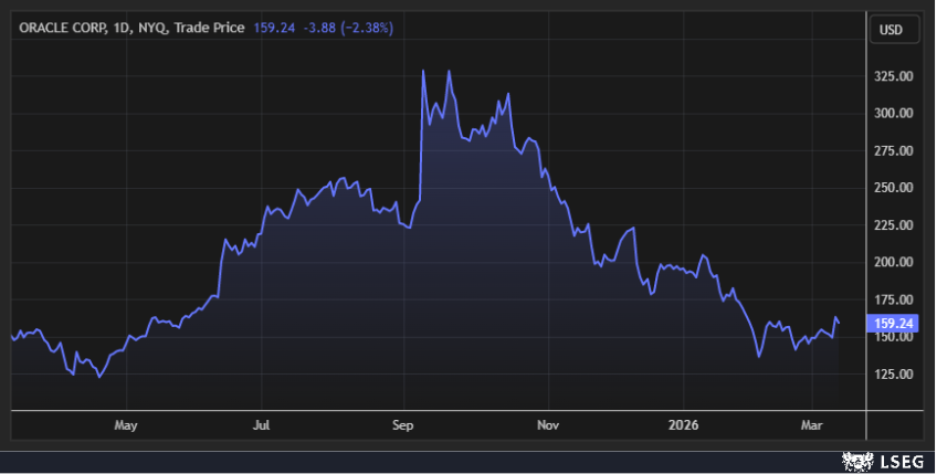
Oracle stock
At its core, the former gatekeepers of AI technologies are quickly seeing their dominance vanish … some from supply chains catching up, and others due to AI itself. If two CNBC reporters could use AI to build a clone of project management firm Monday.com Ltd. (MNDY), what’s stopping all of us from replacing other software firms? Building new database management software? Designing new chip architectures?
That’s triggered a mad rush into “HALO” stocks, short for high assets, low obsolescence companies.
Railways… utilities… miners… not to mention oil and gas stocks.
Now, I must emphasize that most of these HALO picks will underperform over the long term. They’re mostly low-returning, zero-growth companies that offer little beyond quarterly dividends. They’re supposed to be dull… which means their returns are too.
But here’s the thing: Eric has spent decades identifying these exact types of future-proof companies that trade at enormous discounts… and then rise 100% … 500% … 1,000% or more. Many are exotic companies that trade across the globe, hiding beyond Wall Street’s sights. I know the concept might give you pause. Who wants to own the over-the-counter stocks of an Australian gold company or a South African platinum miner?
Well, Eric’s subscribers were certainly happy when he recently sold thoseWestgold Resources Ltd. (WGXRF) sharesfor 1,014% gains and Impala Platinum Holdings Ltd. (IMPUY) shares for 310% profits.
And on Wednesday at 1 p.m. ET, Eric will expand on this idea in a free online presentation he’s calling FutureProof 2026.
In it, he will outline how a new wave of overlooked companies will replace the first wave of AI darlings … and how they will help protect your portfolio from what an AI-powered future might bring.
You can click here to reserve your seat.
Now, allow me to illustrate how simple these investment ideas can be with two prime examples …
Recommended Link
WARNING: $7 TRILLION Event Imminent. Most Americans Unprepared
This isn’t a boom where everyone wins. It’s a transfer from one group to another – like railroads (1800s) and internet (1990s). Louis Navellier, who spent 46 yrs on Wall St., built the grading system institutions paid $24,000/yr for him to evaluate stocks with. Now, his system shows exactly where the $7 trillion is flowing. And it’s not AI. Click here for the full story.
The Second-Order Fertilizer Winner
The Middle East isn’t just an energy hub… it’s a major supplier of nitrogen-based fertilizers too.
In fact, the Persian Gulf region produces so much of these nutrients that it’s responsible for up to 40% of all global exports – making it even more dominant in nitrogen-based fertilizers than in oil and gas.
Conflict in the Middle East has since sent prices of nitrogen-based fertilizers skyrocketing. Urea prices are up around 55% from the start of the year and will likely keep climbing as the spring planting season gets underway.
The most direct beneficiaries have already seen the news reflected in share prices. CF Industries Holdings Inc. (CF)has surged more than 45% since the start of the year, while Nutrien Ltd. (NTR) is up 20%. These American companies are major nitrogen-based fertilizer makers and compete most directly with Middle Eastern imports.
However, one fertilizer company has only started to rally:
The Mosaic Co. (MOS).
This Tampa-based firm is North America’s largest producer of potassium- and phosphorous-based fertilizers potash and phosphate. In fact, it produces roughly 12% and 10% of the global output of these two nutrients.
Now, these two fertilizers are not nitrogen-based, like the types the Gulf states export. So, the stock has barely risen since January.
Think of fertilizers like a three-legged stool. Each type represents a different leg, and you need all three to produce a stable crop. It’s why you’ll often see the “N-P-K” (nitrogen-phosphate-potassium) acronym on fertilizer bottles, and why fertilizing a lawn without soil testing first is a recipe for disaster.
In theory, these three nutrients are notinterchangeable.
However, different crops need different amounts of N-P-K. Corn requires more nitrogen, while soybeans rely on far less. So, high prices?for one type of?nutrient?can often cause shifts in what farmers plant.
That’s why shares of Mosaic should rise from current levels. Farmers are verysensitive to price inputs, and rising nitrogen fertilizer prices will trigger a stampede into crops like soybeans. One researcher at the University of Arkansas’ System Division of Agriculture is already predicting 3.5 million acres of soybeans this year – a level not seen since 2017. (Soy uses far more potash than corn.)
We’re also fast approaching the start of the U.S. planting season. So, even if nitrogen-based fertilizers are allowed past the Hormuz Strait within the next several weeks, many American farmers will have already locked in their potash and phosphate demand for the whole year.
Most importantly, Mosaic is a perfect example of a future-proof company hiding in plain sight.
Few people besides farmers think about potash or who makes it. Even fewer previously considered how AI-resistant fertilizer companies are. Yet vertically integrated fertilizer makers will be almost impossible for AI to replace. Companies must mine minerals out of the ground, process them, and then sell them through international distribution networks. And no matter how smart AI gets, we all still need to eat.
MOS likely has a 2X upside from here.
Future-Proofing Your Liquor Cabinet
The second pick is an Australian company that, like single malt whiskeys, only gets better with time.
I mean this in the literal sense.
Lark Distilling Co. (LRK.AX) is a Tasmania-based spirits firm that specializes in high-end libations. Its flagship blended malt whisky, the Symphony No. 1, has won “Australia’s Best” at the World Whiskies Awards for four consecutive years. Meanwhile, its single malts, like the $200 Classic Cask, are highly rated and routinely earn gold medals at international competitions.
Shares trade on the Australian Securities Exchange, out of Wall Street’s sights.
Now, there are three things to know about Lark.
The first is its recent history. The company overexpanded in the years leading up to the Covid-19 pandemic and overestimated demand from China. Revenues fell by a third between 2022 and 2024 after post-pandemic spending began to dry up. That sent shares from a high of 5.44 Australian dollars to below 1.00 AUD, where it continues to trade today. Lark’s CEO also resigned during this period after a shocking video showed him using illicit drugs. That left the firm leaderless for over a year during this crucial time.
The second is its turnaround. In 2023, Sash Sharma took over as CEO, and the business began to stabilize under him and a new chief financial officer. The company expanded its retail footprint at Australian airports, onboarded new export partners, added distributor partnerships across Asia, and consolidated its production to a single site. The company reported a 2% sales growth in fiscal 2025 and is on track to notch an 8% growth rate this year. Analysts expect growth to accelerate to 28% next year as new distribution channels come online.
The third is valuation. Like most firms, Lark records the value of its inventories at cost (or net realizable value if that’s lower). But unlike everyone else, Lark’s inventories become more valuable with time. All else equal, a 15-year single-malt is worth more than a 10-year version, and so on.
Allow me to do some math. Currently, Lark has 2.5 million liters of whiskey under maturation in its whiskey bank, with a balance sheet value of AUD$57.2 million at cost. Once you add cash, equipment, and receivables, and then deduct debt and depreciation, Lark is worth a tangible book value of roughly AUD$8 million at cost.
Here’s where a mismatch exists. At today’s stock prices, Lark Distilling’s market capitalization is just AUD$74 million, which is less than the AUD$84 million I just mentioned. So, you’re buying a company for a double-digit discount to tangible assets.
Even better, we know that Lark’s whiskey bank is worth more than AUD$57.2 million. (To give you a sense, that’s just $8 per 500-milliliter bottle.) The company sells its 500ml single-malt bottles for at least $200, so inventory values are a magnitude higher than what’s on the books.
That makes Lark a potential 4X company if it’s bought out, or a 10-bagger if it manages to complete its turnaround and regain profitability. Until AI figures out how to age whiskeys faster than Mother Nature can, Lark will remain a relatively future-proof company with plenty of hidden “liquid” assets.
Looking Further Afield
International markets sometimes offer strangely incredible deals. Over a thousand companies outside America trade at negative enterprise value, meaning they could theoretically buy back every share and still have money left over for shareholders.
In fairness, many of these picks will end up going nowhere. International and frontier markets can be notoriously difficult to navigate, and companies in these markets are often horrendously managed. Even Lark Distilling may fail to turn its multimillion-dollar whiskey bank into a profitable business.
But some will turn small stakes into minor fortunes.
That’s why I encourage you to sign up for Eric’s FutureProof 2026 event, scheduled for next Wednesday, March 18, at 1 p.m. ET. During that free broadcast, he will outline exactly what early AI investors got right … how they earned their millions … and what the next wave of investors should be looking at right now.
Eric will also share the names and tickers of 15 companies already beginning to benefit from AI’s emerging bottlenecks. If history is any guide, the next Nvidia-style winner may come from the companies solving AI’s newest constraints.
Until next week,
Thomas Yeung, CFA
Market Analyst, InvestorPlace

investingdistrict.com
investingdistrict.com
Breaking: New #1 Trade Alert Just Emerged

A message from Stock News
Dear Reader,
What if you knew today’s biggest stock winner BEFORE it exploded?
Right now, most traders are flying blind — working off data that’s 15, 20, even 30 minutes old. In the stock market, that’s not just slow. That’s the difference between catching a 100%+ gain and watching it happen without you.
But a small segment of “in the know” traders have already figured this out.
They’re using a built-in tool inside the Stocks.News app that most people completely overlook — and it’s quietly handing them an unfair advantage every single morning.
Here’s how it works: Every day before the market heats up, Stocks.News fires up a proprietary scanner that tears through LIVE market data — running it through dozens of indicators to cut through the noise and zero in on the highest-probability breakouts of the day. The result? A ranked Top 5 Stocks list, updated in real time as breakout probability shifts.
Not yesterday’s data. Not delayed feeds. Right now. Live. Constantly recalculating.
And the results have been nothing short of jaw-dropping. Over the past week, nearly every stock that hit the #1 spot went on to surge 100%+ within days. The most recent #1 pick? It climbed 119% in under 72 hours.
This isn’t luck. This is the right data, at the right time, pointing you in the right direction.
→ Download Stocks News FREE and see today’s #1 pick before the crowd catches on.
P.S. Still on the fence? Let the track record speak for itself:
- CCHH — +196% in 4 days
- QNCX — +238% in under 24 hours
- NCI — +119% in under 72 hours
- DRCT — +90% in under 24 hours
These moves already happened. The next one is building right now.
By clicking the links above, I agree that Stocks.News and its affiliates may email me, with offers and other info. Additionally, I agree to the terms of service, disclaimer and privacy policy.
This is a paid advertisement provided to customers of Schaeffer’s Investment Research. Although we have sent you this email, Schaeffer’s does not necessarily endorse this product nor is it responsible for the content of this advertisement. Schaeffer’s makes no guarantee or warranty about what is advertised above.
To stop receiving these emails, unsubscribe.
Schaeffer’s Investment Research
5151 Pfeiffer Road, Suite 450
Cincinnati, Ohio 45242
Why Big Money Is Dumping Tech for Gold & Resources

AN OXFORD CLUB PUBLICATION
Loyal reader since August 2025
Editor’s Note: I have a message for you from our friends at TrendLabs. I thought you might find it interesting – check it out hereor read more below.
– James Ogletree, Senior Managing Editor
Why Big Money Is Dumping Tech for Gold & Resources
Hey Reader,
Quick question – what’s going on here?
Trump just put a top mining expert on the National Security Council to focus on critical minerals and supply chains.
Apple signed a $500 million deal with a U.S. rare earths producer for magnets – locking in domestic supply.
And 13 billionaires have dumped tech stocks to buy resources instead, including John Paulson, who snapped up a huge stake in an Alaskan gold project.
This isn’t random. Smart money is shifting hard toward real assets.
JC Parets (former hedge fund guy and sharp market forecaster) told me: “This isn’t just a commodities bull market. It’s much, much bigger than that.”
He calls it a “Chaos Cycle” – a pattern that pops up every 10 to 20 years and lasts a decade or more.
When it hits, the market splits: One side takes big hits, while the other side cranks out 10x, 20x, and 30x winners.
JC has the evidence laid out – and he’s clear on which side he thinks wins big.
Watch the quick video here: [Watch Now]
It breaks down the full picture and what he’s telling friends/family to do.
What do you make of this shift?
All the best,
Pete Campbell
Publisher, TrendLabs
P.S. JC says this “Chaos Cycle” isn’t just stocks – it might explain a lot of the geopolitical stuff we’ve seen lately, like moves on Venezuela, Iran, and more. Eye-opening stuff.
You are receiving this email because you subscribed to Wealthy Retirement.
Wealthy Retirement is published by The Oxford Club.
To stop receiving special invitations and offers from Wealthy Retirement, please click here.
Please note: This will not impact the fulfillment of your subscription in any way.
Questions? Check out our FAQs. Trying to reach us? Contact us here.
Please do not reply to this email as it goes to an unmonitored inbox.
Privacy Policy | Whitelist Wealthy Retirement
© 2026 The Oxford Club, LLC All Rights Reserved
The Oxford Club | 105 West Monument Street | Baltimore, MD 21201
North America: 866.237.0436 | International: 443.353.4540
Oxfordclub.com
Nothing published by The Oxford Club should be considered personalized investment advice. Although our employees may answer your general customer service questions, they are not licensed under securities laws to address your particular investment situation. No communication by our employees to you should be deemed personalized investment advice. We allow the editors of our publications to recommend securities that they own themselves. However, our policy prohibits editors from exiting a personal trade while the recommendation to subscribers is open. In no circumstance may an editor sell a security before subscribers have a fair opportunity to exit. The length of time an editor must wait after subscribers have been advised to exit a play depends on the type of publication. All other employees and agents must wait 24 hours after publication before trading on a recommendation.
Any investments recommended by The Oxford Club should be made only after consulting with your investment advisor and only after reviewing the prospectus or financial statements of the company.
Protected by copyright laws of the United States and international treaties. The information found on this website may only be used pursuant to the membership or subscription agreement and any reproduction, copying or redistribution (electronic or otherwise, including on the world wide web), in whole or in part, is strictly prohibited without the express written permission of The Oxford Club, LLC, 105 West Monument Street, Baltimore, MD 21201.
REF: 000142349377
 RJ Hamster