Market Signal | A Timely Investment Alert from Lindsey Hough
Editor’s Note: Silicon Valley legend Jeff Brown is forecasting that Elon Musk’s “Kardashev Project” is about to trigger the greatest wealth creation event in history. If you missed out on Tesla… Go here to see the details of what Elon has coming next or read more below.
Elon Warns of Impending “Chip Wall.” Will you be on the right side?
Elon Musk warns of the biggest bottleneck threatening the AI economy…
Without enough chips, AI will crumble, and the stocks it’s holding up will fall with it.
America’s best tech entrepreneur, Elon Musk, helped build four of the most valuable companies in history.
Now, he’s sounding the alarm about the impending chip wall threatening the AI bubble and every stock dependent on it.
Electronics giants like Dell, Samsung, and Xiaomi are already warning customers of price hikes as chips become scarce.
But Elon says he has a solution.
A solution that could soon result in the world’s first $10 trillion company as Musk takes matters into his own hands.
It’s all part of his master plan.
For the everyday American who’s worked hard to build their nest egg, this could be your last chance to get on the right side. Before the chip wall changes everything we know about the AI economy…
Preserving and even growing everything you’ve built for yourself.
February was my first losing month using the Dark Wire at TheoTRADE. I finished down 0.1%. After nine consecutive winning months, the streak ended. I’m not going to sugarcoat it.
But here’s the full picture. The markets in 2026 have been brutal. The Iran conflict has everything in a tailspin. Other traders are getting crushed. And the worst month this system produced was a fraction of a percent in the red.
March is already up 15%. And the day before yesterday I placed four trades using Dark Wire beacons — all four were winners.
Yesterday I walked through the entire system live. The overnight beacon scan. How those beacons give me a 12-hour head start on where institutional money is moving. The two-hour execution window I use every single morning.
Everything is in the replay. Watch it now before it comes down.
Disclaimer: Neither TheoTrade.com or any of its officers, directors, employees, other personnel, representatives, agents or independent contractors is, in such capacities, a licensed financial adviser, registered investment adviser, registered broker-dealer or FINRA |SIPC |NFA-member firm. TheoTrade does not provide investment or financial advice or make investment recommendations. TheoTrade is not in the business of transacting trades, nor does TheoTrade agree to direct your brokerage accounts or give trading advice tailored to your particular situation. Nothing contained in our content constitutes a solicitation, recommendation, promotion, or endorsement of any particular security, other investment product, transaction or investment.Trading Futures, Options on Futures, and retail off-exchange foreign currency transactions involves substantial risk of loss and is not suitable for all investors. You should carefully consider whether trading is suitable for you in light of your circumstances, knowledge, and financial resources. You may lose all or more of your initial investment. Opinions, market data, and recommendations are subject to change at any time. Past Performance is not necessarily indicative of future results.
TheoTrade
PO Box 24790 Christiansted, Virgin Islands 00824 1 (800) 256-8876
Two and a half months into 2026, and the S&P 500 and tech-heavy Nasdaq 100 are both down.
And if you’ve been watching the headlines, you have a good idea why: software stocks getting crushed, a new slate of global tariffs, and the Iran conflict sending oil prices up 40%.
Jeff has spent decades trading through volatile conditions like these and much, much worse. Think 1987, the dot-com bust, 2008 crash, COVID, and plenty in between.
He’s seen what happens when fear takes over. More important, he knows how to profit from it.
His tool of choice is options. But he doesn’t use them to gamble with reckless leverage.
In fact, Jeff believes you can take any stock trade idea and, with options, make more money with less risk every single time.
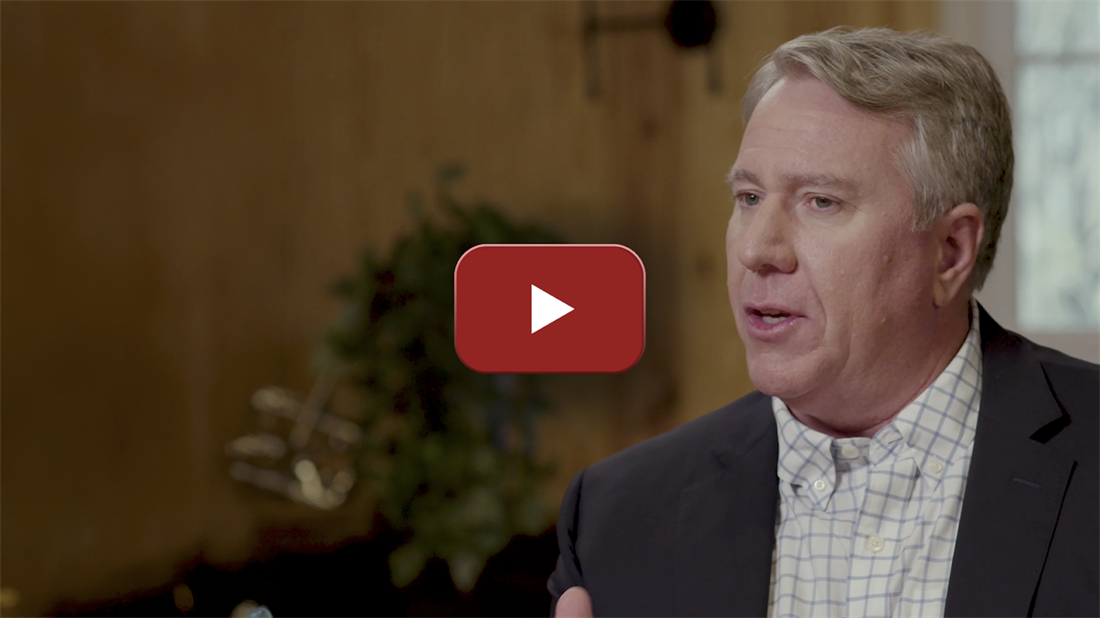
In this conversation, Jeff lays out why he believes much of the damage in this selloff has already been done – at least beneath the surface. And he reveals which sectors he’s watching for his next big trade.
This one’s worth your full attention.
Jeff’s track record in 2026 speaks for itself.
Seven consecutive winning trades, averaging more than 87% gains, using a straightforward approach that anyone can follow.
He did that with his unique approach to options trading, built and refined over decades in the market.
If you’d like to learn more about Jeff’s approach, but aren’t too familiar with options, his beginner-friendly Jeff Clark Trader advisory is exactly what you’re looking for.
It’s not just a “trade of the month” newsletter. It comes with a mountain of educational resources that will help get you set up to trade options the right way.
Silicon Valley insider Luke Lango is stepping forward to share how you can get a pre-IPO stake in OpenAI (for under $10). It will likely be the biggest headline of 2026, and could create THOUSANDS of new millionaires. This is the best chance to achieve the biggest gains this year. Click here for the full story.
This editorial email containing advertisements was sent to peter.hovis@gmail.combecause you are subscribed to this service. To unsubscribe or change your email preferences, please click here.
To contact Customer Service, call toll free: 866-385-2076, Mon–Fri, 9am–5pm ET, or email support@tradesmith.com.
I’m the founder of one of the largest financial research firms in the world. Over the last 26 years we’ve helped investors navigate almost every major economic cycle.
We’ve also been on the forefront of every big financial story from the rise of Bitcoin and MRNA vaccines to robotics and artificial intelligence – just to name a few.
An economic story the likes of which we’ve not seen in centuries. In fact, the last – and only time – this happened was in 1776. But now, on the eve of America’s 250th anniversary, it’s happening again.
And as you’ll discover today, the aftershock of this event could “reset” not just your personal wealth, but the entire U.S. economic system:
How you work, how you vote, how you protect and build your wealth… it’s all being turned upside down by what one famous Stanford economist says is:
“The biggest change ever… bigger than electricity… bigger than the steam engine.”
Yet almost nobody is prepared for it. So, if you’ve been watching the chaos of the past year unfold, struggling to understand what it all means… you’re about to get many – if not all – of the answers you’ve been searching for.
And, most importantly, what it all means for you, your money, and your investment portfolio in the months ahead
Because as you’ll discover, everything from the government taking stakes in companies like Intel, Lithium Americas, and MP Materials.
To Trump’s strike on Venezuela… his deal with Greenland… his seemingly never-ending slew of executive orders… and increasingly centralized grip over the economy…
All the way to the surging popularity of radical socialist politicians like Bernie Sanders, AOC, and Zohran Mamdani…
It’s all deeply and inexorably intertwined in what is, without a doubt, the most consequential story of the year.
A turning point that one Nobel Prize winner says is dividing not just the economy but our entire society.
And, as my guest and I explain, the financial decisions you make in the face of this New 1776 Moment… they could dictate whether you’re enriched, left stuck in the past, or potentially even impoverished by the seismic changes barreling down upon America.
The stocks to buy… the stocks to sell… and the three money moves to ensure you and your loved ones end up on the winning side of this new economic reality.
It’s all laid out here for you…
Good investing,
Porter Stansberry
Special Report
Market Crash Warning? Wall Street Veteran Says Mid-March Could Mark a Turning Point
Written by Bridget Bennett. Originally Published: 3/11/2026.
Key Points
Marc Chaikin, founder and CEO of Chaikin Analytics, says the midterm year has historically been the weakest phase of the presidential cycle, with peaks often forming in mid-March to early April.
Even if indexes are near highs, internal weakness in speculative and large-cap tech can show up first and foreshadow broader downside.
Preparation matters: build cash, trim weak holdings, and watch key technical levels to stay flexible if volatility rises.
When asked about the market outlook heading into mid‑March, Wall Street veteran Marc Chaikin said current conditions are unfolding much as he predicted a year ago.
Chaikin, the founder and CEO of Chaikin Analytics, has more than 50 years of experience in the stock market and is known for blending fundamental and technical analysis. His current warning is rooted in the presidential election cycle, one of the market’s longest‑tracked seasonal patterns. Historically, the second year of a presidential term—often called the midterm year—has been the weakest stretch for equities.
A major force in the crypto world is quietly becoming one of gold’s most aggressive buyers — and most investors have no idea it’s happening.
A longtime gold analyst says profits from a leading stablecoin operation are being funneled into physical gold at a scale that could materially impact supply and demand. After a recent meeting with insiders, he began outlining what this trend could mean for gold prices and a small group of companies positioned to benefit.Read the full gold briefing here
Looking at the last 17 presidential cycles, dating to the 1950s:
The second year of the cycle averaged just a 1% gain in the S&P 500.
The other three years averaged double‑digit returns.
Market peaks during midterm years often occur between mid‑March and early April.
That timing window is exactly where the market finds itself now.
Historical patterns don’t guarantee future outcomes, but Chaikin says they provide a useful framework for understanding probabilities—especially when other warning signs are emerging.
Markets Trading on Expectations, Not Fundamentals
Recent volatility highlights how sensitive markets have become to headlines and geopolitical developments.
That combination presents a difficult dilemma for the Federal Reserve.
Normally, rising inflation would push the Fed to raise rates, while weakening employment would argue for cuts. With both pressures occurring at once, the central bank’s flexibility may be limited.
Geopolitical tensions and rapidly shifting headlines add to the uncertainty. Real‑time information—often amplified through social media and political messaging—can prompt algorithmic trading systems to react instantly, accelerating short‑term market swings.
The result is an environment driven less by fundamentals and more by short‑term reactions and uncertainty.
Weakness Already Appearing Beneath the Surface
Despite the recent volatility, the broader market remains relatively close to its highs: the S&P 500 is only about 2% below its peak. For context, a correction is typically defined as a 10%–20% decline, while a bear market generally requires a 20% drop.
However, Chaikin says many popular stocks are already struggling.
Several of the so‑called Magnificent Seven—a handful of mega‑cap tech leaders—account for roughly one‑third of the S&P 500’s market value, and a number of them are already in steep downtrends. Investors heavily exposed to tech through ETFs or individual holdings like Microsoft (NASDAQ: MSFT) may be experiencing losses far larger than the overall index suggests.
These internal cracks often appear before the broader market begins to decline.
3 Ways Investors Can Protect Their Portfolios
Rather than trying to predict exactly what will happen next, Chaikin emphasizes preparation. If markets move into a correction or bear phase, investors who plan ahead will be better positioned.
The goal isn’t to exit the market completely but to create a cushion.
Cash serves two important purposes:
It reduces emotional pressure during declines.
It provides dry powder to take advantage of opportunities later.
Investors who stay fully invested during downturns often feel forced to sell at the worst possible moment.
2. Sell Weak Stocks First
If you need cash, a logical place to start is selling your weakest holdings.
Chaikin recommends trimming stocks that exhibit bearish characteristics in quantitative models such as the Chaikin Power Gauge, which evaluates companies on 20 fundamental and technical factors.
Stocks already showing bearish signals near market highs are often the most vulnerable during corrections, while stronger areas may remain resilient. Chaikin highlighted sectors currently demonstrating relative strength, including healthcare, aerospace and defense, energy, and infrastructure tied to data center expansion.
Rather than automatically buying the dip, investors may benefit from focusing on industry groups with strong momentum and fundamentals.
3. Watch Key Technical Levels
Technical indicators can provide early clues about the market’s direction.
One widely watched signal is the 200‑day moving average of the S&P 500. Many traders view it as a dividing line between longer‑term uptrends and downtrends. If the index holds above the 200‑day, pullbacks often stay contained; a decisive break below it can signal that selling pressure is widening and that a routine dip may be turning into something more serious.
Other gauges, such as the VIX volatility index, have already spiked in recent sessions. While volatility can create short‑term buying opportunities, sustained spikes often accompany periods of market stress.
Why the Best Opportunity May Come Later
Despite the cautious outlook, Chaikin remains optimistic.
Midterm years have often produced some of the best buying opportunities in the presidential cycle. Markets frequently bottom in late September or early October after months of volatility, then launch into powerful rallies. In some cases, gains following those lows have averaged more than 40% over the next 15 months.
That’s why preparation now can matter more than prediction.
Investors who maintain cash during volatile periods have the flexibility to act when prices reset. Those who stay fully invested through a sharp downturn may instead be forced to react at exactly the wrong moment.
With historical patterns pointing to a weaker midterm year and geopolitical uncertainty adding to volatility, this may be a time to focus on strengthening portfolios rather than chasing short‑term moves.
If history repeats itself, the turbulence of 2026 may not just test investors’ patience—it could ultimately create one of the most attractive buying opportunities of the entire market cycle.
A 52-week high is a technical indicator used by some of the world’s top traders and investors to determine the current and future value of a stock. In this report we reveal today’s top 4 stocks about to reach their 52-week highs.
Futurist Eric Fry predicted that Artificial General Intelligence (AGI) would arrive in 2026, years before most experts said it was possible. Now that this advanced form of AI is emerging from Silicon Valley, Eric says we need to brace for an entirely different phase of the AI boom. Continue reading ➔3 Stocks to Buy After the “Iran Shock”
PORT-OF-SPAIN, Trinidad (AP) — Trinidad and Tobago’s government has received House of Representatives approval to extend a state of emergency for three months, as the twin-island Caribbean nation struggles with a high level of crime. Continue reading ➔Where things stand after the US and Israeli strikes on Iran
Trump’s AI and Crypto Czar David Sacks warned that the U.S. strategy in Iran could lead to “catastrophic” outcomes. Continue reading ➔
Information, charts, or examples contained in this email are for illustration and educational purposes only and not for individualized investment management. This message contains commercial elements, such as advertising and partner offers for which we may receive affiliate compensation. We only send these offers to those who have opted into our newsletter.
If you wish to no longer receive these offers, click on the unsubscribe link at the bottom of this email. Past performance is not indicative of future results. For these reasons, we strongly suggest trading in a DEMO/Simulated account.
The information provided by us is for educational and informational purposes only. We make no representations or warranties concerning the products, practices, or procedures of any company or entity mentioned or recommended in this email and have not determined if the statements and opinions of the advertiser are accurate, correct, or truthful.
If you use, act upon, or make decisions in reliance on information contained in this email or any external source linked within it, you do so at your own peril and agree to hold us, our officers, directors, shareholders, affiliates, and agents without fault.
2967 Dundas St. W. #990, Toronto, ON M6P 1Z2 | Phone Number: 917.672.7040
$231.00-1.41 (-0.60%)(As of 03:59 PM ET)30 DAY PERFORMANCE-11.01% 90 DAY PERFORMANCE-8.32% 1 YEAR PERFORMANCE +5.33%
MARKET CAPITALIZATION
$33.65B
P/E RATIO
22.85
DIVIDEND YIELD
1.04%
ABOUT RESMED
ResMed (NYSE: RMD) is a global medical device and cloud-connectivity company focused on improving outcomes for people with sleep-disordered breathing and chronic respiratory conditions. Founded in 1989, the company is headquartered in San Diego, California, and develops, manufactures and distributes a range of devices and software used by patients, clinicians and providers worldwide. ResMed’s product portfolio centers on noninvasive ventilation and sleep therapy equipment, including continuous positive airway pressure (CPAP) and bilevel devices, masks and related accessories for the treatment… Read Full Profile ▷
RMD COMPANY CALENDAR
NOV 13, 2025Ex-Dividend for 12/18 DividendDEC 18, 2025Dividend PayableJAN 29, 2026Last EarningsFEB 12, 2026Ex-Dividend for 3/19 DividendMAR 13, 2026TodayMAR 19, 2026Dividend PayableAPR 22, 2026Next Earnings (Estimated)JUN 30, 2026Fiscal Year End
The Federal Reserve is selling banks their new FedNow system with one major promise: transfers will happen instantly, 24/7/365 with no more weekend or holiday delays—but when your money moves instantly through a centralized government hub, it can also be frozen instantly by automated algorithms inside the Fed’s new network. Imagine it’s 6:00 p.m. on a Friday when your account is instantly locked by a faceless government computer in Washington because an algorithm flagged a recent purchase or donation as suspicious, cutting you off from your own money until Monday morning or later with no way to pay for anything.Get the 4 steps to Fed-proof your savings now ▷
Warner Bros. Discovery insiders are cashing in after the company’s deal with Paramount, raising the question of whether investors should follow suit.Read The Full Story ▷
Volatile markets can be stomach-churning, but they also create opportunities for risk seekers. These three stocks show rebound potential for technical traders.Read The Full Story ▷
Weiss expert Chris Graebe just revealed a unique gold-related investment that offers much higher upside than gold itself without the downside price risk—private, pre-IPO shares insulated from daily market volatility in a company that has pioneered a new way to extract and process gold 10 times faster and up to 70 times cheaper than a traditional miner without owning or operating a single mine. This is a rare chance to invest in the Alpha Round of funding, one of the earliest and most rewarding pre-IPO funding rounds, with examples of Alpha Round deals that delivered returns as high as 552,332%, enough to grow a $1,000 stake into $5.5 million.Watch the Private Investment Summit for all the facts now ▷
Insurance stocks like Chubb, Progressive, and Arch Capital are attracting investors as steady premiums and rising investment income help stabilize portfolios.Read The Full Story ▷
HSBC stock is counting on the bank’s Asia-focused strategy, as strong profitability and rising dividends and share buybacks position it for long-term growth.Read The Full Story ▷
A little-known U.S. law is back in focus as analysts examine how existing presidential authorities could influence markets in 2026 and beyond.
In a new briefing, a former government advisor explains the historical context behind this statute, why it’s being discussed again, and how certain policy actions could reshape capital flows during America’s upcoming 250th anniversary period. The presentation focuses on preparedness, macro implications, and what investors may want to understand as events develop.See the full briefing here ▷
Dollar General is positioned to outperform its guidance and drive a bullish upgrade cycle, but it won’t start until later in 2026. Read The Full Story ▷
A new energy shock has struck global markets as the U.S.-Israeli war against Iran enters its second week. Oil prices briefly shot over $115 per barrel in the overnight session on Sunday, March 8, before settling back under $90 by Monday evening. Still, oil prices have jumped more than 30% in the last month, and gas prices are quickly approaching a $4 average in the U.S. Energy disruptions have a global impact, but not every country or sector is affected equally. A few market areas could feel more pressure than others, and the funds covering them are ones investors might want to sidestep while the conflict plays out.
AI’s surging energy demand is creating new winners
AI workloads are scaling and data centers are expanding rapidly — driving unprecedented demand for electricity, cooling, and grid infrastructure.
Massive capital is flowing to the companies that enable AI at scale — the power producers, infrastructure owners, and critical technology suppliers behind the scenes.
Sectors and Asset Classes Hit Hardest By Oil Shocks
When an energy shock like an oil crisis hits, there’s a typical playbook that investors turn to seeking to offset risk. The oil and gas sector has obvious tailwinds from prices nearing $100/bbl, and consumer staples tend to hold up well when people start noticing higher prices at the pump. But three sectors that are frequently punished harder than the rest include:
Consumer Discretionary – This sector is among the first to notice the squeeze because an oil shock is a very ‘in your face’ signal. Anyone who commutes or drives regularly feels an immediate impact as gasoline becomes increasingly expensive in a short period. Every extra dollar spent filling a gas tank is one less spent shopping online, ordering takeout, or supplying a home improvement project. Even consumers who don’t drive notice sticker shock as gas prices are visible at every intersection and convenience store, with knock-on effects on economic sentiment. Additionally, companies in the consumer discretionary industry face many input costs influenced by fuel prices, such as shipping and warehousing. If these costs increase rapidly, companies selling discretionary goods will face yet another margin headwind that can’t be fully passed on to customers.
Airlines – Fuel costs are a significant burden, accounting for up to 35% of operating expenses. Oil shocks put the airline industry in a tight spot because fuel prices can rise overnight, while fares and route schedules are locked months in advance and can’t be adjusted quickly to offset the increase. Airlines also face a trickle-down effect from consumer sentiment; if potential travelers feel a pinch in the wallet, they’ll likely eschew destination trips for cheaper routes (or skip the vacation altogether).
European Equities – This scenario played out back in 2022 when Russia invaded Ukraine and sent oil prices over $100/bbl in rapid fashion. We discussed Europe’s struggles to absorb oil shocks when the fighting began because it’s so dependent on energy imports and has limited domestic capacity to meet demand. Policy and geology both play a role here, but until Europe reaches a higher level of decarbonization, it will continue to feel an outsized impact from geopolitical decision-making beyond its borders.
Consider Selling These 3 ETFs as Oil Prices Go Crazy
One of the great things about ETFs is that you can find a fund for any nook and cranny of the market, and the three sectors mentioned above have plenty of liquid options. Here are three funds to consider lightening up on while the war continues in Iran.
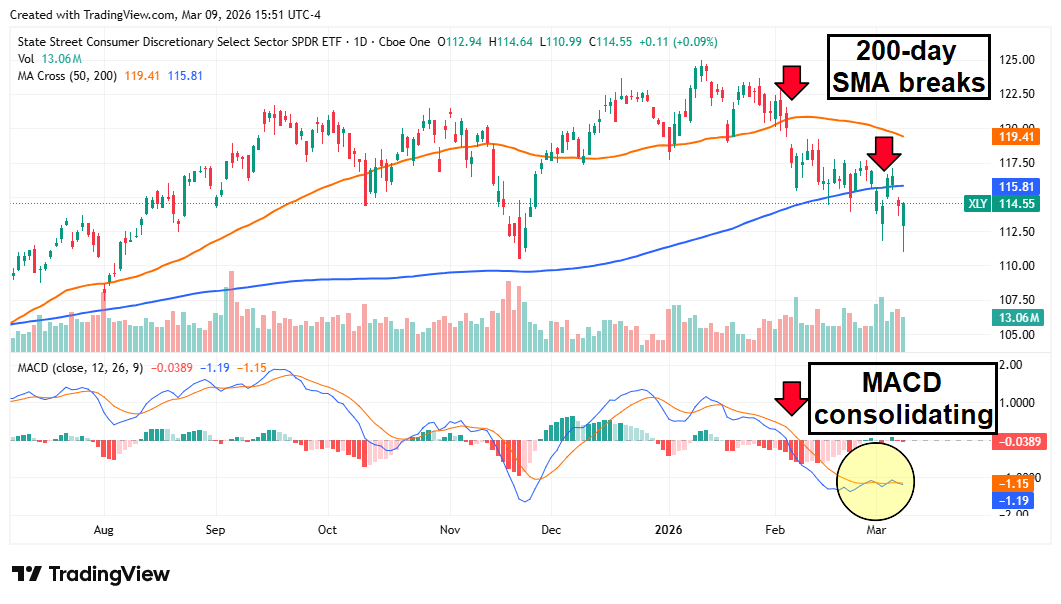
But in the current environment, its liquidity makes it an easy fund to sell, and its biggest holdings like Amazon Inc. (NASDAQ: AMZN) and Tesla Inc. (NASDAQ: TSLA) will suffer if consumers begin putting off big-ticket spending due to rising energy costs.
The ETF has collapsed over the last few weeks, taking out the 50-day and 200-day moving averages as it erases four months’ worth of gains. The Moving Average Convergence Divergence (MACD) confirms the bearish momentum, and is now consolidating with prices hovering below the 200-day. If the war proves lengthy, this consolidation could lead to more selling and new lows on XLY.
The Vanguard FTSE Europe ETF Loses Momentum as European Stocks Pull Back
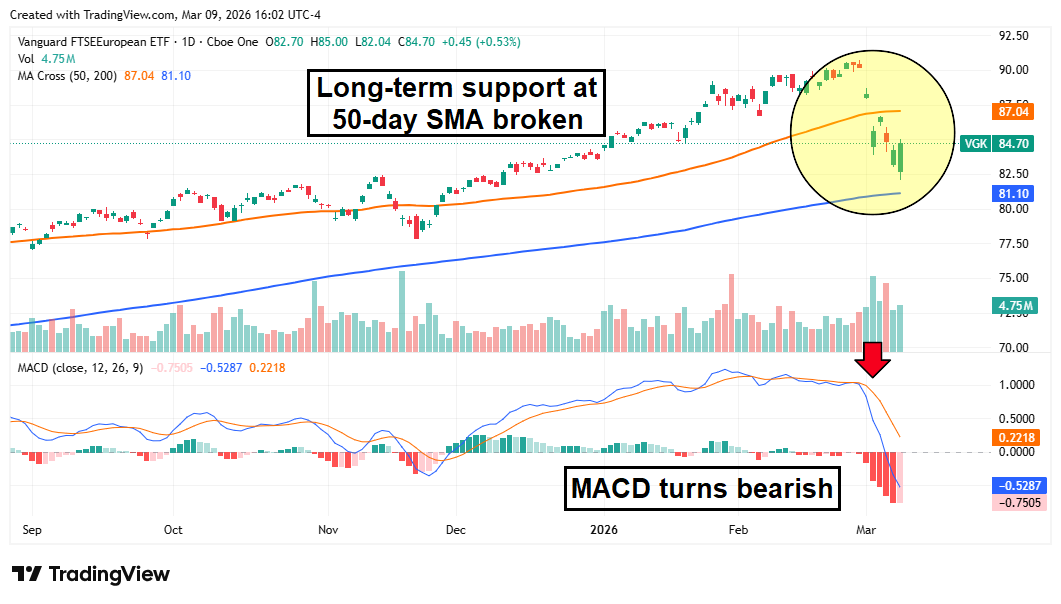
But its holdings are also concentrated in some of the most energy-sensitive countries in Europe, like Germany, France, and the U.K. European stocks have outperformed their U.S. peers over the last two years, but VGK is down more than 5% this month, and its year-to-date (YTD) gain has dwindled to just 1%.
VGK recently took out long-term support at the 50-day moving average, and the next crucial level to watch is the 200-day moving average. The MACD illustrates the speed and ferocity of the drawdown, and sellers are firmly in control of momentum now. If shares can’t hold the 200-day moving average, the downward pressure will only intensify.
The U.S. Global Jets ETF Is Vulnerable in a Risk-Off Market
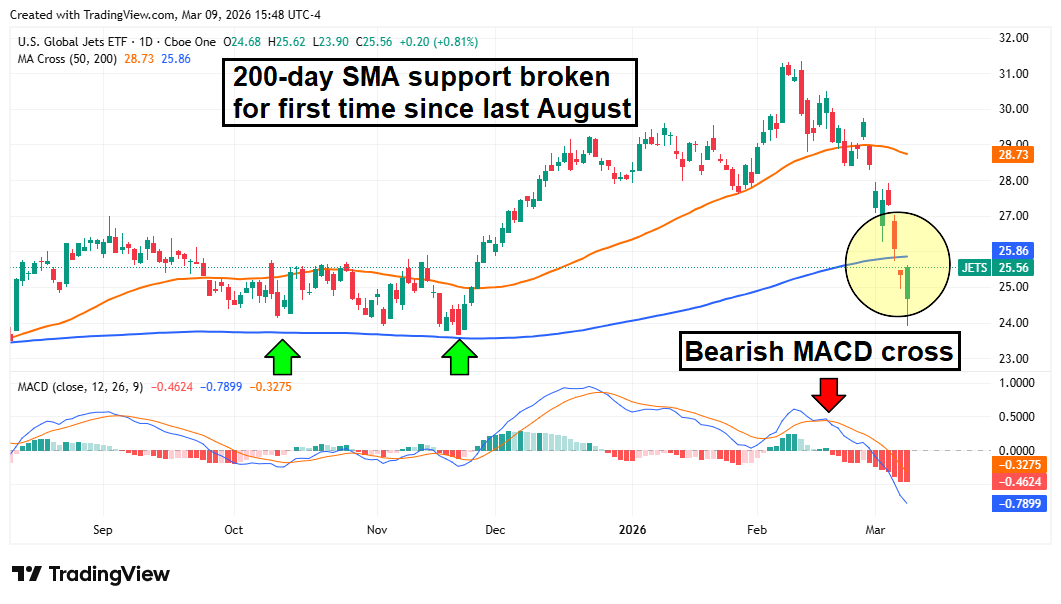
The U.S. Global Jets ETF (NYSEARCA: JETS) faces several headwinds from the current situation. It’s a smaller, more expensive fund that investors likely don’t consider a core holding and will be quick to dump.
JETS is down more than 15% in the last month, and the bearish momentum isn’t showing any signs of dissipating. The stock took out the 200-day moving average during the decline, the first time since last August the fund had breached this level. The MACD is also showing more bearish signals than it has since the Liberation Day tariff debacle last April, hinting that the bottom isn’t in yet.
Thank you for subscribing to DividendStocks.com’s daily newsletter for dividend and income investors that covers ex-dividend stocks, new dividend declarations, dividend stock ideas, and the latest market news.
If you have questions or concerns about your account, don’t hesitate to contact MarketBeat’s U.S. based support team at contact@marketbeat.com.
If you no longer wish to receive email from DividendStocks.com, you can unsubscribe.





 Strategic financial insights, macroeconomic trends, and clear investment strategies for growth-oriented investors.













 RJ Hamster