He Thinks the Market Is About To Change — Again.

Dear Reader,

In 2008—nine months before the Great Financial Crisis—JC Parets warned his hedge fund clients and business partners the market was rolling over.
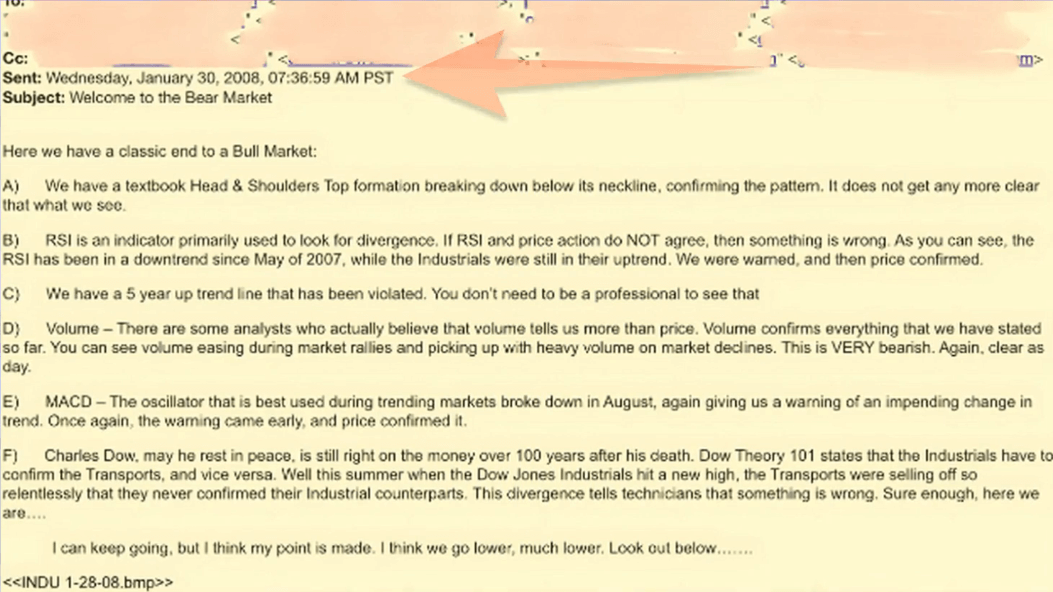
He did it again in 2018.

And again in 2020.

Then in 2022—while markets were collapsing live on Fox Business—he looked straight into the camera and told Maria Bartiromo:

“We’ve hit bottom. It’s time to buy.”

The reaction? Disbelief.

Even Maria gave him that look.
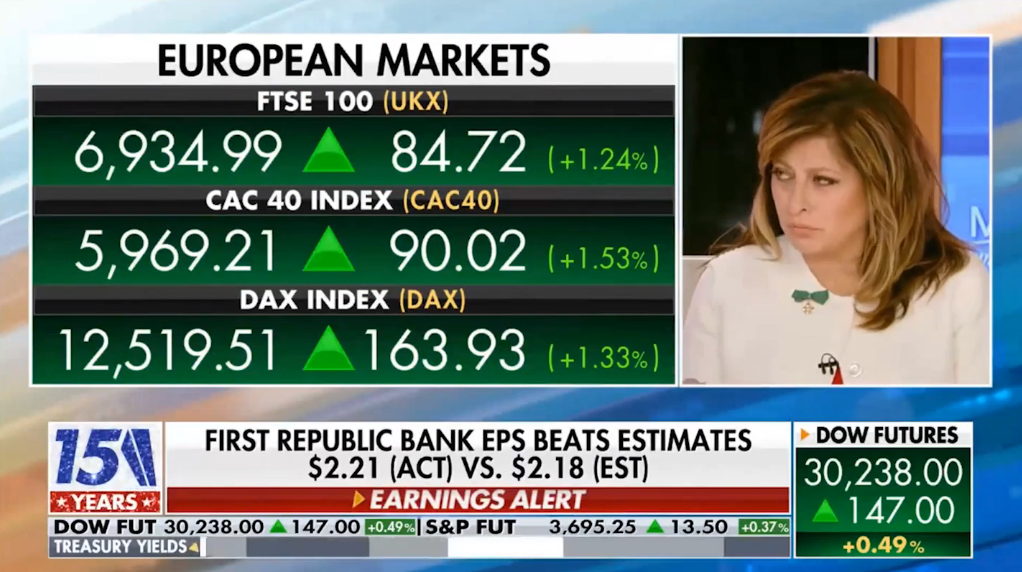
The clip later went viral on X.

But then…

Homebuilders surged 60%. Nvidia exploded 669%. MicroStrategy climbed 1,245%.

What sounded outrageous in the moment… became one of the most profitable calls of the decade.

Now—after more than 800 days of silence—JC is back.

And what he’s saying today may be even more consequential.

If you have money in the market… you’ll want to hear this.

All the best,

Pete Campbell
Publisher, TrendLabs

P.S. 13 billionaires — including Warren Buffett and Jeff Bezos — have already shifted their money.


Just For You

Meta and Rocket Lab Insiders Sell Shares—So Why Is Wall Street Buying?

Reported by Jeffrey Neal Johnson. Article Published: 3/3/2026. 

Split image showing Meta data center with logo and Rocket Lab rocket on launch pad at night, highlighting tech and space growth.

Key Points

  • Institutional investors continue to pour capital into Meta Platforms and Rocket Lab despite high-profile insider selling by executives.
  • Meta Platforms continues to demonstrate operational efficiency with strong revenue growth and healthy profit margins that attract smart money.
  • Rocket Lab maintains a massive backlog of government contracts, which provides long-term revenue visibility and stability for shareholders.
  • Special Report: [Sponsorship-Ad-6-Format3]

It’s a confusing time for retail investors. Markets are trading near record highs, companies are reporting massive revenue gains, and excitement around technology and space exploration is palpable. Yet a troubling trend has emerged in the headlines: the people running these successful companies — CEOs, CFOs, and COOs — are selling stock at an aggressive pace.

When executives sell millions of dollars worth of shares, alarm bells naturally ring. Investors worry the insiders know something the public does not. Is the top in? Are growth prospects slowing? Watching a chief financial officer dump stock can feel like seeing the captain put on a life vest while assuring passengers the ship is unsinkable.

Skip Headlines Straight to Original Research (Ad)

Our investment research analysts are going to be releasing their next investment idea tomorrow morning, around 10:00 AM Eastern time.Add yourself to the distribution list here.

But panic is rarely a profitable strategy. While insider selling creates fear, a deeper look at the data often reveals a counter-signal: institutional accumulation. Hedge funds, pension funds, and investment banks frequently buy the same shares executives are selling. This divergence between individual profit-taking and institutional conviction can offer opportunities for investors who know where to look.

Zuckerberg’s Team Cashes Out, But Wall Street Buys In

Meta Platforms (NASDAQ: META) has been a dominant market force, with its stock trading around $655 as of early March 2026. That level represents a significant rally from prior years, driven by the integration of artificial intelligenceand robust advertising revenue.

Recent filings show Meta’s executives taking substantial chips off the table. In Feb. 2026 alone, CFO Susan Li sold roughly $35 million of stock, and COO Javier Olivan executed multiple sell orders throughout the month. In total, eight insiders have sold over the past 12 months, with no insider buys recorded. To an outsider, seeing senior leadership reduce holdings can look like a lack of confidence.

Understanding Rule 10b5-1 Trading Plans

It’s important to understand how these trades are often executed. Many of the sales occurred under Rule 10b5-1 trading plans — pre-scheduled arrangements that automatically sell stock at set times or prices and are typically established months in advance.

  • Legal protection: These plans shield executives from insider trading allegations. They can’t simply decide to sell based on nonpublic information because the sale schedule was likely set well before any recent developments.
  • Diversification: Executives are frequently paid in stock. Selling is the only practical way to convert that paper wealth into cash for taxes, real estate, or portfolio diversification.
  • Rational behavior: With the stock near all-time highs, locking in gains is a normal part of financial planning and does not necessarily signal a bearish outlook on the company’s future.

Fundamentals Override Insider Fears

While insiders sell, the smart money is often buying. Data from the last 12 months shows a net institutional inflow of more than $100 billion into Meta stock. Recently, billionaire investor Bill Ackman reportedly acquired a multi-billion-dollar stake, arguing the company remains undervalued despite its rally.

Institutions are focusing on fundamentals rather than the optics of insider trades:

  • Earnings beat: In late Jan. 2026, Meta reported earnings per share (EPS) of $8.88, well above estimates of $8.16.
  • Revenue growth: Revenue rose 23.8% year-over-year, showing that the company’s core advertising engine is accelerating.
  • Margins: Despite heavy AI infrastructure spending, Meta maintained net margins above 30%, indicating operational efficiency.
  • Valuation: Trading at a price-to-earnings ratio (P/E) near 27.90, Meta’s valuation is reasonable for a company growing revenue at over 20%.

For Meta’s institutional investors, the thesis is straightforward: Meta is a cash-flow machine with a dominant position, and the current price looks like a stepping stone to higher valuations rather than an endpoint.

Blast Off: Why Institutions Are Chasing a Space Stock

The insider selling versus institutional buying dynamic is even more pronounced at Rocket Lab USA (NASDAQ: RKLB). The aerospace company saw its stock surge from the mid-teens to over $70 in a year, creating sizable liquidity events for leadership.

In Dec. 2025, CEO Peter Beck sold more than $140 million in stock, and CFO Adam Spice sold over $100 million in Jan. 2026. Those are large figures that can spook retail investors.

Context matters. Rocket Lab’s leadership spent years building the company from a startup to a $37 billion industry player. For founders and early executives, selling after a roughly 400% run-upcan be a life-changing financial event. It often reflects the realization of past success rather than a loss of faith in the company’s future — if they thought the company was doomed, they likely would have sold much earlier at lower prices.

Why Wall Street Loves Rocket Lab

Wall Street clearly doesn’t view these insider sales as a red flag. Institutional ownership in Rocket Lab has climbed to nearly 72%. Over the past 12 months, institutions bought $4.96 billion in shares while selling only $1.51 billion. Major funds like Vanguard and Baillie Gifford are absorbing much of the supply created by insiders.

Institutions are buying based on three key catalysts:

  • Massive backlog: Rocket Lab sits on a $1.85 billion backlog, providing multi-year revenue visibility. Much of this work comes from the Space Development Agency (SDA), so revenue is supported by government contracts.
  • Record revenue: The company closed 2025 with record revenue of $602 million, validating its business model.
  • Strategic position: Rocket Lab has effectively cornered the small-to-medium launch market outside of SpaceX.

Even the recent Neutron rocket delay to Q4 2026 — caused by a manufacturing defect in a tank test — hasn’t stopped accumulation. Analysts view the delay as a temporary setback. The size of the SDA contracts and the company’s satellite production capabilities keep the long-term growth narrative intact.

The Bigger Picture: Wealth Transfer

When evaluating names like Meta Platforms and Rocket Lab, it’s easy to get swept up in dramatic headlines. Insider selling makes for attention-grabbing stories, but it rarely tells the whole picture. Executives sell for personal reasons; institutions buy for profit.

The divergence we see today is a classic case of wealth transfer: insiders are cashing out on a decade of growth, while institutions position for the next decade.

Actionable takeaways:

  • Meta Platforms: The “AI fatigue” narrative appears to be mostly noise. Strong institutional support suggests the stock remains appropriate for long-term portfolios.
  • Rocket Lab: The large backlog and the company’s dominant position in the space economy outweigh the optics of insider selling. Institutional accumulation implies the Neutron delay may be a buying opportunity rather than a reason to exit.

Ultimately, while insiders may be taking profits, the market’s largest players are betting heavily that the rally is far from over. Following the flow of institutional capital often provides a clearer signal of value than reading into the tax planning or diversification decisions of a few executives.

Investors seeking long-term growth may want to keep Meta Platforms on their watchlist for potential dips caused by insider-selling headlines, while aggressive growth investors might view Rocket Lab’s pullback as an entry point given the strong institutional support and $1.85 billion backlog.


More Reading from MarketBeat

ZIM’s $35 Buyout: An Arbitrage Play With a Solid Floor

Written by Jeffrey Neal Johnson. Publication Date: 3/9/2026. 

ZIM container ship loaded with cargo containers leaving port terminal, reflecting global container shipping industry.

Key Points

  • The company demonstrated significant operational strength by posting a surprise profit despite challenging market conditions.
  • A pending all-cash acquisition by a major shipping line has created a clear and significant valuation gap for the company’s shares.
  • The deal includes a well-defined plan to secure regulatory approval, increasing the likelihood of a successful transaction completion.
  • Special Report: [Sponsorship-Ad-6-Format3]

In a global shipping industry defined by geopolitical crosscurrents and economic uncertainty, identifying value requires focusing on companies that demonstrate operational resilience and clear catalysts. While market volatility has kept many investors on the sidelines, ZIM Integrated Shipping Services Ltd. (NYSE: ZIM) has emerged with a compelling case.

ZIM recently navigated a challenging market to post a surprise fourth-quarter profit, underscoring a healthy business model. More significantly, ZIM is at the center of a multibillion-dollar acquisition that creates a sizeable valuation gap, presenting a noteworthy situation for investors watching the transportation and logistics sector.

A Surprise Profit in Choppy Waters

Skip Headlines Straight to Original Research (Ad)

Our investment research analysts are going to be releasing their next investment idea tomorrow morning, around 10:00 AM Eastern time.Add yourself to the distribution list here.

A company’s ability to generate profit during market normalization is a strong indicator of fundamental health. For the fourth quarter of 2025, ZIM delivered an earnings surprise that defied expectations. ZIM reported a net profit of $0.32 per share versus the consensus analyst estimate of a $1.01 per share loss. This outperformance reflects ZIM’s strategic and operational discipline.

This bottom-line strength came even as record-high freight rates cooled. ZIM’s quarterly revenue was $1.48 billion, and the average freight rate per twenty-foot equivalent unit (TEU) settled at $1,333. Turning a profit in this environment points to a proactive operational strategy.

One key driver of this efficiency is ZIM’s fleet modernization program, which focuses on integrating newer, more cost-effective and fuel-efficient liquefied natural gas (LNG) vessels. These ships use cleaner fuel and are designed for greater efficiency, helping ZIM lower voyage costs and protect margins.

This operational strength is supported by a complex macro backdrop. Ongoing geopolitical tensions and disruptions in the Red Sea have forced many carriers to reroute vessels around the Cape of Good Hope. These longer transit times effectively absorb excess global shipping capacity, creating a functional floor for freight rates and preventing a market collapse.

ZIM’s performance shows its ability not only to withstand these headwinds but also to leverage its efficient fleet to benefit from resulting market stability. For investors, this proven profitability provides a solid fundamental backstop, reducing downside risk as ZIM moves toward the next major chapter in its corporate story.

A $35 Cash Buyout and the Valuation Gap

While ZIM’s operational health is impressive, the most significant catalyst shaping its investment profile is a pending acquisition by German shipping giant Hapag-Lloyd (OTCMKTS: HPGLY). On Feb. 16, 2026, the two companies announced a definitive agreement under which Hapag-Lloyd would acquire ZIM for $35 per share in an all-cash transaction. The deal values ZIM at roughly $4.2 billion and reframes its valuation for the foreseeable future. The move is expected to strengthen Hapag-Lloyd’s market position, particularly on trans-Pacific routes where ZIM is well represented.

This acquisition creates a classic merger arbitrage scenario. The strategy involves buying the stock of a company being acquired to profit from the spread between the current trading price and the acquisition price. With ZIM’s stocktrading around $28 per share, a clear valuation gap exists. If the deal closes as planned, this spread represents a potential upside of more than 20% from current levels. That potential return is tied to the successful completion of the transaction rather than future freight rates or earnings.

As an additional return, ZIM has declared a fourth-quarter dividend of $0.88 per share, payable to shareholders of record in late March 2026. ZIM has not yet declared an ex-dividend date for the quarter. Investors should note the merger agreement restricts future special dividend distributions, putting the primary focus on the $35 acquisition price as the main driver of shareholder returns.

In effect, the buyout offer acts as a strong magnet for the stock price. The central question for investors is no longer the direction of the shipping market, but the likelihood that the acquisition will close.

A Clear Path to Merger Completion

In any cross-border acquisition, regulatory approval is a critical checkpoint. For the Hapag-Lloyd–ZIM merger, the most significant issue involves the Golden Share held by the State of Israel. Israel relies heavily on maritime trade for economic stability and national security, and the Golden Share gives the government special rights to protect strategic shipping interests and vital supply chains.

Rather than leaving this as a potential deal breaker, the companies built a proactive solution into the agreement. To secure regulatory approval and address Israel’s national security concerns, the deal includes formation of a new, independent Israeli entity called New ZIM. FIMI Opportunity Funds will acquire the Golden Share from the state and operate New ZIM, which will maintain a dedicated fleet of 16 modern vessels to service critical trade routes, ensuring Israel’s supply chain integrity remains intact after the acquisition.

Hapag-Lloyd has also committed to providing commercial support to New ZIM, facilitating a stable operational transition. This clear and functional structure was designed to satisfy regulatory requirements from the outset. By addressing the primary potential roadblock directly, the companies have materially increased the likelihood the deal will close, strengthening the case for the merger arbitrage opportunity.

Why ZIM Warrants Investor Attention

ZIM Integrated Shipping’s recent performance confirms its status as a resilient, efficient operator in a complex global market. The surprise fourth-quarter profit demonstrates a fundamental strength that underpins the company’s current valuation. That operational health is a de-risking factor as shareholders focus on the pending all-cash acquisition by Hapag-Lloyd. The structured plan to resolve Israeli regulatory concerns creates a clear path toward deal completion.

For investors, the situation presents a unique convergence of factors. The company’s proven profitability supports the investment thesis, while the fixed $35-per-share buyout offer provides a defined upside. Investors interested in merger arbitrage may find the current spread in ZIM shares compelling. The combination of a fixed-price cash buyout and solid underlying performance offers a well-defined risk-reward profile worth monitoring.

Thank you for subscribing to The Early Bird, MarketBeat’s 7:00 AMnewsletter that covers stories that will impact the stock market each day.

This email communication is a paid sponsorship from Trend Labs, a third-party advertiser of The Early Bird and MarketBeat. 

If you have questions or concerns about your account, please don’t hesitate to contact our U.S. based support team at contact@marketbeat.com.

If you no longer wish to receive email from The Early Bird, you can unsubscribe.

Copyright 2006-2026 MarketBeat Media, LLC. All rights reserved.
345 N Reid Place, Sixth Floor, Sioux Falls, S.D. 57103-7078. USA..

Today’s Featured Link: Before Tomorrow’s Open: 3 Quiet Setups You Should Review (Click to Opt-In)
Is this the hardest market ever to trade?

I’ve traded for over 30+ years… 200k+ follow me online to see how I trade… plus, regularly on CNBC and Fox Business

This market is almost impossible to swing trade or trade options in.

Day trading is the only strategy to be in at the moment if you plan to stay afloat until the next leg up (or down).

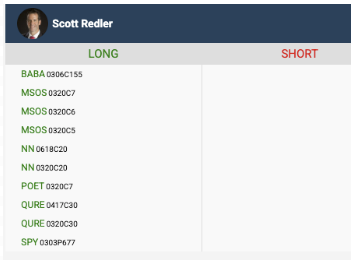
Right now, my open positions is at a multi-year low… normally I have 25+ positions open. Not right now.

Keep your sizing small…

I’ll know… and you will too know when to size up when my #1 indicator shows it. 

I’ve used this indicator for decades, including calling the crash of 2008 live on CNBC.

Grab the free gift from me sharing my top indicator… plus, it’ll get you access to my weekly watchlists as we navigate this choppy market.

Add this indicator to know when you can size up your positions, 

Scott Redler
Co-Founder of T3 Live & Editor of Power Plays

Disclosures
Scott Redler Positions Disclosure as of 2026-03-03 at 10.14.38 AM


Wednesday’s Featured Content

Amprius Stock Price Gets Amped by Hyper Growth Outlook

Written by Thomas Hughes. Published: 3/5/2026. 

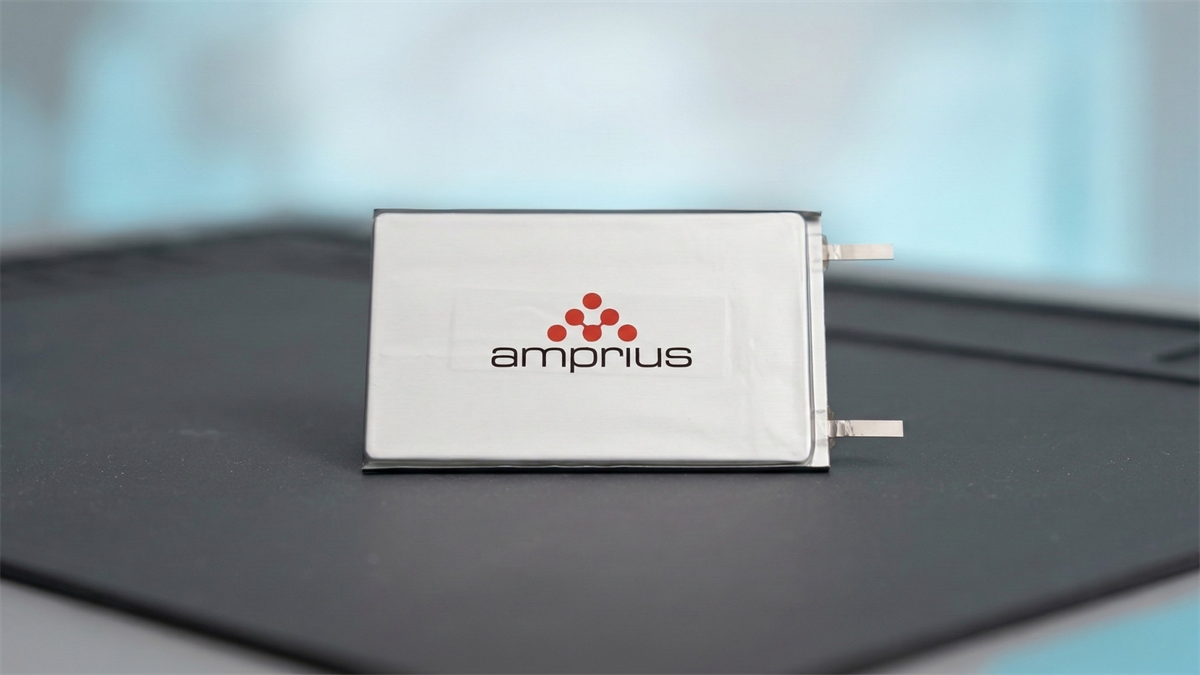
Amprius lithium battery pouch cell with the company logo on a silver casing resting on a dark surface in a lab setting.

Key Points

  • Amprius Technologies is on track for hypergrowth and outperformance in 2026 as manufacturing and demand trends collide.
  • Ramping production and full-NDAA compliance unlock the door to accelerating government demand.
  • AMPX batteries can disrupt the battery market, offering superior performance and energy density, enabling larger payloads and longer ranges.
  • Special Report: [Sponsorship-Ad-6-Format3]

It has taken time, but Amprius Technologies’ (NYSE: AMPX) strategy execution is starting to pay off, amplifying its hypergrowth outlook. Among the key takeaways from its Q4 2025 earnings report was better-than-expected guidance pointing to another year of solid gains.

Management expects revenue growth to slow, but still remain above a 70% year-over-year pace; the guidance also appears conservative.

Skip Headlines Straight to Original Research (Ad)

Our investment research analysts are going to be releasing their next investment idea tomorrow morning, around 10:00 AM Eastern time.Add yourself to the distribution list here.

Follow-on contracts, new customers, improved execution, an expanding manufacturing footprint, and full compliance with the National Defense Authorization Act (NDAA) position the company well.

Other details included a one-time charge related to the discontinued lease of a Colorado facility. Originally intended to serve as Amprius’ manufacturing base, the company has since shifted to a contract manufacturing model for its advancedbatteries, relying on third-party manufacturers.

The one-time charge clarifies the company’s obligations and improves cash-flow visibility as it strengthens its outsourced manufacturing base. Three South Korean battery manufacturers and one U.S.-based manufacturer were recently added to the network, putting the company on track for full NDAA compliance and accelerating government business this year. 

Amprius Accelerates its Profitability Outlook in 2026

Amprius Technologies reported an electrifying quarter: revenue rose more than 137% year-over-year (YOY), beating consensus by over 1,000 basis points (bps). Growth was driven by new and existing customers and strong execution, with client and contract wins pointing to continued momentum in 2026. 

Another catalyst was margin improvement. Gross margin widened by 4,500 bps to 24% (positive), driving a 365% YOY increase in gross profit (also positive) and the company’s first quarter of positive adjusted EBITDA.

The company is still burning cash, but losses contracted sharply and are expected to improve in coming quarters. Analysts currently forecast an inflection to adjusted profits in Q1 2027, though it could occur by the end of 2026; management is guiding toward positive adjusted EBITDA.

Analysts Point to 60% Upside Potential and Long-Term Highs

Analysts have been slow to update estimates after Amprius’ Q4 results, but the bullish trends leading into the report are likely to strengthen in its wake.

Data show coverage increasing to nine analysts on a trailing-twelve-month (TTM) basis, sentiment firming to Moderate Buy with an 88% buy-side bias, and price targets rising.

The consensus price target implies more than 30% upside from the pre-release closing price, while the high-end range — set by Northland Securities last year and reaffirmed by Needham in January — suggests an additional ~25% upside is possible. 

Institutional ownership offers another catalyst. Institutional interest remains light at roughly 5% as of early March, but the trend is strengthening. Institutional buying spiked in Q4 2025 and remained strong in Q1 2026, providing a tailwind for the stock.

This increase in ownership is noteworthy given the spike in short interest in late 2025 and early 2026, which set the market up for potential short-covering rallies or a short squeeze. 

No Red Flags in AMPX’s Balance Sheet: Green Flags in Its Price Action

Amprius’ balance sheet shows no red flags. The company is well-capitalized, reports net cash relative to total liabilities, and increased shareholders’ equity in 2025. Equity grew by nearly 50%, leaving leverage at ultra-low levels and positioning the company to continue executing its strategy.

Looking ahead, the cash balance may decline in coming quarters, but additional capital raises appear unlikely at this point. Without the need to build its own manufacturing capacity, management can focus on development, marketing, and sales — another factor suggesting potential outperformance in the year ahead. 

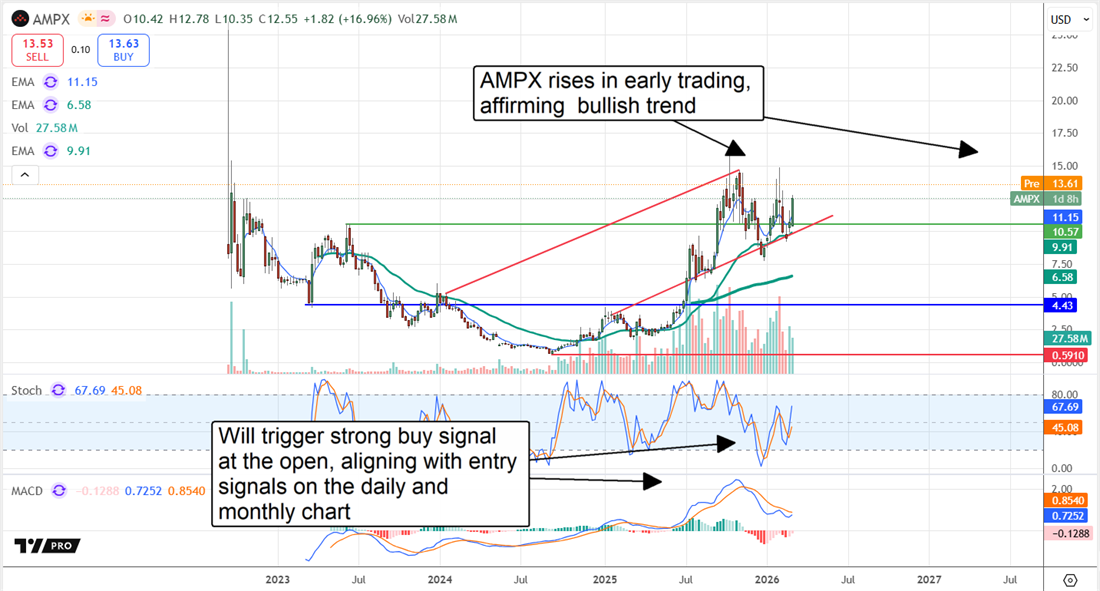
The stock’s price action also shows positive signals. Monthly, weekly, and daily charts converged with bullish indicators following the release. While periodic pullbacks are possible, those dips may present buying opportunities.

AMPX stock chart displaying bullish price action following the earnings release.

Long term, the stock may sustain upward momentum for many quarters — potentially several years — with technical projections suggesting a baseline target of $30.


This Month’s Bonus Content

Qualcomm’s Robotics Push Could Be Bigger Than the Market Thinks

Authored by Sam Quirke. First Published: 3/5/2026. 

Qualcomm branding on chip-themed graphic with Snapdragon processor.

Key Points

  • Qualcomm’s CEO flagged robotics as a major growth opportunity, projecting the segment will “start to get scale within the next two years.”
  • Analysts at Wells Fargo and Loop Capital recently upgraded the stock and raised price targets to $185, citing easing pressures and emerging growth drivers.
  • The chipmaker’s push into automotive, IoT, and edge AI is starting to show traction—robotics could become the next pillar of its diversification strategy.
  • Special Report: [Sponsorship-Ad-6-Format3]

Shares of Qualcomm Inc. (NASDAQ: QCOM) were trading just below $140 early in the week, down approximately 25% from their January high. While they had been under pressure since before Christmas, much of the recent decline followed weak forward guidance in the company’s latest earnings report.

The tech giant has posted modest gains since its early-February low, but the move looks more like consolidation than the start of a major comeback. For many investors, Qualcomm still carries the perception of being overly dependent on smartphones at a time when the broader semiconductor industry is being defined by data-center artificial intelligence demand.

Elon Musk already made me a “wealthy man” (Ad)

I Met Elon Musk “Face-to-Face” 

During a private gathering of Wall Street elites, I was one of two people selected to speak with Elon personally.

As a result, my research now leads me to believe Elon will announce the SpaceX IPO on this date:

March 26, 2026. Circle it on your calendar.

I’m sharing an “access code” that lets anyone grab a pre-IPO stake before it happens. This is your invitation to the biggest wealth-building event of the decade.Click Here to See how to Get Your “SpaceX Access Code”

Yet a new narrative may be quietly forming that challenges that assumption.

Qualcomm’s New Growth Story Beyond Smartphones

In comments earlier this week, Qualcomm’s CEO Cristiano Amon pointed to robotics as a major opportunity for the company’s next phase of growth. Speaking about the evolution of AI-enabled devices, Amon said he expects robotics to “start to get scale within the next two years.”

That remark may not seem revolutionary on its own, but it fits into a broader shift in Qualcomm’s strategy. The company has spent the past several years diversifying beyond smartphones, building new revenue streams in automotive chips, Internet of Things (IoT) devices, and edge AI computing. Robotics could become the next extension of that push.

Qualcomm has already introduced specialized processors designed for robotics systems, applying the same architecture principles that made its Snapdragon chips dominant in mobile devices. The idea is simple: robots, industrial machines, and autonomous systems require the low-power, high-performance computing Qualcomm provides. If robotics adoption accelerates over the next decade, that positioning could prove extremely valuable.

Why the Market Has Been Skeptical on QCOM

Despite the long-term opportunity, the market has remained cautious on Qualcomm—and for good reason. The company’s fortunes have historically been tied closely to smartphone demand, and the global handset market has struggled to regain momentum in recent years.

Weak guidance last month did Qualcomm no favors, reinforcing the perception that the company remains vulnerable to cyclical slowdowns in mobile devices. That narrative has weighed heavily on the stock, especially as investors pour capital into companies seen as clearer beneficiaries of the generative AI boom. The result has been persistent underperformance relative to many of its tech and semiconductor peers.

Analysts Are Starting to Shift Tone

The overall analyst consensus on Qualcomm remains a Hold, but recent commentary has become slightly more constructive. Wells Fargo lifted its rating from Underweight to Equal Weight last week, and Loop Capital went one step further by re-rating the stock to Buy. Both groups also raised their price targets to $185, implying more than 30% upside from current levels.

The view is that several of the pressures that weighed on Qualcomm in recent quarters are beginning to ease just as new growth opportunities are emerging. The company’s expanding data-center ambitions and its potential role in the AI inference market are additional reasons some analysts are more bullish heading into the rest of the year.

Those shifts may seem modest, but they matter because Qualcomm has spent much of the past year fighting a narrative that it’s been left behind in the AI race. If robotics, alongside automotive chips and edge AI platforms, begin contributing meaningfully to revenue growth, that narrative could change quickly.

A Diversification Strategy Taking Shape

Part of the reason analysts are becoming more constructive is that Qualcomm’s diversification strategy is starting to show tangible progress. The company expects its reliance on Apple Inc. (NASDAQ: AAPL) to decline over time while its other segments expand steadily.

At the same time, Qualcomm has been investing heavily in AI-related technologies, including acquisitions aimed at strengthening its presence in data centers and high-performance computing.

These initiatives point to a common objective: reducing Qualcomm’s dependence on smartphones and building a broader semiconductor platform story. Robotics, if Amon’s timeline proves accurate, could become the next pillar of that strategy.

Qualcomm Robotics Traction Could Shift Investor Sentiment

If Qualcomm begins demonstrating real traction in robotics over the coming quarters, investors may reassess the company’s long-term growth profile. For now, the stock’s behavior suggests the market is still waiting for proof. Qualcomm’s shares have stabilized since early February but have yet to mount a decisive recovery. That cautious price action reflects the tension between a weak near-term outlook and what could be a compelling long-term opportunity.

Investors should watch for the stock to consolidate around the $140 level or higher as confirmation that bulls are regaining control. A steady run of higher lows in the weeks ahead would go a long way toward confirming that the market is willing to back Qualcomm’s evolving growth story.

Thank you for subscribing to Earnings360, a morning newsletter that summarizes quarterly earnings for public companies that trade on U.S. markets.

This email communication is a paid advertisement for T3 Live, a third-party advertiser of Earnings360 and MarketBeat. 

If you need assistance with your account, please feel free to contact our South Dakota based support team at contact@marketbeat.com.

If you no longer wish to receive email from Earnings360, you can unsubscribe.

© 2006-2026 MarketBeat Media, LLC. All rights protected.
345 N Reid Place, Sixth Floor, Sioux Falls, S.D. 57103. USA..

Featured Link: An AI just scored 357 stocks. Here’s what it found. (Click to Opt-In)

💡 Earnings Highlights – Key Takeaways & Reports for March 10th

Earnings360 Home

UnsubscribeIran desperately needs THIS from America (ad)

Iran desperately needs THIS from America

Iran Desperately Needs This From America

Trump is about to cut Iran off at the knees. One tiny North Carolina town supplies 80% of the world’s most critical semiconductor material. Business Insider calls it “crucial to make chips that power everything from smartphones to data centers.” When Trump bans exports, Iran’s tech infrastructure crumbles — and every chipmaker on Earth is forced to relocate to U.S. soil. Morgan Stanley estimates the reshoring boom triggers a $10 trillion transformation. A handful of U.S. companies stand to capture most of it.

Full Details Here.Top Earnings NewsWall Street Lifts Targets on Five Below, Ulta Beauty and Nature’s Sunshine Ahead of Key Earnings ReportsWall Street Lifts Targets on Five Below, Ulta Beauty and Nature’s Sunshine Ahead of Key Earnings ReportsLast week’s stock pick was quite popular… (from MarketBeat Alerts)Wall Street Lifts Targets on Five Below, Ulta Beauty and Nature’s Sunshine Ahead of Key Earnings ReportsAeroVironment Likely To Report Higher Q3 Earnings; These Most Accurate Analysts Revise Forecasts Ahead Of Earnings CallAura Minerals Inc. (AUGO) Reports Record Gold Production Despite Q4 Earnings MissAura Minerals Inc. (AUGO) Reports Record Gold Production Despite Q4 Earnings MissNew signals detected in today’s scan. Access the report now (from Alpha Wire Daily)A Look At Guidewire Software’s (GWRE) Valuation After Earnings Beat And Upgraded GuidanceNIO Stock Jumps After Earnings. How the EV Maker Delivered a Surprise Profit.The Aging of America Could Make HCA Healthcare a Long-Term WinnerIs Iran Just a Giant Smokescreen? (ad)

What’s Behind Trump’s Iran Smokescreen?

The headlines scream about oil and regime change in the Middle East. But behind the scenes, President Trump is about to unleash something far more shocking in the homeland.

You won’t hear about it on Fox Business or CNBC.

But it’s about to have a seismic impact on the wealth of every American patriot.

It’s the boldest initiative of President Trump’s second term by far – and it’s not even close.

TO FIND OUT WHY, AND HOW IT COULD AFFECT YOUR FINANCIAL FUTURE – CLICK HERE IMMEDIATELY.

TUESDAY, MARCH 10 Today’s Earnings Announcements

CompanyCurrent PriceConsensus EPSActual EPSBeat/MissConsensus RevenueActual RevenueYoY Revenue GrowthReportABMABM Industries$41.32$0.87$0.83($0.04)$2.24 thousand$2.19 thousand6.1%CTOSCustom Truck One Source$5.72$0.07$0.09$0.02$528.18$584.761.4%KSSKohl’s$15.86$0.86$1.07$0.21$0.00$5.08 thousand-3.9%LEGNLegend Biotech$18.63($0.17)$0.01$0.18$306.30$310.2164.2%RAPPRapport Therapeutics$30.79($0.65)($0.72)($0.07)$0.00$0.00STGWStagwell$5.97$0.29$0.30$0.01$807.44$813.482.4%UNFIUnited Natural Foods$37.59$0.51$0.62$0.11$7.95 thousand$8.11 thousand-2.6%YALAYalla Group$6.63- $0.21- $83.86$0.00Iran Conflict Reveals Trump’s Most Powerful Weapon (ad)

Iran Conflict Reveals Trump's Most Powerful Weapon

Iran Conflict Reveals Trump’s Most Powerful Weapon

It’s not missiles. It’s not sanctions. It’s not tariffs. It’s a commodity found in the Appalachian Mountains. America controls 80% of the one material every enemy nation needs to build advanced technology — semiconductors, AI chips, military electronics. Trump is expected to weaponize this monopoly with an export ban that cuts off China and Iran overnight. Morgan Stanley estimates the reshoring boom triggers a $10 trillion transformation.

See The Full Story Here.

MONDAY, MARCH 9 Yesterday’s Earnings Announcements

CompanyCurrent PriceConsensus EPSActual EPSBeat/MissConsensus RevenueActual RevenueYoY Revenue GrowthReportBETABETA Technologies$20.80($0.47)($2.02)($1.55)$11.13$6.69152.3%CASYCasey’s General Stores$675.05$2.94$3.49$0.55$3.92 thousand$4.08 thousand.3%CNSWFConstellation Software$2,157.53$29.20$24.64($4.56)$3.18 thousand$3.15 thousandDNTHDianthus Therapeutics$82.16($0.97)($1.43)($0.46)$0.57$0.40DRVNDriven Brands$10.28$0.29$0.30$0.01$457.33$459.50HPEHewlett Packard Enterprise$21.90$0.59$0.65$0.06$9.30 thousand$9.31 thousand18.4%KFYKorn/Ferry International$62.46$1.22$1.28$0.06$725.04$692.457.2%LULufax$2.39($0.03)($0.22)($0.19)$724.89$761.36MTNVail Resorts$133.68$6.06$5.87($0.19)$1.08 thousand$1.11 thousand-4.7%SBETSharplink Gaming$7.54($0.05)$0.06$0.11$13.31$17.19SEPNSepterna$28.15($0.23)($0.24)($0.01)$24.12$20.44VOYGVoyager Technologies$28.64($0.36)($0.37)($0.01)$46.65$0.0023.7%ZIMZIM Integrated Shipping Services$28.78($1.01)$0.32$1.33$1.48 thousand$1.54 thousandNew signals detected in today’s scan. Access the report now (ad)

The Quiet Setup That’s Easy to Miss

See Where Early Market Signals Are Forming

Alpha Wire Daily tracks developing activity across small caps—where subtle shifts begin to take shape. These are often the setups that appear before broader attention builds.

GET FREE ALERTS — STAY AHEAD OF THE SIGNALS

Upcoming Earnings Reports

CompanyRelease DateRelease TimeEDITEditas Medicine3/11/2026MorningGPRKGeopark3/11/2026MorningCPBCampbell’s3/11/2026MorningVELVelocity Financial3/11/2026AfternoonDSPViant Technology3/11/2026AfternoonCGEMCullinan Therapeutics3/12/2026MorningLPCNLipocine3/12/2026MorningALEXAlexander & Baldwin3/12/2026MorningGDOTGreen Dot3/12/2026AfternoonOFRMOnce Upon A Farm3/12/2026AfternoonSSentinelOne3/12/2026AfternoonEEXEmerald3/13/2026Morning

MarketBeat Earnings Tools

Earnings360 Home

Thank you for subscribing to Earnings360, a morning newsletter that summarizes quarterly earnings for public companies that trade on U.S. markets.

If you need help with your newsletter, please feel free to contact MarketBeat’s South Dakota based support team at contact@marketbeat.com.

Unsubscribe

Copyright 2006-2026 MarketBeat Media, LLC. All rights reserved.
345 North Reid Place, Sixth Floor, Sioux Falls, S.D. 57103. USA..

Today’s Bonus Content: Iran desperately needs THIS from America (From Banyan Hill Publishing)

All eyes are on Trump’s next move.

Week Ending March 13th, 2026

Tuesday’s Market Moves

S&P 500 – 6,781.48 (-0.21%)

Dow Jones – 47,706.51 (-0.072%)

NASDAQ – 22,697.10 (+0.0051%)

Weekly Recap

OIL & MIDDLE EAST DEVELOPMENTS: During Monday’s session, oil briefly spiked above $100 per barrel before retreating after comments from Donald Trump suggested the conflict in Iran may be nearing an end, sparking a late-day rally in U.S. equities. Secretary of Energy Chris Wright claimed on social media that the U.S. Navy had successfully escorted a tanker through the Strait of Hormuz, though the post was later removed and the White House denied the statement. Investors closely monitored developments in the Middle East, with G7 ministers meeting on Tuesday to discuss a potential coordinated release of oil from strategic reserves after failing to reach agreement on Monday. Saudi Aramco CEO Amin Nasser warned that further disruptions to global energy supply could prove “catastrophic” as tensions continue to escalate.

INTERNATIONAL MARKETS: Overseas, Asian markets moved sharply higher overnight amid optimism over a potential near-term de-escalation. Japan’s Nikkei 225 rose nearly 3%, while Korea’s KOSPI Composite Index gained more than 5%. European markets also traded higher, supported by the pullback in oil prices. Despite recent gains, Japan’s Nikkei 225 is down nearly 8% month-to-date, Korea’s KOSPI has fallen more than 11%, and the EURO STOXX 50 is down over 5%. Bond yields edged up, with the 10-year U.S. Treasury yield starting the day around 4.12%, while gold advanced as the dollar weakened, with traders assessing the outlook for potential monetary easing.

CORPORATE EARNINGS & MOVERS: 

  • Hewlett Packard Enterprise (HPE) slipped despite reporting quarterly earnings that topped expectations, while its forward guidance largely matched analyst forecasts. 
  • Shares of Hims & Hers Health (HIMS) surged 41% after reports that Novo Nordisk will distribute its weight-loss medications through the company’s platform. 
  • Centene (CNC) fell as membership in some Affordable Care Act plans declined.
  • CrowdStrike (CRWD) gained after a Morgan Stanley upgrade to “overweight.”
  • Qualcomm (QCOM) dropped on a BofA Securities “underperform” rating. 
  • Kohl’s (KSS) declined after missing quarterly revenue expectations, while cruise line stocks recovered from last week’s declines. 
  • Gap Inc. (GAP) extended earnings-related losses.
  • Rivian Automotive (RIVN) climbed following a TD Cowen upgrade and optimistic sales projections for its upcoming R2 SUV. 
  • Defense contractors Lockheed Martin (LMT) and Northrop Grumman (NOC) fell after Trump comments suggested the conflict could soon end. 
  • Bitcoin rose modestly but remained below $70,000.

MARKET HIGHLIGHTS & ECONOMIC NEWS: 

  • U.S. equity markets traded slightly higher on Tuesday, with oil prices holding just under $90 per barrel. 
  • Existing home sales unexpectedly rose in February as lower mortgage rates improved affordability, though limited housing supply and geopolitical risks could slow recovery. 
  • In legal news, a federal judge temporarily blocked Perplexity AI from scraping Amazon’s website, marking a key development in AI data-access disputes. 
  • In corporate and tech moves, Meta Platforms acquired AI-agent social network Moltbook.
  • Google expanded its Pentagon AI partnership with new agent tools.
  • Nvidia made a major investment in Mira Murati’s Thinking Machines Lab to advance AI systems using Nvidia computing infrastructure.

_____________________________________________________________

“Buy land. They’re not making it anymore.”
— Mark Twain

_____________________________________________________________

Notable Stocks

  • Nvidia (NVDA)
  • CrowdStrike (CRWD)
  • Hewlett Packard Enterprise (HPE)
  • Centene (CNC)
  • Qualcomm (QCOM)

Weekly Notables

U.S. Existing Home Sales Rise as Lower Mortgage Rates Improve Affordability

U.S. existing home sales unexpectedly increased in February as declining mortgage rates and slower home-price growth brought buyers back into the market. However, limited housing supply could still restrain activity during the upcoming spring selling season. The report from the National Association of Realtors suggested early signs of improvement in the housing market, with affordability gradually strengthening. Notably, the share of first-time homebuyers reached its highest level in five years, highlighting renewed participation among new entrants to the housing market. Housing affordability has also become a key political issue ahead of the November midterm elections.

Google Expands Pentagon AI Partnership with New Military Agent Tools

Google is expanding its partnership with the U.S. military by introducing new tools that allow Pentagon personnel to build custom AI assistants for everyday administrative work. The move deepens the company’s role in defense technology at a time when the government is facing legal challenges from other AI firms over access to military systems. Google announced Tuesday that civilian and military staff will soon be able to create personalized AI agents through the Pentagon’s enterprise AI portal, GenAI.mil. The platform will provide access to a new tool called Agent Designer, enabling users across the Department of Defense to build digital assistants without requiring advanced programming skills.

Earnings Spotlight: Adobe (ADBE)

Adobe (ADBE) is set to report fiscal first-quarter 2026 results after the market closes on March 12, 2026. Analysts expect earnings of about $5.87 per share and revenue near $6.275 billion for the quarter, implying mid-single-digit top-line growth from a year earlier. Street estimates point to continued strength in subscription revenue, with analysts penciling in roughly $6.09 billion for the services that underpin Adobe’s recurring-revenue model. 

What’s Ahead

Inflation and its implications for monetary policy will be a central focus for investors this week. February consumer price index (CPI) data is due today, followed by personal consumption expenditures (PCE) data on Friday. Economists expect both headline and core CPI to rise 2.5% year over year, while headline and core PCE are projected to increase 2.9%. 

March 11: February CPI and core CPI and expected earnings from Campbell’s (CPB).
 

March 12: January factory orders, January housing starts and building permits, and expected earnings from Dollar General (DG), Dick’s Sporting Goods (DKS), Adobe (ADBE), and Lennar (LEN).
 

March 13: January PCE, Q4 GDP second estimate, University of Michigan preliminary March Consumer Sentiment, and January Job Openings and Labor Turnover Survey (JOLTS).
 

March 16: February industrial production, and expected earnings from Dollar Tree (DLTR).
 

March 17: Expected earnings from lululemon (LULU) and DocuSign (DOCU).

Disclaimer: We are engaged in the business of advertising and promoting companies. All content on our website is for informational purposes only and should not be construed as an offer or solicitation of an offer to buy or sell securities. Neither the information presented nor any statement or expression of opinion, or any other matter herein, directly or indirectly constitutes a solicitation of the purchase or sale of any securities. Neither the owner of Trading Wire nor any of its members, officers, directors, contractors or employees are licensed broker-dealers, account representatives, market makers, investment bankers, investment advisers, analyst or underwriters. Investing in securities, including the securities of those companies profiled or discussed on this website is for individuals tolerant of high risks. Viewers should always consult with a licensed securities professional before purchasing or selling any securities of companies profiled or discussed on Trading Wire. It is possible that a viewer’s entire investment may be lost or impaired due to the speculative nature of the companies profiled. Remember, never invest in any security of a company profiled or discussed on this website unless you can afford to lose your entire investment. Also, investing in micro-cap securities is highly speculative and carries an extremely high degree of risk. Trading Wire makes no recommendation that the securities of the companies profiled or discussed on this website should be purchased, sold or held by viewers that learn of the profiled companies through our website. 

Some of the content on this website contains “forward-looking statements.” Such statements may be preceded by the words “intends,” “may,” “will,” “plans,” “expects,” “anticipates,” “projects,” “predicts,” “estimates,” “aims,” “believes,” “hopes,” “potential,” or similar words. Forward-looking statements are not guarantees of future performance, are based on certain assumptions, and are subject to various known and unknown risks and uncertainties, many of which may be beyond a company’s control, and cannot be predicted or quantified, and, consequently, actual results may differ materially from those expressed or implied by such forward-looking statements. It is hereby noted that forward-looking statements contained herein may include everything other than historical information, involve risk and uncertainties that may affect a company’s actual results of operation. A company’s actual performance could greatly differ from those described in any forward-looking statements or announcements mentioned on this website or the websites contained within. Factors that should be considered that could cause actual results to differ include: the size and growth of the market for the company’s products; the company’s ability to fund its capital requirements in the near term and in the long term; pricing pressures; unforeseen and/or unexpected circumstances in happenings; etc. and the risk factors and other factors set forth in the company’s filings with the Securities and Exchange Commission. However, a company’s past performance does not guarantee future results. 

Generally, the information regarding a company profiled or discussed on this website is provided from public sources tradingwire.com makes no representations, warranties or guarantees as to the accuracy or completeness of the information provided or discussed. Viewers should not rely solely on the information obtained through our website or in communications originating from our website. Viewers should use the information provided by us regarding the profiled companies as a starting point for additional independent research on the companies profiled or discussed in order to allow the viewer to form his or her own opinion regarding investing in the securities of such companies. Factual statements, or the similar, made by the profiled companies are made as of the date stated and are subject to change without notice and Trading Wire has no obligation to update any of the information provided. Trading Wire, its owners, officers, directors, contractors and employees are not responsible for errors and omissions. 

From time to time certain content on this website is written and published by our employees or third parties. In addition to information about our profiled companies, from time to time, our website will contain the symbols of companies and/or news feeds about companies that are not being profiled by us but are merely illustrative of certain activity in the micro cap or penny stock market that we are highlighting. Viewers are advised that all analysis reports and news feeds are issued solely for informational purposes. Any opinions expressed are subject to change without notice. It is also possible that one or more of the companies discussed or profiled on this website may not have approved certain or any statements within the website. Trading Wire encourages viewers to supplement the information obtained from this website with independent research and other professional advice. The content on this website is based on sources which we believe to be reliable but is not guaranteed by us as being accurate and does not purport to be a complete statement or summary of the available data. Third Party Web Sites and Other Information This website may provide hyperlinks to third party websites or access to third party content.Trading Wire, its owners, officers, directors, contractors and employees are not responsible for errors and omissions nor does Trading Wire control, endorse, or guarantee any content found in such sites. Trading Wire does not control, endorse, or guarantee content found in such sites. By accessing, viewing, or using the website or communications originating from the website, you agree that Trading Wire, its owners, officers, directors, contractors and employees, are not responsible for any content, associated links, resources, or services associated with a third party website. You further agree that Trading Wire, its owners, officers, directors, contractors and employees shall not be liable for any loss or damage of any sort associated with your use of third party content. Links and access to these sites are provided for your convenience only. Trading Wire uses third parties to disseminate information to subscribers. Although we take precautions to prevent others from obtaining our subscriber list, there is a risk that our subscriber list, through no wrong doing on our part, could end up in the hands of an unauthorized party and that subscribers will receive communications from unauthorized third parties. We encourage viewers to invest carefully and read the investor issuer information available at the web sites of the United States Securities and Exchange Commission (SEC). The SEC has launched an investor-focused website to help you invest wisely and avoid fraud at www.investor.gov and filings made by public companies can be viewed at www.sec.gov and/or the Financial Industry Regulatory Authority (FINRA) at: www.finra.org. In addition, FINRA has published information at its website on how to invest carefully at www.finra.org/Investors/index.htm. 


1389 Center Dr
Park City UT 84098
US

Unsubscribe   |   Change Subscriber Options

The SpaceX “Backdoor”

In the early 2000s, after Elon co-founded PayPal… just $1,000 invested would’ve turned into $16,500 at its peak.

In 2016, Elon started Neuralink… even latecomers who waited until 2021 watched $1,000 grow to nearly $5,000 at its peak.

In 2023, Elon launched xAI… in just one year, a $1,000 investment would’ve transformed into nearly $10,000 at its peak.

Now, Elon is just days away from taking his newest venture to the next level…

And I’ve figured out a way for practically anyone to get in on it with just $100.

Discover the full details here.

Sincerely,
Tim Bohen


More Reading from MarketBeat

GitLab Sell-Off Overdone: AI and Cash Flow Signal a Rebound

Author: Thomas Hughes. Date Posted: 3/4/2026. 

Modern GitLab office interior with large wall-mounted GitLab logo sign in a sleek workspace, representing AI-driven software development and DevOps industry growth.

Key Points

  • GitLab is well-positioned for the age of AI inference, as it enables superior outcomes at all stages of the software development lifecycle.
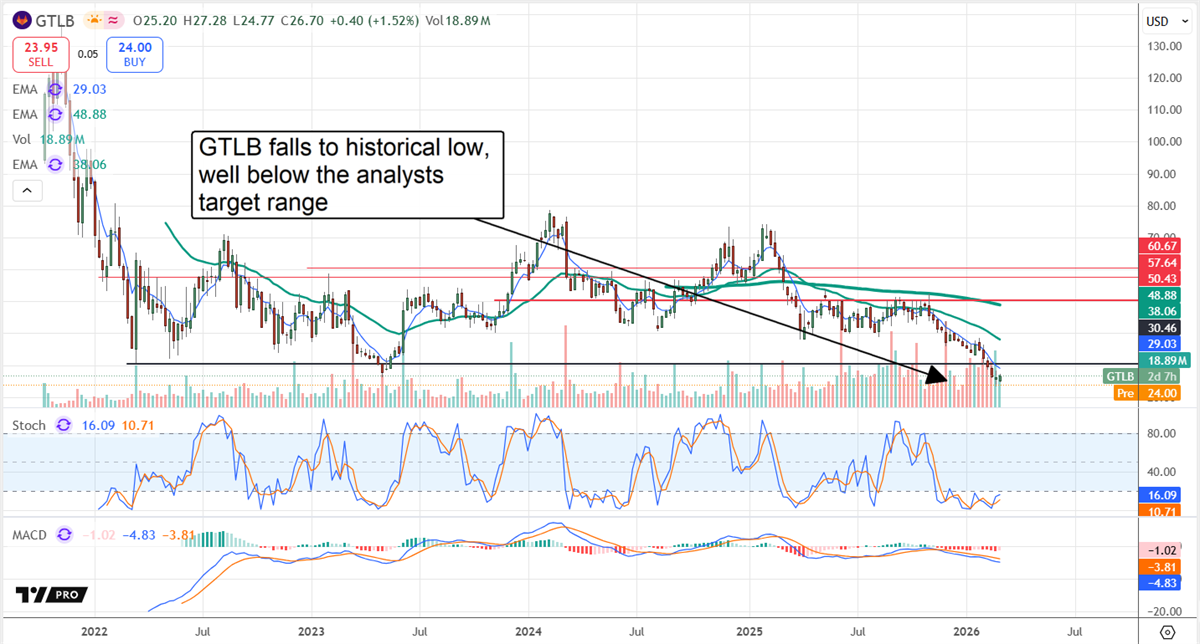
  • Tepid guidance and a weak analyst response sent shares to long-term lows, where institutions are likely to buy.
  • Cash flow is king in 2026, and GitLab has it, as evidenced by its inaugural $400 million share buyback authorization.
  • Special Report: [Sponsorship-Ad-6-Format3]

Fears of slowing growth and AI disruption drove GitLab (NASDAQ: GTLB) shares to long-term lows in early March. That sell-off—overdone from the start—has pushed the stock into ultra-deep value territory, creating an attractive buying opportunity.

While AI-related worries have clouded the near-term outlook, the company continues to grow and is well-positioned for the AI inference era. Its platform and newer products embed AI functionality across the software lifecycle, improving efficiency and outcomes while maintaining security, compliance, and governance.

Skip Headlines Straight to Original Research (Ad)

Our investment research analysts are going to be releasing their next investment idea tomorrow morning, around 10:00 AM Eastern time.Add yourself to the distribution list here.

Evidence of this positioning—and of a healthy outlook—appears in its cash flow and balance sheet, which supported an authorized share buyback. The company is cash-flow positive despite aggressive investment, expects improving cash flows, and plans to spend up to $400 million on repurchases.

That buyback represents roughly 10% of the post-release market cap, strengthening an already solid support base. Investors can reasonably expect GitLab to repurchase shares on price pullbacks, such as the early-March dip to record-low levels.

The balance sheet highlights a strong and strengthening capital position and improving shareholder value. At fiscal year-end, current assets rose across categories, with cash and equivalents well above liabilities. The company has no long-term debt, total liabilities are below equity, and equity increased about 27% for the year.

Valuation, Institutions, and Analysts Point to GTLB’s Robust Upside Potential

GitLab’s shares could double from their March lows based on consensus earnings estimates alone. Forecasts imply a high-teens to low-20s% compound annual growth rate (CAGR) through the middle of the next decade, placing the stock near 10x its 2035 consensus. In one scenario, the shares could rise at least 100% to align with broad market averages, or 200%+ to approach the multiples of established blue-chip tech peers.

Further evidence of GitLab’s value comes from institutional and analyst trends. Institutional investors, including public and private funds, own roughly 95% of the stock and have been net buyers.

MarketBeat data show institutions have been buying on balance for 13 consecutive quarters, with buying activity accelerating in 2025 and again in early 2026.

That creates a strong support base likely to remain a tailwind for the shares once a rebound gains traction.

Analysts reacted cautiously to GitLab’s fiscal Q4 2026 earnings report, but that response came against a high bar. MarketBeat tracked six revisions within 12 hours of the release: one downgrade, five price-target cuts, and one affirmation. Overall sentiment was only modestly affected.

Those six actions still imply a stance stronger than a broad Moderate Buy consensus; the price targets, while trimmed at the low end, average just below the broader consensus and imply roughly 65% upside.

GTLB stock chart displaying share price at a historical low, well below analyst consensus.

GitLab Offers Mixed Guidance After Strong Report

GitLab delivered a solid fiscal year 2026 (FY2026) and Q4. The company reported $260.4 million in net revenue, up about 23.2% year-over-year and 320 basis points above consensus. Strength was driven by larger customers: revenue from large customers rose roughly 18% and from mega-sized customers about 26%, with an 8% increase across the broader customer base.

Net retention rate (NRR) was strong at 118%, and forward-looking remaining performance obligation (RPO) grew meaningfully—up 24% on a current-currency basis and 20% on a reported basis—suggesting durable growth ahead.

Margin dynamics were mixed but generally positive. Gross margin contracted by 200 basis points, but improvements in operating efficiency offset that impact. Adjusted operating marginexpanded by 300 basis points, helping drive a 42.8% increase in operating income. Higher spending did reduce adjusted EPS and free cash flow year over year; however, adjusted EPS of $0.30 beat estimates by $0.07, which undercuts a sell-the-news narrative.

Guidance was mixed: revenue guidance slightly missed consensus, while earnings guidance looked strong. The company expects more than 17% revenue growth this year and wider margins; management’s guidance for adjusted earnings was above consensus (and may be conservative). GitLab outlined five initiatives to drive growth, including expanding its go-to-market presence, accelerating client acquisition, optimizing pricing and packaging, executing its AI strategy, and other operational improvements.


Additional Reading from MarketBeat Media

These 3 Cash Flow Machines Provide Stability in Uncertain Markets

Reported by Nathan Reiff. Article Posted: 3/6/2026. 

A winding path of U.S. dollar bills leading toward a city skyline, symbolizing strong free cash flow and financial growth.

Key Points

  • Cash flow generation is a key attribute of stable companies, allowing them flexibility to not only maintain operations but also to grow and to return value to shareholders via dividends or buybacks.
  • Gilead Sciences and AbbVie are two large biopharma firms with a compelling history of cash flow generation, helping to facilitate continued R&D and pipeline development, among other things.
  • Visa converts about half or more of its revenue to free cash flow, capitalizing on its high-margin business to facilitate growth and dividend payments.
  • Special Report: [Sponsorship-Ad-6-Format3]

When companies face difficult markets, cash flow becomes a critical factor in determining their ability to survive. If a firm cannot meet its near-term obligations with the cash it has on hand, it risks serious trouble. Equally important, strong cash flow enables longer-term planning—everything from expansion and acquisitions to strategic returns of capital to shareholders.

Cash flow is only one metric among many, but it may be particularly important for investors seeking companies that can remain steady amid broad market uncertainty in 2026. The three companies below are household names and major industry players that also have strong cash-flow histories to support their plans for continued growth.

Strong Free Cash Flow Yield and Commitment to Returning Value to Investors

Elon Musk already made me a “wealthy man” (Ad)

I Met Elon Musk “Face-to-Face” 

During a private gathering of Wall Street elites, I was one of two people selected to speak with Elon personally.

As a result, my research now leads me to believe Elon will announce the SpaceX IPO on this date:

March 26, 2026. Circle it on your calendar.

I’m sharing an “access code” that lets anyone grab a pre-IPO stake before it happens. This is your invitation to the biggest wealth-building event of the decade.Click Here to See how to Get Your “SpaceX Access Code”

Anchored by top-selling drugs for COVID-19, HIV, certain cancers and more, Gilead Sciences Inc. (NASDAQ: GILD) is one of the largest biopharma firms available to investors. The company generates compelling free cash flow relative to its share price—its free cash flow yield is around 6%.

Even better for investors, Gilead has committed to returning at least half of its free cash flow each year to shareholders. In 2025, including its dividend distributions, Gilead returned 63% of its annual free cash flow to stockholders.

Despite its scale and established position, Gilead has continued to grow. In Q4 2025, it beat analyst expectations for both earnings per share and revenue, propelled by legacy products and a robust pipeline. In 2026 the company expects at least four major commercial rollouts of new products, which should help diversify its revenue mix.

Gilead faces significant competition—especially in oncology, where some investors would like to see a larger contribution to total sales—but a large majority of Wall Street analysts have bullish ratings on GILD shares. Analysts also see roughly 6% upside potential even after the stock’s more than 28% rise over the past year.

Massive Dividend Growth Made Possible By Solid Cash Generation Power

Another major biopharma name, AbbVie (NYSE: ABBV), posts a free cash flow yield above 5%, which is strong for a company of its size and sector. While AbbVie operates across many therapeutic areas, one of its most compelling attractions for investors is its dividend.

AbbVie has a dividend yield that sits around 2.9%and has more than quadrupled its dividend distributions since the company’s spin-off in 2013.

Although the company reports a high dividend payout ratio—about 293%—which could concern some investors, that payout is underpinned by robust free cash flow. In 2025, for example, AbbVie generated nearly $18 billion in free cash flow while distributing roughly $11.7 billion in total dividends.

The company has demonstrated continued momentum, beating Wall Street expectations for both earnings and revenue in Q4 2025 and providing higher guidance at the time. Much of this growth has been driven by two leading drugs, Skyrizi and Rinvoq, and AbbVie continues to invest heavily in R&D to expand its pipeline.

Excellent Cash Generation Capacity Amid Consumer Resilience

Payments giant Visa Inc. (NYSE: V) operates a high-margin business that generates substantial free cash flow, often converting roughly half of its revenue into free cash flow each quarter. With strong top-line performance—a 14.6% year-over-year revenue improvement in the latest period, for example—Visa is a reliable cash machine for many investors.

Despite macroeconomic headwinds such as tariffs and inflation, Visa’s payments volume and processed transactions continue to rise, reflecting resilient consumer spending. That strength has allowed Visa to increase its dividend while maintaining a manageable payout ratio; the company currently offers a yield of 0.83% with a payout ratio near 25.1%. It’s no surprise that analysts view Visa as a solid Buy, forecasting roughly 22% upside potential going forward.

Thank you for subscribing to DividendStocks.com’s daily newsletter for dividend and income investors that covers ex-dividend stocks, new dividend declarations, dividend stock ideas, and the latest market news.

This message is a sponsored email sent on behalf of Timothy Sykes, a third-party advertiser of DividendStocks.com and MarketBeat. 

If you have questions or concerns about your newsletter, please feel free to email our South Dakota based support team at contact@marketbeat.com.

If you no longer wish to receive email from DividendStocks.com, you can unsubscribe.

© 2006-2026 MarketBeat Media, LLC. All rights protected.
345 N Reid Place, Suite 620, Sioux Falls, South Dakota 57103-7078. United States of America..

Featured Link: An AI just scored 357 stocks. Here’s what it found. (Click to Opt-In)
Broad Holdings Fuel DGRO’s Edge Over Dividend Peers

Earnings360

Unsubscribe

Two AI Stocks Getting Quiet Attention(From Darwin)


Quiet Outperformance From an Overlooked Dividend ETF

Written by Nathan Reiff on March 9, 2026 

Coins stacked in soil beside a thriving plant, symbolizing dividend growth investing and long-term ETF income.

Key Points

  • With nearly 20% in returns in the last year and more than 5% year-to-date, DGRO is an ETF providing growth potential as well as strong dividend opportunities.
  • The fund’s strategy stands out for its emphasis on dividend growth history, helping to ensure that it avoids dividend yield traps and rewards companies with stability and healthy cash flow.
  • DGRO provides broad exposure to nearly 400 names across many sectors and industries, with an emphasis on financials, health care, and information technology stocks.
  • Special ReportHave $500? Invest in Elon’s AI Masterplan (From Brownstone Research)

When it comes to dividend stocks, it’s easy to be tempted by companies based on a ranking of the highest dividend yields. After all, dividend yield is a direct measure of the cash payout a company provides for investors relative to its price, and the higher the yield the more enticing the distribution is, right? In actuality, there are other factors to consider when selecting dividend names, and investors attuned to the history of a dividend’s growth—or lack thereof—may end up identifying more stable and successful investments.

Still, close monitoring of a potential dividend investment’s history of payouts and growth can be difficult to manage for investors looking to trade quickly, and there always exists the risk that a company will face unexpected challenges and have to make cuts to its distributions. To diversify dividend investments, it may help to consider a dividend-focused exchange-traded fund (ETF), which not only holds a larger group of dividend-paying companies but also does the work of selecting and balancing the portfolio. For a broad view of the potent dividend growth space, consider the iShares Core Dividend Growth ETF (NYSEARCA: DGRO).

3 tickers just showed unusual early patterns. See the Trading Ideas report now. (Ad)

Spot the Signals Before They Become Obvious

We track early shifts in volume, structure, and emerging trends as they begin to form.

Trading Ideas focuses on data patterns that often develop before broader visibility.Join Free — Start Seeing the Data Early

Why DGRO’s Angle on Dividend Stocks Stands Out

DGRO is a passively managed fund tracking the Morningstar US Dividend Growth Index, which targets U.S. equities that have both a history of dividend growth and the potential to sustain that growth going forward.

It does this by identifying (from a broader pool of U.S. stocks) companies that have at least five years of uninterrupted growth to their annual dividends, with an earnings payout ratio below 75%.

Interestingly, DGRO’s index excludes companies in the top 10% of dividend yield before screening for dividend growth and payout ratio, perhaps a bid to avoid companies that falsely present a strong dividend case but are actually in trouble because their share price has collapsed.

In the end, DGRO holds roughly 400 positions in a set of companies broadly diversified by market capitalization and sector. The fund does lean toward financials stocks, health care names, and companies representing the information technology sector—together, these three categories represent about half of the total portfolio.

DGRO’s Performance, Portfolio, and Prospects Set It Apart

In the last year, DGRO has returned about 13%, a standout in the dividend space, where companies most commonly deliver value to shareholders via disbursements, not share appreciation. Even as the broader S&P 500 has remained in negative territory to begin 2026, DGRO has returned more than 2% year-to-date (YTD). Of course, investors can also expect a strong dividend from the fund, with a yield of nearly 2% in early March.

Looking more closely at DGRO’s portfolio, the fund takes a fairly broad view by not assigning any single position a very high portfolio weighting. Exxon Mobil Corp. (NYSE: XOM), the massive energy firm and dividend aristocrat with a yield of 2.7% and a history of regular increases to payouts going back more than four decades, is the largest position, but it only occupies 3.6% of the portfolio. While most of the largest positions in DGRO’s basket are indeed well-known dividend stocks, it also contains lesser-known firms for added diversification.

Big-name dividend plays are not necessarily a bad thing, as the emphasis on dividend growth can help to ensure that the companies DGRO holds are likely to be stable even during broader market upheaval. A brief look at some of the other top holdings finds solid dividend stalwarts like Johnson & Johnson (NYSE: JNJ)AbbVie Inc. (NYSE: ABBV), and Apple Inc. (NASDAQ: AAPL).

For an annual fee of 0.08%, DGRO is not the absolute cheapest dividend fund on the market—the massive Vanguard Dividend Appreciation ETF (NYSEARCA: VIG) with over $100 billion in assets under management (AUM) is an example of an alternative that comes in below that rate, with an expense ratio of 0.04%. However, DGRO has beaten VIG on both overall returns and dividend yield in recent periods. DGRO is a smaller fund with just about $39 billion in AUM, but its one-month average trading volume of 2.3 million eclipses its larger rival as well.

To be sure, there are plenty of other dividend ETFs available for investors looking to set up a passive income stream with minimal investment action, and investors would do well to consider multiple options before making a selection. 

Read this article online ›

Further Reading

MarketBeat All Access is the premier all-in-one stock research solution that helps you identify the best stocks, monitor your portfolio, and keep track of the market.

Did you find this article useful?

I liked this article.
I did not like this article.

Thank you for subscribing to Earnings360, a morning newsletter that summarizes quarterly earnings for public companies that trade on U.S. markets.

If you need assistance with your newsletter, please feel free to email our U.S. based support team at contact@marketbeat.com.

If you no longer wish to receive email from Earnings360, you can unsubscribe.

© 2006-2026 MarketBeat Media, LLC. All rights protected.
345 N Reid Place, Sixth Floor, Sioux Falls, S.D. 57103-7078. U.S.A..

See Also: This might just be my most explosive reveal in years! (Click to Opt-In)

IT PASSED! Churchgoers Celebrate After Lawmakers…

DCN Logo

IT PASSED! Churchgoers Celebrate After Lawmakers…

Shock Biblical Discovery – Experts Confirm It

BREAKING: Bishop ARRESTED – He Was Caught With…

He’s Been ARRESTED – He Denied Everything… Christians In Shock


Daily Christian News

Affiliated with American Digest Media
539 W. Commerce St #1610
Dallas, TX 75208 DCN1
United States

UNSUBSCRIBE

This email was sent to PETER.HOVIS@GMAIL.COM
why did I get this?unsubscribe from this listupdate subscription preferences
Daily Christian News · 1328 Highpoint Way · Roanoke, TX 76262 · USA

DGRO’s Dividend Growth Drives Nearly 20% Returns

Earnings360

Unsubscribe

No AI Bots. Just Real Signals. (From Market Pulse Today)


Quiet Outperformance From an Overlooked Dividend ETF

Written by Nathan Reiff on March 9, 2026 

Coins stacked in soil beside a thriving plant, symbolizing dividend growth investing and long-term ETF income.

Key Points

  • With nearly 20% in returns in the last year and more than 5% year-to-date, DGRO is an ETF providing growth potential as well as strong dividend opportunities.
  • The fund’s strategy stands out for its emphasis on dividend growth history, helping to ensure that it avoids dividend yield traps and rewards companies with stability and healthy cash flow.
  • DGRO provides broad exposure to nearly 400 names across many sectors and industries, with an emphasis on financials, health care, and information technology stocks.
  • Special ReportThe Market Reset Is Coming—Here’s How to Read It Early(From Krypton Street)

When it comes to dividend stocks, it’s easy to be tempted by companies based on a ranking of the highest dividend yields. After all, dividend yield is a direct measure of the cash payout a company provides for investors relative to its price, and the higher the yield the more enticing the distribution is, right? In actuality, there are other factors to consider when selecting dividend names, and investors attuned to the history of a dividend’s growth—or lack thereof—may end up identifying more stable and successful investments.

Still, close monitoring of a potential dividend investment’s history of payouts and growth can be difficult to manage for investors looking to trade quickly, and there always exists the risk that a company will face unexpected challenges and have to make cuts to its distributions. To diversify dividend investments, it may help to consider a dividend-focused exchange-traded fund (ETF), which not only holds a larger group of dividend-paying companies but also does the work of selecting and balancing the portfolio. For a broad view of the potent dividend growth space, consider the iShares Core Dividend Growth ETF (NYSEARCA: DGRO).

Before Tomorrow’s Open: 3 Quiet Setups You Should Review (Ad)

Street Ideas highlights early activity in small-cap names before they show up on mainstream radars. Stay ahead of the noise with alerts focused on real momentum, not hype.Get Early Access — Join Free

Why DGRO’s Angle on Dividend Stocks Stands Out

DGRO is a passively managed fund tracking the Morningstar US Dividend Growth Index, which targets U.S. equities that have both a history of dividend growth and the potential to sustain that growth going forward.

It does this by identifying (from a broader pool of U.S. stocks) companies that have at least five years of uninterrupted growth to their annual dividends, with an earnings payout ratio below 75%.

Interestingly, DGRO’s index excludes companies in the top 10% of dividend yield before screening for dividend growth and payout ratio, perhaps a bid to avoid companies that falsely present a strong dividend case but are actually in trouble because their share price has collapsed.

In the end, DGRO holds roughly 400 positions in a set of companies broadly diversified by market capitalization and sector. The fund does lean toward financials stocks, health care names, and companies representing the information technology sector—together, these three categories represent about half of the total portfolio.

DGRO’s Performance, Portfolio, and Prospects Set It Apart

In the last year, DGRO has returned about 13%, a standout in the dividend space, where companies most commonly deliver value to shareholders via disbursements, not share appreciation. Even as the broader S&P 500 has remained in negative territory to begin 2026, DGRO has returned more than 2% year-to-date (YTD). Of course, investors can also expect a strong dividend from the fund, with a yield of nearly 2% in early March.

Looking more closely at DGRO’s portfolio, the fund takes a fairly broad view by not assigning any single position a very high portfolio weighting. Exxon Mobil Corp. (NYSE: XOM), the massive energy firm and dividend aristocrat with a yield of 2.7% and a history of regular increases to payouts going back more than four decades, is the largest position, but it only occupies 3.6% of the portfolio. While most of the largest positions in DGRO’s basket are indeed well-known dividend stocks, it also contains lesser-known firms for added diversification.

Big-name dividend plays are not necessarily a bad thing, as the emphasis on dividend growth can help to ensure that the companies DGRO holds are likely to be stable even during broader market upheaval. A brief look at some of the other top holdings finds solid dividend stalwarts like Johnson & Johnson (NYSE: JNJ)AbbVie Inc. (NYSE: ABBV), and Apple Inc. (NASDAQ: AAPL).

For an annual fee of 0.08%, DGRO is not the absolute cheapest dividend fund on the market—the massive Vanguard Dividend Appreciation ETF (NYSEARCA: VIG) with over $100 billion in assets under management (AUM) is an example of an alternative that comes in below that rate, with an expense ratio of 0.04%. However, DGRO has beaten VIG on both overall returns and dividend yield in recent periods. DGRO is a smaller fund with just about $39 billion in AUM, but its one-month average trading volume of 2.3 million eclipses its larger rival as well.

To be sure, there are plenty of other dividend ETFs available for investors looking to set up a passive income stream with minimal investment action, and investors would do well to consider multiple options before making a selection. 

Read this article online ›

Further Reading

MarketBeat All Access is the premier all-in-one stock research solution that helps you identify the best stocks, monitor your portfolio, and keep track of the market.

Did you find this article useful?

I liked this article.
I did not like this article.

Thank you for subscribing to Earnings360, a morning newsletter that summarizes quarterly earnings for public companies that trade on U.S. markets.

If you have questions or concerns about your subscription, feel free to contact our South Dakota based support team at contact@marketbeat.com.

If you no longer wish to receive email from Earnings360, you can unsubscribe.

© 2006-2026 MarketBeat Media, LLC. All rights reserved.
345 N Reid Pl., Suite 620, Sioux Falls, S.D. 57103. USA..

Just For You: What if an AI did what hedge fund analysts do? (Click to Opt-In)

Do not delete, read immediately

You can feel it, can’t you?

Something big just broke…

Not the stock market, not the banks… something deeper.

The numbers say everything’s fine… but it doesn’t feel fine, does it?

The cost of living keeps rising. The divide keeps widening. The anger keeps building.

Listen, I’ve spent three decades studying financial systems, and I’ve never seen pressure like this. It’s as if the old order of the economy has cracked and something new is forcing its way through.

Most people can’t see it yet. But they sense it. They feel it in their gut.

I’ve pulled on that thread for the past year, and what I’ve uncovered is bigger than anything I’ve ever reported. And it’s happening much faster than anyone imagines.

I explain everything in my new documentary.

➡ Watch it here before it’s too late for you. 

Good investing,

Porter Stansberry


This Month’s Exclusive Story

Insiders Are Loading Up on 3 Small Caps—1 Looks Most Compelling

Submitted by Thomas Hughes. First Published: 2/25/2026. 

Insider transaction filing on a desk, with stock-up chart on phone signaling insider buying.

Key Points

  • Insider buying accelerated across Cineverse, Dorchester Minerals, and AirJoule into late 2025 and early 2026, but the setup differs sharply by name.
  • Dorchester leans on yield and institutional support, Cineverse is insider-led with limited institutional backing, and AirJoule is a tightly held commercialization bet.
  • The highest-upside scenario is paired with the highest execution risk, making position sizing and time horizon critical.
  • Special Report: [Sponsorship-Ad-6-Format3]

Insider activity in Cineverse (NASDAQ: CNVS)Dorchester Minerals LP (NASDAQ: DMLP), and AirJoule Technology (NASDAQ: AIRJ) spiked in Q4 2025 and Q1 2026, highlighting potential opportunities. But insider buying is only one factor — each company’s setup differs sharply, and the details matter.

Cineverse Insiders Double-Down on Double-Digit Holding

Cineverse is a small-cap, ad-supported streaming service focused on niche and non-mainstream entertainment. According to InsiderTrades data, six insiders made sizable purchases in early Q1 2026, raising total insider ownership to more than 13.25%. Buyers included the CFO, CTO and other C-suite executives — and notably, these insiders are the primary market participants showing meaningful interest.

Have $500? Invest in Elon’s AI Masterplan (Ad)

What if you could claim a stake in what’s set to be the biggest IPO ever… starting with just $500?

Everyone is talking about Elon Musk’s SpaceX IPO.Click here to get the details and I’ll show you how to claim your stake…

Analyst coverage is sparse but bullish on a limited basis: the available ratings imply more than 200% upside, though that view rests on only three ratings and only one recent update. Alliance Global Partners most recently reiterated a Buy but provided no price target. 

Institutions have not supported the stock. Data show just 8% institutional ownership and net selling as of early Q1. Contributing factors include tepid growth, an uncertain outlook and a lack of profitability. In 2026, the key drivers will be business traction, a credible path to profitability and an improving outlook. Risks include weak consumer demand and intense competition for streaming attention from dominant players such as Netflix and The Walt Disney Company. 

CNVS stock chart shows insider buying as shares trade below key moving averages, while analysts and institutions stay cautious.

Dorchester Minerals, LP, A High-Yielding Stock With Institutional Support

Dorchester Minerals is an independent limited partnership holding royalty interests across major U.S. energy-producing regions. It is not a high-growth name, but it generates steady cash flow and dividends that vary with commodity prices and production. Two critical details for 2026 are its roughly 12% dividend yield and recent insider buying. Insiders — including the CEO, CFO and several directors — purchased shares in late 2025, helping to underpin the stock’s bottom. The insider group owns nearly 6% of the stock, and institutional activity further supports the market.

Institutional involvement is far greater here than with Cineverse: institutions own about 20% of the sharesand have been net buyers. Net institutional activity was bullish across all four quarters of 2025 and in Q1 2026, accelerating through the year and on pace to reach a multiyear high in early 2026. That creates a supportive tailwind, though it may not produce a dramatic price move without a clear catalyst. 

There is effectively no analyst coverage tracked by InsiderTrades to drive retail interest, leaving institutions as the dominant market force. Absent a catalyst, patient institutional holders may keep the stock range-bound. A primary risk is the variable nature of the dividend — payouts are tied to free cash flow and therefore sensitive to commodity prices and production. Potential catalysts include higher oil prices or increased production/demand. 

DMLP stock chart shows insider buying as shares rebound from recent lows with rising volume and momentum indicators.

AirJoule Insiders Buy Ahead of Commercial Launch

AirJoule (NASDAQ: AIRJ) is an emerging-tech company with a proprietary system that harvests water and cools air more efficiently than common methods and without harmful refrigerants. A key market is data centers, which generate large amounts of heat and are sensitive to humidity. With data-center buildouts continuing and GPU-heavy systems increasing water-cooling needs, AirJoule could benefit from a dual tailwind as hyperscalers and other industries adopt its technology.

Insiders aggressively bought in Q4 2025 and increased activity in Q1 2026; they now own more than 40% of the shares, creating a substantial support base. Institutions hold most of the remaining float and have been accumulating as well. Analysts are generally bullish — four rate the stock a Moderate Buy and the consensus target implies nearly 200% upside. Potential catalysts include the expected commercial launch later this year. Execution risk remains, but it is being mitigated through partnerships and engagements with hyperscalers such as Alphabet (NASDAQ: GOOGL)and Microsoft (NASDAQ: MSFT), as well as participation in the European Net Zero Innovation Hub for Data Centers. 

AIRJ stock chart shows a low-priced base with rising volume, as institutions and insiders accumulate ahead of a potential rebound.

This Month’s Exclusive Story

Will the Super Mario Movie Make It Showtime for Nintendo Stock?

Submitted by Chris Markoch. First Published: 3/7/2026. 

Nintendo Switch console on a desk beside a Nintendo logo display, representing Nintendo’s gaming ecosystem and IP-driven strategy.

Key Points

  • Nintendo sold 15 million Switch 2 consoles in months, but NTDOY stock still needs a catalyst to break resistance.
  • The upcoming Super Mario movie sequel could boost high-margin IP revenue and revive investor sentiment.
  • Strong cash reserves and a dividend provide downside support as investors watch for a technical breakout.
  • Special Report: [Sponsorship-Ad-6-Format3]

Mario and Luigi are two of the most iconic characters in the Nintendo Co. Ltd. (OTCMKTS: NTDOY) universe. The company is counting on their enduring popularity for the upcoming “Super Mario Galaxy Movie,” due out in April.

The film follows the 2023 “Super Mario Bros. Movie,” which surprised some observers by becoming a box-office hit and boosting Nintendo’s intellectual property (IP) sales.

Elon Musk already made me a “wealthy man” (Ad)

I Met Elon Musk “Face-to-Face” 

During a private gathering of Wall Street elites, I was one of two people selected to speak with Elon personally.

As a result, my research now leads me to believe Elon will announce the SpaceX IPO on this date:

March 26, 2026. Circle it on your calendar.

I’m sharing an “access code” that lets anyone grab a pre-IPO stake before it happens. This is your invitation to the biggest wealth-building event of the decade.Click Here to See how to Get Your “SpaceX Access Code”

It’s not surprising, then, that Nintendo is hoping the sequel performs as well or better than the original. The movie’s release is scheduled nearly one year to the day after Nintendo launched its Switch 2 console.

In its most recent earnings report, the company highlighted cumulative global sell-through of 15 million Switch 2 consoles as of the fourth week of December 2025, making it the fastest-selling dedicated video game platform Nintendo has released.

The Year of Super Mario Becomes a Strategic Push

Before the movie hits theaters, Nintendo plans to release “Super Mario Bros. Wonder,” exclusively for the Switch 2. That is one of several initiatives tied to the 40th anniversary of Super Mario Bros.

This push aligns with Nintendo’s strategy to lean on IP as a steadier revenue stream to smooth the lumpiness of console sales. IP revenue still represents only a small portion of the company’s total sales. For example, in the first nine months of the company’s 2026 fiscal year, Nintendo reported $54.5 billion in IP-related revenue.

That amounted to roughly 3% of the company’s overall sales over that period. Still, IP is typically higher-margin revenue that can flow straight to the bottom line.

Tariffs, AI, and Geopolitical Risks Add Uncertainty

Even before the Switch 2 launched, Nintendo faced headwinds from tariffs and other trade costs. The company has mitigated some of those pressures by shifting some production to Vietnam.

Growing concern ahead of the recent report centered on a potential slowdown in Nintendo’s earnings, increasingly influenced by memory chip prices. Supporting that view, the company reported declining year-over-year operating margins through the first three quarters of its 2026 fiscal year.

On the positive side, the Switch 2 — like its predecessor — should enjoy a multi-year sales runway. Even with strong early sales, a large addressable market remains, and demand could be reinvigorated by the new Super Mario movie.

Another risk is how artificial intelligence (AI) will affect the gaming sector. There is concern that agentic AI could enable hobbyists to create games that compete with commercial titles, potentially reducing revenue for established publishers.

Some user-created content is inevitable, but many consumers will likely prefer professionally developed experiences. That positions Nintendo well, especially if it adopts AI to accelerate internal game development.

Since the earnings report, geopolitical tensions involving the U.S., Israel and Iran have raised the risk of shipping delays for the Switch 2, which is transported largely by sea.

NTDOY Stock Needs Technical Confirmation

Nintendo stock has been volatile over the past 12 months. The 52-week range for NTDOY is $13.05 to $24.92. The 52-week high coincided with a two-month surge that peaked in mid-August after the June release of the Switch 2. Since then, the chart has shown a bearish pattern, though it does not appear to be a falling-knife situation — the stock seemed to find a bottom around the earnings report.

When a turnaround might occur is unclear. The 50-day simple moving average (SMA), which has acted as resistance, stalled upward momentum in early March. Investors would want to see a breakout above that level on strong volume to confirm a reversal.

NTDOY stock chart displaying support following earnings.

The best-case scenario for Nintendo is an improvement in the U.S. economy, which would lift consumer discretionary stocks broadly. For Nintendo specifically, consumers who delayed buying a Switch 2 could resume purchases. A swift, orderly resolution of geopolitical tensions and continued clarity around tariffs would also strengthen the company’s outlook.

That may take a quarter or more to play out. In the meantime, Nintendo pays a reliable dividend and holds over $15 billion in cash on its balance sheet, alongside a market capitalization of about $73 billion as of this writing.

Thank you for subscribing to Insider Trades Daily, which covers the most recent insider buying and selling activity from Wall Street CEO’s, CFO’s, COO’s and other insiders.

This email is a sponsored email for Porter & Company, a third-party advertiser of InsiderTrades.com and MarketBeat. 

If you have questions or concerns about your subscription, please contact our U.S. based support team at contact@marketbeat.com.

If you no longer wish to receive email from InsiderTrades.com, you can unsubscribe.

© 2006-2026 MarketBeat Media, LLC. 
345 N Reid Place, Suite 620, Sioux Falls, SD 57103-7078. United States of America..

Featured Link: An AI just scored 357 stocks. Here’s what it found. (Click to Opt-In)

Only 500 people today…

Dear Reader,

Dr. Mark Skousen here.

I’ve worked for the CIA.

I’ve personally met four US presidents.

I’ve spent 45 years studying the markets — calling Black Monday six weeks before it happened… predicting the fall of the Berlin Wall… pinpointing the exact bottom in 2009.

But what I’m about to share with you is the boldest prediction of my career.

After meeting Elon Musk face-to-face at a private gathering of Wall Street elites, I’m now staking my reputation on one date.

March 26, 2026.

Mark it on your calendar right now!

That’s when I believe Elon will announce the SpaceX IPO — what Bloomberg is calling “the biggest listing of ALL TIME.”

I have an “access code” that lets you grab a pre-IPO stake before it happens.

But I’m only willing to share it with 500 people today. After that, you my never get the chance again.

Click here to see how to claim your “SpaceX access code”.

Yours for peace, prosperity, and liberty, AEIOU,

Dr. Mark Skousen
Macroeconomic Strategist, The Oxford Club

P.S. I don’t make predictions lightly. When I put my name on something, I mean it.

Click here before the 500 spots are gone.


This Week’s Bonus Article

Archer Aviation: The Billion-Dollar Battleground 

By Jeffrey Neal Johnson. Article Posted: 2/24/2026. 

Archer Aviation eVTOL flying over city skyline at sunset, spotlighting ACHR stock and air taxi rollout.

Key Points

  • Major institutional asset managers have increased their equity stakes in Archer Aviation, demonstrating strong confidence in its aircraft’s commercial viability.
  • The strategic manufacturing partnership protects the balance sheet by absorbing the significant capital costs of infrastructure development.
  • A tightening supply of available shares, coupled with high short interest, creates a market setup where positive news could trigger upward momentum.
  • Special Report: [Sponsorship-Ad-6-Format3]

Volatility has returned to the electric aviation sector with a vengeance, leaving many retail investors wondering if the flight path has permanently changed. Investors in Archer Aviation (NYSE: ACHR) have experienced significant whiplash over the last 30 days, watching the stock rally to nearly $9 in late January before sliding back to about $6.93 in late February.

To the untrained eye, this roughly 20% drop looks like a warning sign. Seasoned market watchers, however, know this dramatic round-trip isn’t random market noise — it’s the result of a high-stakes clash between two powerful forces.

Skip Headlines Straight to Original Research (Ad)

Our investment research analysts are going to be releasing their next investment idea tomorrow morning, around 10:00 AM Eastern time.Add yourself to the distribution list here.

On one side, institutional investors are quietly accumulating millions of shares, betting on the company’s long-term prospects. On the other, short sellers are betting against Archer, alleging certification delays and alleging operational silence. The stock is now trapped in a defined trading range, waiting for a catalyst to break the deadlock.

That catalyst arrives this week. The market faces a binary window with two critical events: Joby Aviation’s (NYSE: JOBY) earnings report on Wednesday and Archer’s own financial update next Monday. How those two events play out will likely dictate the stock’s trajectory in the first half of 2026.

The BlackRock Backstop: A Floor for the Stock Price

While day traders react to scary headlines, the world’s largest asset managers focus on balance sheets. In late January, an SEC filing revealed a significant vote of confidence in Archer’s future: BlackRock Inc., the largest asset manager in the world, filed an amended Schedule 13G showing it has increased its passive stake in Archer to 8.1%.

For retail investors, this matters. BlackRock is not a venture-capital backer that chases moonshots — it is a risk-averse firm. For a company of BlackRock’s size to hold nearly 10% of a volatile, pre-revenue aerospace business suggests its internal due diligence contradicts the bearish narrative. Institutional investors generally have access to data, models, and management access retail traders do not. Their decision to buy during the dip implies they view the current price as a discount rather than a trap.

Backing this financial floor is Archer’s ongoing partnership with Stellantis (NYSE: STLA), arguably the company’s biggest competitive moat. Unlike some competitors forced to spend hundreds of millions building factories from scratch, Archer leverages Stellantis to absorb heavy capital costs for manufacturing infrastructure. That capital shield preserves Archer’s cash for certification and R&D. For many investors, the presence of BlackRock and Stellantis suggests that at sub-$7.00 levels the stock rests on a reasonably solid foundation.

The Price of Uncertainty: Fear as a Strategy

If institutional backing is so strong, why did the stock drop in February? The answer is market psychology. On Feb. 11, a short-seller report circulated alleging flight logs show no recent testing of the flagship Midnight aircraft and predicting FAA certification could slip to 2028, two years behind the company’s public timetable.

Markets hate uncertainty more than they hate bad news. Because Archer entered a quiet period ahead of its earnings release, management has been limited in what it can say publicly. That regulatory silence allowed the negative narrative to fester, prompting panicked retail selling and amplifying the move lower.

But this dynamic creates a classic market dislocation. Short sellers profit when prices fall, so they have an incentive to spread fear. That in turn sets a trap: if Archer can show on Monday that flight testing has continued on schedule, the basis for the sell-off collapses. Monday’s earnings call is now as much about defending the company’s integrity as it is about the financials.

Wednesday’s Warning Shot: Watching Joby Aviation

Before Archer takes the stage, investors should watch the competition. On Wednesday, Feb. 25, rival Joby Aviation reports earnings, and in emerging sectors the market leader often sets the tone for the entire group — a phenomenon traders call a sympathy trade.

If Joby misses revenue targets or announces certification delays, Archer could fall in sympathy before it even reports. A weak Joby report would bolster critics who argue the entire industry is stalled, so this is a real near-term risk.

That said, a divergence could work in Archer’s favor. Joby has recently faced headwinds, including a Sell initiation from Goldman Sachsamid valuation concerns. Joby currently trades at a premium, while many analysts view Archer as the value play. If Joby falters, capital might rotate from the expensive leader into the undervalued competitor — provided Archer can show execution is on track.

Monday’s Verdict: The $2 Billion Question

The main event is Monday, March 2, when Archer releases Q4 and full-year 2025 results. While headline algorithms will latch onto EPS, investors should treat that number cautiously. Analysts expect a loss of $0.24 per share — but profitability is not the immediate goal for a company in the certification phase.

The real signals will be two metrics: Cash Burn and Liquidity.

  • Cash Burn: The whisper number is under $110 million for the quarter. Continued disciplined spending would be a strong positive.
  • Liquidity: Management needs to show cash and available liquidity near $2 billion to demonstrate runway toward commercialization without immediate dilution.

Beyond the math, CEO Adam Goldstein must use the call to silence the bears. Investors will look for three specific confirmations to rebuild confidence:

  • Flight logs: A clear update on Phase 4 testing to prove the aircraft is actively flying.
  • Timeline: A firm rebuttal of the 2028-delay rumor and a reaffirmation of the company’s 2026 commercialization goal.
  • Strategy: Progress updates on the new U.K. engineering hub and the NVIDIA (NASDAQ: NVDA) partnership to show global expansion and technical momentum.

The 17% Trap: A Coiled Spring

Tension between institutional buyers and short sellers has created a technical setup often described as a coiled spring. Short interest in Archer has risen to roughly 17% of the float — about 90 million shares sold short.

But the tradable float — the number of shares actually available to buy and sell — is smaller than headline figures suggest. BlackRock, Stellantis, and insiders hold large, typically non-trading positions, constraining available supply. That creates a risky posture for the bears.

If Archer rebuts the delay rumors Monday with credible, constructive news, short sellers could be forced to buy back shares to cover losing positions. With limited supply, that squeeze could quickly push the stock back into the $8.00–$9.00 range.

The Final Approach: Time to Choose a Side

Archer enters this week priced for imperfection at about $6.93. Downside is partially protected by institutional support from BlackRock and Stellantis, while upside is amplified by high short interest that could force a rapid cover if the company delivers positive news.

Volatility is all but guaranteed. Investors should watch Wednesday’s Joby report for early clues on the sector, but the decisive moment is Monday’s Archer update. If management executes and addresses the key concerns, institutional buyers will look prescient and the negative cloud around the stock could dissipate. This week is a time to watch the data, not the noise.


This Week’s Bonus Article

Unmanned Profits: The New Kings of the Modern Battlefield

By Jeffrey Neal Johnson. Article Posted: 3/6/2026. 

Three military-style drones fly over a desert at sunset.

Key Points

  • AeroVironment’s battle-proven loitering munitions have become an essential tool for modern ground forces, driving significant revenue growth.
  • Kratos is pioneering the future of air combat with its high-performance, attritable aircraft, designed to serve as a powerful force multiplier.
  • Red Cat’s strategic partnerships are rapidly expanding its capabilities into new defense domains, including counter-drone systems and maritime security.
  • Special Report: [Sponsorship-Ad-6-Format3]

The 21st-century battlefield looks fundamentally different from how it was just a decade ago. The new calculus of conflict is no longer solely determined by the number of tanks or fighter jets a nation possesses. Instead, strategic dominance is increasingly won through the deployment of sophisticated, cost-effective, and often expendable unmanned systems. This technological pivot has been on full display in recent global conflicts, where swarms of intelligent drones have proven capable of altering the course of entire battles—delivering precision strikes and valuable intelligence without risking a single human life.

This paradigm shift has created a distinct opportunity for investors. While the entire defense sector has garnered attention, the most direct exposure to this trend is not found within the diversified portfolios of defense conglomerates. Rather, it lies with specialized, pure-play companies whose growth is directly tethered to the success of unmanned technology.

AeroVironment: The Battle-Tested Industry Standard

Skip Headlines Straight to Original Research (Ad)

Our investment research analysts are going to be releasing their next investment idea tomorrow morning, around 10:00 AM Eastern time.Add yourself to the distribution list here.

AeroVironment (NASDAQ: AVAV) has solidified its position as an industry standard in the unmanned aerial systems (UAS) space. With deep, long-standing ties to the U.S. Department of Defense, the company is a foundational player whose technology is considered essential for modern infantry tactics. Its flagship product, the Switchblade family of loitering munitions, has become synonymous with the kamikaze drone concept, delivering precision kinetic effects that have proven highly effective on the front lines in Ukraine and other conflict zones. This real-world success is reflected in the company’s financials, with recent quarterly revenue up more than 150% year-over-year.

Recent stock volatility has been linked to headlines surrounding the U.S. Space Force SCAR program. A closer look, however, shows this is not a lost contract but a strategic renegotiation to establish a firm-fixed-price deal for a commercial product—something that could deliver more predictable, stable long-term revenue. In a clear signal of management’s confidence in future demand, AeroVironment announced a significant expansion of its manufacturing capacity. The move is designed to scale production for anticipated large orders, positioning the company to meet growing needs from the U.S. military and its allies for its proven systems.

Kratos: Building the High-Tech Future of Air Combat

Kratos Defense & Security Solutions (NASDAQ: KTOS) is carving out a niche as a high-tech innovator focused on next-generation unmanned combat aircraft. The company is a market disruptor with a portfolio of high-performance, attritable jets, including the XQ-58A Valkyrie. These systems are designed to fly as loyal wingmen alongside manned fighter jets, acting as a force multiplier by scouting, deploying weapons, and drawing enemy fire—all at a fraction of the cost of a traditional aircraft. This strategy directly addresses the Pentagon’s need to generate mass against near-peer adversaries without breaking the budget.

This ambitious vision requires substantial capital, and investors have taken note, sending the stock up more than 200% over the past year. The company recently raised over $1 billion through a public offering. While such a move can create short-term pressure on the share price, it is best understood as a strategic decision to build a war chest. These funds are intended to scale production facilities, accelerate research and development, and strengthen the company’s balance sheet to win and execute multi-billion-dollar program-of-record contracts. Further diversifying its business, Kratos has also secured orders for advanced counter-drone systems, demonstrating capability on both the offensive and defensive sides of unmanned warfare.

Red Cat: The Agile Disruptor Seizing New Domains

Red Cat Holdings (NASDAQ: RCAT) is a smaller, more agile contender in the drone space, focusing on versatile small UAS for ground forces, such as its Teal 2 system, which provides critical night-vision capabilities for individual soldiers. The company has recently drawn investor attention not just for its drones, but for a forward-thinking strategy of integrating advanced third-party capabilities to rapidly expand its market reach. The stock’s year-to-date performance, up over 80%, reflects that enthusiasm.

A key driver of this performance is a strategic partnership with Allen Control Systems. The collaboration will integrate Allen Control Systems’ Bullfrog AI-powered autonomous weapon station onto Red Cat’s platforms. The move achieves two important objectives: it propels Red Cat into the lucrative Counter-UAS (C-UAS) market, and the initial integration will be on the company’s unmanned surface vessels (USVs), expanding Red Cat from a drone-only firm into a multi-domain technology provider for both air and sea. This strategic pivot meaningfully increases the company’s total addressable market and outlines a clear path toward accelerated growth.

Finding Your Fit in the Drone Sector

Understanding the distinct profiles of these three companies is key to aligning any potential investment with an individual’s financial strategy. Each offers a different level of exposure to the drone-warfare thesis.

  • AeroVironment: The Established Leader. With a market capitalization of over $11 billion, AVAV presents a more mature investment profile. Its growth is tied to proven technology and the ongoing need for militaries to procure and replenish tactical loitering munitions.
  • Kratos: The High-Tech Innovator. Valued at over $15 billion, Kratos offers a higher-growth profile centered on disruptive, next-generation systems. Its future depends on securing massive, long-term government contracts for its advanced attritable aircraft.
  • Red Cat: The Agile Disruptor. With a market cap under $2 billion, RCAT represents a higher-risk, higher-reward opportunity. Its smaller revenue base is offset by the potential for rapid expansion as it penetrates markets such as C-UAS and maritime defense.

A Clearer View of the 21st-Century Battlefield

The notable growth shown by these specialized drone companies is not a fleeting trend but a reflection of a fundamental, enduring shift in military strategy. While large defense conglomerates offer stability, their size dilutes the impact of any single high-growth sector. For investors seeking direct exposure to the unmanned-systems revolution, the distinct profiles of AeroVironment, Kratos, and Red Cat provide a spectrum of compelling opportunities. Together, they represent a focused way to participate in the accelerating, technology-driven future of the defense industry.

Thank you for subscribing to The Early Bird, MarketBeat’s 7:00 AMnewsletter that covers stories that will impact the stock market each day.

This email message is a sponsored message for The Oxford Club, a third-party advertiser of The Early Bird and MarketBeat. 


This ad is sent on behalf of The Oxford Club. 105 W Monument St, Baltimore, Maryland 21201. If you would like to optout from receiving offers from The Oxford Club please click here


If you need help with your account, feel free to email MarketBeat’s U.S. based support team at contact@marketbeat.com.

If you no longer wish to receive email from The Early Bird, you can unsubscribe.

© 2006-2026 MarketBeat Media, LLC. 
345 N Reid Pl., Suite 620, Sioux Falls, SD 57103-7078. U.S.A..

Further Reading: Elon’s about to mint $625B. Here’s how to ride along. (From Timothy Sykes)