Hello,
Thanks for signing up for MarketBeat Daily Ratings—we’re excited to have you on board.
Every weekday, you’ll get a curated summary of new “Buy” and “Sell” ratings from Wall Street’s top-rated analysts, the latest stock news, and bonus investing content—all delivered straight to your inbox.
You’re just two quick steps away from completing your sign-up:
1. Make sure our emails go to your inbox
Gmail users:
Mobile: Tap the three dots (…) in the top right and select Move to Inbox or Move to Primary
Desktop: Click the folder icon at the top and select Move to Inbox or Primary
Apple Mail users:
Tap our email address at the top (next to From: on mobile), then select Add to VIP
Other providers:
Reply to this message and add newsletters@analystratings.net to your contacts
2. Confirm your subscription
Click this link to confirm your subscription. This verifies your account and ensures you receive your newsletters without interruption instead of getting stuck in your spam filter.
Confirm your subscription here.
After you confirm, feel free to download our popular free report, “7 Stocks to Buy and Hold Forever” with this link.
Thanks again for subscribing—we look forward to being part of your investing journey.

Matthew Paulson
Founder and CEO, MarketBeat.
P.S. If you didn’t mean to subscribe, no problem—you can unsubscribe here.
Additional Reading from MarketBeat Media
This New ETF Aims to Capitalize on Surging AI Memory Chip Demand
Authored by Jessica Mitacek. Publication Date: 4/13/2026.
Key Points
- Specialized memory stocks have eclipsed traditional AI leaders as the market shifts its focus from processing power to data storage.
- The “RAMmageddon” shortage is projected to last through 2028, providing manufacturers with massive pricing power due to the years-long lead times required to build new production capacity.
- The newly launched Roundhill Memory ETF (DRAM) offers a targeted way to play this supercycle, bundling market dominators like Micron and Samsung into a single, high-growth portfolio.
- Special Report: Elon Musk’s $1 Quadrillion AI IPO
The explosive growth of artificial intelligence (AI) over the past few years has produced a crowded field of semiconductor stocks. And while companies like NVIDIA (NASDAQ: NVDA) have grabbed much of the limelight, some lesser-known names have generated gains that dwarf those of the Magnificent Seven mainstays.
Take, for instance, Sandisk (NASDAQ: SNDK), which designs, develops and manufactures data flash storage solutions.
The REAL Reason Trump is Invading Iran (Ad)
For a moment…
Forget about Trump’s ties to Israel.
Forget about reports of Iran’s nuclear program.
Because my research has led me to believe we’re risking World War 3 with Iran for a completely different reason.Click here to find out what it is.
While NVIDIA shares have gained more than 70% over the past year, Sandisk’s stock has surged nearly 2,440% over the same period.
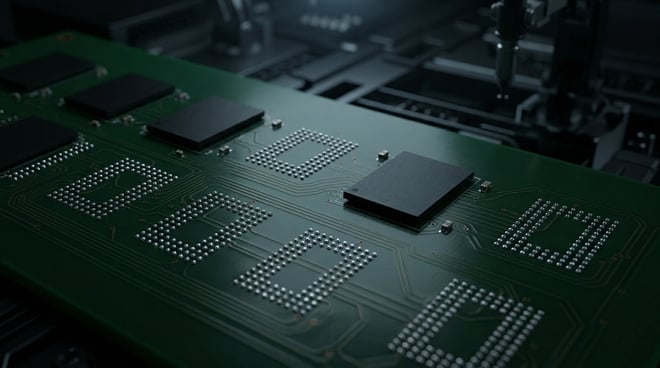
Much of that outperformance is driven by AI-fueled demand for memory chips—the semiconductors that store digital data—whose need is rising as the AI build-out accelerates.
In 2026, a severe global shortage, nicknamed RAMmageddon, has emerged as manufacturers shift production to satisfy AI’s voracious appetite for memory. The resulting supply constraints have pushed prices higher for makers of DRAM and NAND flash memory chips.
For investors looking for a straightforward way to gain exposure to this trend, a newly launched exchange-traded fund (ETF) offers an all-in-one portfolio solution.
Roundhill Positions Itself to Capitalize on the Memory Chip Shortage
Industry consultant Grand View Research estimates the global semiconductor memory market was worth more than $111 billion in 2023 and could grow to over $240 billion by 2030 — a compound annual growth rate (CAGR) of 11.6%. That expansion is driven by broader adoption across industries such as automotive, consumer electronics, IT and telecommunications.
Zooming in, the U.S. memory chip market—which represents nearly 20% of the global industry—is expected to grow at an even faster pace, with a forecast CAGR of 12.2% through 2030.
Against that backdrop and the ongoing AI data center boom and proliferation of large language models (LLMs), Roundhill Investments launched the Roundhill Memory ETF (BATS: DRAM) on April 2.
Because building new fabrication capacity can take years, the memory chip shortage is expected to persist through 2028, putting the fund in a favorable position to benefit from the trend.
The Roundhill Memory ETF is a thematic, sector-specific vehicle that gives investors concentrated exposure to memory chips, their cyclicality and related innovations in a single fund.
The fund focuses on firms across the memory semiconductor supply chain, including companies involved in DRAM and NAND design and development, wafer fabrication, packaging and testing, and the manufacturing of semiconductor capital equipment and materials.
By targeting the memory segment rather than the broader semiconductor industry, DRAM offers focused exposure to companies whose primary businesses are tied to memory chips and related technologies.
An Actively Managed Basket of Memory-Making Market Dominators
The companies in DRAM’s portfolio are leaders in their niches. Among the fund’s top holdings are Micron Technology (NASDAQ: MU), Samsung Electronics (OTCMKTS: SSNLF), Sandisk, Seagate (NASDAQ: STX), and Western Digital (NASDAQ: WDC).
Those five companies alone have a combined market cap exceeding $831 billion and have averaged nearly 930% one-year gains. Past performance is not indicative of future results, but analyst sentiment on these holdings bolsters a bullish case for the year ahead:
- Micron: 33 of 37 analysts assign MU a Buy rating.
- Samsung: 3 of 3 analysts assign SSNLF a Buy rating.
- Sandisk: 17 of 24 analysts assign SNDK a Buy rating.
- Seagate: 19 of 25 analysts assign STX a Buy rating.
- Western Digital: 21 of 24 analysts assign WDC a Buy rating.
The fund carries an expense ratio of 0.65%, which is in the typical range for actively managed ETFs. As a recently launched fund, DRAM currently has $244.56 million in assets under management and an average daily trading volume of about 7.14 million shares, which could pose short-term liquidity considerations.
However, given the rapid growth of AI and the global memory chip shortage, both assets and trading volume are likely to rise in the coming months.
DRAM’s Timing Places It at the Forefront of the Memory Chip Supercycle
The launch of Roundhill’s DRAM fund was timely. The ETF — which, according to its fact sheet, offers a pure-play alternative to broader semiconductor funds — arrives amid a memory chip shortage that supports durable pricing power across the industry.
MarketBeat’s Jeffrey Neal Johnson cautions that rapid price gains could eventually trigger oversupply, but he argues this cycle differs from prior ones because of manufacturing constraints. He said, “This physical limitation creates a supply floor,” and added, “the AI Trade has evolved. It is no longer just about the logic chips that do the thinking.”
That thesis aligns with Grand View Research, which calls memory chips “essential electronic device[s]” and notes their specialized nature contributes to a low level of product substitution.
Thank you for subscribing to MarketBeat!
MarketBeat empowers investors to make better investment decisions by offering real-time financial information and objective market research.
If you have questions about your account, please email MarketBeat’s South Dakota based support team at contact@marketbeat.com.
If you would like to unsubscribe or change which emails you receive, you can manage your mailing preferences or unsubscribefrom these emails.
© 2006-2026 MarketBeat Media, LLC. All rights protected.
345 North Reid Place #620, Sioux Falls, SD 57103. U.S.A..


