View in Browser

The Hidden Tax Burden Crushing America’s Upper-Middle Class
April 21, 2026
Dear Reader,
Happy Tax Month to those who celebrate, which should be no one.
Remember, this nation had no income tax until 1913, which in one of humanity’s worst coincidences is the year the Federal Reserve was clandestinely created.
Your editor continues to wonder when the Taxpayers Union will go on strike.
The government, of course, is insolvent. We’re now at $39 trillion in debt, and that doesn’t include the unfunded promises. That’s over $111,000 for every man, woman, and child under our spacious skies.
I, and many of you, often pay that much — or more — annually in taxes.
Still, from sea to shining sea, politicians are promising “free” stuff while insisting those of us with hard-won means don’t pay our fair share.
On the right, Trump accounts, which promise a $1,000 U.S. Treasury deposit for American children born between 2025–2028, starting on the Fourth of July this year.
On the left, “free” tuition and childcare and utility bills and more.
Both sides perpetually fund the bottomless war machine.
God bless America.
Snarky missive aside, one of the main themes of this decade is going to be the government digging into your wallet. I’ve said this for years, and the theme is picking up pace.
Washington state, where I moved nine years ago specifically because the state constitution forbids an income tax, has now in fact passed an income tax. And that’s on top of passing a capital gains tax a few years ago. Legislators and litigators used semantics, calling it an ‘excise tax’ instead of an ‘income tax’ to get around the law of the land. Howard Shultz, of Starbucks fame, promptly left the state earlier this year for Florida, which has more sun and lower taxes. Jeff Bezos made the move years ago.
You’ve undoubtedly heard about California’s “Billionaire Tax,” which has caused a further flight of wealth and business from the most populous state in the country.
You and I are not billionaires. But we are rich. And there’s an important distinction that needs to be made there.
This C$8 Million Company Just Bought the Key That Unlocks 12,000 Abandoned Gold Mines in Nevada
Nick and Gerardo are finalizing a private placement at C$0.25 per share in a tiny Nevada-focused gold company.
The chairman – who founded a NASDAQ-listed uranium producer and has built gold mills before – just acquired a processing mill worth over $10 million for a fraction of that.

The IPO is slated for October at C$0.50… a built-in double before the company even starts trading. Click here to join now.
For years, the chorus of ‘tax the rich’ has grown. We’re told to “pay our fair share.” Washington state senator Noel Frame recently referred to “the wealthy few” as “the villain.”
There are problems with this framing.
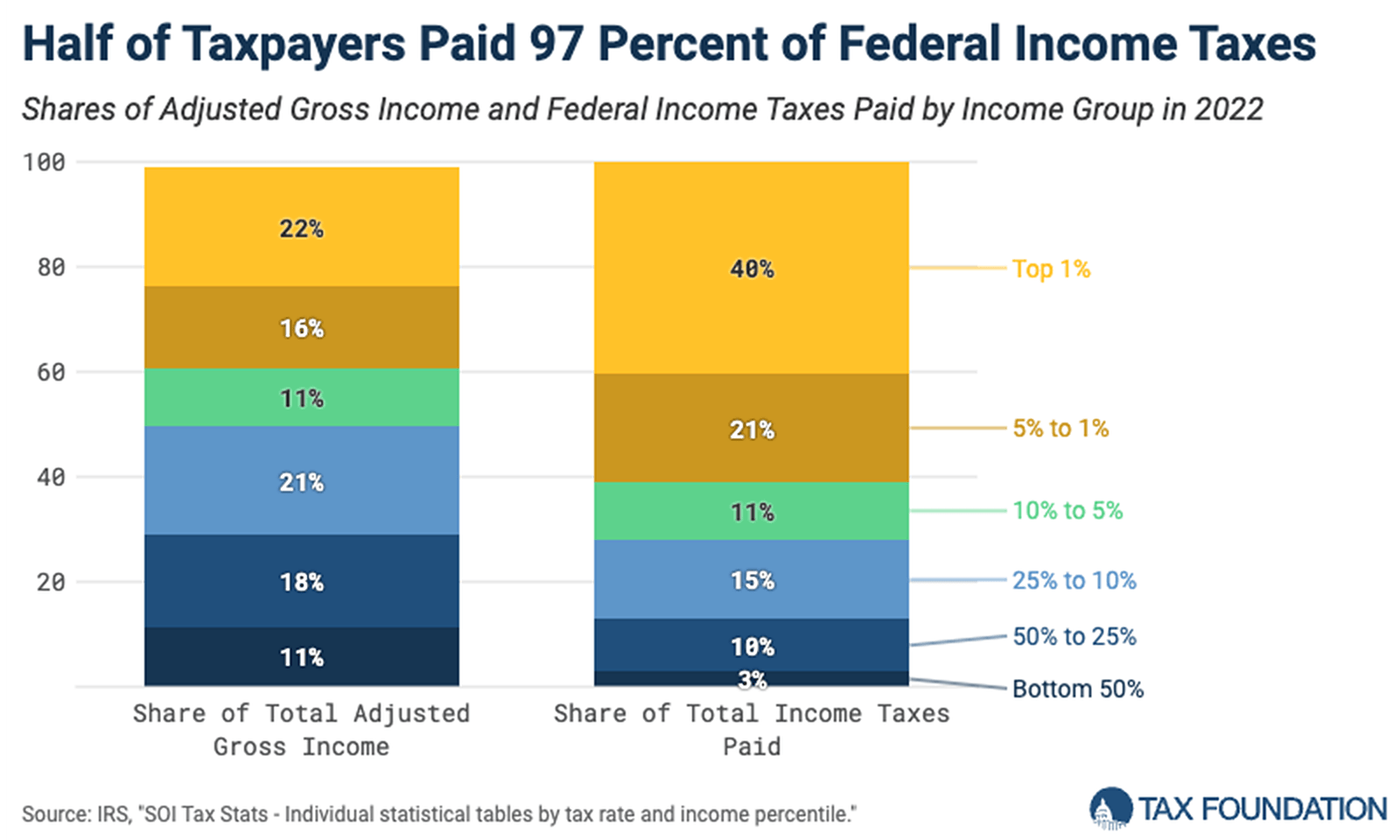
The top 1% of earners are paying 40% of the taxes collected. That’s people with an adjusted gross income (AGI) of $663,164 and above. They also pay the highest effective tax rate at 26%.
Those between the top 5th and 1st percentiles are paying 21% of the taxes. That’s people who earn between $261,591 and $663,164. That group has the second-highest tax rate at 18.8%.
Taxpayers with AGI between the 10th and 5th percentiles ($178,611 and $261,591) are paying 11% of the taxes with a tax rate of 14.3%.
And those in the 25th to 10th percentile income range — between $99,857 to $178,611 AGI — are paying 15% of the taxes with a rate of 10.7%.
So the top 25% of income earners are paying 87% of the taxes. They are all paying progressively higher tax rates. And, with the exception of the $178,611 and $261,591 income cohort — they are all paying a higher share of their income than the bottom 50%.
If you take the data at face value and ask, “who is carrying the heaviest burden relative to what they earn?” — the answer isn’t the bottom and it isn’t the top.
It’s the upper-middle: roughly the 25th to 1st percentile, or the households making about $100K to $660K AGI.
That’s the group that is fully exposed to the progressive system while no longer being shielded by low brackets and credits.
That’s the group getting squeezed by both sides.
That’s us. It’s not Bezos and Schultz.
We’re too “rich” for meaningful credits or subsidies. But we’re not rich enough for sophisticated tax structuring to move the needle dramatically.
Profiting as the Broader Indexes Fall
Market-wide shocks have wiped out profits and destroyed stock values, and the trend may just be starting.
But with the right kind of portfolio construction, it’s possible to mitigate much of the damage.
We’ve done just that, and are up 8% year-to-date versus and S&P that is down overall.
Going from the bottom 50% to the 25th–2nd percentile, the rate goes up 3X to 5X. But going from the 2nd to the 1st, the rate doesn’t even double.
I think this is one reason you get some billionaires and inheritees who embrace higher taxes while millionaires rarely do.
Consider this intro to a recent — partially taxpayer-funded — PBS article:
Chuck Collins figures he won life’s lottery by inheriting vast sums of money through his great-grandfather Oscar Mayer’s processed meat company, but rather than fight to protect every dime Collins has helped push to hike taxes on the ultrarich like himself.
He was successful in helping implement a higher tax in Massachusetts on income over $1 million, and the idea has already taken hold in a handful of other blue states, including California, Maryland, Minnesota and New Jersey.
Notice how the word “ultrarich” creeps in there, though I doubt you’d consider yourself so. It’s that broad brush that paints you and I as the aforementioned ‘villains’ while running small businesses, not international conglomerates.
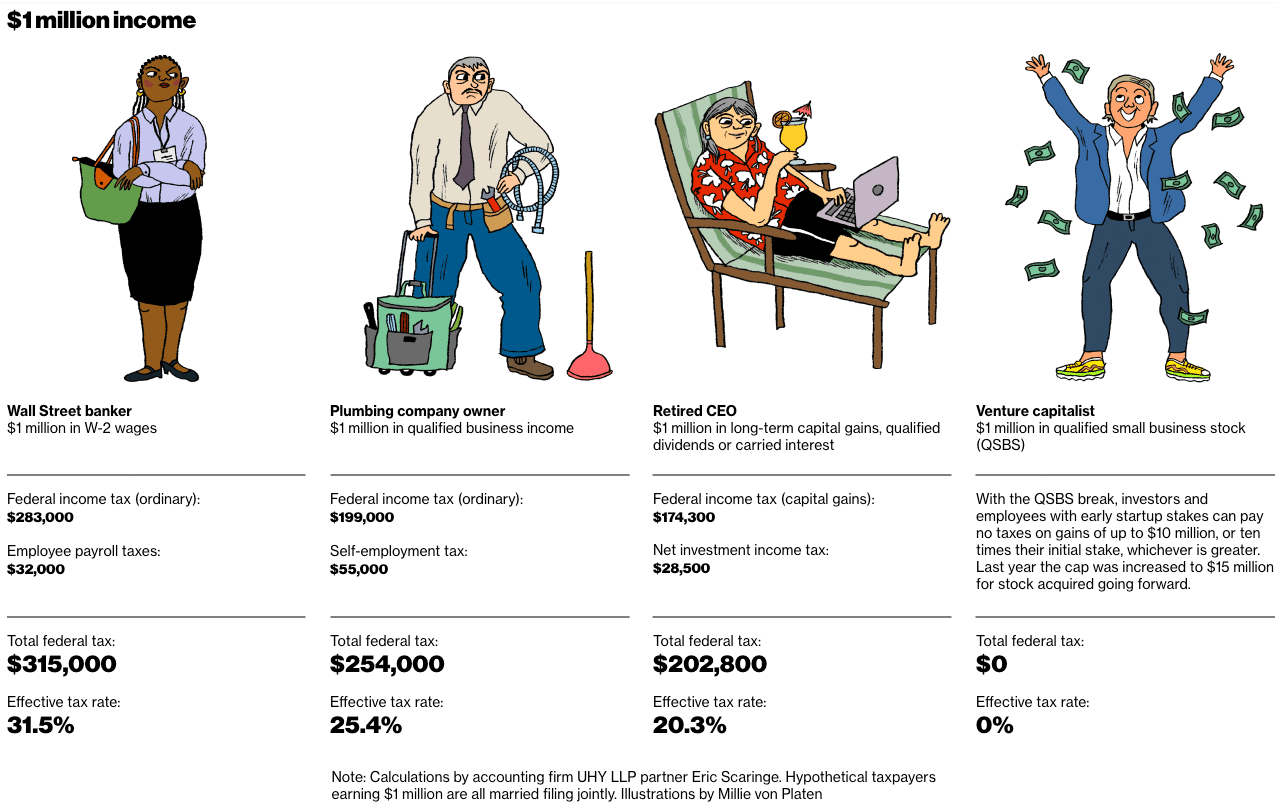
There’s a stark difference in taxes paid by a plumbing company owner and a venture capitalist, as this recent Bloomberg article points out. Consider this graphic:
At the state level, you can bet your pre-tax dollar that income limits for these taxes won’t hold at a million. They will be lowered in the future, which is why Washington state lawmakers refused to include language preventing them from doing so when they passed the income tax earlier this year.
And even if you are in a position to flee, which is tough for rooted families who are rich — but not ultrarich — states are now trying to create a Hotel California of taxation. The National News Desk reported earlier this month that:
Across the country, at least ten states are now exploring or have already passed an exit or wealth tax in order to combat revenue losses from residents fleeing to lower tax areas. That includes California, New York, Washington, and Michigan.
According to recent IRS Service Data from 2022-2023, due to migration from blue to red states, California lost just under $12 billion and New York, $9.9 billion. While Florida gained $20.5 billion and Texas $5.5 billion. Data also showed California lost nearly 230,000 residents.
My advice remains the same as it’s been for years. Remain vigilant on the tax issue. Fight it at the ballot box whenever you can. Be vocal about it. Get a good — and willing to be creative — accountant and/or tax attorney. Learn about business deductions and trusts. Move if you are willing and able.
Sorry for the wandering rant. But it irks me as one of the ten-to-two-percenters who get lumped in with the billionaires, labeled a financial villain, and am told to pay my fair share while already writing large checks to the government, donating a percentage of our small company’s profits every month, and covering 100% of our employees’ health insurance premiums. If taxes keep going up, some of that altruism might be on the chopping block. And I loathe thinking about how the government would allocate the capital given the squandering we habitually see from congress.
Maybe I should open a daycare.
(Editor’s Note: This piece was part of the April issue of Foundational Profits, which helps individuals manage their long-term portfolios by showing exactly how I’m managing mine, complete with a live portfolio and allocation weights. The open portfolio is currently up 38% and the closed portfolio is up 44% for the year. See how to become a member here.)

Call it like you see it,
Nick Hodge
Editor, Resource Stock Digest
Nick specializes in private placements and speculations in early stage ventures, and has raised tens of millions of dollars of investment capital for resource, energy, cannabis, and medical technology companies. Read his full article archive here. Follow Nick on X @nickchodge. Stay updated by saving our new email address Here’s how to update your contacts to ensure you continue receiving our emails from editor@resourcestockdigest.com:
- Gmail: Open an email from editor@resourcestockdigest.com, hover over the email address, click “Add to Contacts.”
- Outlook: Right-click on editor@resourcestockdigest.comand select “Add to Outlook Contacts.”
- Apple Mail: Open the email, click on editor@resourcestockdigest.com, and select “Add to Contacts” or “Add to VIPs.”
- Yahoo Mail: Open an email from editor@resourcestockdigest.com, hover over the email address, click “Add to Contacts.”
Click here for instructions from additional email providers.For Customer Service, please email us at editor@resourcestockdigest.com.
Resource Stock Digest
2250 Double Creek Dr #5669
Round Rock, TX 78665 USA
The email was sent to pahovis@aol.com. To no longer receive these emails, unsubscribe here.
No statement or expression of opinion, or any other matter herein, directly or indirectly, is an offer or the solicitation of an offer to buy or sell the securities or financial instruments mentioned. Resource Stock Digest does not provide individual investment counseling, act as investment advisors, or individually advocate the purchase or sale of any security or investment. Subscribers should not view this publication as offering personalized legal or investment counseling. Investments recommended in this publication should be made only after consulting with your investment advisor and only after reviewing the prospectus or financial statements of the company in question. This letter is not intended to meet your specific individual investment needs and it is not tailored to your personal financial situation. Nothing contained herein constitutes, is intended, or deemed to be – either implied or otherwise – investment advice. Neither the publisher nor the editors are registered investment advisors. This letter reflects the personal views and opinions of the editor and that is all it purports to be. While the information herein is believed to be accurate and reliable it is not guaranteed or implied to be so. Neither Resource Stock Digest, its related companies, employees, nor anyone else, accepts any responsibility, or assumes any liability, whatsoever, for any direct, indirect or consequential loss arising from the use of the information in this letter. The information contained herein is subject to change without notice, may become outdated and may not be updated. Resource Stock Digest, entities it controls, family, friends, employees, associates, and others may have positions in securities mentioned, or discussed, in this letter, and may increase or decrease those positions at any time. No part of this letter/article may be reproduced, copied, emailed, faxed, or distributed (in any form) without the express written permission of Resource Stock Digest. Unauthorized reproduction of this newsletter or its contents by Xerography, facsimile, or any other means is illegal and punishable by law. All rights reserved. Copyright © 2026 Click here to view our Terms & Conditions and Privacy Policy.


