What analysts are saying, who’s running it, what’s actually innovative, and how earnings expectations are shifting into 2026
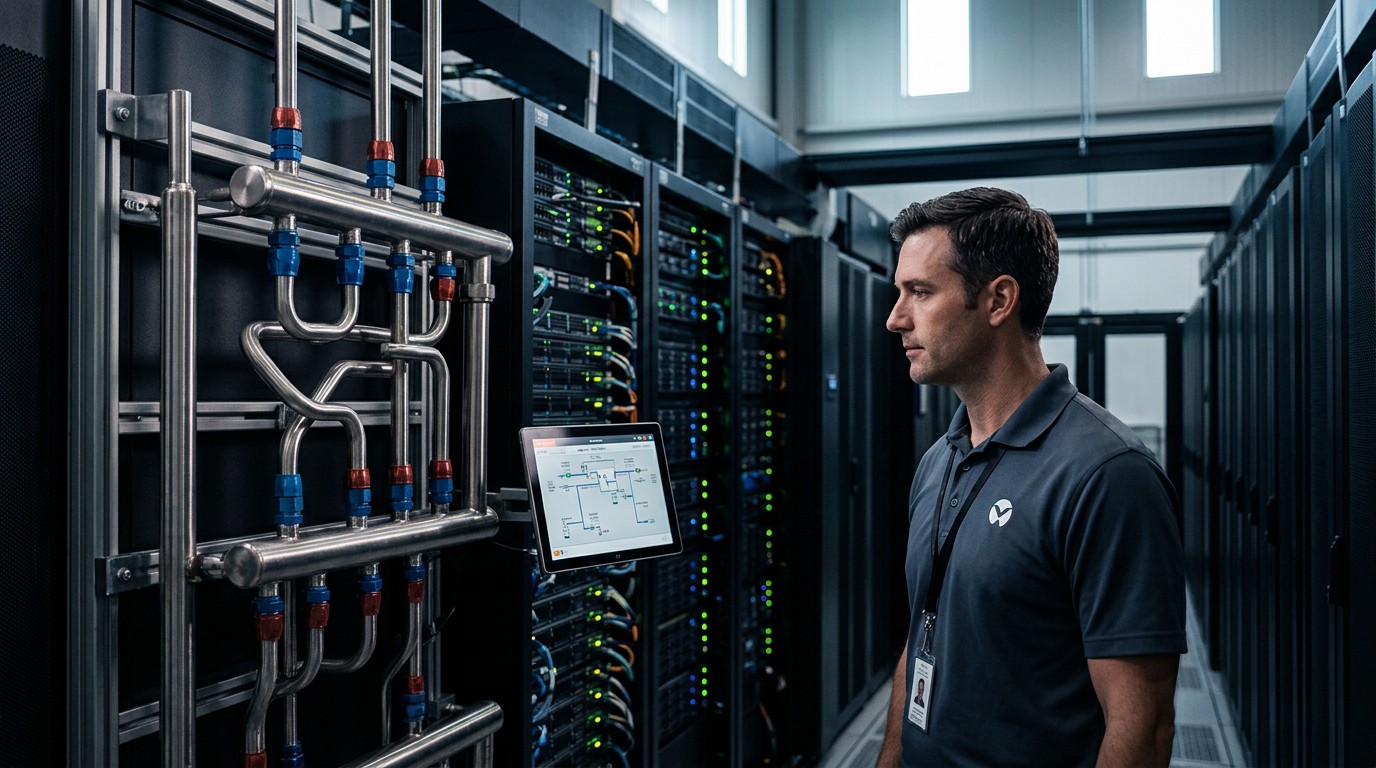
Vertiv isn’t just “picks and shovels” for AI. It’s closer to a scheduler – not in software, but in physics. The rack roadmap is being set by power delivery, heat removal, and how fast you can commission a site without embarrassing outages. When those constraints loosen, AI capacity shows up. When they don’t, it doesn’t. Vertiv sits right on that choke point.
That’s why the stock doesn’t trade like a normal industrial supplier anymore. It’s trading like a company that sells time – shorter build timelines, fewer do-overs, faster “ready for load.” And yes, that’s a little squishy. But it’s also how budgets actually get approved in this cycle.
Vertiv in one sentence: it’s the “physical layer” vendor that keeps AI data centers upright – power delivery, thermal management (increasingly liquid), modular deployments, and a growing services/software layer – and the market is pricing it like that’s a multi-year constraint, not a one-year capex cycle.
Also: this is one of those names where the narrative can outrun execution. The part people skip is lead times, commissioning, and whether backlog turns into shipped product on schedule (and on margin). Management is basically telling you: we’re expanding capacity as fast as we responsibly can, because customers are trying to compress timelines.
SponsoredElon’s $4 Trillion Takeover Target, Revealed
Banking. Cars. Rockets. The Internet itself. Each time, the same pattern: Elon targets an industry the world says can’t be disrupted, the experts call him crazy, the short sellers pile in… and then he does it. Now he’s preparing for his biggest takeover yet.
What Vertiv does (and why AI changes the mix)
Vertiv sells the infrastructure around compute: UPS and power management, switchgear/busbar, thermal (CRAC/CRAH and now liquid cooling), racks/integrated systems, plus monitoring and lifecycle services.
In a “normal” cloud cycle that’s already important. In an AI cycle, it becomes existential because power density and heat flux are the limiting factors. The data hall doesn’t care about your TAM slide – it cares about watts, coolant flow, redundancy, and whether the thing can be maintained without drama.
The company’s own framing (and you can feel the product strategy behind it) is shifting from “components” to system-level architecture – treating the data center as a single unit where power + cooling + compute are designed together. That’s not just marketing; it’s how you sell larger contracts and lock in services.
Leadership: who’s running Vertiv right now
CEO: Giordano Albertazzi
Executive Chairman: Dave Cote
- CFO: Craig Chamberlin
- Chief Product & Technology Officer: Scott Armul
- President, Americas: Anand Sanghi
- President, EMEA: Paul Ryan
- President, Greater China: Wei Shen
- Chief Legal Officer: Stephanie Gill
- CIO: Mike Giresi
- EVP Manufacturing/Logistics/Opex: Anders Karlborg
- SVP Corporate Strategy & Development:Rachel Thompson
Small tangent, but it matters: the “manufacturing/logistics/operational excellence” seat being prominent is basically the tell. This cycle is not won by who has the fanciest slide deck – it’s who can actually build, ship, commission, and service the stuff while everyone is fighting for the same skilled labor and components.
What analysts are saying (the tone, not just the rating)
Most “Street” commentary right now clusters around a few recurring points:
- Demand visibility looks unusually high for an industrial-ish company – highlighted by the step-change in backlog and order strength exiting 2025.
- Margins are expanding with volume(operational leverage) while management is also calling out tariff impacts and mitigation.
- Capacity expansion becomes the swing factor: capex stepping up as they try to convert backlog to revenue.
- Valuation is the pushback: the more bullish the “AI infrastructure bottleneck” framing gets, the more the stock trades like a momentum compounder, not a cyclical equipment supplier.
Concrete example of the “tone shift” post-print: Morgan Stanley raised its price target to $350(from $285) and kept an Overweight rating on April 23, 2026.
One thing to watch: public “consensus” pages can disagree (number of analysts, average target, etc.). Treat them as directionally useful, not source-of-truth. Different data providers can show different snapshots depending on feed timing and included brokerages.
What Vertiv is doing that’s actually “innovative” (not just incremental)
Vertiv’s innovation story is less “a single breakthrough product” and more a stacking of capabilities that lets them sell higher-density deployments, faster deployments, and more services over time.
Liquid cooling: moving from niche to default for AI racks.
Vertiv has been building out liquid cooling in two ways: technology (CDUs/manifolds/secondary fluid networks) and the ugly-but-essential services layer (commissioning, fluid quality, lifecycle maintenance). It has also used acquisitions to broaden both product and services capabilities in liquid cooling.
Digital twins + “unit of compute” thinking:treating the facility as an integrated machine.
Vertiv has been leaning into designing/operating the site as a single system, and has highlighted digital twins as a way to simulate, monitor, and optimize performance across the lifecycle (before and after build). This is one of those ideas that sounds like buzzwords until you realize it can reduce rework and shorten commissioning.
Energy autonomy themes: the power constraint is real, so the solution set is widening.
Power availability is turning into a gating factor. Vertiv’s framing is that operators are increasingly forced toward hybrid on-site generation + storage + microgrid-like approaches as a bridge while grid capacity catches up. That’s not a near-term revenue line item on its own, but it shapes what products/services win the next wave of projects.
Earnings: what happened, and what changed for 2026
Q4 2025 (reported Feb 11, 2026):
- Net sales: $2.88B (+23% YoY; 19% organic).
- Organic orders: +252% YoY; book-to-bill about 2.9x.
- Backlog: $15.0B (up 109% YoY).
- Adjusted diluted EPS: $1.36 (+37% YoY).
- Initial FY 2026 outlook at the time: net sales $13.25B–$13.75B; adjusted diluted EPS $5.97–$6.07.
Q1 2026 (reported Apr 22, 2026):
- Net sales: $2.65B (+30% YoY).
- Adjusted operating margin: 20.8% (up 430 bps YoY).
- Adjusted free cash flow: $653M (up 147% YoY).
- Net leverage: about 0.2x end of quarter.
- Updated FY 2026 guidance raised: net sales $13.5B–$14.0B; adjusted diluted EPS $6.30–$6.40; adjusted free cash flow $2.1B–$2.3B.
- Q2 2026 guide: net sales $3.25B–$3.45B; adjusted diluted EPS $1.37–$1.43.
That guidance raise is the real event. Not the beat, not the margin line. It’s management saying: “the ramp is here and we’re leaning into it.”
Future estimates: what to track (and what can break the model)
Near-term numbers matter, but the “real” forecast inputs for Vertiv in 2026–2027 are more about mechanics:
- Backlog conversion cadence: AI projects can be lumpy; a quarter with monster orders can be followed by one that looks “slow” just because of timing.
- Capacity expansion and capex: 2026 capex is expected to step up as they add manufacturing/technology capacity to ship into demand.
- Mix shift to liquid + services: if liquid cooling penetration accelerates, it’s not just incremental revenue – it can reshape attach rates, commissioning services, and longer-duration maintenance work (which tends to be stickier).
- Tariffs / supply chain / project delays: margins can get choppy if the company eats cost to keep timelines, or if timing slippage changes quarterly mix.
If you want a single anchor point for “future estimates” right now, start with the company’s updated FY 2026 guide: adjusted EPS $6.30–$6.40 and net sales $13.5B–$14.0B. Everything else is basically the market arguing about 2027 operating leverage and how long the AI buildout stays “too fast.”
Recent news that actually matters
- Apr 22, 2026: Q1 2026 results + raised FY 2026 guidance; strong free cash flow; commentary emphasizing customers prioritizing deployment speed and system-level optimization.
- Apr 23, 2026: Morgan Stanley raised its price target (Overweight maintained) after the Q1 update.
- Feb 11, 2026: Q4 2025 results highlighted massive order growth and a sharp step-up in backlog, setting the tone for 2026.
- Dec 2025: completion of the PurgeRite acquisition (about $1B) to expand liquid cooling services for high-density compute.
One more industry context point: the “AI data center” buildout is pushing toward bigger, more power-dense designs, which is accelerating the shift toward liquid cooling, modular deployment, and more sophisticated monitoring/predictive maintenance.
My takeaway (and the two risks I’d respect)
The bull case is straightforward: Vertiv is positioned where AI capex has to go no matter who “wins” the model war – because the chips still need power and they still generate heat. Backlog + guidance raises imply the demand is not theoretical; it’s booked and being delivered.
Risk #1: timing games. If big projects slip, quarterly optics can get weird fast, even if the multi-year story is intact.
Risk #2: execution under compression. When customers demand “faster deployment, greater reliability, comprehensive services,” that sounds great… right up until it becomes warranty expense, expedite costs, or margin give-backs to keep schedules. Management is aware of it, but the tape doesn’t always wait.
– Stock Report
This content is for informational purposes only and should not be considered financial advice. Investing involves risk.
Stock Report is a publication of Investing Media Solutions, LLC.
To view our full policies: Disclaimer | Privacy Policy | Terms & Conditions
© 2026 Stock Report
203 N La Salle Suite 2100
Chicago, Illinois 60601, United States
UnsubscribePowered by beehiivTerms of Service
Deep Research: Vertiv, Inc. (NYSE: VRT)
What analysts are saying, who’s running it, what’s actually innovative, and how earnings expectations are shifting into 2026
Vertiv isn’t just “picks and shovels” for AI. It’s closer to a scheduler – not in software, but in physics. The rack roadmap is being set by power delivery, heat removal, and how fast you can commission a site without embarrassing outages. When those constraints loosen, AI capacity shows up. When they don’t, it doesn’t. Vertiv sits right on that choke point.
That’s why the stock doesn’t trade like a normal industrial supplier anymore. It’s trading like a company that sells time – shorter build timelines, fewer do-overs, faster “ready for load.” And yes, that’s a little squishy. But it’s also how budgets actually get approved in this cycle.
Vertiv in one sentence: it’s the “physical layer” vendor that keeps AI data centers upright – power delivery, thermal management (increasingly liquid), modular deployments, and a growing services/software layer – and the market is pricing it like that’s a multi-year constraint, not a one-year capex cycle.
Also: this is one of those names where the narrative can outrun execution. The part people skip is lead times, commissioning, and whether backlog turns into shipped product on schedule (and on margin). Management is basically telling you: we’re expanding capacity as fast as we responsibly can, because customers are trying to compress timelines.
SponsoredElon’s $4 Trillion Takeover Target, Revealed
Banking. Cars. Rockets. The Internet itself. Each time, the same pattern: Elon targets an industry the world says can’t be disrupted, the experts call him crazy, the short sellers pile in… and then he does it. Now he’s preparing for his biggest takeover yet.
What Vertiv does (and why AI changes the mix)
Vertiv sells the infrastructure around compute: UPS and power management, switchgear/busbar, thermal (CRAC/CRAH and now liquid cooling), racks/integrated systems, plus monitoring and lifecycle services.
In a “normal” cloud cycle that’s already important. In an AI cycle, it becomes existential because power density and heat flux are the limiting factors. The data hall doesn’t care about your TAM slide – it cares about watts, coolant flow, redundancy, and whether the thing can be maintained without drama.
The company’s own framing (and you can feel the product strategy behind it) is shifting from “components” to system-level architecture – treating the data center as a single unit where power + cooling + compute are designed together. That’s not just marketing; it’s how you sell larger contracts and lock in services.
Leadership: who’s running Vertiv right now
CEO: Giordano Albertazzi
Executive Chairman: Dave Cote
- CFO: Craig Chamberlin
- Chief Product & Technology Officer: Scott Armul
- President, Americas: Anand Sanghi
- President, EMEA: Paul Ryan
- President, Greater China: Wei Shen
- Chief Legal Officer: Stephanie Gill
- CIO: Mike Giresi
- EVP Manufacturing/Logistics/Opex: Anders Karlborg
- SVP Corporate Strategy & Development:Rachel Thompson
Small tangent, but it matters: the “manufacturing/logistics/operational excellence” seat being prominent is basically the tell. This cycle is not won by who has the fanciest slide deck – it’s who can actually build, ship, commission, and service the stuff while everyone is fighting for the same skilled labor and components.
What analysts are saying (the tone, not just the rating)
Most “Street” commentary right now clusters around a few recurring points:
- Demand visibility looks unusually high for an industrial-ish company – highlighted by the step-change in backlog and order strength exiting 2025.
- Margins are expanding with volume(operational leverage) while management is also calling out tariff impacts and mitigation.
- Capacity expansion becomes the swing factor: capex stepping up as they try to convert backlog to revenue.
- Valuation is the pushback: the more bullish the “AI infrastructure bottleneck” framing gets, the more the stock trades like a momentum compounder, not a cyclical equipment supplier.
Concrete example of the “tone shift” post-print: Morgan Stanley raised its price target to $350(from $285) and kept an Overweight rating on April 23, 2026.
One thing to watch: public “consensus” pages can disagree (number of analysts, average target, etc.). Treat them as directionally useful, not source-of-truth. Different data providers can show different snapshots depending on feed timing and included brokerages.
What Vertiv is doing that’s actually “innovative” (not just incremental)
Vertiv’s innovation story is less “a single breakthrough product” and more a stacking of capabilities that lets them sell higher-density deployments, faster deployments, and more services over time.
Liquid cooling: moving from niche to default for AI racks.
Vertiv has been building out liquid cooling in two ways: technology (CDUs/manifolds/secondary fluid networks) and the ugly-but-essential services layer (commissioning, fluid quality, lifecycle maintenance). It has also used acquisitions to broaden both product and services capabilities in liquid cooling.
Digital twins + “unit of compute” thinking:treating the facility as an integrated machine.
Vertiv has been leaning into designing/operating the site as a single system, and has highlighted digital twins as a way to simulate, monitor, and optimize performance across the lifecycle (before and after build). This is one of those ideas that sounds like buzzwords until you realize it can reduce rework and shorten commissioning.
Energy autonomy themes: the power constraint is real, so the solution set is widening.
Power availability is turning into a gating factor. Vertiv’s framing is that operators are increasingly forced toward hybrid on-site generation + storage + microgrid-like approaches as a bridge while grid capacity catches up. That’s not a near-term revenue line item on its own, but it shapes what products/services win the next wave of projects.
Earnings: what happened, and what changed for 2026
Q4 2025 (reported Feb 11, 2026):
- Net sales: $2.88B (+23% YoY; 19% organic).
- Organic orders: +252% YoY; book-to-bill about 2.9x.
- Backlog: $15.0B (up 109% YoY).
- Adjusted diluted EPS: $1.36 (+37% YoY).
- Initial FY 2026 outlook at the time: net sales $13.25B–$13.75B; adjusted diluted EPS $5.97–$6.07.
Q1 2026 (reported Apr 22, 2026):
- Net sales: $2.65B (+30% YoY).
- Adjusted operating margin: 20.8% (up 430 bps YoY).
- Adjusted free cash flow: $653M (up 147% YoY).
- Net leverage: about 0.2x end of quarter.
- Updated FY 2026 guidance raised: net sales $13.5B–$14.0B; adjusted diluted EPS $6.30–$6.40; adjusted free cash flow $2.1B–$2.3B.
- Q2 2026 guide: net sales $3.25B–$3.45B; adjusted diluted EPS $1.37–$1.43.
That guidance raise is the real event. Not the beat, not the margin line. It’s management saying: “the ramp is here and we’re leaning into it.”
Future estimates: what to track (and what can break the model)
Near-term numbers matter, but the “real” forecast inputs for Vertiv in 2026–2027 are more about mechanics:
- Backlog conversion cadence: AI projects can be lumpy; a quarter with monster orders can be followed by one that looks “slow” just because of timing.
- Capacity expansion and capex: 2026 capex is expected to step up as they add manufacturing/technology capacity to ship into demand.
- Mix shift to liquid + services: if liquid cooling penetration accelerates, it’s not just incremental revenue – it can reshape attach rates, commissioning services, and longer-duration maintenance work (which tends to be stickier).
- Tariffs / supply chain / project delays: margins can get choppy if the company eats cost to keep timelines, or if timing slippage changes quarterly mix.
If you want a single anchor point for “future estimates” right now, start with the company’s updated FY 2026 guide: adjusted EPS $6.30–$6.40 and net sales $13.5B–$14.0B. Everything else is basically the market arguing about 2027 operating leverage and how long the AI buildout stays “too fast.”
Recent news that actually matters
- Apr 22, 2026: Q1 2026 results + raised FY 2026 guidance; strong free cash flow; commentary emphasizing customers prioritizing deployment speed and system-level optimization.
- Apr 23, 2026: Morgan Stanley raised its price target (Overweight maintained) after the Q1 update.
- Feb 11, 2026: Q4 2025 results highlighted massive order growth and a sharp step-up in backlog, setting the tone for 2026.
- Dec 2025: completion of the PurgeRite acquisition (about $1B) to expand liquid cooling services for high-density compute.
One more industry context point: the “AI data center” buildout is pushing toward bigger, more power-dense designs, which is accelerating the shift toward liquid cooling, modular deployment, and more sophisticated monitoring/predictive maintenance.
My takeaway (and the two risks I’d respect)
The bull case is straightforward: Vertiv is positioned where AI capex has to go no matter who “wins” the model war – because the chips still need power and they still generate heat. Backlog + guidance raises imply the demand is not theoretical; it’s booked and being delivered.
Risk #1: timing games. If big projects slip, quarterly optics can get weird fast, even if the multi-year story is intact.
Risk #2: execution under compression. When customers demand “faster deployment, greater reliability, comprehensive services,” that sounds great… right up until it becomes warranty expense, expedite costs, or margin give-backs to keep schedules. Management is aware of it, but the tape doesn’t always wait.
– Stock Report
This content is for informational purposes only and should not be considered financial advice. Investing involves risk.
Stock Report is a publication of Investing Media Solutions, LLC.
To view our full policies: Disclaimer | Privacy Policy | Terms & Conditions
© 2026 Stock Report
203 N La Salle Suite 2100
Chicago, Illinois 60601, United States


