Unsubscribe Ticker Revealed: Pre-IPO Access to “Next Elon Musk” Company (From Banyan Hill Publishing)
3 Energy Stocks to Buy and 2 to Avoid as AI Power Demand Explodes
Written by Bridget Bennett

Every AI bull run eventually collides with a hard physical constraint. Right now, that constraint is power.
Rob Spivey, director of research at Altimetry Research, has spent months mapping the energy infrastructure buildout behind the AI boom—and his findings point to a specific kind of company that stands to benefit most. Not just any energy stock. The ones that can deliver power without waiting on regulators, utility approvals, or the grid itself.
That thesis is increasingly playing out in real time. When the Federal Energy Regulatory Commission last projected U.S. power demand growth out to 2030, the number came in at 166 gigawatts, up from just 24 gigawatts in 2022. The reason is straightforward: training AI models and running data centers around the clock requires massive, uninterrupted electricity. And the companies building those data centers know they can’t wait for the grid to catch up.
Why Hyperscalers Are Ditching the Grid
The problem isn’t just demand, it’s friction. Data centers are running into what Spivey calls NIMBYism: “not in my backyard” pushback from communities opposed to the power price spikes that come with large-scale AI infrastructure. In some markets, grid interconnection wait times stretch beyond six years. Data center shells sit fully built but unpowered.
Meanwhile, the hyperscalers are spending as if none of that friction exists. Meta Platforms (NASDAQ: META) recently guided to $125–$145 billion in data center capital expenditures for the year. Total hyperscaler spending across Microsoft (NASDAQ: MSFT), Amazon (NASDAQ: AMZN), Alphabet (NASDAQ: GOOGL), and Meta is on pace to exceed $700 billion. The reason they won’t stop, Spivey argues, is structural: this is a winner-take-all race to artificial general intelligence, and the first company to blink declares itself the loser.
The solution is what Spivey calls “bring your own power.” This is behind-the-meter generation that bypasses the grid entirely. Oracle’s Project Jupiter campus in New Mexico is being built entirely off-grid. West Texas is seeing similar developments. The real investment opportunity sits not in utilities waiting to sign grid connection agreements, but in the companies actually building the power.
GE Vernova: The Turbine Monopoly No One Fully Prices In
The first name Spivey points to is GE Vernova (NYSE: GEV). When you need to build a natural gas power plant—the kind that can run 24 hours a day, 365 days a year—there are only three companies in the world that make the turbines: Siemens Energy (OCTMKTS: SMEGF), Mitsubishi (OTCMKTS: MSBHF), and GE Vernova. That supply constraint is already showing up in the order book.
According to GE Vernova’s Q4 2025 earnings release, gas turbine backlog and slot reservation agreements reached 83 gigawatts by the end of 2025, up from 62 gigawatts just one quarter earlier. The company is targeting around 20 gigawatts of annual production capacity by mid-2026. Its total backlog across all segments now sits at $150 billion, up 26% year over year. Turbine reservations are on track to be sold out through 2030.
The deeper story, Spivey argues, is in the margins. When GE Vernova was spun out of General Electric in 2024, it carried a 3% earnings margin, weighed down by costs inherited from the parent company. Its peers, by comparison, operate at roughly 20% uniform margins. That gap is closing. As capacity expands and legacy costs burn off, GE Vernova isn’t just growing its revenue—it’s growing into what its business should have been worth all along.
Even after a significant run, Spivey sees more room ahead. His research has found that in the middle of a bull market, companies that have already doubled have a better-than-coin-flip chance of doubling again—and when uniform accounting confirms the valuation still has room, that probability rises further.
Bloom Energy: The Fuel Cell Company Hyperscalers Just Validated
With Bloom Energy (NYSE: BE), the setup is different, and arguably more dramatic.
Bloom Energy makes solid oxide fuel cells: devices that take natural gas and convert it directly into electricity, without combustion and without connecting to the grid.
For a hyperscaler that wants reliable, around-the-clock power on its own terms, that’s an attractive proposition. The question has always been whether Bloom could scale fast enough to matter.
Oracle’s (NYSE: ORCL) Project Jupiter answered that question in a significant way. The data center campus in New Mexico, one of the largest AI infrastructure projects announced in recent years, will be powered entirely by Bloom’s fuel cells, with a capacity of up to 2.45 gigawatts. Per a deal announced in April 2026, Oracle has contracted for up to 2.8 gigawatts from Bloom across multiple deployments.
Two years ago, Bloom was producing around 100 megawatts of capacity annually. The company has outlined a path to 5 gigawatts per year by 2030. Each deployment also carries a recurring revenue tail: the fuel cells require periodic catalyst replenishment, meaning every megawatt sold generates a service relationship that doesn’t end at installation.
Spivey’s uniform accounting analysis also found that Bloom was already profitable in 2021 and 2022, at a time when conventional accounting made it look like a money-losing startup. The market, he argues, is still partially anchored to that older read, and the actual earnings trajectory looks far stronger than the as-reported numbers suggest.
Kodiak Gas Services: The Double Dip Most Investors Haven’t Found Yet
The third name is more off the radar: Kodiak Gas Services (NYSE: KGS). Most investors know Kodiak as a contract compression company. It operates the fleets of compressors that push natural gas through pipelines as it travels from wellhead to destination. More demand for natural gas means more demand for Kodiak’s compressors. That alone gives it leverage to the AI energy buildout.
But the bigger move is what Kodiak has done more recently. In early 2026, the company completed its acquisition of Distributed Power Solutions, rebranding the business as Kodiak Power Solutions. The deal added approximately 395 megawatts of distributed generation capacity—turbines and reciprocating engines that can be deployed wherever power is needed, including directly at data center sites. Around two-thirds of that acquired fleet is already contracted to data center operators.
The strategic logic: the same operational expertise Kodiak uses to run compression fleets in the field translates directly to running mobile power generation at data center campuses. The company can now sell power at better pricing into high-demand digital infrastructure markets, while its compression business benefits from the increased natural gas volumes that AI-driven electricity demand will require.
Spivey describes this as a double dip—more natural gas throughput drives compressor demand, and more data center power demand lets Kodiak sell generation capacity at premium pricing. The market, he says, hasn’t fully priced what that combination does to long-term profitability. The U.S. natural gas advantage reinforces both sides: EQT (NYSE: EQT), the country’s largest producer, can extract gas for around $1 per BTU against a market price near $5, a cost floor that keeps natural gas the most viable near-term fuel for AI power.
2 Names to Avoid in This Cycle
Not every energy company benefits equally from this shift — and two in particular stand out as names Spivey would sidestep.
The first is NextEra Energy (NYSE: NEE). On the surface, it looks like a perfect fit: the largest utility in the world, with major exposure to wind and solar. But data centers need baseload power—electricity that runs consistently, around the clock, regardless of weather. Wind and solar don’t provide that. Battery backup extends renewable generation by a few hours, not the full overnight window a data center requires. NextEra is structurally misaligned with what the biggest power buyers actually need.
The second is AECOM (NYSE: ACM). Construction and engineering stocks should theoretically ride the data center buildout higher, but AECOM’s project exposure skews toward transportation and wastewater, not power generation and digital infrastructure. The stock was under pressure for months while better-positioned peers ran. When the market is clearly telling you a company isn’t in the right lane, Spivey says, it’s worth listening.
Microsoft CEO Satya Nadella put it plainly: the company has NVIDIA (NASDAQ: NVDA) chips ready to deploy. The bottleneck is power. The chip stocks got there first, but the energy infrastructure story may have more runway left than most investors realize. READ THIS STORY ONLINE
The “secret weapon” behind Microsoft, Meta, Amazon, and Google (Ad)

Is Elon about to trigger another 315X opportunity?
Elon gave Tesla investors the chance to make more than 315 times their money when he revived the electric vehicle industry. $1 billion fund manager Louis Navellier believes Elon’s “Project Apex” will mint a new generation of millionaires. CLICK HERE TO GET THE DETAILS.
Netflix, Pulte, and Mobileye Are Buying Their Own Dips—Should You?
Written by Leo Miller

Struggling stocks are signaling confidence ahead, recently announcing substantial share buyback authorizations. These names are looking to buy shares at what they likely view as depressed prices, providing positive signals to investors going forward.
Netflix’s Buyback Capacity Hits 8% of Market Capitalization
First up is streaming giant Netflix (NASDAQ: NFLX). Netflix shares have seen considerable volatility over the recent past. The stock took big hits after Netflix announced its intention to acquire Warner Bros. Discovery (NASDAQ: WBD). After the deal fell through, Netflix shares managed to rebound above pre-merger announcement levels. However, the stock tanked again after Netflix released its latest earnings report, with the company providing underwhelming guidance.
Now, it looks as though Netflix is trying to pick up some of the slack in its stock price. Around a week after reporting earnings, Netflix authorized a $25 billion share repurchase plan. This adds to the company’s $6.8 billion in remaining buyback capacity held under its December 2024 repurchase authorization. In total, Netflix’s buyback capacity now sits near $31.8 billion. This is very substantial, equal to around 8% of the firm’s approximately $390 billion market capitalization.
Notably, Netflix did not provide a specific reason for its buyback capacity increase, and the program does not have an expiration date. However, given the size of the program, it is likely that Netflix sees value in its falling share price. Currently, Netflix is down just over 30% from its 52-week high.
Pulte Signals High Buyback Spending to Continue
PulteGroup (NYSE: PHM) is another large consumer discretionary name, being one of the top homebuilders in the United States. Pulte shares have been largely stagnant in 2026, providing a slight year-to-date (YTD) loss.
Homebuilders have been in a difficult position, with sales and earnings falling considerably. Still, Pulte avoided a sell-off following its latest report, rising 2.4% afterward.
This came despite sales falling 12% year-over-year (YOY) and adjusted earnings per share falling 30% YOY, showing that the market has priced in very low expectations.
Alongside its earnings, Pulte announced a $1.5 billion increase to its buyback authorization, bringing its total buyback capacity to $2.1 billion.
This is equal to over 9% of the firm’s approximately $23 billion market capitalization, giving it a significant ability to continue lowering its outstanding share count.
Since 2013, Pulte has spent billions on buybacks and cut its outstanding share count in half. The firm’s buyback spending last quarter was $345 million. This was a notable 15% increase over the prior quarter and good for Pulte’s second-highest quarterly buyback spending ever.
The company’s new authorization indicates that its buybacks could continue at this strong pace over the coming quarters.
Mobileye Announces $250 Million Buyback With Shares Down Big
Last up is Mobileye Global (NASDAQ: MBLY). The company provides advanced driver assistance systems (ADAS) and autonomous driving technologies. As an automobile components company, Mobileye sits within the broader consumer discretionary sector. Mobileye shares have faced serious pressure lately, down over 15% in 2026 and more than 40% in the last 12 months.
Mobileye has seen very inconsistent sales growth over this period. The firm has recorded YOY sales shifts as high as 83% and as low as -9% during the past five quarters. This has contributed to significant margin volatility, with adjusted operating margins fluctuating between 21% and 9%.
However, Mobileye’s expected eight-year automotive revenue pipeline ended 2025 at $24.5 billion. This compares to its last 12 months’ revenue of $2.01 billion, signaling a significant opportunity ahead.
Mobileye has also announced a $250 million share buyback program, which is equal to over 3% of its approximately $7.4 billion market capitalization. The firm intends to use the authorization to partially reduce dilution from its recent acquisition of Mentee Robotics.
However, the company also said it sees “an opportunity” to address this dilution at “significantly more attractive prices than those embedded at closing.” Overall, the company likely sees a level of value in its share price, even though the buyback decision relates directly to the Mentee deal.
Analysts Eye Gains Ahead for Netflix, Pulte, and Mobileye
While buyback authorizations do not necessarily mean these names are due for a rebound, they are important indicators worth paying attention to. Looking ahead, MarketBeat consensus price targets imply over 20% upside in NFLX, over 20% upside in PHM, and over 60% upside in MBLY. READ THIS STORY ONLINE
Ticker Revealed: Pre-IPO Access to “Next Elon Musk” Company (Ad)

We’ve found The Next Elon Musk… and what we believe to be the next Tesla.
It’s already racked up $26 billion in government contracts.
Peter Thiel just bet $1 Billion on it.👉 UNLOCK THE TICKER NOW AND GET IT COMPLETELY FREE.
GameStop’s eBay Gamble: Bold Move or Balance Sheet Disaster?
Written by Thomas Hughes
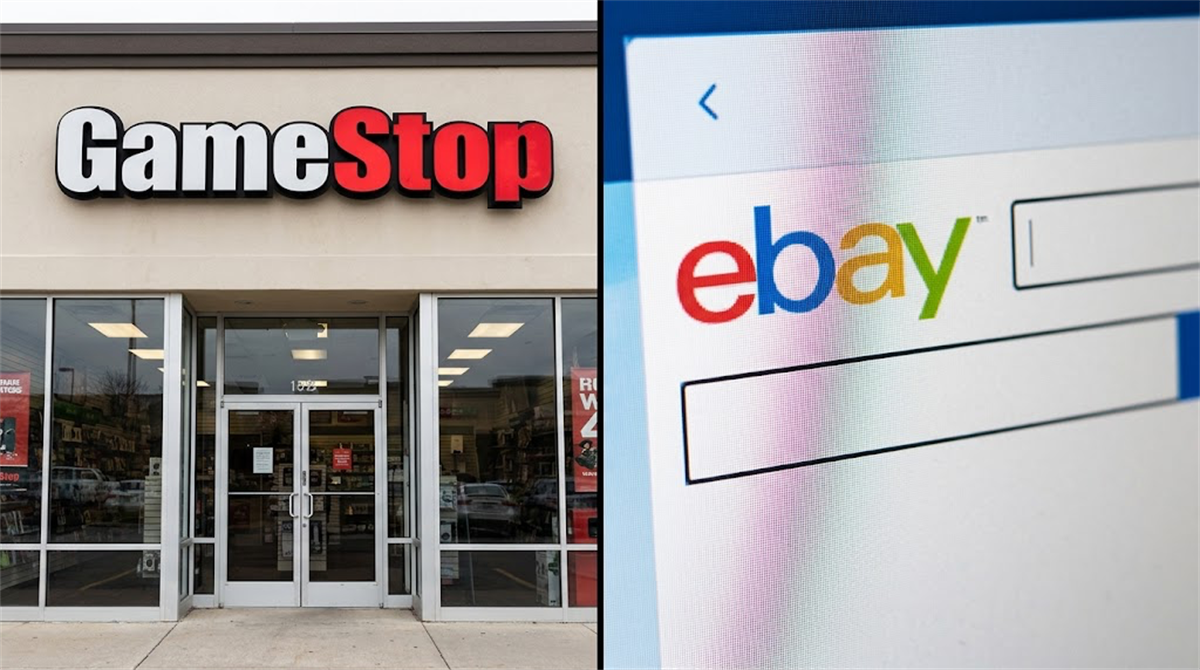
Once a struggling brick-and-mortar retailer, GameStop is now swinging for a much bigger stage. GameStop (NYSE: GME) CEO Ryan Cohen made his move, announcing the intended acquisition of eBay (NASDAQ: EBAY), but now faces many challenges.
The primary challenge is execution, as integrating the two platforms will not be easy. The real question is whether eBay accepts the offer or if the move turns hostile, an event likely to kill the company’s culture and increase the risks.
At face value, the merger is an ant eating an ant-lion, with GameStop trying to buy legitimacy, and comes with considerable challenges. GameStop has ample cash on its balance sheet, but not nearly enough to cover the move, so it will require debt financing to execute. Assuming a quick and easy transition, one in which synergies are realized and revenue streams unblocked, no problem. If, however, there are stumbles or missteps, they will be quickly seen in the stock price.
GameStop Better Bring Its A-Game to eBay Merger
Stumbles are likely. GameStop is in the midst of its own turnaround, with core sales declining and its marketplace insufficient to offset the shortfall, even as eBay works to integrate its own acquisitions. GameStop’s offer should be viewed as a swing-for-the-fences move aimed at increasing scale and reach. A move intended to help it outcompete even larger, better-established platforms such as Amazon (NASDAQ: AMZN) and Shopify (NASDAQ: SHOP), which is unlikely.
On the one hand, Amazon is a global powerhouse commanding approximately 35% to 40% of U.S. eCommerce traffic, while on the other, Shopify provides a full-service platform for retailers, far superior to eBay, and also commands a double-digit share of eCommerce business. eBay is more like 2.5% to 3.5% of the eCommerce business; successful completion relies on a flawless transition of GameStop stores to eBay shipping hubs, which eBay may not even need. As it stands, eBay sellers are generally smaller, home-based operations with smaller sales volumes; the shipping hubs it does have are strictly collection points for international business.
Risks for investors include the very significant threat of dilution. The deal is structured as a 50/50 cash-stock split, meaning approximately $27.75 billion in new stock, approximately 2.3X the company’s early-May market cap, equalling triple-digit dilution in addition to the debt risk. The company’s debt will swell to over 3.25 times its equity, equity which is tied to inventory and Bitcoin. The company’s inventory is central to its core business, which is stalling, and in decline; Bitcoin is another issue altogether.
Bitcoin Is a Distraction: Duh, Sayeth the Analysts
GameStop’s dalliance with Bitcoin is turning into a major misstep and ultimately a distraction that won’t go away quickly. With BTC down from its highs, GameStop suffers unrealized losses and, even with a rebound, the upside is severely limited. The company sold covered calls on its position, effectively transferring control to Coinbase Global (NASDAQ: COIN), with strikes in the $105,000 to $110,000 range only incrementally higher than GME’s entry points. The upside is that GME can earn some income from its position until Bitcoin rebounds; the question is whether it’s worth it, given the capital-intensive eBay offer.
The analyst response to the takeover offer was to be expected. Firms from Robert W. Baird to Morgan Stanley issued commentaries casting doubt on the deal. The primary concerns are the complex structure, the dilution threat, debt, and doubts about feasibility. Analysts doubt the deal will even happen and see eBay’s turnaround working on its own. In this scenario, Mr. Cohen’s bid is more likely to go hostile, as the eBay board may see no value in the takeover.
GameStop: A Risky Buy—eBay: A Good Buy
The stock price action is mixed. GME’s share prices fell approximately 8% upon the announcement of the acquisition, confirming resistance at the top of a trading range, but support is also evident. The decline halted near the 30-day EMA, which has been supporting the share price in Q2. If this level continues to support the market, a retest of the range top is likely, and a new high is possible.
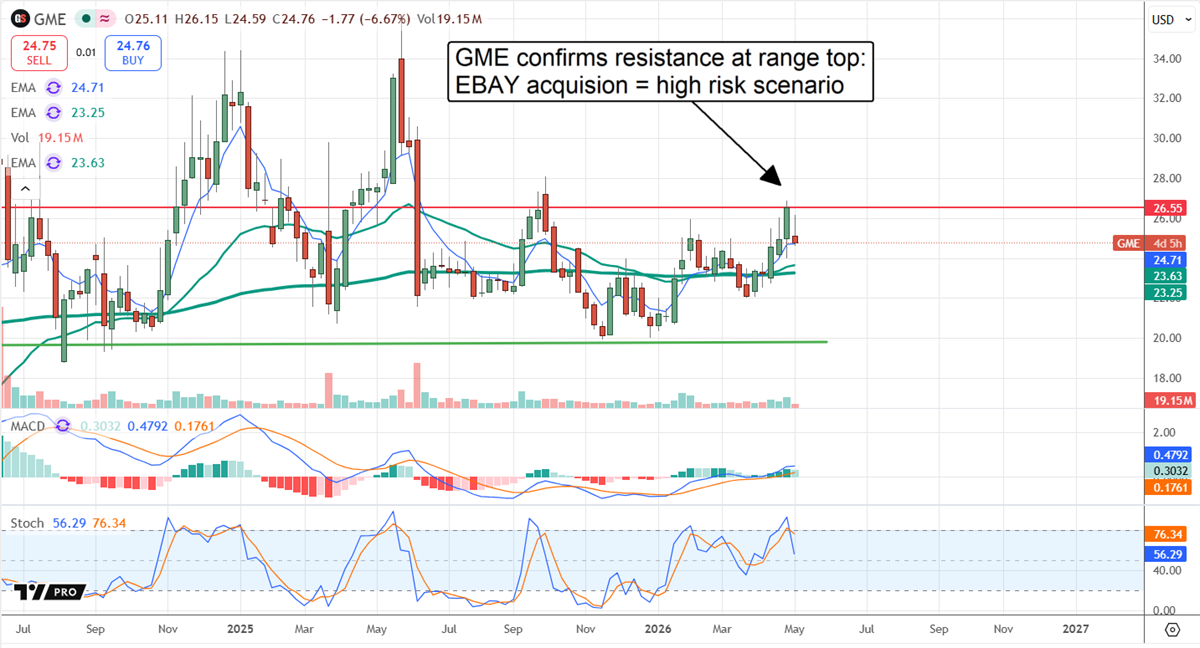
Among the risks for traders is the short interest. Short selling in GME stock heated up earlier this year and has the interest running near 15%. A move higher, specifically one that hits or exceeds an existing resistance target, is likely to trigger short interest in a self-limiting movement. In this scenario, GME stock will remain range-bound until the deal goes through and evidence of traction is seen, the core business improves, or another catalyst emerges.
eBay stock advanced to a fresh high after the announcement, and may continue to move higher. The much-needed publicity is raising awareness that its AI-powered turnaround is gaining traction. The company has increased focus on four pillar categories, and efforts are resonating with consumers.
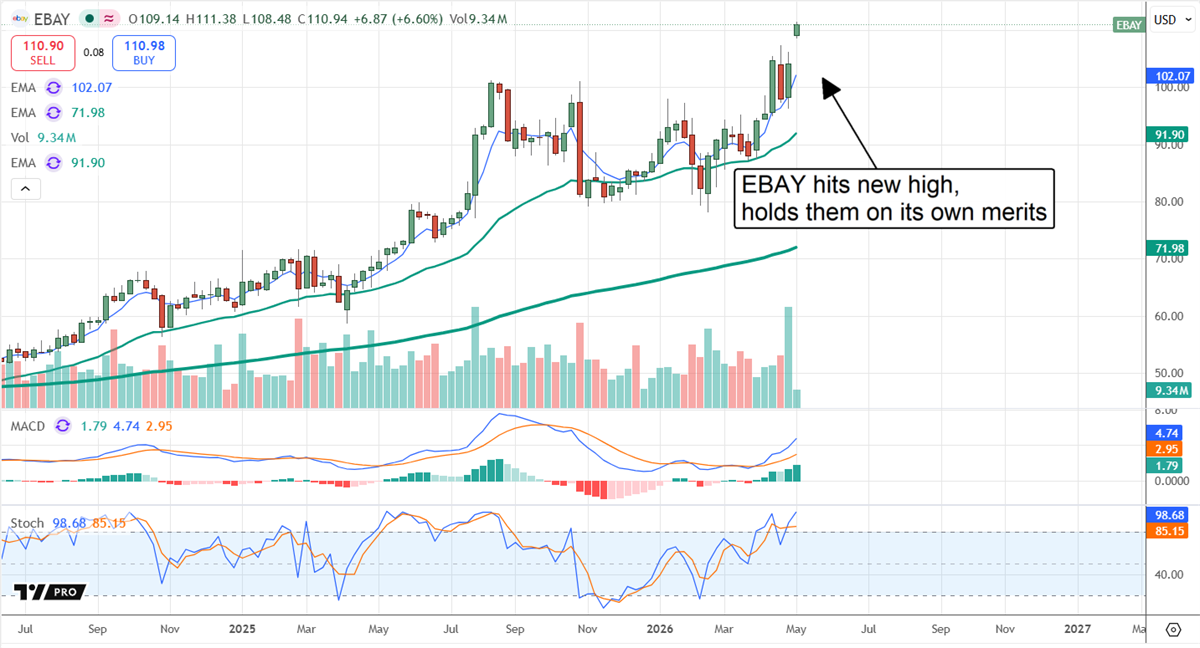
Results in early 2026 reveal outperformance and acceleration, a recipe for stock price rallies. With stronger fundamentals, a cleaner balance sheet, and a turnaround already in motion, eBay appears to hold the upper hand in this standoff—and may ultimately find itself in a position to dictate terms rather than accept them. READ THIS STORY ONLINE
Nobody Understands Why Trump Is Invading Iran (here’s the answer) (Ad)

Most investors are reacting to the Iran strikes without understanding the underlying motive driving the decision.
Addison Wiggin, Founder of Grey Swan Investment Fraternity, says there is a hidden reason behind the bombing – and knowing it could change how you position your money right now.DISCOVER THE REAL REASON BEHIND THE IRAN STRIKES BEFORE MARKETS REACT
More Stories
- The Real SpaceX Play: 5 Chip Stocks Powering the IPO Before It Launches
- Why Lockheed Martin’s Earnings Miss Could Be a Blessing in Disguise
- 55,000 attended – here is what they learned about the June IPO(Ad)
- Qualcomm’s 50% Surge: Bubble Territory or Breakout Moment?
- 3 Emerging Markets ETFs to Maximize Exposure to High-Potential Countries
- Tyson Foods’ Total Returns: Tasty Treats for Income Investors?
- Powering Up: UGI Banks $685M in Strategic Turnaround
The Night Owl is a financial newsletter that provides in-depth market analysis on stocks of interest to individual investors. Published by MarketBeat and Early Bird Publishing, The Night Owl is delivered around 9:00 PM Eastern Sunday through Thursday. If you give a hoot about the market, The Night Owl is the newsletter for you.

If you need help with your account, please don’t hesitate to contact MarketBeat’s South Dakota based support team at contact@marketbeat.com.
Unsubscribe
© 2006-2026 MarketBeat Media, LLC.
345 North Reid Place, Suite 620, Sioux Falls, SD 57103-7078. United States..
Read More: Here’s the BIG PROBLEM with the SpaceX IPO(From The Oxford Club)

 RJ Hamster