
You know it’s serious when the economic conversation spills over onto the usually “fun” side of social media.
A few days ago, a post crossed my Instagram feed with this warning: “The AI bubble is 17x larger than the dot-com bubble,” it read. “And 4x larger than the 2008 Financial crisis.”
People swarmed the comments. They wanted to know what happens to their savings… or the cash under the mattress… if the bubble pops.
“What if I’ve avoided AI this whole time?” one person asked. “How will it affect me?”
They’re not wrong to ask. If we look at the last two bubbles, the effects when they popped rippled beyond people’s stock accounts.
The dot-com crash contributed to an eight-month recession in 2001. By the spring of 2004, an estimated 403,300 jobs had been lost in the IT sector alone.
The effects of the 2008 crash were even deeper.
A Frontline article published in 2012 (four years after the stock market’s collapse) showed that:
- There were still 12.5 million people out of work, not saving for retirement, and not contributing to the GDP.
- The government had poured about $23 trillion into a host of programs and bailouts.
- Real estate had lost roughly $7 trillion, stocks $11 trillion, and retirement accounts another $3.4 trillion.
- The Census Bureau’s 2010 estimate said 46.2 million people were in poverty – the largest number in 52 years.
I’m not saying this to scare you. But with the AI bubble getting bigger each day, we can’t afford to bury our heads in the sand.
And what nobody mentioned in that discussion I read last week was the story we’ve been tracking in these pages. Yet it provides the clearest answer to the one question that kept coming up: What can I do about it?
One Market, Two Signals
On April 17, I wrote to you about the Crude Oil Civil War we’re seeing. You can read that full essay here. The short version is this: There’s a civil war happening in the crude oil markets, and most people don’t know it’s connected to the AI bubble.
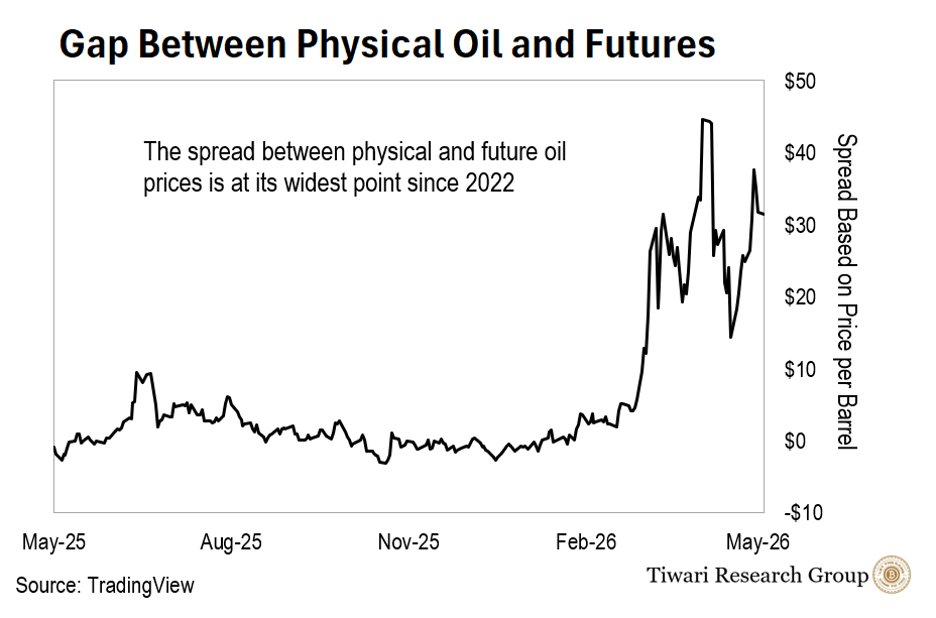
What’s happening is that the “right now” price for physical oil is telling a very different story than the “future” price traders expect to pay in the months ahead.
You can see that in the chart below, which shows the gap (or “spread”) between physical oil prices and futures prices.
That gap hasn’t been this high since 2022, when Russia invaded Ukraine.
What does it mean?
On one hand, the physical market is screaming “shortage.” Buyers need barrels NOW, and they’re paying anything to get them.
That’s because the Iran conflict has a chokehold on the Strait of Hormuz. That’s the narrow waterway through which roughly 20% of global oil supply passed before the war started in February.
On the other hand, traders are saying, “This is temporary. It’ll resolve soon.”
The problem is the market has been saying that for two months. And yet, as you can see, the gap is not really getting any smaller.
This matters because oil touches the price of everything we buy. The longer prices stay high, the more every airline, trucking fleet, chemical plant, and utility in the world will see its primary input cost rise.
And oil prices just hit fresh wartime highs on Friday.
Some of that exposure is hedged, but those hedges don’t last forever. It can take 6-12 months for the full effects to show up. By the time most people feel it, the damage is already done.
Why the “Smart” Money Is Trapped
The irony is that, at the exact moment oil is making historic moves, the institutions managing your retirement savings are legally handcuffed from owning it.
Take CalSTRS, one of the largest pension funds in America. It manages $368 billion in public equities. Between 2022 and 2025, it slashed its traditional (fossil fuels) energy weighting by 36% and moved $30 billion into low-carbon investments.
That’s exactly what I showed you on Wednesday. The “smart” money is being forced to follow ESG mandates in what could be one of the most profitable periods for oil.
Even when we zoom out to all of energy combined, it’s still one of the most underowned sectors in the market. In 2008, it represented 15% of the S&P 500.
Today, it sits at only 3.5%. Compare that to the IT sector, which represents an enormous 32% of the market.
That is a generational abandonment of energy in favor of tech. And history shows us what happens when an unloved sector gets an unexpected catalyst. It snaps back violently.
We saw this back in 2020, when energy hit a record-low weight of just 2% of the S&P 500. Most investors left it for dead after Covid lockdowns crushed oil demand.
That was a mistake. Energy went from the worst-performing sector in 2020 to the top performer in 2021. It gained 46% vs. the S&P 500’s 27%.
By 2022, energy was the only sector in the S&P 500 that finished positive, up 58%. Ten other sectors fell, and the broader index dropped 19%.
That’s a roughly 315% cumulative gain from the unloved bottom over two years, in the most hated sector in the market.
This time, with the physical oil market flashing stress signals, Daily Editor Teeka Tiwari believes we’ll see an even sharper snapback.
Just last week, Al Jazeera published a piece that asked, “When will the Strait of Hormuz be ‘safe’ for commercial shipping again?” The answer boiled down to: Not anytime soon. From that April 28 article:
About 2,000 ships remain stranded in the Gulf. Even if the strait reopens to all traffic, the United States has said it could take six months to clear mines it believes have been laid by Iran.
That is one reason maritime insurers cancelled “war risk” insurance for tankers traveling through the strait in March.
Al Jazeera reported this could push premiums up to 5% of hull value. Before the war, that number was only about 0.25%.
Hull value refers to what the ship itself is worth. Think of it like an insurance appraisal on the vessel, the same way your home has an appraised value before you can insure it. A 5% premium tells us insurers are still pricing the Strait of Hormuz like a war zone, not a shipping lane.
In other words, the crude market is only getting more fractured. And when oil sends mixed signals like this, it usually means the stress has not yet fully worked its way through the economy… and the household names in your retirement portfolio.
The “Paycheck” Strategy for This Market
This is where the oil story connects to the AI bubble.
If oil keeps rising, costs rise across the economy. That matters for every company. But it matters most for the companies already priced for perfection.
The first wave of AI gains went to the obvious names: Nvidia, AMD, Meta, Microsoft, and the rest of the high-flying tech giants.
But those stocks are now swinging violently. One day, investors are questioning whether AI companies will follow through on their promises. The next day, the same stocks are ripping higher.
We saw this with last week’s earnings. Meta and Microsoft beat analyst expectations, and yet they crashed 9% and 4%. Why? Because investors got spooked on AI spending.
That kind of volatility is exactly what we’d expect in a crowded trade. Teeka has been sounding the alarm on this since late last year. And in the January 6 Daily, he wrote:
Right now, Alphabet, Amazon, Meta, Microsoft, Nvidia, and Tesla are trading at an average weighted earnings multiple of 56x. That means you have to be willing to pay up to $56 today for every $1 the company earns in a year.
These names are trading at more than 2.5x the entire S&P 500. If that’s not a red flag, I don’t know what is.
We’re not interested in chasing that. Instead, Big T believes the biggest winners from AI won’t necessarily be the flashy tech names everyone is buying today.
The real gains will come from blue-chip companies using AI to improve their margins, cut costs, and boost productivity.
That’s exactly what Teeka’s “Nvidia’s $16 Trillion Paycheck Program” is designed to do. It doesn’t involve buying a single share of Nvidia. It doesn’t involve chasing risky AI startups. And it doesn’t require you to guess which chatbot wins.
Instead, it focuses on a select group of blue-chip companies positioned to benefit from AI adoption while paying reliable dividends along the way. The next scheduled payout is May 15. You can learn more about it here before that deadline.
The bottom line is this: Even people with no money in the markets are starting to sound the alarm on the AI bubble. In times like these, you don’t want to play a high-stakes guessing game.
You want to own the companies built to win no matter what happens next… and get paid while everyone else is guessing.
Don’t Watch the Future Happen. Own It!
Houston Molnar
Update your email preferences or unsubscribe here
© 2026 Tiwari Research Group
1607 Ponce De Leon Ave
San Juan, Puerto Rico 00909, Puerto Rico

 RJ Hamster