Unsubscribe The #1 stock to buy BEFORE the June S-1 filing (From Behind the Markets)
Shopify’s Valuation Crisis Creates Opportunity in 2026
Written by Thomas Hughes

The most pressing problem with Shopify (NADAQ: SHOP) stock is its valuation. The stock commands a significant premium, trading at over 120X trailing earnings, but it is well-deserved and prices in a robust outlook. The company self-funds growth, sustains a high-20% growth pace, and points to compounding results in the upcoming year.
Looking ahead, the forward estimates are robust, placing this stock in the low teens by 2035, suggesting a solid upside. In this scenario, Shopify’s stock could rise by 70% or more simply to align with broad market trends, and that’s not counting its emerging position as an AI-powered eCommerce leader.
The company is leaning hard on its 20 years of eCommerce data, using it to power agentic and assistant AI tools internally and for its customers. Internal uses increase productivity and throughput while the client-facing ones enable quick, easy, scalable online business construction, maintenance, client acquisition, sales, and payments. Execs say the advantage puts them in a category of one and expect results to compound in 2026.
Shopify Accelerates Growth in Q1: Guides Hot
Shopify had a robust quarter, which is saying something for a company that has sustained high growth for many years. The Q1 results reflect an acceleration compared to the prior quarter and the prior year, with revenue up 34.3% and outpacing the consensus by 250 basis points (bps). Strength was driven by all geos, merchant sizes, and channels, with gross merchandise volume up 34.7%, monthly recurring revenue up by 16.5%, and strength in both subscriptions and merchant services. Subscriptions were weakest, rising by only 21%, but were compounded by services penetration, which increased by nearly 40%.
Margin was another area of strength, despite the contraction in GAAP results, caused by a non-cash one-off. The company experienced gross margin pressure but navigated the environment well, with gross profit growth trailing revenue growth by only 210 bps, and operational strengths offsetting the difference. Operating income increased by 88% and, equally important, the free cash flow margin was maintained at 15%.
Guidance is a bullish catalyst for this market, though it was insufficient to immediately support the price action after the release. The company forecasts revenue in the high-20% range compared to the consensus 26.75%, with a mid-teens free cash flow margin. Among the sticking points are increased spending, which is cutting into the profitability outlook. The caveat is that investment in operations and AI has been paying off for the business and is likely to continue doing so.
Bullish Analysts Enter Wait-and-See Mode
The analyst response was ultimately bullish for the stock price, although near-term headwinds have emerged. No analyst revisions were issued immediately after the release, but several commentaries were, highlighting slowing growth and increased spending.
The critical detail is that the group of 44 provides a high conviction in the Moderate Buy rating, as there is a 77% Buy-side bias, coverage has been increasing, and the price target trend is positive as of early May. Consensus forecasts a 40% upside relative to critical support targets, with the high-end adding double-digits.
Institutions are a concern for Shopify investors in 2026. The group owns nearly 70% of the stock and has been distributing aggressively, with activity ramping sequentially into Q1 2026. The pace is also high, about $3.5-to-$1, and central to the stock price action over the past few quarters. The good news is that early Q2 activity reverted to accumulation, helping cement the market floor. However, there is a risk that institutions sell into any rally that forms.
Shopify Stock Is at Rock Bottom in 2026
Shopify stock may struggle to advance until later this year, but it is not expected to fall significantly either. The market shows clear support at the 150-week exponential moving average, a trigger point for long-term buy-and-hold investors, including institutional traders. The likely outcome is that Shopify trends sideways within its existing range, possibly retreating to the $110 level or slightly lower before rebounding within it.
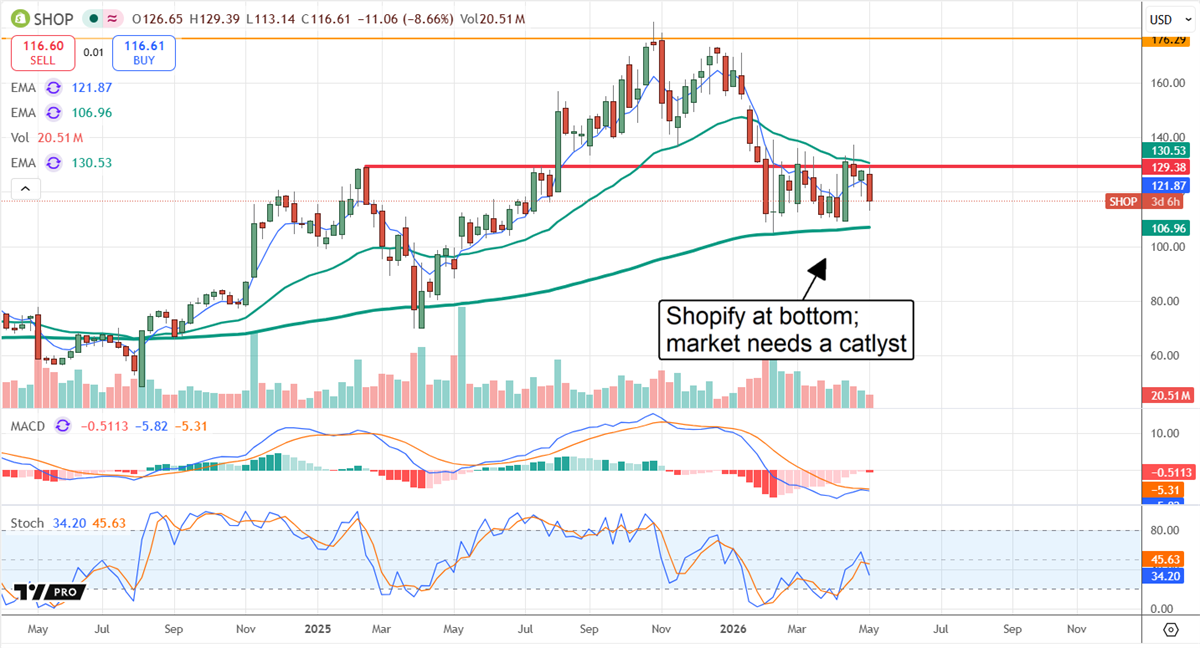
Catalysts in 2026 include the buyback authorized at the end of FY2025. Worth $1 billion, it underscores management’s confidence in the company’s financial position and has begun providing shareholders with leverage. While incremental, sequential share count reduction will add up over time and help lift this market. Future catalysts include the potential to accelerate returns, such as additional buyback authorization and dividends. Risks include increased competition from names like Amazon (NASDAQ: AMZN) and Mercado Libre (NASDAQ: MELI), which continue to take commerce share in developing and emerging markets. READ THIS STORY ONLINE
Ticker Revealed: Pre-IPO Access to “Next Elon Musk” Company (Ad)

We’ve found The Next Elon Musk… and what we believe to be the next Tesla.
It’s already racked up $26 billion in government contracts.
Peter Thiel just bet $1 Billion on it.👉 UNLOCK THE TICKER NOW AND GET IT COMPLETELY FREE.
Palantir Drops After a Blowout Q1—What Investors Should Know
Written by Chris Markoch

Palantir Technologies (NASDAQ: PLTR) delivered a blockbuster Q1 2026 earnings report after the market closed on May 4. But 85% year-over-year (YOY) revenue growth and a Rule of 40 score of 145%, among other highlights, weren’t enough to cheer investors. PLTR dropped 7% the day after the report.
The predictable concern was the company’s valuation. The company delivered earnings per share of 33 cents. That was 5 cents above projections for 28 cents. The number was also 153% higher YOY. On a GAAP basis, the earnings beat was even more impressive. GAAP EPS of 32 cents was 325% higher YOY.
To put that in even more perspective, Palantir chief executive officer, Dr. Alex Karp, made this observation in his letter to shareholders, “Indeed, we generated nearly as much in profit in the first quarter of the year as we did in revenue only twelve months ago.”
This is key to reconciling the PLTR price. Analysts are projecting earnings growth of around 43% in 2026. The company is on pace to do far better than that. But critics of Palantir’s valuation only need to be right once. And at least the day after earnings, momentum was on their side.
Government and Commercial Growth Both Accelerate—A Rare Double
As in the past several quarters, Palantir registered strong growth on both the government and commercial sides of its business. U.S. commercial revenue grew 133% YOY to $595 million, and U.S. government revenue grew 84% YOY to $687 million.
It’s hard to understate the importance of this growth, as Palantir critics often continue to miss the massive growth story that’s occurring on the commercial side of the business. The company was born through its business with the U.S. government, but it’s become much more than that.
As the numbers show, both sides of the business continue to grow and grow strongly. In fact, Palantir raised its full-year outlook for both revenue and earnings. That’s impressive after the quarter it just posted.
Wall Street Is Raising Targets While Burry Shorts the CEO
The real signal for Palantir investors comes from the analyst community. Dan Ives of Wedbush was quick to reiterate its Outperform rating and $230 price target for PLTR. Rosenblatt Securities also reiterated a Buy rating and raised its price target from $200 to $225.
It’s worth noting that some analysts have been lowering their price targets on the stock. But in all cases, it would confirm a range-bound state that has been in place for much of this year. There’s also more news from one of Palantir’s favorite bears, Michael Burry, who says he is now outright shorting PLTR. However, Burry said he’s not just shorting the stock based on valuation, he’s “shorting the business model. I am shorting the entire premise upon which the company rests. I am shorting the CEO.”
This is a continuation of a feud that’s existed between Burry and Karp since the end of 2025 when Burry announced he had taken out put options against PLTR. The stock is down over 20% in 2026, and institutional selling outpaced buying in the first quarter. Some would say that proves Burry right. Others would reference a broken clock.
Is Palantir Being Punished for Its Past Success?
The reality of Palantir in 2026 is different than it was just a few years ago. Investors who expect the stock to climb 550% in the next five years, as it has in the last five years, will likely be disappointed. The company has a lot of growth priced into it.
But that doesn’t mean it’s not worth a premium valuation. Institutions will continue to own PLTR, and analysts (with some exceptions) continue to raise their price targets. It’s possible that PLTR will continue to chop around for 2026 while investors sort out the winners and losers in the AI software space.
But just as was the case in 2021 and 2022, that patience is likely to be rewarded for retail investors, many of whom are content to hold the stock after taking out their initial investment.
The Eye Test Still Matters—And Palantir Keeps Passing It
Palantir is a victim of the self-fulfilling prophecy. At this point, the critics have nothing more to say other than valuation, and they’re confident that at some point, that will be reflected in the stock price.
I’m not going to argue math with anyone. That’s like debating metrics like expected batting average or WAR+ with baseball purists.
But in sports, as in investing, the eye test still matters. Palantir isn’t going to make the cut for investors who focus solely on valuation. There are plenty of other stocks that they can own and still sleep at night.
However, the eye test is compelling. Look at it this way. If you had one player to send to the plate for one at-bat in a “gotta have it” moment, there are a lot of players who come to mind that wouldn’t check the boxes as a great hitter. But will you bet against them in the moment? Probably not.
That analogy works for Palantir on two levels. Palantir not only met the moment, it crushed it. Furthermore, it suggested that there’s even stronger growth to come, which almost doesn’t seem possible. And it would be dubious, except that Palantir has continued to do surprise quarter after quarter.
But it also illustrates what Palantir means to its customers on both the commercial and business sides. They rely on Palantir’s Ontology to deliver the insights that they can’t get in any other way.
It’s not a valuation darling. Its business model is misunderstood and, in some cases, misrepresented. But investors who are waiting for PLTR to get the analysts’ stamp of approval will be kept waiting. Meanwhile, the stock is likely to move higher over time. READ THIS STORY ONLINE
The #1 stock to buy BEFORE the June S-1 filing (Ad)

When the SpaceX IPO launches, most retail investors will be locked out. The banks, funds, and insiders get in early – while everyone else waits on the sidelines.
But one small infrastructure supplier – a critical piece Musk can’t scale the Colossus network without – is still trading well under institutional radar. A new briefing reveals the name and ticker at no cost.GET THE SPACEX INFRASTRUCTURE STOCK NAME AND TICKER HERE
TSLA: 3 Reasons the Stock Could Hit $400 in May
Written by Sam Quirke

Having initially traded down following last month’s earnings report, shares of Tesla Inc (NASDAQ: TSLA) are once again pointing north. The stock is currently trading around $390, putting it within touching distance of $400. This means that Tesla has not only recovered the ground it lost following April’s report but has actually pushed past its pre-earnings price, a clear sign that sentiment has swung to the bulls’ side.
That kind of price action matters, especially given the multi-month downtrend that had been gathering pace. As we head into the start of summer, it’s looking more and more like Tesla has flipped the narrative back in its favor, and the path toward $400 looks increasingly clear. Let’s take a look at the bull case and the top three reasons in particular that Tesla should be back trading above that level in the coming weeks.
Reason #1: The Earnings Reset Has Reopened the Bull Case
As MarketBeat noted at the time, Tesla’s latest earnings report didn’t need to be perfect. It just needed to be good enough to stabilize the story and remind investors of the company’s underlying strength—which is exactly what it did.
Margins improved, profitability held up better than many had feared, and the company’s Services revenue grew strongly. Taken together, these factors helped shift the focus away from short-term concerns around demand and pricing pressure and back toward Tesla’s ability to generate sustainable earnings.
More importantly, the report addressed one of the key bearish arguments that had been building in recent months. That is, Tesla’s core business was losing momentum in a way that could not be easily offset by exciting, but as yet unrealized, future ambitions.
Instead, what the results showed was a business that is adjusting, not collapsing. This distinction is crucial. When a stock is under pressure, the first step toward a recovery is removing the worst-case scenario from the table. Tesla has done that, and in doing so has diminished, if not completely removed, one of the stronger headwinds that was pushing the stock down in recent weeks.
Reason #2: The Growth Story Is Now Bigger Than Cars
If the earnings report stabilized the downside, then Tesla’s evolving growth narrative has been driving the upside. Thanks in large part to clear messaging on this in last month’s report, the company is increasingly being viewed through the lens of artificial intelligence, autonomy, and robotics rather than just as an electric vehicle manufacturer. This is a shift Tesla has been trying to achieve for months now, and it looks like it’s finally starting to stick.
Developments around full self-driving, the ongoing buildout of its robotaxi ambitions, and progress in areas like Optimus are all contributing to a broader story that extends well beyond car sales. Tesla continues to invest heavily in these areas, and the path to clear returns is becoming clearer. That’s helping to reposition the shift in investors’ minds from a theoretical pivot to an actual strategic plan.
In terms of what this means for the stock, the key point is that the company’s growth potential is expanding rapidly. While Tesla’s automotive business remains important, it’s no longer the sole driver of the valuation, and arguably isn’t even the primary driver of valuation anymore.
Investors are instead starting to price in the potential for entirely new revenue streams, which is creating room for the stock to move higher—hence why $400 could soon become the new floor.
Reason #3: Momentum and Sentiment Are Now Aligned
Perhaps the most important factor in the near term is the alignment between price action, sentiment, and positioning. Tesla’s recovery from last week’s post-earnings dip has been decisive, especially when you consider the stock had been selling off continuously since December.
The setup is, for now at least, looking less like a short-term bounce and more like the start of a fresh uptrend. At the same time, analyst sentiment is moving in the same direction. Recent updates over the past two weeks have seen HSBC upgrade the stock to a Buy rating, while Tigress Financial, Deutsche Bank, and President Capital all reiterated bullish positions. The updated price targets are also supporting the case for further upside from here, with President Capital’s fresh $428 target in particular suggesting that a move beyond $400 is imminent.
Add in a broader risk-on backdrop that’s driving equities to all-time highs, with investors increasingly happy to lean back into growth names like Tesla, and the setup becomes even stronger. The stock has quickly moved from the defensive to the offensive, and while it still needs to deliver, $400 now looks like the next step rather than an ambitious target. READ THIS STORY ONLINE
5 Space Stocks Set to Watch as the New Space Race Heats Up (Ad)

With NASA’s Artemis missions underway and launch costs falling dramatically, the space economy is evolving into a long-term infrastructure play with contracts and recurring revenue to match.
A new free report highlights five publicly traded companies across launch, satellites, defense, and space-based intelligence – from a rocket company expanding into spacecraft manufacturing to a real-time satellite intelligence firm selling data to governments and corporations.READ THE FREE REPORT AND DISCOVER ALL FIVE SPACE ECONOMY STOCKS
More Stories
- NVIDIA’s China Connection: Investor Risks With Earnings Ahead
- Amazon Weaponizes Logistics, Triggering Sector-Wide Selloff
- Trump Admin to Pump $1 Billion into this “Off-the-Radar” AI Stock(Ad)
- Atomic Dividends: Big Tech’s New Energy Bet
- onsemi Stock Dips After Earnings: Why the Dip Is Buyable
- Norwegian Cruise Line Cuts Outlook as Headwinds Build
- Monolithic Power Systems: AI Stock Beat, Raised and Upgraded Post-Earnings
The Night Owl is a financial newsletter that provides in-depth market analysis on stocks of interest to individual investors. Published by MarketBeat and Early Bird Publishing, The Night Owl is delivered around 9:00 PM Eastern Sunday through Thursday. If you give a hoot about the market, The Night Owl is the newsletter for you.

If you have questions or concerns about your account, please feel free to contact our U.S. based support team at contact@marketbeat.com.
Unsubscribe
© 2006-2026 MarketBeat Media, LLC. All rights reserved.
345 N Reid Pl. #620, Sioux Falls, S.D. 57103. United States of America..
Featured Link: Ticker Revealed: Pre-IPO Access to “Next Elon Musk” Company(From Banyan Hill Publishing)


