Unsubscribe Ticker Revealed: Pre-IPO Access to “Next Elon Musk” Company (From Banyan Hill Publishing)
How Williams Companies Is Cashing in on the AI Power Boom
Written by Chris Markoch

Williams Company Inc. (NYSE: WMB) moved up a modest 1% after delivering mixed headline numbers in its Q1 2026 earnings report. The company delivered adjusted earnings per share (EPS) of 73 cents, easily beating expectations of 63 cents. However, revenue was a slight miss with Williams delivering $3.03 billion, below expectations of $3.28 billion.
Some context is required. For midstream infrastructure companies like Williams, revenue can be misleading due to commodity pass-through accounting. A more relevant metric of a company’s health is adjusted EBITDA. And that’s an area where Williams shone, reporting a record $2.25 billion.
The key takeaway from the report is that demand for natural gas far exceeds supply. The company cited research that natural gas demand will increase by 35% in the next decade. It’s a structural tailwind for WMB to move higher, even as it approaches its consensus price target and the top of its 52-week range.
Williams Doesn’t Directly Export LNG, But…
Natural gas companies are getting a tailwind from the supply disruptions in the Middle East, which are increasing demand for LNG from the United States. That’s not going to impact Williams directly, as its transmission pipelines are confined to the continental United States.
But the company does have an acquired interest in Louisiana LNG. That gives the company fixed-fee revenue tied to that export market. Also, the company’s Transco pipeline corridor is a primary gas artery for Gulf Coast LNG facilities. This is a specific, concrete relationship that positions Williams to benefit from expanding Gulf Coast export capacity.
Data Centers Hold the Key to Long-Term Demand
The data center opportunity may be the most underappreciated element of the Williams growth story. The company is investing approximately $9.6 billion in behind-the-meter power projects. That means it is essentially building turnkey natural gas power plants directly connected to hyperscaler data centers, bypassing the traditional grid entirely.
The portfolio includes six named projects: Socrates, Apollo, Aquila, Socrates the Younger, Neo, and Atlas, with in-service dates ranging from late 2026 through 2028. Combined ISO capacity across these projects exceeds 2,500 megawatts, under agreements ranging from 10 to 12.5 years. Williams also has approximately 6 gigawatts of additional projects in its backlog.
The strategic logic is straightforward. Hyperscalers need power that is fast to deploy, always on, and independent of grid constraints. Renewables cannot currently meet that standard without massive battery storage infrastructure that doesn’t yet exist at scale.
Williams is positioning itself as the answer to that gap. Instead of simply moving gas, this means Williams is embedding itself directly into customer infrastructure under long-term contracts.
The company’s backlog of approximately $15.5 billion between 2027 and 2033 accounts for about 18 months of current revenue. That’s a good reason to believe there’s a higher floor for WMB.
But how high is the ceiling? WMB is butting up to its consensus price target of roughly $79. Analysts have been slow to update their ratings and price targets since the report. However, since the company’s Q4 earnings report, a handful of firms have raised their price targets. The most bullish comes from Morgan Stanley (NYSE: MS), which raised its target to $90 from $83.
How Concerned Should Investors Be About the Debt?
The one area of the report that investors shouldn’t be too quick to dismiss is the company’s growing capital expenditures (CapEx). The new midpoint of $7.3 billion has pushed the company’s leverage to approximately 4.1x. That’s only a tick above the company’s target of between 3.5 to 4x.
In a vacuum, the number isn’t a concern. Williams has an investment-grade balance sheet and laddered maturity levels. However, in 2008, WMB was rocked after a credit shock hit the market, catching the company offside. While a credit shock of that magnitude seems unlikely, the risk of a mild credit shock is not zero.
That said, there’s probably an appropriate level of concern to apply to the company’s elevated debt level. It’s not zero, but it’s not a high-priority concern.
The heavy capital investment is front-loaded into the current calendar year. And on the earnings call, the company noted that the projects coming online in 2027 and 2028 will generate new EBITDA, helping reduce the leverage ratio before active debt paydown begins.
Maybe Not a Stock to Hold Forever, But a Strong Performer for Now
The continued buildout of renewable energy projects, specifically solar and battery storage, is a real threat to Williams. However, the threat is likely not a significant one to the business until 2035 or later.
At that point, battery storage at grid scale will become economically competitive with natural gas. It’s also when the company’s current wave of LNG export contracts begins to roll off. Adding to the bear case is that the timeline also roughly coincides with the company’s longer-dated transmission contracts coming up for renewal.
These three headwinds converging around the same horizon are worth monitoring. If any one of them accelerates faster than expected, that 2035 timeline could compress. But what may happen in the future isn’t the same thing as what’s happening right now. For now, Williams looks like a solid choice for income and growth during this unprecedented period of natural gas demand. READ THIS STORY ONLINE
URGENT: $2 Gold Stock With Major Discovery (Ad)

A $2 gold stock is said to quietly control what may be the largest gold deposit in the world – worth nearly $1 trillion.
According to Jim Rickards, an announcement is expected around July 1that could bring this historic discovery into public view.SEE THE FULL DETAILS ON THIS $2 GOLD STOCK BEFORE JULY 1
DigitalOcean’s AI Surge: How Far Can This Rally Go?
Written by Thomas Hughes

Digital Ocean (NYSE: DOCN) is an AI infrastructure play potentially beyond compare. It not only owns and operates a network of high-performance data centers but also has the software stack to support them. It is a cloud computing solution for small and medium-sized businesses, enabling them access and scalability alongside ease of use, and the business is gaining traction. Plans include expanding its footprint over the coming year, driven by a rising tide of AI demand; the question for investors is how high this AI play can go.
DigitalOcean Accelerates, Outperforms, and Raises Guidance
DigitalOcean had a solid Q1 earnings report, with revenue growth topping 22%, accelerating sequentially and compared to the prior year.
Revenue outpaced the consensus by a substantial margin, indicating a fundamental misunderstanding of the growth opportunity, and is expected to continue accelerating in the upcoming quarters. Growth was driven by large clients and AI demand, with annual run-rate revenue (ARR) from large clients up by 180% and AI-related ARR up by 221%.
Margin news was mixed, with margin contracting in some comparisons and expanding in others. The critical details are that the core business is profitable, profitability improves with scale, and weaknesses are tied to spending increases. Spending increases aim to increase capacity and underpin management’s decision to increase guidance. They now expect at least 50% revenue growth in the subsequent fiscal year and may be cautious in the estimate. The company is already expanding its footprint, and pricing is a factor to consider as well. Demand for GPU capacity is driving rental prices through the roof, and DigitalOcean is exposed to the market.
Strong Market Getting Stronger, But Upside May Be Limited
The MACD indicator suggests that this rally is just getting started. It is a measure of market momentum and can be used to gauge whether a market is strengthening or weakening. In this case, the convergence between the MACD peak and price action suggests the market is strengthening and likely to continue higher over the long term, with periodic corrections aside.
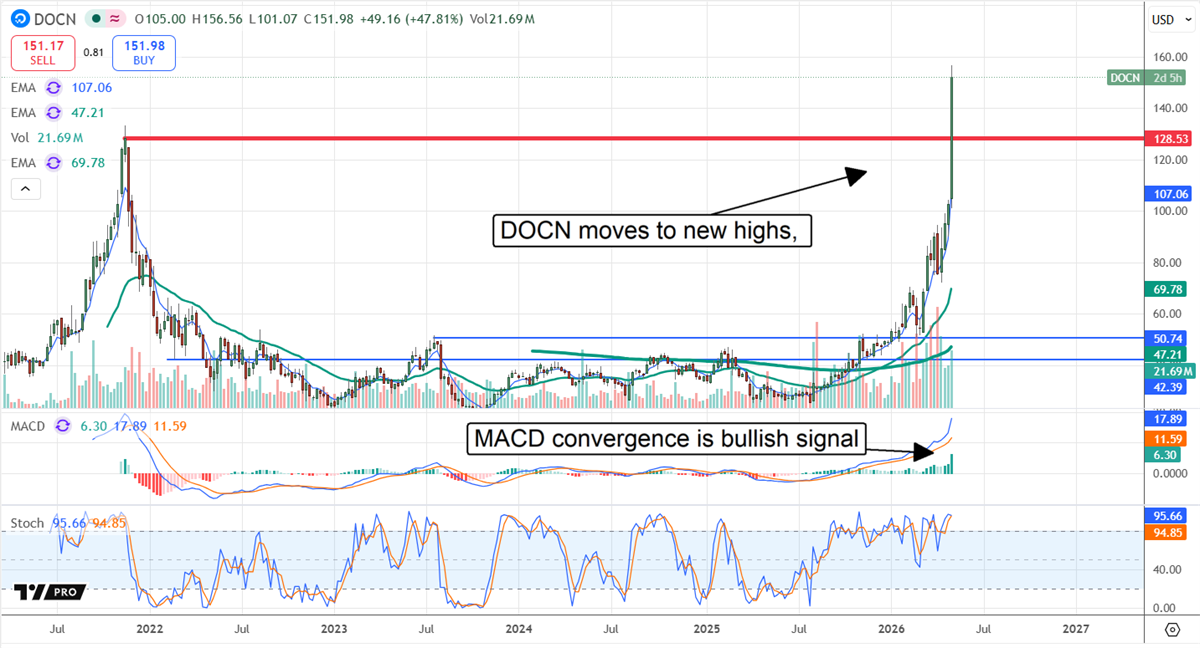
Analysts, institutions, and valuation suggest the upside may be limited, but they are not the only factors in play. Analysts rate the stock as a conviction Moderate Buy with 75% Buy-side bias, but price action has outpaced the consensus price target. The likely outcome is that DOCN stock price corrects at some point, touching base with the consensus level before continuing its advance in the longer term. Additionally, institutions were selling heavily in late 2025 and early 2026, which presents a headwind for the market and could amplify any correction that forms.
Valuation is the biggest concern, as the stock trades at over 125X its current-year earnings forecast. The market is pricing in a robust outlook, but even so, valuation is expected to fall only slightly over the next few years, leaving the stock highly valued relative to its forecasts and tech peers. The worst-case scenario is that this company fails to meet its outlook, leading to a market reset and a massive stock price correction, but that is unlikely given the recent Q1 results and the guidance update.
2 Catalysts for DOCN Price Action May Strengthen
While analysts and institutions limit the upside potential, they also provide support for this market. The market has outrun the consensus price target, but the trend remains positive, with recent revisions leading it into the high end of the range. Those revised price targets would be sufficient for more than 30% upside from the $150 level, where the DOCN stock price surged following the report. Institutions, on the other hand, sold heavily in early 2026 but reverted to buying in early Q2 and may continue to accumulate as the quarter progresses.
Catalysts for this stock include its aggressive expansion. The plans include more than tripling total capacity by early 2028, potentially driving revenue growth into the triple-digit range and sustaining it for several quarters. Risks include the cost of buildout, including a nearly-$1 billion equity raise, and the threat of dilution. As it stands, the share count is up approximately 10% at the end of Q1, and though the company is well-capitalized, additional funding is not out of the question. Delays, missteps, and cost-overruns will be reflected in the stock price.
DigitalOcean is leaning on debt to fundits expansion, and its balance sheet can handle the load. Highlights at Q1’s end include increased cash, current and total assets, with long-term debt and liabilities declining, equity improving, a net-cash position, and low total leverage. The likely outcome is that cash flow will enable debt reduction as the buildout progresses, with cash flow increasing over time and equity rising alongside it. READ THIS STORY ONLINE
Ticker Revealed: Pre-IPO Access to “Next Elon Musk” Company (Ad)

We’ve found The Next Elon Musk… and what we believe to be the next Tesla.
It’s already racked up $26 billion in government contracts.
Peter Thiel just bet $1 Billion on it.👉 UNLOCK THE TICKER NOW AND GET IT COMPLETELY FREE.
Capital One’s Big Bet Faces Rising Credit Risk
Written by Peter Frank

It’s complicated, but just you wait. That’s the message from Capital One (NYSE: COF) in light of its first-quarter results as it undertakes a significant rejiggering of its business.
For many investors, that’s not been a convincing argument. The lender’s stock has fallen more than one-third since early January. But analysts expect the shares to rebound. Investors trying to decide whether the recent selloff is a red flag or a buying opportunity need to pick through the numbers carefully.
Capital One’s Road to Payments Giant
Capital One is arguably one of the most closely watched bets in American banking. When the company completed its takeover of Discover in May 2025, it bought more than a credit card company. It got its own payments network.
Instead of running its cards on the Visa (NYSE: V) or Mastercard (NYSE: MA)platforms, which charge merchants interchange fees, Capital One can route transactions on its own rails, potentially saving billions over time.
The combined company now lands solidly among the top four payment networks in purchase volume with Visa, Mastercard, and American Express (NYSE: AXP).
From the deal, management has promised more than $2.5 billion in annual synergies, including $1.5 billion from cost savings and $1.2 billion from network efficiencies.
Much of that might not show up until 2027, after the planned technology merger and migration of customers.
That’s the idea, but the first-quarter results told a more complicated story.
Earnings Missed Expectations
For the first quarter, Capital One reported adjusted earnings of $4.42 per share, missing analyst expectations of $4.61 per share. Revenue surged 52.3% year-over-year to $15.23 billion, thanks in large part to the contribution of Discover. But even that fell short of Wall Street forecasts.
The number that caught much of the attention, though, was net interest margin, which sank to 7.87%, down 39 basis points from the prior quarter. That measure of the difference between what a bank earns on its loans and what it pays on deposits again disappointed.
For its part, the company blamed fewer calendar days in the first quarter compared with the last three months of 2025 and the seasonal impact of customers paying down debt after the holidays. But strong retail deposit growth and the impact of the company’s sale of the Discover Home Loans portfolio also factored in.
There was some good news. Earnings before the bank set aside reserves for potential troubled loans rose 8% quarter over quarter to $6.8 billion. And signs that integration was coming along led to non-interest expenses falling 9% to $8.5 billion, and marketing spend dropping 23%.
Credit Losses Keep Climbing
Still, other trends were troubling. Capital One’s provision for possible credit losses surged 72% YOY to $4.07 billion—again coming in higher than analyst estimates. Overall, net charge-offs reached $3.8 billion for the quarter, up 41% YOY.
This is not the direction investors wanted to see. Capital One’s core business is consumer credit cards, and its customers have historically skewed toward subprime and near-prime borrowers. Even with Discover’s more affluent consumer profile, stressed household budgets with elevated inflation and interest rates could keep Capital One’s loan losses eating into earnings.
In fact, management’s decision to build reserves by an additional $230 million, most notably in auto and consumer banking, could suggest possible tough conditions ahead.
Capital Levels Provide Some Protection
The company does have room to cushion surprises. Capital One’s Tier 1 capital ratio stands at a healthy 14.4% and is in line with many in the financial sector. And while the dividend yields just 1.7% annually on a payout of $3.20 per share, the board has approved a $16 billion buyback plan near the end of last year.
The bank’s efficiency ratio, which is a measure of how much it spends to generate each dollar of revenue. stood at 55.57%. That’s not bad for retail banks with large branch networks, but above the sub-50% levels enjoyed by many digital-first banks. Still, the level trended down from the previous and YOY quarters, and the gap suggests some redundancies still exist. The migration of Discover’s credit card customers onto Capital One’s technology platforms, if completed as planned, could provide some relief for these numbers.
The Discover Deal Must Deliver
The central question still is whether the Discover acquisition will deliver on its promises. The strategic logic of the Discover deal is clearly there. Owning a payment network may help expand the combined brands’ merchant acceptance globally, which is a lingering soft point, and could unlock substantial revenue.
But the integrations and cost savings need to arrive. That becomes even more interesting as Capital One also picked up another business in April when the lender closed on a $5 billion for Brex.
That additional strategic pivot moved the company even further beyond its traditional consumer business. Brex, a fintech platform that provides business payments and spend management services, delivers to Capital One an AI framework designed to automate accounting workflows. Beyond consumers, the purchase is a potentially neat fit for a lender to small businesses.
Analysts Still Expect Upside
With all the numbers and news to digest, analysts remain broadly bullish on the company, though some lowered their targets after the first quarter results.
As of now, the consensus rating on the stock is Moderate Buy, with an average price target of $258.14 implying roughly a one-third upside from current levels near $190. Price targets for 12 months range from $215 at the more cautious end to $310 at the most optimistic.
An agreement to pay $425 million to settle a class action suit alleging that Capital One had practiced deceptive marketing tactics also knocked the stock price in late April.
Investors Face a High-Risk Bet
For investors, there’s obviously still much to consider. Capital One is a high-conviction bet wrapped in genuine near-term uncertainty. For investors with a two-year time horizon and a stomach for volatility, the current price near $190 may prove to be an attractive entry point.
The 30+% decline from a recent peak may have already priced in a meaningful amount of bad news. If credit quality stabilizes and integration milestones are met, the stock has clear room to recover toward analyst targets.
But the risks remain. The company’s 1.7% dividend yield is unremarkable for income investors. And credit losses are still rising, while questions over two integrations remain. If you enjoy the uncertainty of predictions markets, this stock may be for you. READ THIS STORY ONLINE
The #1 stock to buy BEFORE the June S-1 filing (Ad)

When the SpaceX IPO launches, most retail investors will be locked out. The banks, funds, and insiders get in early – while everyone else waits on the sidelines.
But one small infrastructure supplier – a critical piece Musk can’t scale the Colossus network without – is still trading well under institutional radar. A new briefing reveals the name and ticker at no cost.GET THE SPACEX INFRASTRUCTURE STOCK NAME AND TICKER HERE
More Stories
- Apple Talks Just Changed Everything for Intel
- Insider Sales: Top AST SpaceMobile Insider Cuts Postion Over 30%
- Are any of these 10 “toxic” stocks in your portfolio? (Ad)
- Just How Big a Problem Could Amazon’s Cash Burn Rate Be?
- BlackBerry Rewrites Its Own Operating System
- Years in the Making, AMD’s Upside Movement Has Just Begun
- Grab Holdings Faces Hurdles, But Upside Potential Is Hard to Ignore
The Night Owl is a financial newsletter that provides in-depth market analysis on stocks of interest to individual investors. Published by MarketBeat and Early Bird Publishing, The Night Owl is delivered around 9:00 PM Eastern Sunday through Thursday. If you give a hoot about the market, The Night Owl is the newsletter for you.

If you need assistance with your newsletter, feel free to email our U.S. based support team at contact@marketbeat.com.
Unsubscribe
© 2006-2026 MarketBeat Media, LLC.
345 N Reid Pl., Suite 620, Sioux Falls, South Dakota 57103. U.S.A..
Check This Out: Your $29.97 book is free today(From Profits Run)


