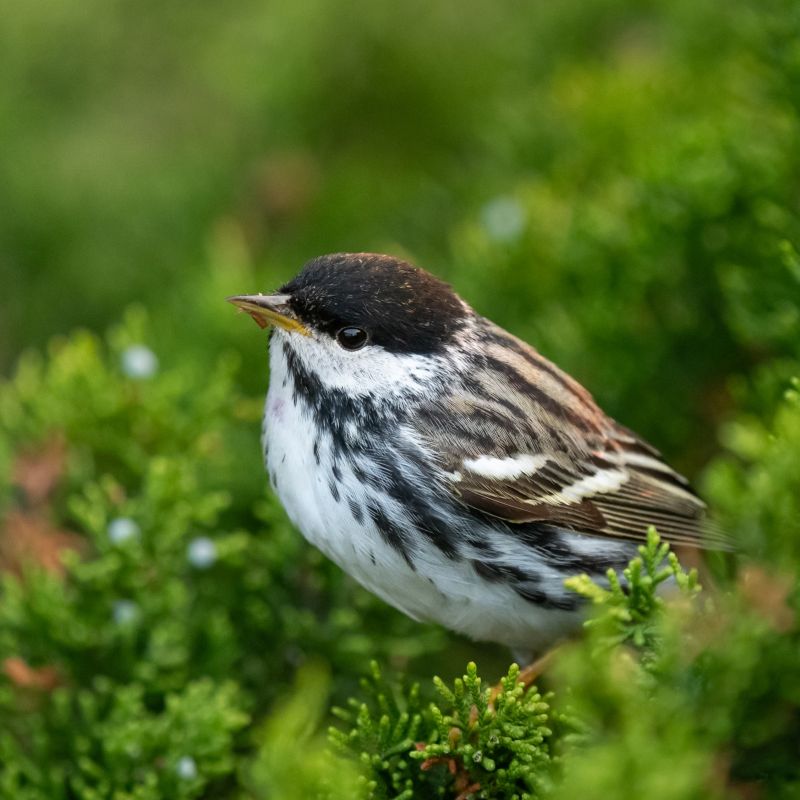
In Canada, the Seal River Watershed encompasses a vast 12-million-acre landscape of pristine forests, wetlands, lakes, streams, and rivers. It’s one of the largest intact watersheds on Earth, providing clean water and healthy lands to local communities, while also acting as an important Natural Climate Solution, storing an immense amount of carbon in its forest floors and peatlands. It is home to iconic species like polar bears, belugas, and wolverines. Millions of migratory birds rely on the Seal River Watershed—which lies in the heart of the Boreal Forest in the province of Manitoba—including Tennessee and Blackpoll Warblers, Common Loons, Hudsonian Whimbrels, Harris’s Sparrows, and other birds you may see in your own neighborhood.
The Seal River Watershed Alliance, an Indigenous collaboration of four First Nations; the Manitoba Government; and the Government of Canada have proposed to conserve the Seal River Watershed through multiple layers of protection and stewardship. The entire watershed will be an Indigenous Protected and Conserved Area that will include a new national park and a new provincial park.
This layered approach offers a variety of tools and resources to conserve the land, sustain Dene and Cree traditions, generate economic opportunity, and promote recreational access for all. The Government of Canada is now requesting public comment on the shared proposal, so you have a chance to speak out.
I was born on 6 August 1956 in San Francisco, California to Janet and (the late) Richard Hovis.
I grew up in Santa Monica, California where I attended elementary, junior high school, and high school (graduating in 1974), in addition to involvement in sports and recreation (Little League +, the Boy’s Club ++). Further, it was in elementary school – St. Augustine’s By-the -Sea Parish School that I found, and made the choice to truly journey with God.
I attended Arizona State University from 1974 to 1977 – seeking to become an architect, however, I was not accepted, and, as such, I graduated with a Liberal Arts degree.
Upon graduation from Arizona State University, I attended Cal Poly San Luis Obispo and studied City and Regional Planning at the Master’s level. I successfully completed one (1) year in a two (2) year program – I did not complete the Master’s degree in City and Regional Planning – due to personal reasons.
I returned to Santa Monica where I started (October 1979) my career as graphic designer with Exxon Company, USA. I spent five years with Exxon Company, USA.
While working with Exxon Company, USA I was accepted into architectural school – Sci-Arc in Southern California, however, I did not attend preferring to stay with Exxon..
In 1982 I married Laura Flosi and in April 1983 we had our one and only child – Lauren Alain Hovis – a gift from God.
We moved to Phoenix, Arizona in 1984 from Los Angeles, where I went to work as a graphic designer with Kitchell CEM (from 1985 -1987).
From 1987 – 1995 I was an independent contractor, and a registered representative in mortgage finance, financial management, graphic design, and drafting.
Further, I attended the University of Phoenix and successfully obtained a Master’s in Business Administration (MBA) in 1982.
I was also a member of the Scottsdale Jaycees, where I became very involved in community events and projects.
In 1994, I accepted a cartography position with the Defense Mapping Agency in Reston, Virginia. As such, I relocated from Phoenix to Reston.
In 1998, I was accepted and worked as a Visual Information Officer with the Central Intelligence Agency. In 2002, I worked as a Support Officer until my retirement (due to a need for shoulder surgery) in September 2018.
Away from my Federal Government service, I have been involved in various organizations and activities in Northern Virginia.
In November of 2011, I married Rebecca Ouellette in Santa Monica, California. I reside in San Tan Valley, AZ with my two hamster - Jess and Timothy, our fish, our lizard - RJ Lizard., and our cats - Pearl and Grey.
As to hobbies, I enjoy playing sports, attending sporting events, mentoring individuals from financial management to hamsters, building models, photography, travel, multimedia design, managing partner for RJ Hamster, and jazz – smooth jazz to a samba or a bossa nova.
Love and God Bless,
Peter – aka RJ Hamster Jo hi
View all posts by RJ Hamster





 RJ Hamster