Unsubscribe Larry Benedict’s three-step gold strategy anyone can follow (From Brownstone Research)
Before the Moon Base Gets Built, These 4 Companies Win
Written by Thomas Hughes

Photonics is critical to AI, with data centers the primary driver of business in 2026. The vast amounts of data require ultrafast, high-bandwidth transmission, or else face the bottlenecks presented by traditional copper.
However, photonics is good for more than just AI, and space is the placewhere it is needed most. Photonics is viewed as absolutely critical for the development and commercialization of space, as it enables not only the ultra-fast communication required, but also is low-weight and smaller in size, enabling lighter craft and larger payloads, is naturally resistant to interference, and is useful for remote sensing. Remote sensing has many applications, among them the maneuvering and docking of ultra-expensive spacecraft and stations on track for construction in upcoming years.
Aeluma Advances Commercialization Process
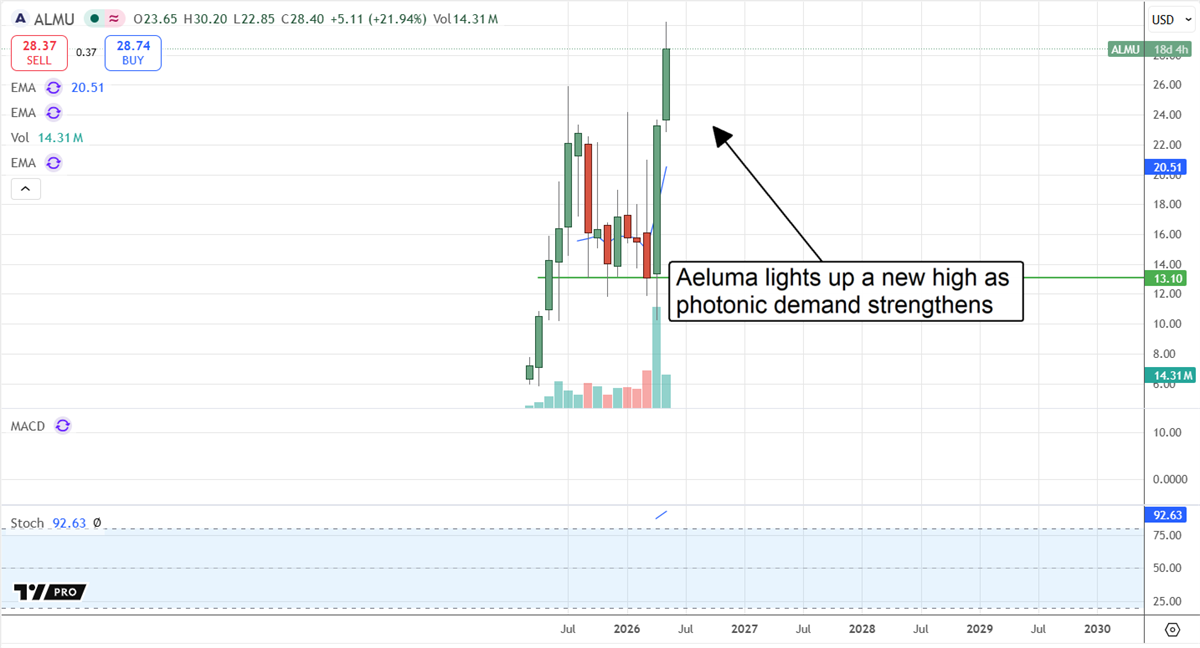
Aeluma (NASDAQ: ALMU) is among the best-positioned photonics companies today. It is advancing both compound semiconductor technology and the development of quantum dot lasers to power photonic devices and scalable manufacturing processes.
Its Heterogeneous Integration Platform combines numerous advanced copackaging processes into a single platform, enabling both scale and efficiency that can disrupt the market. Catalysts in 2026 include its path to commercialization, which was amplified by recent government awards.
Aeluma has secured more than $4 million in government contracts, including from NASA, to advance its strategy. Revenue is expected to begin growing by year’s end, but significant gains are not expected until 2028. The opportunity for investors is getting into this stock early, before the race for space gains momentum. Momentum is expected to build this year, coinciding with the SpaceX IPO slated for late spring or early summer.
SpaceX is the single largest space company, dominating the launch schedule, commanding a high-double-digit market share, and opening the door to an influx of institutional investment in space. While Mars remains the endgame, the near-term focus has shifted to a moon base, with Starship rocket bodies serving as the initial structures. The goal is to establish a moon-based manufacturing economy, with initial base construction planned for sometime in 2028.
Coherent: AI Drives Business, But Good for Space, Too
Coherent Corp. (NYSE: COHR) is among the most diversified optics and photonics companies on the market, making a range of reliable, high-speed and copackaged products critical for AI infrastructure.
It also manufactures components made to withstand the harsh conditions of space and is positioned to benefit from the upcoming boom.
As it stands, the stock price is in an uptrend, supported by accelerating growth and better-than-expected guidance that likely underestimates future strength.
\The upcoming launch of Advanced Micro Devices’ (NASDAQ: AMD)MI450 line will unleash a second wave of data center demand, helping Coherent sustain its momentum.
Lumentum Lights Up the Photonic Opportunity
Lumentum (NASDAQ: LITE) is another well-diversified photonic manufacturer with business in space. The company produces a range of products for defense, aerospace, and satellite applications and is expected to grow in 2026.
The business is underpinned by AI and datacenter demand, driving revenue acceleration to 90% in fiscal Q3 2026 and expected to remain strong in upcoming quarters. Catalysts for the stock price include an uptrend in analysts’ sentiment and institutional buying, which indicate a strong support base and a market tailwind.
The stock price action reflects the strength of the tailwind and opportunity ahead. The market for LITE and COHR stock is up by quadruple-digit percentages as of mid-2026 and is likely to continue rising.
The technicals include rising volume and convergent momentum, an indication of a strengthening market, unlikely to reverse course without a change in fundamentals. The only change in fundamentals likely to come is an increase in strength, as AI workloads become more intense and reliant on reliable, high-speed communications.
nLIGHT: Laser Focused on Defense Applications
nLIGHT (NASDAQ: LASR) is a laser-focused photonics company amid a strategic shift. The company targets aerospace and defense applications, with products providing a range of power and output sizes, enabling a wide range of end uses.
Results in 2026 reveal acceleration and the potential for additional acceleration, as defense demand ramps higher. Of them all, space will be the strongest catalyst for nLIGHT as its semiconductor and fiber lasers are critical to a variety of space-specific applications, including advanced manufacturing of rockets and engines, and actively designs space-specific sensing and communications products.
Analyst trends are robust for this company. Although the price action is leading the consensus, MarketBeat’s reported consensus increased by more than 300% on a trailing 12-month basis, with high-end targets offering substantial upside.
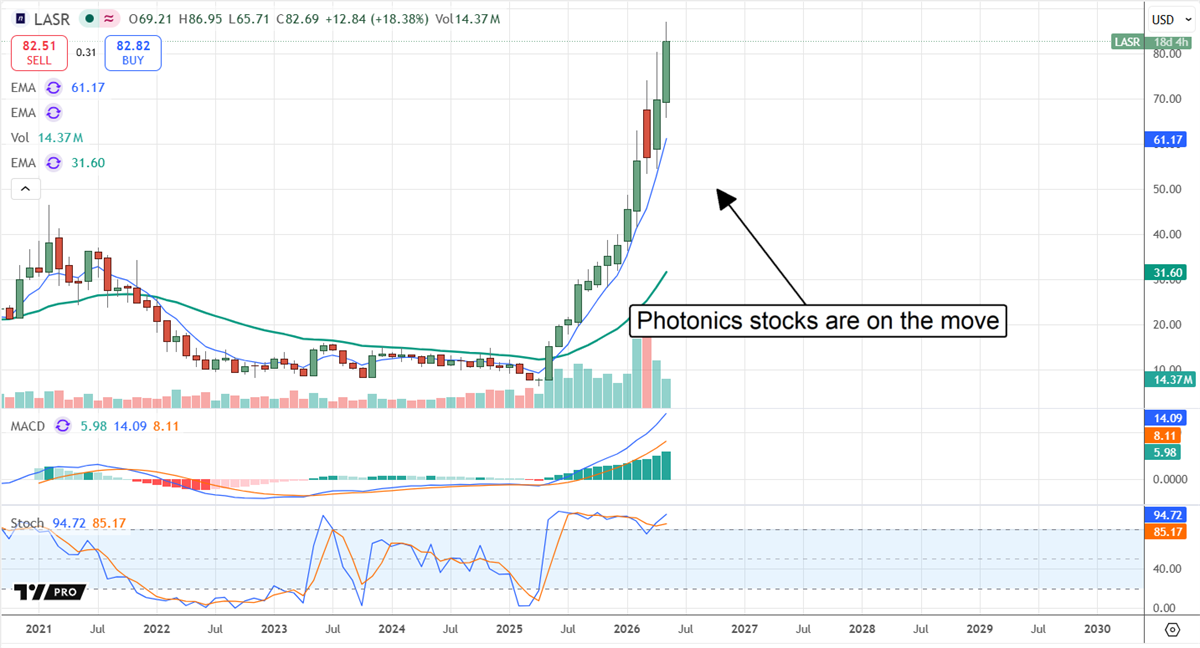
The likely outcome is that nLIGHT’s business continues to improve and sustain the positive revision cycle. In this scenario, nLIGHT can easily grow into its earnings outlook and sustain an uptrend over time. READ THIS STORY ONLINE
Need to confirm your interest (Ad)

Your account is not currently signed up for MarketBeat’s free Monday morningstock ideas. Our team is going to be releasing an important pick on Monday morning (at 11am ET) and we want to make sure that you are able to see it.ADD YOUR NAME TO THE DISTRIBUTION LIST HERE
Industrial Buybacks: Top Homebuilding Supplier Leads Buyback Increases
Written by Leo Miller

Buyback announcements often send key signals to investors about how companies view their own stock. When firms announce new buyback authorizations, it can be an indicator that they see opportunity in shares.
These signals are particularly strong when buyback authorizations represent a significant percentage of a company’s market capitalization. This gives firms the ability to repurchase an ample amount of their shares at what they may view as a depressed price.
Recently, several stocks in the industrials industry have announced notable buyback programs, and in some cases, management has made strong statements as to why.
Builder’s FirstSource Claims “Tremendous Discount” in Shares
Starting off the list of industrial buyback announcements is Builders FirstSource (NYSE: BLDR). The company is the United States’ largest supplier of structural building products for single-family and multi-family housing developers. However, markets have hit the stock very hard lately, down more than 20% in 2026, and down well over 40% from its 52-week high.
General weakness in the housing market has driven this, with Builders FirstSource posting revenue declines for eight quarters in a row. In its latest earnings report, the company posted a year-over-year (YOY) revenue drop of 10%. Adjusted earnings per share (EPS) fell by a massive 82% YOY, and the company lowered its full-year guidance.
However, the company also made a significant buyback announcement, authorizing a new $500 million program. This adds to its $200 million in remaining capacity. Overall, the firm’s $700 million in buyback capacity is equal to over 8% of its approximately $8.4 billion valuation, a very significant figure. This comes after the firm spent $306 million on buybacks in Q1.
Notably, CEO Peter Jackson said the company saw “an opportunity to pick up shares of BFS at a tremendous discount.” That’s one of the stronger statements that investors will ever see regarding a company’s buyback activity, and the firm now has much more ammo going forward.
Snap-On Boosts Buyback to Go Along With Solid Dividend
Snap-On (NYSE: SNA) is one of the most recognizable names in the world of automotive tools, selling wrenches, diagnostic systems, and other equipment. Snap-On has a strong presence among dealerships and independent repair shops and serves a broader range of customers in industries like aerospace. The stock has put up decent performance lately, with a 12-month return near 15%.
Sales trends have been improving, with revenue growth hitting 5.8% YOY in its latest quarter after dropping 3.5% in Q1 2025. Tariffs have been a persistent headwind and a recurring topic on earnings calls, and the company noted margin impacts in the last quarter.
However, Snap-On is indicating some optimism going forward, recently announcing a $500 million buyback program. This new program replaces its past one and is equal to around 2.6% of the company’s approximately $19.4 billion market capitalization. The program is meaningful in size, but is not particularly large.
Still, Snap-On attests that its capital return initiatives demonstrate “unyielding confidence in the abundant possibilities of our future.” Notably, Snap-On also pays a fairly significant quarterly dividend of $2.44 per share. This gives the stock a solid indicated dividend yield near 2.6%.
Fortive’s Buyback Capacity Exceeds 5% After Big-Time Spending
When thinking about industrial stocks, Fortive (NYSE: FTV) isn’t necessarily the first name that comes to mind. However, the company provides a range of advanced instrumentation products and software, as well as healthcare sterilization tools, putting it in the industrial sector.
After falling around 2% in 2025, Fortive shares have put up a relatively strong performance in 2026, with a total return near 10%. This sits just above the S&P 500’s approximately 8% return on the year. The stock received a large 10% boost after releasing its Q4 2025 earnings report, with the company providing better-than-expected guidance for 2026. Fortive anticipates adjusted EPS of $2.95 at the midpoint, or an increase of 9% YOY.
Additionally, Fortive has given itself much more buyback firepower, increasing its general buyback authorization to 20 million shares. This is equal to a substantial 6.4% of the company’s 309 million diluted shares outstanding. The company also has $66.7 million in buyback capacity available under a special-purpose repurchase program.
Notably, the firm has been buying back shares at a strong pace, reducing its share count by over 10% since June 2025. Its recent buyback announcement suggests that it intends to continue on a similar path going forward.
Analysts Eye Rebound in Builders FirstSource Amid Housing Woes
In line with management’s strong statements, Wall Street analysts are the most bullish on Builders FirstSource going forward. The MarketBeat consensus price target near $102 implies upside in shares over 30%. Targets updated after the company’s latest earnings report are only slightly lower, averaging approximately $99.50. Still, a significant housing recovery will likely be needed for BLDR shares to reach these optimistic forecasts. READ THIS STORY ONLINE
Larry Benedict’s three-step gold strategy anyone can follow (Ad)

Former hedge fund manager Larry Benedict generated $274 million in profits – and Barron’s ranked his fund in the top 1% worldwide. Now he’s applying the same approach to the gold market through a strategy called ‘Gold Skimming.’
Individual trades using this method have produced $2,975, $3,781, and even $6,786 from a five-day gold decline – all without owning a single ounce. It works in a regular brokerage account and takes just three steps to execute.WATCH LARRY’S FREE PRESENTATION AND LEARN THE FULL GOLD SKIMMING STRATEGY
3 Stocks That Win If Inflation Surprises to the Downside
Written by Chris Markoch

On May 12, the April reading of the Consumer Price Index (CPI) will be released. Polymarket predicts the number is most likely to come in at 3.7% or 3.8%. That “more of the same” result would support the Federal Reserve leaving interest rates unchanged.
With energy prices surging on Middle East tensions, it would seem rate cuts are firmly off the table. Unless there’s a downside surprise. Incoming Federal Reserve chair Kevin Warsh has aligned with a narrative that productivity gains from artificial intelligence (AI) will be a “significant deflationary force“—one that could offset energy-driven pressures and put rate cuts back on the table.
Homebuilder and housing-related stocks are hoping for that outcome. While much consumer attention focuses on the lower leg of the K-shaped economy, the housing market is acutely tied to the upper leg—including retirees looking to trade down and first-time buyers, both squeezed by a lack of supply.
Lower mortgage rates won’t be an overnight fix. But if viewed as the first of several cuts over 18–24 months, it could give these stocks real momentum. Supporting the idea that markets are always forward-looking, several housing stocks are getting analyst price target upgrades.
D.R. Horton Uses Volume to Outperform in a Tough Housing Market
To go with a housing metaphor, D.R. Horton Inc. (NYSE: DHI) is the best house in a bad neighborhood. DHI is bucking the sector trend, up over 20% in the last 12 months.
It comes down to strategy. D.R. Horton is the largest U.S. homebuilder by volume. That’s largely due to its “pace over price” strategy. The company offers incentives to keep its inventory moving. It comes at the expense of margin, but in a high-rate market, volume is more important than price. Plus, the company has in-house mortgage and financial service divisions that can allow it to fund rate buydowns directly.
Investors should keep their short-term expectations in check. DHI has been range-bound over the last six months, and it’s only up about 1% in 2026 as of this writing. It’s also trading at about 14x earnings, which is higher than its historic average. But D.R. Horton is likely to get a significant bounce on a market resurgence. It also pays a safe dividend that has been increasing at an average annual rate of over 17% in the last three years.
Lennar’s Asset-Light Strategy Will Be in Focus If Rates Fall
Lennar Corp. (NYSE: LEN)represents the other side of homebuilder stocks. LEN is down 20% in the last 12 months and over 15% in 2026.
The hope comes from the company’s ongoing pivot to an asset-light model. The company offloads land development to third-party entities to reduce balance sheet exposure.
That was the part of the company’s Q1 2026 earnings report that analysts liked. The problem was the forward guidance, which said mortgage rates would stay around 6.2% to 6.4%. That, along with other headwinds Lennar cited, is keeping institutional investors cool on the stock.
Analysts have been lowering their price targets for LEN, but the consensus price target of $99.87 is 14% above the stock’s price as of this writing. And that may not be capturing the expected earnings growth of around 29%.
LEN trades at around 12x earnings, which is a discount to the broader market, but a premium to its historic average.
Home Depot Is a Housing Recovery Play
Home Depot (NYSE: HD) is the valuation play of this group. At around 22x earnings, it’s trading at a discount to both the S&P 500 and its historic average. However, critics may say that the stock looks cheap for a reason. Total sales and adjusted earnings per share were both down year over year in 2025.
This reflects the fact that Home Depot’s business is adjacent to an active housing market. For a couple of years, the company benefited from a surge in remodeling. And a recent UBS survey showed that the home improvement market may be improving.
That would confirm the broader narrative that the company’s results are fixable if it can get some assistance from the housing market. For now, analysts are trending bearish and lowering their price targets. Still, the consensus price target of $410.86 implies a move of over 30% in the next 12 months.
Home Depot reports its Q1 2026 earnings on May 19. At that point, investors will be listening for the company’s forward guidance, which has been pointing to a potential recovery in the second half of 2026. READ THIS STORY ONLINE
The retirement move gaining attention in 2026 (Ad)

Gold outperformed the S-P 500 in 2026, breaking through 5,000 while stock-heavy retirement accounts swung on every trade war headline. JPMorgan has raised its 2026 gold forecast to 6,300 – with a credible path to 8,000 if investor allocations shift even slightly.
Most Western portfolios still hold less than 1% in gold, and most retirement savers don’t realize their IRA or 401(k) can hold physical gold – no new account, no penalty, no tax hit, done in days.GET THE FREE GUIDE TO ADDING GOLD TO YOUR IRA OR 401-K TODAY
More Stories
- Meta Platforms’ Wild Post-Earnings Swings: Where Analyst Price Targets Stand Now
- Catching Falling Knives: Is Time to Buy These Beaten-Down Stocks?
- AI’s Next Breakout? 3 Stocks Still at Reasonable Prices (Ad)
- 3 Small-Cap Stocks to Buy as the Russell 2000 Extends Its Rally
- MercadoLibre Boldly Invests in Growth: Discount Deepens
- AI Dividend Increases: 3 Massive Winners Boosting Payouts
- The Stars Are Aligning For Apple: Get Ready for $300
The Night Owl is a financial newsletter that provides in-depth market analysis on stocks of interest to individual investors. Published by MarketBeat and Early Bird Publishing, The Night Owl is delivered around 9:00 PM Eastern Sunday through Thursday. If you give a hoot about the market, The Night Owl is the newsletter for you.

If you need assistance with your newsletter, feel free to contact MarketBeat’s U.S. based support team at contact@marketbeat.com.
Unsubscribe
© 2006-2026 MarketBeat Media, LLC. All rights reserved.
345 N Reid Place, Sixth Floor, Sioux Falls, S.D. 57103-7078. U.S.A..
From Our Partners: [Watch] FREE STOCK PICK for Elon Musk’s Starlink SuperIPO(From Paradigm Press)


