Mark here.
I’ve watched enough manias, booms, and market rotations to know how this usually ends.
At first, almost nobody is paying attention.
Then a few well-informed investors begin to move.
Then the story turns mainstream.
And finally, the public rushes in when the best part of the move is already behind us.
That’s why I want to be very direct with you today:
That date matters because I believe it may mark the end of a brief period when ordinary investors still have time to position themselves in what I believe is a highly unusual pre-IPO setup.
I believe we are in the final stretch of a quiet accumulation window.
And when that kind of window closes, it tends to close fast.
The reason I’m so focused on this is simple.
The market is obsessed with the obvious name.
I’m focused on the secondary beneficiary.
That’s often where the asymmetry is.
That’s often where informed investors can still get in before the crowd.
And that’s why I want you to review this now, while time is still on your side.
Before June 1, watch my full presentation here<<<
After that, I believe this setup could start attracting much wider attention.
Yours for peace, prosperity, and liberty, AEIOU,
Dr. Mark Skousen
Macroeconomic Strategist, The Oxford Club
Today’s Bonus Content
TFI Earnings Beat: Is This Stock the Freight Recovery King?
Author: Jeffrey Neal Johnson. Posted: 4/30/2026.

Key Points
- TFI International’s Less-Than-Truckload segment experienced a dramatic positive reversal in shipment volumes, signaling a sustainable demand recovery.
- TFI International is achieving higher revenue per truck by intentionally reducing its fleet size, proving a strong focus on profitability over market share.
- Following a strong earnings beat and improved guidance, Wall Street analysts are upgrading their ratings and price targets for the company.
- Special Report: Have $500? Invest in Elon’s AI Masterplan
The transportation sector continues to weather a protracted freight recession, with persistent margin compression and volume headwinds challenging even the most established operators. Against this difficult backdrop, TFI International (NYSE: TFII)delivered first-quarter results that suggest a cyclical bottom may be forming for best-in-class logistics companies. TFI International’s ability to manage operational levers and maintain profitability in a weak market signals a potential turning point, positioning it to capture significant upside as supply chains normalize and industrial activity rebounds.
From Deep Freeze to Spring Thaw
The most compelling evidence of a market shift lies within TFI International’s Less-Than-Truckload (LTL) segment, its largest division by revenue. The segment experienced a dramatic intra-quarter reversal that far outpaced broader market trends. After starting the year with a 10% year-over-year decline in shipment volumes in January, worsened by severe weather, momentum shifted sharply, with March volumes expanding by 8%.
Ticker Revealed: Pre-IPO Access to “Next Elon Musk” Company (Ad)
We’ve found The Next Elon Musk… and what we believe to be the next Tesla.
It’s already racked up $26 billion in government contracts.
Peter Thiel just bet $1 Billion on it.👉 Unlock the ticker now and get it completely free.
Management confirmed on its April 27, 2026, earnings call that this positive trend has continued into the second quarter, suggesting the demand inflection is not just a temporary rebound, but the start of a more sustainable recovery.
This volume inflection is the direct catalyst behind management’s aggressive forward guidance. TFI expects a sequential improvement of 400–500 basis points in its consolidated operating ratio (OR) for Q2. The LTL segment is forecast to lead that improvement with a remarkable 600–700 basis-point sequential OR gain.
As volumes return, TFI International’s leaner cost structure and improved network density should allow a larger share of revenue to flow through to operating income. This improvement is further supported by the delayed implementation of a general rate increase (GRI) in mid-March, which should provide a pricing tailwind through the second quarter. While TFI International’s service levels are still being refined to match industry leaders, the volume recovery gives it the operational leverage needed to become more selective with freight and begin closing the pricing gap with peers.
The Art of Shrinking to Grow
While the LTL segment shows signs of a volume recovery, the Truckload division demonstrates the value of disciplined fleet management and a strategic market focus. TFI grew its revenue per truck per week, excluding fuel surcharges, by 8.6% in the first quarter. This was accomplished while simultaneously reducing its total truck count by 7.1%.
This dynamic of running fewer assets while generating higher revenue per unit is a clear sign of a management team focused on productivity and profitability over sheer market share. It reflects a cultural shift, particularly within the legacy Daseke operations, from being good truckers to being good businessmen who prioritize return on invested capital.
This operational discipline is translating directly into pricing power, particularly in TFI International’s industrial-focused end markets. Management noted that recent U.S. flatbed contract renewals are coming in at high-single to low-double-digit increases. This pricing strength is partially driven by tightening capacity across the U.S. and Canada, as regulatory actions have removed unsafe and non-compliant operators from the market. By focusing on industrial freight, such as the rapidly growing logistics for data center construction, which grew from $8 million to $21 million in revenue year over year, TFI insulates itself from the volatility of retail-centric freight and aligns with a potential North American industrial renaissance.
The Political Risk Masking TFI’s True Potential
Despite the strong quarterly performance and optimistic Q2 outlook, management has refrained from issuing full-year 2026 guidance. This caution is primarily tied to geopolitical and macroeconomic uncertainty, specifically the mandatory joint review of the USMCA (CUSMA) trade agreement scheduled for July 2026. This event creates a certainty cliff for cross-border freight, a highly profitable business for TFI. While this presents a near-term risk that tempers full-year forecasts, it also creates a coiled-spring scenario. A smooth and favorable resolution to the trade pact review would likely trigger a significant relief rally and force analysts to revise full-year estimates upward.
TFI International’s capital allocation strategy underscores its internal confidence. Within the earnings report, the board approved a 4% increasein the quarterly dividend to 47 cents per share. This move came even as Q1 free cash flow declined year over year to $123.7 million, a dip management attributed to a temporary working capital distortion due to the timing of fuel payments. Raising the dividend against this backdrop signals confidence in the sustainability of future cash flows and a commitment to returning capital to shareholders throughout the economic cycle.
TFI International Charts a New Course
The first-quarter earnings beat and strong guidance were major catalysts for TFI International, sending shares to a new 52-week high on heavy volume. The stock’s performance reflects the emerging narrative, with a year-to-date return of over 35%.
Sell-side analysts have moved quickly to validate the thesis. Following the report, Bank of America (NYSE: BAC) upgraded the stock from Neutral to Buy and raised its price target to a street-high $161. The current consensus rating stands at Moderate Buy, reflecting a mix of bullish outlooks and some analysts waiting for further confirmation of the recovery.
Investors seeking exposure to the freight cycle may find TFI International’s demonstrated operational control a compelling reason to add the stock to their watchlist. While macroeconomic risks tied to trade policy and fuel costs persist, TFI International’s ability to drive a margin inflection before a full-blown market recovery sets it apart. Those with a higher risk tolerance might view the current momentum as the beginning of a sustained cyclical upswing, whereas more cautious investors may prefer to wait for a potential consolidation before establishing a position.
Today’s Bonus Content
MercadoLibre Boldly Invests in Growth: Discount Deepens
Author: Thomas Hughes. Posted: 5/11/2026.

Key Points
- MercadoLibre’s strategy, which works, is also a hindrance as it involves significant upfront investment to drive profitable growth.
- Growth outperforms, reaching a hyperpace in Q1 as efforts gain traction.
- Analysts trimmed targets in Q2 2026 but continue to rate it as a Moderate Buy with a 50% upside potential.
- Special Report: Have $500? Invest in Elon’s AI Masterplan
MercadoLibre (NASDAQ: MELI) reported a robust Q1 result, but there was one issue: margins contracted, and guidance suggests that pressure will continue. That has left some investors feeling a bit squeamish.
However, this company has long followed a spend-first, grow-later model while building out its robust Latin American eCommerce empire. Spending has been focused on its ecosystem, fulfillment network, merchants, and consumer acquisition.
Ticker Revealed: Pre-IPO Access to “Next Elon Musk” Company (Ad)
We’ve found The Next Elon Musk… and what we believe to be the next Tesla.
It’s already racked up $26 billion in government contracts.
Peter Thiel just bet $1 Billion on it.👉 Unlock the ticker now and get it completely free.
The net result is continued growth that remains impressive, while spending can be controlled over time. This stock is moving lower on emotion, not fundamentals, and appears to be setting up for a solid rebound in the near future. According to CFO Martín de los Santos, the impact is profitable.
While spending is up, it is by choice and offset by declining operating costs in maturing markets.
MercadoLibre Outperforms in Q1, Metrics Point to Acceleration
MercadoLibre had a solid Q1 2026, with revenue growing by nearly 50% to $8.85 billion. The top line beat MarketBeat’s consensus estimate by more than 625 basis points (bps), with strength across the platform. Brazil was mentioned several times in the report, but gains were also made in Mexico and other key growth markets as the company improves penetration and takes share from traditional retailers.
Internal metrics point to further acceleration. On the commerce side, total payment volume increased by 50%, items sold rose by 47%, and items per client increased by 16%. On the fintech side, the company’s credit portfolio grew by 87% as consumers leaned into card services, monthly active users increased by 29%, and assets under management rose by 77%.
Even the margin news wasn’t entirely negative. The company reported another contraction, but revenue strength helped offset the weakness. The result was $8.23 in GAAP earnings, 3 cents better than expected, with revenue strength expected to continue. Assuming the 2026 spending plans deliver the same results as in the past, the likely outcome is that MELI continues to drive hypergrowth and cash flow across its network, outperforming on a quarterly basis.
Analysts’ Sentiment Weighs on Market: Rebound Potential Improves
The analyst reaction was to be expected, with numerous price-target cuts following the release. Trends are pointing to the low end, but even that still offers some upside for the stock, with as much as 50% upside possible at the consensus target. The market will likely struggle to gain traction until analyst trends improve. Until then, the group of 19 analysts MarketBeat tracks rates MELI as a Moderate Buy with 78% Buy-side bias, and institutions to which the analysts cater are buying.
Data show institutions owning nearly 90% of MercadoLibre stock and buying on balance over the trailing 12 months. Their activity ramped sequentially into Q1 2026, only pausing in early Q2 to wait for the release. The likely outcome is that institutions continue accumulating on balance, as the fundamental story has only strengthened. MELI will likely slow spending in the coming years, improve its margins, and generate considerable cash flow for investors over time.
MercadoLibre’s balance sheet presents no red flags. The company is well-capitalized, has little to no significant long-term debt, and improving equity. The biggest risk is execution, but that appears limited at this time, though there are still hurdles to cross. The company’s rapid credit portfolio expansion exposes it to rising consumer risk, as evidenced by growing debt write-offs, and there is concern that the situation could worsen.
MELI Stock Sets Fresh Low: Oversold and Ready to Rebound
MELI’s stock price action moved lower and set a fresh low following the release, but indicators including MACD and stochastic suggest the downtrend is nearing an end. They diverge from the lows, highlighting underlying market strength and suggesting the bulls are regaining control. The risk is that MELI continues to move lower, potentially hitting $1,400 before the bottom is in. MELI stock will likely hit fresh highs once its rebound begins, underpinned by an expanded marketplace, improved penetration, and margin improvement.
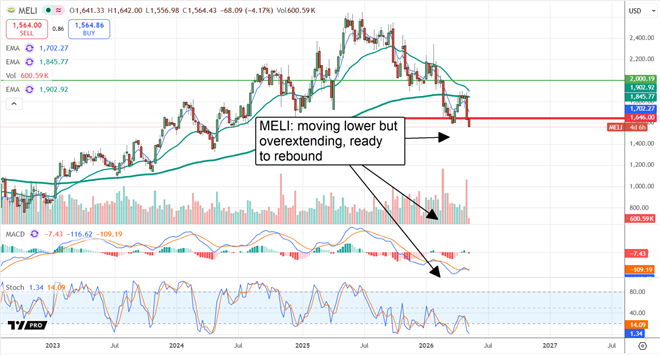
Catalysts include the rapidly expanding fulfillment center network and lower thresholds for free shipping. The combination is driving profitable scale, as revenue leverage offsets the increased cost and improves consumer satisfaction and ongoing business. The company plans to add more than a dozen centers in its core market by year-end. Fintech is another catalyst, with the company’s portfolio and services integration driving growth. Mercado Pago, the fintech arm, is transitioning from a mere payment platform into a full-service fintech capable of self-sustaining operational growth.
Thank you for subscribing to The Early Bird, MarketBeat’s 7:00 AMnewsletter that covers stories that will impact the stock market each day.
This email communication is a sponsored message sent on behalf of The Oxford Club, a third-party advertiser of The Early Bird and MarketBeat.
This ad is sent on behalf of The Oxford Club. 105 W Monument St, Baltimore, Maryland 21201. If you would like to optout from receiving offers from The Oxford Club please click here.
This offer is brought to you by [Affiliate name]. [Insert physical address of affiliate]. If you would like to unsubscribe from receiving offers brought to you by [Affiliate name] click here.
If you have questions or concerns about your subscription, don’t hesitate to contact our South Dakota based support team at contact@marketbeat.com.
If you no longer wish to receive email from The Early Bird, you can unsubscribe.
© 2006-2026 MarketBeat Media, LLC. All rights protected.
345 N Reid Pl. #620, Sioux Falls, S.D. 57103. United States..
Read More: The most important tool in any traders arsenal (Click to Opt-In)


