Unsubscribe The #1 stock to buy BEFORE the June S-1 filing (From Behind the Markets)
The Smart Glasses Gold Rush Is Leaving Old-School Eyewear Behind
Written by Jeffrey Neal Johnson

The augmented reality (AR) and virtual reality (VR) adoption curve has hit a structural inflection point, pivoting rapidly from high-friction headsets to mass-market, AI-integrated smart eyewear. Validated by massive commercial traction from early incumbents, the rollout of the Android XR ecosystem signals a highly lucrative hardware supercycle. This shift presents an opportunity for investors, with market data suggesting enormous upside for the hyperscalers and precision manufacturers who capture the optical-electronic convergence, while traditional brands face significant headwinds.
For years, spatial computing was a story of niche, isolating headsets, a market perpetually waiting for its breakthrough moment. That narrative is now obsolete. The catalyst that proved the market has crossed into mainstream adoption came from the partnership between Meta Platforms (NASDAQ: META) and EssilorLuxottica (OTCMKTS: ESLOY). The alliance sold over seven million units of its Ray-Ban AI-integrated frames in 2025 alone, a figure that confirms a robust consumer appetite for ambient, wearable technology that integrates seamlessly into daily life. This commercial success has now forced a competitive response, officially igniting the smart glasses war.
Platform Wars: Choosing Your Champion
The battle for market dominance is quickly consolidating around two major ecosystems. On one side stands the incumbent Meta-EssilorLuxottica alliance, which leverages the powerful brand recognition of Ray-Ban and Meta HorizonOS’s established user base.
On the other hand is the newly unveiled Android XR platform, a formidable collaboration led by Alphabet (NASDAQ: GOOGL) and Samsung (OTCMKTS: SSNLF). This new ecosystem aims to replicate the open-source success of the Android smartphone model, where a common operating system fuels innovation across multiple hardware partners.
Google provides the Gemini AI software and operating system, Samsung contributes core processing and component expertise, and fashion-forward eyewear companies like Warby Parker (NYSE: WRBY) serve as the initial hardware and distribution partners.
However, the market’s reaction to this unveiling provides a critical insight into where value is expected to accrue. In the two days following the announcement, Warby Parker’s stock price slid nearly 15%. Investors were unimpressed by the revelation that its first-generation product would be audio-only, lacking the integrated visual display many consider true augmented reality.
This immediate and harsh repricing suggests the market views Warby Parker not as a technology peer, but as a commoditized hardware partner, essentially a stylish casing for Google’s powerful software. WRBY’s staggering price-to-earnings (P/E) ratio exceeding 1,200x appears difficult to justify without a proprietary software moat. A pattern of recent insider selling, including significant stock disposals by a director and the CEO, further reinforces this bearish sentiment.
Where the Real AR Money Is Made
While facing new competition, incumbent EssilorLuxottica is not standing still. Despite EssilorLuxottica’s stock pricefacing pressure and declining by more than 35% year-to-date as investors price in a more fragmented market, EssilorLuxottica is making strategic moves to build a defensible moat. The recent acquisition of Faro, a specialized Italian manufacturer known for high-precision milling, is a clear attempt to control the means of production.
By internalizing the complex engineering required to embed technology into frames without compromising design, EssilorLuxottica is betting on advanced manufacturing as a key differentiator.
This creates a physical bottleneck that software-focused partners and lower-cost assemblers may struggle to replicate.
EssilorLuxottica’s strategy stands in stark contrast to the tech giants’ approach.
The market is clearly rewarding the companies that own the underlying software and core infrastructure. Alphabet’s stock price, for example, has climbed about 25% year-to-date.
These gains are not tied to the physical frames but to the immense value of the AI models, operating systems, and semiconductor chips that power the entire experience. Alphabet’s recent joint venture with Blackstone to build out a next-generation AI data center empire underscores this point. Alphabet is investing billions in the foundational infrastructure that will support not just smart glasses, but a whole universe of AI-driven services. For tech hyperscalers, smart glasses are simply another endpoint, another vehicle to deploy their high-margin software and collect valuable data.
A Clear-Eyed View of AR Investment
The emerging smart glasses supercycle is less about the brand on the frame and more about the operating system running inside. The central conflict is a three-way race between Meta’s HorizonOS, Google’s Android XR, and Apple’s (NASDAQ: AAPL) visionOS. These software platforms represent the true long-term moats that will dictate market leadership for the next decade.
This structural shift requires investors to recalibrate their approach to gaining exposure to the AR/VR thesis. The data suggests that while eyewear brands may see volume growth, they also face the risk of severe margin compression as the hardware becomes commoditized.
The primary beneficiaries appear poised to be the technology providers who control the software ecosystems and the key component suppliers. Of course, this sector is not without risks. Significant macro headwinds could emerge from regulatory bodies concerned with the privacy implications of always-on cameras and microphones. Furthermore, Samsung’s current labor disputes in South Korea could create near-term supply chain disruptions and margin pressure.
Investors with a long-term thesis on spatial computing may want to monitor the hyperscalers who own the emerging operating systems, as they appear to be capturing the lion’s share of the value chain. For those seeking exposure to the physical hardware, the key differentiator may not be brand recognition but rather proprietary manufacturing capabilities that can defend against commoditization. The recent market volatility suggests that in the new era of wearable AI, a powerful software stack is proving to be a much more durable asset than a stylish frame. READ THIS STORY ONLINE
ALERT: Drop these 5 stocks before the market opens tomorrow! (Ad)

The Wall Street Journal is already raising the alarm about a potential market crash, and Weiss Ratings research points to the first half of 2026 as a particularly rough stretch for certain holdings.
Some of America’s most popular stocks could take serious damage as a radical market shift plays out. Analysts at Weiss Ratings have identified five names you may want to remove from your portfolio before this unfolds.
If any of these are in your portfolio, now is the time to review your positions. SEE THE 5 STOCKS TO AVOID
3 Rare Earth Stocks That Win No Matter What China Does Next
Written by Bridget Bennett
A U.S.-China rare earth truce is technically in effect, but China is still throttling shipments, shortages persist, and Trump left Beijing last week without a confirmed extension of the agreement, which expires in November 2026.
For investors watching the domestic rare earth sector, the fine print matters more than the headline.
China controls roughly 70% of global rare earth mining and processes between 85% and 90% of the global supply. Those minerals, which are used in permanent magnets for AI data centers, electric vehicles, and military hardware, don’t have a quick Western replacement. The truce bought time, but the underlying problem is unchanged.
That’s the setup Sean Brodrick of Weiss Ratings has been watching closely. His thesis: even if China eases supply, the U.S. government has committed to maintaining a price floor for critical domestic producers, meaning the economics don’t collapse just because Chinese exports resume.
Washington has made its strategic priorities clear, and it’s backing them with capital. And, as Brodrick notes, China has shown a willingness to reimpose restrictions when it suits them. The truce clock is already running.
The Minerals Powering the New Economy
Rare earth elements aren’t a niche industrial input; they’re embedded in the infrastructure of the modern economy.
The four key magnetic rare earths—neodymium, praseodymium, dysprosium, and terbium—are essential for the permanent magnets that run everything from EV motors to AI data center equipment.
The heavy rare earths, such as dysprosium and terbium, are particularly critical because they protect magnets from heat-induced degradation, making them indispensable in high-performance applications.
China’s export control playbook has specifically targeted these materials. Restrictions introduced in late 2024 and expanded through 2025 covered gallium, germanium, antimony, and several rare earth elements. The November 2025 truce paused those controls, but customs data shows Beijing is still limiting shipments in practice, keeping supply tight and prices elevated.
For U.S. companies that depend on these materials for defense systems, semiconductors, and clean energy hardware, a pause that doesn’t fully function isn’t a supply chain strategy. Apple (NASDAQ: AAPL) CEO Tim Cook has already responded, striking a supply agreement with MP Materials Corp. (NYSE: MP) to source domestically produced rare earths—a signal of how seriously major U.S. companies are taking the risk.
Critical Metals Corp.: The Greenland Play
Critical Metals Corp. (NASDAQ: CRML) is developing the Tanbreez project in southern Greenland, one of the largest rare earth deposits on the planet.
The U.S. Export-Import Bank has issued a letter of interest for a potential $120 million funding package, and the company has secured approval to increase its ownership stake in Tanbreez to 92.5%.
What gives Critical Metals its strategic weight is the nature of the deposit.
Tanbreez is a heavy rare-earth resource, a specific category China has most aggressively restricted. That’s not a coincidence. For U.S. defense independence, projects like Tanbreez aren’t optional. Brodrick sees CRML as having significant room to run from current levels, noting it remains well below the highs it hit when U.S.-China tensions peaked.
Critical Metals is still in development and pre-revenue. The timeline to production is measured in years, not quarters. Government support helps reduce financing risk, but substantial execution and permitting hurdles remain.
USA Rare Earth: Mine to Magnet
USA Rare Earth, Inc. (NASDAQ: USAR) is building something rarer than the minerals it mines: a fully domestic, vertically integrated rare earth supply chain.
The company controls Round Top Mountain in West Texas, which hosts at least 15 of the 17 rare-earth elements, and a commercial magnet production facility in Stillwater, Oklahoma.
The U.S. Department of Commerce has backed the company with a nonbinding letter of intent worth $1.6 billion, including $277 million in CHIPS Act funding.
USAR has been one of the more volatile names in the sector, swinging sharplyon each policy headline. Brodrick’s view on that volatility: it’s an entry point, not a reason to stay away. The government price floor means the long-term economics aren’t purely at the mercy of whatever China decides this November.
For investors who can tolerate the swings, the mine-to-magnet vertical is a structural advantage in a sector where most companies control only one piece of the chain.
When supply dips on positive China headlines, Brodrick’s instinct is to buy because the restrictions can always come back, and the domestic buildout has to happen regardless.
American Rare Earths: The Early-Stage Wild Card
The most speculative of the three is American Rare Earths Ltd. (OTCMKTS: ARRNF). Despite the name, it’s an Australian company operating in the U.S., developing the Halleck Creek project in Wyoming, which the company describes as the largest rare earth resource in North America.
Halleck Creek contains the four key magnetic rare earth elements and carries a notable advantage over many global deposits: unusually low levels of radioactive elements, which reduces regulatory hurdles to permitting and operations. The U.S. government has supported the company’s technical development through R&D partnerships, and that work has produced processing breakthroughs that the company says lower operating costs. A pre-feasibility study is expected, followed by a pilot phase that would ship mined material to Saskatchewan for refined oxide production. American Rare Earths has also stated plans to uplist to the Nasdaq.
This one carries the most risk of the three. There is no direct U.S. government equity stake yet, and the stock trades at a fraction of a dollaron the OTC market. Brodrick is candid about that: the odds favor this team, this project, and this location—Wyoming is among the most mining-friendly states in the country—but nothing is guaranteed.
The Longer View
A truce that expires in November 2026—and that China is already working around in practice—is not a supply chain solution. China has a demonstrated willingness to use export restrictions as economic leverage, and nothing in the current agreement changes that structural reality. The question isn’t whether domestic rare earth development matters—Washington has already answered that with significant capital commitments. The question is: which projects have the assets, the management, and the staying power to see them through?
Brodrick’s framework is straightforward: volatility in this sector is noise. The signal is the long-term buildout of a domestic rare earth industry that the U.S. cannot afford to leave undone. Pullbacks are the entry. What happens in any one trade negotiation is a chapter. The book is much longer. READ THIS STORY ONLINE
The #1 stock to buy BEFORE the June S-1 filing (Ad)

When the SpaceX IPO launches, most retail investors will be locked out. The banks, funds, and insiders get in early – while everyone else waits on the sidelines.
But one small infrastructure supplier – a critical piece Musk can’t scale the Colossus network without – is still trading well under institutional radar. A new briefing reveals the name and ticker at no cost.GET THE SPACEX INFRASTRUCTURE STOCK NAME AND TICKER HERE
Amylyx Stock: Why the Full Pipeline Story Matters
Written by Chris Markoch
The idiom “never judge a book by its cover” can cut both ways when it comes to clinical-stage biotechnology companies like Amylyx Pharmaceuticals (NASDAQ: AMLX). The stock is up over 140% in the last 12 months as the company has made progress on its pipeline.
One of the drugs in the pipeline is Avexitide, a treatment for post-bariatric hypoglycemia after Roux-en-Y gastric bypass surgery. In early May, Amylyx announced it had completed full enrollment in its Phase 3 trial, LUCIDITY. Topline results are expected in Q3 2026, which is pivotal for the short-term outlook for AMLX.
However, this is a story that’s playing out in three distinct chapters that will take years to fully develop. And, as is the case with even large-cap biotech companies, execution is always a risk. Investors saw that with another company, Regeneron Pharmaceuticals (NASDAQ: REGN), on May 18, when it delivered Phase 3 results for its melanoma study of fianlimab + Libtayo that failed to meet its primary endpoint versus Keytruda, the industry standard from Merck & Co. (NYSE: MRK).
That said, positive news is positive news. Amylyx is committed to developing treatments for diseases with high unmet needs. Here’s a full read on the company’s progress as of late May, 2026.
Chapter 1: A GLP-1 Contrarian Play
Amylyx is taking the opposite approach to the GLP-1 boom: instead of developing agonists for weight loss, the company is developing a GLP-1 antagonist. Avexitide is a first-in-class GLP-1 antagonist that could become the first-ever FDA-approved therapy for post-bariatric hypoglycemia (PBH). This is a metabolic condition that affects approximately 8% of patients in the United States who have undergone one of the two most common types of bariatric surgery.
A key consideration for investors is that PBH has a small addressable market of around 160,000. So while it’s addressing the GLP-1 market, it’s addressing it in a niche fashion. That doesn’t make it any less relevant. But if investors are going to look at Amylyx with conviction, they’ll need to take a wider view.
Chapter 2: An Important Proof of Concept
Next in the company’s pipeline is AMX0035, the company’s therapeutic for Wolfram Syndrome. This is a rare genetic disease that presents significant challenges for patients. It usually begins in childhood with insulin-requiring diabetes and is marked by progressive optic nerve changes that affect vision and can involve broader neurological symptoms that increasingly affect daily life.
The addressable global market is estimated to be about 15,000 to 30,000, with about 1,000 to 2,000 in the United States. AMX0035 is in its Phase 2 HELIOS trial, and Amylyx has already delivered positive results at both the Week 24 and Week 48 milestones. The company plans to share Week 96 data later this year.
This is an incredibly small market, but it can serve as proof of how Amylyx can treat neurodegenerative diseases, which is where the plot thickens.
Chapter 3: When the Plot Really Takes Off
Further back in the company’s pipeline is AMX0114, the company’s treatment for ALS. The global ALS therapeutics market is expected to reach $1.7 billion in 2034 and is growing at a compound annual growth rate (CAGR) of 10%. This is a market with essentially no disease-modifying options. That gives pricing power to companies that develop anything that demonstrably works.
Amylyx has completed enrollment of Cohort 2 of its ongoing Phase 1 trial in March 2026, with early biomarker data from Cohort 1 expected to be delivered in June 2026. Significantly, the drug carries FDA Fast Track Designation, and the early readouts have been positive.
But this is still a drug in its early phases. It will be 2029 or 2030 at the earliest before investors will have a line of sight on commercial production.
Time Is Your Friend
Investors who are planning to hold AMLX for the long haul can build a position over time. One idea is to divide a position into thirds and allocate one-third of the capital to each pipeline milestone.
That way, investors can capture the potential upside with less downside risk. The Amylyx analyst forecasts on MarketBeat give the stock a consensus price target of $23, a gain of over 60% from its opening price on May 21. But that implies that the results the company is expected to deliver later this year will be positive.
It’s also important to note that AMLX has about 15% short interest, which is meaningful given the stock’s 20% decline over the 30 days ending May 20. That reflects the recent earnings report, which served as a reminder that the company is not profitable and has not yet generated revenue.
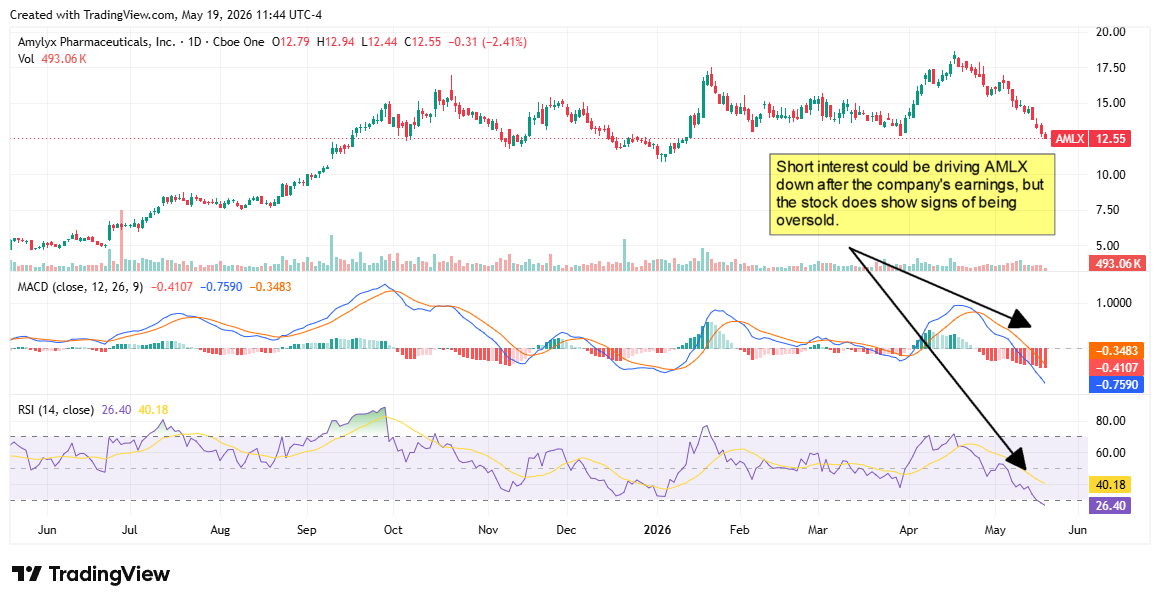
The company is a niche play today. Whether it’s being priced for its future growth remains to be seen. Like many biotech stocks, Amylyx has risk, but the upside may be worth a speculative position. READ THIS STORY ONLINE
Goldman Sachs just told you what to buy (most people missed it) (Ad)
Goldman Sachs just revealed that 40% of AI data centers will be crippled by electricity shortages by 2027 – not chips, not funding, but power. Demand is growing 15% per year and the grid can’t keep up.
One small company makes the exact equipment these data centers need. They’re sitting on $1.5 billion in orders, their hardware is already inside Musk’s Colossus, and the stock still trades like a name nobody’s heard of. Analyst Dylan Jovine is releasing the ticker for free.SEE THE STOCK POSITIONED TO SOLVE AI’S BIGGEST POWER CRISIS
The Night Owl is a financial newsletter that provides in-depth market analysis on stocks of interest to individual investors. Published by MarketBeat and Early Bird Publishing, The Night Owl is delivered around 9:00 PM Eastern Sunday through Thursday. If you give a hoot about the market, The Night Owl is the newsletter for you.
If you have questions or concerns about your subscription, please don’t hesitate to email MarketBeat’s South Dakota based support team at contact@marketbeat.com.
Unsubscribe
© 2006-2026 MarketBeat Media, LLC.
345 N Reid Place, Suite 620, Sioux Falls, SD 57103. U.S.A..
Today’s Bonus Content: ALERT: Drop these 5 stocks before the market opens tomorrow!(From Weiss Ratings)


