Unsubscribe Elon Confirms SpaceX IPO For 6/12 [Act Now!] (From Paradigm Press)
Banks Are Buying Back Stock Hand Over Fist, Including These 3 Names
Written by Leo Miller
While many investors have focused heavily on the artificial intelligence trade lately, the banking industry has quietly performed well too. One commonly used proxy of the industry’s performance is the Invesco KBW Bank ETF (NASDAQ: KBWB). Over the last 12 months, the fund has delivered a total return of around 35%, exceeding the S&P 500’s approximately 27% return over that period.
Notably, large-scale share buybacks have been a common theme among many bank stocks. After engaging in big-time buyback spending over the past several quarters, these three names are loading up again. All have huge buyback capacity equal to more than 10% of their market capitalizations. This allows these firms to continue lowering their outstanding share counts, adding a tailwind to per-share metrics.
Citigroup’s Buyback Capacity Hits 14% Amid Turnaround Success
First up is one of the most well-known banking institutions in the world, Citigroup (NYSE: C). The stock has gone on an extremely strong run, delivering a total return above 70% over the last 12 months. This comes as Citi’s turnaround plan has been progressing well. In 2025, Citi saw record revenues across all of its five main business lines, and four out of five posted double-digit growth in Q1 2026. Overall, 2025 revenue hit a record $86.4 billion.
Citi has also made judicious use of buybacks recently, spending $13 billion on repurchases in 2025—around four times what it spent in 2024. The company’s buyback pace continues to accelerate, with $6.3 billion of repurchases in Q1 2026, or nearly half of its 2025 spending in just one quarter.
Now, the company has filled its buyback chest to the brim, authorizing a new $30 billion repurchase program. The firm noted, “This reflects both our earnings power and our confidence in the trajectory of our business.” The size of this program is very significant, equal to 14% of Citi’s market capitalization near $210 billion.
This gives the firm a significant ability to continue lowering its share count, which it has reduced by more than 15% over the past five years.
KeyCorp Announces $3B Buyback Plan as Investment Banking Shows Out
KeyCorp (NYSE: KEY) shares have also performed well, but to a much lesser extent than Citi. Shares have delivered a total return of about 40% in the last year. Notably, KeyCorp’s investment banking business had its second-best year ever in 2025, and ended the year saying that its pipelines are at historically elevated levels. In Q1 2026, the company reiterated this, saying that pipelines were up 5% from year-endand that merger-and-acquisition pipelines were at record levels.
The company’s buyback spending has also been higher than expected. KeyCorp spent $200 million on repurchases in Q4 2025, double what it anticipated.
In Q1 2026, KeyCorp spent nearly $400 million, well more than the $300 million it set out for. The company currently says that it expects to spend $1.3 billion on buybacks in 2026—but specifically notes that this is a floor estimate.
Pursuant to this, the company just added $3 billion in buyback capacity. This buyback program is also very large, equal to just under 13% of KeyCorp’s market capitalization near $23.5 billion.
Notably, KeyCorp also returns a significant amount of capital through its dividend program. Overall, the company’s indicated dividend yield sits near 3.8%.
M&T Makes Strong Progress on Improving Loan Quality, Spends Big on Buybacks
Last up is M&T Bank (NYSE: MTB), which has delivered decent but not impressive performance over the last 12 months, up about 20%. Sizeable gains have been made over the past six months, as M&T has made strong progress in reducing its criticized loan balance. These are loans where the risk has increased relative to original expectations, putting the lender in an unfavorable position.
Notably, M&T reduced its criticized commercial loans by 27% in 2025. Progress continued in Q1 2026, with its criticized loan balance falling by $700 million to $6.6 billion.
Buybacks have also been a key part of M&T’s strategy, with the firm noting that it repurchased 9% of its outstanding shares in 2025. As part of its $5 billion buyback authorization, the company recorded $1.25 billion in repurchases during Q1 2026. This was equal to 3.5% of its outstanding shares versus the end of 2025. With this, the company now has around $3.75 billion in buyback capacity remaining.
Despite already undertaking big-time repurchases, its buyback firepower remains large. Overall, M&T’s capacity is equal to around 12% of its approximately $31 billion market capitalization.
Trump Policies Help Big-Bank Buybacks Hit Historic Levels
Notably, elevated buyback activity isn’t confined to these three names; it is characterizing much of the banking industry. In Q1, the largest U.S. banks hit a quarterly record for buyback spending at $33 billion. Analysts note that the Trump administration’s deregulatory stance has been a boon for buybacks as companies have to lock up less of their capital. READ THIS STORY ONLINE
June 12: 4,566X Bigger Than Amazon IPO? (Ad)

Elon Musk has confirmed the SpaceX IPO for June 12, 2026, at a valuation of up to $2 trillion – potentially 4,566 times larger than Amazon’s IPO.
America’s top venture capitalist has identified a strategy that lets any investor take a pre-IPO stake in SpaceX using a regular brokerage account and as little as $100. Once the IPO happens, this opportunity closes permanently.GET THE FULL DETAILS BEFORE THE JUNE 12 WINDOW CLOSES
2 Aluminum Stocks Poised for Big Tariff-Related Gains
Written by Nathan Reiff

The price of aluminum has surged by almost 50% in the last year, reaching multi-year highs amid pressure due to the Iran war, domestic tariffs, and more. The shutdown of the Strait of Hormuz has had a particularly strong impact, given its critical role in the transmission of aluminum through the Middle East to other parts of the world.
Higher aluminum costs have weighed on companies relying on the metal across a variety of industries, including automotive firms like Ford Motor Co. (NYSE: F) and beverage firms like Keurig Dr Pepper (NASDAQ: KDP). All of these businesses must prepare mitigation strategies if material costs remain elevated to protect their margins.
On the other hand, domestic aluminum firms like Kaiser Aluminum Corp. (NASDAQ: KALU) and Century Aluminum Co. (NASDAQ: CENX) may be better positioned, particularly thanks to Section 232 tariffs.
Kaiser Aluminum Could Benefit From Tariffs and Aerospace Business, But Valuation Is a Risk
Kaiser Aluminum is a producer of semi-fabricated aluminum products for a variety of different markets, including aerospace, automotive, electronics, and more. The company’s earnings for Q1 2026 were very strong: more than 42% year-over-year (YOY) growth in revenue and an earnings per share (EPS) beat of $1.78, plus record EBITDA and solid guidance for the full year.
The company is seeing demand strengthen while simultaneously boosting operational execution through improved facility performance. This has allowed the firm to boost margins by about 850 basis points YOY. Additionally, free cash flow for the first quarter reached $69 million, and the firm ended the quarter with liquidity of roughly $596 million, giving it plenty of flexibility going forward.
With Section 232 tariffs including a 50% tariff on many aluminum imports and aluminum-based products, domestic firms like Kaiser could benefit. Still, as a specialized aluminum products firm, Kaiser may not be particularly dependent upon raw aluminum prices. Where Kaiser does stand out, however, is in its significant aerospace and defense business. Demand here is likely to remain strong, and multi-year contracts should provide a meaningful stability buffer—even as the auto segment faces potential headwinds from lagging demand and ongoing tariff volatility.
For investors, Kaiser could be a strong industrial materials firm with some potential tariff-related upside and lower risk than a pure commodity producer. Analysts are fairly optimistic, with half calling KALU shares a Buy. However, given that KALU shares are up more than 50% year-to-date (YTD), valuation may be a concern. Indeed, Wall Street expects more than 10% in downside potential.
Century’s Exposure to Tariffs Makes It a Big Beneficiary
While Kaiser is focused on aluminum products, Century is primarily an aluminum producer operating smelters across the United States and Europe. This means the firm is heavily exposed to aluminum pricing, and tariffs may give CENX shares a big boost as a result.
Century is advantageously positioned because it not only benefits from aluminum prices that are higher overall due to tariffs, but also from the fact that it does not need to pay tariffs on most of its production, thanks to its domestic focus.
The company is planning a new smelter in Oklahoma that could help to significantly boost its domestic production capacity. Enthusiasm surrounding Century’s prospects in the current tariff climate has led to a unanimous Buy rating from all five analysts rating CENX shares, as well as a consensus price target of $80. This price represents not only a 20% premium over recent levels but also essentially double the level at which CENX stock traded at the start of 2026.
Still, investors should keep in mind that Century’s dependence on tariff-related prices is significant. If tariffs shift and premiums collapse, the company could see a major hit to its earnings and valuation multiples. Further, building a new smelter will cost billions of dollars, and the cash-intensive nature of the project means Century is exposing itself to financing, execution, and construction risks.
For investors keen to capitalize on the tariff-related impact on aluminum prices, there also exists the possibility of gaining exposure to the commodity itself. An exchange-traded fund like the Invesco DB Base Metals Fund (NYSEARCA: DBB) holds a portfolio of aluminum futures to track commodity prices directly. This approach takes the other company-specific variables out of the equation, allowing for a more direct way of gaining exposure the price of aluminum. However, DBB is exposed to a variety of metals, so it is not aluminum-specific. READ THIS STORY ONLINE
Elon Confirms SpaceX IPO For 6/12 [Act Now!] (Ad)
![Elon Confirms SpaceX IPO For 6/12 [Act Now!]](https://www.marketbeat.com/images/webpush/files/thumb_20251107163807_pushbusiness-1730089640.jpg)
Elon Musk has confirmed SpaceX will IPO on Friday, June 12, 2026, at a valuation of up to $2 trillion – potentially the largest IPO in history.
Publisher Matt Insley of Paradigm Press says there is still a window to act on a little-known strategy before the listing opens to the public.SEE THE FULL DETAILS ON POSITIONING AHEAD OF THE SPACEX IPO
AutoZone’s Pullback Sets Up a Long-Term Buying Opportunity
Written by Thomas Hughes
AutoZone (NYSE: AZO) is a buy-and-hold quality stock nearly beyond compare. The company’s management, strategy, market position, market trends, operational quality, cash flow, and capital returns are a recipe for ever-growing value, as reflected in the long-term price action. AZO’s stock price advanced approximately 500% from the pandemic low to the 2025 peak, and additional highs are still likely in 2026.
The takeaway in 2026 is that the AZO market is experiencing a much-needed price correction and setting up a buying opportunity of generational proportions. It may take some time for AZO’s market to regain traction and resume its uptrend, but it will, and when it does, the gains could be explosive. Catalysts include international expansion, market share gains, business optimization, and aggressive share buybacks.
The company is expanding aggressively in Latin America, specifically in Mexico and Brazil, where middle-class expansion is fastest. Meanwhile, the company also focuses on capturing the fragmented commercial auto parts markets and driving supply chain efficiency through digitization. The critical factors are earnings growth, cash flow, and aggressive share buybacks. The company is well regarded as an efficient steward of capital, reducing its share count significantly on both a quarterly and an annual basis. Q1 activity amounted to $586 million, about 92% of operating profits, reducing the count by an average of 2% on a trailing 12-month (TTM) basis.
Mixed Results Favor AutoZone Investors
AutoZone reported a mixed quarter with revenue for its fiscal Q3 2026 falling short of the consensus estimate. However, the $20 million miss was slim and easily overlooked in light of the 8.5% growth and margin strength. Revenue growth was underpinned by increases in store count in the U.S., Mexico, and Brazil, compounded by a 3.9% systemwide comp. Comps rose by 4.1% domestically and 1.6% internationally, below expectations but still a healthy gain.
Margin news was also mixed, which was central to the stock price decline. However, the gross margin reduction and overall impact are less than feared, leaving operating profit up approximately 6.5% year over year and GAAP earnings per share well ahead of the consensus forecast. At $38.07, GAAP earnings were nearly $2 above expectations and 5.5% better than expectations, sufficient to sustain operations and capital returns while enabling strategy execution.
AutoZone’s balance sheet provides no red flags. The company’s cash balance held relatively steady despite the increased investment and robust capital return. Other highlights include increased inventory and total assets, and a reduction in deficit. Normally a problem, the shareholder deficit results from share buybacks and is likely to persist over time. AutoZone has returned more than $12.5 billion to investors over the past decade, approximately 25% of its late-May market cap.
AutoZone Market Over Reacts to Results: Deepens Value Opportunity
Analyst trends have contributed to AutoZone’s 2026 stock price weakness, as some price targets were reduced early in the year. The caveat is that this market overreacted to the adjustment, compounding the move in late May after the fiscal Q3 release.
Trading near $3,000, AZO stock is 20% below the lowest price target tracked, while analyst consensus forecasts more than 40% upside. The likely result is that AZO reaches bottom sometime in late Q2 or early Q3, and begins to regain traction later in the year.
Institutional trends are among the reasons why the AZO stock price is nearing its bottom. The institutional group owns approximately 93% of the shares and has accumulated on a TTM basis.
Price action in late May has entered the range where institutional buying was strongest, suggesting a robust response from this group is forthcoming. If not, AZO’s stock price could enter a sustained downtrend, but that is not indicated by the results, analysts’ trends, or chart price action.
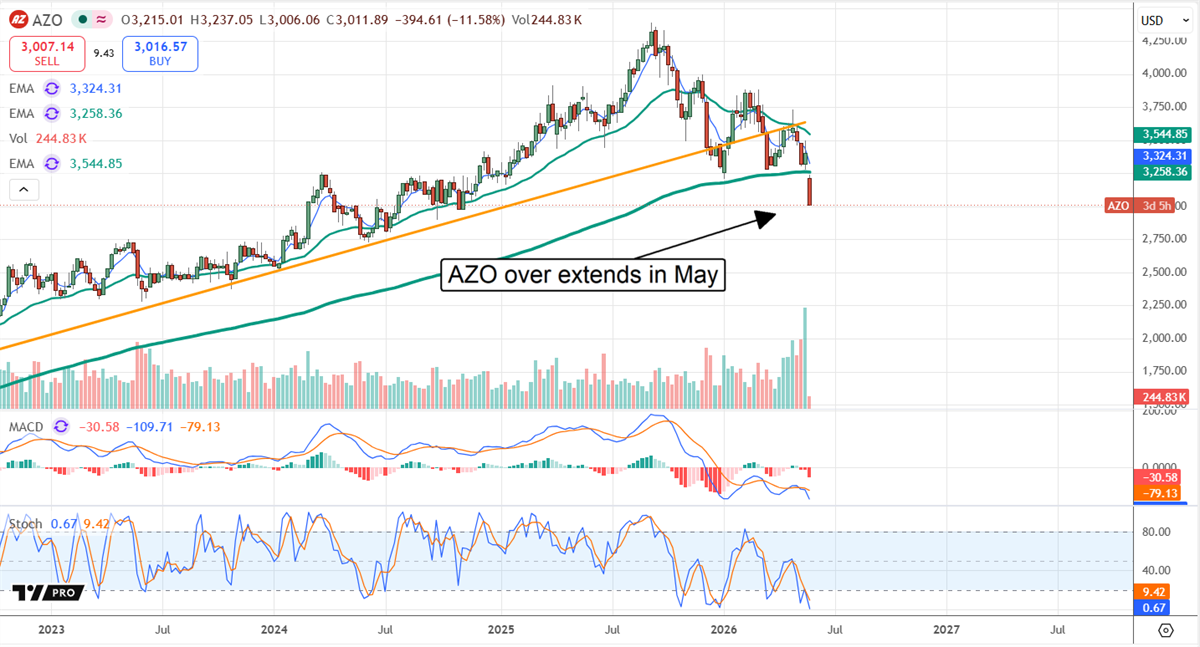
The chart price action reveals a mid-term downtrend, with an increasingly strong chance of a rebound. While price action moves lower, the MACD is diverging, and the stochastic is deeply oversold, suggesting bears have lost control and all the bulls need is a trigger to start buying. That could be as simple as the valuation, which suggests a 50% discount to the five-year outlook, but may require more tangible news, which may not be revealed until the company’s fiscal Q4 earnings results are released.
The biggest risk for AutoZone this year is margin compression. While the impacts of aggressive expansion are manageable, produce results, and will slow over time, rising costs are more of a concern and may continue eroding results. The question is whether efficiencies gained from the “Mega Hub” strategy will be enough to support margin recovery over time. READ THIS STORY ONLINE
Pre-IPO Warning: SPCX [Watch Now!] (Ad)
![Pre-IPO Warning: SPCX [Watch Now!]](https://www.marketbeat.com/images/webpush/files/thumb_20251107164257_pushbanking-5.jpg)
Tech investor James Altucher – who called Netflix, Facebook, and Bitcoin early – says the SpaceX IPO (Ticker: SPCX) is the single biggest opportunity of his career. SpaceX is confirmed to go public on Friday, June 12, in an IPO valued at up to $2 trillion.
But Altucher warns against buying shares on IPO day. He has identified a strategy that lets investors claim a pre-IPO position in SpaceX before it goes public – with what he believes is far greater profit potential.CLICK HERE TO SEE JAMES ALTUCHER’S FULL SPACEX PRE-IPO STRATEGY
More Stories
- 5 Stocks Winning the AI Race While Everyone Watches NVIDIA
- After NVIDIA, Broadcom’s Earnings Are Next—Here’s What to Watch
- SPCX: Bigger Than AMZN? (Ad)
- Quantum Stocks Just Got a Lifeline—Who Benefits Most?
- Why Walmart’s Rally May Need a Reset
- AST SpaceMobile’s June Launch Plan Puts Its 2026 Satellite Goal Back in Focus
- Alphabet Just Unveiled Its Most Ambitious AI Lineup Yet
The Night Owl is a financial newsletter that provides in-depth market analysis on stocks of interest to individual investors. Published by MarketBeat and Early Bird Publishing, The Night Owl is delivered around 9:00 PM Eastern Sunday through Thursday. If you give a hoot about the market, The Night Owl is the newsletter for you.
If you have questions about your subscription, please feel free to email MarketBeat’s South Dakota based support team at contact@marketbeat.com.
Unsubscribe
© 2006-2026 MarketBeat Media, LLC. All rights protected.
345 N Reid Place, Sixth Floor, Sioux Falls, S.D. 57103-7078. U.S.A..
Read More: The “secret weapon” behind Microsoft, Meta, Amazon, and Google(From InvestorPlace)


