Unsubscribe SpaceX will crumble without these 5 companies (From InvestPub)
Credo Technologies Accelerates AI—Its Stock Price Will Follow
Written by Thomas Hughes
Credo Technologies (NASDAQ: CRDO) is accelerating AI, and the impact is reflected in its stock price. The company’s pioneering work in zero-flap connectivity isn’t yet the standard but is quickly becoming the go-to solution for hyperscalers, enterprises, and AI factories.
Utilizing digital and optical solutions, embedding them into unified hardware, and complementing it with advanced Active Electric Cables and the software to support it all, Credo connects not only the GPUs within the servers and the servers and racks within the data center rooms, but the rooms of server racks and buildings of rooms, resolving a crippling issue for the industry. Flaps.
Flaps are when optical connections drop and reconnect. It’s not a new problem, but one with wide-ranging implications for AI.
Working at lightning-fast speeds, 800G to 1.6T, connectivity is critical. It takes 10’s of thousands of GPUs to train advanced models; a single flap can throw the system out of sync, leading to idle components, inefficient use, and waste. Controlling waste is critical, as AI is expensive. Zero-flap technology has been proven to use 50% less power than standard optics in data center clusters and to save up to $1,000 in upfront hardware costs. Additionally, AECs provide 10X greater reliability and 10X to 20X greater lifespan, so it’s easy to see why they are in high demand.
Credo Technologies Uptrend Gains Strength
Credo Technologies’ stock price was in the midst of an uptrend earlier this year, suggesting a textbook trend-following entry point in late March. Centered on a MACD convergence, rising trading volume, and the fundamental story, the signal resulted in a massive upside; now, additional upside is indicated. MACD has converged yet again with the fresh highs, alongside improving trading volume, reflecting a market not only in an uptrend but also as strong as it’s ever been and getting stronger.
In this scenario, CRDO’s stock price may correct, and the correction could be significant due to the magnitude of previous price swings. Still, such a correction would present a buying opportunity. As it stands, price action as of mid-June reflects potential for a peak, but the selling has yet to gain traction. The critical near-term support level is near $240, but a move to $215 or even lower is possible.
Analysts’ trends are a factor in the stock price outlook. While consensus assumes the market is fairly valued as Q2 2026 nears its end, the trends are positive, including increasing coverage, firming sentiment, and an uptrend in price targets. The consensus of 18 analysts tracked by MarketBeat is a Moderate Buy, with an 89% Buy-side bias; coverage is nearly double on a trailing 12-month basis (TTM), and the price target is up nearly 3X year-over-year, with the high end pegged at $300. A move to $300 would be sufficient to set another all-time high.
Institutional trends also factor into the stock price rally, as they own 80% of the stock and have been aggressively accumulating. MarketBeat data reflects a $2-to-$1 pace on a TTM basis, with activity ramping into Q1 2026. The Q1 balance is far more aggressive, ramping to over $3 bought for each $1 sold, and held strong into Q2. Although the net amount of institutional activity fell, the balance remains bullish at a $2.2-to-$1 pace, sufficient to limit downside risk as the quarter progresses.
Credo Has Catalysts to Drive Price Action This Year
Credo’s most visible stock price catalyst is its upcoming fiscal Q1 2027 earnings release, scheduled for early September. Consensus forecasts another triple-digit revenue gain, and outperformance is likely. Nearly 80% of revenue and earnings revisions have been upward, forecasting results in the high-end range. More importantly, this company is already profitable and expected to experience margin improvement linked to revenue leverage. Consensus pegs earnings per share growth will come in over 120%, about 1,200 basis points higher than revenue growth.
Reasons to believe Credo Technologies will outperform its estimates, potentially exceeding the high end of the range, include surging demand for GPUs and AI capacity, new product/revenue engines, and exceptional margins. Scaling revenue resulted in significant improvements in prior quarters and is likely to have continued into fiscal Q4. Other catalysts include results or news from hyperscalers affirming that the data center outlook continues to grow.
The biggest risks are customer concentration and valuation; however, customers include major hyperscalers that continue to ramp up AI spending, and the valuation reflects growth. In this light, Credo is shifting from an emerging-tech story to an execution story, and the company appears to be executing well. READ THIS STORY ONLINE
The #1 stock to buy AFTER the June 12th filing (Ad)

When the SpaceX IPO launches, most retail investors will be locked out. The banks, funds, and insiders get in early – while everyone else waits on the sidelines.
But one small infrastructure supplier – a critical piece Musk can’t scale the Colossus network without – is still trading well under institutional radar. A new briefing reveals the name and ticker at no cost.GET THE SPACEX INFRASTRUCTURE STOCK NAME AND TICKER HERE
Qualcomm Goes All-In: The $10B Bet to Crush NVIDIA
Written by Jeffrey Neal Johnson
The semiconductor market is experiencing a tectonic shift, and legacy hardware designers are scrambling to secure a seat at the artificial intelligence table.
Many investors are closely tracking Qualcomm Incorporated (NASDAQ: QCOM) as the company engineers a massive pivot away from cyclical consumer electronics. For decades, Qualcomm built a global empire on mobile smartphone processors, but an aging upgrade cycle demands a new growth engine.
Qualcomm is combining internal product development with targeted acquisitions to penetrate the hyperscale data center ecosystem. By pursuing alternative neural architectures, the firm is positioning itself as a potential low-power, high-efficiency alternative to current AI inference market leaders.
The broader market clearly recognizes the value of this pivot, pushing Qualcomm’s stock price up around 30% since the start of 2026. The immediate narrative centers on a massive acquisition target that could further accelerate the balance of power in enterprise computing.
Bypassing the Dealer: Qualcomm Could Drop $10B on RISC-V
A major catalyst driving institutional interest is that Qualcomm is reportedly in talks to acquire AI processor startup Tenstorrent.
Reportedly valued at a $8 billion to $10 billion, this prospective deal would represent a steep premium over Tenstorrent’s previous $3.2 billion valuation, reflecting the extreme scarcity of top-tier silicon architecture talent in today’s market.
Tenstorrent is led by Jim Keller, a legendary silicon architect whose track record spans fundamental processor designs at nearly every major technology conglomerate over the past two decades.
More importantly, Tenstorrent builds hardware on RISC-V, an open-standard instruction set architecture. This is a highly strategic distinction that investors need to understand. Historically, mobile processors have relied heavily on proprietary ARM architecture, subjecting manufacturers to rigid licensing fees and strict design constraints. Integrating Tenstorrent’s RISC-V technology could give Qualcomm more architectural flexibility and reduce reliance on proprietary CPU licensing in certain future products, though it would not eliminate external dependencies across the broader hardware stack.
This maneuver would build on Qualcomm’s under-the-radar December 2025 buyout of Ventana Micro Systems. Combining Ventana’s high-performance server chiplets with Tenstorrent’s neural accelerators would complete a proprietary, non-ARM hardware stack. Instead of retrofitting low-power mobile chips for heavy enterprise workloads, Qualcomm is developing a purpose-built architecture specifically designed to handle intensive data center operations.
Cashing in the Chips: Dragonfly Enters the Server Room
Securing the underlying architecture is only half the battle; deploying hardware effectively in enterprise environments requires a dedicated server platform. At the recent COMPUTEX summit, Qualcomm officially unveiled Dragonfly as a dedicated brand for data center artificial intelligence inference chips.
To fully grasp the market opportunity here, investors must differentiate between training and inference. Training requires massive clusters of graphics processing units that consume vast amounts of electricity to build large language models. Inference is the actual daily application of those models, which includes answering user prompts, executing automated tasks, and processing real-time data streams. Crucially, inference runs continuously.
Hyperscale data centers are currently facing severe power envelope and liquid-cooling constraints. Facilities simply cannot draw enough electricity off the local power grid to run power-hungry training hardware for basic inference tasks. Dragonfly targets this exact physical bottleneck. Positioned heavily for agentic workloads, where models autonomously execute complex, multi-step workflows without constant human prompting, Dragonfly prioritizes power efficiency above all else.
By pairing the Dragonfly server platform with Tenstorrent’s specialized hardware accelerators, Qualcomm aims to offer hyperscalers a gigawatt-saving alternative. If physical server rack space and local electricity availability become the primary limiting factors for scaling generative networks, low-power inference hardware provides a distinct, highly defensible competitive moat.
A Royal Flush: Qualcomm’s Bulletproof Balance Sheet
The financial metrics firmly support this aggressive expansion phase. Qualcomm shares are currently trading around $220, reflecting a steady year-to-date climb. While Qualcomm recently experienced a 25% technical pullback from peak levels, giving up some decade-high valuation multiples, underlying profitability remains strong. Qualcomm generated $9.20 in trailing 12-month earnings per share (EPS), boasting net margins of 22.31% and an impressive 42.11% return on equity.
Legacy markets are undeniably contracting. Core handset revenue declined 13% year over year in the second quarter of fiscal 2026, pressured by inflation in memory components and suppressed production volumes in key Asian markets. The diversification strategy is already bearing fruit, offsetting these headwinds. The company’s automotive revenue surged 38% year over year, surpassing a $5 billion annualized run rate.
Wall Street is actively adjusting financial models to account for the shifting revenue base. JPMorgan analysts recently placed Qualcomm on a Positive Catalyst Watch, raising the price target to $265. Their aggressive modeling projects Qualcomm data center revenue scaling rapidly, hitting $3 billion by fiscal 2027 and accelerating to $35 billion by fiscal 2031.
The River Card: Securing Your Stake in Qualcomm
Qualcomm is signaling immense balance sheet confidence ahead of these capital-intensive integrations. The board of directors recently raised the quarterly dividend to 92 cents per share.
This dividend hike operates concurrently with a massive $20 billion share repurchase program authorized in March 2026. This buyback program allows Qualcomm to retire up to 14.5% of outstanding stock, providing a strong structural floor during broader market rotations.
Institutional focus is squarely fixed on the upcoming June 24 Investor Day. Markets anticipate detailed roadmaps outlining the potential Tenstorrent integration, the broader Dragonfly rollout, and updated margin guidance.
Transitioning from a cyclical handset supplier to a foundational enterprise infrastructure provider carries execution risks, particularly when challenging entrenched industry incumbents. The strategic pivot aligns perfectly with the most pressing pain point in the global technology sector: the need for affordable, energy-efficient computing power.
Investors seeking exposure to the next phase of the digital infrastructure buildout may want to add Qualcomm to their watchlists as it builds out a new data center footprint and executes an aggressive acquisition strategy. READ THIS STORY ONLINE
SpaceX will crumble without these 5 companies (Ad)

The SpaceX IPO is drawing near, but the real opportunity may lie in 5 lesser-known companies providing the critical infrastructure SpaceX depends on to operate.
Goldman Sachs and Morgan Stanley are reportedly already building positions in one of these names. Another is a resource miner that Elon Musk’s broader empire – including Tesla – relies on. Lance Ippolito has detailed all five inside his free SpaceX Investing Blackbook.DOWNLOAD THE FREE SPACEX INVESTING BLACKBOOK BEFORE THESE NAMES GO MAINSTREAM
Jabil Just Gave Investors a Stronger Reason to Buy the Dip
Written by Thomas Hughes
Jabil (NYSE: JBL) is perfectly positioned for the AI supercycle, and its stock price looks poised to continue rising for years. The thesis begins with Jabil’s position as a manufacturing specialist for mega tech companies. It designs, builds, and manages complex hardware manufacturing supply chains across industries, providing infrastructure, engineering, and logistics. The thesis is strengthened by catalysts such as AI, U.S. expansion, client utility, and the AI virtuous cycle.
The AI boom drives demand for servers, photonics, and liquid-cooling systemstoday, and for products from infrastructure to IoT-connected devices long into the future.
Client utility is evident in its services and footprint, which includes more than 100 facilities in over 25 countries, enabling highly localized and resilient supply chain solutions.
Finally, there is the AI virtuous cycle. A virtuous cycle is when the output of new technology leads to improvements throughout the system and technological advancement.
As it stands, Jabil is implementing AI and automation throughout its operations, increasing efficiency and capabilities and advancing technology.
Jabil Sends Signal: Outperformance in Q1 and Robust Guidance
Jabil had a solid fiscal Q3, with revenue growing nearly 12% to $8.8 billion, topping consensus estimates of $8.61 billion.
Growth was underpinned by datacenter and AI strength, which management says improved meaningfully, as well as by improvements in other previously underperforming segments, such as Automotive and Connected Living.
Margin news was also bullish. The company widened gross and net margins despite input cost pressures and increased R&D. Net margin rose to 3.1% and adjusted earnings per share (EPS) came in at $3.16, up 24% from last year and 6 cents better than expected. Free cash flow was also solid, up abour 22% year-to-date (YTD) and sufficient to support aggressive share repurchases.
The best news in the fiscal Q3 release was the guifdance, which indicated that strength would persist into the subsequent fiscal year. Executives set aggressive targets for fiscal Q4, well above the consensus, and lifted their forecast for the year. As it stands, revenue is forecast at $35 billion, up more than 15% year-over-year and 200 bps above MarketBeat’s reported consensus, with execs “feeling good” about the setup for next year.
Jabil’s Capital Return Keeps Institutions and Analysts Interested
Jabil’s free cash flow is a significant factor as it enables aggressive share buybacks. The company targets using 80% of free cash flow for buybacks, which has amounted to over $800 million so far during its fiscal year, The trailing 12-month (TTM) activity reduced the count by 2.55% on average for the quarter and 3.85% for the YTD period, providing significant leverage for investors.
The only downside is that aggressive buyback activity is reflected on the balance sheet, revealing diminished cash and reduced equity at Q3’s end. The offset, however, is that investments, contract assets, and receivables all increased, indicating Q3’s cash reduction is no problem for shareholders.
Jabil’s analyst trends reveal a triple-strength sentiment tailwind is in place, including increased coverage, firming sentiment with an 82% Buy-side bias, and an uptrend in price targets. While consensus lags the market as of mid-June 2026, it is up more than 100% on a TTM basis, with recent targets pushing the high end. It stands at around $430, implying a more than 15% upside.
Institutional activity is likewise bullish. They own more than 90% of the stock and have been accumulating shares. The TTM balance is approximately $ 1.50 to $1 and may strengthen as the fiscal year-end approaches.
Jabil Pulls Back: Buy the Dip?
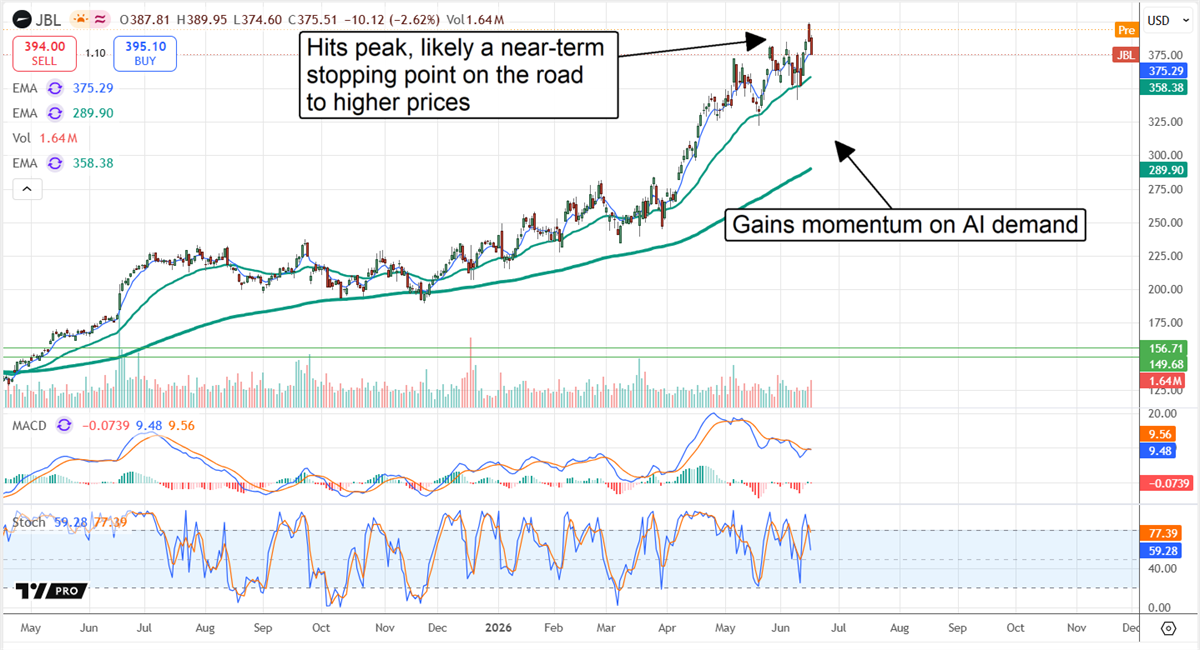
Jabil’s stock price action surged ahead of the release, indicating an optimistic market anticipating strength. The caveat is that JBL’s price action peaked and may continue to pull back in June. Expected strength amounts to a sell-the-news event, and it will be several more weeks until Jabil’s leading clients begin reporting.
The likely outcome is that subsequent reports from Jabil and its clientele will affirm the robust outlook and trigger a trend-following signal in this market. Support targets include $370 and $355, either of which may trigger the signal.
Jabil’s biggest risk this year is its valuation. Trading at over 30x, JBL is at historically high levels, pricing in solid growth. This leaves the company open to executional risk as production ramps up and to stock price volatility. Any delays, missteps, or changes to fundamental outlook will be reflected in the stock’s price. Additionally, a sluggish recovery in legacy markets may offset AI strengths. READ THIS STORY ONLINE
New Gold Supercycle (Ad)

While the S&P 500 gained 13.5% last year, gold ran roughly 60% – and one overlooked gold-linked asset soared as much as 216%. Central banks have logged 18 consecutive months of gold purchases, and figures like U.S. Treasury Secretary Scott Bessent and Paul Tudor Jones have publicly named gold their top macro trade.
But the biggest opportunity may not be gold itself. In the last supercycle, a specific backdoor gold play returned 846%, 1,668%, and 1,915%. Ross Givens, Director of Research at Traders Agency, has put together the full breakdown – including three trades you can make right now.SEE THE THREE GOLD SUPERCYCLE PLAYS AND HOW TO GET POSITIONED TODAY
More Stories
- Cheap Thrills: Why These 3 Entertainment Stocks Are Soaring
- 2 Quantum Stocks Are Drawing Capital as AI Infrastructure Hits a Wall
- Historical gold find meets record-high prices – timing matters (Ad)
- Critical Metals: Sizing Up This Tiny Rare-Earth Stock Making Big Moves
- The AI Trade Is Getting Harder to Pick, But These 3 ETFs Take a Different Route
- 3 Space ETFs for a Timely Investment
- CoreWeave Insider Sales Look Big, But Should Investors Worry?
The Night Owl is a financial newsletter that provides in-depth market analysis on stocks of interest to individual investors. Published by MarketBeat and Early Bird Publishing, The Night Owl is delivered around 9:00 PM Eastern Sunday through Thursday. If you give a hoot about the market, The Night Owl is the newsletter for you.

If you have questions about your subscription, please don’t hesitate to contact MarketBeat’s South Dakota based support team at contact@marketbeat.com.
Unsubscribe
© 2006-2026 MarketBeat Media, LLC. All rights reserved.
345 North Reid Place, Sixth Floor, Sioux Falls, SD 57103-7078. U.S.A..
Read More: The #1 stock to buy AFTER the June 12th filing(From Behind the Markets)

 RJ Hamster