Unsubscribe Trump’s AI Secret: 100X Faster Than Nvidia (From Eagle Publishing)
The AI Boom Has a Second Act—And It’s Playing Out in Optics
Written by Bridget Bennett

The AI build-out conversation tends to start and stop with chips. But the companies quietly landing multi-year, multi-billion-dollar contracts right now aren’t making semiconductors—they’re making the glass, connectors, and routing systems that hold the entire data center ecosystem together.
Lucas Downey of TradeSmith sees the AI infrastructure stack as five distinct layers: land and site development, power, cooling, compute, and memory, and finally, networking and connectivity.
That last layer—fiber, optics, and high-speed interconnects—is where he’s focused, and where he believes analysts are still playing catch-up.
The Shift From Copper to Glass
The transition driving demand here is straightforward: data centers are moving away from copper wiring and toward optical links made of glass and fiber. Optical connections carry data at the speed of light, generate less heat than copper, and reduce cooling costs.
For hyperscalers running massive AI workloads, those efficiency gains compound quickly.
Downey estimates AI infrastructure capital expenditure is approaching $1 trillion globally. The optical networking segment alone is seeing supply bottlenecks—there aren’t enough components to meet demand—which is exactly the kind of constraint that tends to reward established manufacturers with the capacity to scale.
Amphenol: Connectors at the Core of Every Rack
The first name Downey highlights is Amphenol Corporation (NYSE: APH), one of the world’s largest manufacturers of electronic connectors and interconnect systems. Amphenol isn’t making the lasers or chips—it’s making the physical connections between every component inside a data center: the racks, the servers, the assemblies. Every nanosecond of latency matters in high-speed AI workloads, and every connection counts.
The company delivered one of the biggest earnings beats of the recent season, with revenue of $7.62 billion, well above the Street’s estimate of $7.08 billion. Earnings per share (EPS) also beat, and guidance came in above expectations. Downey notes that the magnitude of this latest beat is what’s drawing renewed attention from analysts, who he says are still revising numbers higher.
Amphenol carries roughly a $200 billion market cap and has posted double-digit revenue and earnings growth projections extending out to 2028—making it, in Downey’s view, a core position in a theme that isn’t slowing down.
Corning: The Fiber Backbone of the AI Era
The most widely recognized name on the list is Corning Incorporated (NYSE: GLW), a company that has been manufacturing specialty glass for over 170 years and is now at the center of the next generation of optical fiber infrastructure.
Corning recently secured two significant hyperscaler deals. The first is a partnership with NVIDIA Corporation (NASDAQ: NVDA) to expand U.S.-based optical connectivity manufacturing—Corning expects to grow its U.S. optical connectivity capacity 10x and U.S. fiber capacity by more than 50% under the agreement. The second is a multi-billion-dollar deal with Amazon.com (NASDAQ: AMZN) for U.S. fiber manufacturing, announced earlier this month.
At a J.P. Morgan conference, Corning’s management projected its sales run rate reaching $20 billion by year-end, $30 billion by 2028, and $40 billion by 2030. On the earnings side, Downey points to EPS slated around $3.19 this year, accelerating to $4.21 next year and $5.75 in 2028. He expects those numbers to be revised higher as more hyperscalers follow NVIDIA and Amazon to the table.
The stock has already had a substantial run, and the analyst consensus has been slow to keep pace. Downey draws a direct parallel to Micron Technology (NASDAQ: MU), where analysts persistently underestimated the demand cycle before eventually catching up with a wave of estimate upgrades. He sees the same dynamic unfolding in optical.
Ciena: The Traffic Director of the Optical Network
The third name is Ciena Corporation (NYSE: CIEN), which Downey describes as the intelligent routing layer of the optical ecosystem. Where Amphenol handles physical connections, and Corning manufactures the fiber cables, Ciena optimizes how data travels through those cables—routing light-speed signals, managing bandwidth, and reducing congestion across distributed AI clusters with thousands of simultaneous data packets in motion.
Ciena’s recent earnings reflected the same demand story: EPS came in at $1.64 against estimates of $1.46, revenue beat consensus, and the company raised its full-year guidance to $6.3 billion—above the prior estimate of $6.15 billion—while noting margin expansion.
The stock has pulled back after a roughly 500% one-year run, which Downey attributes to seasonal mechanics—Russell index reconstitution and quarter-end rebalancing—rather than any change in fundamentals. He sees the pullback as a buying opportunity, with full-year 2026 EPS estimates around $6.50, accelerating to $9.65 the following year and $14.28 in 2028.
Following the Earnings, Not the Headlines
The broader framework Downey applies across all three names is the same: track where earnings estimates are going, not where the stock price has already been. When a company is landing multi-year deals with the world’s largest cloud providers, the official estimates tend to lag reality. Analyst upgrades follow contracts, and stock re-ratings follow upgrades.
Near-term volatility—whether from AI bubble headlines, sector rotations, or index rebalancing—doesn’t change the underlying demand picture. The data center build-out has committed capital stretching to 2030 and beyond. For investors willing to look past the noise, the optical layer may be the quietest opportunity left in an AI trade that’s anything but quiet. READ THIS STORY ONLINE
Read this or regret it forever (Ad)

Three Nobel Prize Winners expose this once-in-a-generation wealth shift:
“Don’t Say I Didn’t Warn You”
Porter Stansberry exposes how the convergence of three immense forces is about to rewrite everything about the American way of life: how you work, save, invest… it’s all about to change. DON’T BE LEFT BEHIND. CLICK HERE NOW.
Gold’s 2026 Rally Has Cracked—Is It Time to Buy the Pullback?
Written by Nathan Reiff

Gold notched a notable turn in June, slipping into negative year-to-date territory after a sharp pullback from its January peak. The decline marked a sharp break from the metal’s powerful 12-month rally, as a stronger U.S. dollar, higher Treasury yields, easing safe-haven demand tied to the Iran conflict, and lingering inflation concerns all appeared to weigh on prices.
For investors, the question has pivoted from “how long will the rally last?” to “is this a normal correction—and, if so, is it a buying opportunity or a signal that further declines are on the way?” Fundamentally, gold still offers some vital diversification benefits, and many of the underlying reasons to seek out gold (fiscal deficits, uncertainty surrounding inflation, geopolitical turmoil) still remain. A comparison of several different means of building exposure to gold may be an instructive approach for investors on the fence in mid-2026.
Bullion or ETF Exposure?
While gold bullion provides the benefits of direct ownership and a lack of company-specific risk, most investors find its illiquidity, as well as the costs of storage and insurance, to be prohibitive.
Exchange-traded funds (ETFs) provide an easy means of accessing gold and tracking the spot price of the metal, less a modest expense ratio.
The SPDR Gold Shares (NYSEARCA: GLD) is (pardon the pun) the gold standard among spot gold ETFs.
As the first U.S.-traded gold fund and the first fund to be backed by a physical asset, it not only established the trend but has continued to dominate: the fund has close to $132 billion in assets under management.
While the expense ratio of this fund of 0.40% is higher than the fees for many other ETFs across themes and strategies, the reality is that this expense is still likely lower than the cost of storing and protecting gold bullion for most investors.
For investors anticipating a continued decline to the price of gold, ETFs also offer the potential for inverse exposure. A riskier play than GLD due to its use of leverage, the ProShares UltraShort Gold Fund (NYSEARCA: GLL) is one of a small number of ways to bet against gold in the ETF space.
Utilizing futures rather than bullion, GLL aims for -2x the daily price of gold. As a leveraged fund, it resets daily, and holding GLL for longer than a single day will skew results.
However, those anticipating a very short-term decline in gold prices and willing to take a risk—leveraged funds also amplify losses as well as returns—might keep this fund in mind, despite its higher expense ratio of 1.26%.
How Gold Mining Stocks May Fit In
Gold mining stocks offer another type of exposure to gold, albeit an indirect one. These companies are typically closely tied to the performance of gold, and share prices often mimic gold bullion to some degree. However, operational success, production costs, reserve status and quality, management, and many other factors can also impact the share price of a gold miner.
Newmont Corp. (NYSE: NEM) is a very popular choice, not only because it is consistently one of the largest gold companies in the world both in terms of output and market capitalization, but also because of its performance record.
In Q1 2026, for instance, the company reported 46% year-over-year (YOY) revenue growth and a solid earnings beat, helping to drive a $6-billion share repurchase program.
Of course, this all took place while the gold rally still had momentum.
A host of smaller firms have a distinct risk/reward profile from the larger, diversified gold producers like Newmont.
Aura Minerals (NASDAQ: AUGO), for instance, is much smaller at only about $5 billion in market cap, but this firm still has mounting analyst support, including strong projected earnings growth of nearly 41% in the coming year.
If gold prices rebound, AUGO could be positioned for especially impressive returns. On the other hand, smaller companies may face more significant operational risks—having fewer mining locations, for instance, can leave a firm exposed to financial dangers should an accident or other unforeseen development halt production.
All told, investors must make a determination as to whether gold will continue to fall or if a rebound is in short order. A combination of methods of building exposure can help to diversify and mitigate risk; however, even if the price of the metal remains volatile. READ THIS STORY ONLINE
Trump’s AI Secret: 100X Faster Than Nvidia (Ad)

Trump’s $200 Billion Revolution Changes Everything AI
With 100X faster processing power… and 90% less energy usage… current AI systems could become obsolete. And three companies control the technology that could make it happen.DISCOVER THE “TRILLION DOLLAR TRIANGLE” HERE.
5 Tech Stocks to Buy on the July Pullback
Written by Thomas Hughes

Every trader and investor should keep one principle close: wait for the opportunistic entry. Opportunistic entries are those unforeseeable, often irrational, price pullbacks that occur in otherwise healthy, growing, and attractive stocks. The story in July is that, between-cycle market angst, AI fears, and growth concerns, entry points have opened up in many high-quality stocks.
The likely outcome is that the headwinds that have been impairing price action as of early summer 2026 will begin to fade by early fall, at which point price recoveries will begin, if not before.
Amprius Technologies: Short-Sellers Capped Gains
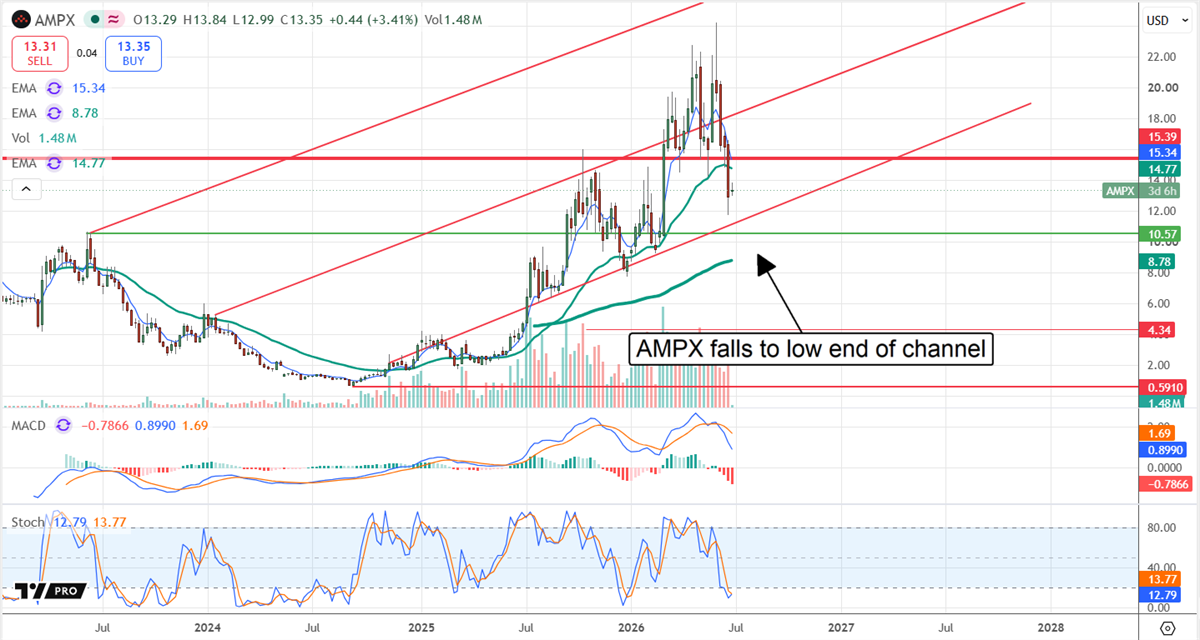
Amprius Technologies’ (NYSE: AMPX) June price pullback was driven in large part by short sellers, who sold based on valid concerns about production capacity, order volume, and the company’s scalability. However, early-year results and orders suggest acceleration will continue in the upcoming quarters and may gain momentum as production ramps up.
This year’s catalysts include the U.S. government’s push to build up its drone capabilities and the Matternet deal, which marks a major commercial milestone and promises additional catalysts in the coming quarters. One such catalyst would be progress in battery cell design for Matternet’s drone delivery fleet, an eventual design win that would result in subsequent product orders.
The company’s upcoming Q2 results are another catalyst, expected to affirm the momentum seen in the previous quarter. Analysts forecast revenue to grow by more than 100% and the path to profitability to clear.
The 10 analysts tracked by MarketBeat rate the stock a Buy, with 90% Buy-side bias, and expect it to rise 65% from the late-June support target.
Oracle: Deeply Oversold With Backlog Conversion Closing In
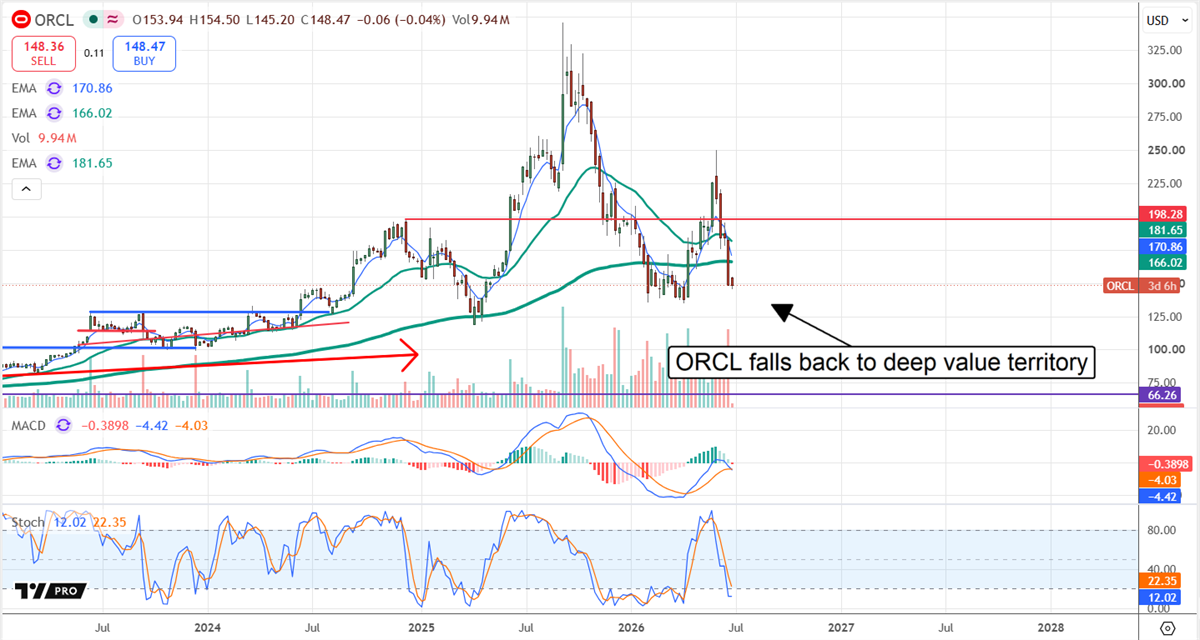
Oracle’s (NYSE: ORCL) share price continues to be punished for its massive spending plans, growing debt, and dilution. However, the market is mispricing the stock, treating it as an emerging startup rather than a blue-chip tech company with a backlog of going on a trillion dollars. The takeaway is that this year’s price weakness is a historical opportunity to buy an AI-critical name at pennies on the dollar.
Trading near $150, Oracle’s forward price-to-earnings multiple (P/E) falls into the low-single digits within 10 years, suggesting several hundred basis points of stock price upside will be realized as backlog converts to revenue, cash flow, and earnings. MarketBeat tracks 38 analysts rating ORCL as a consensus Moderate Buy with 79% Buy-side bias and 80% upside from early 2026’s lows.
Snowflake: Melt-Up Can Gain Momentum
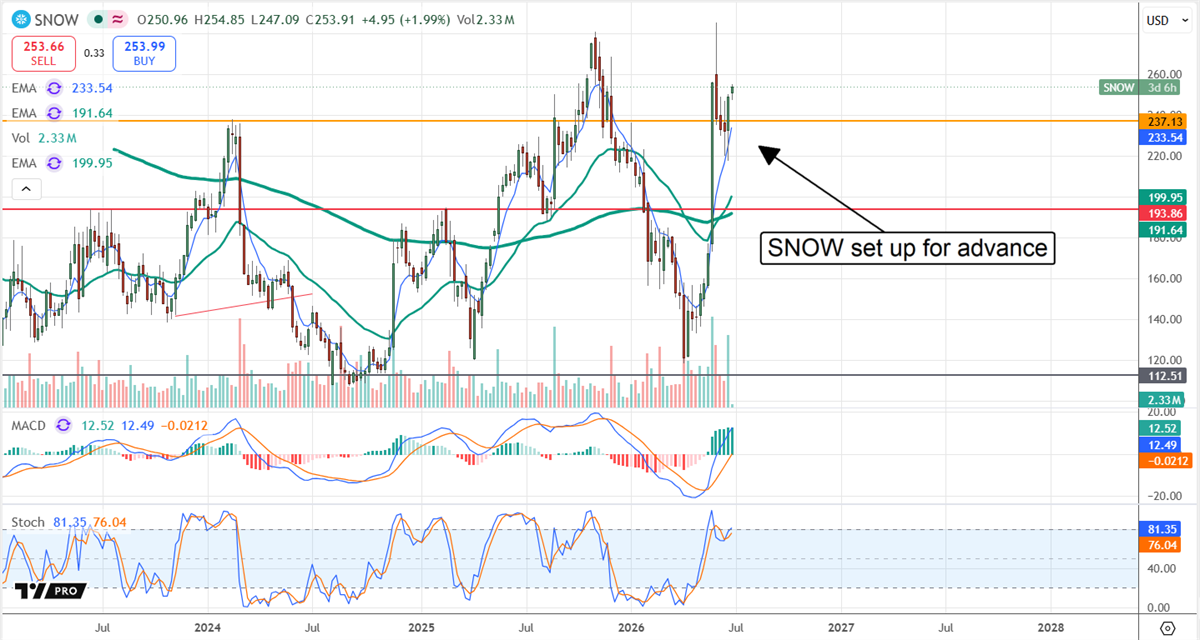
Snowflake’s (NYSE: SNOW) stock price melt-up began earlier this year when its results affirmed the AI-driven SaaS-pocalypse wasn’t happening. What is happening is that AI is underpinning demand for business, business is accelerating, and profitability is improving. Analysts responded well to Snowflake’s earnings news, raising the stock price outlook and setting the market up to advance.
The technical outlook is solid, with the market up sharply in Q2 and consolidating near highs. Convergence in the MACD suggests the market is getting strong and that fresh highs are coming. Analysts’ trends suggest only modest upside at the consensus, but even the consensus would be sufficient for a fresh high. The fresh high is significant as it would open the door to a more substantial technical move, more than 100% at the high-end range.
Salesforce: Left for Dead, Generates Cash Flow, Buys Back Shares
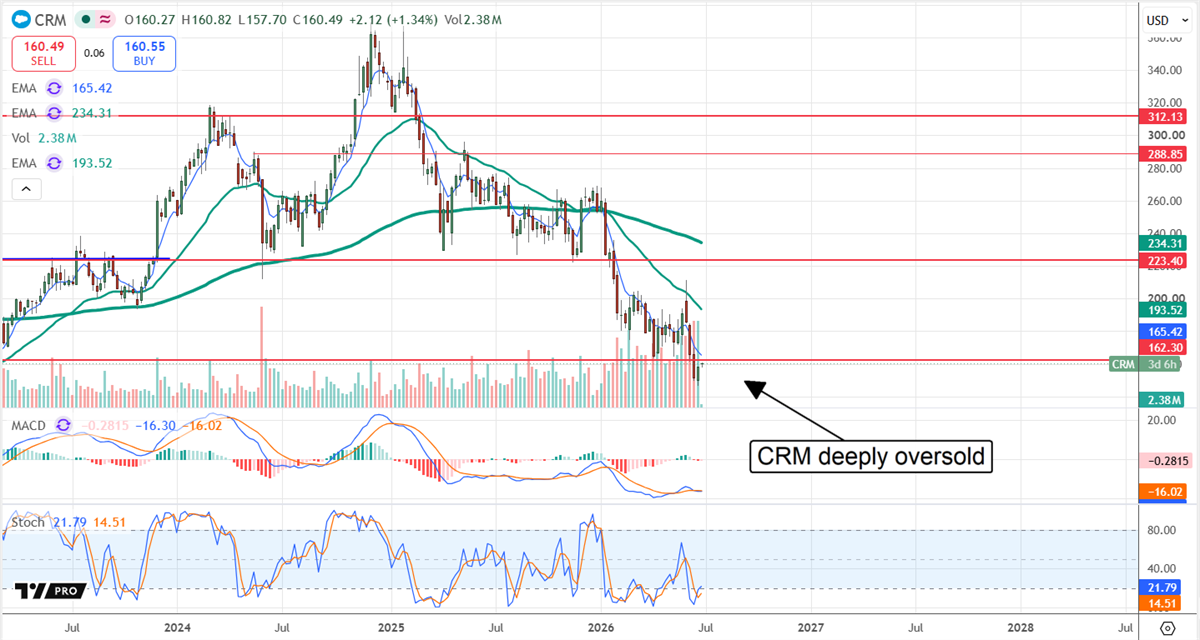
Salesforce’s (NYSE: CRM) stock price hit fresh lows in June despite the deep value presented and the strength of the company’s Q1 results. The sticking point was the guidance, which was viewed as mixed relative to the high bar analysts set.
Salesforce is not only growing but has accelerated back to a double-digit growth pace and is expected to continue that pace in upcoming quarters.
More importantly, Salesforce generates substantial cash flow and uses it to buy back shares. Buybacks reduced the count by an average of 1.9% for Q1 over the trailing 12-month period.
Forty-three analysts rate CRM as a consensus Moderate Buy with 63% Buy-side bias. CRM stock trades at a potential floor, the analysts’ lowest recorded target, with 65% upside forecasted by the consensus.
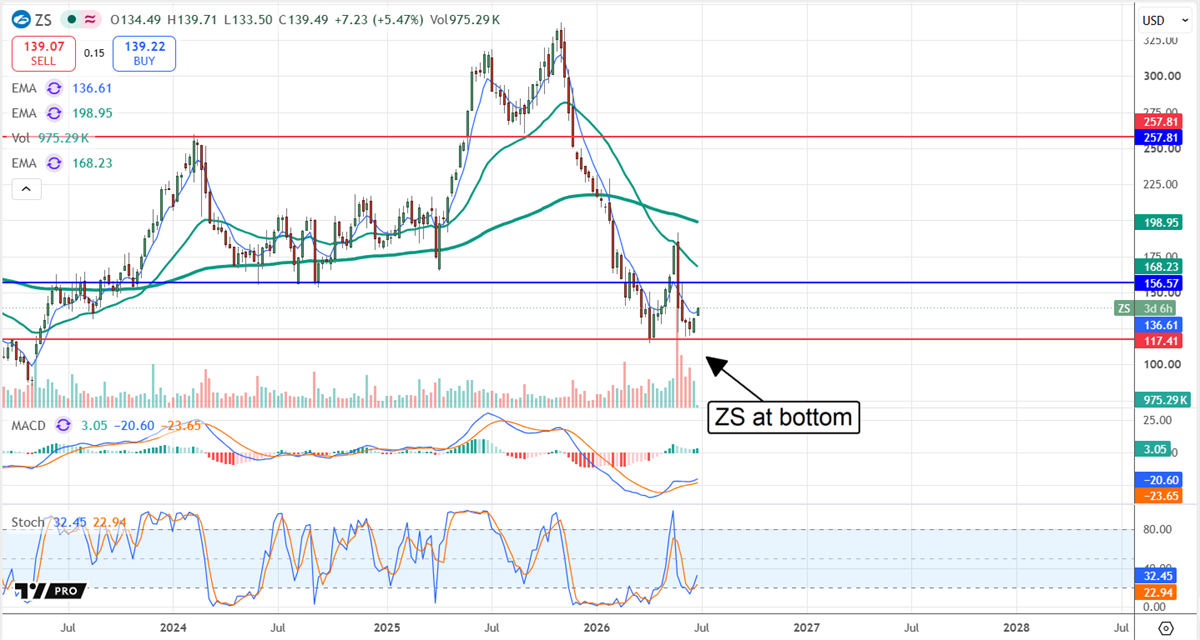
Zscaler: Cautious Guidance Sets Stage for Rapid Price Recovery
Zscaler’s (NASDAQ: ZS) stock price is down while its peers are in rally mode due to a shift in sales teams. The company’s key sales managers left, creating a temporary gap that prompted management to issue cautious guidance.
It will take time for the gap to be filled, but it will be, and sales will continue at a strong pace because Zscaler provides utility for its clients. The cloud-native platform secures remote access, limiting use to authorized personnel. It also inspects web traffic and protects data.
The bulk of analysts’ revisions spurred by the firm’s earnings news were reaffirmed ratings and price targets. Analysts assign ZS a consensus Moderate Buy rating. There is an 82% Buy-side bias within the data, and a forecast for a 55% upside from the 2026 lows.
The $15 Gold Fund That Pays Up to $1,152/Month (Ad)

Gold is hitting record highs, but most investors are leaving income on the table. A $15 fund is quietly paying out up to $1,152 a month to regular investors – no mining stocks, no options, no physical metal required.
Chief Income Strategist Tim Plaehn calls it a breakthrough strategy that transforms gold’s rally into reliable monthly payouts. The next distribution is just days away.DISCOVER THE GOLD INCOME FUND BEFORE THE NEXT PAYOUT DATE
More Stories
- JPMorgan Stands by Sky-High Broadcom Target as Shares Slide
- Qualcomm’s Investor Day Just Changed the Growth Story Forever
- Problems at SpaceX: time to get out? (Ad)
- Is Apple’s Latest Plunge the Canary in the Coal Mine for Tech Stocks?
- onsemi: What the Market Gets Wrong, You Can Get Right
- Is McCormick a Steal Ahead of Game-Changing Unilever Deal?
- Is OpenAI’s IPO Delay a Warning for AI Investors?
The Night Owl is a financial newsletter that provides in-depth market analysis on stocks of interest to individual investors. Published by MarketBeat and Early Bird Publishing, The Night Owl is delivered around 9:00 PM Eastern Sunday through Thursday. If you give a hoot about the market, The Night Owl is the newsletter for you.

If you have questions about your subscription, please contact MarketBeat’s South Dakota based support team at contact@marketbeat.com.
Unsubscribe
Copyright 2006-2026 MarketBeat Media, LLC. All rights reserved.
345 N Reid Pl. #620, Sioux Falls, SD 57103. U.S.A..
Today’s Featured Content: Read this or regret it forever(From Porter & Company)

 RJ Hamster