Unsubscribe Walker Lane Belt explorer could offer leveraged gold exposure (From Wall Street Logic)
PriceSmart Stock Eyes $220 as Chile Expansion Fuels Growth
Written by Thomas Hughes

PriceSmart (NASDAQ: PSMT) is accelerating growth and outpacing peers in revenue growth, suggesting further upside for its stock price. The risk is its valuation, which, at approximately 36x the current year forecast, is high.
The caveat for bears is that this valuation aligns with peers, pricing in quality and growth, and likely underestimates PriceSmart’s strength. The company is well-positioned as the leading (in some cases) membership club retailer in Latin America. Its warehouse empire spans 12 countries and one U.S. territory, with new markets opening regularly.
The critical detail in 2026, and the operational factor for share prices, is the expected six new clubs by next spring, a more than 10% increase, with at least one in a new market with great potential. The fiscal Q3 results included plans to open the first PriceSmart in Chile. Chile represents a more lucrative market, with a well-established retail industry lacking a membership club, and consumers with greater spending power.
Estimates suggest that as many as five PriceSmarts could be located in Chile, with longer-term growth possible. Country-specific catalysts include a lean toward more economically friendly policies, attracting foreign investment, and its position in mining and green energy. Chile’s dominance in lithium and copper, and its emergence in green hydrogen, are fueling the economic growth and rising incomes that underpin the spending power PriceSmart depends on.
PriceSmart Delivers in Latest Quarter, Outperforms Peers
PriceSmart had a solid fiscal Q3, with revenue growing 12.5% to $1.48 billion. The growth outpaced Costco (NASDAQ: COST), accelerated from the prior year, and beat the analyst consensus by approximately 200 basis points (bps). Strength was seen across the network, with merchandise sales underpinning the strength. Comp sales, a sign of localized strength and organic growth, increased by 10.7% and are expected to remain strong in the upcoming quarters. Region-specific catalysts include rapidly improving industrialization, employment, and consumer health.
Margin new was another factor underpinning the stock price increase posted this year. The company is widening its margin with scale, driving a 14.4% increase in adjusted EBITDA despite foreign exchange and macroeconomic headwinds and cost pressures.
The company does not issue formal guidance, but it showed clear momentum in its results and an optimistic outlook, given its accelerating expansion plans. The likely outcome is that PriceSmart will continue to grow at a robust pace in the coming quarters, with growth accelerating in 2027 as new stores come online.
PriceSmart’s Weak Analyst Coverage Masks High Institutional Support
PriceSmart’s analyst coverage is weak, with only one tracked by MarketBeat, but there are mitigating factors.
The large, 80% institutional ownership, numerous large ownership blocks, lack of regular market-moving news (to drive trading volume), and low market cap are to blame. That said, institutions and long-term oriented funds hold the bulk of shares, while insiders control nearly all the rest. In this environment, the stock price can continue to rise, as institutions have been accumulating, and cash flows give them no reason to exit.
PriceSmart’s cash flow enables it to invest in growth, sustain a healthy balance sheet, and return capital to investors. The capital return is dividend distribution, which, although low in yield, is strong in reliability and growth. The yield is below average, about 0.7% annualized as of mid-July, but coverage is ample, the payout ratio runs below 30%, and annual increases are becoming the norm.
PriceSmart Set Up to Advance in Q3 2026
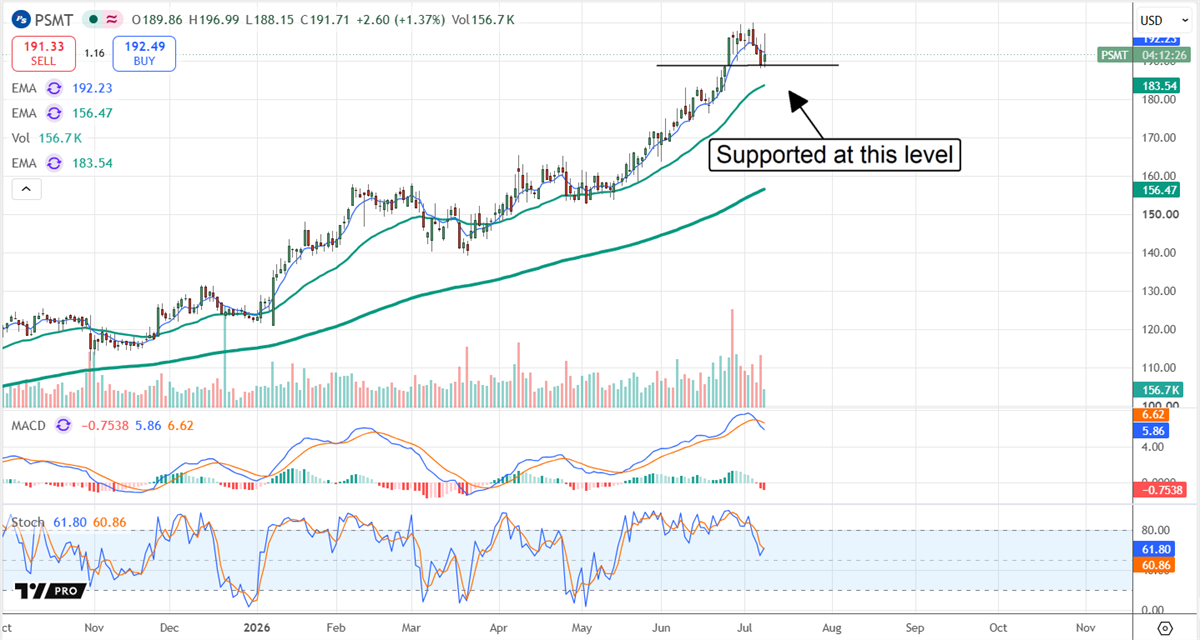
PriceSmart’s stock price experienced some volatility ahead of the release but stabilized in its wake. The result is that support was confirmed at the $190 level, and a bullish pattern is emerging. The past few weeks’ action amounts to consolidation within an uptrend and is potentially a Bullish Flag. If confirmed by a breakout to the upside, the upside targets correspond to the magnitude of the preceding rally, or about $30. In this scenario, PSMT’s share price can rise to $220 or higher by year’s end.
PriceSmart’s biggest risks lie in its business model, which relies on cross-border dealings. Risks include currency devaluation, as it buys in U.S. dollars and sells in local currency, and currency repatriation. Some markets, specifically Trinidad & Tobago, have faced severe currency shortages that have prevented the repatriation of profits. Geopolitical instability, supply, and import barriers also pose threats. The company mitigates these threats with dynamic sourcing, geographic diversification, regional logistics hubs, and private labels.
What the market gets wrong about this stock is that it is neither a traditional brick-and-mortar retailer nor a simple emerging-market play, but rather a highly specialized membership club with durable cash flows and a moat. The membership model, specifically the fees, underpins its profitability, making it more of a subscription service with a 90% renewal rate than a retailer. Additionally, the threat posed by eCommerce giants is mitigated by PriceSmart’s footprint, which enables more cost-effective delivery of bulky items at scale to remote locations. READ THIS STORY ONLINE
I endorsed someone else’s model for the first time (Ad)

Porter Stansberry spent 30 years ignoring outside investment systems – until he met Emmet Savage in Dublin. Savage’s model, built on Hamiltonian mechanics applied to equity analysis, has delivered nearly 2,000% returns over 17 years with only one losing year.
What convinced Porter wasn’t the returns. It was the sell discipline – a framework that identifies the exact moment a position’s energy begins to decay, signaling an exit before the decline. He calls it the most rigorous sell system he has ever seen, comparing its edge to RenTech’s famed Medallion Fund.WATCH PORTER’S FULL BREAKDOWN OF PROJECT PROPHET AND EMMET’S SYSTEM
Dollar Tree’s Turnaround Is Starting to Take Root
Written by Jeffrey Neal Johnson

The discount retail space weathered a relentless storm over the past two years. Soaring inflation forced low-income consumers to ruthlessly prioritize essentials, while retail shrinkage and elevated logistics costs steadily eroded operating margins.
Many operators in this space found themselves trapped in a multi-quarter downtrend, punished by a market that demands immediate top-line growth. The high-volume, low-margin business model requires near-perfect execution, and any disruption in supply chains or consumer spending habits quickly translates into severe equity drawdowns. Dollar Tree, Inc. (NASDAQ: DLTR) is aggressively defending its valuation floor with a replenished $2.5 billion buyback and a 120-bps expansion in gross margin, defying the broader discount retail traffic slump.
Spotting the Green Shoots Early
When a retailer falls out of favor, the market prices in peak pessimism and assumes operational headwinds will persist indefinitely. Finding an entry point requires looking past the immediate noise to identify structural business shifts before they fully reflect in the share price.
Mispricing occurs when Wall Street focuses entirely on lagging metrics, such as historical foot traffic, out of caution, while ignoring forward-looking capital allocations. Recent capital moves and shifting Wall Street sentiment suggest that the worst of Dollar Tree’s margin compression is in the rearview mirror.
Pruning the Float: A $2.5B Buyback Takes Root
When equity prices face sustained downward pressure, institutional behavior and management capital allocation provide the clearest signal of a fundamental floor. On July 2, 2026, the Dollar Tree board of directors authorized a $2.5 billion share repurchase program. For an enterprise carrying a $23.76 billion market capitalization, this authorization represents a potential retirement of roughly 10.7% of the outstanding float.
This move serves as a standard return of capital, but investors should also view it as an aggressive defense of the current valuation. The $2.5 billion authorization arrived shortly after a significant institutional shift. In June 2026, activist investor Mantle Ridge executed a $500 million accelerated share repurchase via a block trade. Mantle Ridge executed large-volume block trades with major banks, who in turn sold the shares back to Dollar Tree outside of the market to avoid affecting the working share price.
The exit of activist capital, paired with a concurrent reduction in board seats, signals that Dollar Tree is transitioning out of a turbulent restructuring phase and returning its focus to organic operational execution. A block trade clears institutional overhang, allowing the stock to discover its natural price without the downward pressure of a major stakeholder liquidating on the open market. By actively reducing the share count, management mathematically bolsters future earnings per share, creating a protective floor against ongoing top-line volatility.
Trimming Costs to Spark Bottom-Line Growth
The most compelling argument for a turnaround lies directly on the balance sheet. In retail, top-line revenue grabs the headlines, but gross margin pays the bills.
This margin recovery stems from tangible structural tailwinds that are beginning to cascade down the income statement. Dollar Tree successfully secured $110 million in tariff refunds, providing an immediate, unexpected cash injection. Easing logistics and freight costs are further padding the bottom line.
In a high-volume, low-margin business environment, capturing an additional 120 basis points of margin is an operational victory that directly offsets the sluggish consumer environment. If the broader macroeconomic environment worsens, a repaired margin structure provides crucial downside protection.
Wall Street is beginning to reprice these structural improvements. Two prominent analyst upgrades hit the wire in early July. Raymond James upgraded Dollar Tree from Market Perform to Outperform, establishing a $140 price target. Their analysis points to fiscal 2026 guidance being artificially conservative, noting that additional tariff refunds and supply chain efficiencies could yield hundreds of millions in unexpected profitability in the back half of the year.
Goldman Sachs also adjusted its stance, moving from Sell to Neutral and bumping its price target to $125. The shift from a bearish to a neutral rating from a major institutional desk often forces large portfolio managers to reevaluate their short exposure, potentially triggering a steady unwinding of bearish bets. With short interest hovering around 7.66%, representing over 13 million shares, any string of operational beats creates the conditions for a sustained technical reversal.
Watering the Roots: Value Perception Precedes Traffic
To analyze the setup objectively, investors should examine the lingering bearish arguments. Top-line foot traffic remains the primary headwind. In Q1, Dollar Tree reported a negative 1% traffic comp, indicating that the core low-income demographic is still visiting stores less frequently than in previous years.
Rival operators like Dollar General (NYSE: DG) continue to aggressively expand their real estate footprint, while big-box giants like Walmart (NASDAQ: WMT) and Target (NYSE: TGT) use deep price rollbacks to fiercely defend their market share. Dollar General’s strategy of blanketing rural America with new store openings keeps constant pressure on Dollar Tree to maintain its competitive footing. The competitive environment is brutal, and waiting for traffic to turn positive before initiating a position often means missing the largest segment of the equity recovery.
This is where leading indicators become vital. The Goldman Sachs upgrade relied heavily on proprietary sentiment data. This specific data set tracks consumer perception of price and value. According to their findings, value perceptions among low-income households are finally beginning to stabilize and turn positive. Consumer perception serves as a leading indicator, as shoppers must believe a retailer offers superior value before they change their driving habits and foot traffic patterns.
If value perception is indeed stabilizing, the negative traffic comps should begin to flatten out over the next two quarters. Because Dollar Tree already fixed the margin structure, any eventual return of positive foot traffic will drop cleanly to the bottom line without being absorbed by elevated supply chain costs.
The Harvest: Is Dollar Tree Ripe for the Picking?
The current financial metrics fit a classic value-investing framework. Dollar Tree trades at a deeply compressed trailing price-to-sales ratio of 1.22x and a forward price-to-earnings ratio of 17.66. The market is valuing Dollar Tree as if the peak margin compression of 2024 and 2025 is a permanent fixture, entirely discounting the 120-bps margin expansion reported in the most recent quarter.
Navigating the retail sector requires identifying businesses that can engineer their own profitability regardless of macroeconomic traffic slumps. The combination of easing logistics costs, substantial tariff refunds, and a management team willing to retire over 10% of the float creates an asymmetric risk profile.
Investors seeking exposure to the discount retail turnaround might watch the upcoming Q2 earnings release for signs of continued gross margin stability. Those comfortable with near-term volatility may view the current valuation multiples as an opportunity to build a position before consumer foot traffic officially catches up to the newly repaired balance sheet. READ THIS STORY ONLINE
Walker Lane Belt explorer could offer leveraged gold exposure (Ad)

Gold has surged past $5,300 per ounce, with Goldman Sachs and JPMorgan forecasting $6,000+ by end of 2026. Central banks bought a record 863 tonnes in 2025 alone – and one small-cap explorer in Nevada’s Walker Lane Belt may be positioned to benefit.
Sitting 18 miles north of Tonopah in the same district that produced over 15 million ounces at Kinross Gold’s Round Mountain Mine, this explorer carries historic drill intercepts of 30 meters at 2.5 g/t gold and surface samples exceeding 100 g/t. With a market cap under $15 million and drills ready to turn in H2 2026, the window may be narrow.GET THE FULL STORY ON THIS DRILL-READY NEVADA GOLD EXPLORER
Why Levi’s Digital Strategy Is Paying Off in a Big Way
Written by Thomas Hughes

Levi’s (NYSE: LEVI) turnaround story is one that could be written about in books. The company, an endearing, entrenched, iconic legacy brand, has embraced the modern era, delved deeply into technological advancement, and is now experiencing a virtuous cycle tied to AI.
Indeed, Levi’s is now a retail AI story, as its direct-to-consumer (DTC) shiftnot only improved sales and margins but also enabled proprietary data, driven by a solid eCommerce presence, and data is what AI is all about.
Now, Levi’s is capitalizing on its growing data set, strengthening its network as it leans into higher-margin business, loyalty membership, and comp store growth.
To fully comprehend the change, investors must consider where Levi’s was. Struggling with in-store merchandising and an obvious wholesaling failure, Levi’s made the DTC shift, which unlocked a retail bottleneck.
Consumers who wanted Levi’s products couldn’t easily find them at 3rd-party retailers; DTC solved the issue.
With control over its stores, Levi’s can ensure product and merchandising quality while also realizing higher retail margins. Within that, digitalization enabled not only data collection but also full-scale merchandising—consumers no longer have to dig through a pile of messy, picked-through jeans to find the style and size they need; they are now within easy reach. And the impact on the business has been staggering.
Levi Strauss Accelerates Turnaround With Beat-and-Raise Quarter
Levi Strauss posted a solid Q2, with revenue up 8% to $1.56 billion. This was an acceleration over the prior year, outperforming consensus by more than 540 basis points (bps) on strength across all markets, channels, and categories. DTC grew by 11%, underpinned by eCommerce, while wholesale grew at a more modest pace. Worth more than 50% of the revenue, DTC’s growth was driven by a 6% comp and a 19% increase in eCommerce. Regionally, the Americas were strongest at up 9%, underpinned by a 5% gain in the U.S., while Asia grew by 10% and Europe by 4%.
Margin was another strength driven by the DTC business. The company posted improvements at the gross and operating levels, driving a 35 bps improvement in operating margin and a 70 bps gain in adjusted earnings before interest and taxes (EBIT). Bottom-line results reflect strength, with adjusted earnings per share (EPS) up 27% year over year (YOY) to 28 cents, 4 cents above MarketBeat’s reported analyst consensus.
As good as the Q2 results were, it is the guidance that will keep Levi’s market advancing this year. The company increased its targets for revenue, margin, and earnings, lifting the high ends and tightening the ranges.
Levi’s guidance aligns with consensus forecasts, affirming confidence, and is likely to be cautious. CEO Michelle Gass says the company is in the earliest phases of its DTC growth and has more ways to win than ever, including a larger addressable market.
Levi’s Raises Dividend, Signaling Confidence in Outlook
Levi’s solid Q2 report was accompanied by a 14% increase in the dividend distribution. While the increase was not unexpected, the size was above average, signaling confidence in the outlook. Investors should consider distribution safety, which ranks well with a payout ratio below 40% and a robust growth trajectory. Future increases may not be as large but are likely, as are share buybacks. Q2 activity, including the impact of an accelerated share repurchase authorization, reduced the count by an average of 2.35%.
Analysts responded optimistically but noted that the guidance failed to impress. Although solid in light of past results, analysts had hoped for more, setting the stage for a stock price correction. In this scenario, Levi’s may see a post-release stock price pullback, potentially moving as low as $22, but in the longer term, the forecasts remain very bullish.
The consensus of 16 analysts tracked by MarketBeat is a Moderate Buy, with an 81% Buy-side bias; no Sell ratings are tracked, and price targets have been rising. Consensus, which was up 35% YOY ahead of the release, forecasts a modest double-digit increase relative to the pre-release closing price, with the high end pointing to a fresh all-time high.
Institutional activity suggests the downside risks are limited as of early July. While the trailing 12-month activity includes significant selling in prior quarters, the balance reverted to accumulation in Q2 and has sustained a robustly bullish pace in early Q3, suggesting the Q2 strength was anticipated. The likely outcome is that any post-release price pullback will trigger more buying, underpinning technical support for this market. Levi’s biggest risks include tariff uncertainty and foreign exchange headwinds, but the company appears to be navigating the environment well. READ THIS STORY ONLINE
The next AI rotation is already underway are you positioned? (Ad)

Hedge funds are rotating out of AI hype and into the hardware layer powering it. New research identifies three profitable U.S. infrastructure companies leading this shift.
One just posted 76% year-over-year data-center growth. Another holds a $12 billion backlog from global hyperscalers. A third is generating 59%+ gross margins on next-gen chips.ACCESS THE FULL ANALYSIS, PRICE SETUPS, AND CATALYSTS NOW
More Stories
- Southwest MAX Incident Revives Headline Risk for Boeing and Airline Stocks
- Rivian’s 75 Million-Share Offering Turns the R2 Growth Story Into a Dilution Test
- 7 Stocks to Watch Before AI Headlines Peak (Ad)
- Fiserv’s Debit Network Talks Raise a Bigger Question for Visa and Mastercard
- Lockheed Martin Secures the Ultimate Defense Moat
- Catching the AI Wave: DigitalOcean Reels in AI Whales
- Scotiabank Sees a New Growth Story for Cloudflare
The Night Owl is a financial newsletter that provides in-depth market analysis on stocks of interest to individual investors. Published by MarketBeat and Early Bird Publishing, The Night Owl is delivered around 9:00 PM Eastern Sunday through Thursday. If you give a hoot about the market, The Night Owl is the newsletter for you.

If you have questions or concerns about your newsletter, please don’t hesitate to contact our U.S. based support team at contact@marketbeat.com.
Unsubscribe
© 2006-2026 MarketBeat Media, LLC. All rights protected.
345 N Reid Pl. #620, Sioux Falls, S.D. 57103-7078. USA..
Just For You: I endorsed someone else’s model for the first time(From Porter & Company)


